9
   

THE US, THE UN AND IRAQ, ELEVENTH THREAD


mysteryman
 
  1  
Reply Sat 17 Mar, 2007 02:58 pm
xingu wrote:
http://buckfush.com/images/George_Bush_War_Record.jpg

Amen


Lets see...March 20,2003 till march 17,2007 equals 3 days short of 4 years

September 1,1939 to Sept 2,1945 equals 6 years and 1 day.

Your are correct,we have been in Iraq longer.

Geez,didnt you learn simple math in school?
0 Replies
 
hamburger
 
  1  
Reply Sat 17 Mar, 2007 03:21 pm
mysteryman wrote :

Quote:
Lets see...March 20,2003 till march 17,2007 equals 3 days short of 4 years

September 1,1939 to Sept 2,1945 equals 6 years and 1 day.

Your are correct,we have been in Iraq longer.

Geez,didnt you learn simple math in school?


perhaps someone can solve a mystery for me . when was it that the united states of america entered WW II ?
hbg
0 Replies
 
blueflame1
 
  1  
Reply Sat 17 Mar, 2007 03:21 pm
mysteryman, poor soul. Stretching and stretching and of course stretching. Dec. 7 1941 was a day that will live in infamy.
0 Replies
 
mysteryman
 
  1  
Reply Sat 17 Mar, 2007 03:24 pm
blueflame1 wrote:
mysteryman, poor soul. Stretching and stretching and of course stretching. Dec. 7 1941 was a day that will live in infamy.


So,WW2 started on Dec 7,1941?

I'm sure the family members of the allied troops that were killed in combat in Europe and the pacific before that date will be glad to know they werent fighting a war.
I'm sure it will make them feel better.
0 Replies
 
blueflame1
 
  1  
Reply Sat 17 Mar, 2007 03:51 pm
mysteryman, the vets Bushie was referring to in the cartoon are American vets and the reference is to America's involvement im WW2. But of course you gotta stretch the truth in defense of Bushie. Not bright. Never clever. But consistent.
0 Replies
 
revel
 
  1  
Reply Sat 17 Mar, 2007 05:49 pm
mysteryman wrote:
revel wrote:
Roadside Bomb Kills 4 U.S. Troops in Baghdad

Quote:
BAGHDAD, March 15 -- Four American soldiers were killed and two others were wounded Thursday when a roadside bomb exploded near their vehicles in eastern Baghdad, the U.S. military said.

The soldiers were returning from search operations when one roadside bomb detonated, then another. The second bomb caused the casualties, the military said.


4 U.S. Soldiers Killed In Roadside Bombing

Quote:
CBS/AP) A roadside bomb exploded Thursday in eastern Baghdad, killing four U.S. soldiers and wounding two others, the U.S. military said.

The attack began when one bomb went off as a U.S. unit was returning from a search operation in the mostly Shiite area, the military said. Moments later, a second bomb exploded, killing and wounding the soldiers.

A demolition team that searched the site after the attack found an explosively formed projectile, a type of high-tech bomb which the U.S. military believes comes from Iran. The device was detonated by the team.

Earlier Thursday, the military said a U.S. soldier was killed the day before in combat in Anbar province, west of Baghdad.


Are you trying to say that these are two seperate attacks?
These are two reports of the same incident,and even you should have seen that.


Your right I should have seen it, thanks for pointing it out. I'll make an effort to be more vigilant in my future postings.

Terrible thing about the chlorine bomb today though.
0 Replies
 
ican711nm
 
  1  
Reply Sat 17 Mar, 2007 09:19 pm
WORLD WAR II STARTED IN 1931 WHEN THE JAPANESE INVADED CHINA.

The USA was merely a tardy participant in WWII.
0 Replies
 
Joe Nation
 
  1  
Reply Sun 18 Mar, 2007 05:31 am
Quote:
So,WW2 started on Dec 7,1941?

I'm sure the family members of the allied troops that were killed in combat in Europe and the pacific before that date will be glad to know they werent fighting a war.
I'm sure it will make them feel better.


It did for Americans, prior to that date there had been only changes in training levels for the US Military. Until the Pearl Harbor attacks, the US was a neutral party, we declared war on Japan on Dec 8th, Germany declared war on the US four days later.

Joe(then we were in it)Nation
0 Replies
 
xingu
 
  1  
Reply Sun 18 Mar, 2007 05:35 am
It appears some conservatives lack of historical knowledge matches their ignorance of current events.

I guess with people who are dictated by ideology the two go hand in hand.
0 Replies
 
revel
 
  1  
Reply Sun 18 Mar, 2007 07:36 am
4 Years After Start of War, Anger Reigns

Quote:
Thousands of demonstrators protesting the fourth anniversary of the war in Iraq marched on the Pentagon yesterday, jeered along the way by large numbers of angry counter-protesters.

Organizers billed the antiwar rally as marking the 40th anniversary of the 1967 march on the Pentagon. At times, verbal clashes during the cold and blustery day demonstrated that the bitter divisions of four decades ago sparked by Vietnam are very much alive in the debate over Iraq.
0 Replies
 
mysteryman
 
  1  
Reply Sun 18 Mar, 2007 09:04 am
So,now only when America entered the war did it become a war?

Sorry,but since British,Australian,Dutch,and other nationalities forces died in war looong before the US got into WW2 (BTW,British,Australian,and other troops are dying in Iraq now),then for you to not include them now is wrong and xenophobic on your part.
0 Replies
 
Walter Hinteler
 
  1  
Reply Sun 18 Mar, 2007 09:17 am
mysteryman wrote:
So,now only when America entered the war did it become a war?


Certainly not: the war started when Germany attacked Poland on September 1, 1939, with Britain and France declaring war on Germany on September 3.

For the USA, the war started .... see above or look it up in your history book.
0 Replies
 
mysteryman
 
  1  
Reply Sun 18 Mar, 2007 09:28 am
Walter Hinteler wrote:
mysteryman wrote:
So,now only when America entered the war did it become a war?


Certainly not: the war started when Germany attacked Poland on September 1, 1939, with Britain and France declaring war on Germany on September 3.

For the USA, the war started .... see above or look it up in your history book.


I know exactly when the war started,and I said that in an earlier post.
My point is that there are some people on here saying the war didnt start till Dec 7,1941.

Now,since British troops were involved in the war long before then,to say that the war in Iraq has lasted longer then WW2 is wrong,since the Brits are in Iraq with us now,unless you are either downplaying or ignoring their involvement in WW2.
0 Replies
 
Walter Hinteler
 
  1  
Reply Sun 18 Mar, 2007 09:35 am
Obviously, MM, you don't understand ...
0 Replies
 
mysteryman
 
  1  
Reply Sun 18 Mar, 2007 09:52 am
Walter Hinteler wrote:
Obviously, MM, you don't understand ...


Your right,I dont understand.

I dont understand how anyone can downplay or ignore the help we are recieving from our staunchest ally,and the length of their involvement,just to try and make a weak point.

By comparing how long the war in Iraq has lasted to how long WW2 lasted,while ignoring how long our allies fought in WW2,even thought those same allies are with us in Iraq,is false and degrading to those same allies.

Now,I know that you and others will disagree,but since WW2 started on Sept 1,1939 the war in Iraq has NOT lasted as long as WW2.

Sorry,but there is no way anyone can say it has.
0 Replies
 
xingu
 
  1  
Reply Sun 18 Mar, 2007 10:57 am
mysteryman wrote:
Your right,I dont understand.

That's very evident. The cartoon had to do with AMERICAN troops, not other nationalities. So we start with 12/7/41, not 1939 or 1931.

I might add that with the current Commander-in-Chief the war may last longer than the 9/1/39 WWII or the Vietnam War.

Quote:
In remarks at the ceremony, Gates said the U.S. is ready to defend its interests in the Middle East for decades to come, even though the Iraq war has been tougher than expected.

http://www.saukvalley.com/articles/2007/03/17/news/national/302292254430804.txt

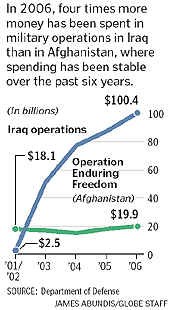
At $2 billion dollars a week, sure we can do this for decades. To get more money we'll just cut taxes.
http://www.boston.com/news/world/middleeast/articles/2006/09/28/cost_of_iraq_war_nearly_2b_a_week/

http://cache.boston.com/bonzai-fba/Third_Party_Graphic/2006/09/28/1159435878_7481.gif
0 Replies
 
blueflame1
 
  1  
Reply Sun 18 Mar, 2007 11:05 am
"That's very evident. The cartoon had to do with AMERICAN troops, not other nationalities. So we start with 12/7/41, not 1939 or 1931." Naturally but it aint evident to Snidely.
0 Replies
 
revel
 
  1  
Reply Sun 18 Mar, 2007 11:27 am
I am trying to understand current US strategy in Iraq right now. Why are we concentrating so much on Shiite militants instead of Sunni insurgents? Shiite militants seem mainly to just fight Sunnis, while Sunni militants fight US soldiers and other Iraqis, so why are concentrating so much on Shiite militants?

Sunni Militants Disrupt Plan to Calm Baghdad

Quote:
WASHINGTON, March 17 ?- In January, when President Bush announced his plans to reinforce American troops in Baghdad, Shiite militias were seen as the main worry. Some analysts predicted that bloody clashes with Shiite militants in the Sadr City district in northeastern Baghdad were all but inevitable.

Instead, during the early weeks of the operation, deadly bombings by Sunni Arab militants have emerged as a greater danger. In particular, the threat posed by the Sunni group Al Qaeda in Mesopotamia was underscored when American troops seized a laptop computer from a senior operative in the group who was killed in late December.

Information from captured materials indicates that the group's leadership sees "the sectarian war for Baghdad as the necessary main focus of its operations," according to an intelligence report that was described by American officials.

Reflecting concern over the bomb attacks, especially car bombings, American military officials have begun to emphasize that bringing security to the Iraqi capital will involve not only the protection of Baghdad neighborhoods, but also raids to shut down bomb factories and uncover arms caches in the largely Sunni areas on the outskirts of the city.

"The Baghdad belts are increasingly seen as the key to security in Baghdad," Lt. Gen. Raymond T. Odierno, the American officer in charge of day-to-day operations in Iraq, said in an e-mail message. "I believe this is where you can stop the accelerants to Baghdad violence. We have already found a large number of significant caches in these areas related to car bombs and I.E.D.'s," or improvised explosive devices, commonly known as roadside bombs.

"The Shia have gone to ground for the most part, but there are still rogue elements of Shia extremists that are still a threat and conducting operations against the coalition, but more importantly against the government of Iraq," he added.

The threat has shifted on the eve of the fourth anniversary of the start of the war in Iraq, in which American forces toppled Saddam Hussein only to face a growing insurgency and find themselves involved in an arduous effort to head off growing sectarian strife.

In its efforts to stabilize Iraq, American commanders have had to contend with Al Qaeda in Mesopotamia, other Sunni Arab insurgent groups, a variety of Shiite militias, criminals and, they say, Iranian operatives. The greater Baghdad area seems to include all of them, making the mission there one of constant adjustment to adversaries who are revising their own tactics.

According to American intelligence analysts, Al Qaeda in Mesopotamia's Baghdad strategy has gone through several changes. The overwhelming majority of the group's members are believed to be Iraqi. But some senior commanders are foreigners, including Abu Ayyub al-Masri, an Egyptian who became the leader of the organization last year after the death of Abu Musab al-Zarqawi, the Jordanian terrorist who founded the organization.

The group has been active in the Sunni-dominated Anbar Province in western Iraq. But it has also long operated in the Sunni areas on the outskirts of the capital. Mr. Hussein encouraged the settlement of Sunnis in these areas in the hope that it would protect his government, and some towns and rural communities there have emerged as havens for Sunni militants.

In the summer and fall of 2006, the group's leaders saw an opportunity to step up the fight in Baghdad against Shiite militias, American troops and the nascent Iraqi security forces, according to captured documents. Some of the insight into the group's strategy was obtained from the laptop computer seized when a senior Iraqi adviser to Mr. Masri was killed by troops of the American-led forces in late December at a traffic checkpoint.

The adviser, who among other aliases used the name Abu Hasan, was detained by the multinational troops in January 2005 but inadvertently released because his role in Al Qaeda in Mesopotamia was not well understood at the time.

As outlined in the captured documents and other material that was seized, the group's initial strategy was to push Shiites out of western Baghdad. As part of the sectarian battle for the capital, the strategy also called for attacking Shiites in parts of nearby provinces, specifically southern Salahuddin, western Diyala and eastern Anbar, attacks that the group's leaders also calculated would put American and Iraqi troops on the defensive. (The documents, American officials say, also reflected a continued interest in obtaining chemical weapons.)

But Shiite militias, particularly Mahdi Army operatives, responded with their own offensive, forcing the Sunni militants to retreat. A Pentagon report to Congress noted in November that the main Shiite militia group, the Mahdi Army, had replaced Al Qaeda in Mesopotamia "as the most dangerous accelerant of potentially self-sustaining sectarian violence in Iraq." American forces, instead of withdrawing from the capital as the Sunni insurgents had hoped, prepared plans to reinforce their troops there.

According to captured memos portrayed in American intelligence reports, the group was frustrated with the Shiite militias' success, was unhappy with weapons shortages and was somewhat disorganized, according to an account by an American official who asked not to be identified because he was discussing intelligence matters.

As a result, the organization adjusted its tactics. It began to rely more on the Sunni enclaves on the outskirts of Baghdad. Senior leaders rotated through the areas in order to direct operations while lower-level fighters operated in the capital.

Car-bomb components are also made in the surrounding Sunni areas and then smuggled into Baghdad, where they are assembled in the hope of killing Shiites and escalating sectarian violence. In a reflection of the group's tactical shift, car bombings have greatly increased this year, reaching a peak in Iraq in January and February, according to Maj. Gen. William B. Caldwell IV, the top spokesman for the United States military. Of the 77 car bombings in Iraq in February, 44 were in Baghdad.

In addition to car bomb attacks, the group's basic tactics are to attack American and Shiite militia supply lines. When faced with American combat power, the Sunni militants tend to disperse, hoping to fight another day, American commanders say.

Col. J. B. Burton, the commander of the Second Brigade Combat Team for the First Infantry Division, told reporters on Friday that the Sunni militants were also taking advantage of the decision of some Shiite militias to become less active or leave Baghdad. Sunni militants "have seen an opportunity with Shia extremists out of the area to strike with much violence," Colonel Burton said. "What we have seen is when the Shia extremists departed our area of responsibility, specifically in western Baghdad, incident rates in the Shia areas dropped dramatically," he said. "Incident rates in the Sunni areas increased a bit with vehicle-borne improvised explosive devices targeting Shia gathering places and Iraqi security force locations."

American military officials said they had long understood that Baghdad could not be secured without also controlling the surrounding suburbs, but the car bombings have made this all the more important. Among other areas, Sunni enclaves are located in the belt from Yusufiya to Salman Pak south of the capital and in towns like Baquba in Diyala Province north of the city. An American battalion was recently sent to Diyala as a result of sectarian fighting and Al Qaeda in Mesopotamia operations there.

Gen. David H. Petraeus, the senior American commander in Iraq, alluded to the problem in his news conference last week, noting that two car-bomb factories had recently been discovered in Salman Pak, to the southeast, and in Karma, northwest of Baghdad.

"They tend to be in the outskirts in these very rural areas, small villages and outlying houses and farms, and so forth," General Petraeus said. "And we clearly have got to find as many of those as we can to destroy them and then, obviously, to interdict those that are still able to be built."

"Although the focus, the priority, clearly is Baghdad, anyone who knows about securing Baghdad knows that you must also secure the Baghdad belts, in other words, the areas that surround Baghdad," he said.

I mean look what happened today, by Sunni insurgents.

7 more American troops killed in Iraq
0 Replies
 
hamburger
 
  1  
Reply Sun 18 Mar, 2007 01:05 pm
the difficulties the americans face in iraq trying to distinguish between friend and foe , are quite well presented in this report .

the problems seem to go even further because today's friend may be tomorrow's enemy (the book :...PRINCE OF THE MARSHES... gives a good illustration of how quickly alliances shift in iraq) .

so while today the americans may be attacked by sunnis in a certain area of iraq , tomorrow they may be attacked by shiites in some other area .
some iraquis also seem to slip in and out of uniform at times - it's quite clear : this is not a convential war .
hbg


Quote:
INSIDE THE 'SURGE'
U.S.-Iraqi joint teams lack a key weapon: trust
American troops deployed for the Baghdad security crackdown are wary of the officers they now live with. Who's a militiaman and who isn't?
By David Zucchino
Times Staff Writer

March 17, 2007

JOINT SECURITY STATION SULAKH, IRAQ ?- The U.S. military command center inside this cramped Iraqi police station is off-limits to Iraqi police. A Humvee and two U.S. soldiers block access to the American side.

The barricaded police post in northwest Baghdad is called a joint security station, the latest U.S. effort at teaming American soldiers with Iraqi police to battle insurgents and militiamen. But at least for now, the station is literally split down the middle.

"We don't trust 'em," 1st Lt. Steve Taylor said of his Iraqi police counterparts. "There's no way to know who's good and who's bad, so we have to assume they're all bad, unfortunately."

The station's fortified rooftop flies an Iraqi flag, but no Iraqis are allowed there. It's restricted to American soldiers, who maintain a 24-hour watch over the adjoining neighborhood. With one eye, they watch for insurgents and militiamen. With the other, they watch their supposed allies, the police.

Since U.S. forces invaded Iraq four years ago, training and bolstering the Iraqi police and army have been central to the strategy for gradually withdrawing American units. But the U.S. military is only now fully embedding its forces with Iraqi police in local neighborhoods ?- and as the Sulakh station shows, the effort is daunting.

There will be no trust between U.S. soldiers and Iraqi police until the Iraqi government fulfills its promise to root out the Shiite Muslim militiamen who dominate the force. From the top ranks of the Interior Ministry, which controls the police, to ordinary officers, the force is riddled with members of militias notorious for killing Sunni Arab civilians and mutilating the corpses.

At the same time, the police and Shiite civilians are targeted by Sunni insurgents, who kill dozens at a time in mammoth explosions.

"I've lost a lot of men," said Col. Ali Mohammed Rahim, the Sulakh station commander, who leads a mostly Shiite force. "Snipers, [improvised explosive devices], kidnappings, murders ?- all because they are Iraqi police. We are all targets. I am very worried."

On a wall outside Rahim's office are color portraits of slain officers. "Martyrs," said a colleague, gesturing toward the photos and shaking his head.

Rahim said he worried about being killed on his 20-minute commute to work. He has moved his wife and family to live with relatives in an area where no one knows he works for the police.

His station is in the Adhamiya district of Baghdad, whose residents are a mix of Shiites and Sunnis, with a smattering of Kurds.

At least 15 joint security stations have been set up since U.S. and Iraqi authorities launched a major security crackdown in Baghdad last month. A total of about 30 are to be established in coming weeks, said Army Maj. Gen. William B. Caldwell IV, the top U.S. military spokesman in Iraq.

Until recently, almost all U.S. forces in Iraq lived on massive forward operating bases, or FOBs, venturing out for vehicle patrols but then returning to base. Many of the 21,500 additional troops now being deployed to Baghdad and western Iraq will live with Iraqi police in joint security stations and with Iraqi army troops in combat outposts, a belated acknowledgment that effective counterinsurgency tactics require working hand in hand in neighborhoods with security forces to win the confidence of the civilians there.

Rahim was an army officer during Saddam Hussein's regime. Until last month, he had never worked with U.S. forces ?- and American troops had never entered his precinct.

His area is a dumping ground for mutilated corpses, he said. But since the so-called U.S. surge troops moved into his station last month, he said, the number has dropped from 10 a day to 10 a week.

"The people feel safer with American forces here," Rahim said. "Since the Americans are living here now, people feel like the U.S. wants to help, finally."

Capt. Tim Marzano, who commands 66 U.S. soldiers at the station, said he was working to "develop a baseline trust" with Rahim and his officers, though Rahim complained that he had only 80 of the 200 officers he had been promised.

"I believe the majority of them are either neutral or pro-coalition, and we have to work on gaining confidence so eventually they can function on their own," Marzano said.

For U.S. soldiers, the station offers bare-bones living. On the FOBs, troops have bountiful hot food at the mess hall, satellite TV, Internet cafes, flush toilets and hot showers. At Sulakh, they use plywood outhouses and eat packaged meals.

Taylor said he expected insurgents to attack the station with car bombs or rocket-propelled grenades. At least three joint security stations have been besieged, with U.S. forces and Iraqi police suffering casualties.

"We know an attack is going to come, but we can defend ourselves, believe me," Taylor said. He cited the station's reinforced concrete barriers and protective glass, plus heavy weapons, air support and an on-call quickreaction force.

Despite the threats and hardships, several paratroopers in the unit ?- the 2nd Battalion, 319th Airborne Field Artillery Regiment of the 82nd Airborne Division ?- said they preferred hitting the streets to sitting in distant FOBs.

"You're going to be away from your family anyway, so you might as well jump into the thick of it," said Spc. Brandon Webb, 25. "We're soldiers. We need to be close to the fight."

Late one night, a U.S. patrol of 22 paratroopers walked through the neighborhood, seeking out Iraqi civilians willing to offer information. Because of the 8 p.m-to-6 a.m. curfew, they reasoned, people in their homes might be willing to talk because they were unlikely to be seen by their neighbors.

As the patrol turned a corner, three men approached. They complained that insurgents were paying neighborhood children to plant bombs and transmit messages. They said the insurgents planned their strategy at a shop inside the Fish Market, a nearby bazaar.

"We want you to kill these men," one of them told Lt. Josh Rowan, the patrol commander.

"Now you're talking!" Rowan said.

He asked the men if they were willing to put on disguises and accompany U.S. soldiers to point out the shop. They agreed.

"Going out on foot at night is the only way to get guys like that to talk to you," Rowan said. "Otherwise they're too afraid."

The next day, soldiers from the station embarked on their first foot patrol with Iraqi police. Six police officers toting AK-47 automatic rifles took the lead, followed by 26 Americans in full combat gear. They walked across cracked concrete and past trash piles, drawing stares and a few waves from residents in tea shops and doorways.

A mosque loudspeaker was blaring the Muslim call to prayer when Taylor knocked on the door of a house. A middle-aged man in a dishdasha robe invited him into his diwaniya, or reception room, where he and Taylor discussed the local security situation through a masked interpreter named Phillip.

The resident, who declined to give his name, said that the neighborhood was relatively safe but that the Fish Market was terrorized by gunmen.

"We're here to help you," Taylor said. "We just want peace and quiet."

The man nodded. "We do, too, inshallah [God willing]."

At another house, the patrol encountered a sedan pocked with bullet holes. There was dried blood on the back seat.

As the Iraqi police officers listened in, a man named Mohammed told the soldiers the blood was from a family member killed by insurgents three weeks before at an illegal checkpoint.

After the police moved on, Mohammed approached an American reporter walking with the patrol and said in English: "Nobody will tell you anything with the police along. Nobody trusts them. They are thieves and killers."


link to full report :
...IRAQI - U.S. FORCES POLICE POSTS...
0 Replies
 
ican711nm
 
  1  
Reply Sun 18 Mar, 2007 01:56 pm
Joe Nation wrote:
Quote:
So,WW2 started on Dec 7,1941?

I'm sure the family members of the allied troops that were killed in combat in Europe and the pacific before that date will be glad to know they werent fighting a war.
I'm sure it will make them feel better.


It did for Americans, prior to that date there had been only changes in training levels for the US Military. Until the Pearl Harbor attacks, the US was a neutral party, we declared war on Japan on Dec 8th, Germany declared war on the US four days later.

Joe(then we were in it)Nation

Americans voluntarily fought in China prior to 12/7/41 to help the Chinese against the Japanese. One group was called the Flying Tigers. The noses of their P40 fighter planes were painted to look like the mouths of tigers. Others flew DC-3 cargo planes across the Himalayan mountains to help supply the Chinese with food and ordnance.
0 Replies


Related Topics

Obama '08? - Discussion by sozobe
Let's get rid of the Electoral College - Discussion by Robert Gentel
McCain's VP: - Discussion by Cycloptichorn
The 2008 Democrat Convention - Discussion by Lash
McCain is blowing his election chances. - Discussion by McGentrix
Snowdon is a dummy - Discussion by cicerone imposter
Food Stamp Turkeys - Discussion by H2O MAN
TEA PARTY TO AMERICA: NOW WHAT?! - Discussion by farmerman
 
Copyright © 2026 MadLab, LLC :: Terms of Service :: Privacy Policy :: Page generated in 0.05 seconds on 03/08/2026 at 01:36:43