0
   

THE US, THE UN AND IRAQ, TENTH THREAD.


cicerone imposter
 
  1  
Reply Thu 21 Jun, 2007 11:41 am
Kara, I believe I missed it. Can you provide us with a summary?
0 Replies
 
xingu
 
  1  
Reply Thu 21 Jun, 2007 11:52 am
June 19, 2007
Op-Ed Contributor
Brothers to the Bitter End
By FOUAD AJAMI
SO the masked men of Fatah have the run of the West Bank while the masked men of Hamas have their dominion in Gaza. Some see this as a tolerable situation, maybe even an improvement, envisioning a secularist Fatah-run state living peacefully alongside Israel and a small, radical Gaza hemmed in by Israeli troops. It's always tempting to look for salvation in disaster, but in this case it's sheer fantasy.

The Palestinian ruin was a long time in coming. No other national movement has had the indulgence granted the Palestinians over the last half-century, and the results can be seen in the bravado and the senseless violence, in the inability of a people to come to terms with their condition and their needs.

The life of a Palestinian is one of squalor and misery, yet his leaders play the international game as though they were powers. An accommodation with Israel is imperative ?- if only out of economic self-interest and political necessity ?- but the Palestinians, in a democratic experiment some 18 months ago, tipped power to a Hamas movement whose very charter is pledged to the destruction of the Jewish state and the imposition of Islamist rule.

The political maxim that people get the leaders they deserve must be reckoned too cruel to apply to the Palestinians. Before Hamas, for four decades, the vainglorious Yasir Arafat refused to tell his people the basic truths of their political life. Amid the debacles, he remained eerily joyous; he circled the globe, offering his people the false sense that they could be spared the consequences of terrible decisions.

In a rare alignment of the universe, there came Mr. Arafat's way in the late 1990s an American president, Bill Clinton, eager to redeem Palestinian claims and an Israeli soldier-statesman, Ehud Barak, who would offer the Palestinians all that Israeli political traffic could bear and then some.

But it was too much to ask of Mr. Arafat to return to his people with a decent and generous compromise, to bid farewell to the legend that the Palestinians could have it all "from the river to the sea." It was safer for him to stay with the political myths of his people than to settle down for the more difficult work of statehood and political rescue.

For their part, the Arab states have only compounded the Palestinian misery. The Arab cavalry was always on the way, the Arab treasure was always a day away, and there was thus no need for the Palestinians to pay tribute to necessity. In recent years, the choice was starkly posed: it was either statehood or a starring role on Al Jazeera, and the young "boys of the stones" and their leaders opted for the latter.

After Mr. Arafat's death, the mantle passed to a fairly decent man, Mahmoud Abbas, a leader for a post-heroic era. He is free of Mr. Arafat's megalomania, and he seemed keen to cap the volcano; he promised, as he put it, "one law, one authority, one gun" in the Palestinian street. But he has never been a master of his world; by the time he had been given his political stewardship the culture of the Palestinian world had succumbed to a terrifying cult of violence.

It has long been a cherished legend of the Palestinians, and a proud claim, that they would not kill their own, that there would be no fratricide in their world. The cruelty we now see ?- in both Gaza and the West Bank ?- bears witness that the Palestinians have run through the consolations that had been there for them in a history of adversity.

It isn't a pretty choice, that between Hamas and Fatah. Indeed, it was the reign of plunder and arrogance that Fatah imposed during its years of primacy that gave Hamas its power and room for maneuver. We must not overdo the distinction between the "secularism" of Fatah and the Islamism of Hamas. In the cruel streets and refugee camps of the Palestinians, this is really a distinction without a difference.

It is idle to think that Gaza could be written off as a Hamas dominion while Fatah held its own in the towns of the West Bank. The abdication and the anarchy have damaged both Palestinian realms. Nablus in the West Bank is no more amenable to reason than is Gaza; the writ of the pitiless preachers and gunmen is the norm in both places.

There is no way that a normal world could be had in the West Bank while Gaza goes under. There is no magic wand with which this Palestinian world could be healed and taught the virtues of realism and sobriety. No international peacekeeping force can bring order to the deadly streets and alleyways of Gaza. A population armed to the teeth and long in the throes of disorder can't be pacified by outsiders.

For decades, Arab society granted the Palestinians everything and nothing at the same time. The Arab states built worlds of their own, had their own priorities, dreaded and loathed the Palestinians as outsiders and agitators, but left them to the illusion that Palestine was an all-consuming Arab concern.

Now the Palestinians should know better. The center of Arab politics has shifted from the Mediterranean to the Persian Gulf, a great political windfall has come to the lands of the Gulf and the Arabian Peninsula, vast new wealth due to the recent rises in oil prices, while misery overwhelms the Palestinians. No Arabs wait for Palestine anymore; they have left the Palestinians to the ruin of their own history.

The rise of Hamas in Gaza should concentrate the minds of the custodians of power in the Arab world. Palestine, their old alibi, the cause with which they diverted the attention of their populations from troubles at home, has become a nightmare in its own right. An Arab debt is owed the Palestinians ?- the gift of truth and candor as well as material help.

Arab poets used to write reverential verse in praise of the boys of the stones and the suicide bombers. Now the poetry has subsided, replaced by a silent recognition of the malady that afflicts the Palestinians. Except among the most bigoted and willful of Arabs, there is growing acknowledgment of the depth of the Palestinian crisis. And aside from a handful of the most romantic of Israelis, there is a recognition in that society, as well, of the malignancy of the national movement a stone's throw away.

The mainstream in Israel had made its way to a broad acceptance of Palestinian statehood. In the 1990s, Yitzhak Rabin, the soldier who had led its army into acquisition of the West Bank and Gaza in the Six-Day War of 1967, told his people that it was time to partition the land and to accept Palestinian sovereignty. It was an unsentimental peace, to "get Gaza out of Tel Aviv," as Mr. Rabin put it, but it was peace nonetheless.

In varying degrees, all of Mr. Rabin's successors accepted this legacy. There was even a current in Israel possessed of a deep curiosity about the Palestinians, a romance of sorts about their ways and folk culture and their connection to the sacred land. All this is stilled. Palestinian society has now gone where no "peace processors" or romantic poets dare tread.

Fouad Ajami, a professor at the Johns Hopkins School of Advanced International Studies, is the author of "The Foreigner's Gift: The Americans, the Arabs and the Iraqis in Iraq."

http://www.nytimes.com/2007/06/19/opinion/19ajami.html?_r=1&oref=slogin
0 Replies
 
Kara
 
  1  
Reply Thu 21 Jun, 2007 12:10 pm
Thanks, xingu. You beat me to it.

I thought the piece was brilliant...profoundly sad but true.
0 Replies
 
cicerone imposter
 
  1  
Reply Thu 21 Jun, 2007 12:38 pm
xingu and Kara, Thank you for bringing my attention to this article. It spells out today's problems from yesterday's problems, primarily the way Israel has treated its own citizens, and the Palestinians themselves for their poor leadership and extremism that continues its own conflicts.

This paragraph from the NYTimes article is the primary problem for Israel and the Palestinians.


"The life of a Palestinian is one of squalor and misery, yet his leaders play the international game as though they were powers. An accommodation with Israel is imperative ?- if only out of economic self-interest and political necessity ?- but the Palestinians, in a democratic experiment some 18 months ago, tipped power to a Hamas movement whose very charter is pledged to the destruction of the Jewish state and the imposition of Islamist rule."
0 Replies
 
xingu
 
  1  
Reply Thu 21 Jun, 2007 01:20 pm
As long as we have this Israeli-Palestinian conflict going on we will have Americans being killed. We will be paying for it until it is resolved.
0 Replies
 
Kara
 
  1  
Reply Thu 21 Jun, 2007 07:40 pm
c.i., the paragraph you posted is key to the piece, a seminal statement of the core problem.

xingu, I don't see it quite that way but the end result may be the same. The tragedy of Palestine and Israel is a decades-old story, and we should continue to try to help solve it because it is our uncritical support for Israel that fuels the fires; but we did not strike the match. This is a complex issue, and each "side" has arguments in its favor and reasoned analysis behind its viewpoints. One seldom sees so perceptive a disquisition as in the NY Times piece.

Americans will continue to be killed because we try to impose our will upon the world by force.
0 Replies
 
xingu
 
  1  
Reply Thu 21 Jun, 2007 08:03 pm
Kara wrote:
Americans will continue to be killed because we try to impose our will upon the world by force.


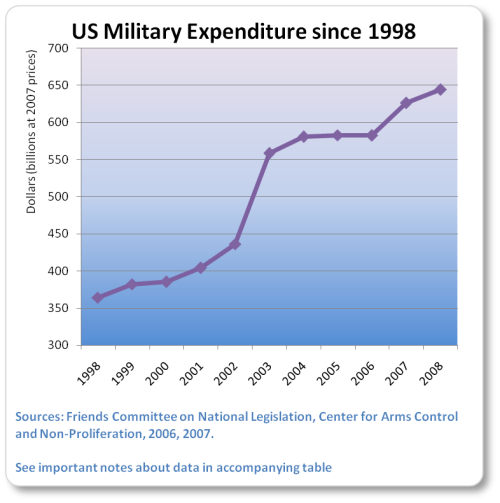
And that comes from arrogance. Arrogance comes from our power. We are obsessed with our military. Think of what will happen to any politician who wants to cut the Defence budget and spend more to help Americans in need. The conservatives would crucify him. It seems every budget has to have an increase in military spending.

http://www.globalissues.org/i/military/country-distribution-2005.png

http://www.globalissues.org/i/military/us-spending-1998-2008.png
0 Replies
 
cicerone imposter
 
  1  
Reply Thu 21 Jun, 2007 08:23 pm
the only problem I find with the pie chart and graph is simply that the US's continued wars in Afghanistan and Iraq will have a long future that we will be paying on irregardless of when active warfare actually ends.

Our soldiers are returning home with injuries that in many cases will require lifelong medical needs; that's not figured into the current federal budget.

It's not just a matter of Bush's funding cuts for our veterans, but the added co-pays and fees that are being tacked onto their benefits. The increasing demand by our veterans for benefits and services as they return from war will not be met by the budgets now being proposed by Bush.

Bush would rather VETO stem cell research rather than helping our returning veterans; cells are more important.
0 Replies
 
Kara
 
  1  
Reply Thu 21 Jun, 2007 08:33 pm
c.i., his veto of stem cells has nothing to do with his possible insensitivity and probable ignorance of veteran's problems. He is a political animal, swept by the tides of his voting base. His stem cell veto is in line with his conservative base (although I think Bush is more of a Republican than a conservative.) He is perhaps not cognizant, or paying attention to, the burgeoning problems of the returning wounded service people.

xingu, we have always backed up our ideology with our military might. We are not the more powerful nation on earth because of our ideas, which is extraordinary because we could be. But could that happen, without our muscle?
0 Replies
 
cicerone imposter
 
  1  
Reply Fri 22 Jun, 2007 01:36 am
Kara, I believe I know what a conservative or republican is supposed to be; I used to be one. Bush is none of those. Please show me where I'm wrong. Stem Cell has nothing to do with conservatism or republicanism. It has everything to do with his religion.
0 Replies
 
xingu
 
  1  
Reply Fri 22 Jun, 2007 05:40 am
Kara wrote:
c.i., his veto of stem cells has nothing to do with his possible insensitivity and probable ignorance of veteran's problems. He is a political animal, swept by the tides of his voting base. His stem cell veto is in line with his conservative base (although I think Bush is more of a Republican than a conservative.) He is perhaps not cognizant, or paying attention to, the burgeoning problems of the returning wounded service people.

xingu, we have always backed up our ideology with our military might. We are not the more powerful nation on earth because of our ideas, which is extraordinary because we could be. But could that happen, without our muscle?


First I believe Bush vetoed the stem cell bill because of his religious beliefs. He doesn't have to appeal to any base as he's not running for anymore offices.

I don't know that our ideas are extraorninary. What we offer is opportunity. Europe offers the same thing which is why they, like us, are having an immigration problem. Other countries offer freedom and hope.

What is the best country to live in? Not America.

Quote:
Norway still the world's best place to live

For the fourth year in a row, the United Nations has ranked Norway as having the highest standard of living in the world. Sweden, Australia and Canada are next in line, while the United States is further down the scale.
Norway, also known for its scenic beauty, is once again being hailed as the world's best country in which to live.

Norway tops UN list over best places to live - again - 24.07.2002
The annual ranking is based largely on average levels of education and income, combined with expected length of lifetime.

The report measured standards of living in 177 countries around the world. Other Nordic countries also ranked high, with Iceland in 7th place, Finland 13th and Denmark 17th.

Norway's gross national product per person amounted to USD 36,600, beaten only by Luxembourg. Its men and women are expected to live to an age of 78.9 years and Norway is one of 19 countries in the world with no measurable rates of illiteracy.

Researchers for the United Nations Development Program (UNDP) also weighed countries' degrees of cultural freedom in their analysis. They called cultural freedom a "basic human right," and awarded high scores in this year's UN Human Development Report to countries that accept immigrant cultures in addition to their own.

Norway's cultural diversity has blossomed in recent years, and public policies are aimed at integrating various ethnic groups and promoting tolerance.

Norway also was lauded for its high literacy rate in addition to educational levels and material wealth. Norwegians themselves generally point to their country's scenic beauty, recreational opportunities, clean water and fresh air.

The United States landed in eighth place on the list, while France, for example, was 16th.

The worst countries in which to live are all in Africa, according to the UN report. All 23 nations at the bottom of the list were African, with war-torn Sierra Leone in last place.

http://www.aftenposten.no/english/local/article828724.ece

Remember this?

"Give us your poor, your tired, your huddled masses longing to be free..."

We invaded Iraq and created a huge refugee problem. We will not take in but a very few Iraqi refugees, refugees we created.

Not so for Sweden.

Quote:
SODERTALJE, Sweden: Walking down the carpeted aisle of Sodertalje's low-slung St. John's Church one recent morning, Anders Lago's broad, blond features looked out of place among the hundreds of black-clad Iraqi mourners at a memorial service. Lago is the mayor of this scenic Swedish town of 60,000 people, which last year took in twice as many Iraqi refugees as the entire United States, almost all of them Christians fleeing the religious purge taking place amid Iraq's anti-American insurgency and sectarian strife.

So the mourners are now part of Lago's constituency, and their war is rapidly becoming Sodertalje's war - to the mayor's growing chagrin.

Sodertalje, he says, is reaching a breaking point and can no longer provide newcomers with even the basic services they have a right to expect.

About 9,000 Iraqis made it to Sweden in 2006 - almost half of the 22,000 who sought asylum in the entire industrialized world. This year, when the United States has promised to take in 7,000 Iraqis, around 20,000 are expected to seek asylum in Sweden.


http://www.iht.com/articles/2007/06/13/europe/sweden.php

I think there's a big difference between America of yesterday and of today. We've changed. Our arrogance and pride, our faith in military might and our vain belief that we are the leader of the world has turned us away from helping people to creating chaos and unstability.

We have become very unpopular in this world since George Bush became president.
0 Replies
 
Kara
 
  1  
Reply Fri 22 Jun, 2007 05:40 am
c.i., Very Happy ...I'm sure you know the definition of those terms well, from the inside out. Better than I, who am only slightly less liberal than I was when at Berkeley. I didn't mean to sound preachy, although my post sounds that way when I reread it. I was trying to say that the man is not a thinker, but we all know that.

I don't agree with the Republicans who are not in favor of stem cell research on unused embryos, but I understand why they believe what they do. I think their beliefs are sincere. I think their beliefs about Plan B are wrong, too, but who am I to say that life begins before implantation? I just don't think it does. If you believe something is murder, then you have to act on that belief.

I also find some people's reasoning specious when they say, He's pro-life but he believes in the death penalty and he is not terribly supportive of poor people AFTER they are born and struggling to live. We all think such contradictory things, sometimes, and I see that quite a few Republicans do not go along with the party line on stem cell research. I think one can have views toward an issue that are partial: you don't believe in one part of a belief statement but you go along with another part.
0 Replies
 
Kara
 
  1  
Reply Fri 22 Jun, 2007 09:16 am
xingu, I agree with almost everything you say. I'm not sure about the best place in which to live; that is still somewhat subjective.
0 Replies
 
cicerone imposter
 
  1  
Reply Fri 22 Jun, 2007 06:08 pm
It seems the Bush regime and the high command are still playing games with the lives of our troops. Anybody know how a yo-yo works?


US may reduce forces in Iraq by spring By PAULINE JELINEK, Associated Press Writer
1 hour, 12 minutes ago


WASHINGTON - The U.S. may be able to reduce combat forces in Iraq by next spring if Iraq's own security forces continue to grow and improve, a senior American commander said Friday. He denied reports the U.S. is arming Sunni insurgent groups to help in the fight against al-Qaida.

Lt. Gen. Raymond Odierno, the top day-to-day commander of U.S. forces in Iraq, did not predict any reductions in U.S. forces but said such redeployments may be feasible by spring. There are currently 156,000 U.S. troops in Iraq.
0 Replies
 
ican711nm
 
  1  
Reply Fri 22 Jun, 2007 06:14 pm
Interesting!
0 Replies
 
Kara
 
  1  
Reply Fri 22 Jun, 2007 09:15 pm
c.i., I wonder about that. I read it all today, too.

Is this a political posting? I do not know what to believe anymore.

I do not understand people who want our troops to be withdrawn suddenly, or even soon. Why the sudden restlessness? Could it have to do with 2008 elections....surely not. Yeah.

If there is anyone with leadership ability and the articulateness to express it, someone who can lead this country into the next four years, I have not seen that person yet. We have hard decisions in front of us, and one can go on and on about why, who caused it, what wrong moves were made. I could do that, say that, and what is accomplished?

We will be moved ahead by a leader who has a vision of the next ten years, and YES, those are the ten years we will be in Iraq. We need to be shown the way by someone who is fearless, about how to deal with the challenges in this country we have occupied. I do not see that person yet. All I see are politicos who are backing and filling, and CYA'ing, and looking over their shoulders at the runners behind them.

Do any of you see that person, or that perspective, yet?
0 Replies
 
cicerone imposter
 
  1  
Reply Fri 22 Jun, 2007 10:42 pm
Kara, The primary reason I posted that article is very simple; Bushco and his gang keeps telling us we'll leave when they ask us to leave. Well, isn't it interesting that Bush is building the largest embassy in the world in Baghdad as we speak, and some 14 permanent bases in Iraq.

Then we get all this bullshite about "if" the Iraqis forces grow and improve, maybe, just maybe, we might be able to start withdrawing our troops.

God, Americans are stupid!
0 Replies
 
cicerone imposter
 
  1  
Reply Sat 23 Jun, 2007 09:29 am
Roadside bombs in Iraq kill 7 troops

By BUSHRA JUHI, Associated Press Writer
51 minutes ago


BAGHDAD - Roadside bombs killed seven American troops in Iraq on Saturday, including four in a single strike outside Baghdad, the military said, as U.S. and Iraqi troops captured two senior al-Qaida militants in Diyala province.

Separately, a predawn operation by U.S. forces working with Iraqi informants in Baghdad's main Shiite district of Sadr City netted three other militants suspected of ties to Iran, the military said.

The Americans have accused Iran of providing mainly Shiite militias with training and powerful roadside bombs known as explosively formed projectiles, or EFPs, that have killed hundreds of U.S. troops in recent months.

Roadside bombs, including EFPs and other makeshift devices used by Sunni and Shiite militants alike, are the No. 1 killer of foreign troops in Iraq and Saturday's deaths were no exception.

Roadside bombs killed four soldiers northwest of the capital, a U.S. airman in Tikrit, and two U.S. soldiers in eastern Baghdad whose unit has recently targeted bomb networks. In addition, a British soldier died Saturday of wounds from a roadside bombing the day before in the southern city of Basra.
0 Replies
 
BumbleBeeBoogie
 
  1  
Reply Sat 23 Jun, 2007 10:07 am
Militants Said to Flee Before U.S. Offensive
June 23, 2007
Militants Said to Flee Before U.S. Offensive
By JOHN F. BURNS
New York Times

BAGHDAD ?- The operational commander of troops battling to drive fighters with Al Qaeda from Baquba said Friday that 80 percent of the top Qaeda leaders in the city fled before the American-led offensive began earlier this week. He compared their flight with the escape of Qaeda leaders from Falluja ahead of an American offensive that recaptured that city in 2004.

In an otherwise upbeat assessment, Lt. Gen. Raymond T. Odierno, the second-ranking American commander in Iraq, told reporters that leaders of Al Qaeda in Mesopotamia had been alerted to the Baquba offensive by widespread public discussion of the American plan to clear the city before the attack began. He portrayed the Qaeda leaders' escape as cowardice, saying that "when the fight comes, they leave," abandoning "midlevel" Qaeda leaders and fighters to face the might of American troops ?- just, he said, as they did in Falluja.

Some American officers in Baquba have placed blame for the Qaeda leaders' flight on public remarks about the offensive in the days before it began by top American commanders, including Gen. David H. Petraeus, the overall commander in Iraq. But General Odierno cast the issue in broader terms, saying Qaeda leaders were bound to know an attack was coming in light of President Bush's decision to pour nearly 30,000 additional troops into the fight in a bid to secure Baghdad and areas around the capital that have been insurgent strongholds. That included Baquba, which lies 40 miles north.

"Frankly, I think they knew an operation was coming in Baquba," General Odierno said in a teleconference briefing with Pentagon reporters from the American military headquarters in Baghdad. "They watched the news. They understood we had a surge. They understood Baquba was designated as a problem area. So they knew we were going to come sooner or later."

Still, he implied American commanders may have played a part by flagging the offensive in advance. "I think they were tipped off by us talking about the surge, the fact that we have a problem in Diyala Province," he said.

In his news conference, General Odierno offered the broadest assessment yet of the multipronged American offensive around Baghdad that got under way this week, using the additional troops sent to Iraq as part of Mr. Bush's troop buildup. Despite the flight of the Qaeda leaders from Baquba ?- a pattern that appears to have been replicated in other areas included in the new offensive, including Qaeda strongholds along the Tigris River south of Baghdad ?- he adopted an upbeat tone, saying the offensive held "a good potential" for reducing the Qaeda threat to the point that American force levels in Iraq could be reduced by next spring.

First, he said, American and Iraqi troops would need to sustain their crackdown long enough for Iraqi forces to move into neighborhoods cleared of Qaeda fighters and hold them. This is a pattern American commanders have tried unsuccessfully before, as in a failed attempt to secure wide areas of Baghdad last summer. But General Odierno said Iraqi forces were "getting better," "staying and fighting," "taking casualties" and adding an additional 7,500 soldiers to their overall strength every five weeks.

"If you ask me today, I think by the spring, or earlier, they will be able to take on a larger portion of their security, which means I think potentially we could have a decision to reduce our forces," he said. But he quickly tempered his optimism, aware that top generals here have made repeated forecasts of a turnarounds in the war, only for the situation to get progressively worse. "You know, there's so many things that could be happening between now and then, as we've all learned," he said.

The forecast of a possible troop reduction by the spring of 2008 had strong political echoes, coinciding as it did with the date for beginning an American troop withdrawal that has been favored by some leading Democrats in Congress. It also coincides with the April 2008 date that American commanders in Iraq have said they have been given by the Army and Marine Corps leadership in Washington as the last point at which the current American force level of about 156,000 ?- augmented by the additional five Army brigades and Marine units deployed as part of the so-called surge ?- can be sustained, given staffing constraints.

Addressing the problems facing American troops in Baquba, General Odierno played down the significance of the Qaeda leaders fleeing ahead of the offensive, saying American forces would hunt them down. "I guarantee you, we're going to track down those leaders," he said. "And we're in the process of doing that. We know who they are, and we're coming after them, and we're going to work that extremely hard."

Before the Baquba operation, American commanders had said that one difference from previous offensives that had failed to net top Qaeda leaders would be the use of "blocking maneuvers" around the city to close off escape routes.

Although that appears to have failed, American commanders in Baquba said Friday that several hundred Qaeda fighters ?- about 80 percent of the recruits who were there when the offensive began Tuesday ?- remained in the western half of the city, and that there would be tough fighting to root them out for units of the 10,000-person force of American and Iraqi troops committed to the battle.

The force is one of the largest assembled for any operation outside Baghdad since the recapture of Falluja, and closely resembles, in its aims, the Falluja offensive of November 2004.

American hopes that the Falluja offensive would deal a mortal blow to Al Qaeda were thwarted when the leaders who fled the city moved elsewhere, and resumed the Islamic militants' trademark pattern of suicide bombings and assassinations at a higher intensity than before. Since Falluja, Qaeda groups have shown a remarkable resilience in the face of relentless pursuit by the American forces, regrouping time and again after American offensives. Even Falluja has not escaped. American commanders said this week that, more than 30 months after the city was recaptured, Qaeda groups have reinfiltrated the city, mounting suicide bombing attacks, assassinating police and city council leaders and forcing a fresh American and Iraqi offensive this month that has been aimed at capturing or killing the Qaeda fighters.

After more than three years of saying publicly that they had all the troops they needed for the war here, American commanders have begun acknowledging in the past year that the ability of the Qaeda groups to establish new strongholds after old ones are destroyed ?- and to regenerate their leadership ?- has owed much to the fact that American manpower has been severely stretched.

But with all the additional Army brigades ordered into the war by Mr. Bush now in the field, along with additional Marine units, the commanders here now have more firepower than they have had at any time since the American invasion in 2003. With that, the American generals face what they have acknowledged to be the best, and possibly last, chance to persuade critics in Congress and a disillusioned American public that persisting in Iraq is worthwhile.

General Odierno, at his news conference, sketched the sweep of the new offensive. He said the main thrust was aimed at Qaeda strongholds in Diyala Province, with its capital at Baquba; at the Arab Jabour area south of Baghdad, where Qaeda groups have sent wave after wave of car and truck bomb attacks into the capital; in scattered training areas and safe havens west and northwest of the capital; and in Baghdad itself, where major American operations have begun in the past weeks in the districts of Adhamiya, Rashid and Mansour.

"So far, within Baquba," General Odierno said, "there have been many successes: four weapons caches have been found and cleared; three truck and car bombs have been captured and destroyed; over 25 deep-buried I.E.D.'s have been found and cleared, many of them pointed out by the local populace; and 10 house-bound I.E.D.'s have been destroyed ?- those are 10 houses that have been rigged with thousands of pounds of explosives to try and kill us as we enter." I.E.D., or improvised explosive device, is military jargon for a homemade bomb.
---------------------------------------------

Michael R. Gordon contributed reporting from Baquba, Alissa J. Rubin from Baghdad and Richard A. Oppel Jr. from Arab Jabour.
0 Replies
 
cicerone imposter
 
  1  
Reply Sat 23 Jun, 2007 12:04 pm
That the insurgents and others like al Qaeda would "flee" the areas where our troops are going to "move" is not a new phenomenon. With only 21,500 more troops, there is no way to control anything; even the place of battle. If our troops move east, the insurgents will move west.... it's a very simple tactic. After our troops take over a city, then move to another one, the insurgents will move back. It's not military strategy at all; it's child's play. It doesn't take a military strategist to figure this out.

It's like when Bush used to tell us we can't tell the enemy when we'll leave Iraq, because they'll just wait us out. Dumb and dumber; now our military is saying we may leave by XXXXX. Different scenario, I guess.

When we have stupid people running our country, we get stupid results.
0 Replies


Related Topics

Obama '08? - Discussion by sozobe
Let's get rid of the Electoral College - Discussion by Robert Gentel
McCain's VP: - Discussion by Cycloptichorn
The 2008 Democrat Convention - Discussion by Lash
McCain is blowing his election chances. - Discussion by McGentrix
Snowdon is a dummy - Discussion by cicerone imposter
Food Stamp Turkeys - Discussion by H2O MAN
TEA PARTY TO AMERICA: NOW WHAT?! - Discussion by farmerman
 
Copyright © 2026 MadLab, LLC :: Terms of Service :: Privacy Policy :: Page generated in 0.05 seconds on 03/10/2026 at 12:35:51