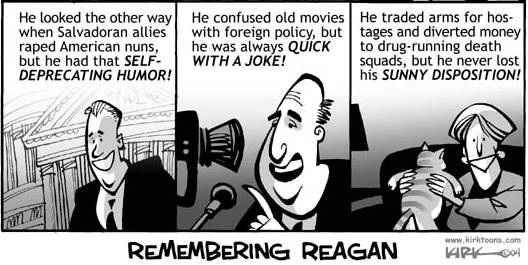
And now that edgar has clarified that, I'm gonna shift off the civil rights discussion, if y'all don't mind. There is a nice thread in praise of the Gipper, and I just posted on it, and this one seems better for pointing out the parts of the legacy that aren't quite so flattering.
Like
Ronald Reagan and AIDS:
Quote:From everything that we can ascertain from the historical record, Reagan's religious background, feelings, or beliefs had nothing to do with his political response to the AIDS epidemic. His appalling policies led to enormous setbacks for HIV/AIDS science and research, discrimination against people with AIDS, and the lack of any comprehensive outreach for prevention or education work, all adding to the already staggering amount of mounting deaths. His policies on AIDS were a product of indifference, disdain, self-imposed ignorance, and political capitulation to a staunchly reactionary and religious Republican constituency that was to reshape not only the party, but also the state of U.S. politics.
Although AIDS was first reported in the medical and popular press in 1981, it was only in October 1987 that President Reagan publicly spoke about the epidemic. By the end of that year 59,572 AIDS cases had been reported and 27,909 of those women and men had died. How could this happen? How could Reagan not say anything? Do anything?
Does everyone remember the climate when this disease first began to be reported in the media? The jokes went something like: "What do you call four queers on skates? Roll-aids."
Hospital emergency rooms refused to treat homosexuals. Would not even touch them.
Most of the talk from Republicans centered around phraseology such as "God's scourge."
Years later, the Centers for Disease Control issues an alert when three people die from the hantavirus, a disease spread by rats and confined to an outbreak of a few counties in New Mexico, but during the '80's thousands of people were dead, dying, and getting infected and 'gay cancer'
still wasn't getting anyone's attention in Washington.
Quote:Throughout all of this Ronald Reagan did nothing. When Rock Hudson, a friend and colleague of the Reagan's, was diagnosed and died in 1985 (one of the 20,740 cases reported that year), Reagan still did not speak out. When family friend William F. Buckley, in a March 18, 1986 New York Times article, called for mandatory testing of HIV and said that HIV+ gay men should have this information forcibly tattooed on their buttocks (and IV drug users on their arms), Reagan said nothing. In 1986 (after five years of complete silence) when Surgeon General C. Everett Koop released a report calling for AIDS education in schools, Bennett and Bauer did everything possible to undercut and prevent funding for Koop's too-little too-late initiative. By the end of 1986, 37,061 AIDS cases had been reported; 16,301 people had died.
The most memorable Reagan AIDS moment was at the 1986 centenary rededication of the Statue of Liberty. The Reagan's were there sitting next to the French Prime Minister and his wife, Francois and Danielle Mitterrand. Bob Hope was on stage entertaining the all-star audience. In the middle of a series of one-liners, Hope quipped, "I just heard that the Statue of Liberty has AIDS, but she doesn't know if she got it from the mouth of the Hudson or the Staten Island Fairy." As the television camera panned the audience, the Mitterrands looked appalled. The Reagans were laughing. By the end of 1989, 115,786 women and men had been diagnosed with AIDS in the United States?-more then 70,000 of them had died.
This is probably the most shameful legacy of Ronald Reagan. Oh yes, there was that little Iran-Contra matter; he could lie and pretend no one told him about arms for hostages while North and Poindexter ran completely amuck and afoul of the law -- and it
should have gotten him impeached -- but he managed to skate through that, with no perceivable impact to his legacy.
His non-response to the AIDS pandemic tars his record permanently.