How about platform shoes with clear spiked 7 inch heels? They won't be running around then.....
Imam Mohamed Magid, executive director of the All Dulles Area Muslim Society in Northern Virginia, said while he understood Islamic offense at the cartoons, Muslims would be better off protesting defamations against the faith perpetrated by their co-religionists.
"Prophet Muhammad is offended every day when somebody blows themselves up in a marketplace in Iraq. He's offended whenever somebody is beheaded. Prophet Muhammad would have opposed the burning of these embassies, or calls to kill Danes or other people," Magid said. "You can't be untouchable and then call other people infidel."
So someone publishes a Cartoon which breaks no laws and thousands of muslims over the world breakout in protests and expect the rest of the world to unilaterally condemn the action, without considering the fact that to many other countries freedom of expression is an inalienable right.
However, when muslim suicide bombers blow up innocent people in Israel, or even buildings in NYC, the so called moderate muslim condemnation of such acts is always followed by some kind of justification for the action.
Where is the unilateral muslim condemnation of killing of innocents? If moderate muslims really do believe that killing innocents goes against Islam, where were the spontaneous protests when the Twin Towers fell? Logically, looking at the reaction of the muslim world one could conclude that they hold Cartoons to be greater blasphemy than murder.
Europe, and more broadly "Western Civilization" is suffering from it's own policies, it's own aggrandizement, and it's own hypocrisy. As much as I deplore religion, and especially Islam, for both political, philosophical, historical and personal reasons, it's hard to blame the fanatic Muslims for what is inherently a European, or Western problem.
"Free speech" is a fuzzy concept, yet it seems that it is only applied partially. Free speech has always been an illusion. Europeans, and in fact, Westerners like to boast about the fact that, they are tolerant, liberal, progressive, and believe in those enlightenment values such as free speech and the free flow of ideas. That is, like all things, partially true. If Westerners truly believed in free speech, they would not have these supposed 'hate crimes' legislations, or laws that ban the scrutiny or the freedom of inquiry regarding the Holocaust or other unpopular ideas, and in many Western European countries you can be fined, jailed, and/or exiled if you dare question the Holocaust or somehow make fun of Jews.
While I deplore Islam, and the fanatic, narrow-minded, backward response of the Muslims of the world regarding a few cartoons, I see it more as a protest against these double standards, against a history of Western meddling into the Middle East, and continued support for Israeli policies. As someone who is a self-styled anarchist, I do not believe any religion is or should be exempt from criticism, or even mockery. In any event, here is a wonderful article that I thought is illuminating.
-----------------------------------------------------------------------------------
Democracy Not an Export Item
by Leon Hadar
The irrational response to the Danish cartoons shows that the Middle East may not be fit for democracy after all.
In a new film, Looking for Comedy in the Muslim World, comedian Albert Brooks is dispatched to south Asia by humorless Bush administration officials to look for, well, comedy in the Muslim world.
Trying to cope with the depressing reality of a post-September 11 world in which Americans now occupy some parts of an angry anti-American Muslim universe, the gloomy bureaucrats in Washington hope a Jewish comic from Hollywood will help them discover what makes Muslims laugh.
After all, laughter is a universal trait, and if we Westerners laugh, the Muslims will probably laugh with us. And who knows? This could be a form of Preventive Comedic Diplomacy: A laugh a day in Baghdad, Kabul and Tehran could keep the US military away.
Unfortunately, Brooks's mission of making the Muslim world safe for comedy proves to be a sad joke. As with most of his liberal Hollywood colleagues, Brooks believes that all cultures can be brought together by shared commitment to universal values. But these fellows in India and Pakistan just don't get his sarcastic and self-deprecating sense of humor, not to mention the double entendres and sexual innuendoes.
His Comedy Hour is a flop and he discovers to his chagrin that while Muslims do laugh "like us", their concept of what is funny is not the kind that might work for a stand-up comedian in New York, Melbourne or, for that matter, a cartoonist in Copenhagen. It's not that the 12 cartoons of the prophet Mohammed published in the small Danish newspaper Jyllands-Posten were very funny; they were quite tasteless and offensive. But you could say that about much of the stuff that we find any day of the week in our Western media, including caricatures that mock Jesus, bash Catholic priests, offend Jews and insult racial minorities.
If you don't like what you see, feel free to send angry letters to the editor, boycott and demonstrate against the offensive newspaper and ask public figures to condemn it. But in a society where freedom of expression is valued, you don't threaten the life or use violence against those who disturb your political beliefs or religious sensibilities. And that includes crude anti-fill-the-blank cartoonists.
That this kind of commitment to a free exchange of ideas and tolerance of dissent that those of us who were raised and educated in the West seem to take for granted, like the air we breathe, is not shared by many Muslims across the world, and especially those residing in the Arab Middle East, has become quite evident in a very dramatic way in recent days.
The violence perpetrated by the mobs in centers of Arab civilization, such as Beirut, Damascus and Cairo, is very disturbing and reflects an illiberal political culture that is breeding religious intolerance and anti-modern attitudes. And it is strengthening the power of radical Islamic groups, ranging from the Arab-Sunni Muslim Brotherhood to the Shia Hezbollah.
What is even more disturbing is that some of this anti-Western frenzy has exploded in places in the Arab Middle East - in the new Iraq and in Palestine - where the Bush administration has been promoting its campaign to spread freedom and where open elections were showcased by Washington as highlighting its Wilsonian agenda of making the region safe for democracy.
Indeed, members of the radical political Islamist groups elected to power during this US-produced celebration of democracy - Iraq's Shia clerics and Palestine's Hamas terrorist group - have, with rare exceptions, been serving as cheerleaders for mobs attacking Americans and Europeans, including Danish troops maintaining peace in Iraq and officers of the European Union in Gaza, which is the main source of economic assistance for the Palestinians.
But the neoconservative intellectuals who have been the driving force behind the pro-democracy campaign in the Middle East refuse to admit that, not unlike Brooks's comedy spiel, their own democracy shtick has been a policy disaster. In two strategic parts of the Middle East - the Persian Gulf and Israel/Palestine - it has led to the victory of political parties whose values run contrary to that of the US.
These groups, for instance, would reverse women's rights and give second-class citizenship to non-Muslims. And their goals - in Iraq, an alliance with Iran, and in Palestine, a refusal to recognize Israel - would harm US strategic interests, the Israeli-Palestinian peace process and hinder efforts to prevent Iran from acquiring nuclear weapons.
So much for the idea that free elections give birth to liberal pro-Western governments. As policy analyst Fareed Zakaria argues, elections that take place in societies that lack the necessary institutional foundations - a functioning civil society, free markets, independent press and judiciary, religious tolerance - tend to produce an "illiberal democracy" that only exacerbates the problems of divisions and dysfunction and bring to power nationalist and religious populists who exploit their people's fears of the "other".
From that perspective, the US push for democracy in the Middle East has been a self-defeating strategy that has made the region safe for nationalism and other radical forms of ethnic, religious, and tribal movements that regard the US and its allies in the region as the source of all evil. It's difficult for American neoconservatives who fantasize about a global multicultural community committed to liberal democratic values to admit that perhaps the Muslims are not "like us" after all.
They laugh, but don't appreciate our sense of humor. They want to be free, but don't share our concept of liberal democracy, a set of values and institutions that can only develop through a long process of trial and error and in a hospitable environment. Perhaps the time has come for Washington to adopt a more realistic approach and stop looking for democracy in the Middle East while pursuing a policy that secures the real interests of the Western democracies in the region.
After all, liberal democracy, like humor, is not an export commodity. And, unlike humor, it's a very serious business.
Here are three reasons why Muslims are relevant to the West:
1) The threat of terrorism.
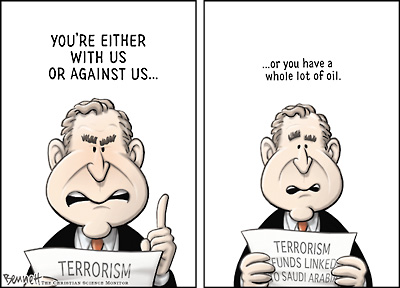
2) Oil - if the Middle East's main product was cabbage, the West could give a damn about Muslims.
3) The massive media hype that has gone with this cartoon has exasperated and amplified the situation.
We won't be able to solve the Muslim issue. What we need to do is make them irrelevant to the West. Fighting them, responding to them, buying their oil all make matters worse.
Chumly wrote: Fighting them, responding to them, buying their oil all make matters worse.
Very true, as the saying goes, violence begets more violence. Still, the situation is not going to change, and the West is heading toward its decline.
good post rodent
particularly liked this bit
Anonymouse wrote:.. against a history of Western meddling into the Middle East,
Steve (as 41oo) wrote:good post rodent
particularly liked this bit
Anonymouse wrote:.. against a history of Western meddling into the Middle East,
I bet you didn't think a rodent can surprise you did you?
Anonymouse wrote:Chumly wrote: Fighting them, responding to them, buying their oil all make matters worse.
Very true, as the saying goes, violence begets more violence. Still, the situation is not going to change, and the West is heading toward its decline.
Well whether the West is heading toward its decline remains to be seen because the West *will* change a very great deal in the next 500 years. Whether the Muslims will have such impetus for change, is more of an open question.
Anonymouse wrote:Steve (as 41oo) wrote:good post rodent
particularly liked this bit
Anonymouse wrote:.. against a history of Western meddling into the Middle East,
I bet you didn't think a rodent can surprise you did you?
I am considering this. What sort of front teeth you got?
What the hell is our oil doing under their sand? Damn thieves!

freedom4free wrote:What the hell is our oil doing under their sand? Damn thieves!
Oily bah bah and his Forties Field.
The whole thing stems from the US's obsession with massive oil consumption. Add to this the US's paranoia of atomic energy for electrical generation, add the lame ass SUV's, add the etc
Steve (as 41oo) wrote:Anonymouse wrote:Steve (as 41oo) wrote:good post rodent
particularly liked this bit
Anonymouse wrote:.. against a history of Western meddling into the Middle East,
I bet you didn't think a rodent can surprise you did you?
I am considering this. What sort of front teeth you got?
That all depends on who's asking. Not many like rodents, which is why I chose the name.
i'll try to get a link to an article in today's newspaper throwing some light on the situation in denmark and the demonstrations taking place throughout europe and in the middle-east
(toronto's globe and mail).
but i can really put it in a nutshell :
a)find out how many muslims there are in the world
b)find out how many muslims demonstrated - an estimate will do
c)calculate the percentage of muslims who demonstrated and the percentage of muslims who did NOT demonstrate(who went about their daily business of trying to make a living, much like you and i).
nuff' said !
hbg
thanks F4F, good map. Interesting that right in the middle of all that western military and oil interests is a large space where US has no military at all. Bush must have studied this very carefully. And he's found it has a name, Iran.
here is an article that appeared on the frontpage of the 'globe and mail' (canada's - somewhat - conservative business newspaper) on saturday, february 11, 2006.
i think it provides a more balanced and measured look at the questions being raised in the western press about the incompatibility of muslims and freedom of the press.
perhaps the article is not shrill enough for everyone. to me , it doesn't just skim the surface but provides insight. hbg
----------------------------------------------------------
A tale of two Muslim Danes
DOUG SAUNDERS
From Saturday's Globe and Mail
When he was 11 years old, a shy young man named Naser Khader found himself transported from the swelter and bustle of Damascus, the only home he had ever known, to a land of cold weather, withdrawn people and incomprehensible customs.
He did not like it. The streets of Copenhagen felt like they belonged to some tight-knit private club. They were jammed with pristine bicycles that, then as today, are never locked ?- nobody fears theft in Denmark, because everyone seems to know everyone else.
Everyone, that is, except these new arrivals with coffee-coloured skin and a desert religion. His father, who had no education, worked as a meat packer; his mother was illiterate. Like many of the millions of young Islamic immigrants who entered Europe in his generation, he did not feel like he was part of the club, even as his parents struggled to be accepted. Young Naser kept asking when they were going to go home.
"For the first 10 years or so, I didn't want to be a Dane, I wanted to go back to the Middle East. Everyone my age felt that way. The majority of foreigners have not chosen themselves to come to Denmark; it's a choix ce taken by their parents."
Until he was in his early 20s, the only place he felt at home was in the mosque.
"My parents are religious. And I was very religious until I was 18 or so ?- then I started to read philosophers. I started to put question marks on things."
Mr. Khader had begun a trajectory that would lead him from the closed world of the Islamic diaspora into the centre of European public life, as a member of Parliament and the leader of a new movement of moderate Muslims who favour democracy, secularism and civil liberties. As the world has exploded in riots, killings and angry denunciations over the publication of images of the Prophet Mohammed in a Danish newspaper, he has become part of the European answer.
Last week, he led a demonstration of Muslims demanding an apology from Saudi Arabia, for attacking Denmark's press freedoms. He has become one of several prominent voices in Europe arguing that non-religious, fully Europeanized Muslims are the silent majority and that they need to be heard.
Back in the 1970s, as he was beginning that transition from exotic outsider to a leader of society, another Arabic boy was moving into the same dull working-class neighbourhood in western Copenhagen.
His neighbour, Ahmed Akkari, 10 years younger, was the child of secular, moderate, liberal parents who had fled the violence of the Middle East and tried hard to become Danes. Young Ahmed, following the path of a surprising number of young Europeans from the Mideast, turned away from his parents' secular liberalism and toward fundamentalist religion, conservatism and active opposition to Europe's values.
While the young Mr. Khader was falling under the sway of Friedrich Nietzsche and other European thinkers, and becoming an important figure in Danish centre-left politics, Mr. Akkari was becoming a devotee of Ahmad Abu Laban, a radical imam 30 years his senior who has admitted ties to violent Islamist organizations in the Middle East and who preached a harsh adherence to sharia law.
This year, their trajectories crossed. It was Mr. Akkari who, at Mr. Abu Laban's behest, travelled to Lebanon, Syria and Egypt in December to spread the news ?- and some false rumours ?- about the cartoon images of the Prophet Mohammed. And it has been Mr. Khader, the parliamentarian, who has led the moderate Muslim protest against the riots, killings, boycotts and calls for censorship that have sprung from Mr. Akkari's actions.
For moderate, Europeanized Muslims like Mr. Khader, it seems as if their world has been invaded by their extremist cousins.
"I'm like most Muslims in Europe ?- I call myself Muslim, but Muslim in a light way ?- a cultural Muslim, not practising," Mr Khader said the other day. He spoke, in measured tones, in his office in Denmark's elegant Parliament buildings.
"You have two movements. One is those whose parents were secular, they became more and more religious. But a larger movement, it's my movement. We don't want to define ourselves by our religion ?- we say, 'My religion is private.'."
Are these "cultural" Muslims really the majority? Almost certainly.
Denmark, a fairly typical European country in this respect, has an estimated 180,000 Muslims out of a population of five million. They are served by 80 to 100 mosques, with an estimated 15,000 worshippers. In other words, fewer than 10 per cent of Denmark's Muslims are even religiously observant. A similar majority of Western Europe's Muslims are believed to be secular ?- in France, only 5 per cent visit a mosque weekly. The rest presumably view Islam as a culture rather than a religion or a basis for politics.
That was evident last year when France, whose six million Muslims are the continent's largest population, passed a law that bans the wearing of head scarves by girls in schools. It was fiercely opposed by the fundamentalist Muslim leadership ?- by the French counterparts to Mr. Akkari. But after the law came into effect, the number of girls who tried to defy it, nationwide, numbered in the low hundreds. For all but a tiny group of Muslims, expressing the orthodox version of their faith held no interest ?- but being French, and European, was very important.
This is a frustrating question for Danes, who have seen their nation transformed almost overnight from a byword for tolerance and peacefulness into a country that is demonized by Muslims everywhere and viewed by other Western democracies as being somehow guilty of creating a monster. It is an even more frustrating question for Danes who happen to be Muslim, like Mr. Khader. They wonder how a tiny and ill-respected group of orthodox believers in their midst have poisoned an entire community.
Some observers believe that the small and powerless nature of Muslim immigrant communities actually creates this harsh polarization. Muslims ?- mainly Turks, as well as people from the Indian subcontinent in Britain ?- began arriving in western Europe in the 1960s, in guest-worker programs. They tended to be politically moderate and non-religious, and have come to play a major role in many European cultures.
Arabs, however, began arriving only in the 1970s, through refugee programs. Those programs mostly ended, abruptly, in the 1990s. Denmark stopped all immigration in 2002, imposing Europe's most restrictive immigration laws.
The Arabs were desperately poor, usually illiterate, and often had left not because they wanted to join Europe but because they were forced to flee. Lacking a successful, assimilated elite who could create role models for harmonious membership in society, the orthodox religious extreme ?- never very large in number ?- became the leaders and figureheads of Arab Muslims. This not only gave Muslims few visible alternatives, but turned them into figures of fear and revulsion.
"Our newspapers for years have been absolutely full of headlines about the perceived threat to fundamental values of tolerance and freedom from these Muslims, even though they are almost invisible and have no power to change anything," said Garbi Schmidt, who, as director of the Research Programme on Ethnic Minorities at the Danish National Institute for Social Research, is one of Europe's leading authorities on Muslim immigrants.
Because their rank-and-file are so unknown and invisible to Europe's mainstream, people hear the only voice that is speaking loudly and clearly. In many countries, this is the radical, orthodox religious leaders, who often, like Mr. Abu Laban, resemble extremist politicians more than preachers. In places like Denmark, where Hitler's rampage left terrible memories, the hateful messages of people like Mr. Abu Laban, and their calls for censorship of the media and repression of women, strike a troubling chord.
That helps explain the freedom-of-speech debate that led the Danish newspaper Jyllands-Posten to publish the offensive Mohammed cartoons. To outsiders, it seemed a bit bizarre: Denmark's freedom of speech has never been challenged, and the country's Muslims, most of whom live in grubby neighbourhoods and work in shipping industries, and who have only three MPs in a Parliament of 179 seats, have never had the power to challenge it.
The worry, of course, is that this perception builds a high wall around Arab-Muslim groups, forcing them to make a harsh choice: to erase their roots entirely, undergoing the tough rite of passage required to become unquestionably European (as Mr. Khader has happily done) or to become a permanent outsider, defining yourself as a member of "Islam," a nation opposed to Europe's hegemony (as Mr. Akkari appears to have done).
Extreme Islamist and terrorist movements have their roots in the Middle East, in conflicts that have little to do with Europe. But for young men who face these increasingly difficult barriers to membership in the exclusive club of normal European life, these violent foreign movements hold great appeal. They are one way to get over that wall.
And the Muslims who join those movements become the most visible, well-financed and outspoken figures in their local Islamic commux nities, far more articulate and organized than the moderate majority. This sows fear among mainstream Europeans, who see millions of potential extremists in their tatty suburbs.
In Denmark, this effect has been dramatic ?- in part because it is a small country with its own insecurities (its cultural relationship with Germany, its much larger southern neighbour, is much like Canada's with the United States). The thought of a very different, very un-Danish immigrant group asserting itself led many Danes to erect previously unheard-of walls of "Danishness."
This, in turn, forced some Muslims into extremism. And that extremism, in turn, led Danes to assert themselves even more loudly, against a tiny, but frightening, threat to their identity.
That is what led to the offensive Mohammed cartoons.
"In Denmark, it is one of our traditions that we act a little bit like Vikings. We are a little bit rude and we are not very politically correct. We insult each other for fun ?- that was just something we did, but during this battle it became a matter of patriotism to be rude and insulting, and we made a point of demonstrating it," said Soren Sondergaard, a senior official with the Danish People's Party, which opposes immigration and is part of the governing coalition.
With each cycle of conflict, to use that analogy, the Europeans became a bit more Viking, and the small group of Muslims became a bit more like the rampaging Moors of mythology. The effect, in the words of Ms. Shmidt, is "mental segregation." Most Muslims continue to identify themselves as members of society, but some take the rhetoric seriously and turn themselves into the fearful jihadists of the European imagination.
Fleming Rose, the cultural editor of the Jyllands-Posten, stated this clearly to a German newspaper this week, a day before he was forced to resign for planning further offensive publications. He was trying to defend the publication of the cartoons, a noble cause, but his words, in retrospect, look like the perfect recipe for the dirty bomb of European-Islamic relations.
"By making fun in this way, we've not only created Muslims [i.e. extremists], we've also created Danes," he said. "Humour, even offensive humour, brings people together. Because by making fun of people we're also including them in our society. It's not always easy for those concerned, but that's the price they've got to pay."
This is the threat: That frightened Europeans will continue to manufacture "Muslims," transforming promising young children of immigrants into closed-minded extremists. And that those orthodox Muslims will in turn create angry, closed-minded "Europeans."
hamburger,
Quote:by making fun of people we're also including them in our society

is that a joke ?
A Propagandist, Hitler would have been Proud of :
If you replace the Muslims with Jews in that article, i'am sure Hitler would have got great support from his people, the Nazi program of exterminating Jews from Europe would have been a lot easier.