1
   

Rainforest Thread #78 -- Is April cruel?


danon5
 
  1  
Reply Mon 11 Jun, 2007 07:00 am
Stradee, right you are..... There is so much to see around us at all times. Most people don't see it though. Many years ago I was driving along a wooded road in the Fall and commented on the colors. My friend who was riding with me said, "Wow, I never noticed that before!!" Amazing.

We're still waiting for pics from Baaston and New Yawk.

Clicking on. One more tree saved today.
0 Replies
 
ul
 
  1  
Reply Mon 11 Jun, 2007 08:11 am
Stradee and Danon,
you are right. I noticed that many people are not aware of their surroundings. They are not trained in listening and watching, it seems. No time? Not enough "thrill" compared to TV shows, I-pods, news flashes? I do know that we have to teach this kind of awreness.

Yesterday when we had a thunderstorm with long running grumbling thunders I remembered how my daughter reacted in her first storm. She was about two years old, first time spending a summer on a real mountain farm. Facinated by the huge tractor. One day there was a storm brewing. Thunder rolling. She pointed to the sky and said:
"Mom, listen. There is a tractor in the sky."

More thunder here.
0 Replies
 
Stradee
 
  1  
Reply Mon 11 Jun, 2007 02:29 pm
Great story, ul! Kids are so in tune to thier enviornment!

There is so much happening in the natural world, from the loud claps of thunder and lightening, to a calm rain, or a windy day - seeing and listening are skills kids are naturally born with. It's only when the stresses of the world interfer, do people forget the magic and wonders the earth offers each day.

Dan and ul, I recall a trip taken to Montana with a friend.

Driving through Idaho, then Montana was awsome! I wish i was prolific enough to explain Montana's mountain ranges. Idaho's a lovely state, but we were driving primarly on roads that ran alongside large farming communities - but there were also wonderful landmarks and Indian reservations along the way - the history of the West never ceases to amaze. Montana is a massive, georgous state of wildlife, mountain ranges, colors, streams, rivers - and meadows that span thousands of acres with elk, deer, and moose - and the amazing thing is...the animals could be seen grazing side by side with domesticated cattle.

Was a great trip - weather was happening at every bend of the road - at higher elevations thunder storms, and at the same time...sunny and warm weather on the opposite side of the road facing the foothills that appeared animated, if that makes any sense. Montana is probably one of the few states where people can visit, view the natural world, and not see another vehicle on the roadway for miles, even hours! Amazing.
0 Replies
 
danon5
 
  1  
Reply Mon 11 Jun, 2007 04:30 pm
Ahh, ul and Stradee, - - I've been often to Montana. Both sides. It's really a beautiful state... Just Google one of our past presidents - Teddy Roosevelt who spent some time there as a cowboy...... And, all the other artists who were associated with the state = Remington and Will James to say the least...... There are more.

Well, it's still a great state.

Even though Custer screwed it up out of complete stupidity and ego.

Mostly, ego.

IMHO.

Till later,

Dan
0 Replies
 
danon5
 
  1  
Reply Mon 11 Jun, 2007 09:28 pm
Yo, Wildclickers......

Don't forget this site....

http://www.frappr.com/wildclickers
0 Replies
 
danon5
 
  1  
Reply Tue 12 Jun, 2007 06:05 am
Early Tuesday clicks...
0 Replies
 
ul
 
  1  
Reply Tue 12 Jun, 2007 06:23 am
.naD ,gninrom dooG
.yzarc leef I -krow fo stol ,dimuh ,toH !skcilc kciuQ Very Happy
0 Replies
 
danon5
 
  1  
Reply Tue 12 Jun, 2007 06:49 am
lu, nirg - - - .toh taht eb ot nosaes eht ni ylrae oot s'tl
0 Replies
 
danon5
 
  1  
Reply Tue 12 Jun, 2007 07:03 am
Before ehBeth returns and starts chastising us for running such a long thread - -

Any volunteers for starting a new thread???
0 Replies
 
Stradee
 
  1  
Reply Tue 12 Jun, 2007 08:06 am
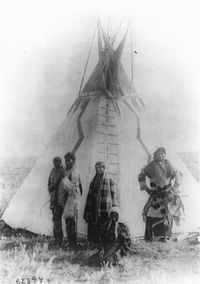
Dan, there hasn't been one state not affected by some fools ego, however, Montana's managed to keep infringement at minimum, and also with 77 mountain ranges plus, wildlife and people seem to coexist without the usual concrete everything mentality. With most of the states land mass prarie, i'm surprised there arn't a zillion housing projects dotting the landscape. The names of many territories are a good indication that the Indians were the only people able to maintain during the harsh winter months.

http://upload.wikimedia.org/wikipedia/commons/thumb/3/39/Assinniboine2.jpg/200px-Assinniboine2.jpg
0 Replies
 
danon5
 
  1  
Reply Tue 12 Jun, 2007 04:19 pm
Growing up and playing games with my friends - we inevitably (during the early 40's) played "Cowboys and Indians"...... I always chose to play the Indian. In fact, I am in real life blood brother to an Apache whose name is Eagle (in Apache). During the ceremony, he named me Quiet Hawk (in Apache). I still have his grandfathers elkskin necklace.
0 Replies
 
shewolfnm
 
  1  
Reply Tue 12 Jun, 2007 08:19 pm
except for a few days, I have made it a point to click daily.

more then I used to. :wink:
0 Replies
 
ul
 
  1  
Reply Wed 13 Jun, 2007 06:09 am
Hi, shewolf. Thanks for clicking.

When traveling around I often wish I could paint or find the right words to capture the moment. But I save mental images.

Danon, sorry.
Before the term will be over I have no time to "play" on the computer.
0 Replies
 
danon5
 
  1  
Reply Wed 13 Jun, 2007 07:31 am
Hi, shewolf - thats great you click. We like to think we are saving a tree each day we are on-line.

Thanks, ul. I know with your kids you are really busy.

Merry Andrew did this thread Exclamation Thanks Merry.

Anyone else with an idea for a new one?

All clicked.
0 Replies
 
ehBeth
 
  1  
Reply Wed 13 Jun, 2007 01:09 pm
Hey kids!

No new ideas, but my best friend from high school days just sent me a link to an op-ed she had published in our hometown paper

Quote:
Paved with good intentions: It's not easy being green

*********
Environment Op-Ed - Wednesday, June 13, 2007 Updated @ 11:14:19 AM

It's spring again; let the carnage begin. I'm talking about the carnage on Ontario's roads, and I don't mean human.

We hear a lot about the impacts of our cars on the environment, particularly their role in contributing to global climate change. Vehicle emissions are but one of the ecological impacts of cars and roads.

What goes through your mind when you see an animal dead on the centre line? Responses are inclined to be as diverse as the group of people asked the question. It's a shame, but animal rights advocates seem to ignore the most important animal of all, the human animal. It's a huge moral issue; animals have as much right to exist as we do. It's an aesthetic issue; it's just awful to see some poor creature killed on the road.

The Good Roads Movement began in 1880, championed by bicyclists in Rhode Island. Various groups gradually joined in, touting the benefits of improved roads for increasing the ease of moving people and their goods around the country. In the 1880s and 1890s, roads became a political issue in Ontario. It was the development of the automobile, however, that had the biggest impact on the condition and type of roads in the region. A University of Toronto study reported that the major roads of southern Ontario (both two-lane and multi-lane paved) increased from 7,133 kilometres in 1935, to 23,806 kilometres in 1965, to 35,637 kilometres in 1995 ?- a time of increasing human settlement and economic growth in southern Ontario. It is safe to say that consideration of the incidental impacts on wildlife populations was not a priority.
Little thought was given to the environment, except how to get around it.

It is difficult to find reliable numbers to put the issue in perspective. According to the Wildlife Society, more than 200 motorists are killed each year in the United States (and thousands more are injured) in animal-vehicle collisions. The Ontario Ministry of Transportation's 2004 "annual report" on road safety (the most recent available) reports an increase in the number of collisions involving wild animals: from 7,564 in 1995 to 13,707 in 2004. They reported eight fatalities and 726 injuries resulting from these collisions, along with another 13,112 instances of property damage.

The flip side of the issue is that millions of vertebrates (mammals, birds, reptiles and amphibians) are killed every year by vehicles on roads. Most are never counted, as the car or truck involved drives on its way safely. And while most people feel bad when they see "Bambi" dead on the side of the road, they barely notice Mickey, Big Bird, Yertle the Turtle, or Kermit. Sue Meech, with the Sand Pines Wildlife Center in Napanee, reports that at least 10 per cent of the injured or orphaned animals brought in to her facility are victims of roads, with another 10 per cent "unknown trauma found at roadside. Her centre took in over 1,250 mammals and birds in 2006. Fred Schueler, with the Bishops Mills Natural History Center, did a survey along Highway 15, from the Joyceville to Carleton Place one evening in September 2003; he reported a conservative estimate of 1,575 frogs killed. In one evening. As you might expect, wildlife populations reflect these losses. Researchers find direct relationships between increased road density and decreased numbers of frogs and many other species.

Roads and highways are one of the most significant threats to turtles and turtle populations. In Ontario, six of our eight species of turtles are considered to be at some level of risk (one is endangered). Turtles are long-lived animals, slow to mature and breed, so when a single female turtle is killed on the road it can cause a significant long-term impact on local populations. As well, sex ratios can become skewed since it is the females that are most vulnerable as they come out to nest and lay their eggs. World Turtle Day was celebrated on May 23rd, ironically a peak month for turtles venturing onto Ontario roads as they search for nesting grounds.

One main ecological impact is road avoidance. Studies around the world have shown that when animals hesitate to cross roads or avoid approaching them, that roads effectively subdivide populations, making them more vulnerable to extinction. Have a look at an Ontario road map, and you can begin to appreciate the scale of the problem.

Other impacts from roads include the access they give hunters (both legal and not) to wildlife populations. Slope failure and erosion result in sedimentation to fish habitat. Roads are also conduits for non-native species - a whole different way that people have impacted the ecosystem, a whole other topic. Land managers sometimes close roads to public use, at least seasonally, to protect certain species, but in North America this is generally restricted to National Parks or other protected areas. In March 2007, Taiwan closed portions of a major highway to protect the seasonal migration of a butterfly - the Purple Milkweed Butterfly (the only migratory butterfly other than our own Monarch Butterfly). In on-line chat about this news, some thought it was great, but others were outraged at the idea of closing a highway for a "bug."

In many ways it comes down to a personal conservation ethic - not something that can be mandated by government. If you're reading this, you probably care about the environment. Many Canadians put environment at the top of their list of concerns. If you can't give up your car altogether ?- and who can? How many subdivisions don't even have sidewalks. Here are three simple things you can do to reduce your car-related ecological footprint:

1. Reduce the amount of driving you do - good for your wallet, good for your waist, good for the environment.

2. Carpool - yes, it's a bit of a pain to organize.

3. Slow down. It's that simple. Leave yourself enough time. This means: reduced greenhouse gas, reduced impact to your wallet, reduced road kill, reduced chance of accident leading to damage to property or loss of life

If you hear yourself making the excuses, remember that personal ethic thing and try again. As Kermit said, "It's not easy being green."


*********** is a biologist and environmental consultant. She lives in Elginburg.
0 Replies
 
ehBeth
 
  1  
Reply Wed 13 Jun, 2007 01:12 pm
You and your 300 friends have supported 2,759,107.8 square feet!

Marine Wetlands habitat supported: 166,436.8 square feet.
You have supported: (0.0)
Your 300 friends have supported: (166,436.8)

American Prairie habitat supported: 59,881.1 square feet.
You have supported: (14,444.4)
Your 300 friends have supported: (45,436.7)

Rainforest habitat supported: 2,532,790.0 square feet.
You have supported: (180,788.6)
Your 300 friends have supported: (2,352,001.4)

~~~~~~~

1 1447 63.339 acres
0 Replies
 
danon5
 
  1  
Reply Wed 13 Jun, 2007 07:04 pm
Oooooooo, Paved with good intentions.......... Sounds like a great intro!

That - of course - leads to the Hell we are living with in the destruction of the Rain Forest that gives us life.............. Well, there ya go......

A good one.

Obviously robbed from an old, dead person who said a LOT of good things that still apply to all our lives today...... Very Happy Very Happy Very Happy Very Happy Very Happy

Go for it. Exclamation
0 Replies
 
danon5
 
  1  
Reply Thu 14 Jun, 2007 06:48 am
Here we are at another Thursday - except, this is Flag Day in USA.

The History Of Flag Day
The Fourth of July was traditionally celebrated as America's birthday, but the idea of an annual day specifically celebrating the Flag is believed to have first originated in 1885. BJ Cigrand, a schoolteacher, arranged for the pupils in the Fredonia, Wisconsin Public School, District 6, to observe June 14 (the 108th anniversary of the official adoption of The Stars and Stripes) as 'Flag Birthday'.
On June 14, 1889, George Balch, a kindergarten teacher in New York City, planned appropriate ceremonies for the children of his school, and his idea of observing Flag Day was later adopted by the State Board of Education of New York.
On June 14, 1891, the Betsy Ross House in Philadelphia held a Flag Day celebration, and on June 14 of the following year, the New York Society of the Sons of the Revolution, celebrated Flag Day.
The Pennsylvania Society of Colonial Dames of America on April 25, 1893 adopted a resolution requesting the mayor of Philadelphia and all others in authority and all private citizens to display the Flag on June 14th.
In 1894, the governor of New York directed that on June 14 the Flag be displayed on all public buildings.
On June 14th, 1894, under the auspices of this association, the first general public school children's celebration of Flag Day in Chicago was held in Douglas, Garfield, Humboldt, Lincoln, and Washington Parks, with more than 300,000 children participating.
Franklin K. Lane, Secretary of the Interior, delivered a 1914 Flag Day address in which he repeated words he said the flag had spoken to him that morning: "I am what you make me; nothing more. I swing before your eyes as a bright gleam of color, a symbol of yourself."
Inspired by these three decades of state and local celebrations, Flag Day - the anniversary of the Flag Resolution of 1777 - was officially established by the Proclamation of President Woodrow Wilson on May 30th, 1916. While Flag Day was celebrated in various communities for years after Wilson's proclamation, it was not until August 3rd, 1949, that President Truman signed an Act of Congress designating June 14th of each year as National Flag Day.
0 Replies
 
ul
 
  1  
Reply Thu 14 Jun, 2007 06:48 am
Nice article, thanks for posting.
Paved with good intentions - now start actions. It is in our hands ( and legs) to make changes.

Hot and humid. It is like being in Washington. :wink:
A thunderstorm is brewing, the birds stopped singing already, first gusts of wind and rolling thunder. I love thunderstorms! Very Happy
0 Replies
 
Stradee
 
  1  
Reply Thu 14 Jun, 2007 08:02 am
Howdy Wildclickers!

Interesting articles ehBeth and Dan, thanks.

NASA has developed a computerized air traffic control system that will allow millions of people to fly. The only feasible solution for keeping wildlife safe from squishing.

http://www.cbsnews.com/stories/2005/04/15/60minutes/main688454.shtml


... On June 19, 1865, Major General Gordon Granger issued his order proclaiming America's remaining slaves free. On that day, General Granger and a group of Union soldiers landed at Galveston, Texas and announced that the Civil War had ended and that the slaves were now free. While more than two years after President Lincoln's Emancipation Proclamation, Juneteenth is a day most often associated with true emancipation.

Though initially celebrated only locally in Galveston, Juneteenth enjoys growing popularity and is now observed nationwide by Americans from all backgrounds. And while this day holds a special meaning for descendants of slaves, Juneteenth provides an important opportunity for us all to commemorate a central tenet of our nation that is best stated in the Declaration of Independence: "We hold these truths to be self-evident, that all men are created equal, that they are endowed by their Creator with certain unalienable Rights, that among these are Life, Liberty and the pursuit of Happiness."

While Juneteenth celebrations vary widely in content, one of the most common elements is the choral singing of "Lift Every Voice and Sing," written by James Weldon Johnson. I am happy to provide the lyrics of this essential American song.

"Lift Every Voice and Sing"
by James Weldon Johnson

Lift every voice and sing
Till earth and heaven ring,
Ring with the harmonies of Liberty;
Let our rejoicing rise
High as the listening skies,
Let it resound loud as the rolling sea.
Sing a song full of the faith that the dark past has taught us,
Sing a song full of the hope that the present has brought us,
Facing the rising sun of our new day begun
Let us march on till victory is won.

Stony the road we trod,
Bitter the chastening rod,
Felt in the days when hope unborn had died;
Yet with a steady beat,
Have not our weary feet
Come to the place for which our fathers sighed?
We have come over a way that with tears have been watered,
We have come, treading our path through the blood of the slaughtered,
Out from the gloomy past,
Till now we stand at last
Where the white gleam of our bright star is cast.

God of our weary years,
God of our silent tears,
Thou who has brought us thus far on the way;
Thou who has by Thy might
Led us into the light,
Keep us forever in the path, we pray.
Lest our feet stray from the places, Our God, where we met Thee;
Lest, our hearts drunk with the wine of the world, we forget Thee;
Shadowed beneath Thy hand,
May we forever stand.
True to our God,
True to our native land.

Sincerely,

Barbara Boxer
United States Senator
0 Replies


Related Topics

 
Copyright © 2026 MadLab, LLC :: Terms of Service :: Privacy Policy :: Page generated in 0.04 seconds on 03/10/2026 at 07:11:09