November 14, 2004
New York Times
The Political Conversion of New York's Evangelicals
By ANDREA ELLIOTT
The signs are all around. Storefront churches dot the commercial landscapes of the Bronx and Queens. Twice as many churchgoers - about 15,000 - pray weekly at the Christian Cultural Center in Brooklyn, compared with five years ago. Some 200,000 New Yorkers tune in daily to Radio Vision Cristiana, an AM radio station. And last March, thousands of evangelicals gathered on the steps of the State Supreme Court in the Bronx to protest the idea of same-sex marriage.
Evangelism is flourishing not just in the red states of the nation's heartland, but in the urban, liberal stronghold of New York City, where thousands of evangelical churches are anchored in working-class neighborhoods. Whether it will evolve into a local political force, as it has nationally, remains an open question. But a range of interviews with pastors, congregants and religious experts suggests that a new debate - and perhaps a political conversion - is taking place in parts of the city's minority neighborhoods, swaths that Democrats have long claimed as their own.
It is a conversion that prompted Jeanmarie Salazar, a Puerto Rican mother of four in the Bronx, to vote for President Bush even though his economic policies troubled her. And a conversion that caused Harold Thompson, an African-American from Flatbush who lived through the civil rights movement, to part with a lifetime of voting Democratic, citing the "immorality that is destroying our country."
Both Ms. Salazar and Mr. Thompson belong to evangelical churches whose leaders have spread a single but potent message: Faith trumps everything else, even traditional party alignments.
"They're beginning to think about the social transformation of New York City," said Tony Carnes, a sociologist of religion at Columbia University.
Precisely determining the number of people who consider themselves members of evangelical churches or movements is difficult. Mr. Carnes said that he conducted a census of the city's evangelical churches and estimated that 1.5 million New Yorkers attend them. A separate study, conducted in 2000 by the Association of Statisticians of American Religious Bodies, put the number of evangelical New Yorkers closer to 1 million, said Vivian Klaff, a professor of sociology at the University of Delaware who analyzed the study's data.
If a fully accurate count of evangelicals in the city is difficult to achieve, it is even harder, at the moment, to define the voting patterns of evangelicals. But the number of Protestant New Yorkers who cast ballots for a Republican president more than doubled in the last four years, to nearly a quarter of those surveyed at polling sites by Edison Media Research and Mitofsky International. And a recent study by Mr. Carnes suggested that a majority of evangelical church leaders in the city were breaking with tradition and voting Republican: of 1,006 ordained ministers surveyed last year, Mr. Carnes found, 55 percent said they planned to vote for Mr. Bush.
About 30 percent of the ministers were black and 30 percent Hispanic, reflecting the demographic breakdown of the religious group, Mr. Carnes said.
"It's a significant development," said Randall Barnes, a professor of American religious history at Barnard College. But, he added, the Republican Party in New York City is "still a decade or two away from making significant inroads into that community."
Any measuring of the political clout of evangelicals in the city, now or in the future, is complicated by the fact that a sizable portion of them are from other countries, and some are not eligible to vote, said Mr. Carnes, who conducted his study with a team of pollsters at the International Research Institute on Values Changes, an independent research group in New York City. The study was financed by the Christian Cultural Center, a charismatic evangelical church.
But the results indicated a shift to the right among voting evangelicals. In a separate study he did in 1997, Mr. Carnes said, only 22 percent of the city's evangelical church leaders surveyed identified themselves as "politically conservative."
In the aftermath of the election, an increasingly complex image has emerged of the Christian electorate - one that is not entirely captured under the religious right rubric. In New York City, there are the evangelicals who consider themselves liberal and voted for Kerry but find that they are missing from the mainstream image of their faith.
But then there are those, like Mr. Thompson, who broke with tradition for the first time to vote Republican.
And while many New Yorkers have loudly voiced their sense of alienation from the faith-based vote of the red states, the city's evangelicals, in numerous interviews, said they felt a similar invisibility in the Democratic stronghold they call home.
"You feel like you're alone," said Abraham Lopez, 19, as he stood on a recent Saturday outside the Assemblies of United Christian Churches on Third Avenue in the South Bronx.
Perhaps no single event better captures the group's presence than a same-sex marriage protest on March 14 in the South Bronx.
Led by State Senator Rub鮠Diaz, 150 Bronx churches closed for the day. They sent their congregants to the steps of the State Supreme Court on the Grand Concourse where thousands of people - estimated at 8,000 by Mr. Carnes, who used two methods to count the crowd - filled the streets. A large banner hung between two pillars, reading, "No to Homosexual Marriage."
"We said, 'Sunday nobody goes to church; we'll go to the street,' " said Mr. Diaz, one of the most noted of the city's Hispanic evangelicals. Mr. Diaz, whose South Bronx district includes about 250,000 people, is both an evangelical pastor and a registered Democrat.
"I am a conservative Democrat," Mr. Diaz, 61, said in a telephone interview from Puerto Rico. "When it comes to education, when it comes to health, when it comes to jobs, I'm a Democrat. When it comes to moral issues - marriage, abortion - I'm not a Democrat."
Mr. Diaz has a history of stirring controversy with his conservative stands on same-sex marriage and abortion. In 1994, after he organized a voter drive for Mayor Rudolph W. Giuliani , Mr. Diaz, then a city councilman, vocally criticized the Gay and Lesbian Olympic Games. Mr. Giuliani then issued a statement distancing himself from Mr. Diaz's views. In 2003, Mr. Diaz filed a lawsuit, which is still pending, against the city over the opening of a small public school for gay students. He defends his positions unflinchingly, saying things like he "cannot wait" for the reversal of Roe v. Wade and eagerly admitting that gay rights activists have picketed his church.
Several political strategists who have worked with Republicans and Democrats said that no one with Mr. Diaz's conservative views would be able to win a citywide or statewide office. But in local city politics, like races for the State Assembly and the City Council, the faith-driven agenda might have greater impact.
"In a Democratic primary where you take the party affiliation question out of play, then I think it could become a more powerful influence," said Kieran Mahoney, a Republican political strategist whose clients have included Gov. George E. Pataki.
Pedro Espada Jr., who lost to Mr. Diaz in the primary this year, said he had no doubt that the evangelical movement could sway local politics. Mr. Espada, who was ousted from his Senate seat by Mr. Diaz in 2002, tried to reach out to evangelical voters by visiting Bronx churches.
"They would say, 'Espada, we would vote for you but you are not a Christian,' " Mr. Espada said. But other politicians were more skeptical that the group's members would be driven by religion when they entered the voting booth.
Fernando Ferrer, the former Bronx borough president who is running for mayor, said, "Issues of faith and family matter, but so do issues of how we support our families, equal access and opportunity, housing, education, health care, jobs."
While Hispanics and African Americans in New York City have traditionally voted Democratic, those who attend evangelical churches may feel a different pull.
Jos頃asanova, a professor of sociology who specializes in religion and politics at New School University and has studied evangelicals around the world, said that even if they are poor, they tend to vote for conservative candidates.
"They do not so much identify with their economic position right now, but with the one they ought to have with the help of God," he said. "They are very conservative and pro-market and do not expect the government to help them."
It is not clear how pervasive this view has been in New York City's evangelical community. But the Rev. A. R. Bernard has made a point of preaching economic independence and social conservatism at the Christian Cultural Center, where more than 90 percent of congregants are African Americans or black immigrants.
"We are teaching them self-reliance," Mr. Bernard said. "We have a whole new generation of people of color who have grown up without legal and racial barriers. They have experienced unprecedented wealth, unprecedented education, a position in the marketplace. So once you have something to conserve, you become more conservative."
Mr. Bernard, who said he voted for President Bush, does not publicly endorse candidates. However, he did tell his congregants that they should question the tendency to vote along traditional party lines.
Two of his church's members, Raina and Robert Bundy, said they decided to vote for Mr. Bush by following the news, watching the debates and, ultimately, praying over their choice. Like many African Americans, they said they were brought up to vote Democratic, but now compared the tradition to their mothers' old recipes for collard greens.
"We don't use fatback, it's all about olive oil now," Mrs. Bundy said. "You don't keep cooking something even though you know it's not good for you."
Marjorie Connelly and Jennifer Medina contributed reporting for this article.
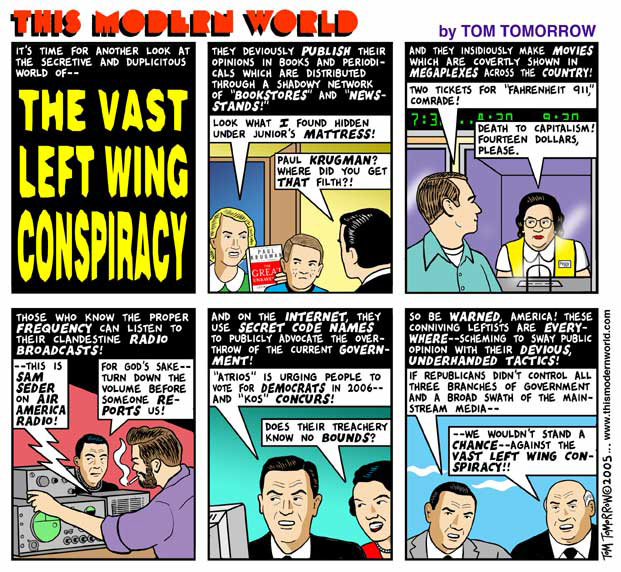
But . . . but wait Lola, it's the secular conspiracy that threatens the very fabric of our society, there aren't any christian conspiracies . . . can't you see that . . . they're making evolutionist Satan-worshippers of all the kiddies in school . . . oh, oh . . . i get it now . . . you're one a THEM . . . you'll get yours, just you wait . . .
nice chair, Lola
But . . . but wait Lola, it's the secular conspiracy that threatens the very fabric of our society, there aren't any christian conspiracies . . . can't you see that . . . they're making evolutionist Satan-worshippers of all the kiddies in school [. . .]
But . . . but wait Lola, it's the secular conspiracy that threatens the very fabric of our society, there aren't any christian conspiracies . . . can't you see that . . . they're making evolutionist Satan-worshippers of all the kiddies in school . . . oh, oh . . . i get it now . . . you're one a THEM . . . you'll get yours, just you wait . . .
May 21, 2005
Creationism: God's gift to the ignorant
As the Religious Right tries to ban the teaching of evolution in Kansas, Richard Dawkins speaks up for scientific logic.
Science feeds on mystery. As my colleague Matt Ridley has put it: "Most scientists are bored by what they have already discovered. It is ignorance that drives them on." Science mines ignorance. Mystery ?- that which we don't yet know; that which we don't yet understand ?- is the mother lode that scientists seek out. Mystics exult in mystery and want it to stay mysterious. Scientists exult in mystery for a very different reason: it gives them something to do.
Admissions of ignorance and mystification are vital to good science. It is therefore galling, to say the least, when enemies of science turn those constructive admissions around and abuse them for political advantage. Worse, it threatens the enterprise of science itself. This is exactly the effect that creationism or "intelligent design theory" (ID) is having, especially because its propagandists are slick, superficially plausible and, above all, well financed. ID, by the way, is not a new form of creationism. It simply is creationism disguised, for political reasons, under a new name.
It isn't even safe for a scientist to express temporary doubt as a rhetorical device before going on to dispel it.
"To suppose that the eye with all its inimitable contrivances for adjusting the focus to different distances, for admitting different amounts of light, and for the correction of spherical and chromatic aberration, could have been formed by natural selection, seems, I freely confess, absurd in the highest degree." You will find this sentence of Charles Darwin quoted again and again by creationists. They never quote what follows. Darwin immediately went on to confound his initial incredulity. Others have built on his foundation, and the eye is today a showpiece of the gradual, cumulative evolution of an almost perfect illusion of design. The relevant chapter of my Climbing Mount Improbable is called "The fortyfold Path to Enlightenment" in honour of the fact that, far from being difficult to evolve, the eye has evolved at least 40 times independently around the animal kingdom.
The distinguished Harvard geneticist Richard Lewontin is widely quoted as saying that organisms "appear to have been carefully and artfully designed". Again, this was a rhetorical preliminary to explaining how the powerful illusion of design actually comes about by natural selection. The isolated quotation strips out the implied emphasis on "appear to", leaving exactly what a simple-mindedly pious audience ?- in Kansas, for instance ?- wants to hear.
The deceitful misquoting of scientists to suit an anti-scientific agenda ranks among the many unchristian habits of fundamentalist authors. But such Telling Lies for God (the book title of the splendidly pugnacious Australian geologist Ian Plimer) is not the most serious problem. There is a more important point to be made, and it goes right to the philosophical heart of creationism.
The standard methodology of creationists is to find some phenomenon in nature which Darwinism cannot readily explain. Darwin said: "If it could be demonstrated that any complex organ existed which could not possibly have been formed by numerous, successive, slight modifications, my theory would absolutely break down." Creationists mine ignorance and uncertainty in order to abuse his challenge. "Bet you can't tell me how the elbow joint of the lesser spotted weasel frog evolved by slow gradual degrees?" If the scientist fails to give an immediate and comprehensive answer, a default conclusion is drawn: "Right, then, the alternative theory; ?'intelligent design' wins by default."
Notice the biased logic: if theory A fails in some particular, theory B must be right! Notice, too, how the creationist ploy undermines the scientist's rejoicing in uncertainty. Today's scientist in America dare not say: "Hm, interesting point. I wonder how the weasel frog's ancestors did evolve their elbow joint. I'll have to go to the university library and take a look." No, the moment a scientist said something like that the default conclusion would become a headline in a creationist pamphlet: "Weasel frog could only have been designed by God."
I once introduced a chapter on the so-called Cambrian Explosion with the words: "It is as though the fossils were planted there without any evolutionary history." Again, this was a rhetorical overture, intended to whet the reader's appetite for the explanation. Inevitably, my remark was gleefully quoted out of context. Creationists adore "gaps" in the fossil record.
Many evolutionary transitions are elegantly documented by more or less continuous series of changing intermediate fossils. Some are not, and these are the famous "gaps". Michael Shermer has wittily pointed out that if a new fossil discovery neatly bisects a "gap", the creationist will declare that there are now two gaps! Note yet again the use of a default. If there are no fossils to document a postulated evolutionary transition, the assumption is that there was no evolutionary transition: God must have intervened.
The creationists' fondness for "gaps" in the fossil record is a metaphor for their love of gaps in knowledge generally. Gaps, by default, are filled by God. You don't know how the nerve impulse works? Good! You don't understand how memories are laid down in the brain? Excellent! Is photosynthesis a bafflingly complex process? Wonderful! Please don't go to work on the problem, just give up, and appeal to God. Dear scientist, don't work on your mysteries. Bring us your mysteries for we can use them. Don't squander precious ignorance by researching it away. Ignorance is God's gift to Kansas.
Richard Dawkins, FRS, is the Charles Simonyi Professor of the Public Understanding of Science, at Oxford University. His latest book is The Ancestor's Tale
ID as a movement
The Intelligent Design movement is an organized campaign to promote ID arguments in the public sphere, primarily in the United States. The hub of the movement is the Center for Science and Culture, a subsidiary of the Discovery Institute, a politically conservative think tank. According to Reason magazine, promotional materials from the Seattle-based Discovery Institute acknowledge that the Ahmanson family donated $1.5 million to the Institute's Center for the Renewal of Science and Culture for a research and publicity program to "unseat not just Darwinism but also Darwinism's cultural legacy".
Mr. Ahmanson funds many causes important to the Christian religious right, including Christian Reconstructionism, whose goal is to place the U.S. "under the control of biblical law"(sources: Creationism's Trojan Horse: The Wedge of Intelligent Design (http://www.amazon.com/exec/obidos/ASIN/0195157427/qid=1095946867/sr=ka-1/ref=pd_ka_1/002-1200768-5974420), Oxford University Press, 2004, and "Avenging angel of the religious right (http://www.salon.com/news/feature/2004/01/06/ahmanson/)" in Salon Magazine).
Though outwardly secular in its arguments, the ID movement is religiously motivated by conservative Christians who wish to replace the current materialistic understanding of the universe and its origins with a Christian explanation:
"Design theory promises to reverse the stifling dominance of the materialist worldview, and to replace it with a science consonant with Christian and theistic convictions."
(source The Discovery Institute: The "Wedge Document": "So What?" (http://www.discovery.org/scripts/viewDB/index.php?command=view&program=CSC%20Responses&id=2101)).
Discovery Institute's "Wedge Project" Circulates Online
by James Still
A recently-circulated position paper of The Center for the Renewal of Science & Culture (CRSC) reveals an ambitious plan to replace the current naturalistic methodology of science with a theistic alternative called "intelligent design."
The CRSC, a program launched by the Discovery Institute in 1996, is the major force behind recent advances in the intelligent design movement. The Center is directed by Discovery Senior Fellow Dr. Stephen Meyer, Associate Professor of Philosophy at Whitworth College. Its mission is "to replace materialism and its destructive cultural legacies with a positive scientific alternative." The Discovery Institute hopes that intelligent design will be the usurper that finally dethrones the theory of evolution.
On March 3, 1999, an anonymous person obtained an internal white paper from the CRSC entitled "The Wedge Project," which detailed the Center's ambitious long-term strategy to replace "materialistic science" with intelligent design. The paper describes the CRSC's mission with a sense of urgency:
"The social consequences of materialism have been devastating. As symptoms, those consequences are certainly worth treating. However, we are convinced that in order to defeat materialism, we must cut it off at its source. That source is scientific materialism. This is precisely our strategy. If we view the predominant materialistic science as a giant tree, our strategy is intended to function as a "wedge" that, while relatively small, can split the trunk when applied at its weakest points. The very beginning of this strategy, the "thin edge of the wedge," was Phillip Johnson's critique of Darwinism begun in 1991 in Darwinism on Trial, and continued in Reason in the Balance and Defeating Darwinism by Opening Minds. Michael Behe's highly successful Darwin's Black Box followed Johnson's work. We are building on this momentum, broadening the wedge with a positive scientific alternative to materialistic scientific theories, which has come to be called the theory of intelligent design (ID). Design theory promises to reverse the stifling dominance of the materialist worldview, and to replace it with a science consonant with Christian and theistic convictions."
The paper outlines a "wedge strategy" that has three phases. Phase I, "Scientific Research, Writing, and Publicity" involves the Paleontology Research Program (led by Dr. Paul Chien), the Molecular Biology Research Program (led by Dr. Douglas Axe), and any individual researcher who is given a fellowship by the Institute. Phase I has already begun, the paper argues, with the watershed work of Phillip Johnson, whose Darwinism on Trial sparked the intelligent design movement. The Center hopes that more Christian scientists will step forward and engage in research that would support the intelligent design theory.
Phase II, "Publicity and Opinion-Making" involves communicating the research of Phase I. The Center plans to do this through book tours, opinion-making conferences, apologetics seminars, a teacher training program, use of opinion-editorials in newspapers, television program productions (either with Public Broadcasting or another broadcaster), and the printing of publications to distribute. Phases I and II are to be implemented over the next five years (1999-2003). Phase II is
"to prepare the popular reception of our ideas. The best and truest research can languish unread and unused unless it is properly publicized. For this reason we seek to cultivate and convince influential individuals in print and broadcast media, as well as think tank leaders, scientists and academics, congressional staff, talk show hosts, college and seminary presidents and faculty, future talent and potential academic allies. Because of his long tenure in politics, journalism and public policy, Discovery President Bruce Chapman brings to the project rare knowledge and acquaintance of key op-ed writers, journalists, and political leaders. This combination of scientific and scholarly expertise and media and political connections makes the Wedge unique, and also prevents it from being 'merely academic.' Other activities include production of a PBS documentary on intelligent design and its implications, and popular op-ed publishing. Alongside a focus on influential opinion-makers, we also seek to build up a popular base of support among our natural constituency, namely, Christians. We will do this primarily through apologetics seminars. We intend these to encourage and equip believers with new scientific evidence's that support the faith, as well as to "popularize" our ideas in the broader culture."
Phase III, "Cultural Confrontation and Renewal" begins sometime in 2003 and may take as long as twenty years to complete. It involves three things: (1) "Academic and Scientific Challenge Conferences"; (2) "Potential Legal Action for Teacher Training"; and (3) "Research Fellowship Program: shift to social sciences and humanities". The white paper describes Phase III as the renewal phase because it seeks to fill the void left behind by materialistic evolution (attacked in Phase II) with its own intelligent design model:
"Once our research and writing have had time to mature, and the public prepared for the reception of design theory, we will move toward direct confrontation with the advocates of materialist science through challenge conferences in significant academic settings. We will also pursue possible legal assistance in response to resistance to the integration of design theory into public school science curricula. The attention, publicity, and influence of design theory should draw scientific materialists into open debate with design theorists, and we will be ready. With an added emphasis to the social sciences and humanities, we will begin to address the specific social consequences of materialism and the Darwinist theory that supports it in the sciences."
The Wedge Project white paper ends with a detailed summary of progress-to-date, including goals for the future.
The reintroduction of theism into public discourse in Phase III is set to begin sometime in 2003. But before Phase III can begin, Phase II must have already dethroned naturalism through a vigorous public relations and opinion-shaping campaign. This puts the cart before the horse. When will there be time to conduct careful research? Science is supposed to be a vehicle that provides the reason to believe that intelligent design is a better explanation than naturalism. To think that a scientist must reach his or her conclusions within a five-year span of time, running concurrent with a public relations campaign, is hardly good scientific practice. Not only will it put unnecessary pressure on the scientist to reach conclusions before the data warrants it, but it ignores the very nature of the scientific enterprise. Often it takes years before the findings in science are fully understood and many more before the results are applied to real-world problems.
Another problem with the CRSC's plan is that it seeks to replace evolutionary theory at a time when the theory enjoys nearly unanimous support in the scientific community. Thomas Kuhn, in his The Structure of Scientific Revolutions, describes what has happened historically when one theory comes to replace another. He writes that the anomaly of an insufficient theory will have "lasted so long and penetrated so deep that one can appropriately describe the fields affected by it as in a state of growing crisis . . . the emergence of new theories is generally preceded by a period of pronounced professional insecurity." Kuhn's point is clear. Before a new theory in science is sought, there is usually a growing crisis coupled with mounting skepticism, doubt, and the elucidation of cogent reasons for thinking that the existing theory is inadequate. Where is the growing crisis that casts doubt on evolution and methodological naturalism, the tool that led to the theory of evolution? Aside from a few participants in well-publicized Templeton-funded conferences, scientists experience no insecurity with their current methods. Even if the theory of evolution were inadequate, why should we expect the scientific community to turn to theistic explanations?
Ray. In the short time you've posted here I've never seen you disagree with a poster without vilification and personal slurs. Alluding to Lola's need for psychiatric care is so...so boorish. What is it? Were you bullied in the second grade schoolyard? Are you one of those short men maniacs?
I'd be appreciative of less "Raybanisms" and more cut and paste...capiche?
Ray. In the short time you've posted here I've never seen you disagree with a poster without vilification and personal slurs. Alluding to Lola's need for psychiatric care is so...so boorish. What is it? Were you bullied in the second grade schoolyard? Are you one of those short men maniacs?
I'd be appreciative of less "Raybanisms" and more cut and paste...capiche?