Reply
Sun 13 Jul, 2008 01:52 pm
Green Party Taps McKinney
July 13, 2008 9:49 AM
For those voters who think Ralph Nader and Bob Barr are too conventional, the Green Party this weekend named former Rep. Cynthia McKinney, D-Georgia, its 2008 presidential nominee.
At the Green Party's nominating convention Saturday in at the Chicago Symphony Center, McKinney received 313 out of 532 votes cast in the first round of balloting.
"I am asking you to vote your conscience, vote your dreams, vote your future, vote Green," McKinney told the convention's 800 or so attendees. "A vote for the Green Party is a vote for the movement that will turn this country right-side-up again."
McKinney, a former six-term congresswoman and the first African-American woman elected to represent Georgia in Congress, might be best known for asking "What did this administration know and when did it know it, about the events of September 11th?"
Controversy has followed the outspoken public official seemingly wherever she goes. In 2000 she wrote that "Al Gore's Negro tolerance level has never been too high. I've never known him to have more than one black person around him at any given time." (She said that despite the fact that Gore's campaign manager at the time, Donna Brazile, is African-American.) In March 2006, McKinney and a Capitol Hill Police officer got into an altercation.
McKinney was defeated for reelection in the Democratic primary in 2002. After her successor unsuccessfully ran for US Senate, McKinney reclaimed her US House seat in 2004, only to be defeated in the primary again in 2006.
McKinney's vice presidential nominee will be hip-hop activist and journalist Rosa Clemente, 35.
In 2004, 119,859 Americans voted for then-Green Party nominee David Cobb, giving him 0.1 percent of the total. In 2000, 2.8 million voters chose then-Green Party nominee Nader, giving him 2.7 percent of the total, and in the view of many Democrats, helping to swing the election to then-Gov. George W. Bush.
Green Party candidate for President of the United States from the U.S. state of Georgia. McKinney served as a Democrat in the U.S. House of Representatives from 1993 to 2003, and from 2005 to 2007, representing Georgia's 4th Congressional District. McKinney was defeated in the 2002 Democratic primary, in part due to Republican crossover voting in Georgia's open primary election, which permits anyone from any party to vote in any party primary.[1] Later returning to the House following her successor's run for Senate, she was defeated again by Hank Johnson in the 2006 Democratic primary.[2] She left the Democratic Party in September 2007[3] and is now the Green party nominee for the 2008 US Presidential Election.
Early life and political career
Cynthia McKinney was born in Atlanta, Georgia, the daughter of Billy McKinney, one of Atlanta's first Black law enforcement officers, and a former Georgia State Representative, and of Leola McKinney, a retired nurse.
In an interview, McKinney once described how as a young girl she was exposed to the Civil Rights Movement through her father, an activist who regularly participated in demonstrations across the south. As a police officer, McKinney's father would challenge the racially discriminatory policies of the Atlanta Police Department that were in effect at the time by publicly protesting in front of the station, often carrying young McKinney on his shoulders. After years of protesting social injustice in this way, McKinney's father decided it would be a more effective strategy to actually make public policy than to protest it. He sought to enter politics, and McKinney attributes her father's election victory after several failed attempts to the passage of the voting rights act passed by Lyndon B. Johnson, which was enacted to safeguard the rights of black voters. This, according to McKinney's account, was an early experience that opened her eyes to the power of government and its potential to guarantee social justice through legislation.
McKinney earned a B.A. in international relations from the University of Southern California, a Masters of Art in Law and Diplomacy from the Fletcher School of Law and Diplomacy.
Her political career began in 1986 when her father, a representative in the Georgia House of Representatives, submitted her name as a write-in candidate for the Georgia state house. She got about 40 percent of the popular vote, despite the fact that she lived in Jamaica at the time with then-husband Coy Grandison (with whom she had a son, Coy McKinney, born in 1987). In 1988, McKinney ran for the same seat and won, making the McKinneys the first father and daughter to simultaneously serve in the Georgia state house.
McKinney immediately challenged House rules requiring women to wear dresses by wearing slacks. In 1991, she spoke against the Gulf War, causing many legislators to walk out in protest of her remarks.
In 2007, McKinney moved from her long time residence in the Atlanta suburb of Stone Mountain to California. She is a Ph.D. student at University of California, Berkeley.
First terms in Congress
In the 1992 election, McKinney was elected to the U.S. House of Representatives as the member of Congress from the newly created 11th District, a 64 percent black district stretching from Atlanta to Savannah. She was the first African American woman to represent Georgia in the House.[6] She coasted to re-election in 1994.
In 1995 the U.S. Supreme Court ruled in Miller v. Johnson that the 11th District was an unconstitutional gerrymander because the boundaries were drawn based on the racial composition of the constituents.[6] McKinney's district was subsequently renumbered as the 4th and redrawn to take in almost all of DeKalb County, prompting outrage from McKinney. She asserted that it was a racially-discriminatory ruling, given the fact that the Supreme Court had previously ruled that Texas's 6th District, which is 91 percent white, was constitutional.[6]
The new 4th, however, was no less Democratic than the 11th, and McKinney was easily elected from this district in 1996. She was re-elected two more times with no substantive opposition.
On October 17, 2001, McKinney introduced a bill calling for "the suspension of the use, sale, development, production, testing, and export of depleted uranium munitions pending the outcome of certain studies of the health effects of such munitions. . . ." The bill was cosponsored by Reps. Aníbal Acevedo Vilá, Puerto Rico; Tammy Baldwin, D-Wis.; Dennis Kucinich, D-Ohio; Barbara Lee, D-Ca.; and Jim McDermott, D-Wash.[7]
Criticism of Al Gore
During the 2000 presidential campaign, McKinney wrote that "Al Gore's Negro tolerance level has never been too high. I've never known him to have more than one black person around him at any given time." The Gore campaign was outraged and responded by pointing out that Gore's campaign manager, Donna Brazile, was black.
2002 primary defeat
In 2002, McKinney was defeated in the Democratic primary by DeKalb County judge Denise Majette.[9] It was stunning by itself that Majette, who had never run in a partisan contest before, was able to unseat the seemingly entrenched McKinney. However, Majette defeated McKinney with 58% of the vote to McKinney's 42%.
McKinney protested the result in court, claiming that thousands of Republicans, knowing they had no realistic chance of defeating her in the November general election, had voted in the Democratic primary against McKinney in revenge for her anti-Bush administration views and her allegations of voter fraud in Florida in the 2000 Presidential Election. Like 20 other states, Georgia operates an open primary: voters do not align with a political party when they register to vote and may participate in whichever party's primary election they choose. Thus, relying on the Supreme Court's decision in California Democratic Party v. Jones, which had held that California's blanket primary violated the First Amendment (despite the fact that the Court explicitly differentiated ?- albeit in dicta ?- the blanket primary from the open primary in Jones), on McKinney's behalf, five voters claimed that the open primary system was unconstitutional, operating in violation of the Equal Protection Clause of the Fourteenth Amendment, the associational right protected by the First Amendment, and various statutory rights protected by §2 of the Voting Rights Act.
The district court dismissed the case, noting that the plaintiffs had presented no evidence in support of the 14th Amendment and Voting Rights Act claims, and lacked standing to bring the First Amendment claim. It interpreted the Supreme Court's Jones ruling to hold that the right to association involved in a dispute over a primary ?- and thus, standing to sue ?- belongs to a political party, not an individual voter. On appeal in May 2004, the Eleventh Circuit Court of Appeals upheld this result in Osburn v. Cox,[10] noting that not only were the plaintiffs' claims meritless, but the remedy they requested would likely be unconstitutional under the Supreme Court's decision in Tashjian v. Republican Party of Connecticut. On October 18, 2004, the Supreme Court brought an end to the litigation, denying certiorari without comment.
Other factors in her defeat were her controversial statements regarding Bush's involvement in and her opposition to aid to Israel and a perceived support of Palestinian and Arab causes and alleged antisemitism by her supporters. On the night before the primary election, McKinney's father stated on Atlanta television that "Jews have bought everybody ... J-E-W-S" in the election, referring to Dekalb County's large Jewish community.
Between terms
Cynthia McKinney in 2006McKinney traveled widely as a public speaker between her terms in office. Throughout 2003 and 2004, McKinney toured America and much of Europe speaking of her defeat, her opposition to the Iraq War, and the Bush administration. In a January 2004 issue of Jet magazine, McKinney said that the "white, rich Democratic boys club wanted [her] to stay in the back of the bus."
On September 9, 2004, McKinney was a commissioner in the The Citizens' Commission on 9-11. On October 26, 2004, she was among 100 prominent Americans and 40 family members of those who were killed on 9/11 who signed the 9/11 Truth Movement statement, calling for new investigations of what they perceived as unexplained aspects of the 9/11 events.
There was speculation that she was considering a run as the Green Party's nominee for the 2004 presidential election. However, she had made no secret that she wanted her congressional seat back, and turned down the Green Party nomination.
2004 return to Congress
Majette declined to run for re-election to the House, opting instead to become a candidate to replace retiring Senator Zell Miller, a conservative Democrat. McKinney instantly became the favorite in the Democratic primary. Since it was taken for granted that victory in the Democratic primary was tantamount to election in November, McKinney's opponents focused on clearing the field for a single candidate who could force her into a runoff election.
However, her opponents' efforts were unsuccessful, and five candidates entered the Democratic primary. As a result of the fragmented primary opposition, McKinney won just enough votes to avoid a runoff. This all but assured her return to Congress after a two-year absence. However, contrary to traditional practice, the Democrats did not restore McKinney's seniority. Had she been able to regain her seniority, she would have been a senior Democrat on the International Relations and Armed Services committees, as well as ranking Democrat on an International Relations subcommittee.
McKinney hosted the first delegation of Afro-Latinos from Central and South America and worked with the World Bank and the U.S. State Department to recognize Afro-Latinos. She stood with Aboriginals against Australian mining companies; and with the U'wa people of Colombia in their fight to save their land from oil rigs.
She was one of the 31 in the House who objected to the official allotment of the electoral votes from Ohio in the United States presidential election, 2004 to incumbent George W. Bush.
9/11 Commission
Initially, McKinney kept a low profile upon her return to Congress. However, on July 22, 2005, the first anniversary of the release of the 9/11 Commission Report, McKinney held a well-attended Congressional briefing on Capitol Hill to address outstanding issues regarding the September 11, 2001 attacks.[18] The day-long briefing featured family members of victims, scholars, former intelligence officers and others who critiqued the 9/11 Commission account of 9/11 and its recommendations. The four morning panels purported to address flaws, omissions, and a lack of historical and political analysis in the commission's report. Three afternoon panels critiqued the commission's recommendations in the areas of foreign and domestic policy and intelligence reform. An Atlanta Journal-Constitution editorial maintained that the purpose of the event was to discuss whether or not the Bush administration was involved in the 9/11 attacks, expressing surprise that McKinney was once again taking on the issue that was widely believed to have cost her her House seat. The Journal-Constitution declined to publish McKinney's reply.[20] The 9/11 Commission has sealed all the notes and transcripts of some 2,000 interviews, all the forensic evidence, and both classified and non-classified documents used in compiling its final report until January 2, 2009. McKinney's interest in 9/11 relates specifically to what she expresses as her opposition to excessive government secrecy, which she has challenged with numerous pieces of legislation.
MLK Records Act
McKinney has submitted to Congress two different versions of the same bill, the "MLK Records Act" (one in 2003, the other in 2005), which, if signed into law, would release all currently sealed files concerning the 1968 assassination of Martin Luther King, Jr..[21] These records were sealed in 1978 and are not due to be declassified until the year 2028. The 2005 version of the MLK Records Act, HR 2554 had 67 cosponsors by the time McKinney left office at the end of 2006. A Senate version of the bill (S2499) was introduced by Senator John Kerry and was co-signed by Sen. Hillary Rodham Clinton. The bill has also received numerous endorsements from former members of the House Select Committee on Assassinations.
Tupac Shakur Records Act
Documents relating to the death of rapper Tupac Shakur, in which McKinney has taken an active interest, would be released under another bill introduced by Rep. McKinney. In a statement, McKinney explained her reason for the bill: "The public has the right to know because he was a well-known figure. There is intense public interest in the life and death of Tupac Shakur." Legislation demanding release of records is a more direct route than the tedious process and limited scope of the Freedom of Information Act (FOIA).
Hurricane Katrina activism
McKinney has been an advocate for victims of Hurricane Katrina and a critic of the government's response. Over 100,000 evacuees from New Orleans and Mississippi relocated to the Atlanta area, and many have now settled there.
During the Katrina crisis, evacuees were turned away by the Gretna Police when they attempted to cross the Crescent City Connection Bridge between New Orleans and Gretna, Louisiana.Rep. McKinney was the only member of Congress to participate in a march across the Crescent City Connection Bridge on November 7, 2005, to protest what had happened on that bridge in the aftermath of Hurricane Katrina.
In response, McKinney introduced a bill on November 2, 2005, that would temporarily deny federal assistance to the City of Gretna Police Department, the Jefferson Parish Sheriff's Office, and the Crescent City Connection Division Police Department, in the state of Louisiana. The bill was referred to the House Judiciary Subcommittee on Crime, Terrorism, and Homeland Security, but was not acted on. However, in August 2006, a grand jury began an investigation of the incident.
McKinney chose to be an active participant in the Select Bipartisan Committee to Investigate the Preparation for and Response to Hurricane Katrina, despite the Democratic Party leadership's call for Democratic members to boycott the committee. She submitted her own 72-page report.[28] She sat as a guest along with only a few other Democrats. In questioning Department of Homeland Security Secretary Michael Chertoff, McKinney referred to a news story in which the owners of a nursing home had been charged with negligent homicide for abandoning 34 clients who died in the flood waters. McKinney asked Chertoff: "Mr. Secretary, if the nursing home owners are arrested for negligent homicide, why shouldn't you also be arrested for negligent homicide?"
The Congressional Black Caucus' Omnibus Bill (HR 4197) was introduced on November 2, 2005, to provide a comprehensive response to the Gulf Coast residents affected by Hurricane Katrina. The second title of the bill was submitted by McKinney, seeking a Comprehensive Environmental Sampling and Toxicity Assessment Plan, or CESTAP, to minimize harm to Gulf Coast residents from the toxic releases into the environment caused by the hurricane.
At the request of McKinney, the Select Bipartisan Committee to Investigate the Preparation for and Response to Hurricane Katrina, chaired by Thomas M. Davis, held a previously unscheduled hearing titled "Voices Inside the Storm" on December 6, 2005.
Rep. McKinney along with Rep. Barbara Lee (CA), produced a "Katrina Legislative Summary," a chart summarizing House and Senate bills on Hurricane Katrina. On June 13, 2006, McKinney pointed out on the House floor that only a dozen of the 176 Katrina bills identified on the chart had passed into law, leaving 163 bills stalled in committee.
On August 2, 2007, McKinney participated in a press conference in New Orleans to launch an International Tribunal on Hurricanes Katrina and Rita, which she described as an effort to seek justice for the victims of those hurricanes and their aftermath.
Anti-war and human rights legislation
Until 2000, McKinney served on the House International Relations Committee, where she was the highest-ranking Democrat on the Human Rights Subcommittee. McKinney worked on legislation to stop conventional weapons transfers to governments that are undemocratic or fail to respect human rights. Her legislation to end the mining of coltan in eastern Democratic Republic of Congo was mentioned in the United Nations Security Council's "Special Report on Ituri."
On November 18, 2005, McKinney was one of only three House members (out of 406) to vote for H.R. 571, introduced by House Armed Services Committee chairman Duncan Hunter, Chairman of the Armed Services Committee, on which McKinney sat. Hunter, a Republican, offered this resolution calling for an immediate withdrawal of U.S. forces in Iraq in place of John Murtha's H.J.Res. 73, which called for redeployment "at the earliest possible date." In her prepared statement, McKinney accused the Republicans of "trying to set a trap for the Democrats. A 'no' vote for this Resolution will obscure the fact that there is strong support for withdrawal of US forces from Iraq ... In voting for this bill, let me be perfectly clear that I am not saying the United States should exit Iraq without a plan. I agree with Mr. Murtha that security and stability in Iraq should be pursued through diplomacy. I simply want to vote 'yes' to an orderly withdrawal from Iraq."
Articles of impeachment introduced
At the end of the 2006 legislative session, McKinney introduced articles of impeachment against President George W. Bush as (H Res 1106), which makes three charges against Bush: manipulating intelligence and lying to justify the war in Iraq, failing to uphold accountability and violating privacy laws with his domestic spying program.
The second article also makes charges against Vice President Dick Cheney for helping to "fix" the intelligence in order to justify the Iraq War, and against Secretary of State Condoleezza Rice for making false statements concerning Iraq's alleged weapons of mass destruction program.[citation needed]
Capitol Police incident
Main article: March 29, 2006 Capitol Hill Police Incident
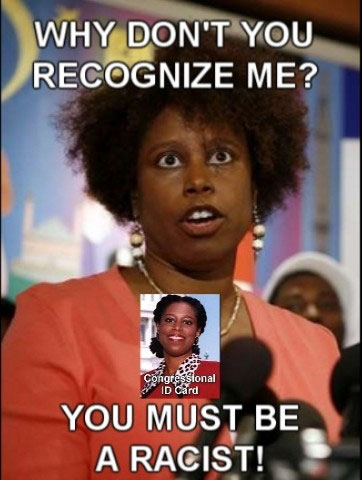
On the morning of March 29, 2006, McKinney entered the Longworth House Office Building's southeast entrance and proceeded past the security checkpoint, walking around the metal detector. Members of Congress have identifying lapel pins and are not required to pass through metal detectors. The officers present failed to recognize McKinney as a member of Congress because she was not wearing the appropriate lapel pin.[34] She proceeded westward down the ground floor hallway and about halfway down the hallway was grabbed by United States Capitol Police officer Paul McKenna, who states that he had been calling after her: "Ma'am, Ma'am!"; at that time it is reported that McKinney struck the officer. Two days later, Officer McKenna filed a police report claiming that McKinney had struck "his chest with a closed fist."
In the midst of a media frenzy, McKinney made an apology on the floor of the House of Representatives on April 6, 2006, neither admitting to nor denying the charge, stating only that: "There should not have been any physical contact in this incident." Minutes before making the Congresswoman's apology, McKinney's security officer made contact with a TV correspondent outside of the U.S. Capitol.
Though McKinney was not indicted for criminal charges nor subjected to disciplinary action by the House, the president of the Fraternal Order of Police has advocated the filing of a civil suit by Officer McKenna.
On-air criticism of aide
In the wake of the March 2006 incident with the Capitol Police officer, Rep. McKinney was still very much in the news and her office invited the media to attend one of her monthly "District Days," where she spends one full day meeting with constituents to discuss issues of concern. At her April 23, 2006, "District Days" event, Rep. McKinney was being interviewed by WGCL's Renee Starzyk, who rather than asking questions about District Days as McKinney would have liked, repeatedly questioned her about the March 29 scuffle with a Capitol police officer. Frustrated, McKinney stood up and apparently forgot she was still wearing the microphone. Her offscreen comments were captured on tape. She was heard saying, "Oh, crap, now you know what ... they lied to Coz, and Coz is a fool."[38] She was referring to one of her aides, Coz Carson. McKinney realized the embarrassing mistake and returned on screen with the microphone, this time with instructions on what parts of the interview CBS 46 was allowed to use, "anything that is captured by your audio ... that is captured while I'm not seated in this chair is off the record and is not permissible to be used ... is that understood?"[4] The comments from the interview were immediately aired on CBS and eventually across the nation. (Importantly, McKinney stated after the "Coz is a fool" statement was made that it was off the record, as opposed to stating beforehand that certain portions are off the record.)
2006 primary and primary runoff
Main article: Georgia 4th congressional district election, 2006
McKinney finished first in the July 18, 2006 Democratic primary, edging DeKalb County Commissioner Hank Johnson 47.1% to 44.4%, with a third candidate receiving 8.5%.[39]However, since McKinney failed to get at least 50% of the vote, she and Johnson were forced into a runoff.
McKinney's loss is attributed to a mid-decade redistricting, in which the 4th had absorbed portions of Gwinnett and Rockdale Counties, as well a highly publicized controversial run-in with a U.S. Capitol police officer. In the runoff of August 8, 2006, although there were about 8,000 more voters than in the primary, McKinney received about the same number of votes as in July. Johnson won with 41,178 votes (59%) to McKinney's 28,832 (41%).[40] CNN reported that during her concession speech, McKinney hardly mentioned her opponent but praised the leftist political leaders elected in South America (including Hugo Chavez of Venezuela).
2008 Green Party presidential candidacy
This article contains information about one or more candidates in an upcoming or ongoing election.
Content may change as the election approaches.
Wikinews has related news:
Wikinews interviews U.S. Green Party presidential candidate Cynthia McKinneyOn December 11, 2007, McKinney announced her candidacy for the Green Party nomination for President of the United States in the 2008 presidential election. Green Party members attempted to recruit McKinney both in 2000 and 2004. In 2000, she was widely mentioned as a possible vice-presidential running mate for Ralph Nader; in 2004, attempts were made to convince McKinney to run on the Green Party ballot line for president.
While there had been a great deal of excitement among party members about a possible McKinney run in those prior elections, the congresswoman had little to do with the party apart from having had Green Party loyalists working on her congressional campaigns. This changed drastically following her defeat in the 2006 election. McKinney attended the California Green Party strategy retreat in Sonoma, California, where she was the keynote speaker. On May 25, 2007, she was asked about a presidential run on WBAI and confirmed that she had thought about a Green run: "2008 has not been ruled out, some kind of effort. Certainly now it is questionable as to whether that effort would come under the banner of the Democratic Party."
Cynthia McKinney before speaking at the Green Party Presidential Debate in San Francisco, January 2008.On June 9, speaking at a Harlem fundraiser for her Congressional campaign debt, McKinney addressed speculation that she might run for president in 2008. At the end of the program, Robert Knight of Pacifica Radio, who emceed the evening's events, took the pulpit to ask: "I can't hardly wait for 2008. Ms. McKinney, in 2008, what color is your parachute?" McKinney responds from the audience, "it's not red and it's not blue."[46] McKinney also appeared at the July 15 Green Party National Meeting in Reading, Pennsylvania, where she suggested that the Green Party could become a progressive political force. "[T]he disgust of the American people with what they see before them ?- all they need is the blueprint and a road map. Why not have the Green Party provide the blueprint and the road map?"
At an August 27 peace rally in Kennebunkport, Maine McKinney confirmed the depth of her disenchantment with the Democratic Party, urging San Francisco voters to replace Nancy Pelosi with antiwar activist Cindy Sheehan.[47] On September 10, in a letter to the Steering Committee of the Green Party of the United States, McKinney stated she would not seek the Green Party nomination for president.[48] However, in early October it appeared that McKinney was making moves toward declaring herself an official Green Party candidate.
By October 9, 2007, Green leaders were receiving emails indicating McKinney had formally joined the Green Party. The emails also indicate McKinney could announce a Green Party presidential bid by the third week of October. Following a brief exploratory visit to California in mid-October, McKinney filed with the FEC. She formally announced her candidacy with a video on her website and on YouTube on December 16, 2007. Later that month she agreed to join with others on the Green Party California Primary Ballot for an event in San Francisco entitled Campaign 2008: A Presidential Debate That Matters.[50] McKinney has also filed with the State Board of Elections of Illinois for the Green party in the presidential race.
On July 9, 2008 she named her running mate as Rosa Clemente and clinched the party's nomination three days later at the 2008 Green Party National Convention.
Awards and honors
McKinney has been featured in a full-length documentary titled American Blackout. On April 14, 2006, she received the key to the city of Sarasota, Florida, and was doubly honored when the city named April 8 as "Congresswoman Cynthia McKinney Day" in Sarasota. On May 1, 2004, during her hiatus from office, McKinney was awarded the fifth annual Backbone Award by the Backbone Campaign "because she was willing to challenge the Bush administration and called for an investigation into 9-11 when few others dared to air their criticism and questions."
On June 14, 2000, Rep. McKinney was honored when part of Memorial Drive, a major thoroughfare running through her district, was renamed "Cynthia McKinney Parkway," but the naming has come[55] under scrutiny since her primary defeat in 2006.[citation needed] Memorial Drive leads from south Atlanta to Stone Mountain. Her father had previously been honored when a portion of Interstate 285 around Atlanta was dedicated as "Billy McKinney Highway."
Electoral history
Georgia's 11th congressional district: Results 1992-1994[56] Year Democrat Votes Pct Republican Votes Pct
1992 Cynthia A. McKinney 120,168 73% Woodrow Lovett 44,221 27% *
1994 Cynthia A. McKinney 71,560 66% Woodrow Lovett 37,533 34%
*Write-in and minor candidate notes: In 1992, write-ins received 11 votes.
Georgia's 4th congressional district: Results 1996-2004[56] Year Democrat Votes Pct Republican Votes Pct
1996 Cynthia A. McKinney 127,157 58% John M. Mitnick 92,985 42%
1998 Cynthia A. McKinney 100,622 61% Sunny J. Warren 64,146 39% *
2000 Cynthia A. McKinney 139,579 61% Sunny J. Warren 90,277 39%
2002 Denise L. Majette 118,045 77% Cynthia Van Auken 35,202 23%
2004 Cynthia A. McKinney 157,461 64% Catherine Davis 89,509 36%
 )
)

 Stumble It!
 Tweet This
 Bookmark on Delicious
 Share on Facebook
 Share on MySpace