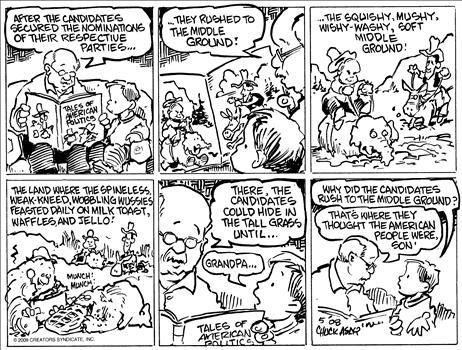
And now this. . . .
George Will has raised the questions and I think these are questions that deserve an answer or at least a philosophy--I admit I had to look up the definition for 'peripatetic'.
While I don't think any of the candidates can say specifically what they will do until they know what circumstances they will be facing, I think all should advise us that they are aware of and have given seriously consideration to these issues:
Questions For McCain
You say 'some greedy people' on Wall Street 'perhaps need to be punished.' So, government should treat greed as a crime?
May 19, 2008 Issue
by George Will
Peripatetic John McCain, the human pinball, continues to carom around the country as his rivals gnaw on each other. Although action, not reflection, is his forte, perhaps he should go to earth somewhere, while the Democrats continue the destruction, and answer some questions, such as:
You say you are not "ready to go to war with Iran," but you also say the "one thing worse" than "exercising the military option" is "a nuclear-armed Iran." Because strenuous diplomacy has not dented Iran's nuclear ambitions, is not a vote for you a vote for war with Iran?
You say that although Russia has blocked "everything we have tried to do" through the United Nations, you are confident that a "league of democracies" that "control so much of the world's economy" can modify the behavior of Iran, which has "a lousy economy." Does that mean war can be avoided only if France, Germany, Japan and China, which have important commercial relations with Iran, impose severe sanctions, and they break Iran's nuclear ambitions?
Your goal in Iraq is "success," which you define as "the establishment of a generally peaceful, stable, prosperous, democratic state." Would a "generally" peaceful, stable, prosperous but authoritarian state be unacceptable? Or a mildly prosperous and "generally" stable state but one with simmering violence?-which describes a number of nations today, including Iraq? Does the task of making your four adjectives descriptive of Iraq require and therefore justify more years of military involvement in the suppression of groups that are manifestations of sectarianism, criminality and warlordism? What other nations should we police?
In 1999, during U.S. intervention in the Balkans, you advocated mobilizing infantry and armored divisions to show Serbia's Slobodan Milosevic that there was "no self-imposed limit to our determination to liberate Kosovo from his tyranny." You described your policy as "rogue-state rollback" against those who threaten "our strategic interests and political values." How did Serbia threaten America's strategic interests? Are America's political values threatened by any state that does not practice them? If so, how long is your list of nations eligible for "rogue-state rollback"?
You vow to nominate judges who "take as their sole responsibility the enforcement of laws made by the people's elected representatives." Their sole responsibility? Do you oppose judicial review that invalidates laws that pure-hearted representatives of the saintly people have enacted that happen to violate the Constitution? Does your dogmatic deference to popular sovereignty put you at odds with the first Republican president, who nobly insisted that there are some things the majority should not be permitted to do?-hence his opposition to allowing popular sovereignty to determine the status of slavery in the territories? Do you also reject Justice Antonin Scalia's belief that the Constitution's purpose is "to embed certain rights in such a manner that future generations cannot readily take them away"? Does this explain your enthusiasm for McCain-Feingold's restrictions on political speech, and your dismissive reference to, "quote, First Amendment rights"? Would you nominate judges who, because they think those are more than "quote
rights," doubt McCain-Feingold's constitutionality?
http://www.newsweek.com/id/136308