76
   

Global Warming...New Report...and it ain't happy news


Walter Hinteler
 
  1  
Reply Sat 22 Mar, 2008 03:11 pm
okie wrote:
... while we also virtually ignore water vapor.


Don't tell me such: my uncle found in 1913/4 [PhD-thesis published] the 'Hinteler-effect' (published - together with Schmidt - in Zeitschrift für physikalische Chemie, 91, 103 [1916]), something about the adsorption of water vapor.

"Unfortunately" (he died due to illnesses he got in the Great War in the early 20's) his results were overturned from 1926 onwards :wink:
0 Replies
 
Foxfyre
 
  1  
Reply Sat 22 Mar, 2008 03:34 pm
Walter Hinteler wrote:
Foxfyre wrote:
... that we all sensed was based on bad science motivated by flawed political goals and at least partially financed by people with less than noble motives.


So you would consider e.g.

Jennifer Marohasy, a biologist and senior fellow of Melbourne-based think tank the Institute of Public Affairs

as being a "good girl" while

Anthony Bergin, the research director of the Australian Strategic Policy Institute and co-author of the 2007 report A Change in Climate for the Australian Defence Force

is a "bad guy" from the group you described above?


No I don't think I would consider that at all, Walter, which is probably why I never said anything like that.
0 Replies
 
parados
 
  1  
Reply Mon 24 Mar, 2008 07:52 am
okie wrote:
Walter Hinteler wrote:
okie wrote:
Auto mechanics learn that principle first as part of diagnosing any problem.


I always contact mine first if I've scientific questions.

The point, which is common sense, applies to any scientific or mechanical problem. Look at the most common or direct probabilities first. For example, if your house is too cold or too hot, first check the thermostat instead of calculating the amount of insulation in your walls. If the car quits running, first check to see if you ran out of gas before checking the spark plug wires or the timing.

Here we have a situation with Earth heating up very very slightly, also Mars and other celestial bodies showing a heating trend. Duh, just maybe it is the solar cycle here that is the chief culprit? Is that a slight possibility, Walter, or does it make more sense to invest all of our resources into calculating the effects of CO2, which by the way is a very minor constituent of the atmosphere, while we also virtually ignore water vapor. This whole issue has been handled very, very badly by the scientists and the media. No common sense has been applied by the Al Gores of the world.


They HAVE checked the solar cycle. But like a fool that knows nothing about cars you keep demanding that we are out of gas even after the gas tank has been checked several different ways and shown to hold gas.

Water vapor has NOT been ignored either. But if it makes you feel better to show your inability to even look at the science by claiming they haven't checked it then go ahead and shout your ignorance to the world.
0 Replies
 
High Seas
 
  1  
Reply Mon 24 Mar, 2008 09:20 am
Walter Hinteler wrote:
okie wrote:
... while we also virtually ignore water vapor.


Don't tell me such: my uncle found in 1913/4 [PhD-thesis published] the 'Hinteler-effect' (published - together with Schmidt - in Zeitschrift für physikalische Chemie, 91, 103 [1916]), something about the adsorption of water vapor.

"Unfortunately" (he died due to illnesses he got in the Great War in the early 20's) his results were overturned from 1926 onwards :wink:


Walter - you may know that the great Austrian physicist Edwin Schroedinger also worked as a meteorologist during WWI and also published a monograph on a related topic.

To your knowledge, any connection / contact between the two?
0 Replies
 
Walter Hinteler
 
  1  
Reply Mon 24 Mar, 2008 09:28 am
High Seas wrote:
To your knowledge, any connection / contact between the two?


No - there's just his PhD-thesis in a couple of ( some German, fewer Austrian, one Swiss and one French) university libraries ... and the new founds, quoting him. (That is: I didn't look for more.)

[Uncle's work was more practical chemistry/physics orientated - the Schrödinger equation/method is in a different 'field' as far as I understand that.]

P.S.: 'your' book will get a new readership next week.
0 Replies
 
ican711nm
 
  1  
Reply Mon 24 Mar, 2008 07:06 pm
IPCC has done incompetent work checking the solar cycle's effect and water vapor's effect on average global temperature.

These 400 scientists have said as much:
http://epw.senate.gov/public/index.cfm?FuseAction=Minority.Blogs&ContentRecord_id=f80a6386-802a-23ad-40c8-3c63dc2d02cb
U.S. Senate Report: Over 400 Prominent Scientists Disputed Man-Made Global Warming Claims in 2007.

Quote:
INTRODUCTION:

Over 400 prominent scientists from more than two dozen countries recently voiced significant objections to major aspects of the so-called "consensus" on man-made global warming. These scientists, many of whom are current and former participants in the UN IPCC (Intergovernmental Panel on Climate Change), criticized the climate claims made by the UN IPCC and former Vice President Al Gore.


SOME EXAMPLES

Quote:
Israel: Dr. Nathan Paldor, Professor of Dynamical Meteorology and Physical Oceanography at the Hebrew University of Jerusalem has authored almost 70 peer-reviewed studies and won several awards. "First, temperature changes, as well as rates of temperature changes (both increase and decrease) of magnitudes similar to that reported by IPCC to have occurred since the Industrial revolution (about 0.8C in 150 years or even 0.4C in the last 35 years) have occurred in Earth's climatic history. There's nothing special about the recent rise!"


Russia: Russian scientist Dr. Oleg Sorochtin of the Institute of Oceanology at the Russian Academy of Sciences has authored more than 300 studies, nine books, and a 2006 paper titled "The Evolution and the Prediction of Global Climate Changes on Earth." "Even if the concentration of ?'greenhouse gases' double man would not perceive the temperature impact," Sorochtin wrote. (Note: Name also sometimes translated to spell Sorokhtin)


Spain: Anton Uriarte, a professor of Physical Geography at the University of the Basque Country in Spain and author of a book on the paleoclimate, rejected man-made climate fears in 2007. "There's no need to be worried. It's very interesting to study [climate change], but there's no need to be worried," Uriate wrote.


Netherlands: Atmospheric scientist Dr. Hendrik Tennekes, a scientific pioneer in the development of numerical weather prediction and former director of research at The Netherlands' Royal National Meteorological Institute, and an internationally recognized expert in atmospheric boundary layer processes, "I find the Doomsday picture Al Gore is painting - a six-meter sea level rise, fifteen times the IPCC number - entirely without merit," Tennekes wrote. "I protest vigorously the idea that the climate reacts like a home heating system to a changed setting of the thermostat: just turn the dial, and the desired temperature will soon be reached."


Brazil: Chief Meteorologist Eugenio Hackbart of the MetSul Meteorologia Weather Center in Sao Leopoldo - Rio Grande do Sul, Brazil declared himself a skeptic. "The media is promoting an unprecedented hyping related to global warming. The media and many scientists are ignoring very important facts that point to a natural variation in the climate system as the cause of the recent global warming," Hackbart wrote on May 30, 2007.


France: Climatologist Dr. Marcel Leroux, former professor at Université Jean Moulin and director of the Laboratory of Climatology, Risks, and Environment in Lyon, is a climate skeptic. Leroux wrote a 2005 book titled Global Warming - Myth or Reality? - The Erring Ways of Climatology. "Day after day, the same mantra - that ?'the Earth is warming up' - is churned out in all its forms. As ?'the ice melts' and ?'sea level rises,' the Apocalypse looms ever nearer! Without realizing it, or perhaps without wishing to, the average citizen in bamboozled, lobotomized, lulled into mindless ac­ceptance. ... Non-believers in the greenhouse scenario are in the position of those long ago who doubted the existence of God ... fortunately for them, the Inquisition is no longer with us!"


Norway: Geologist/Geochemist Dr. Tom V. Segalstad, a professor and head of the Geological Museum at the University of Oslo and formerly an expert reviewer with the UN IPCC: "It is a search for a mythical CO2 sink to explain an immeasurable CO2 lifetime to fit a hypothetical CO2 computer model that purports to show that an impossible amount of fossil fuel burning is heating the atmosphere. It is all a fiction."


Finland: Dr. Boris Winterhalter, retired Senior Marine Researcher of the Geological Survey of Finland and former professor of marine geology at University of Helsinki, criticized the media for what he considered its alarming climate coverage. "The effect of solar winds on cosmic radiation has just recently been established and, furthermore, there seems to be a good correlation between cloudiness and variations in the intensity of cosmic radiation. Here we have a mechanism which is a far better explanation to variations in global climate than the attempts by IPCC to blame it all on anthropogenic input of greenhouse gases."


Germany: Paleoclimate expert Augusto Mangini of the University of Heidelberg in Germany, criticized the UN IPCC summary. "I consider the part of the IPCC report, which I can really judge as an expert, i.e. the reconstruction of the paleoclimate, wrong," Mangini noted in an April 5, 2007 article. He added: "The earth will not die."


Canada: IPCC 2007 Expert Reviewer Madhav Khandekar, a Ph.D meteorologist, a scientist with the Natural Resources Stewardship Project who has over 45 years experience in climatology, meteorology and oceanography, and who has published nearly 100 papers, reports, book reviews and a book on Ocean Wave Analysis and Modeling: "To my dismay, IPCC authors ignored all my comments and suggestions for major changes in the FOD (First Order Draft) and sent me the SOD (Second Order Draft) with essentially the same text as the FOD. None of the authors of the chapter bothered to directly communicate with me (or with other expert reviewers with whom I communicate on a regular basis) on many issues that were raised in my review. This is not an acceptable scientific review process."


Czech Republic: Czech-born U.S. climatologist Dr. George Kukla, a research scientist with the Lamont-Doherty Earth Observatory at Columbia University, expressed climate skepticism in 2007. "The only thing to worry about is the damage that can be done by worrying. Why are some scientists worried? Perhaps because they feel that to stop worrying may mean to stop being paid," Kukla told Gelf Magazine on April 24, 2007.


India: One of India's leading geologists, B.P. Radhakrishna, President of the Geological Society of India, expressed climate skepticism in 2007. "We appear to be overplaying this global warming issue as global warming is nothing new. It has happened in the past, not once but several times, giving rise to glacial-interglacial cycles."


USA: Climatologist Robert Durrenberger, past president of the American Association of State Climatologists, and one of the climatologists who gathered at Woods Hole to review the National Climate Program Plan in July, 1979: "Al Gore brought me back to the battle and prompted me to do renewed research in the field of climatology. And because of all the misinformation that Gore and his army have been spreading about climate change I have decided that ?'real' climatologists should try to help the public understand the nature of the problem."


Italy: Internationally renowned scientist Dr. Antonio Zichichi, president of the World Federation of Scientists and a retired Professor of Advanced Physics at the University of Bologna in Italy, who has published over 800 scientific papers: "Significant new peer-reviewed research has cast even more doubt on the hypothesis of dangerous human-caused global warming."


New Zealand: IPCC reviewer and climate researcher and scientist Dr. Vincent Gray, an expert reviewer on every single draft of the IPCC reports going back to 1990 and author of The Greenhouse Delusion: A Critique of "Climate Change 2001: "The [IPCC] ?'Summary for Policymakers' might get a few readers, but the main purpose of the report is to provide a spurious scientific backup for the absurd claims of the worldwide environmentalist lobby that it has been established scientifically that increases in carbon dioxide are harmful to the climate. It just does not matter that this ain't so."


South Africa: Dr. Kelvin Kemm, formerly a scientist at South Africa's Atomic Energy Corporation who holds degrees in nuclear physics and mathematics: "The global-warming mania continues with more and more hype and less and less thinking. With religious zeal, people look for issues or events to blame on global warming."


Poland: Physicist Dr. Zbigniew Jaworowski, Chairman of the Central Laboratory for the United Nations Scientific Committee on the Effects of Radiological Protection in Warsaw: "We thus find ourselves in the situation that the entire theory of man-made global warming?-with its repercussions in science, and its important consequences for politics and the global economy?-is based on ice core studies that provided a false picture of the atmospheric CO2 levels."


Australia: Prize-wining Geologist Dr. Ian Plimer, a professor of Earth and Environmental Sciences at the University of Adelaide in Australia: "There is new work emerging even in the last few weeks that shows we can have a very close correlation between the temperatures of the Earth and supernova and solar radiation."


Britain: Dr. Richard Courtney, a UN IPCC expert reviewer and a UK-based climate and atmospheric science consultant: "To date, no convincing evidence for AGW (anthropogenic global warming) has been discovered. And recent global climate behavior is not consistent with AGW model predictions."


China: Chinese Scientists Say C02 Impact on Warming May Be ?'Excessively Exaggerated' - Scientists Lin Zhen-Shan's and Sun Xian's 2007 study published in the peer-reviewed journal Meteorology and Atmospheric Physics: "Although the CO2 greenhouse effect on global climate change is unsuspicious, it could have been excessively exaggerated." Their study asserted that "it is high time to reconsider the trend of global climate change."


Denmark: Space physicist Dr. Eigil Friis-Christensen is the director of the Danish National Space Centre, a member of the space research advisory committee of the Swedish National Space Board, a member of a NASA working group, and a member of the European Space Agency who has authored or co-authored around 100 peer-reviewed papers and chairs the Institute of Space Physics: "The sun is the source of the energy that causes the motion of the atmosphere and thereby controls weather and climate. Any change in the energy from the sun received at the Earth's surface will therefore affect climate."


Belgium: Climate scientist Luc Debontridder of the Belgium Weather Institute's Royal Meteorological Institute (RMI) co-authored a study in August 2007 which dismissed a decisive role of CO2 in global warming: "CO2 is not the big bogeyman of climate change and global warming. "Not CO2, but water vapor is the most important greenhouse gas. It is responsible for at least 75 % of the greenhouse effect. This is a simple scientific fact, but Al Gore's movie has hyped CO2 so much that nobody seems to take note of it."


Sweden: Geologist Dr. Wibjorn Karlen, professor emeritus of the Department of Physical Geography and Quaternary Geology at Stockholm University, critiqued the Associated Press for hyping promoting climate fears in 2007. "Another of these hysterical views of our climate. Newspapers should think about the damage they are doing to many persons, particularly young kids, by spreading the exaggerated views of a human impact on climate."


USA: Dr. David Wojick is a UN IPCC expert reviewer, who earned his PhD in Philosophy of Science and co-founded the Department of Engineering and Public Policy at Carnegie-Mellon University: "In point of fact, the hypothesis that solar variability and not human activity is warming the oceans goes a long way to explain the puzzling idea that the Earth's surface may be warming while the atmosphere is not. The GHG (greenhouse gas) hypothesis does not do this." Wojick added: "The public is not well served by this constant drumbeat of false alarms fed by computer models manipulated by advocates."
0 Replies
 
okie
 
  1  
Reply Mon 24 Mar, 2008 09:00 pm
Anybody besides me notice the doomsdayers and Gore defenders are becoming a little more scarce here, and when they do appear, they seem a little more unsure?
0 Replies
 
Foxfyre
 
  1  
Reply Mon 24 Mar, 2008 11:29 pm
It does seem that the AGW skeptics are more active these days; perhaps because we are finding more and more scientific opinion that affirms our impressions on this.
0 Replies
 
Diest TKO
 
  1  
Reply Tue 25 Mar, 2008 01:08 am
No. We are still here. I read this thread daly. I'm still not impressed with any of the junk science. Currently reading a book on the topic and reading the IPCC 2007 report from front to back.

What's the phrase? "Keep honking, Im reloading."

Since I'm here I thought I'd post a definition.
IPCC wrote:
Radiative forcing - What is radiative forcing? The influence of a factor that can cause climate change, such as a greenhouse gas, is often evaluated in terms of its radiative forcing. Radiative forcing is a measure of how the energy balance of the Earth-atmosphere system is influenced when factors that affect climate are altered. The word radiative arises because these factors change the balance between incoming solar radiation and outgoing infrared radiation within the Earth's atmosphere. This radiative balance controls the Earth's surface temperature. The term forcing is used to indicate that Earth's radiative balance is being pushed away from its normal state.
Radiative forcing is usually quantified as the ?'rate of energy change per unit area of the globe as measured at the top of the atmosphere',
and is expressed in units of ?'Watts per square metre' (see Figure 2). When radiative forcing from a factor or group of factors is evaluated as positive, the energy of the Earth-atmosphere system will ultimately increase, leading to a warming of the system. In contrast, for a negative radiative forcing, the energy will ultimately decrease, leading to a cooling of the system. Important challenges for climate scientists are to identify all the factors that affect climate and the mechanisms by which they exert a forcing, to quantify the radiative forcing of each factor and to evaluate the total radiative forcing from the group of factors.


T
Keep honking.
O
0 Replies
 
ican711nm
 
  1  
Reply Tue 25 Mar, 2008 11:37 am
Diest TKO wrote:
No. We are still here. I read this thread daly. I'm still not impressed with any of the junk science. Currently reading a book on the topic and reading the IPCC 2007 report from front to back.

What's the phrase? "Keep honking, Im reloading."

Since I'm here I thought I'd post a definition.
IPCC wrote:
Radiative forcing - What is radiative forcing? The influence of a factor that can cause climate change, such as a greenhouse gas, is often evaluated in terms of its radiative forcing. Radiative forcing is a measure of how the energy balance of the Earth-atmosphere system is influenced when factors that affect climate are altered. The word radiative arises because these factors change the balance between incoming solar radiation and outgoing infrared radiation within the Earth's atmosphere. This radiative balance controls the Earth's surface temperature. The term forcing is used to indicate that Earth's radiative balance is being pushed away from its normal state.
Radiative forcing is usually quantified as the ?'rate of energy change per unit area of the globe as measured at the top of the atmosphere',
and is expressed in units of ?'Watts per square metre' (see Figure 2). When radiative forcing from a factor or group of factors is evaluated as positive, the energy of the Earth-atmosphere system will ultimately increase, leading to a warming of the system. In contrast, for a negative radiative forcing, the energy will ultimately decrease, leading to a cooling of the system. Important challenges for climate scientists are to identify all the factors that affect climate and the mechanisms by which they exert a forcing, to quantify the radiative forcing of each factor and to evaluate the total radiative forcing from the group of factors.


T
Keep honking.
O

HONK HONK Laughing OINK OINK


http://www.ipcc.ch/pdf/assessment-report/ar4/wg1/ar4-wg1-ts.pdf

From IPCC's Technical Summary

Page 24, TS.2.1.1, 2nd paragraph:

Quote:
... rate of increase in the combined radiative forcing from these greenhouse gases of about + 1 W m2 over the past four decades ...

[/size]

Interesting, considering the fact that the sun's irradiance increased about + 1 W/m~2 over the last 30 years 1975 to 2005.

Perhaps what the incompetent IPCC consensus actually measured/calculated/stipulated was the sun's increase in irradiance, even though on page 30, TS.2.4, 2nd paragraph, they wrote:
Quote:
The estimated direct radiative forcing due to changes in the solar output since 1750 is +0.12 [+0.06 to +0.3] W m2 ...

:wink:
0 Replies
 
parados
 
  1  
Reply Tue 25 Mar, 2008 12:57 pm
Quote:

Interesting, considering the fact that the sun's irradiance increased about + 1 W/m~2 over the last 30 years 1975 to 2005.

Interesting that you don't have a source for this.


But then that's nothing new from you ican.
You will hem and haw and then present information that doesn't support your statement before you pretend you never said it in the first place.
0 Replies
 
parados
 
  1  
Reply Tue 25 Mar, 2008 01:16 pm
http://publishing.royalsociety.org/media/proceedings_a/rspa20071880.pdf

Figure 1 in this quite clearly shows there is no +1 w increase from 1975-2005 as you claimed ican. But that isn't a surprise since you have consistently made claims not supported by facts.

There is a 1 w variation based on the 11 year cycle but no 1 watt increase from 1975 to 2005 since both are at or near the low end of the cycle. The 1976-2007 shows a decrease in TSI of about .25 if we are looking at the low ends of the cycles.
0 Replies
 
Steve 41oo
 
  1  
Reply Tue 25 Mar, 2008 02:40 pm
BBC reports

Quote:
Professor Vaughan predicted in 1993 that the northern part of the Wilkins Ice Shelf would be lost within 30 years if climate warming continued. But he said it is happening more quickly than he expected.

He told BBC News: "What we're actually seeing is a chunk of the ice shelf drop off in a way that suggests it is not just a normal part of iceberg formation.

"This is not a sea level rise issue, but is yet another indication of climate change in the Antarctic Peninsula and how it is affecting the environment."

Scientists say the Antarctic Peninsula, which juts out into the Southern Ocean towards the tip of South America, has experienced unprecedented warming over the last 50 years.

Several ice shelves have retreated in the past 30 years - six of them collapsing completely.
0 Replies
 
ican711nm
 
  1  
Reply Tue 25 Mar, 2008 02:49 pm
parados wrote:
Quote:

Interesting, considering the fact that the sun's irradiance increased about + 1 W/m~2 over the last 30 years 1975 to 2005.

Interesting that you don't have a source for this.


But then that's nothing new from you ican.
You will hem and haw and then present information that doesn't support your statement before you pretend you never said it in the first place.

Laughing You seem to like me repeating myself. That's ok with me!!!

From:
http://www.oism.org/pproject/s33p36.htm

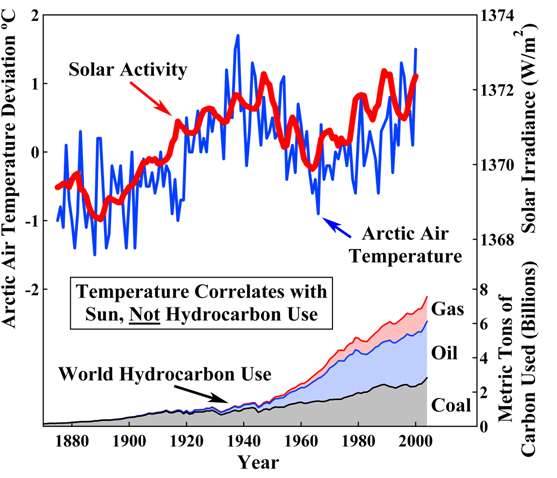
Solar irradiance 1975 = 1370.5 w/m~2.

Solar irradiance 2005 = 1371.5 w/m~2.

Increase solar irradiance from 1975 to 2005 = 1371.5 - 1370.5 = 1.0 w/m~2.

http://www.oism.org/pproject/Slides/Presentation/Slide3.png
!!!Arctic Air Temperature versus Solar Activity and CO2 trend


http://www.oism.org/pproject/Slides/Presentation/Slide5.png
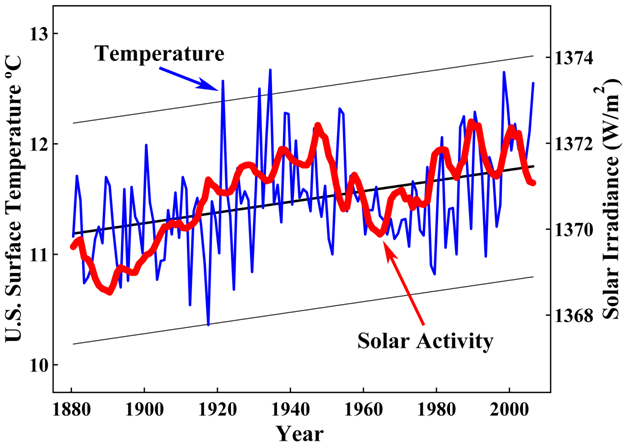
!!!US Surface Temperature Trends versus Solar Activity
0 Replies
 
ican711nm
 
  1  
Reply Tue 25 Mar, 2008 02:50 pm
parados wrote:
http://publishing.royalsociety.org/media/proceedings_a/rspa20071880.pdf

Figure 1 in this quite clearly shows there is no +1 w increase from 1975-2005 as you claimed ican. But that isn't a surprise since you have consistently made claims not supported by facts.

There is a 1 w variation based on the 11 year cycle but no 1 watt increase from 1975 to 2005 since both are at or near the low end of the cycle. The 1976-2007 shows a decrease in TSI of about .25 if we are looking at the low ends of the cycles.

Laughing You seem to like me repeating myself. That's ok with me!!!

From:
http://www.oism.org/pproject/s33p36.htm

Solar irradiance 1975 = 1370.5 w/m~2.

Solar irradiance 2005 = 1371.5 w/m~2.

Increase solar irradiance from 1975 to 2005 = 1371.5 - 1370.5 = 1.0 w/m~2.

http://www.oism.org/pproject/Slides/Presentation/Slide3.png
!!!Arctic Air Temperature versus Solar Activity and CO2 trend


http://www.oism.org/pproject/Slides/Presentation/Slide5.png
!!!US Surface Temperature Trends versus Solar Activity
0 Replies
 
Diest TKO
 
  1  
Reply Tue 25 Mar, 2008 03:18 pm
Ican711nm - since you seem to find lots of pretty charts can you find any of those charts non-dimentionalized to a particular year's value? Do you have any that include deforrestation? What about land ice?

All on one graph?

If you can find one, it would prodive actual perspective on the evidence.

Thank you
K
O
0 Replies
 
ican711nm
 
  1  
Reply Tue 25 Mar, 2008 04:33 pm
Diest TKO wrote:
Ican711nm - since you seem to find lots of pretty charts can you find any of those charts non-dimentionalized to a particular year's value? Do you have any that include deforrestation? What about land ice?

All on one graph?

If you can find one, it would prodive actual perspective on the evidence.

Thank you
K
O

Aah "perspective!" I'm all for it.


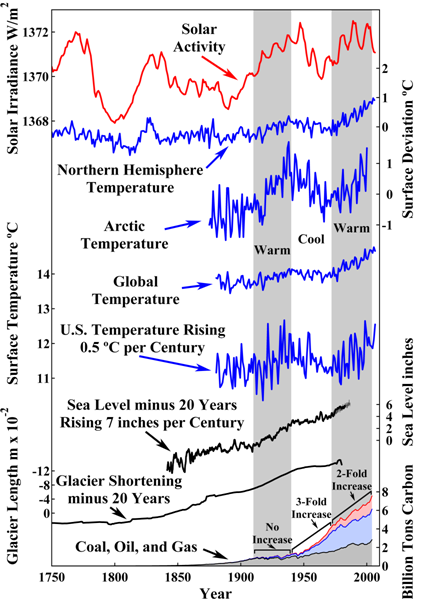
http://www.oism.org/pproject/Slides/Presentation/Slide13.png
Composite versus CO2 activity

In the event you would like more, please goto:
http://www.oism.org/pproject/s33p36.htm
and browse.
0 Replies
 
parados
 
  1  
Reply Tue 25 Mar, 2008 07:32 pm
Now we get to see ican's source and what it really does...

I love the first chart ican. The last number listed for solar irradiance is in 2000 not the 2005 you claimed. In fact the supposed source of this chart was presented for publication in May of 2005 so can't possibly include numbers for 2005. Soon also did his study in decadal (5-15 year) and multidecadal (10-80 year) time frames. This chart claims to be from Soon but doesn't tell which time frame it is using. The TSI and arctic temperature numbers are flattened and not by year.

It is EASY to read the chart. just hold a straight line down from the last point on it. It goes down to 2000. We now have evidence that your source doesn't come close to matching your claim.

So what is your source for 1975-2005?

Your cited source does NOT list these numbers on the page you cited.
Quote:
Solar irradiance 1975 = 1370.5 w/m~2.

Solar irradiance 2005 = 1371.5 w/m~2.
Those numbers are nowhere to be found other than in your imagination.

Your second chart that compares solar activity to US temperatures quite clearly does NOT show an increase in 1 w/m^2. At most it is a .5 increase and more likely a .25 increase. (This chart is also not from published science. The footnote lists it as coming from "private communication" with Soon.)

The final chart you posted later that compares 5 or more things quite clearly doesn't show a 1 w/m^2 increase from 1975 to 2005

It seems you can't read a chart ican and you just make up numbers hoping no one will question them.

Lets face facts here ican. You can't provide any valid support for you numbers you claim for 1975 and 2005. You can provide no scientific source. You can only provide graphs from a non scientific site and then you read the graphs incorrectly.
0 Replies
 
ican711nm
 
  1  
Reply Tue 25 Mar, 2008 08:39 pm
Parados, you act as if you cannot read accurately and comprehend more than one graph at a time. Together they support my claims. Here again are the three graphs I posted:


http://www.oism.org/pproject/Slides/Presentation/Slide3.png
!!!Arctic Air Temperature versus Solar Activity and CO2 trend.

In this first graph, please note that the number of years between points on its abscissa are 20 years apart. The solar irradiance and arctic temperature curves in this graph go up to about the year 2002.


http://www.oism.org/pproject/Slides/Presentation/Slide5.png
!!!US Surface Temperature Trends versus Solar Activity.

In this second graph, please note that the number of years between points on its abscissa are also 20 years apart. The solar irradiance and US surface temperature curves in this graph go up to about the year 2007.


http://www.oism.org/pproject/Slides/Presentation/Slide13.png
!!!Composite versus CO2 activity.

In this third graph, please note that the number of years between points on its abscissa are 50 years apart. The right most gray area covers 1975 to 2005. The solar irradiance, and global temperature curves in this graph also go up to about the year 2007.


Lets face facts here, parados. You need to learn how to read graphs more accurately.
0 Replies
 
Diest TKO
 
  1  
Reply Tue 25 Mar, 2008 09:57 pm
ican711nm wrote:
Diest TKO wrote:
Ican711nm - since you seem to find lots of pretty charts can you find any of those charts non-dimentionalized to a particular year's value? Do you have any that include deforrestation? What about land ice?

All on one graph?

If you can find one, it would prodive actual perspective on the evidence.

Thank you
K
O

Aah "perspective!" I'm all for it.


http://www.oism.org/pproject/Slides/Presentation/Slide13.png
Composite versus CO2 activity

In the event you would like more, please goto:
http://www.oism.org/pproject/s33p36.htm
and browse.

They don't have any nondimentionalized graphs?
K
O
0 Replies


Related Topics

 
Copyright © 2026 MadLab, LLC :: Terms of Service :: Privacy Policy :: Page generated in 0.09 seconds on 03/09/2026 at 01:03:05