74
   

Global Warming...New Report...and it ain't happy news


hightor
 
  1  
Reply Fri 5 Dec, 2025 05:22 am
@Walter Hinteler,
Quote:
People often have a motive for denying climate change: their own fear.


Yes, it's similar to religion that way.

Quote:
...there is also ‘belief perseverance’.


Also known as "faith".
izzythepush
 
  1  
Reply Fri 5 Dec, 2025 05:26 am
@hightor,
It's sealioning worthy of Brandon, instead of discussing a topic you're being asked to prove this that and the other.

It's just time wasting, and like Brandon, Ionus never follows the rigid set of rules he tries to impose on others.

He's not arguing in good faith, his views are fixed, evidence be damned.
izzythepush
 
  1  
Reply Fri 5 Dec, 2025 06:49 am
@hightor,
In many ways religion is the problem, "The World was made by God, Man cannot change God's work/plan, so any global warming is all part of God's plan and has nothing to do with human action."
hightor
 
  1  
Reply Fri 5 Dec, 2025 07:08 am
@izzythepush,
I think it's funny that, after ten years, he shows up to continue his important work on this site. Makes me wonder if, while in the midst of some endless argument, he got kicked off another forum.
hightor
 
  1  
Reply Fri 5 Dec, 2025 07:30 am
@izzythepush,
That's why I think the accusation that informed people who support the AGW hypothesis do so for religious reasons. To be charitable, this may be because of Lovelock's "Gaia Paradigm" but I've never seen contemporary climate scientists attempt to use their findings in support of Lovelock's theory. AGW is nothing more than a composite of many conclusions from multiple scientific disciplines, conclusions based on evidence and hypotheses under constant revision as new evidence is encountered.
hightor
 
  1  
Reply Fri 5 Dec, 2025 08:23 am
NASA study confirms that Earth is getting darker

Eric Ralls wrote:
Earth has grown a full shade darker since 2001. In practical terms, the planet is reflecting less sunlight back into space than it used to, resulting in a change in climate.

After analyzing satellite data, a team led by Norman Loeb at NASA’s Langley Research Center in Hampton, Virginia, uncovered this previously unknown inequality between Earth’s northern and southern hemispheres.

The trend, measured between 2001-2024, matters not only because it nudges the global energy balance, but also because it isn’t uniform.

The Northern Hemisphere is dimming faster than the Southern – an imbalance that adds extra heat where ice and snow are already in retreat.

Small shift, big consequences

At the top of the atmosphere, Earth handles about 240–243 watts of solar energy per square meter.

Against that huge background, the researchers found a hemispheric divergence of roughly 0.34 watts per square meter each decade.

It sounds tiny, but climate change is a story of small, persistent numbers. An extra trickle of energy, applied year after year, can alter sea-ice seasons, snow cover, cloud fields, winds, and currents in ways that reinforce the original shove.

Historically, the two halves of the planet haven’t balance perfectly. The south tends to gain a touch more solar energy aloft; the north tends to lose a touch more.

Normally, the atmosphere and oceans ferry heat back and forth across the equator and smooth the difference.

However, over the last two decades, that conveyor hasn’t fully kept pace. The north’s darkening has outstripped the system’s ability to compensate.
Ice, snow, and surface color

One driver is straightforward: reflectivity, or albedo. Bright surfaces – sea ice, snow, and some cloud tops – bounce sunlight back into space. Replace them with darker ocean or bare ground and more energy sticks around.

The Northern Hemisphere has seen pronounced declines in spring snow cover and summer Arctic sea ice.

Swapping white for dark doesn’t just absorb more light; it makes it harder for ice and snow to rebound the next season, a classic positive feedback.

Cleaner air, darker Earth

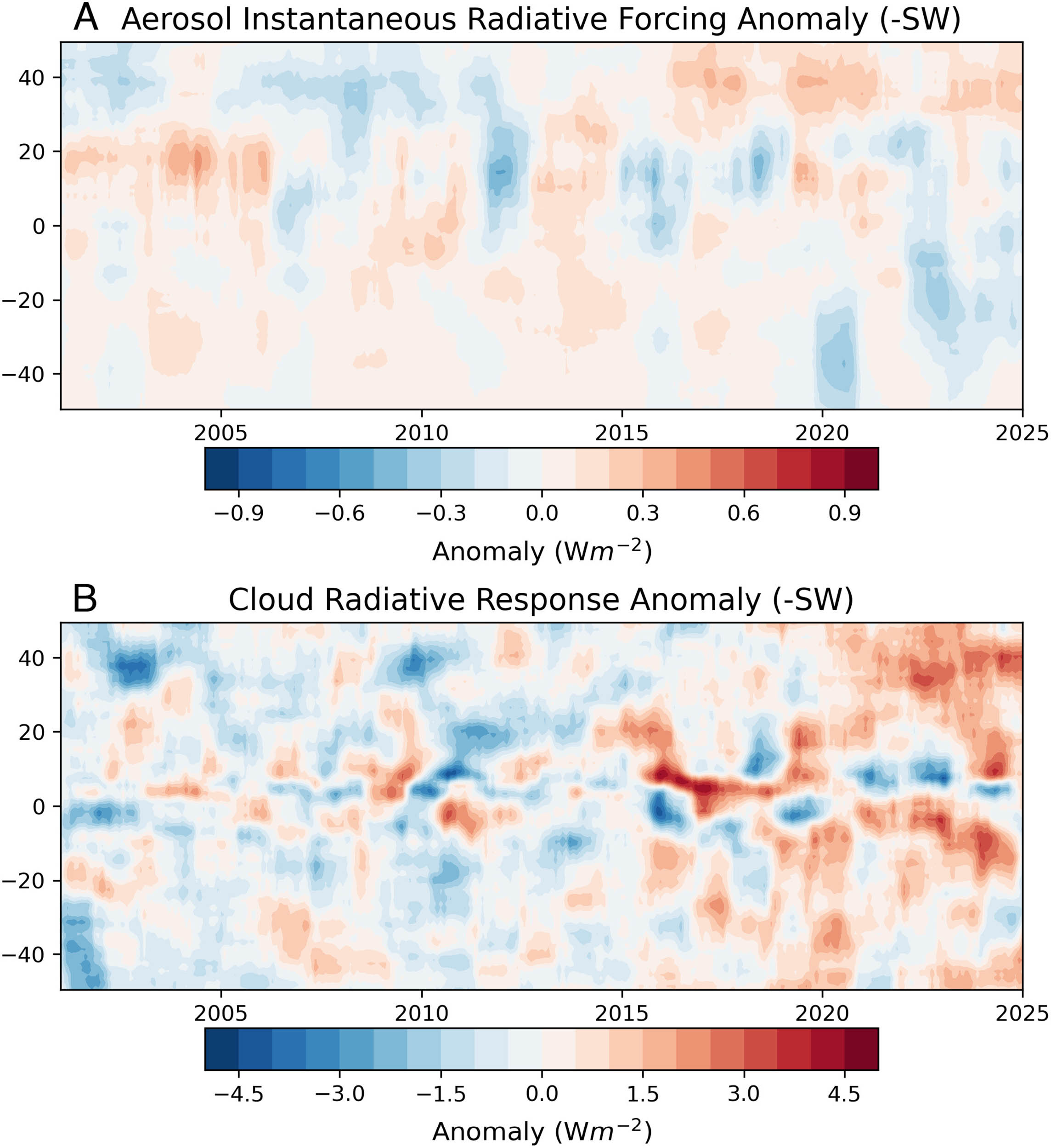
The atmosphere is the second driver. Water vapor and clouds influence how much sunlight gets reflected or trapped. But the clearest fingerprint comes from aerosols – the tiny particles that scatter light and seed cloud droplets.

In the north, aerosol pollution has dropped sharply thanks to tighter air-quality rules in North America, Europe, and parts of East Asia.

That’s a public health victory. It also means fewer particles to brighten clouds or scatter sunlight, leaving the hemisphere a bit less reflective.

By contrast, the south has had sporadic aerosol boosts from natural events.

Australia’s extreme bushfire seasons lofted smoke high into the atmosphere, and the Hunga Tonga-Hunga Ha‘apai eruption injected material that affected upper air reflectivity.

Those intense pulses temporarily restored a bit of “shine” in the south, widening the north–south gap.

Clouds can’t explain a darker Earth

It’s tempting to assume clouds will simply shuffle around and restore symmetry – more low clouds here, fewer there. The new work suggests that safety net has limits.

As sea ice retreats and aerosol levels shift, clouds do respond, but not perfectly and not always in ways that cancel the imbalance.

This finding matters for climate models, which need to capture how aerosols influence droplet formation, how cloud fields evolve over warmer, less icy oceans, and how those changes alter the planet’s overall reflectivity.

https://cff2.earth.com/uploads/2025/10/04140855/earth_reflecting-less-sunlight_getting-darker_PNAS_1m.jpg
Zonal mean anomalies in (A) aerosol–radiation interaction IRF and (B)–SW cloud radiative response for 2001 to 2024. Credit: PNAS

Subtle dark trends reshape climate


Climate warming is powered by a few sustained watts per square meter across Earth.

Layer a steady hemispheric tilt on top – less reflection in the north – and you influence where heat accumulates and how fast ice sheets, mountain glaciers, and permafrost respond.

No single year flips the system, but over decades, a quiet, persistent energy imbalance can reshape seasonal patterns, storm tracks, and regional extremes.

That’s why there’s no case for “brightening” the sky with pollution. Aerosols are short-lived – days to weeks – while carbon dioxide lingers for centuries.

Trying to prop up planetary reflectivity by tolerating dirtier air would cost lives and do nothing about ocean acidification or long-term greenhouse warming.

The practical path is already under way: keep cutting CO₂ and methane, keep cleaning the air, and keep sharpening our understanding of short-lived particles and clouds so forecasts of their effects continue to improve.

Watching Earth’s glow fade

The Arctic remains the bellwether. Sea-ice extent and thickness, the timing of spring snowmelt, and the evolving brightness of northern land and ocean surfaces will continue to shape the north’s albedo.

In the south, the occasional volcanic eruption or severe fire season will deliver temporary aerosol bursts.

Meanwhile, the oceans’ ability to ferry heat across the equator will be crucial; if the hemispheric split persists, models will need to lean harder into regional details, not just global averages.

The bottom line is simple: Earth is getting darker, especially in the north. That means a little more solar energy is sticking around each year.

It’s a quiet signal, not a blaring siren, but in climate terms, a quiet signal that never lets up can be just as powerful.

earth.com
0 Replies
 
izzythepush
 
  2  
Reply Fri 5 Dec, 2025 08:31 am
@hightor,
I thought he got kicked out of prison.
0 Replies
 
Walter Hinteler
 
  2  
Reply Mon 15 Dec, 2025 10:43 am
The number of glaciers worldwide is shrinking. A team from ETH Zurich has taken a closer look at how many could melt in the coming decades. Their conclusion: depending on the climate scenario, between 2,000 and 4,000 such ice streams could disappear each year.

Peak glacier extinction in the mid-twenty-first century
Quote:
Abstract

Projections of glacier change typically focus on mass and area loss, yet the disappearance of individual glaciers directly threatens culturally, spiritually and touristically significant landscapes. Here, using three global glacier models, we project a sharp rise in the number of glaciers disappearing worldwide, peaking between 2041 and 2055 with up to ~4,000 glaciers vanishing annually. Regional variability reflects differences in average glacier size, local climate, the magnitude of warming and inventory completeness.
0 Replies
 
hightor
 
  1  
Reply Mon 15 Dec, 2025 12:37 pm
Fortunately we have responsible people in office working to solve the problems caused by industrial pollution. Here's an example from the progressive state of South Carolina (home of A2K's popular member, "Lash" – now sadly missing.)

New Bill That Would Ban ‘Chemtrails’ Advances In South Carolina Senate

Quote:
Yesterday the Senate Medical Affairs Subcommittee voted 2-1 to advanced legislation that would ban “chemtrails” across the state of South Carolina.

The vote on Senate Bill 110 followed a tense hearing (you can watch the full video of the hearing here) dominated entirely by supporters of the chemtrail theory. Testimony included appearances by national activist Dane Wigington, founder of GeoengineeringWatch.org, and claims major weather events are engineered by the federal government. The Environmental Protection Agency, however, maintains that no such programs exist, stating in a July fact sheet that it is “not aware of any contrail intentionally formed… for the purpose of geoengineering or weather modification.”

Rep. Thomas Lee Gilreath, who’s leading a similar effort in the SC House, says three to five other states — including Republican-led Florida and Tennessee — have already passed comparable legislation.

“First of all, there’s 3 to 5 other states that have legislation on this, so South Carolina wouldn’t be the only crazy one in here, or conspiracy state in here,” said Representative Thomas Lee Gilreath in the hearing. “They are releasing 40-60 million tons of this stuff annually…inside these military planes, in the fuselage, is filled with tanks, they disperse it out the rear end of the plane. Putting 40-60 million tons a year out is a job, these pilots get paid very well for doing that, they have a name for ’em, I can’t remember it right now.”

Lawmakers Push Forward Despite Federal Reassurances

Subcommittee members said they supported moving the bill despite differing views on its scientific basis. Sen. Jeff Zell of Sumter, an Air Force veteran, said federal agencies have “hidden” information in the past and argued the state should not dismiss the possibility.

“You can go to the Google machine and figure out what the federal government has hidden from its citizens over the last 100 years — particularly in the last 50,” said Zell. “This isn’t to say that I’m 100 percent in agreeance that there’s this massive conspiracy. But I wouldn’t doubt it at all if there was.”

Gubernatorial candidate Sen. Josh Kimbrell was the lone vote against the bill. He challenged Wigington directly, arguing that too few aircraft exist to meaningfully alter regional weather, even if someone tried.

Bill Would Make Weather-Altering Emissions Illegal

The bill amends Section 48-1-110 of state law to explicitly prohibit releasing any chemical or substance “with the express purpose of affecting temperature, weather, or the intensity of the sunlight” inside South Carolina.

The bill also states, as fact, that:

“Whereas, it is documented that the federal government or other entities acting on the federal government’s behalf or at the federal government’s request may conduct geoengineering experiments by intentionally dispersing chemicals into the atmosphere, and those activities may occur within the State of South Carolina”

If passed, the law would take effect immediately upon the governor’s signature.

source

0 Replies
 
Walter Hinteler
 
  1  
Reply Wed 17 Dec, 2025 12:40 pm
National Center for Atmospheric Research in Boulder, Colo., is responsible for many of the biggest scientific advances in humanity’s understanding of weather and climate since its founding in 1960.

The Trump administration said it will be dismantling the National Center for Atmospheric Research.
Russell Vought, the White House budget director, called the laboratory a source of “climate alarmism.”

Trump Administration Plans to Break Up Premier Weather and Climate Research Center (NYT, NO paywall)
0 Replies
 
Ionus
 
  -2  
Reply Sun 21 Dec, 2025 02:59 am
@hightor,
Everything in your post assumes global warming through belief and not facts. Would you have me prove Santa Claus is not real or do you think the emphasis should be on you to prove he is real ?
Ionus
 
  -2  
Reply Sun 21 Dec, 2025 03:02 am
@hightor,
Religion ? Global Warming is the perfect storm. All those children who were taught to save the planet now have the reason to do exactly that. Like you, facts are irrelevant. Can you prove GW is a fact ? Can you prove it is caused by CO2 ?
0 Replies
 
Ionus
 
  -2  
Reply Sun 21 Dec, 2025 03:04 am
@hightor,
Keep wondering, especially about GW. You are far removed from the facts, slipping in a strawman, you little devil you !
0 Replies
 
Ionus
 
  -2  
Reply Sun 21 Dec, 2025 03:05 am
@hightor,
You have never even attempted to prove facts that may support your religious paradigm.
0 Replies
 
hightor
 
  2  
Reply Sun 21 Dec, 2025 04:50 am
@Ionus,
Ionus wrote:
Everything in your post assumes global warming through belief and not facts.


Well, yeah. I haven't conducted the research myself and arrive at my beliefs by studying the discoveries and interpretations of the scientists who specialize in that field. You haven't shared evidence which you use to support your beliefs and I'm just inviting you to share your factual evidence. It seems that your main argument is that I'm not conducting a proper debate but you refuse to provide the evidence you use to determine that human activity does not affect climate. You haven't made counterarguments for any of the widely accepted claims about global temperatures and simply make ad hominem accusations, i.e that my climate beliefs are simply "religious". But your belief that there is no climate crisis could also be characterized that way, especially since you don't even provide evidence that accepted climate science is wrong. I gave you an opportunity and you declined to present the scientific data disputing, for example, claims that heat-trapping gases exist and that they are the result of industrial pollution. Maybe you'd rather prove that ocean temperatures are not warming or that glaciers are not melting? If your beliefs are based on faith, just say so.

I wrote:
a) Show me that the average global temperature isn't rising, and for a bonus, show that this rate hasn't increased since the start of the Industrial Age, and for extra points, especially over the past three decades.


It seems that you don't believe the many graphs which chart the rise of average global temperatures so I'm asking you to show us the studies which deny that they have risen and that you use to support your beliefs.

I wrote:
b) Then, explain what natural processes could lead to a rise in the average global temperature and how they would work.

The greenhouse gas phenomenon was discovered in the 19th century, and with that evidence, early theories of global warming were made. You apparently deny that these gases have any effect in the atmosphere so you should direct us to the studies that you have used to come to that conclusion.

I wrote:
c) Next, cite reasons why the accumulation of CO2 and numerous other greenhouse gases in the atmosphere has not, and will not, affect global temperature.

Again, we need to see that science behind your conjecture.

I wrote:
d) Lastly, make a sound argument as to why cutting back on CO2 is any more destructive to humans than allowing these gases to continue to accumulate.

You should be more than happy to share the reasons why cutting back on greenhouse emissions is destructive to human beings. I base my beliefs on the substantial climatological evidence that has been compiled and widely published, critiqued, and corrected when necessary and still has the overwhelming support of the scientific community.
hingehead
 
  2  
Reply Sun 21 Dec, 2025 05:14 am
@hightor,
I blocked that FW over a decade ago.

The simplest way I've found to describe why the burning of fossil fuel can't be good for our existence on the planet is to ask a reasonably knowledgeable denier (rare, I know) to ponder the geologic history of the earth.

Effectively coal, oil, gas were naturally sequestered over hundreds of millions of years - that drawn out process reshaped the atmosphere, climate and the environment of the Earth to a point where we evolved to suit the conditions (less than 1% of that sequestering period).

Shoving all that sequestered carbon back into the atmosphere in a couple of centuries and expecting nothing to happen is naive.
0 Replies
 
izzythepush
 
  2  
Reply Sun 21 Dec, 2025 06:53 am
@hightor,
Well done for dealing with such ignorant, and senile, outbursts.

It seems like his descent into mental decrepitude is something he wants to act out in public.
0 Replies
 
hightor
 
  2  
Reply Mon 22 Dec, 2025 05:50 am
Overlooked hydrogen emissions are heating Earth and supercharging methane, research finds

https://scx1.b-cdn.net/csz/news/800a/2025/overlooked-hydrogen-em.jpg

Quote:
Rising global emissions of hydrogen over the past three decades have added to the planet's warming temperatures and amplified the impact of methane, one of the most potent greenhouse gases, according to new research published in Nature.

Authored by an international consortium of scientists known as the Global Carbon Project, the study provides the first comprehensive accounting of hydrogen sources and sinks.

"Hydrogen is the world's smallest molecule, and it readily escapes from pipelines, production facilities, and storage sites," said Stanford University scientist Rob Jackson, senior author of the Nature paper and chair of the consortium.

"The best way to reduce warming from hydrogen is to avoid leaks and reduce emissions of methane, which breaks down into hydrogen in the atmosphere."

Amplifying methane

Unlike greenhouse gases including carbon dioxide and methane, hydrogen itself does not trap heat in Earth's atmosphere. Through interactions with other gases, however, hydrogen indirectly heats the atmosphere roughly 11 times faster than carbon dioxide during the first 100 years after release, and around 37 times faster during the first 20 years.

The main way hydrogen contributes to global warming is by consuming natural detergents in the atmosphere that destroy methane.

"More hydrogen means fewer detergents in the atmosphere, causing methane to persist longer and, therefore, warm the climate longer," said lead study author Zutao Ouyang, an assistant professor of ecosystem modeling at Auburn University, who began the work as a postdoctoral scholar in Jackson's lab in the Stanford Doerr School of Sustainability.

In addition to extending the heat-trapping life of methane, hydrogen's reactions with nature's detergents also produce greenhouse gases such as ozone and stratospheric water vapor, and affect cloud formation.

The researchers estimate hydrogen concentrations in the atmosphere increased by about 70% from preindustrial times through 2003, then briefly stabilized before picking up again around 2010. Between 1990 and 2020, hydrogen emissions increased mostly because of human activities, the authors found.

Vicious cycle

Major sources include the breakdown of chemical compounds, including methane, which itself has been rapidly building up in the atmosphere because of growing emissions from fossil fuels, agriculture, and landfills.

It's a vicious cycle: Because methane breaks down into hydrogen in the atmosphere, more methane means more hydrogen. More hydrogen, in turn, means methane emissions stick around longer, doing more damage.

"The biggest driver of hydrogen increase in the atmosphere is the oxidation of increasing atmospheric methane," said Jackson, the Michelle and Kevin Douglas Provostial Professor at Stanford. Since 1990, the authors estimate the annual emissions from this source of hydrogen has grown by about 4 million tons, to 27 million tons per year in 2020.

Other important hydrogen sources since 1990 include leakage from industrial hydrogen production and the process of nitrogen fixation, which farmers harness to grow legume crops like soybeans. Natural sources of hydrogen, such as wildfires, varied from year to year without a consistent trend across the 1990-2020 period.

Future energy systems

The most detailed data in the study covers the decade ending in 2020, drawing on multiple datasets and models and incorporating emission factors for hydrogen and precursor gases such as methane and other volatile organic compounds.

The authors found 70% of all hydrogen emissions were removed during this period by soil, largely through bacteria consuming hydrogen for energy.

Overall, the buildup of hydrogen in our atmosphere has contributed a fraction of a degree (0.02 degrees Celsius) to the nearly 1.5 degree Celsius increase in average global temperatures since the Industrial Revolution.

According to Ouyang, Jackson, and colleagues, this temperature increase from rising hydrogen concentrations is comparable to the warming effect of the cumulative emissions from an industrialized nation such as France.

Any contribution to warming could diminish the climate benefits of replacing fossil fuels with hydrogen, which has long garnered interest from some politicians, executives, and academics as a clean-burning alternative to oil and gas for heavy industry and transportation.

More than 90% of hydrogen production today is enormously energy intensive. It's derived mainly from coal gasification or steam methane reforming, which have large carbon footprints.

But because it's possible in theory to produce hydrogen with renewable energy and close to zero carbon emissions, most scenarios for decarbonizing the world's energy systems in the coming decades assume low-carbon hydrogen production will dramatically increase.

"We need a deeper understanding of the global hydrogen cycle and its links to global warming to support a climate-safe and sustainable hydrogen economy," Jackson said.

Ouyang worked on the research as a postdoctoral scholar in the Jackson Lab in the Stanford Doerr School of Sustainability's Department of Earth Science. He is now an assistant professor at Auburn University.

Jackson is a professor of Earth system science in the Doerr School of Sustainability and a senior fellow in the school's two institutes, the Woods Institute for the Environment and Precourt Institute for Energy.

Stanford co-authors not mentioned above include Steve Davis, a professor of Earth system science in the Doerr School of Sustainability and senior fellow at the Precourt Institute for Energy.

phys.org
0 Replies


Related Topics

 
Copyright © 2025 MadLab, LLC :: Terms of Service :: Privacy Policy :: Page generated in 0.1 seconds on 12/25/2025 at 07:54:06