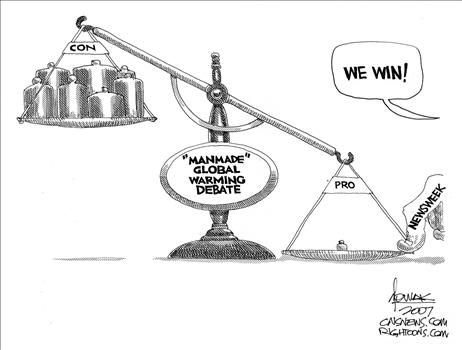
Time Out, Ican and Parados! Y'all goin' around in circles - break, break, break!
Good news for polar bears, even if no ice is left in the oceans: their DNA shows they've gone through an interglacial much warmer than now about 100,000 years ago and came out of it just fine >>
Quote: Professor Ingolfsson is hopeful the bears will cope - and believes the palaeo-record will offer some reassurance.
"The polar bear is basically a brown bear that decided some time ago that it would be easier to feed on seals on the ice. So long as there are seals, there are going to be polar bears. I think the threat to the polar bears is much more to do with pollution, the build up of heavy metals in the Arctic.
http://news.bbc.co.uk/2/hi/science/nature/7132220.stm
>> but as many of us have said all along, pollution with heavy metals is by far the greater threat to them, and to us!

That's where I think our environmental gurus should be focusing instead on futile efforts to alter what is most likely normal climate fluctuations. I would like for us to be concentrating all our efforts on controlling and/or eliminating substances that are proved to be harmful to the enviroment and all living creatures on our planet, including us. I do hope they use better science to determine what is and is not harmful overall, however, than they seem to use to prove a case for global warming.
Yeah, the debate is over... for Al Gore.
A March poll by Gallup on Americans shows that global warming ranks 9th in the list of environmental worries and down 4 points compared the same poll made in 2007:
http://www.gallup.com/poll/104932/Polluted-Drinking-Water-No-Concern-Before-Report.aspx
The more the AGW crowd gets hysterical, the more Americans get cool

Al Gore must be picking up his quick & scam money like crazy before the turn of the tide.
Foxfyre wrote:parados wrote:okie wrote:parados wrote: Are you sure you want to use a site that lists historical papers and measurements that have since been shown to be wrong as your source for what you think CO2 has been the last few centuries?
I don't know about you okie, but I wouldn't use a paper from 1958 as my source since Mauna Loa measurements had not yet been nor had the present ice cores been done.
I'm not bragging on the data, but I wouldn't brag on ice cores either, parados. If its all we have, its all we have. By the way, you dodged the CO2 emissions by plants. Which is it, they absorb more or the same or less, and what are you including, living plants or the entire plant cycle? You can't have it both ways, and I think you have tried.
When did I claim it wasn't the entire cycle that created a zero sum?
I hardly dodged it. I ignored it because you have nothing to base your wild accusation on. By changing the type of plants or increasing the amount of biomass you can change the cycle but the natural cycle has been pretty much a zero sum game for centuries.
So given this bit of scientific information re this zero sum game, why does the IPCC recommend carbon credits be extended to those countries with large amounts of vegetation? Would you say that this policy recommendation is based on faulty science?
http://www.bicusa.org/en/Article.3454.aspx
Not cutting down forests is a way to reduce CO2 emissions.
okie wrote:parados wrote: When did I claim it wasn't the entire cycle that created a zero sum?
I hardly dodged it. I ignored it because you have nothing to base your wild accusation on. By changing the type of plants or increasing the amount of biomass you can change the cycle but the natural cycle has been pretty much a zero sum game for centuries.
"Wild accusation?" Earth to Parados, I am only asking you a question and pointing out an inconsistency: You claim the natural cycle is pretty much a zero sum game, but in the next breath you claim it would really matter to plant trees or certain kinds of plants, I guess it has to be certain kinds of trees or plants, and it only works while they are alive for however long they live? I guess you want to pretend some plants don't die and rot?
Trees can and do live for centuries. You did know that didn't you okie?
4,700 year old pine tree
AVERAGE GLOBAL TEMPERATURE °K INCREASE 1975 TO 2005
287.0281 °K + 0.6365 °K = 287.6646 °K. That's a 0.2217% increase.
CARBON DIOXIDE PPM INCREASE IN THE ATMOSPHERE 1975 TO 2005
331 ppm + 48 ppm = 379 ppm. That's a 14.5% increase.
CARBON DIOXIDE BMT INCREASE IN THE ATMOSPHERE 1975 TO 2005
76.25 bmt + 76.25 bmt = 152.5 bmt. That's a 100% increase.
High Seas wrote:Time Out, Ican and Parados! Y'all goin' around in circles - break, break, break!
I am just curious why you haven't corrected ican about his statements High Seas. Can we assume your silence means you agree with his math and logic?
http://www.able2know.org/forums/viewtopic.php?p=3136213#3136213
ican711nm wrote:AVERAGE GLOBAL TEMPERATURE °K INCREASE 1975 TO 2005
287.0281 °K + 0.6365 °K = 287.6646 °K. That's a 0.2217% increase.
CARBON DIOXIDE PPM INCREASE IN THE ATMOSPHERE 1975 TO 2005
331 ppm + 48 ppm = 379 ppm. That's a 14.5% increase.
CARBON DIOXIDE BMT INCREASE IN THE ATMOSPHERE 1975 TO 2005
76.25 bmt + 76.25 bmt = 152.5 bmt. That's a 100% increase.
Could you comment on this statement High Seas? I would love to see if you think CO2 can increase only 14.5% in ppm at the same time it increases 100% in BMT as ican just claimed.
parados wrote:ican711nm wrote:AVERAGE GLOBAL TEMPERATURE °K INCREASE 1975 TO 2005
287.0281 °K + 0.6365 °K = 287.6646 °K. That's a 0.2217% increase.
CARBON DIOXIDE PPM INCREASE IN THE ATMOSPHERE 1975 TO 2005
331 ppm + 48 ppm = 379 ppm. That's a 14.5% increase.
CARBON DIOXIDE BMT INCREASE IN THE ATMOSPHERE 1975 TO 2005
76.25 bmt + 76.25 bmt = 152.5 bmt. That's a 100% increase.
Could you comment on this statement High Seas? I would love to see if you think CO2 can increase only 14.5% in ppm at the same time it increases 100% in BMT as ican just claimed.
Finally, Parados, you have begun to get it!
My calculation of percentages is based on IPCC numbers, not my numbers. Keep up the good work, Parados. There are at least two more IPCC logical flaws there for you to discover.
So how many 4,700 year old trees do you own, or how many does Al Gore own, Parados? With a straight face, tell me that you have alot of trees that you have planted or that Al Gore has planted that will live more than a hundred years, or maybe in some cases a few hundred years. Big deal anyway, a hundred years or a few hundred years is miniscule in in the grand scheme of things.
And the big question is why should you get credit for something that will most assuredly die at some point and eventually cancel out the credit? Will your children or grandchildren have to pay your carbon debts for your dying trees?
P.S. I have seen bristlecone pine trees, have you? They are not that plentiful and the effort to get one to grow is not an easy or quick thing I would bet, and the likelihood that you could grow enough to amount to a hill of beans, carbon credit wise is preposterous. Besides, they only grow at high elevations.
hate to tell you this, okie, but we're pretty minuscule in the grand scheme of things too. If we foul our own nest, the universe is not gonna give a sh*t. No free passes for us. If we screw up, we're gonna have to get ourselves out of it. And in human terms, a hundred years is a long time, as Brazil keeps chopping down the rainforest to grow beef for your Big Mac, I say good for Al Gore planting trees, and keeping that good oxygen coming. Hell of a lot better to breathe oxygen than CO2. Hell of a lot cooler too.
If we are so miniscule, then how are we capable of destroying the earth? I think you have it all wrong. It is the environmental crowd that is totally arrogant that they first of all think that they need to "save the earth," and secondly that they are even capable of it if it actually needed saving. The whole proposition of saving the earth is preposterous in my opinion. It is nothing more than liberal bilge that was dreamed up and foisted upon our children to indoctrinate them in school.
Chopping down trees is not going to destroy the earth. Besides, in areas like Oklahoma, there are literally hundreds of thousands, if not millions of trees more than existed before it was settled by Europeans. I would venture to guess that there are more trees in the U.S. than existed prior to 1776. I saw a study once many years ago that indicated that to be the case. I haven't researched it recently, but my experience of traveling around the country tends to indicate it probably is the case.
And the whole point of the debate with Parados was, in case you missed it, was the fact that he claimed that plants are pretty much a zero sum game in terms of absorbing CO2 when you consider the entire life cycle to include dying and rotting plants. When Foxfyre wondered why environmentalists thought planting trees did any good, then he has now resorted to the idea that well, if you plant trees that live a long time, then it is beneficial! Now if you buy that as logical, then good luck. He hasn't changed anything, but instead just lengthened the cycle, but with the same result. I guess if the trees outlive him, then his children or grandchildren can pay the carbon debts, is that it? I don't think the reasoning is very brilliant if you ask me.
Most of the carbon sequestered in the earth is from dead and decayong plant matter. Increase the sequestration, you lower albedo, reducing heat gain, you enable the ground to retain more water, and water is going to be one of the huge problems of this century, since we're drawing more from just about every major aquifer and water source in the world now than can be sustained, plus you increase agricultural potential, which mechanized agriculture has severely reduced. Not to mention the reduced impact of global warming. Increasing soil-sequestered carbon can minimize global warming, desertification and biodiversity loss, and it makes good long-term economic sense as well, once you look beyond the five-year balance sheet.
"mongabay.com
February 21, 2008
Restoring the ability of soil to store carbon by promoting native grasses and vegetation can help reverse global warming, desertification and biodiversity loss, says an Australian researcher.
Land use change ?- including deforestation, bush fires, and soil degradation ?- accounts for roughly 20 percent of global greenhouse gas emissions, but land management practices can be used to reduce emissions. While reforestation and avoided deforestation have garnered a lot of attention of late, restoration of other forms of vegetation can dramatically increase the capacity of degraded landscapes to store carbon.
Tony Lovell of Soil Carbon P/L in Australia estimates that by actively supporting regrowth of vegetation in damaged ecosystems, billions of tons of carbon dioxide can be sequestered from the atmosphere.
In February 2008, Lovell discussed the potential of soil carbon restoration.
--------------------------------------------------------------------------------
Mongabay: What are the advantages of increasing the capacity of soil to store carbon?
Lovell:
In arid and seasonally dry areas, continuous grazing creates disasters like that on the left. Returning to herding-style management with long recovery periods between grazings heals the land (right)
We are not so much increasing the capacity of soil to store carbon as restoring its ability to store carbon. The result of conventional agricultural practices such as artificial fertilizing, ploughing, stubble burning, bare fallows, etc is to run down the organic matter in the soil, and it is this organic matter that is the source of stored soil carbon. The main advantages in direct global warming terms (sources/sinks) of restoring soil's ability to store carbon are that it is immediate, massive and involves capturing excess CO2 from atmospheric circulation. There are additional huge benefits in terms of water retention, drought tolerance, biodiversity increase, cost decreases, etc as well. The immediacy is a result of using the natural biological process of photosynthesis ?- as the grasses and other plants grow they absorb C02 each and every day. The massive capacity is simple mathematics.
Determining how much carbon dioxide (CO2) can physically be consumed from the atmosphere?
LEFT: This river in Zimbabwe used to flow year-round. Then overgrazing by wandering livestock bared much of the soil in the surrounding area. Today the river flows only as flash floods following heavy rains. Biodiversity loss is severe, livestock are starving, and most wildlife has disappeared. RIGHT: This nearby river had similar problems. It now has water year-round, and flows during most of the year. Drought is rare, biodiversity is increasing, and wildlife has reappeared in large numbers. Soil Carbon P/L notes that capturing just 1 mm more rain per year means: 1 liter more usable water per square meter; 10,000 liters more water per hectare; 1,000,000 liters more water per square kilometer; Less drought, because more water stays in the soil to recharge rivers, springs, and wells; and more forage, because plants can also use that water.
As the planet has 7.8 billion tonnes of carbon dioxide in circulation for each 1 ppm of atmospheric CO2, and there are 5 billion hectares of inappropriately managed or unmanaged, desertifying savannahs on the Earth (which on empirical evidence we contend to be the case), the question that should sensibly be asked is: How much carbon dioxide would be absorbed if policies were put in place (in Australia and elsewhere) that caused the focus of on-ground management to be deliberately directed towards the widespread consumption of cyclical GHGs within the currently under-utilised savannah lands?
Consumption of CO2 per hectare
One hectare is 10,000 sq. metres. If a hectare of soil 33.5 cm deep, with a bulk density of 1.4 tonnes per cubic metre is considered, there is a soil mass per hectare of about 4,700 tonnes.
If appropriate management practices were adopted and these practices achieved and sustained a 1% increase in soil organic matter (SOM)6, then 47 tonnes of SOM per hectare will be added to organic matter stocks held below the soil surface
This 47 tonnes of SOM will contain approximately 27 tonnes of Soil Carbon (ie 47 tonnes at 58% Carbon) per hectare
In the absence of other inputs this Carbon may only be derived from the atmosphere via the natural function known as the photo-synthetic process. To place approximately 27 tonnes of Soil Carbon per hectare into the soil, approximately 100 tonnes of carbon dioxide must be consumed out of the atmosphere by photosynthesis
A 1% change in soil organic matter across 5 billion hectares will sequester 500 billion tonnes of physical CO2
Converting global Soil Carbon capacity to ppm of atmospheric GHGs
Every 1% increase in retained SOM within the topmost 33.5 cm of the soil must capture and hold approximately 100 tonnes per hectare of atmospheric carbon dioxide (the variability in the equation being due only to the soil bulk density). We submit that under determined, appropriate management, that this is readily achievable within a very few years
For each 1% increase in SOM achieved on the 5 billion hectares there will be removed 64 ppm of carbon dioxide from atmospheric circulation (500,000,000,000 tonnes CO2 / 7,800,000,000 tonnes per ppm = 64 ppm).
Soil Organic Matter is the plant material released into the soil during the natural phases of plant growth. It includes root material sloughed off below the soil surface and plant litter carried into the soil by microbes, insects and rainfall
Soil Carbon is the elemental carbon contained within Soil Organic Matter (SOM).
One tonne of CO2 contains 12/44 units of carbon (ie 0.27 tonnes of carbon per tonne of CO2.). Therefore 27 tonnes of carbon sequesters 27/0.27 = 100 tonnes CO2 (rounded). NB Carbon atomic weight 12, oxygen atomic weight 16 ie CO2 = 12+(16+16) = 44
The global opportunity and numbers
TOP: This cattle ranch in Sonora, Mexico, is typical of hundreds of millions of hectares of grazing land in arid and seasonally dry areas worldwide. BOTTOM: This is the neighboring ranch, La Inmaculada. The ranch is in the same area; has the same rainfall, same soils, and same plant species. The pictures were taken on the same day and La Inmaculada actually has more cattle than the drier ranch. The only difference between the two is management
It appears that the pre-industrial level of atmospheric carbon dioxide was 280ppm, and that globally we are now at 455ppm, and heading towards 550ppm. To get from 550ppm back to 280ppm, 270ppm must be removed. Globally, a 4.2% increase in SOM would potentially reverse the expected situation. In any case, any form of determined management will substantially reduce the now crippling legacy loadings in the atmosphere.
--------------------------------------------------------------------------------
Mongabay: How does one restore carbon to the Earth?
Lovell: By actively mimicking nature and thereby allowing natural cycles to reinvigorate. Arid and semi-arid grazing lands co-evolved with massive herds of grazing animals that were kept bunched up by the presence of pack-hunting predators. When humans removed these predators and fenced in the animals we severely disrupted this natural behaviour leading directly to desertification and massive release of soil carbon into atmospheric circulation. The process that actually removes CO2 from atmospheric circulation is photosynthesis. A simple question for anyone ?- think of the biggest plant you have ever seen ?- it is probably a huge tree more than 50 metres tall, 10 metres around and weighing hundreds of tonnes. You can walk up to this tree and hit it ?- it is solid. Where did the material come from to make this tree? Far too many people answer ?- "from the ground the tree is growing in". The truth is that over 50% of the solid "thumpable" bit of the tree came directly out of the atmosphere as CO2. While a tree is much more visible than grass, the result is the same.
The global opportunity and numbers
This simple picture says it all ?- if we allow the grasses to express themselves to the stage shown on the right they absorb CO2 from atmospheric circulation and turn it into plant material. We then manage our grazing animals to eat the grass down to the level somewhere between the middle 2 grass plants. At this point the reduced leaf mass is unable to support the large root mass, and so the plant sloughs off the now excess root material (carbon). The plant then commences to regrow but critically it regrows using carbon absorbed by photosynthesis, not the carbon it previously sloughed off. Repeat this process and you in essence "pump" CO2 out of the atmosphere and store it underground.
--------------------------------------------------------------------------------
Mongabay: What does Soil Carbon Australia offer?
Lovell: Our main focus is on raising awareness of the important role soil carbon plays in mitigating global warming, and ideally on having it recognized as a tradeable item under any global emissions trading scheme. This will dramatically change the incentives that farmers respond to and thus bring about a massive positive change in agricultural practices.
--------------------------------------------------------------------------------
Mongabay: Where are you working?
Lovell: We are based in Australia, and have colleagues in the USA, New Zealand, Spain, England, South Africa and South America.
--------------------------------------------------------------------------------
Mongabay: Have you looked at the potential to earn carbon credits for sequestration?
Lovell: Yes ?- it is widely recognized and accepted that soil carbon sequestration works ?- the only questions are ones of measurement, monitoring and verification (MMV). We as a society have dealt eith these MMV issues in regards to afforestation and deforestation so should be able to do so with regards to soil carbon.
--------------------------------------------------------------------------------
Mongabay: Are you familiar with "terra preta" soils in the Amazon? If so, how does your process compare with this form of soil carbon?
Lovell: "terra preta" is probably the best example of just what we are talking about ?- a carbon rich, biologically active soil created as a result of appropriate human management. In the 5 billion hectares we want to bring attention to the results will not be as dramatic due to the lower rainfall and inherently poorer quality of the soils themselves, but the results will be significant and well worthwhile."
<delete "biodiversity loss". I can't remember what I meant to say there, but it wasn't that>
username, I am glad you have all of that figured out. It should now be easy to feed all of that data that is pinned down so exact into a computer and come up with exactly what the problem is and what we need to do to fix it. The scenarios you present are very straightforward, and free of any potential errors, interpretations, and calculations.

parados wrote:Foxfyre wrote:parados wrote:okie wrote:parados wrote: Are you sure you want to use a site that lists historical papers and measurements that have since been shown to be wrong as your source for what you think CO2 has been the last few centuries?
I don't know about you okie, but I wouldn't use a paper from 1958 as my source since Mauna Loa measurements had not yet been nor had the present ice cores been done.
I'm not bragging on the data, but I wouldn't brag on ice cores either, parados. If its all we have, its all we have. By the way, you dodged the CO2 emissions by plants. Which is it, they absorb more or the same or less, and what are you including, living plants or the entire plant cycle? You can't have it both ways, and I think you have tried.
When did I claim it wasn't the entire cycle that created a zero sum?
I hardly dodged it. I ignored it because you have nothing to base your wild accusation on. By changing the type of plants or increasing the amount of biomass you can change the cycle but the natural cycle has been pretty much a zero sum game for centuries.
So given this bit of scientific information re this zero sum game, why does the IPCC recommend carbon credits be extended to those countries with large amounts of vegetation? Would you say that this policy recommendation is based on faulty science?
http://www.bicusa.org/en/Article.3454.aspx
Not cutting down forests is a way to reduce CO2 emissions.
Yes, that is my understanding too, but you can't have it both ways. Either plants remove CO2 from the atmosphere or the plant cycle is a zero sum gaime.
The former UK's PM Tony Blair will lead a new international team to tackle the intractable problem of securing a global deal on climate change.
A group, which has the backing of the USA and China.
Act urgently or global warming will be irreversible, he warns:
Blair to lead campaign on climate change
Quote:Blair said: "Essentially what everyone has agreed is that climate change is a serious problem, it is man-made, we require a global deal, that there should be a substantial cut in emissions at the heart of it, and this global deal should involve everyone, including in particular America on the one hand and China on the other, so it is the developed and developing world.
username wrote: Increasing soil-sequestered carbon can minimize global warming, desertification and biodiversity loss, and it makes good long-term economic sense as well, once you look beyond the five-year balance sheet.
"mongabay.com
February 21, 2008
...
Tony Lovell of Soil Carbon P/L in Australia ...
And of course, Lovell just cares about "saving the planet", not about his 5-year BS (oops, balance sheet).