The LORD said, “I am going to destroy everything on earth, all human beings and animals, birds and fish. I will bring about the downfall of the wicked. I will destroy the whole human race, and no survivors will be left.
Or like those in the day of Noah, will we ridicule those who are prepared to make those necessary preparations, until they were swept away with the waters of the flood?
Summary: Tiny plastic particles aren’t just choking oceans and cities—they’re quietly infiltrating forests too. Scientists discovered that most microplastics arrive through the air, settling onto treetops before being washed or dropped to the forest floor in rain and falling leaves. Once there, natural processes like leaf decay help bury and store these particles deep in the soil. The findings reveal forests as hidden reservoirs of airborne pollution—and potentially a new frontline in the growing microplastics crisis.
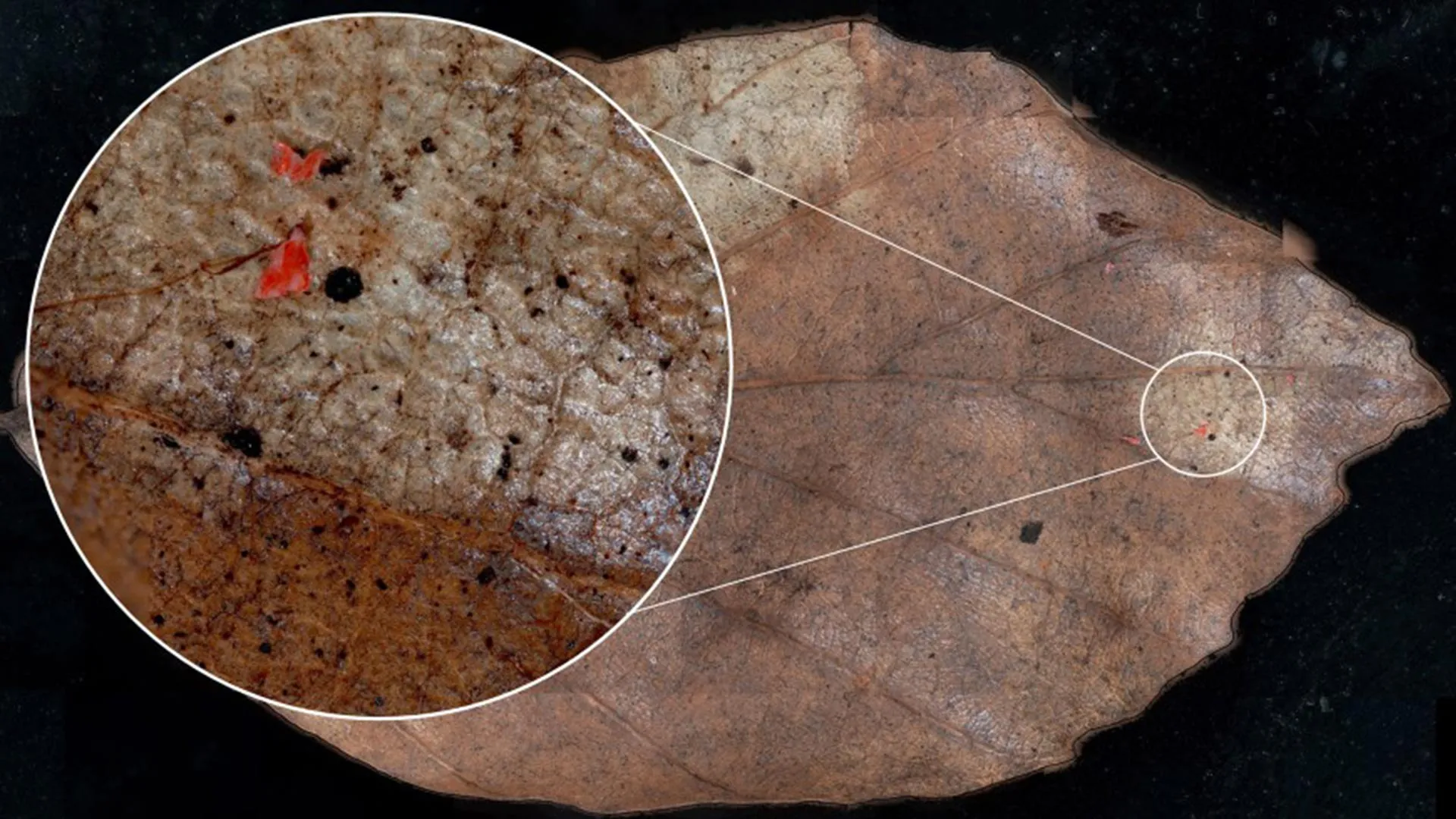
The research team developed a customized method for analyzing microplastics on leaf surfaces. Credit: Collin Weber
Microplastics and nanoplastics are widely known for contaminating oceans, rivers, and farmland. New research now shows they are also accumulating in forests. Geoscientists at TU Darmstadt report this finding in a study published in Nature Communications Earth & Environment, highlighting a largely overlooked form of environmental pollution.
The study reveals that forests are not just affected by local pollution sources. Instead, most microplastics arrive through the air and gradually build up in forest soils. According to the researchers, these tiny plastic particles first land on the leaves in the upper canopy.
"The microplastics from the atmosphere initially settle on the leaves of the tree crowns, which scientists refer to as the 'comb-out effect'," explains lead author Dr. Collin J. Weber from the Institute of Applied Geosciences at TU Darmstadt. "Then, in deciduous forests, the particles are transported to the forest soil by rain or the autumn leaf fall, for example."
How Plastic Particles Move Into the Soil
Once on the forest floor, natural processes take over. The breakdown of fallen leaves plays a key role in trapping and storing microplastics in the soil. The researchers found the highest concentrations in the top layer of leaf litter, where decomposition has just begun. However, significant amounts were also detected deeper underground.
This movement into lower soil layers is linked not only to the decomposition of organic material but also to biological activity, such as organisms that help break down leaves and redistribute particles.
Measuring Microplastics in Soil, Leaves, and Air
To better understand how microplastics accumulate, the research team collected samples from four forest sites east of Darmstadt in Germany. They analyzed soil, fallen leaves, and atmospheric deposition (the transport of substances from the Earth's atmosphere to the Earth's surface) using a newly developed method combined with spectroscopic techniques.
In addition, the scientists created a model to estimate how much microplastic has entered forests from the atmosphere since the 1950s. This helped them assess how much of the total pollution stored in forest soils can be traced back to airborne sources.
Forests as Indicators of Airborne Plastic Pollution
"Our results indicate that microplastics in forest soils originate primarily from atmospheric deposition and from leaves falling to the ground, known as litterfall. Other sources, on the other hand, have only a minor influence," explains Weber. "We conclude that forests are good indicators of atmospheric microplastic pollution and that a high concentration of microplastics in forest soils indicates a high diffuse input -- as opposed to direct input such as from fertilizers in agriculture -- of particles from the air into these ecosystems."
A New Environmental and Potential Health Concern
This research is the first to clearly show how forests become contaminated with microplastics and to directly connect that contamination to particles transported through the air. Until now, this pathway had not been thoroughly studied.
The findings provide an important foundation for evaluating the environmental risks of microplastics in both air and soil. "Forests are already threatened by climate change, and our findings suggest that microplastics could now pose an additional threat to forest ecosystems," says Weber. The results may also have implications for human health, as they underscore how microplastics travel globally through the atmosphere and may be present in the air we breathe.
Atlantic Ocean currents that are vital for keeping Earth's climate in check will halve in strength by 2100 and may be closer to collapse than first thought, a new study finds.
The Atlantic Meridional Overturning Circulation (AMOC) acts as an oceanic conveyor belt, circulating warm water north from the tropics and cold water south. This regulates climates across Europe, Africa and America while also sustaining aquatic life.
Now, a study estimates the AMOC will slow down between 43% and 59% by 2100 — a 60% stronger weakening than past models predicted. The research corrects for biases in previous estimates by including the temperature and saltiness of the Atlantic Ocean's surface, according to the study published Wednesday (April 15) in the journal Science Advances.
This "more substantial AMOC weakening" means that a critical planetary system is closer to a tipping point — an irreversible "point of no return" for the climate — than many past models suggest, the authors wrote in the study.
However, other experts note that the predicted magnitude and speed of an AMOC slowdown varies greatly from study to study.
"In my opinion there is a need to interpret new results for each study into a wider context," María Paz Chidichimo, an expert on ocean circulation at the National Scientific and Technical Research Council (CONICET) and National University of San Martín in Buenos Aires, Argentina, told Live Science in an email.
"Studies predict AMOC decline on a range from small decline to large decline, but I think the magnitude and timing of AMOC decline are still uncertain given the large spread in model projections," she added.
Laura Jackson, an expert in North Atlantic ocean currents at the Met Office in the U.K., agreed. "It is still an open question as to which model AMOC projections are most likely," she told Live Science in an email.
Catastrophic collapse
An AMOC collapse would last for hundreds to thousands of years and have catastrophic consequences. It would send temperatures in northern Europe plummeting while southern Europe experiences extreme droughts. The sea level would rise along the northeast coast of North America. Disruption would spread across food webs and ecosystems in the ocean and on land — for example, the amount of land available for growing wheat and maize, which supply two-fifths of global calories, would be cut by more than half.
Modeling the AMOC slowdown
Observations reveal that the AMOC has weakened compared with its 1850 to 1900 baseline. Previous research has attempted to estimate the strength and pace of the AMOC slowdown, with some studies finding minimal weakening by the end of the century while others predict an imminent collapse.
However, because continuous AMOC monitoring only began in 2004, few previous studies have included real-world observations in their calculations. And where real data has been used, most studies only incorporated a single observable variable, such as past AMOC strength or average seasonal temperature changes, the authors wrote in the study.
Yet since AMOC is a complex system, multiple observable variables should be considered in climate models, the authors wrote.
In this new study, the researchers used different statistical methods to compare the performance of various climate models that project an AMOC based on different emission scenarios, evaluating which was most accurate at predicting the future AMOC's slowdown.
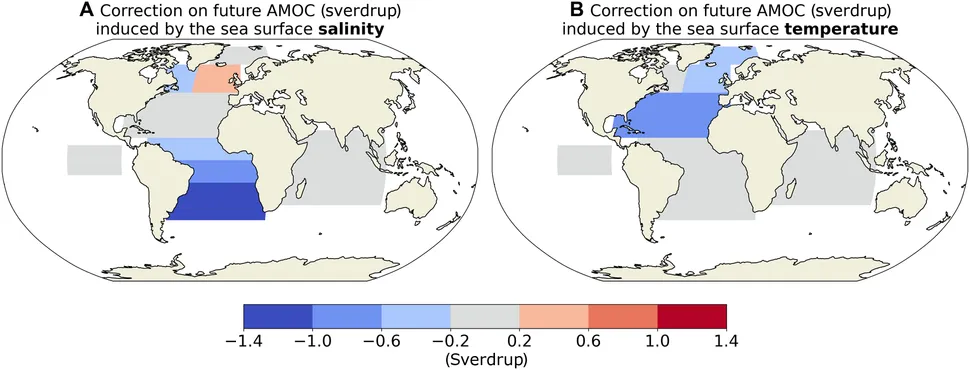
The scientists found that the most accurate model paired sea surface temperatures and salinity across the Atlantic with a statistical method rarely used in climate modeling. This method, called "ridge-regularized linear regression", reduced the prediction error of the model by 79% compared with the standard modeling approach.
The new study suggests that the greater the simulated sea surface salinity in the south Atlantic, the weaker the AMOC is estimated to be by 2100. (Image credit: Portmann et al, Science Advances (2026) CC-BY-NC)
This model estimated that AMOC will slow by around 51% from its 1850 to 1900 average. The Intergovernmental Panel on Climate Change's (IPCC) 2022 report called a 50% AMOC slowdown a "substantial weakening."
"This is a key result with implications for the future climate of the Atlantic and beyond," the authors wrote in the study.
While these results are not particularly surprising, the finding that "the projected weakening is larger than previously thought is clearly worrying," David Thornalley, a professor of ocean and climate science at University College London in the U.K. who was not involved in the research, told Live Science in an email.
The predicted AMOC is "so weak that it is then very likely on the way to full shutdown," Stefan Rahmstorf, a professor of ocean physics who heads the Earth system analysis department at the Potsdam Institute for Climate Impact Research in Germany, told Live Science in an email.
Even so, experts told Live Science that AMOC model estimates are largely driven by which variables are included in the analyses, so results can vary. And although the new study corrects for previous biases, there "remains uncertainty in how well models can simulate and predict changes in the AMOC," Thornalley said.
Focusing too heavily on an AMOC collapse may not be the most helpful path forward, Chidichimo said. "We have enough scientific evidence of AMOC variability and slowdown, and we are already experiencing environmental changes associated with AMOC change which have important socioeconomic impacts world wide," she said. "Nations need to prepare now."