Thursday, June 05, 2008
Icelandics A Special Breed
By Lee Ross
New Mexico Mountain View Telegraph
A 900 pound lap-dog is how Paula Hodges describes her Icelandic horse, Alfur.
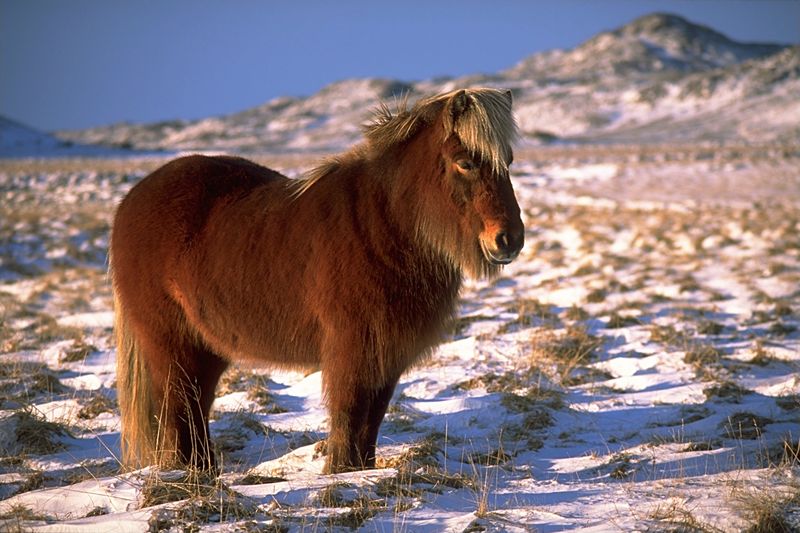
Icelandic horses ?- which look like furry, stocky ponies with spiked hairdos ?- are a special breed, Paula said.
"They even breathe differently," she said as she walked out to see the six Icelandic horses she and her husband, Wayne, own.
Paula explained that the horses take shallower breaths to compensate for the cold winter air in Iceland. As she talked, the horses came to visit her and her husband on their pasture land, which is a few acres in northern Stanley.
She and her husband sometimes train the horses in a small arena that shows the couple's eclectic tastes: It is decorated with Tibetan prayer flags that Wayne said he got at an arts and crafts fair in the East Mountains. He said they've never been to Tibet, though they'd love to go.
As Paula continued her discourse on Icelandic horses, Wayne saddled and then brought a horse to the arena.
Icelandic horses also have a longer intestine than most horses, Paula said, which means they aren't as susceptible to colic. She also said, with no natural predators in Iceland since they were introduced there in 1865, the horses don't "spook" as easily.
In fact, the Icelandic's bloodlines are closely guarded. Once the horses have set foot on foreign soil, they are not allowed back to their native land. And there is another interesting rule to the breed.
"All Icelandics have to have Icelandic names," Paula said.
The horses have names like Bjork, which means birch tree; Baldur, the name of a Norse god; and Stjarni, which means star.
Alfur, which means elf, is the horse Paula mounted and walked around the arena to show off how smooth the ride is.
It's a breed that is becoming increasingly popular. In fact, there was a demonstration in 2001 held at the Outpost Ice Arena, a skating rink in Albuquerque.
"That house was absolutely packed. You couldn't put another body in it," Paula said.
In Iceland, the horses are raced on frozen lakes and can reach 35 miles per hour, according to Paula. They run on the ice at a gait called "pace," in which the legs on either side of the horse move together. Unlike other horses, Icelandic horses are relatively easy to ride at this gait. To cut into the ice, the horses are fitted with special carbide-tipped shoes for the races, Wayne said.
"It's very dangerous," Wayne said.
Instead of racing on ice, Paula and Wayne use the horses to compete in mounted shooting competitions held by the Single Action Shooting Society at the Founder's Ranch in Torrance County.
Paula said the breed was first brought to New Mexico in the 1990s, as far as she knows, by Ula Hudson from Cedar Grove. Around that time Paula, a relatively inexperienced horse rider, was able to ride one of Hudson's horses, an Icelandic stallion.
Stallions are known to be high-spirited and this one had only been ridden once before, but, Paula said, that is not how the horse she rode behaved.
"He (the horse) was just a perfect gentleman all the way, so I was more than sold," she said.
She also said that unruly horses are probably not bred in Iceland, where they eat horse meat. There's a saying that if a horse kicks in the day it'll be dinner that night. She added that she's not sure of the veracity of the saying.
The horseflesh, so to speak, is not cheap. At about $8,000 to $15,000 per horse, according to Paula, Icelandics fetch a comparatively high price. And they're worth it, Paula said.
"They're such personable horses," Paula said.
She said they live to be 35 to 50 years old; the oldest, which worked pulling a cart, lived to be 57.
"His person died," she said. "The horse stopped eating."


 Stumble It!
 Tweet This
 Bookmark on Delicious
 Share on Facebook
 Share on MySpace