1
   

Railway Imagery: When Artists Look Down the Track


Reply Mon 9 Jun, 2008 01:53 am
I like those paintings (especially the Pissarro) :wink:


From today's (New York) Sun [print edition: 09.06.08, front page and page 16)

http://i32.tinypic.com/1zvskqo.jpg


http://i29.tinypic.com/ibhr3l.jpg
  • Topic Stats
  • Top Replies
  • Link to this Topic
Type: Discussion • Score: 1 • Views: 2,263 • Replies: 20
No top replies

 
Walter Hinteler
 
  1  
Reply Mon 9 Jun, 2008 01:56 am
Quote:
When Artists Look Down the Track
Railway Imagery Is Explored At Two Museums


By CHARLOTTE COWLES, Staff Reporter of the Sun
June 9, 2008

The mystique of the railways has attracted artists since the mid-1800s. The advent of sprawling new connections between cities, coasts, and populations provided a common subject for artists looking to capture modernity. Trains have steamed across canvases by British Victorian artists, Impressionists, and American realists who were engaged by the themes of technological innovation, class difference, and the changing relationship between distance and time.

In an exploration of the connections between artists' interpretations of train imagery, two museums ?- National Museums Liverpool in England and the Nelson-Atkins Museum of Art in Kansas City ?- have collaborated on a show and an accompanying book, "The Railway: Art in the Age of Steam."

Co-author and editor of the book Ian Kennedy, who is also a curator at the Nelson-Atkins Museum, emphasizes the importance of connecting American and European perspectives. "The idea of the train and art has been very well-covered in literature," Mr. Kennedy said, citing the widely known idea of trains' popularity with the Impressionists. "The iconography of it has been well-addressed."

This show explores new territory by comparing train imagery across centuries and oceans, contrasting artists' interpretations of the railway that stem from their nationalities, time periods, and political agendas. "We wanted to see how artists responded to the subject," Mr. Kennedy said. "We wanted to have art talking about the railway on an international basis." The colorfully illustrated volume not only includes examinations of the visual representations of the railroad, but also combines several disciplines, including literary and sociopolitical history, to study its presence in art in both Europe and America.

Mr. Kennedy notes that when steam-powered trains first exploded onto the European landscape in the mid-1840s, they were met with awe, fear, and wonder. Such emotions were reflected most notably in J.M.W. Turner's "Rain, Steam, and Speed - the Great Western Railway" (1844). With shimmering atmospheric effects and dramatic proportions, the artist was able to evoke a nation's anxiety and admiration for the new railway travel.

While art is often a medium for reflecting a cultural mindset, it is also a tool used to shape opinion ?- a theme that is taken up here. "British Victorian artists would use the railways for social comment," Mr. Kennedy said. "People were thrown together in train cars like never before."

Examples in the book include British artist Abraham Solomon's "First Class: The Meeting ... and at First Meeting Loved" (1854), which he produced in contrast to "Second Class: The Parting 'Thus part we rich in sorrow, Parting poor'" (1855). The two works portray the differences between the passengers and conditions in the different modes of railway travel, and also highlight the gaps in social strata existing within British society. These images were some of the first to highlight the railways' compartments as an expression of class distinction, Mr. Kennedy said. They were later reworked and engraved, which led to their widespread distribution and, in turn, the association between railway travel and social standing.

In America, artists used images of the railway to make statements of a different sort. "American photographs from the 1860s to the 1880s were very promotional in addition to being works of art," Mr. Kennedy said. Photographer Andrew J. Russell, among others, worked to "highlight the tourist potential of areas previously considered dangerous," Mr. Kennedy, in his essay "Crossing Continents," wrote. "Indeed it is remarkable how quickly the West developed from being a frontier wilderness into a tourist attraction."

Russell photographed trains chuffing easily past craggy mountaintops, through yawning tunnels, and over bridges spanning deep precipices. "The idea of seeing nature as something beautiful rather than an obstacle came directly out of railways," Mr. Kennedy said. "The train enabled people to see the Rockies as objects of natural beauty rather than a danger." He subscribes to the historical theory that National Parks are a direct result of the Union Pacific, as people learned to see nature as something to be admired and preserved rather than a nuisance to be overcome.

During the Depression, trains became a nostalgic symbol of hope. "It was an antidote to difficult times during the depression," Mr. Kennedy said. "People celebrated railways the same way that they celebrated factories belching out smoke. It showed that people were busy and people had jobs." He cited the Thomas Hart Benton paintings of the 1930s, such as "The Engineer's Dream" (1931), which highlights the thick black cloud billowing from the steam engine.

The book covers art produced until the 1960s, when various other fuels replaced steam for train power. "Trains just aren't relevant in America today, for the distances that we travel," Mr. Kennedy said, "but it's a fascinating way of looking at history. Without the railway, America would never be what it is today."
0 Replies
 
ossobuco
 
  1  
Reply Mon 9 Jun, 2008 12:07 pm
I remember loving some railroad paintings - this'll make me try to remember them.

Will be back with some examples.
0 Replies
 
dagmaraka
 
  1  
Reply Mon 9 Jun, 2008 12:16 pm
http://photos-364.ll.facebook.com/photos-ll-sf2p/v287/153/5/697154364/n697154364_973399_8248.jpg
0 Replies
 
ossobuco
 
  1  
Reply Mon 9 Jun, 2008 12:20 pm
Oooh, that's GREAT, Dag.


Here's a famous painting, from the Art Institute in Chicago - Monet's Arrival of the Normandy Train, Gare Saint-Lazare, 1877


http://www.artic.edu/artaccess/AA_Impressionist/images/Monet-train_lg.jpg
0 Replies
 
Walter Hinteler
 
  1  
Reply Mon 9 Jun, 2008 12:27 pm
I think, Turner can be labeled to have painted as first the way to modern times ...


http://i27.tinypic.com/b8qr9i.jpg
Rain, Steam, and Speed - the Great Western Railway
1844, 91 ?- 122 cm, London, National Gallery
0 Replies
 
ossobuco
 
  1  
Reply Mon 9 Jun, 2008 12:35 pm
Haven't found this photo's history yet, but it is from a link on this site -
http://blog.usa.gov/roller/govgab/tags/history

http://history.utah.gov/news_and_events/currents/images/photo-Train_001.jpg


Manet's The Railway


http://www.nga.gov:80/image/a00006/a0000681.jpg

from the National Gallery of Art (USA) -

Edouard Manet
French, 1832 - 1883
The Railway, 1873
oil on canvas


While the impressionists were preparing for their first exhibition, Manet was completing his submissions to the 1874 Salon, which included this painting. At that time the Gare Saint-Lazare, where the bourgeoisie embarked for popular recreation spots like Chatou and Argenteuil, was the busiest train station in Paris. The station's ambitious bridge, which carried six streets across the rail yard, was a familiar landmark, but for Manet it is an almost invisible background. Only the iron fences and the steam billowing from an unseen engine locate his enigmatic figures. Opposites in blue and white, the woman faces us with a direct but indecipherable stare while the child turns away.

The painting's title?-Manet called it simply "Railroad"?-disturbed Salon audiences. They had trouble matching it with the subject, which itself was hard to define. The woman, close to the front of the picture plane, seems to engage us. Her expression, though, provides no hint of her story, only detachment and ambiguity. It did not help that for many contemporaries, Manet's style, with its broad, flat areas of color juxtaposed without transitional tones, appeared unfinished.
0 Replies
 
ossobuco
 
  1  
Reply Mon 9 Jun, 2008 12:35 pm
love that Turner painting...
0 Replies
 
cjhsa
 
  1  
Reply Mon 9 Jun, 2008 12:48 pm
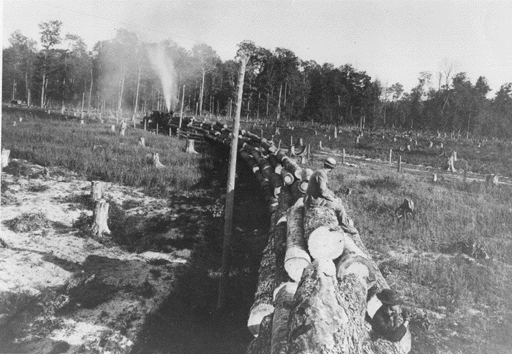
http://www.classroomhelp.com/lessons/michigan/lumberingIMG/large/PH2444.gif

That could easily be my grandfather sitting on that log. This is how Detroit and Chicago were built/rebuilt.
0 Replies
 
wandeljw
 
  1  
Reply Mon 9 Jun, 2008 12:53 pm
http://www.artic.edu/aic/collections/citi/images/standard/WebMedium/WebImg_000003/4230_178696.jpg

The Arcueil Aqueduct at Sceaux Railroad Crossing
Jean Baptiste Armand Guillaumin, 1874

(another one from Chicago's Art Institute)
0 Replies
 
ossobuco
 
  1  
Reply Mon 9 Jun, 2008 12:56 pm
There are a lot of good photos on this site -
http://www.betterphoto.com/gallery/dynoGall2.asp?catID=248&style=&contestCatID=


They are copyright careful. Slightly reminiscent of the Turner is a photo by Connie Bagot... (page 2)
0 Replies
 
ossobuco
 
  1  
Reply Mon 9 Jun, 2008 12:58 pm
I'm remembering that Ragman has a strong photo of a train station on his collection website. Maybe he'll see this thread and post it here.
0 Replies
 
ossobuco
 
  1  
Reply Mon 9 Jun, 2008 03:05 pm
List of movies with TRAINS -

http://www.trains.com/trn/default.aspx?c=a&id=189
0 Replies
 
djjd62
 
  1  
Reply Mon 9 Jun, 2008 03:10 pm
from canadian atist alex colville

http://www.canadacouncil.ca/canadacouncil/archives/prizes/ggvma/2003/images/high_res/Colville_04.jpg

Horse and Train, 1954
0 Replies
 
ossobuco
 
  1  
Reply Mon 9 Jun, 2008 03:12 pm
Wow.... dj.
Tricky installation, or is that the caboose?
or 'shopping'..

I was just looking some more at the BetterPhoto link; my favorite so far is on page 8, Marilyn Cain's End of the Train.
0 Replies
 
djjd62
 
  1  
Reply Mon 9 Jun, 2008 03:16 pm
Trivia about colville's horse and train

His painting "Horse and Train" (1954), was inspired by two lines from the poet Roy Campbell:
"Against a regiment I oppose a brain
And a dark horse against an armored train."

"Horse and Train" appears on the cover of the album Night Vision by Bruce Cockburn.

Alex Colville and his painting "Horse and Train" are mentioned in the introduction (and in the story itself) of Nova Scotia fiction writer Barry Wood's short story Nowhere to Go published in England's Postscripts #14 in 2008.
0 Replies
 
ossobuco
 
  1  
Reply Mon 9 Jun, 2008 03:19 pm
Oh, d'oh. I missed it was a painting. I demote myself to back of the class.


Evocative.
0 Replies
 
Ragman
 
  1  
Reply Wed 11 Jun, 2008 05:25 pm
As requested, here's my pix taken in a subway station in NYC:

http://image20.webshots.com/21/0/56/56/233805656ydCxkG_ph.jpg
0 Replies
 
ossobuco
 
  1  
Reply Wed 11 Jun, 2008 05:48 pm
FORBIDDEN!!

Well, to me, anyway.
0 Replies
 
djjd62
 
  1  
Reply Wed 11 Jun, 2008 05:52 pm
me too
0 Replies


Related Topics

 
  1. Forums
  2. » Railway Imagery: When Artists Look Down the Track
Copyright © 2026 MadLab, LLC :: Terms of Service :: Privacy Policy :: Page generated in 0.03 seconds on 03/06/2026 at 11:12:43