17
   

Get yer polls, bets, numbers & pretty graphs! Elections 2008


Cycloptichorn
 
  1  
Reply Wed 13 Feb, 2008 09:19 am
Fishin is correct - though I will say, it certainly doesn't represent bad news for Obama!

Cycloptichorn
0 Replies
 
nimh
 
  1  
Reply Wed 13 Feb, 2008 10:20 am
fishin wrote:
I mentioned this in the "Obama '08" thread last night but I think it bears repeating - Primary results carry very little, if any, weight as far as extrapolating how any general election results might turn out (other than the obvious of determining who the party's nominee will be).


Hhmmmm...

In the other thread, I echoed your sentiment. I think it's foolish to, as Finn was doing, extrapolate from one candidate winning the primaries to that candidate having the better chance in the general elections. After all, the same things that endear you to a majority of your party's stalwarts, may turn off the floating voters you need in the general elections.

However, it is another thing to examine what independent voters do. They're not party stalwarts. They constitute a sizable chunk of the people you also need to win over in general elections.

If independent voters in Virginia were twice as likely to be motivated to vote by one of the Democratic candidates than by one of the Republican candidates, that is a good sign.

It's nothing much more than that - it doesnt guarantee anything. A lot of factors could be at work -- for example, people thinking that McCain already had it in the bag, so didnt need their vote anymore; better to vote in the (close) Democratic race where your vote still counts for something. But 2:1 is a huge difference, and it is a difference that has emerged time after time, if not quite to this degree, in previous primaries too. Even when the Republican race was still close, it wasnt attracting close to as many independent voters as the Democratic primary did.

There is no guarantee that the indys who decided to vote in the Dem race rather than the Rep one in all of these past primaries will also pull the Dem lever in the GE, of course, no. But it does show an enthusiasm gap of sorts - if many more usually floating/undecided voters take the trouble to go vote for you than for a candidate in the other party, there's evidently more excitement/enthusiasm about your race. That is a good sign, regardless.
0 Replies
 
fishin
 
  1  
Reply Wed 13 Feb, 2008 10:34 am
nimh wrote:
It's nothing much more than that - it doesnt guarantee anything.


This was my overall point. I agree that it is interesting, but there is no precise correlation so people shouldn't jump to conclusions. Wink
0 Replies
 
sozobe
 
  1  
Reply Wed 13 Feb, 2008 10:42 am
Catching up...

Saw the speech in Madison last night, very cool. SUCH a Madison crowd. Kept thinking I recognized people but nobody I was sure about.
0 Replies
 
Cycloptichorn
 
  1  
Reply Wed 13 Feb, 2008 01:42 pm
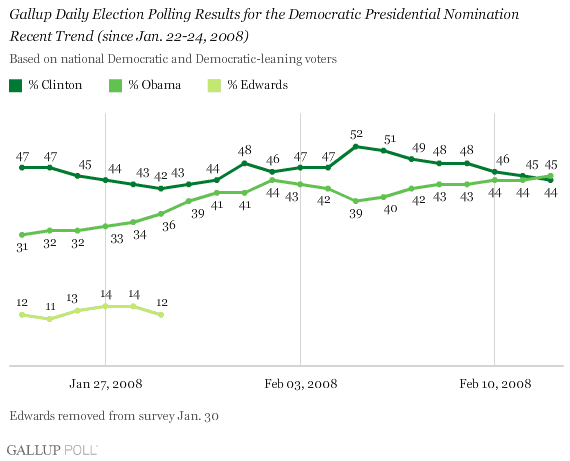
And, the day comes.

Gallup Dailies.

http://media.gallup.com/poll/graphs/021308DailyUpdateGraph1.gif

As these are three-day tracking polls, expect Obama to pull farther ahead over the next few days.

OBAMARAMA

Cycloptichorn
0 Replies
 
Butrflynet
 
  1  
Reply Wed 13 Feb, 2008 02:42 pm
nimh wrote:
fishin wrote:
I mentioned this in the "Obama '08" thread last night but I think it bears repeating - Primary results carry very little, if any, weight as far as extrapolating how any general election results might turn out (other than the obvious of determining who the party's nominee will be).


Hhmmmm...

In the other thread, I echoed your sentiment. I think it's foolish to, as Finn was doing, extrapolate from one candidate winning the primaries to that candidate having the better chance in the general elections. After all, the same things that endear you to a majority of your party's stalwarts, may turn off the floating voters you need in the general elections.

However, it is another thing to examine what independent voters do. They're not party stalwarts. They constitute a sizable chunk of the people you also need to win over in general elections.

If independent voters in Virginia were twice as likely to be motivated to vote by one of the Democratic candidates than by one of the Republican candidates, that is a good sign.

It's nothing much more than that - it doesnt guarantee anything. A lot of factors could be at work -- for example, people thinking that McCain already had it in the bag, so didnt need their vote anymore; better to vote in the (close) Democratic race where your vote still counts for something. But 2:1 is a huge difference, and it is a difference that has emerged time after time, if not quite to this degree, in previous primaries too. Even when the Republican race was still close, it wasnt attracting close to as many independent voters as the Democratic primary did.

There is no guarantee that the indys who decided to vote in the Dem race rather than the Rep one in all of these past primaries will also pull the Dem lever in the GE, of course, no. But it does show an enthusiasm gap of sorts - if many more usually floating/undecided voters take the trouble to go vote for you than for a candidate in the other party, there's evidently more excitement/enthusiasm about your race. That is a good sign, regardless.


I'm growing more than a little suspicious of the numbers of crossovers too. If my party's candidate had mostly already won the primaries, and I lived in a state that allowed it, I'd be going independent so I could switch party ballots and vote for the person I thought either least likely to win against my favorite or vote for my second choice after admitting my first choice had no chance of winning the general election.

I haven't yet decided which is the real case. I'm hoping it is the second one, but the cynic in me warns that the first is just as likely and more in tune with the politics of today. The trends in the various moving graph lines help me continue to believe that the inner cynic might be wrong this time.
0 Replies
 
nimh
 
  1  
Reply Wed 13 Feb, 2008 04:34 pm
fishin wrote:
This was my overall point. I agree that it is interesting, but there is no precise correlation so people shouldn't jump to conclusions. Wink

Ah... so we were heatedly agreeing :wink:
0 Replies
 
nimh
 
  1  
Reply Wed 13 Feb, 2008 06:37 pm
Superdelegates ... who has not yet endorsed? Is Obama cutting the gap? How do the numbers on different news sites compare?

All questions that are covered on this website: 2008 Democratic Convention Watch

---

Superdelegates who haven't endorsed

Updated on Friday, February 8.

A practical overview - for example if you want to check out if your state's congressmen, governor or DNC members have committed yet, and you're thinking of sending them a letter or email in case they havent yet...

NB: Some updates in the comments section

---

The Ultimate Delegate Tracker

Updated on Monday, February 11.

A table that compares five different news sources' delegate and superdelegate numbers - by state!

---

Obama barely cutting superdelegate gap

Wednesday, February 13, 2008

Quote:
We wrote this last Tuesday:

    Three weeks ago, Clinton was leading Obama in superdelegates, 165-69, a 96 superdelegate lead. As of today, just over 3 weeks later, Clinton leads 201-107, a 94 superdelegate lead. 74 superdelegates have endorsed over the last 3 weeks (3.3/day), and Obama has won 38 of the 74, or 51% of them. So while Obama is now keeping pace with Clinton, he's certainly not cutting into the gap as some have expected, or even thought was actually happening.
A week later, and the spread as of this morning is 228-138, a 90 superdelegate lead. 58 superdelegates have endorsed over the last week, and Obama has taken 31 of the 58, or 53%. It has been written elsewhere that Obama has made big inroads into the superdelegate gap. It hasn't happened yet.
0 Replies
 
OCCOM BILL
 
  1  
Reply Wed 13 Feb, 2008 08:41 pm
nimh wrote:
realjohnboy wrote:
But then, 7% of Repubs crossed over and voted in the Dem primary. And MSNBC describes that as huge? They went to Obama by 7-3, but how huge is huge?

But your summary is wrong. It's not that "7% of Repubs crossed over and voted in the Dem primary", it's that 7% of voters in the Dem primary were Republicans.

With a turnout in the Democratic primary of 973,000, that makes for some 68,000 Republicans voting in the Dem primary.

Meanwhile, Republicans made up 76% of voters in the Republican primary - but turnout in the Republican primary was much lower. Meaning that this 76% made up about 361,000 voters.

So, of a total of 429,000 Republican voters in these primaries, 68,000 voted in the Democratic primaries. That's 16%, or one in six -- that's pretty huge. And of those 68,000, almost three-quarters went to vote for Obama (72%, according to the current update of the exit polls).
Nimh, this is great stuff! So great, my nephew wants to use it to show the overall percentage of Republicans who voted for Obama. Could you please source these numbers? (I'm guessing you remember where they came from since you are Nimh). I'd owe you a big favor!
0 Replies
 
FreeDuck
 
  1  
Reply Wed 13 Feb, 2008 09:09 pm
Butrflynet wrote:

I'm growing more than a little suspicious of the numbers of crossovers too. If my party's candidate had mostly already won the primaries, and I lived in a state that allowed it, I'd be going independent so I could switch party ballots and vote for the person I thought either least likely to win against my favorite or vote for my second choice after admitting my first choice had no chance of winning the general election.


Yeah, but that's a separate case. Republicans can vote in the Dem primary without having to go independent, so those people are already counted separately from independents. I tend to think that independents will vote in the primary for the person they intend to vote for in the general, barring some big change or that person not being available to vote for in the general. Remember that if you're independent, in most states you have no say in who the nominees are and you are probably frequently disappointed by your choices. You're not likely to be motivated by partisanship but more likely to be motivated to try to get a candidate that you actually want to vote for in the general.
0 Replies
 
fishin
 
  1  
Reply Wed 13 Feb, 2008 09:51 pm
FreeDuck wrote:
Remember that if you're independent, in most states you have no say in who the nominees are and you are probably frequently disappointed by your choices.


I don't know how much that holds up any more. At least 21 of the states hold open or semi-open primaries and at least 4 of the states that hold caucuses have them open as well. So at least 25 of the 50 states are open to some degree and Independents can participate in all of those.

The listing I looked at only lists 11 at totally closed so I'm not sure what the status is on the other 15 states.
0 Replies
 
nimh
 
  1  
Reply Wed 13 Feb, 2008 09:58 pm
OCCOM BILL wrote:
Nimh, this is great stuff! So great, my nephew wants to use it to show the overall percentage of Republicans who voted for Obama. Could you please source these numbers? (I'm guessing you remember where they came from since you are Nimh). I'd owe you a big favor!

Sure, but do note that I was just talking about Virginia!

I got the total number of voters in the Democratic and the Republican primaries from the website of the Virginia State Board of Elections - here for the Democratic race, and here for the Republican race.

The numbers about:

- Republicans making up 7% of voters in the Dem primary and 76% of the voters in the Republican primary;

- Independents making up 22% of voters in the Dem primary and 21% of the voters in the Republican primary;

- The percentages of the Independents who voted in either race going for Obama or Clinton, resp. McCain or Huckabee or Paul;

were all taken from the exit polls - see here for the Democratic primary, and here for the Republican primary.

The rest was calculated on the basis of the above.
0 Replies
 
OCCOM BILL
 
  1  
Reply Wed 13 Feb, 2008 10:55 pm
nimh wrote:
OCCOM BILL wrote:
Nimh, this is great stuff! So great, my nephew wants to use it to show the overall percentage of Republicans who voted for Obama. Could you please source these numbers? (I'm guessing you remember where they came from since you are Nimh). I'd owe you a big favor!

Sure, but do note that I was just talking about Virginia!

I got the total number of voters in the Democratic and the Republican primaries from the website of the Virginia State Board of Elections - here for the Democratic race, and here for the Republican race.

The numbers about:

- Republicans making up 7% of voters in the Dem primary and 76% of the voters in the Republican primary;

- Independents making up 22% of voters in the Dem primary and 21% of the voters in the Republican primary;

- The percentages of the Independents who voted in either race going for Obama or Clinton, resp. McCain or Huckabee or Paul;

were all taken from the exit polls - see here for the Democratic primary, and here for the Republican primary.

The rest was calculated on the basis of the above.
Thank you much, my friend. YOU RULE! I just forwarded that on to the boy (16 year old)(voluntary leader of some local Obama campaign group, not homework), who said he wanted to refer to it in his spiel.

Ps. I'd say that 16% Republican figure is made up of 12% who want Obama to be the next President; and 4% trying to block him. Razz
0 Replies
 
sozobe
 
  1  
Reply Thu 14 Feb, 2008 06:26 am
Give my regards to the boy!
0 Replies
 
OCCOM BILL
 
  1  
Reply Thu 14 Feb, 2008 07:15 am
sozobe wrote:
Give my regards to the boy!
Will do.
0 Replies
 
nimh
 
  1  
Reply Thu 14 Feb, 2008 07:47 am
OCCOM BILL wrote:
Thank you much, my friend. YOU RULE!

No prob, Bill Smile
0 Replies
 
nimh
 
  1  
Reply Thu 14 Feb, 2008 08:02 am
Intrade - Not all it's cracked up to be?

On the evening of the New Hampshire primaries, the price of Obama stocks on the political betting market Intrade started at 63 (out of 100) and first grew to 76 - only to the collapse to 25 in the face of incoming results.

It was a stark warning about the limits to the supposed predictive value of betting markets like this. In the end, all the bets represent is the collective assessment of people who are also just going on the same info as you. In Holland, where opinion polls are put even more at the centre of elections coverage than in America, the main weakness of the political betting market was that in the end, all it did was mirror the latest opinion poll numbers with a day or two delay.

This article describes how a 27-year-old professional poker player has gamed the market and has earned a 35% return in just six weeks - revealing some of the weaknesses of the system:

Quote:
Looking for Sure Political Bets at Online Prediction Market

New York Times
By DAVID LEONHARDT
February 13, 2008

There is a professional poker player in Queens named Serge Ravitch who is convinced that he can make money off this year's presidential election. But to explain what he's up to, I want to start with a story about last week's Democratic primary in California.

By early evening last Tuesday, the day of the primary, Hillary Clinton looked very likely to win California. The initial exit polls, which were released to the media around 5 p.m. Eastern time and posted on various blogs by 7 p.m., showed Mrs. Clinton ahead by three points. As subsequent polls came out, her lead grew.

But everyone knows that exit polls can be misleading. (If early exit polls were always right, President John Kerry would now be running for re-election.) So on Tuesday evening, I also checked out Intrade, a Web site where people buy and sell contracts whose price is tied to real-world events. Strangely enough, the prices on Intrade were suggesting that Barack Obama would win California.

There was good reason to take those odds seriously: Intrade has done an excellent job of predicting election results over the last few years. In 2004, President Bush won every state in which Intrade's contracts ?- as of the night before Election Day ?- gave him a better than 50 percent chance of winning. He lost every state where the traders thought Mr. Kerry was the favorite. Late on election night in 2006, while the talking heads on CNN and MSNBC were still saying that the Republicans would hold onto the Senate, Intrade knew better.

It's no wonder, then, that the site has become a phenomenon. In recent months, when I have asked former advisers to Mr. Bush or Bill Clinton what they think will happen in 2008, they've often talked about Intrade. The Wall Street Journal and The Financial Times run regular online features based on the odds. Journalists ?- me included ?- have praised Intrade as a miniature version of the stock market, where the collective wisdom of the masses reveals a larger truth.

But now a little backlash has begun. Barry Ritholtz, author of the popular Big Picture economics blog, has put together a list of Intrade's misses. Last Tuesday, meanwhile, I e-mailed a high-profile Democratic economist and asked what he made of the dueling numbers coming from the California polls and from Intrade. He replied with a salty message, dismissing the usefulness of Intrade. Then there is Mr. Ravitch, a 27-year-old lawyer turned poker player whose previous claim to fame was his role in exposing an online-poker cheating scandal. In late December, he started posting notes on an Internet message board vowing to profit from what he saw as Intrade's blatant inefficiencies. He has generally been announcing his trades as he makes them, and most of them have paid off. In the span of just six weeks, he says, he has earned a 35 percent return.

"I believe quite simply that the people who are trading on Intrade and the methods they're using are so flawed that they can't be right in the long run," he told me.

After what happened in the California primary ?- Mrs. Clinton won there handily ?- I started to wonder if he had a point.

The mechanics of Intrade are simple enough. You can buy or sell a contract tied to the outcome of an event ?- Will Barack Obama win the California primary? Will "Atonement" win Best Picture? Will the United States or Israel bomb Iran this year? ?- so long as you can find someone else willing to be on the opposite side of the bet. Once the outcome becomes clear, the contract pays either $10 or nothing at all.

At 8:30 p.m. last Tuesday, the Obama-wins-California contract was selling for about $6 (which meant the market collectively thought he had a 60 percent chance of winning). If I wanted to bet on him and you agreed to bet against him, I would have deposited $6 in your Intrade account. Had he won, you would have owed me $10 ?- the original $6, plus $4 in profit. Since he didn't win, you would have kept my money. It's all very similar to the futures market on Wall Street.

Or at least it's similar in concept.

In practice, Intrade is different because there still isn't all that much trading on the site. (For legal reasons, Americans often have to use bank transfers, instead of credit cards, on the site.) John Delaney, Intrade's chief executive, said that roughly $50 million in contracts tied to the 2008 election had changed hands already, which is up from $15 million for the entire 2004 election cycle. But $50 million is still roughly equal to the value of ExxonMobil shares that change hands every 10 minutes.

The limited size of Intrade's market has created two main problems. The first is that the biases of a small group of traders can have a big effect on prices. And these biases seem most obvious in exaggerated odds for unlikely events. As Justin Wolfers, a University of Pennsylvania economist who studies prediction markets, notes, the odds "hit 5 or 10 all the time when a guy is dead in the water."

Mr. Ravitch has made a nice profit betting against Ron Paul, the libertarian who late last year was, amazingly, given almost a 10 percent chance of becoming the Republican nominee. "If you asked anyone in politics whether there was ever, at any point, a 10 percent chance of Ron Paul being the nominee," Mr. Ravitch said, without finishing the sentence. "That sort of makes my case for me."

In a more liquid market, Mr. Paul's small band of intense supporters wouldn't be able to affect his price. On Intrade, they can. Along similar lines, Al Gore is now given an 11 percent chance of being the Democratic vice-presidential nominee, which Mr. Ravitch considers silly.

The second problem is that the market seems to react to new information too slowly. In a healthier market, you can't easily predict where prices are going. After the drug maker Schering-Plough reported strong earnings on Tuesday, for example, its stock price jumped. But the stock is unlikely to continue soaring in coming weeks. The market has already adjusted to the news.

On Intrade, such reactions often happen in slow motion ?- and eventually turn into overreactions. Mr. Obama's stock rose for days after he won Iowa, then fell during the two weeks after he lost New Hampshire and rose again in the 10 days after he won South Carolina. The impact of each contest took surprisingly long to sink in.

For this reason, Mr. Ravitch has recently been betting that the odds of Mr. Obama's getting the Democratic nomination will keep going up this month, even though they were already around 60 percent when we spoke late last week. As Mr. Obama wins more primaries, Mr. Ravitch figures the contracts will continue to gain value, and he can then sell them before the March primaries, which look more favorable to Mrs. Clinton.

I suspect that something similar happened with the California contracts: There simply wasn't enough trading volume to ensure that the market reacted quickly enough to new information. There wasn't enough smart money.

The California prices were particularly striking, because in the past Intrade had been most useful on the day of elections. Its longer-term odds ?- like the fact that the Democrats are given a 66 percent chance of winning the White House ?- may be interesting, but they are based on probabilities that are inherently unknowable. On Election Day, by contrast, the odds can reflect real information, like exit polls, voter turnout and early returns.

So it's certainly fair to say that Intrade isn't as advanced as some of us had thought. But that's why the existence of people like Mr. Ravitch is so welcome. As more traders try to exploit Intrade's inefficiencies, those inefficiencies will become rarer and rarer.

Already, academic studies have shown that Intrade's record is better than that of any single poll or any single pundit. Come Tuesday ?- when voters in Wisconsin and Hawaii go to the polls ?- I'll be back at Intrade to try to figure out what's going on. If you have any better ideas of where to look, let me know.
0 Replies
 
nimh
 
  1  
Reply Thu 14 Feb, 2008 08:24 am
nappyheadedhohoho wrote:
What happened to the 'youth' vote? ABC just reported they must have slept in.

nappyheadedhohoho wrote:
[..] I gather they are surprised (and a little disappointed) after all the hype, that the youth didn't 'get out' to vote as expected.

Diane Sawyer mused, "maybe if we promise them pizza next time".


I strongly doubt that Nappyheadedhohoho was right about the youth staying home back then on Super Tuesday, but I didnt bother looking it up.

I did come across this re the Maryland primary this week though:

Quote:
As in other states, [Obama's] victory was aided by young voters. Voters under age 30 made up 14 percent of Democratic primary participants, up from 8 percent four years ago.

The overall rate of young people from either party taking part in the election grew from 11 percent in 2000 to 15 percent this week, according to an analysis by the University of Maryland's Center for Information and Research on Civic Learning and Engagement.

[..] While historically high, Maryland's youth turnout rate increase was lower than that in some other states, where the rate tripled or, in the case of Tennessee, quadrupled, said Peter Levine, executive director of the UM civic learning and engagement center.

"It's a statistically significant increase, but not the most dramatic increase in the country," Levine said.

The phenomenon owes its genesis to more than just the Obama phenomenon, as in some states Clinton carried the youth vote, Levine said. The national numbers reflect "some fairly deep changes in young people," he said, which show themselves also in high volunteerism rates.

(Voters trend young, black)

Also note the mention of the youth turnout rate quadrupling in Tennessee - one of those states that voted on Super Tuesday, when Nappyheaded claimed the much-vaunted youth vote just slept in.
0 Replies
 
sozobe
 
  1  
Reply Thu 14 Feb, 2008 11:16 am
Promising but close in WI:

http://www.pollster.com/08-WI-Dem-Pres-Primary.php
0 Replies
 
sozobe
 
  1  
Reply Thu 14 Feb, 2008 12:42 pm
Meanwhile, I'm worried that Edwards is going to endorse Hillary. I've seen a few indications. One is that he's characterized it as a head/heart struggle -- his head tells him Hillary, his heart tells him Obama. That seems a precursor to saying he's going with his head to me. Another is that he's closely consulting with Elizabeth about it, and I can easily imagine that Elizabeth would be a Hillary supporter.

There is more than that, too. Nothing conclusive, but I'm worried.

I wonder how much of an effect it would have, if he did?
0 Replies


Related Topics

 
Copyright © 2026 MadLab, LLC :: Terms of Service :: Privacy Policy :: Page generated in 0.04 seconds on 02/28/2026 at 08:03:53