Let’s talk about the religious left, and why, despite recent signs of energy, it’s unlikely to ever match the power of the religious right. But maybe it doesn’t need to.
Why the Religious Right Is the Ultimate Political Prize
For starters, the religious right is pretty religiously and racially homogeneous, and very cohesive. It includes the majority of Mormons and around half of Catholics, but it’s dominated by White evangelicals. More than 80% of White evangelicals voted for Trump in all three of his elections, making up a full one-third of his voters. That cohesion has built over decades, and it’s a large, reliable voting bloc.
By some estimates, White evangelicals make up roughly 13 to 17% of the adult population, but 17 to 22% of the electorate — with some exit polls putting it as high as 27%. Combine 80%-plus voting cohesion with those overall numbers and punch-above-their-weight turnout, and you’ve struck electoral gold.
The Religious Left Is a Grab Bag, Not a Bloc
The religious left, on the other hand, is a grab bag of diverse faiths and traditions. You’ve got the vast majority of Black Protestants, the majority of Jews, roughly half of Catholics, and about half of White mainline Protestants, among others. Definitely not a single cultural or religious identity — or even a single religion.
Of those groups, only Black Protestants match, and actually exceed, White evangelicals in terms of voting cohesion. But they only make up about 5 to 8% of the population, and they vote at about their weight electorally — so they make up about 5 to 8% of the electorate as well.
A bigger piece of a potential religious left is White mainline Protestants: theologically liberal denominations like the United Methodist Church, Episcopalians, and the liberal wings of the Presbyterians and Lutherans, among others. In the 1950s, these churches comprised over half the U.S. population. They’re now down to about 11 to 13% of American adults.
Real Political Energy, Right Now
Despite declining numbers, mainline Protestants bring some major political advantages to the table — and in Trump 2.0 there have been real indications of political energy. Mainline clergy and denominations have been on the front lines of resistance to Trump’s policies, both in the streets and in the courts. You saw that most powerfully in Minnesota, against ICE operations there.
Mainliners also vote at high rates, about the same as White evangelicals, and they have extensive pre-existing physical and organizational infrastructure — tens of thousands of buildings increasingly used for community organizing, denominational bureaucracies, and cooperative efforts that cross faith lines.
And because they lack the religiously driven group conformity of evangelicalism, mainliners are a persuadable demographic. Mainline support for Trump dropped from 53% in September 2024 to 46% in February of this year, according to PRRI data. The decline on immigration issues specifically has been even more pronounced.
So: real assets, real capacity for political growth for Democrats.
But Here’s the Tricky Part: They Are Not a Tribe
The religious left starts out from a more diverse place theologically, racially, and socioeconomically. But even within the mainline tradition itself, it’s just not an identity. It’s something you do, or something you believe — it’s not who you are.
The reasons for this run deep, to the differing theologies of evangelicalism and mainline Protestantism. These traditions began diverging over a century ago but really solidified after World War II, mainly over the issue of biblical interpretation — and that has defined them both theologically and culturally. Evangelicals doubled down on a rigid, fixed view of the Bible called inerrancy, while theological liberals allowed their theology to absorb new knowledge and experience. That one thing has defined two different religious cultures.
Evangelicalism is built around certainty, conformity, submission to authority, and a sense of embattlement — as the larger culture evolved, evangelicalism intentionally tried to stay static, anchored to a fixed view of scripture. Mainliners, meanwhile, are more tolerant of dissent and debate, more attracted to nuance and moral complexity, and more reluctant to practice church discipline or use fear to attain conformity.
As one mainline pastor put it to me: our tradition says you get to be your own person. In some ways it’s more demanding — you have to think for yourself — but it also means it doesn’t require the same level of group commitment.
It’s Not Just Theology — It’s Cognition
That same pastor mused to me that it was almost like theological liberals think in an entirely different way. And there’s data to back that up. There’s evidence that these theological differences map onto cognitive differences.
Sociologist Samuel Perry recently published a study showing that Christian nationalist belief — which overlaps significantly, but not completely, with evangelicalism — is strongly correlated with lower scores on a verbally based cognitive test, even controlling for educational attainment. Another sociologist, Darren Sherkat, found the same was true for believers in biblical inerrancy, a defining belief of evangelicals.
In other words: theological conservatives view the world in absolutes and prize group cohesion over critical thought, while theological liberals tend to be more ambivalent, analytical, nuanced, and inclusive of different viewpoints. Personally, I love that about mainline Christianity — it’s part of why I’m a mainline Christian myself. But I can also see how it’s a major political disadvantage. Political movements thrive on herd mentality, and theological liberals are more like unherdable cats.
Mars, Venus — and the Pulpit
What’s interesting is that this religious divide maps onto the different characteristics of the two political parties themselves. I just read How to Eat an Elephant, One Voter at a Time by Sarah Longwell, editor of The Bulwark. She has a chapter called “Republicans Are From Mars, Democrats Are From Venus.”
She argues that Republican operatives behave like mercenaries — homogeneous, tightly aligned, and hierarchical, within a culture that subordinates disagreement to a shared cause. Democrats, on the other hand, are stitched together from independent, issue-driven nonprofits, each pulling candidates toward its own priorities rather than falling in line.
The two parties’ voters reflect this too. Longwell notices how people from different parties talk: Republicans start sentences with “I am” — I am a Christian, I am a Republican. Democrats start sentences with “I believe.” That’s identity versus viewpoint.
So politically and religiously, the right has built a political tribe in part from a pre-existing religious tribe. The left — religious or political — builds coalitions instead. And tribes are simply easier to move. That’s probably not going to change.
What the Religious Left Actually Needs to Do
But as Sarah argues, the left doesn’t need to become an equally tribal counter to the right in order to beat them. It does need to adopt some of the right’s communications and organizing strategies — and that’s true politically, and it’s true religiously as well.
For one thing, mainline Christians have often been quiet, private, and reticent about their faith. To counter the religious right, they need to get loud, proud, and clear. They need to appropriate evangelical language and framing, to quote scripture chapter and verse — both to politically mobilize and persuade their own members (who are, again, real swing voters), and to peel off some White evangelicals too.
James Talarico told a reporter that speaking about his faith hasn’t always been his normal posture, but after watching MAGA hijack his faith, he felt compelled to offer a different vision of Christianity. I think he’s been incredibly effective at this, largely because of his knowledge of the Bible — he’s been to seminary, and it clearly shows.
The Bible Is Preaching Itself
The good news is that the religious left doesn’t have to mount a full-scale religious revolution. It only needs to put some cracks in the Republican hold on Christianity — on White Christianity, specifically. And now is the time, because the religious right is on a moral back foot, whether it realizes it or not. Trump has put on a vivid anti-gospel pageant that just gets more and more obvious, and frankly absurd.
As Diana Butler Bass says, the Bible is preaching itself.
I, for one, am going to be eagerly awaiting the religious cross-tabs of the midterm results to see if real change might be at hand.
FBI director Kash Patel defended his agency’s decision to roll back restrictions on agent applicants who have previously engaged in bestiality, arguing the FBI “did not want to punish victims of bestiality” by automatically disqualifying them.
The Quiet Part, Out Loud
The Republicans in Texas have new reason to worry this week, and it highlights a lot about the realities confronting the Texas GOP. I think it also reveals a lot about the contemporary Republican Party in the United States as a whole.
Most people following politics are already familiar with the headwinds confronting Republicans in Texas. Texas has one of the highest Hispanic populations in the country, and despite swinging record numbers of Hispanic voters to the GOP in 2024 — genuinely historic numbers of Hispanic voters supporting Donald Trump and other Republicans — Hispanic support for Republicans has been slipping steadily ever since. Following the 2024 election, there were triumphant announcements from the Republican Party that a new era of coalition-building was underway, one that would usher in a new political age. But that hasn’t held.
Put those two facts together — a very high Hispanic population in Texas, and declining Hispanic support for Republicans — and you have one of the issues that genuinely concerns the GOP in Texas right now.
Why This Matters for November
This matters because Democratic Senate candidate James Talarico currently leads GOP candidate Ken Paxton in most polls. If Talarico wins, it would mark the first time the Democratic Party has won a U.S. Senate seat in Texas in decades — and it would meaningfully increase the odds that Democrats retake the Senate in the midterms.
So the GOP in Texas is sitting on two anxieties at once: declining minority support for the party, and a real, live threat of a Democratic senator coming out of Texas. Against that backdrop, the Texas GOP has been eager to convince Hispanic and other minority voters that despite the party’s economic policies — policies that have harmed minority voters of nearly every kind — Republicans really do care about and support Hispanic Americans.
This week, a Republican nominee for the Texas Railroad Commissioner position made that job considerably harder.
The Post
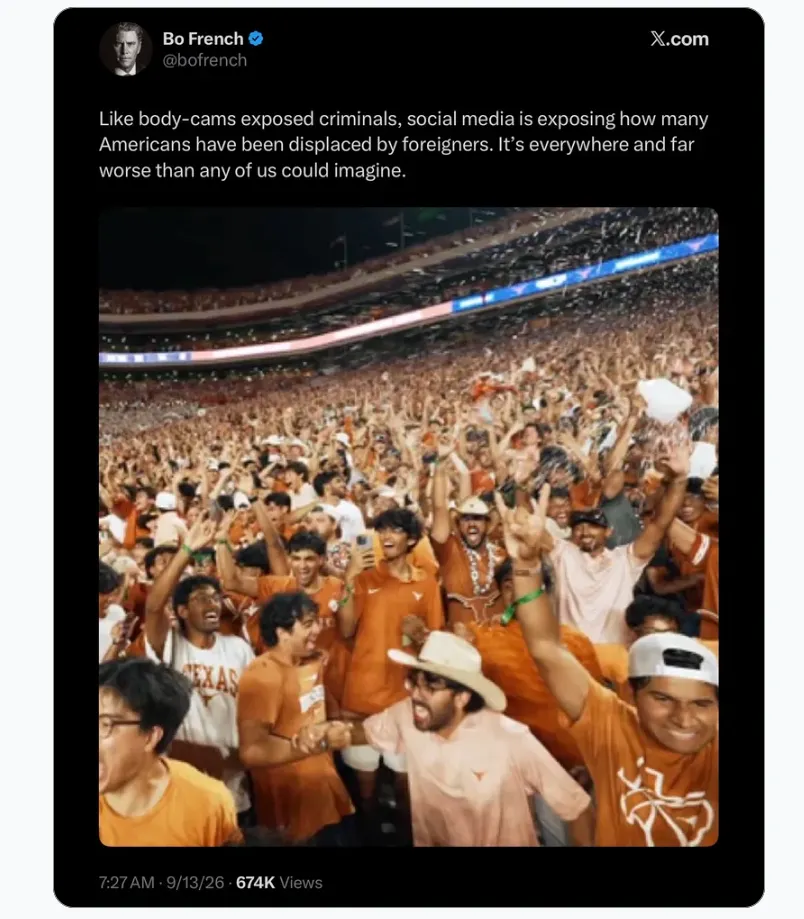
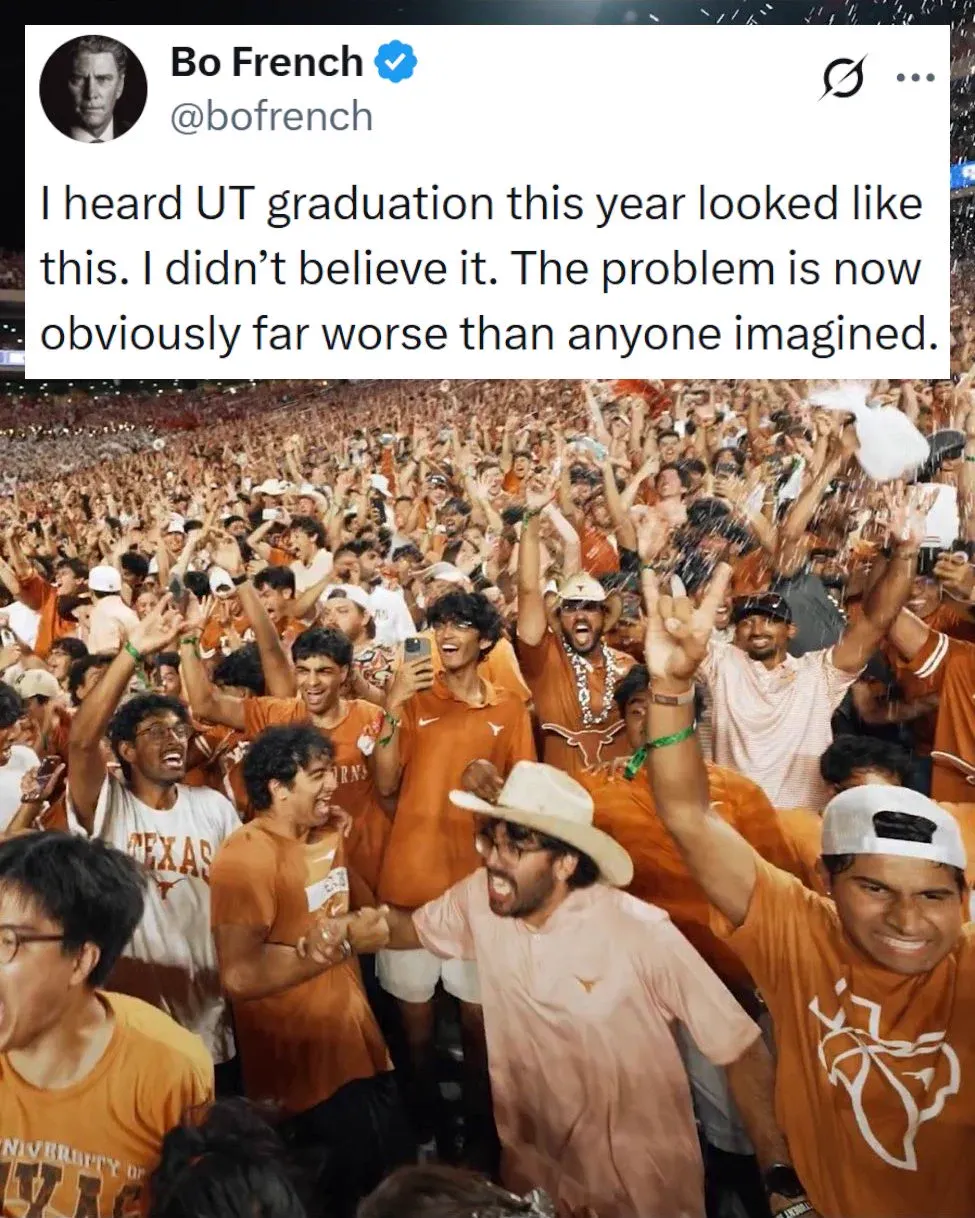
Bo French posted an image on X of University of Texas students celebrating a Longhorns game — just a photo of students at a football game. The students in the image appeared to include a number of people of South Asian descent. Above the photo, French wrote:
The post set off a firestorm inside the Texas GOP, with many condemning it and a few even calling it what it plainly is: racist. But notably, almost no one in the Texas GOP called for French to withdraw from the race. And French himself has stood by his comments. In an interview on Sunday, he said it is “not racist to point out that we should be favoring Texans over foreigners.”
So here’s the shape of the story: a member of the GOP makes comments widely viewed as racist, causing most of the Texas GOP — especially candidates in tight or contested races — to panic publicly, while the politician in question stands by his statement with the quiet support of other party members. That’s the version of the story you’ll find in most news outlets, and it’s worth reading. But the coverage tends to stop at exactly the point where it gets interesting.
What the Coverage Misses
Most reporting on this frames the story around damage control — Republican strategists explaining that comments like French’s make outreach to Hispanic and other minority voters more difficult. That’s true. But it treats French’s post as a communications problem rather than what it actually is: Bo French saying the quiet part out loud.
Yes, the GOP wants to win over Hispanic and other minority voters. But the party’s policies, its priorities, and its rhetoric — both since 2024 and well before it — make clear that most of the GOP doesn’t actually hold positions all that far from French’s. When strategists complain that statements like his make outreach “difficult,” they’re skipping past the more uncomfortable fact: they want those votes without having to actually support American minorities.
What a post like French’s reveals isn’t a position that most of the GOP finds offensive. It’s a position most of the GOP quietly shares but goes to considerable lengths to avoid saying in public. They don’t view Hispanic Americans, or South Asian American students, as real Americans — or in this case, as real Texans.
French actually said something in his own defense that I agree with. In that same interview, he suggested his fellow Republicans share his sentiments but are simply afraid of being labeled racist. In other words: they think what he thinks, they just don’t want to be called out for it. I think French is a racist, I think the post was racist, and I agree with him that many in the GOP share his views — no matter what they tell minority voters to convince them otherwise.
What the Post Actually Reveals
Look closely at what French actually said and the logic falls apart in a revealing way. He decries that the UT graduating class “looks like this,” pointing to an image of students who appear to be of South Asian descent. Then, in his follow-up interview, he says the university should be serving “Texans” — the implication being that none of the students in the photo are Texan.
He has no reason to think that. He has no way of knowing that. The only reason he says it is that he is profiling these students based on how they look. They don’t read as Texan to him — which is to say, they aren’t white.
That’s the assumption underneath French’s comments: that people of color simply aren’t real Texans, and by extension, aren’t real Americans. It doesn’t even occur to him that someone could be both a person of color and a Texan. In his mind, their presence in that photo means non-Americans are being served by the University of Texas, and that this shouldn’t be happening.
The Deeper Ideology
I think this is the real revelation about the Christian nationalist ideology that defines the contemporary Republican Party. The GOP wants minority votes — it actively courts them. But within that ideology, within that worldview, there is no actual place for minority voters as full participants in the party’s vision of America. It’s a vision of a white Christian nation, and minority communities don’t fit inside it as anything other than instrumental.
Instead, in the GOP imagination, minority communities tend to occupy one of two roles:
• A problem to be solved — deported if they’re not citizens, denaturalized if the assumption is (wrongly) made that they aren’t, treated by default as if they don’t belong.
• A resource to be drawn on strategically, but only when needed — courted in 2024, then largely ignored since, with no follow-through on the “coalition-building” that was promised. Now, heading into the 2026 midterms, the party needs those votes again, so the courting resumes.
What doesn’t have a place in that ideology is the idea that minority communities represent real Americans — full stop, not conditionally, not strategically. That’s what Bo French’s post shows us, whether he meant to reveal it or not.
What Comes Next
This is a story worth continuing to watch, especially with the 2026 midterms bearing down and the Texas Senate race as competitive as it’s been in decades. It’ll be worth watching how the Texas GOP handles French going forward — whether the discomfort passes, whether he faces any real consequences, or whether, as seems likely, the party quietly moves on while hoping voters forget.
FBI director Kash Patel defended his agency’s decision to roll back restrictions on agent applicants who have previously engaged in bestiality, arguing the FBI “did not want to punish victims of bestiality” by automatically disqualifying them.
One thing I would not have expected President Donald J. Trump to be spending his time on with just weeks to go until Election Day is creating new conspiracy theories about Tom Crooks, who shot at him in the summer of 2024 from a rooftop in Butler, Pennsylvania. But here we are.
The president yesterday asserted on Truth Social that Butler “was all a Democrat Plot, to get me out of the Election, that failed.”
That the assassination attempt was the work of Trump’s political enemies is a baseless claim that the White House has leaned into for some time. In early January, the White House published a revisionist history of Jan. 6 that, TPM’s Hunter Walker noted at the time, included the following line: “Despite relentless Deep State efforts to imprison, bankrupt, and assassinate him … President Trump emerges triumphant.”
The website suggested, without any shred of evidence, that what happened in Butler was the work of the “Deep State” — the catch-all term for any government bureaucrat who might be behaving in a disfavored way, from slowing deregulation to, apparently, plotting a presidential candidate’s murder.
But Trump himself blaming it directly on a “Democrat Plot” takes the claim to another level. He then went on to castigate former FBI Director Chris Wray, claiming materials about the assassination were “missing, altered, corrupted or gone” and declaring Wray should “pay a price for the way he handled this assassination attempt.”
It’s unclear what Trump is gesturing toward here, if anything. The New York Post reported yesterday that “a trove of documents” was provided by law enforcement to Senate Judiciary Committee Chairman Chuck Grassley (R-IA) as part of his investigation into the assassination attempt. But the documents sound like they simply add details to what we already knew: Crooks was really into guns, and didn’t talk to people much.
Grassley himself seemed to tell NBC yesterday that there wasn’t new information about a plot. “We don’t know anything about the motivation [of] why [Crooks] wanted to kill Trump,” he said.
FBI Director Kash Patel yesterday also seemed to throw cold water on the idea of any plot. “We found no evidence that [Crooks] was literally even speaking to any other human being other than his parents who he resided with,” he told the Senate Judiciary Committee.
Among the few things we do know about Crooks, in fact, was that his desire to create a spectacle appeared nonpartisan. He went to the gun range a lot, and didn’t talk very much. He googled the dates of the Democratic and Republican National Conventions. He researched school shooters, and Lee Harvey Oswald, to whom he is now often compared.
“Neither Oswald nor Crooks were the kind of people who make history, not like Kennedy and Trump,” wrote Mike Rothschild, who writes about conspiracy theories for TPM, around Butler’s second anniversary. “But somehow, these two losers found a way to write their names into the fabric of American lore. Something greater had to be at work. There had to be a conspiracy — who was behind it and why would have to be filled in later.”
A significant portion — 24% — of Americans now believe Butler was staged, polls suggest. An additional 32% don’t know what to think. These conspiracy theorists, however, tend not to believe it was the work of Democrats. Rather, they think it was a plot orchestrated by Trump himself.
Yesterday U.S. District Judge Christopher Cooper of the District of Columbia refused to permit the Kennedy Center board, stacked by Trump with his own loyalists, to return Trump’s name to the facade of the building. Cooper reiterated that Congress had prohibited such an addition and would have to change that law in order to make the addition of Trump’s name legal.
The board of the Kennedy Center promptly appealed and voted to close the venue for two years for renovations. Then Trump posted on social media that those renovations couldn’t take place unless the court approved the addition of his name to the building. Without that, he posted, “unfortunately, the Building is destined to doom. Isn’t that too bad?”
Although the Kennedy Center board insisted that only Trump’s name on the building would restore donations, in fact, the Washington Post reports that ticket sales and fundraising plunged when Trump added his name to the building in the first place.
Nonetheless, Trump posted that he is the only one who can save it, “because I have the ability to raise the money, and the ability to construct—that few others have. I also have the strength and power of the Presidency, which will be needed [to] do what must be done, and give it a strong shot at Greatness again!”
As George Conway of the Bulwark noted, “To destroy things he can’t possess or control is his essential nature.”
It is also as if Trump is self-soothing by celebrating his core identity even as his incompetence and greed have driven the United States, and the world, into crisis.
But even that is not providing him comfort these days. Representative Joyce Beatty (D-OH), an ex-officio member of the Kennedy Center board and the member who sued over his takeover of the center, explained to Symone Sanders-Townsend of MS NOW that Trump called into the board meeting after the court decision and “went into a tantrum.”
While most people appear to have refused to confront Trump to his face—Maine governor Janet Mills’s “We’ll see you in court” was so rare it made headlines—Beatty took him on. She recounted: “It was the most unprofessional thing that I’ve ever witnessed or been a part of it.” But after he called her “an obstructionist” and “dumb” and said he thought she was “incompetent,” she retorted: “I know you’re incompetent.” Beatty appealed to the chair to stop Trump’s unprofessional behavior, but when he continued to berate her, claiming it would be her fault if someone were killed at the center, she responded: “You’re already killing people, we’re at war.” And when he talked about what a great developer he was, she “reminded him that he had more bankruptcies than anybody in the room.”
“I mean, it really went there,” Beatty told Sanders-Townsend. “I was not going to let him bully me, intimidate me. And the facts stand for themselves.”
Indeed, these days, facts across the board are challenging Trump’s image of himself.
Panic is sounding across the U.S. about oil prices. The Houthis in Yemen, backed by Iran, are threatening the Bab el-Mandeb strait at the outlet of the Red Sea on its way to the Arabian Sea and the Indian Ocean, threatening another 4% of the world’s oil supply to global markets. Saudi Arabia had diverted oil shipments from the Persian Gulf to the Red Sea through the East-West pipeline across the country, but officials have closed the pipeline after strikes. Today, senior executives from Shell and Equinor warned that the world is looking at tightening supplies of oil and “price volatility” as the industry is losing the ability to offset the disruptions.
On X, Patrick De Haan, a petroleum analyst at GasBuddy, charted the rise of diesel prices in the U.S. this week. Diesel jumped $0.82 a gallon in Fort Stewart, Georgia; $0.82 in Moorhead, Minnesota; $0.75 in Athens, Georgia. In the twelve hours before 1:30 this afternoon, Eastern time, gasoline jumped $0.30 a gallon in Lawrence County, Ohio, and Edwardsburg, Michigan. It jumped $0.28 a gallon in Des Moines, Iowa. De Haan reported that gas prices in and around Chicago appeared to be rising to $4.99 a gallon today.
As De Haan noted, it was “no shock, with diesel setting new all-time records and showing no signs of slowing,” that the Federal Reserve raised interest rates today for the first time since July 2023. Trump has been adamant that he wants to see interest rates lowered and has threatened to cut off trade with certain countries unless the Fed lowered them. But rising inflation meant that the board instead voted unanimously to raise rates by a quarter of a percentage point to a target range of 3.75% to 4%.
Trump did not take the news well. “Interest Rates in the United States should be 1%, or less, because we are the Best Credit in the World—BY FAR,” he posted. “LOWER THE INTEREST RATES FOR THE UNITED STATES OF AMERICA, AND FAST!”
At a political rally in North Carolina, Trump suggested that the Fed is attacking him personally. “They’re raising the rates to make Trump do as bad as they can possibly do,” he said, referring to himself in the third person. “The problem they have is that we have the greatest economy in history.” “So they’re raising that only for political reasons and that’s a raise against Trump.”
In Ireland, where he traveled for the Irish Open golf tournament at his course in Doonbeg, Trump told reporters on Sunday that the U.S. might stay in Iran and “keep the oil” as the U.S. did in Venezuela. He claimed Venezuelan oil has “paid for the war many times.”
But—even aside from the fact invading a country and taking its resources violates the U.N. charter—there is no record of that money or where it is going. In January 2026, a U.S. official told Jarrett Renshaw of Reuters that the U.S. had completed its first sale of Venezuelan oil, valued at $500 million. That money was to be held in a U.S. account in Qatar, not the U.S. Treasury.
Yesterday, testifying before the House Financial Services Committee, Treasury Secretary Scott Bessent refused to answer questions Representative Sean Casten (D-IL) asked about the Venezuelan oil money.
Bessent refused to say how much money from Venezuelan assets—including gold, as well as oil—had flowed through Treasury accounts or accounts managed by Treasury since January, and said he had no knowledge of whether the money was flowing to “the U.S. government, U.S. persons, or U.S. corporations.” He deflected by saying simply: “Again…this is the, uh, one of the largest assets that maybe ever to go on the U.S. balance sheet.”
Yesterday was a big day for revelations about the war on Iran. Jonah Kaplan of CBS News published photographs showing the damage caused to buildings, vehicles, and equipment at U.S. bases in the Middle East by Iranian strikes. Active service members leaked the photos to CBS News because, as one said, “This is major damage to our bases that hasn’t been communicated to the American public. We’re standing there with our eyes closed getting punched in the face.” “We’re not defending these bases,” the service member said. “We’re just watching them get destroyed.”
John Ismay of the New York Times reported on a new report from the Pentagon’s inspector general on Monday explaining that the first four months of the Iran war caused “strategic inventory shortfalls”; that Iranian strikes have destroyed “hundreds of buildings and structures” at U.S. bases in Bahrain, Iraq, Jordan, Kuwait, Oman, Qatar, Saudi Arabia, and the United Arab Emirates; that dozens of military aircraft have been damaged or destroyed; and that the Defense Department has limited facilities for medical treatment in the region and has had to relocate helicopters for medical evacuations from Iraq and Kuwait.
A new report from the nonpartisan Congressional Budget Office said that the Iran war, which has taken 18 U.S. lives and wounded more than 800 servicemembers, has also cost the U.S. about $38 billion as of August 1 and could cost as much as $2 billion a month while it goes on, and that it will continue to drive inflation.
For the third time, the House passed a war powers resolution directing Trump to remove U.S. military personnel from hostilities against Iran unless Congress explicitly authorizes him to keep them there. Seven Republicans joined the Democrats to pass the measure by a vote of 220 to 204.
Yesterday Representative Thomas Massie (R-KY) blindsided House speaker Mike Johnson (R-LA) by introducing eight counts of impeachment against Defense Secretary Pete Hegseth.
The first three articles accuse him of “waging war in contravention of the War Powers Resolution of 1973.” The fourth accuses him of “ignoring laws that minimize civilian casualties.” The fifth accuses him of directing “the extrajudicial killings of at least 221 persons aboard seagoing vessels” in the Caribbean and eastern Pacific. The sixth accuses him of “suppressing free speech” through his attempts to silence Senator Mark Kelly (D-AZ), a Navy veteran. The seventh article accuses him of the “kidnapping of a sovereign foreign leader,” Venezuela’s president Nicolás Maduro. The final article charges Hegseth with waging an “unlawful war in Yemen,” in 2025.
Massie told CNN that he had kept his plan secret to prevent House leadership from keeping him from the floor to read the articles. To protect Republican lawmakers from having to take a stand either for or against the Iran war, Speaker Johnson canceled votes set for Thursday and sent the House home until November 9, 2026, after the midterm elections.
Johnson blasted Massie, saying: “Secretary Hegseth has done an extraordinary job, the Department of War. We’re in the middle of international conflicts right now, and we should not be playing games with national security.” As for sending lawmakers home early, he said: “It’s time for our members to go home to their districts and make their case to the American people, to go and explain all the great things we’ve done.”
Trump apparently does not think voters will swing behind the Republicans based on their record. News broke on Monday that the Supreme Court would not allow him to implement new rules that would allow the United States Postal Service to screen mail-in ballots, something Trump insisted was imperative to purify voting.
On Tuesday, he dropped the facade that the rule was about anything other than rigging the election and expressed anger that his three hand-picked appointees to the Supreme Court did not do his bidding.
“Republicans just got another bad decision from the United States Supreme Court,” he posted. “This Supreme Court is bullied and cajoled by the Radical Left into making decisions that have set America back at least a hundred years. These are not the people I interviewed to serve on the United States Supreme Court, they are merely a shell of their original selves.”