Donald Trump bought Nvidia stock worth millions of dollars as he made decisions on America’s China policy that would benefit the chipmaker, an analysis has found.
In May 2025, Trump’s administration rescinded a Biden-era rule designed to prevent the most advanced US-made AI chips from being exported to China.
This rule aimed to strengthen the US’s own chip industry and to protect America from what was widely regarded as a national security threat: the possibility that China might develop superior AI.
In the days before he rescinded the rule, Trump’s public financial disclosures indicate that he bought between $1m (£760,000) and $5m worth of Nvidia stock – a purchase noted in an analysis by the anti-corruption group DeKleptocracy.
He also bought shares in other tech companies, including Apple, Meta and Microsoft.
The diffusion rule would have limited Nvidia’s ability to sell to what has been one of its largest markets: China accounted for about a quarter of the company’s sales between 2010 and 2022. Nvidia’s shares rose in value just after Trump announced the rescission of the rule, and after he had bought the stock.
In December 2025 Trump said he would allow Nvidia to sell H200 chips to China, a decision that was greenlit by the Department of Commerce in January 2026. This was a controversial move. H200s were one of the company’s most advanced chips – six times better than what was available in China at the time, said experts.
The Council on Foreign Relations suggested selling H200s would “supercharge” China’s future AI factories and strengthen the US’s rival.
Trump’s public financial disclosures indicate he made at least three purchases of Nvidia shares in the days after announcing this, all of them between $250,001 and $500,000.
These trades are among Trump’s larger purchases of Nvidia stock, although he appears to have made dozens of transactions involving the chipmaker’s shares since taking office.
DeKleptocracy wrote in its analysis: “While the country debates how a possible Chinese spy may have manipulated White House policy for one AI company, it must grapple with how Trump’s corruption may have motivated him to deliver the entire AI industry’s technology to China.”
The US – and the global economy – have been grappling with revelations that Jensen Huang, Nvidia’s former chief executive, had an affair with an alleged Chinese spy, Alice Huang.
Reports have suggested this relationship allowed Alice Huang’s company, Megaspeed, to obtain billions of dollars worth of Nvidia’s chips, even as other companies struggled.
Trump was twice briefed by US intelligence officials on their conclusions that Alice Huang was a Chinese asset. He did not act on this assessment.
Jensen Huang has been described as a close Trump ally and has met the president a number of times. Nvidia made a $25m contribution to Trump’s ballroom in October 2025, with Huang saying he was “delighted to be a part of it”.
Trump sat out the airline grounding of Friday and the snarl it left behind, leading observers to note that he has not been seen in public since last Wednesday. He answered those observations today, posting at 8:42 this morning: “I am in the White House having meetings on many subjects. Very exciting times for the USA. Great things are happening—We are the “hottest” Country anywhere in the World!”
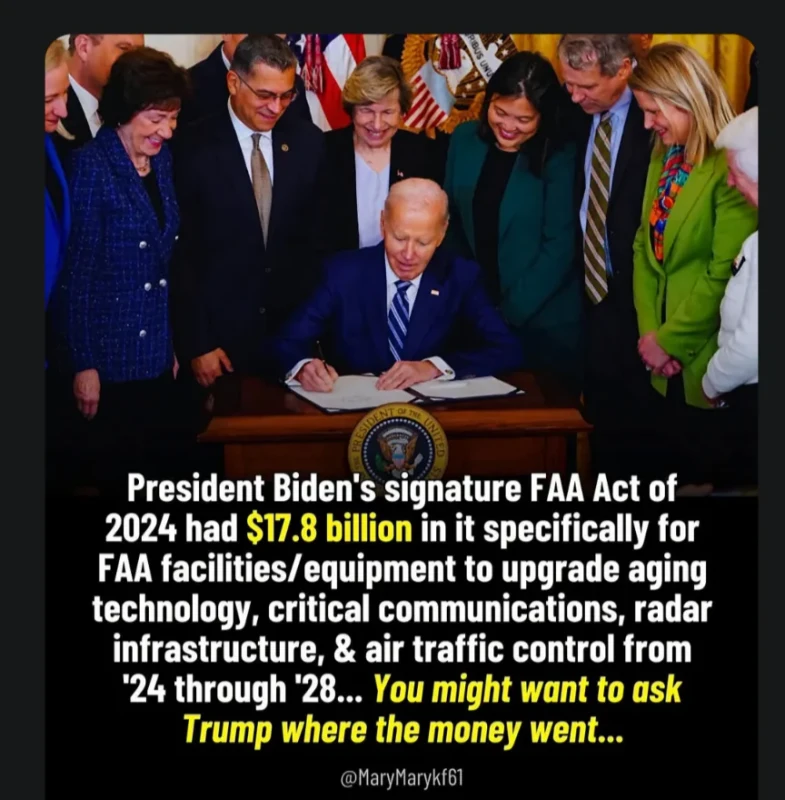
Trump also finally weighed in on the crisis of Friday, when the Federal Aviation Administration (FAA) abruptly grounded all planes in the U.S. for about five hours, ultimately forcing almost 10,000 flights to be canceled on Friday, 6,600 on Saturday, and at least another 1,300 on Sunday. Passengers across the country were stranded over the weekend. Secretary of Transportation Sean Duffy said he expects airline operations to resume their normal patterns on Monday.
As Duffy did on the Sunday talk shows today, Trump blamed former president Joe Biden for the crisis.
“The Biden Administration was an FAA disaster,” he posted. “Everything they touched turned bad. Big money spent unwisely, making an old and broken system worse than when they began. We have the knowledge and plan for the Flight Control Systems, we need Congress to give the money, FAST! Our FAA is doing a great job, and is ready to go.”
Minutes later, he explained: “If Congress approves the desperately needed money for Air Traffic Control, we can get it built quickly and efficiently. It will be the BEST SYSTEM anywhere in the World. Much of our current air control system is 50 years old—RIDICULOUS! We have already started the work, but it should be done all at once, not in drips [sic] and drabs. Congress must approve. The Biden Administration set it back years!”
When he addressed the press Friday evening, before the FAA had lifted the ground stop, Duffy told reporters that his department needed $50 billion to fix the antiquated system even as he said he didn’t know what had caused the aviation communications breakdown. Today, when Kristen Welker asked Duffy on Meet the Press if he feels he owes an apology to the American people for the crisis that happened on his watch, he answered: “I can’t apologize for what was passed off to us.”
He continued: “I can’t blame Republicans or Democrats, ’cause it’s all of them. Goes back 20, 25, 30 years of a lack of investment, a lack of, you know, waving the flag to say, Hey, this is a problem. Let’s fix it. Why they didn’t do that, I don’t know.”
In fact, as Democrats noted yesterday after Duffy’s Friday night press conference, Congress did fund upgrades to the air traffic control system in the Republicans’ so-called “One Big Beautiful Bill Act.”
The top-ranking Democrat on the House Committee on Transportation and Infrastructure, Rick Larsen of Washington, and the top-ranking Democrat of the Subcommittee on Aviation, André Carson of Indiana, noted that Congress approved $12.5 billion for the Department of Transportation “to make necessary safety upgrades to our air traffic control system.” But, they continued, “Fifteen months later, the administration [has] obligated $4.3 billion but only spent $1 billion, leaving $8 billion unobligated and $11 billion unspent. Explain to Congress, again, why they need more money?”
Even before that, in the $1.2 trillion Bipartisan Infrastructure Law passed by Congress and signed into law by President Joe Biden on November 15, 2021—five years ago today—lawmakers appropriated $25 billion for upgrades to airport and air traffic control infrastructure.
But on the day he took office, Trump issued an executive order that could freeze all disbursements of money under the Bipartisan Infrastructure Law, an order that Carson, along with 153 other House Democrats, opposed. This freeze seemed to reflect the economic principles outlined in Project 2025, which rejected public investment in infrastructure and instead called for “public-private partnerships” in which private companies build infrastructure and own it and the government rents that infrastructure through contracts paid for by tax dollars.
That philosophy appears to have driven the second Trump administration. The day Trump took office, the head of the FAA, Mike Whitaker, resigned. Whitaker had been confirmed by the Senate with a unanimous vote but had clashed with billionaire Elon Musk over regulations. Whitaker had also grounded Boeing 737 Max planes after a door plug blew out of one.
Also on the day he took office, Trump fired the head of the Transportation Security Administration (TSA) and fired the members of the Aviation Security Advisory Committee, mandated by Congress after the 1988 bombing of PanAm Flight 103 over Lockerbie, Scotland, to examine safety issues at airlines and airports. The memo firing them said the Department of Homeland Security was getting rid of the members of all advisory committees out of a “commitment to eliminating the misuse of resources and ensuring that DHS activities prioritize our national security.” In other words, DHS would focus almost exclusively on immigration, for which Republicans delivered appropriations of $74.85 billion in 2025.
On February 6, 2025, Duffy posted that “the DOGE team”—those in Musk’s “Department of Government Efficiency,” theoretically charged with saving money—was “going to plug in to help upgrade our aviation system,” saying that “‘experienced’ Washington bureaucrats are the reason our nation’s infrastructure is crumbling.”
On the same day, Trump told reporters: “We’re all gonna sit down and do a great computerized system for our control towers. Brand new. Not pieced together, obsolete, like it is, land-based. Trying to hook up a land-based system to a satellite system…. We spend billions of billions of dollars trying to renovate an old, broken system, instead of just saying cut it loose, and let’s spend less money and build a great system done by two or three companies, very good companies, specialists, that’s all it is.”
In mid-February 2025, the administration fired several hundred FAA employees, including personnel who maintained FAA radar as well as landing and navigational aids, while more than a thousand others retired or quit. Later that month, Musk claimed the FAA’s air traffic control system was failing and that SpaceX’s Starlink needed to take over the contract to fix it. That shift never happened. Instead, according to Danielle Wallace of Fox Business, SpaceX said it had provided Starlink kits to L3Harris, a defense contractor, “to identify instances where Starlink could serve as a long-term infrastructure upgrade for aviation safety.”
While it is not yet certain what caused the communications outage that led to the ground stop, Duffy appeared to suggest yesterday that L3Harris might have been to blame for the communications outage. Today on MS NOW, Representative James Walkinshaw (D-VA), who sits on the House Oversight Committee, said that experts say the crisis happened as it did—an upgrade in the middle of a busy travel day rather than at a time of lower traffic—because Trump officials are rushing to modernize the air traffic system to get it in place before Trump leaves office in January 2029.
But there is a larger story behind the already huge story of the airline ground stop.
In his first inaugural address on January 20, 1981, President Ronald Reagan said: “In this present crisis, government is not the solution to our problem; government is the problem.” People on the right usually drop the “in this present crisis” part of the quotation to bolster their own determination to destroy the federal government that they think coddles “liberals,” people of color, and women. Since the 1980s, they have insisted that the federal government is simply a means of redistributing tax dollars to the undeserving and that the way to “make America great again” is to privatize the functions of the government, giving businessmen the room to create enterprises that will thrive, thus hiring workers and developing the economy.
In the twenty-first century, that idea has given us an ideology that echoes that of the elite enslavers of the pre–Civil War South or the “robber barons” of the late nineteenth century: that a few wealthy men have the right—and maybe the duty—to rule the rest of us. Enslaver James Henry Hammond insisted that the vast majority of Americans were “mudsills” holding up the “civilized” men like himself just as sills driven into the mud held up the stately plantation homes in which men like him lived.
In June 1889, steel magnate Andrew Carnegie explained that “great inequality…[and]...the concentration of business, industrial and commercial, in the hands of a few” were “not only beneficial, but essential to…future progress.” Rather than pay higher wages or contribute to a social safety net—which, Carnegie wrote, would “encourage the slothful, the drunken, the unworthy”—a rich man should accumulate wealth and spend it in ways he, with “his superior wisdom, experience, and ability to administer,” considered beneficial for the community.
Today’s MAGA Republicans have gone a step further, adjusting the old idea of the superiority of the few to the modern state. Rejecting the idea of a small federal government that will leave a few wealthy men free to concentrate wealth, they now back the idea of a strong government that funnels tax dollars to those men through government contracts. This, along with the use of that strong government to enforce the religious principles of right-wing theocrats, is the plan outlined in Project 2025.
Now in power, officials in Trump’s administration are creating a strong government, using our tax dollars to advance their own agenda—like funding SpaceX and detention facilities run by private corporations—rather than investing in services and programs for the American people.
On Friday, when the ground stop was still in force and people were stranded all over the country, Homeland Security Secretary Markwayne Mullin told reporters: “This is what the leadership of President Trump looks like, by the organization and the team he’s put together.”
This weekend, Trump’s leadership and his team looked utterly incompetent.
Looking back at the revolution that ended the rule of the robber barons, First Lady Eleanor Roosevelt wrote: “It always amuses me when any one group of people take it for granted that, because they have been privileged for a generation or two, they are set apart in any way from the man or woman who is working in order to keep the wolf from the door. It is only luck and a little temporary veneer and before long the wheels may turn and one and all must fall back on whatever basic quality they have.”
The extraordinary Nvidia scandal encapsulates the nation’s economic and political system in 2026. On October 29, 2026, the New York Times reported that Jensen Huang, the chief executive officer of chipmaker Nvidia and the major voice shaping the Trump administration’s AI policy, had an extramarital affair with Huang Le, or Alice Huang, suspected of being a Chinese spy. Huang worked for the Singaporean company Megaspeed, which appears to have been a pass-through for AI technology, including AI chips, to get to China. Since those chips can be used in military applications including weapons, the U.S. has since 2022 prohibited the export of advanced chips on the grounds of national security.
As Jonathan V. Last put it in The Bulwark today: “By all indications, Alice Huang was a Chinese spy working as the head of a Chinese-backed shell company that was routing banned chips to China. She was not duping or coercing Huang into breaking the law. She was helping him.”
Huang has made it clear that he thinks Nvidia should be able to sell advanced AI chips to everyone, including China, with the argument that such sales will make the rest of the world dependent on American technology. As Last noted, such a stance is also the policy that would make the most money for Nvidia…and Huang himself.
In that stance, Huang appears to have had the support of Commerce Secretary Howard Lutnick, who has refused to crack down on sales of Nvidia chips to data brokers like Megaspeed, which take advantage of a loophole in the law that prohibits sales of the chips but does not stop Chinese firms from renting the chips from data centers in Malaysia, Indonesia, and Thailand. The Biden administration tried to close that loophole, but Trump revoked those rules, saying they stifled innovation.
Ana Swanson, Aaron Krolik, and Paul Mozur of the New York Times reported yesterday that Cantor Fitzgerald, the financial firm formerly headed by Lutnick and now run by his sons, is invested in those data centers in Southeast Asia that serve Chinese customers.
Trump has also sided with Huang. Meryl Kornfield and Steve Thompson of the Washington Post reported today that Trump’s stake in Nvidia rose at least as high as $62 million before the scandal broke.
Ian Duncan, Zach Dorfman, and Warren P. Strobel of the Washington Post reported that Huang, Lutnick, and Trump opposed “a bipartisan group of government officials, lawmakers and think tank analysts,” who “view Nvidia’s chips as a vital asset in the rivalry between the two nations and one that the U.S. should strictly control.”
That faction is backed by U.S. laws.
On Friday, Treasury Secretary Scott Bessent blamed Lutnick for slow-walking the restrictions on Megaspeed that would have closed the loophole that enabled it to send Nvidia’s chips to China. But, as former U.S. ambassador to NATO Ivo Daalder noted in his newsletter The Diplomatic Cable, “blaming Lutnick suits everyone except Lutnick. It spares the president who set the policy, the adviser who sold it, and the principals who stayed silent until a sex-and-spies scandal made silence costly.”
When they broke the story of the scandal in the New York Times on October 29, Jonathan Swan, Maggie Haberman, Ana Swanson, Paul Mozur, Tripp Mickle, and Julian E. Barnes reported that U.S. intelligence agencies had informed Trump about Huang’s entanglement about a year ago and he had chosen not to distance himself from the Nvidia leader. Huang continued to meet and travel with Trump, and in March 2026, Trump asked him to serve on the “President’s Council of Advisors on Science and Technology” to offer advice on AI policy.
Members of the Trump administration appear to have been covering for Nvidia’s work with Megaspeed. According to Ana Swanson and Devlin Barrett of the New York Times, Commerce Department investigators were looking at Megaspeed last year, suspecting it was smuggling Nvidia’s chips into China, when Jeff Kessler, a Trump appointee who reports to Lutnick, apparently tipped off Nvidia about the investigation. The case was transferred to the Justice Department, where it appears to have stalled.
When voters elected Democrats to the majority in both the House of Representatives and the Senate on November 3, the ability of the Trump administration to hide this apparent extraordinary disregard for the law and for U.S. national security came under threat. The Nvidia board launched an investigation, and Huang stepped down on November 12.
But Nvidia was not just any company. It was central to the AI buildout. It has been referred to as the “central bank of AI” because under Huang, it partnered with six major financial institutions to launch a $500 billion financing platform to support AI startups and specialized cloud providers. That AI buildout was central to the performance of the stock market in Trump’s second term.
Today Matt Egan of CNN reported that when taken along with the popular hatred for data centers, Huang’s downfall points to the bursting of the AI bubble and a hit on the U.S. economy. Gary Gensler, who led the Securities and Exchange Commission from 2021 until 2025, told Egan that the “the only question is if it’s a soft recession or something more dramatic.” Today the Nasdaq Composite index of tech stocks fell for a third day, losing more than 2%.
Anxiety over what will happen at Nvidia and in AI without Huang at its head has led nearly 180,000 tech executives, workers, and shareholders, including billionaire Elon Musk, to sign a petition calling for Huang’s reinstatement. Trump, too, backed the idea of Huang’s return, saying: “I think he learned a big lesson.” He continued: “I guess maybe one lesson more important than another, but I would certainly not mind seeing that.”
Trump downplayed the severity of the case. He suggested that Alice Huang might not have been a spy, and that our national security “was not put at risk, and, uh, our country is now stronger than ever before. And you know, China plays games with us so we play games with China.”
But this afternoon, a source speaking for Nvidia’s board of directors told reporters that the board is not considering reinstating Huang. The Bulwark’s Last noted that the exposure from the scandal has “almost certainly spread to other high-level Nvidia executives” and notes that the “statute of limitations for criminal violations of the Export Control Reform Act, which governs technology diversion, is five years.” A conviction can lead to up to twenty years in prison.
As Robert Johnson and Walt Hickey wrote in Business Insider in 2012, it is not uncommon for companies to sell military equipment illegally to other countries because the practice is “extremely lucrative.” But if indeed members of the administration were in on it, we are in entirely new territory, with the lust for profits overriding national security at the top of our government. In that—the idea that selling out the people of the country for profit is acceptable all the way to the Oval Office—the scandal seems to represent this moment.
Today the Treasury Department and the National Security Council overruled the Commerce Department to issue a new rule restricting the export of chips to countries deemed likely to supply chips or computing power to countries that are subject to U.S. arms restrictions. The new rule applies to Indonesia, Malaysia, Singapore, and Thailand.
Someone asked me the other day what my favorite historical scandal is, and it happens to be one that also involved members of a political administration. It is the scandal that bedeviled President U.S. Grant: the Whiskey Ring. In the 1870s, a group of whiskey distillers and distributors in midwestern cities bribed Treasury officials and IRS agents to undercount the amount of whiskey they were producing so they could avoid taxes. The scandal eventually swept in Grant’s friend and sometime aide Orville Babcock, thus tainting Grant, too.
The government had grown dramatically during the Civil War, and no one knew quite what that would mean for the country. The Whiskey Ring was the first major U.S. scandal in which members of a presidential administration profited directly from their official duties. Public reaction to the lawbreaking set the precedent that Americans would not accept such official criminality.
Former IRS agent John McDonald, who was part of the conspiracy and, to his chagrin, discovered the outcome of such lawlessness, wrote a book about the scandal. It’s called Secrets of the Great Whiskey Ring; and Eighteen Months in the Penitentiary.
CNN just published a story claiming that U.S. intelligence had picked up evidence that Iran may be planning a dirty bomb or chemical weapons attack in Washington, D.C., targeting top administration officials. They make no mention of Israel or Israeli intelligence, but if you’re following news out of Israel since the October 27th election, you’ll know that Benjamin Netanyahu has been working in overdrive to get the U.S. to restart the hot war with Iran, apparently believing that a renewed conflict will give him leverage to remain in power. There were similar efforts just before the election. The aim then was to perhaps delay the election as a war-time measure.
Here are the details.
For the last several days the Israeli press has been talking about how Netanyahu’s government has been telling the U.S. it has intel on possible Iranian attacks on top Cabinet officials as well on Trump himself. This comes as the opposition bloc has been warning Netanyahu not to take any steps to restart fighting while Gadi Eisenkot works to form a “change” government unless a military action is based on some concrete imminent threat. They clearly think he’s going to try to do that. And the Chief of Staff of the IDF has apparently already resisted pressure to back such action.
At first Netanyahu’s caretaker government was refusing to provide security briefings to opposition leader Eisenkot as he tries to form a new government. (Eisenkot is the former Chief of Staff of the IDF, 2015-19). That briefing eventually did happen. But afterwards it was revealed that Netanyahu didn’t brief Eisenkot on the fact that he was in the process of sending Mossad chief Roman Gofman to D.C. to discuss Iran with CIA chief John Ratcliffe. That visit happened last Friday.
There are three key security chiefs to pay attention to right now in Israel; all are Netanyahu appointees. Gofman is head of the Mossad. David Zini is the head of the Shin Bet (the domestic security service). He’s currently embroiled in a scandal about an apparent attempt to discredit Netanyahu’s election defeat with claims of election fraud in the country’s Arab minority. Gofman and Zini are both Netanyahu loyalists. The final one is Eyal Zamir, the current Chief of Staff of the IDF. He is reportedly the only one of the three holding the line against an election-gaming attack on Iran. For various reasons, a Prime Minister is more constrained over who he can choose as head of the IDF.
Let’s ask the obvious question: is this intelligence about Iranian attacks in D.C. reported by CNN not the intel Netanyahu has been pushing to Trump over the last two weeks and which Gofman apparently came to D.C. to discuss just last Friday? Two days ago, Israeli daily Israel Hayom reported that the Mossad intel had now been “corroborated by another Western intelligence agency.” That seemed to add more credibility to it. It said nothing about the U.S. having its own intelligence about such a planned attack.
The U.S. appears to be taking this seriously as U.S. and Israel reports say that top administration officials have been relocated to D.C. area military bases for their protection.
One doesn’t even need to posit bogus or manufactured intelligence. There’s almost always intelligence of something. There’s lots of noise and chatter. A lot of it means nothing. It’s a matter of what you decide to take seriously or dismiss.
Now, one theory might be that Israel had this intelligence and now the U.S. has some of its own too and the reason they both have it is that it’s actually happening, or at least that elements in the Iranian military and intelligence agencies are discussing the idea. If Iran is really planning this it wouldn’t be a surprise if multiple intelligence agencies picked up evidence of it. The CNN article implies that this is the U.S.’s own intelligence. But it doesn’t say so explicitly.
In Israel right now there are countless articles and lines of analysis about Netanyahu’s deperate efforts to restart the Iran War as a way to remain in power. The opposition has been warning repeatedly that Netanyahu is a clear and present danger to Israeli security because he’s trying to use his control over the national security apparatus to remain in power. Gadi Eisenkot has issued this warning again and again publicly. If you’re watching news in Israel and D.C., it’s kind of impossible not to see these two stories fitting together hand in glove.
At a minimum, any intelligence or prodding from Netanyahu’s government right now when it comes to anything having to do with Iran should be met with great skepticism.
US intel indicates Iran developing plans to potentially
detonate a dirty bomb in Washington.
Yesterday, just as the airline industry began to recover from the ground stop of the weekend, United Airlines announced it was undergoing an outage. Several major banks also experienced problems. Today Apple announced issues with some of its products, and Natasha Bertrand, Katie Bo Lillis, Sean Lyngaas, Davis Winkie, and Zachary Cohen of CNN reported that the highly classified network the National Security Agency uses internally was down.
The problems are not limited to the U.S. Last week, an outage in Microsoft spread to at least 74 countries and territories.
As Tim Sullivan of the Associated Press explained, the culprits behind those crises appear to be upgrades and maintenance rather than malicious activity, although Transportation Secretary Sean Duffy today said that director Kash Patel has the FBI investigating.
Samantha Subin of CNBC reported today that part of the problem is that AI is revealing software vulnerabilities, forcing businesses to patch software and update their older systems to guard against hacking. That means IT and security teams are scrambling, even as the tech sector has seen historic job cuts as companies turned to AI.
In the U.S. government, the crusade of the Department of Government Efficiency (DOGE) also led to job losses or resignations in IT: almost 20,000 of them in 2025 alone. As Natalie Alms of Government Executive reported last February, those losses affected a key public health tracking system, the modernization of IRS tax systems, and a USPS benefits program, and threatened the government’s cyber defense system.
The Trump administration cut the workforce of the Cybersecurity and Infrastructure Security Agency (CISA) by about a third, including most of its senior career officials, and has proposed cutting another $700 million from its budget in 2027, saying it wants to cut “weaponization and waste.”
In the worldview of Trump and his allies, government workers are lazy and useless: in March 2025, Trump said of government workers: “[M]any of them don’t work at all. Many of them never showed up to work.” He claimed his administration was saving billions of dollars by getting rid of “fat and waste and fraud and abuse,” and that they’re “keeping the best people.”
But now, not even two years into Trump’s second administration, things are falling apart, and no one in the administration is capable of putting them back together.
Arriving at Manila today on his way to China for a meeting with Presidents Xi Jinping of China and Vladimir V. Putin of Russia, Trump brushed off the technological outages that have wreaked such havoc in the U.S. “It’s life,” Trump said. “When you’re big and powerful and you have all the money, things like that happen. It’s fine.”
It turns out that while planes were grounded on Friday, Trump was in the Oval Office with actor Jon Voight. Jonathan Lemire of The Atlantic reported yesterday that Trump then called a number of people powerful in Hollywood to discuss new laws to rebuild the entertainment industry. Trump did not acknowledge the airport chaos on Friday. Instead, he posted at length about revitalizing the entertainment industry.
When asked what responsibility he took for the ground stop on Friday, Trump answered: “I don’t take any responsibility. They did a great job.”
In fact, Trump seems to be concerned primarily about his legacy, focusing on his Washington, D.C., projects and his attempt to cozy up to Putin and Xi. He has flooded his social media with complaints about the Washington, D.C., golf course he wants to rebuild, wild claims that the American economy is booming, and AI slop showing him comforting Homeland Security Secretary Markwayne Mullin’s son after a traumatic brain injury six years ago.
Meanwhile, perhaps because they had such low opinions of what government workers actually did, Trump’s team seems surprised to discover their jobs aren’t easy. Transportation Secretary Sean Duffy says the Federal Aviation Administration (FAA) outage is not his fault and that he is “moving at an incredible speed that no one has done at the FAA or in decades.” He is also demanding $50 billion—a random number $20 billion higher than the request he made just the day before the ground stop—to upgrade FAA systems.
Emily Goodin of the New York Post today reported that on Saturday, as an estimated 1.5 million people were stranded across the country, Secretary Mullin took a private government jet to Baton Rouge, Louisiana, to see the Louisiana State University Tigers football team play the University of Texas. He spent some of his time there in the box of the chief executive officer of Bollinger Shipping, Ben Bordelon, whose company has contracts with the Department of Homeland Security.
“We would have never went if the airlines—if the airways—weren’t completely open. [And] they’d been completely open for 21 hours,” Mullin told CNBC. “I would have never taken airspace if the airspace wasn’t open and we still got to live our life at the same time.”
Today the United States officially lost the status of having eliminated measles that it earned more than 25 years ago. Because the disease has circulated continuously for a year in the U.S., the Pan American Health Organization announced the disease can no longer be considered eliminated here. As Tara Suter of The Hill noted today, in the last two years, the U.S. has seen at least 7,700 cases of measles and more than 10 deaths.
In the Senate, Chuck Schumer (D-NY) blamed “the resurgence of this dangerous virus” on “the pathological stupidity plaguing this administration.” On social media, Secretary of Health and Human Services (HHS) Robert F. Kennedy Jr. blamed covid for disrupting “routine childhood vaccination,” and wrote: “We will stop measles outbreaks, protect American families, and work to regain U.S. measles elimination status. I continue to recommend MMR vaccination as the most effective way to prevent measles.”
But of course, Kennedy has downplayed vaccines and in May 2025 said he would direct federal agencies to explore new treatments for measles—including vitamins and cod liver oil supplements—rather than focusing on vaccinations, which are 97% effective in preventing infection. At the time, a spokesperson for HHS said Kennedy’s decision was meant to help those who did not want vaccinations.
Kennedy’s abrupt aboutface might be a reflection of the fact that on Sunday, on CBS’s Face the Nation, Senator Bill Cassidy (R-LA) said that Kennedy has been a “failure as Secretary of Health and Human Services. He was supposed to be doing something positive on ultra-processed foods…. There’s been minimal progress, and now we’ve lost our measles elimination status, and we have infants dying from measles.” “There is no logic. This is about covering a series of failures,” Cassidy said.
Cassidy, who is a medical doctor, was the deciding vote in Kennedy’s confirmation. On Sunday, he said: “This has been a failure. If I were president, I would choose someone else because there needs to be accountability for higher health care costs, more measles deaths, losing elimination status, and no progress on processed foods.”
Meanwhile, Trump seemed to want his trilateral meeting with Xi and Putin to demonstrate his membership in the club of autocrats he admires. But Ukraine’s president Voldymyr Zelensky, whom Trump taunted last year as having no cards, had something to say about it.
Just after midnight this morning, former U.S. Ambassador to Russia Michael McFaul commented: “The Xi-Putin-Trump meeting will not be the beginning of some new world order dominated by great powers. Rather, it will be a photo-op for Putin to help him push the myth that Russia is respected great power. It’s a gift to Putin. Nothing more.”
But over the course of last night, Ukrainian forces launched more than 1,400 drones into Russia, one of the largest barrages of the war. They targeted the Kerch bridge that links Crimea to Russia, a bridge begun after Russia seized Crimea in 2014. Putin personally opened the bridge, which is a symbol of Russia’s claims to Ukraine. The bridge is now closed, a powerful representation of Putin’s weakness as he and Trump—himself weakened by the November election and his own erratic behavior—go to the meeting with Xi.
Ukrainian forces hit the Kerch Strait Bridge again tonight. According to the Institute for the Study of War, they damaged the bridge’s railway carriage and completely collapsed the sections of the bridge that carried automobiles.
Tonight the Associated Press called the Alaska race for the U.S. Senate. Voters have chosen to replace incumbent Dan Sullivan, a Republican, with Democrat Mary Peltola. Peltola’s victory means that voters flipped nine Senate seats from the Republicans to the Democrats in this year’s midterm elections, giving the Democrats a margin of 56 to 44.
“As a lifelong Alaskan who has dedicated my career to serving our state,” Senator-elect Peltola posted, “ there is no greater honor than having Alaskans’ support in our fight to take on corporate greed, lower costs, and put Alaska first. Thank you, Alaska,” she continued. “Let’s get to work.”
I’ve just spent several days talking to Arab, Iranian, Israeli, American and European analysts and diplomats attending the Sir Bani Yas regional conference in Abu Dhabi, overlooking the Persian Gulf. The mood was something I’d never encountered here before. Not shock and awe, but shock and dread.
The dread comes from the dawning awareness that this latest war with Iran, started by America and Israel, is going to end with Iran more dominant than ever over its neighbors. The Gulf Arabs never urged the United States to start this war, but once it did, they assumed it had a plan to finish it. They assumed the Americans understood that the only government they ever toppled primarily with air power was Japan’s — and that took two nuclear bombs. So, there is a gnawing feeling that the United States and Israel started something that they either don’t know how to finish or no longer want to pay the price to finish — and that Iran’s Arab neighbors will be paying instead, for an Iran that will be emboldened by being able to say it fought the “Great Satan” — America — and the “Little Satan” — Israel — to a draw.
The prevailing sentiment was most pointedly conveyed to me by an Eastern European diplomat at the conference, citing an aphorism from Cold War days: “The trouble with being an ally of the United States is that you never know when it will turn around and stab itself in the back.”
(...)
They assumed the Americans understood that the only government they ever toppled primarily with air power was Japan’s .
The Danish parliament has unanimously approved a new Arctic security pact between Greenland, Denmark and the US in what it is hoped will mark a new chapter in relations, months after Donald Trump’s threats to invade the largely autonomous territory.
The deal, which was signed by the US president and the prime ministers of Greenland and Denmark, Jens-Frederik Nielsen and Mette Frederiksen, in September after months of talks, updates a 1951 defence agreement to give the US underwater access to Greenland and specific permission to construct a missile defence system.
It also recognises Greenland, a former Danish colony, as an equal partner and stipulates that if it were to become fully independent of Denmark, it would remain in Nato.
Having already been approved by the Greenlandic parliament earlier this month, all that remained for the agreement to come into effect, said the Danish foreign minister, Lars Løkke Rasmussen, was for Trump to send a notification to the US Congress.

