12
   

The 47th President and the Post-Biden World 2.0


Frank Apisa
 
  1  
Reply Fri 24 Apr, 2026 10:49 am
@Region Philbis,
Region Philbis wrote:


Laughing Laughing Laughing

unreal...


R(pinch me, i'm having a nightmare)P


Ya beat me to it, Reg.

Incredible that Hegseth cannot see the irony in what HE, PERSONALLY says.
0 Replies
 
hightor
 
  2  
Reply Fri 24 Apr, 2026 02:44 pm
Trump Holds the American People in Total Contempt

Jamelle Bouie wrote:
To say that President Trump is corrupt is to somehow understate the size, scope and magnitude of his corruption.

It is as if you were to describe a modern thermonuclear device as a “bomb.” That is true enough, but it is not quite the truth. It does not capture the nature of the thing in full.

So it goes for Trump’s corruption, which is so vast as to be a new phenomenon in American politics. The president and his family have leveraged his office to the tune of nearly $4 billion. They have received hundreds of millions of dollars from a network of branded cryptocurrency assets. Investors include large corporations, foreign nationals and state actors hoping to curry favor with the administration.

One such actor, according to The Wall Street Journal, was Sheikh Tahnoon bin Zayed Al Nahyan, brother and national security adviser to the president of the United Arab Emirates. Tahnoon’s investment fund purchased a half-billion-dollar stake in the Trump family’s crypto fund, World Liberty Financial, just days before Trump’s second inauguration. Tahnoon has since successfully lobbied the White House for Emirates access to America’s most advanced A.I. chips, with a large portion going to Tahnoon’s A.I. company.

Or consider the president’s pardons. Changpeng Zhao, the founder of Binance, a crypto firm, was convicted in 2023 for violating the Bank Secrecy Act. After Trump returned to office, Zhao — whose company donated software to World Liberty Financial so that it could start its own cryptocurrency — lobbied for a pardon. In October of last year, Trump granted the pardon, raising the possibility that Zhao could recover his court-ordered fines — $4.3 billion to the U.S. government as punishment for allowing criminal actors to use Binance for a broad array of illicit transactions, including child sex abuse, illegal narcotics and terrorism.

To tie the two stories together, in May 2025 a different investment company also linked to Sheikh Tahnoon, MGX, announced that it would buy a $2 billion stake in Binance using the cryptocurrency provided by World Liberty Financial. This deal could net the Trump family up to $80 million a year in interest.

Trump’s various projects — his monuments to himself — also appear to be little more than state-sanctioned opportunities for graft. The president has collected hundreds of millions of dollars from wealthy donors and large corporations for his proposed ballroom, presidential library and triumphal arch. Tens of millions of dollars marked for the library are unaccounted for, according to a report in The New Republic.

Last but far from least is the president’s $10 billion lawsuit against the I.R.S., for damages for leaking his tax returns to the public in 2019 and 2020. According to a recent news report, lawyers for the president are in talks with the I.R.S. to settle. This is tantamount to presidential looting of the Treasury, little different than if Trump had stolen the money outright.

Regardless of whether Trump suffered actual harm from the release of his tax returns, the fact of the matter is that it is a profound violation of the spirit of public service — to say nothing of the oath of office — to sue his own government for cash. And for his officials to then arrange a settlement would be unconscionable. As with nearly all of this president’s most transgressive moves, it shows total contempt for the American people.

Here, it is worth looking at the worst of presidential corruption before the advent of Trump, if only to dismiss apologists who claim that his bad conduct is not out of the ordinary. These examples come from “Presidential Misconduct: From George Washington to Today,” an edited volume based on a report commissioned by the House Judiciary Committee in 1974 as it investigated the Nixon administration.

Despite the general reputation for graft that pervades the 19th century, it is hard to find anything like the personal corruption of Trump, even among Gilded Age presidents like Grover Cleveland and Rutherford B. Hayes. Most corruption was limited to the lower ranks of each administration. It was Columbus Delano, in Ulysses S. Grant’s Interior Department, who was accused of issuing fraudulent land grants. And Green B. Raum, commissioner of the Pensions Bureau under Benjamin Harrison, who accepted loans from pension lawyers in exchange for favorable treatment.

Looking through the 20th century, there is, of course, the administration of Warren G. Harding, infamous for its rampant corruption. Charles Forbes, head of the Veterans Bureau, was convicted of conspiracy to defraud the government and sentenced to two years in prison. Albert Fall, secretary of the interior, eventually went to jail for secretly leasing private oil drilling rights in the scandal known as Teapot Dome. Harding himself did not appear to be personally corrupt, although the sordidness of his associates tarnished his reputation.

Franklin D. Roosevelt gave his sons jobs in his administration, and Dwight D. Eisenhower accepted gifts for use on his Pennsylvania farm. Lyndon B. Johnson, who spent his life in politics, was heavily scrutinized over his personal fortune, amassed as an elected official. But as The New York Times noted in 1964, “The records of the Johnson family enterprises and of the F.C.C. have been thoroughly combed, not only by Republican researchers but also by reporters for such competent periodicals as The Wall Street Journal and U.S. News & World Report, without turning up any credible evidence that Mr. Johnson has ever misused his political influence to enhance his personal fortune.”

To walk through subsequent presidents is to get a similar picture. Is there gross misconduct? Yes. After all, Richard Nixon was forced to resign. Was there graft and petty corruption among other higher and lower officers in each administration? Also yes.

But do we see anything like the self-dealing and naked personal enrichment of Trump and his family? No, we do not.

Another way to put this is that corruption was a largely incidental occurrence in previous presidential administrations. As the historian C. Vann Woodward wrote in the preface to the original House Judiciary report, “Though all the presidents had allegations — many of them, the realities — of misconduct to cope with in their administrations, for the great majority of them the problem was a minor concern among many larger concerns.”

With Trump, however, the misconduct is the concern. You might even say that his corruption, like his cruelty, is the point.

Corruption of this sort may, in fact, be inherent to the authoritarian enterprise. Look abroad to those leaders, or former leaders, who rode to power on promises of national greatness and ethno-religious domination of minorities. What drives them? Not ideology or rhetoric as much as their drive to steal anything that cannot be tied down. Viktor Orban’s bromides on “Western civilization” were little more than a cover for a glorified looting spree whose beneficiaries, it should be said, included influential American conservatives. Vladimir Putin has spent decades siphoning Russia’s wealth into his pockets. And populists elsewhere in Europe and in Latin America have been caught, again and again, with their hands in the national cookie jar.

Trump is a type, one of many figures around the world whose nationalist, patrimonial political movement is little more than a cover. As his presidency begins to crumble around him, we should expect him to focus all the more intently on enriching the Trump family at the expense of the American people.

We should heed the wisdom of the founding generation. To them, corruption was poison, a cancer that ate at the foundations of self-government. A state so stricken was bound to succumb to political death.

With Congress in the hands of a prostrate Republican majority, there is little the opposition can do at this moment to strike back at the president’s corruption. But this may not be true for much longer, and when the time comes, Democrats should work to take back his ill-gotten gains and hold his enablers and co-conspirators responsible for their actions.

The other option, to look forward, let bygones be bygones and ignore the transgressions of the recent past, is a one-way road to ruin.

nyt
0 Replies
 
hightor
 
  2  
Reply Sun 26 Apr, 2026 02:35 am
Quote:
Tonight the White House Correspondents’ Association (WHCA) held its annual black-tie dinner, which is designed both to raise money for the institution and to provide a glitzy night out for journalists. In recent years the event has drawn criticism for the chumminess it reveals between White House journalists and the lawmakers they cover. This year, that concern was heightened dramatically when the WHCA invited President Donald J. Trump to attend the dinner and to give a speech.

Since he entered the political arena, Trump has denigrated the press and even urged supporters to attack journalists, but in his second term his administration has gone further, trying to silence the press with lawsuits or threats of them against media outlets and individuals, blocking access to the White House and the Pentagon for journalists Trump dislikes, personally attacking female journalists, arresting independent journalists Don Lemon and Georgia Fort, and raiding the home of Washington Post political correspondent Hannah Natanson. Inviting him to address the press at a fancy dinner seemed to normalize his attacks on the First Amendment.

While it is customary for a president to attend at least one WHCA dinner, where traditionally a comedian roasts him, Trump has always refused to attend. This year, though, he agreed (although a mentalist was engaged to perform instead of the usual comedian). With his job approval numbers plummeting and the administration mired in a war in Iran that Trump appears to have started on a whim, along with the economy stumbling, there was plenty of speculation about what he would say at the event and how journalists should react if he used the opportunity to insult them.

We will probably never know. Something happened at the event that made Secret Service agents evacuate Trump and First Lady Melania Trump. Exactly what happened is not yet clear: it appears law enforcement stopped an armed man outside the event, and a subsequent noise alarmed dinner attendees and Secret Service agents, who rushed the president, the first lady, and other government officials to a secure location.

During the confusion, as Trump was being held near the ballroom, he posted: “Quite an evening in D.C. Secret Service and Law Enforcement did a fantastic job. They acted quickly and bravely. The shooter has been apprehended, and I have recommended that we ‘LET THE SHOW GO ON’ but, will entirely be guided by Law Enforcement. They will make a decision shortly. Regardless of that decision, the evening will be much different than planned, and we’ll just, plain, have to do it again.”

Then, at 8:36, he posted that law enforcement “has requested that we leave the premises, consistent with protocol, which we will do, immediately. I will be giving a press conference in 30 minutes from the White House Press Briefing Room. The First Lady, plus the Vice President, and all Cabinet members, are in perfect condition. We will be speaking to you in a half an hour. I have spoken with the representatives in charge of the event, and we will be rescheduling within 30 days.”

Trump took to the podium a little after 10:30. Referring to the threat of a shooting at the White House Correspondents Dinner—which has never happened before—he said: “I will say, you know, it’s not a particularly secure building, and, uh, I didn’t want to say this, but this is why we have to have all of the attributes of what we’re planning at the White House. It’s actually a larger room, and it’s much more secure. It’s got— It’s drone proof. It’s bulletproof glass. We need the ballroom. That’s why Secret Service, that’s why the military are demanding it. They’ve wanted the ballroom for 150 years for lots of different reasons, but today’s, uh, a little bit different, because today, we need levels of security that probably nobody’s ever seen before.”

Trump said that there was a record crowd at tonight’s event and that he felt everyone coming together, but he urged people to do so even more fully in light of what he said was another attempt on his life. In response to a question about why Trump thought attempts on his life happened so frequently—a reminder: there is as yet no information about what the man’s plan or motives were—he responded that assassins come for “impactful people” and boasted of how much he has done for the country.

The Framers of our government enshrined the right to freedom of the press in our Constitution along with the right to gather together, to practice any religion we want (including none at all), the right to say what we want, and the right to ask our government to do (or not to do) things. After writing a new constitution that created a far stronger national government than existed under the Articles of Confederation, which had underpinned the government since 1777 (although the Articles were not ratified until 1781), the Framers designed the ten amendments that make up the Bill of Rights to hold back government power.

The power to control what citizens can publish about the government would give leaders the power to destroy democracy. A free press is imperative to keep people informed about what leaders are doing. Lose it, and those in power can do whatever they wish without accountability.

From the beginning of the American republic, though, the press was openly partisan. This meant the president worked quite closely with newspaper reporters from his own party while ignoring, or sometimes even trying to silence, his opponents. By the 1880s the country had begun to turn against the partisan press and to “independent” newspapers, and the number of papers took off.

No longer advocates for a party position and eager to attract readers, reporters began to look for new, exciting stories. And not much was more exciting in 1886 than a marriage in the White House. On June 2 of that year, 49-year-old President Grover Cleveland married 21-year-old Frances Folsom, who had been his unofficial ward, in the Blue Room.

Reporters had dogged their courtship (many thought he was interested in her more age-appropriate mother), and they flocked after the newlyweds, finally prompting the irritated president to ask his personal secretary to keep them away. But while the president was angry at the scrutiny, editors recognized a good story, and by the end of Cleveland’s first term, a reporter had figured out he could just stay at the White House and write columns based on interviews with people coming from meetings with the president. Other papers immediately stationed their own people at the White House.

In Cleveland’s second term, which started in 1893, his private secretary worked directly with the press. Through the next few presidencies, the role of press secretary began to take shape. Theodore Roosevelt relished attention from reporters. When his shy successor William Howard Taft shunned them, they complained he was hiding things.

So, shortly after he took office in 1913, President Woodrow Wilson held the nation’s first press conference, only to complain both that reporters were quoting statements he considered off the record and that the conferences were a free-for-all in which anyone could shout out questions, often ones Wilson found irritating (like his opinion about Groundhog Day).

In 1914, rumors circulated that Congress might begin to choose which reporters would be allowed at Wilson’s press conferences. In alarm, eleven White House reporters organized the White House Correspondents’ Association. In 1921, as part of their annual election of officers, fifty members of the growing WHCA held a dinner. With former newspaperman Warren G. Harding in the White House, they were in a celebratory mood despite Prohibition (which they ignored). Taking their cue from the famous Gridiron Club, which held dinners where they roasted politicians, WHCA members poked fun at the administration and Congress.

While at first the reporters simply wanted access to the president, as the WHCA became an established force it came to work for transparency more generally, recognizing that journalists are the main eyes and voice of the people. It protected press passes for journalists who regularly covered the White House, and assigned seats in the briefing room.

But all that changed in February 2025, after Trump took office for the second time. White House press secretary Karoline Leavitt announced that the administration would no longer recognize the role of the WHCA in managing the White House press pool. Instead, she said the “White House press team” would control access to the White House. At the time, then–WHCA president Eugene Daniels said the change “tears at the independence of a free press in the United States” and “suggests the government will choose the journalists who cover the president.”

“In a free country,” Daniels said, “leaders must not be able to choose their own press corps.”

Trump repeated tonight that the White House Correspondents’ Dinner will be rescheduled.

hcr
izzythepush
 
  2  
Reply Sun 26 Apr, 2026 03:22 am
@hightor,
After the shooting officials have said they don't know the shooter's motive.

I do, Donald Trump, that's motive enough.
0 Replies
 
cmturner
 
  1  
Reply Sun 26 Apr, 2026 06:51 am
I have to step in long enough to tell you the shooting incident was 100% faked.
izzythepush
 
  2  
Reply Sun 26 Apr, 2026 07:12 am
@cmturner,
I wouldn't be surprised, but it's a bit early to say one way or another.
cmturner
 
  1  
Reply Sun 26 Apr, 2026 07:15 am
@izzythepush,
izzythepush
 
  2  
Reply Sun 26 Apr, 2026 07:33 am
@cmturner,
It's all conjecture, thers's no real hard evidence yet.

I'm going to reserve judgement until then.
0 Replies
 
jespah
 
  4  
Reply Sun 26 Apr, 2026 04:04 pm
It certainly looks and feels staged. However (and this is probably speaking more to the overall incompetency of this administration than anything else...), they didn't perform Job 1 when it comes to a shooter in a staged shooting.

What is Job 1, you ask?

It's to kill the shooter.

Dead shooters don't eventually write a book or give an interview or otherwise spill the beans.
Brandon9000
 
  -2  
Reply Sun 26 Apr, 2026 08:56 pm
@cmturner,
cmturner wrote:
I have to step in long enough to tell you the shooting incident was 100% faked.

It's interesting that you would allege such a thing and give no particle of evidence to support it.
cmturner
 
  1  
Reply Sun 26 Apr, 2026 09:05 pm
@Brandon9000,
You mean the youtube I posted has not a particle of support? Oh well.
Walter Hinteler
 
  2  
Reply Sun 26 Apr, 2026 11:37 pm
@jespah,
The best thing for Trump: no one is asking about Iran anymore.
izzythepush
 
  2  
Reply Mon 27 Apr, 2026 02:19 am
@Brandon9000,
Your definition of evidence is meaningless.
0 Replies
 
hightor
 
  2  
Reply Mon 27 Apr, 2026 02:21 am
@cmturner,
The video's weak. Lots of conjecture. "Shots will be fired" was an unfortunate choice of words from Leavitt but it makes sense – trying to get people to tune into another one of Trump's stupid speeches filled with inept one-liners and promising plenty of red meat for his base. Fake news and fake conspiracies are all part of the country's cultural deterioration under Trump.
0 Replies
 
hightor
 
  2  
Reply Mon 27 Apr, 2026 02:23 am
Quote:
Today Assistant Attorney General Brett A. Shumate of the Department of Justice Civil Division wrote to the lawyer for the National Trust for Historic Preservation demanding that the organization drop its lawsuit against Trump’s planned ballroom on the site where the East Wing of the White House used to be.

The letter claimed that there was “another attempt on President Trump’s life” last night at the Washington Hilton, where Secret Service agents apprehended a man carrying a shotgun, a handgun, and multiple knives on the floor above the room where the White House Correspondents dinner was taking place last night.

The man, whom police have identified as Cole Tomas Allen, 31, of California, sprinted through a magnetometer before authorities stopped him. Shots were fired, although it remains unclear who fired them. A Secret Service agent wearing a bulletproof vest was shot but has been released from the hospital. According to the U.S. Attorney for the District of Columbia, Jeanine Pirro, the government is charging Cole with two counts of using a firearm and one count of assault on a federal officer using a dangerous weapon.

Shumate said last night’s incident “proves, yet again, that the White House ballroom is essential for the safety and security of the President, his family, his cabinet, and his staff. When the White House ballroom is complete, President Trump and his successors will no longer need to venture beyond the safety of the White House perimeter to attend large gatherings at the Washington Hilton ballroom. The White House ballroom will ensure the safety and security of the President for decades to come.”

“Put simply,” Shumate wrote, “your lawsuit puts the lives of the President, his family, and his staff at grave risk…. Enough is enough.” He demanded the National Trust for Historic Preservation “voluntarily dismiss this frivolous lawsuit today in light of last night’s assassination attempt on President Trump. If your client does not dismiss the lawsuit by 9:00 AM on Monday, the government will move to dissolve the injunction and dismiss the case in light of last night’s extraordinary events.”

This is an odd angle to take, since, as Bluesky user Tom Shafer pointed out, the Hilton ballroom seats 2,945 people and Trump says his proposed ballroom will seat only 999. And to be clear, a judge has permitted the construction of the secure facility under the ballroom to continue despite the lawsuit; it’s just the ballroom itself that’s currently at issue.

Attending the White House Correspondents’ Dinner is not an official requirement; this is actually the first time Trump has chosen to go as president. As Emily Davies, Isaac Arnsdorf, Jeremy Roebuck, and Joe Heim of the Washington Post reported today, the Trump administration could have provided a higher level of security last night as it has for other gatherings of high-ranking officials, but it did not designate the dinner as a “National Special Security Event.” Even so, Secret Service agents did indeed stop Cole before he could enter the ballroom.

Yesterday, David A. Fahrenthold, Luke Broadwater, and Andrea Fuller of the New York Times reported that the Trump administration has secretly awarded the company it chose to build the ballroom a no-bid $17.4 million contract to repair two ornamental fountains in Lafayette Park near the White House. In 2022 the Biden administration estimated the cost of the work to be $3.3 million. The journalists explain that the Trump administration dramatically increased the estimated cost by adding an additional 27% for inflation and then adding another inflation estimate of 24%, then increased its estimate by another 50% because it wanted to get the fountains fixed quickly, then simply gave the contract to Maryland-based Clark Construction.

While Trump claims the ballroom will be paid for by private donations, the government will pay for the fountain repairs. This means the contract should have been open for competitive bidding. To justify awarding the contract without that process, the journalists report, the administration cited an “urgency” exception to normal procedures meant for war or natural disasters.

The focus on last night’s event has obscured this upcoming week’s big story.

Trump has justified his refusal to seek congressional approval for his attack on Iran by claiming Iran posed an “imminent threat” to the U.S. While Trump’s own intelligence agencies contradicted that claim, it enabled Republicans to argue that Trump had authority to launch the strikes under the 1973 War Powers Act, which allows the president to act to counter an “imminent” threat.

But the War Powers Act says the president must notify Congress of any such action within 48 hours of its start. Then, by 60 days after that notification, the president has to stop using the military for that action unless the Congress either declares war or authorizes the use of the military for that specific action. Democrats have fought hard against Trump’s unilateral decision to go to war, but Republicans have refused to press him to get congressional approval, apparently hoping that Trump would find a way out of the Middle East crisis before hitting the 60-day mark.

But so far he has not, and the 60-day window closes on May 1.

Trump appears to believe the U.S. blockade of Iranian ports will hurt the country so badly that Iranian leaders will have to agree to his demands. But that pressure will take time to build. “I have all the time in the World, but Iran doesn’t,” he posted Thursday. He told reporters: “Don’t rush me. Don’t rush me…. So we were in Vietnam, like, for 18 years; we were in Iraq for many, many years.… I don’t like to say World War II, because that was a biggie, but we were four and a half, almost five years in World War II. And we were in the Korean war for seven years. I’ve been doing this for six weeks.”

If Trump doesn’t find an end to the conflict, Republicans must either vote to authorize what is already a deeply unpopular war or let Trump continue his war without congressional approval, adding fuel to accusations that he is becoming a dictator. After all, Trump claimed in January, after he had attacked Venezuela without congressional approval, that the War Powers Act is unconstitutional and would “take away our Powers to fight and defend the United States of America.”

The idea that the president can use the military as he wishes without authority from Congress demolishes one of the fundamental principles of our democracy: that we have a right to a say in how our lives and treasure are spent.

Rather than enabling Trump, Republicans could reassert the authority the Framers of the Constitution put in Congress’s hands and stop his deadly blundering.

“We’ve heard a lot of talk from Republicans that they’ll give this president 60 days,” the second-ranking Democrat in the House, Katherine Clark of Massachusetts, told Mike Lillis of The Hill. “And this is a failed effort. And it’s long past time that he come to Congress and explain what the strategy is and what the exit is. Republicans have been saying that is a crucial timeline for them. So put your vote up on the board.”

hcr
izzythepush
 
  1  
Reply Mon 27 Apr, 2026 02:31 am
@hightor,
Trump is repeating Carter's mistake in believing the regime won't act against its own self interest.
hightor
 
  2  
Reply Mon 27 Apr, 2026 03:37 am
@izzythepush,
Trump is willing to inflict suffering (or let Iran inflict suffering) on the rest of the world in the mistaken idea that "the USA doesn't need the Strait of Hormuz to be open." Aluminum, helium, and fertilizer are all needed in the USA for manufacturing and agriculture. All he sees is higher prices being paid for US petroleum and LNG exports.
0 Replies
 
hightor
 
  3  
Reply Mon 27 Apr, 2026 03:41 am
Rumors and Speculation Swirl Online After Shooting at Washington Dinner

Influencers jumped to fill the information void with conspiracy theories about the attack at the White House Correspondents’ dinner on Saturday.


Quote:
Almost as soon as gunshots were reported from the White House Correspondents’ dinner on Saturday night, social media was flooded with conspiracy theories and finger-pointing over the attack. In a now-common phenomenon after such incidents, prominent influencers fill the information vacuum with speculation in a bid for attention and followers.

The miasma of falsehoods, rumors and conjecture has clouded multiple breaking news moments in recent years, including two previous assassination attempts against President Trump and the capture of Nicolás Maduro, then Venezuela’s president.

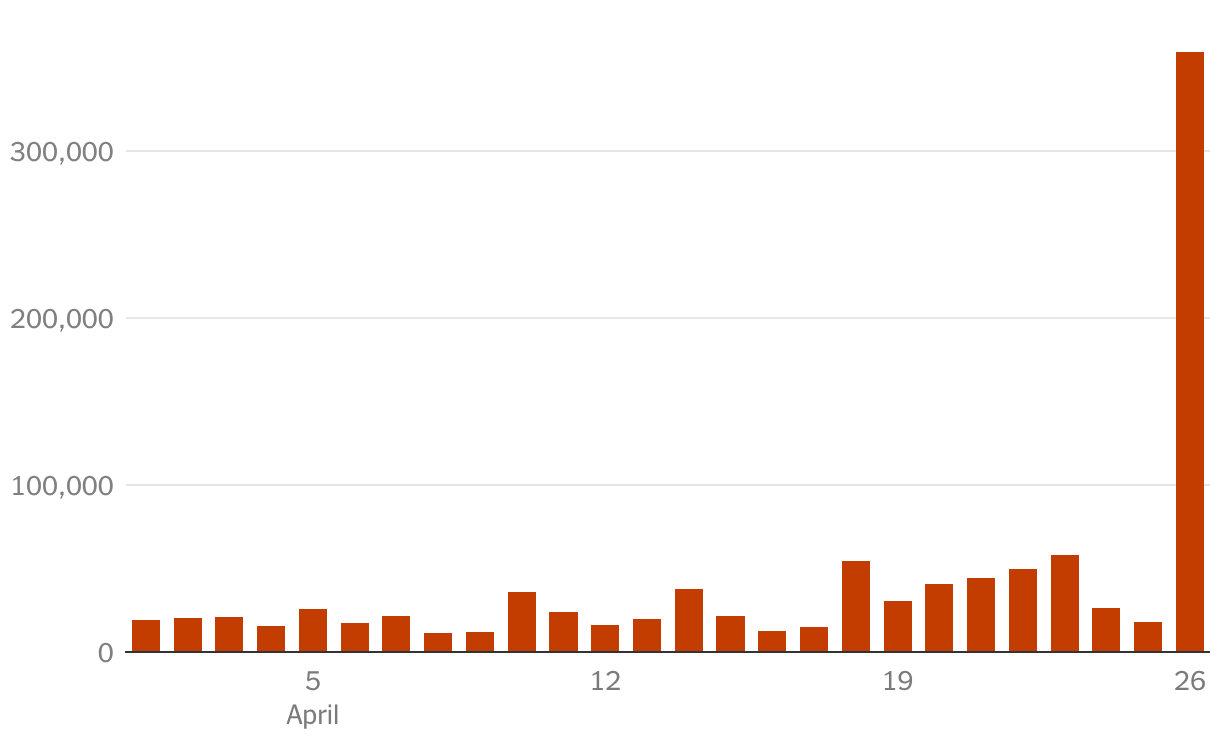
This time, users from across the political spectrum were participating in the chaos on platforms like X, Facebook and TikTok. Some users claimed that the attack was “staged,” suggesting without evidence that it was part of an apparent plot by Mr. Trump or others to distract from bad polling numbers or the war with Iran. The term “staged” surged to more than 300,000 posts on X by midday Sunday, according to data by TweetBinder, a social media analytics company owned by Audiense. (At least some of those posts refuted the notion that the attack was planned.)

‘Staged’

More than 300,000 posts appeared on X using the keyword “staged,” part of a surge of conspiracy theories claiming that attacks on President Trump were not genuine.

Posts on X containing the word “staged”
https://datawrapper.dwcdn.net/n4Pb6/plain.png

Other users were quick to assign blame, tying the shooter to Israeli causes without proof, and using imagery that was apparently manipulated with A.I. tools to support their claims. RT, a Russian state news channel, amplified some of those claims on X.

The result is an almost-instant online free-for-all over the truth, which plays out in just seconds and minutes after news of an attack is made public, and continues for days and weeks even as the truth often remains elusive. Nearly two years after an assassination attempt on Mr. Trump at a rally in Pennsylvania, for example, many influential accounts continue to claim that the event was staged, even though two people were killed.

“People are reshaping reality based on what they want to be true or not,” said Cliff Lampe, a professor and associate dean for academic affairs at the School of Information at University of Michigan. “They’re not looking for good information, they’re looking for confirmatory information, and will often go very deep down a rabbit hole of side-by-side pictures, microshots of the president’s face, et cetera.”

At the same time, the president has participated more actively online than previous leaders, marshaling his supporters to post about events as he does, and fanning the flames of conspiratorial thinking. After the attack on Saturday, Mr. Trump said the ordeal should support his effort to build a gilded ballroom on White House grounds. Scores of right-wing influencers picked up the message, sharing posts that said Mr. Trump’s planned ballroom was an urgently needed addition to White House security measures. (The dinner was held at the Washington Hilton Hotel.)

Among the most-shared posts online on Saturday night and Sunday were claims that the attacker was shot and killed on scene — in fact, he was arrested — along with speculation about his motives and political alliances. After some of the posts gained millions of views, the authors sometimes posted corrections that made clear that the attacker was not killed, but those received only a fraction of the views.

“Rumor moves very quickly, and then it often takes a very long time to correct those errors,” Dr. Lampe said.

Influencers have motivation to post speculation and rumor, even if they do not believe it: The attention it brings can be vital in gaining followers and, on revenue-sharing platforms like X, can mean larger payouts.

For example, Mario Nawfal, an online influencer who has previously promoted Russian talking points, on Sunday posted a collection of unfounded theories on X and then immediately said he did not believe them.

“My position: I don’t believe any of the theories, definitely don’t think it was staged,” he wrote at the end of the post, which received more than 300,000 views.

X did not respond to a request for comment.

One clip from Fox News that spread widely on Sunday featured a phone interview with Aishah Hasnie, a White House correspondent for the network who had attended the dinner. Her call dropped midway through her firsthand account, leading some users to claim that the network had deliberately suppressed her story.

She later clarified in a post on X that there was little reliable signal in the ballroom where she was calling from.

“Getting out the truth and establishing facts and reliable information takes time,” said Amanda Crawford, associate professor at the University of Connecticut who has studied media coverage of mass shootings and conspiracy theories. “But our audiences really don’t have that kind of patience. And so you’re immediately seeing narratives that are being geared to answer the questions that people want to know, often building on the biases of people that are sharing them.”

nyt
izzythepush
 
  1  
Reply Mon 27 Apr, 2026 05:40 am
@hightor,
They have a suspect and evidence has been found in his room.

Now he may be a patsy, the evidence could be planted and he's being fit up like a kipper.

I think it's more likely that he legitimately targetted Trump but was allowed to get so far by secret services so they could arrest him with a lot of drama instead of quietly on the train to Chicago.

That's just my opinion, I don't have any evidence one way or another.
Brandon9000
 
  -2  
Reply Mon 27 Apr, 2026 06:18 am
@cmturner,
cmturner wrote:

You mean the youtube I posted has not a particle of support? Oh well.

Posting a link to someone's video in which he discusses many opinions is not evidence. You, yourself, have not posted one single sentence of evidence.
 

Related Topics

 
Copyright © 2026 MadLab, LLC :: Terms of Service :: Privacy Policy :: Page generated in 0.03 seconds on 05/19/2026 at 07:47:35