76
   

Global Warming...New Report...and it ain't happy news


Foxfyre
 
  1  
Reply Thu 10 Jan, 2008 04:11 pm
Thanks Ican (and Okie and CJ). Not that I would have hunted up and reposted the pages and pages of stuff I have posted so far on this thread. It is true that for us non-scientists, the opinion that AGW is probably not competently scientifically supported is indeed just an opinion. But it is not necessarily an uninformed opinion but is based on the scientific opinions of scientists I have read and the scientific opinions of scientists that you, me, Okie, Minitax, and many others have posted and posted and posted.
0 Replies
 
ican711nm
 
  1  
Reply Fri 11 Jan, 2008 12:07 pm
THE GLOBAL WARMING CONSENSUS FALSITIES
Quote:

http://epw.senate.gov/public/index.cfm?FuseAction=Minority.Blogs&ContentRecord_id=f80a6386-802a-23ad-40c8-3c63dc2d02cb

U.S. Senate Report: Over 400 Prominent Scientists Disputed Man-Made Global Warming Claims in 2007

Senate Report Debunks "Consensus"

Complete U.S. Senate Report Now Available: (LINK)
Complete Report w/out Intro: (LINK)
0 Replies
 
Steve 41oo
 
  1  
Reply Fri 11 Jan, 2008 01:11 pm
a few people still believe the earth is flat. I'm not going to waste my time. (I looked up "Dr" Richard S Courtney, the only prominent British name...it seems he has no academic degree and works for the British Coal industry)


AGW is a fact. The UK government announced yesterday a radical programme to build new nuclear power stations. Now why would they do that?
0 Replies
 
georgeob1
 
  1  
Reply Fri 11 Jan, 2008 01:43 pm
Steve 41oo wrote:
AGW is a fact.

I agree, though there are sound reasons to dispute the predictions and the relative cost & benefits of the remedies proposed by the AGW zealots.

Steve 41oo wrote:
The UK government announced yesterday a radical programme to build new nuclear power stations. Now why would they do that?
Many reasons - (1) it is much cheaper than any other source save only hydroelectric; (2) It involves zero environmental emissions; (3) the effect on public health is much less than that of burning gas or coal.
0 Replies
 
Walter Hinteler
 
  1  
Reply Fri 11 Jan, 2008 02:11 pm
georgeob1 wrote:
Steve 41oo wrote:
The UK government announced yesterday a radical programme to build new nuclear power stations. Now why would they do that?
Many reasons - (1) it is much cheaper than any other source save only hydroelectric; (2) It involves zero environmental emissions; (3) the effect on public health is much less than that of burning gas or coal.


I'm not sure if it's really much cheaper - this is a graphic from today's The Guardian

http://i10.tinypic.com/6yklth5.jpg

Quote:
Nick Clegg, Liberal Democrat leader "The government must be honest about how much it will cost to build and run new nuclear power stations and who is going to pick up the bill. Even if energy companies could run them without taxpayers' money, consumers would just end up paying for them through higher fuel bills. The government should abandon these expensive white elephants and focus on increasing energy efficiency and the use of genuinely renewable technologies."


Actually, I think that you really need nuclear power to have a working "energy mix".

Britain doesn't get a lot of energy from nuclear power stations - compared to other European countries

http://i7.tinypic.com/7341rip.jpg

And if no more nuclear power stations were built, they would be left with just one in 2030 (Sizewell B).
However, under the new plans, plants closures would still mean that nuclear power will only generate half of what it now by then.
0 Replies
 
ican711nm
 
  1  
Reply Fri 11 Jan, 2008 02:16 pm
Steve 41oo wrote:
a few people still believe the earth is flat. I'm not going to waste my time. (I looked up "Dr" Richard S Courtney, the only prominent British name...it seems he has no academic degree and works for the British Coal industry)


AGW is a fact. The UK government announced yesterday a radical programme to build new nuclear power stations. Now why would they do that?

What is your evidence to support your claim?

Quote:
The following are signatories to the Dec. 13th [2007] letter to the Ban Ki-moon, Secretary-General of the United Nations on the UN Climate conference in Bali [Link to List of signatories]:

Quote:
Signatories of an open letter on the UN climate conference
Published: Tuesday, December 18, 2007
...
Richard S. Courtney, PhD, climate and atmospheric science consultant, IPCC expert reviewer, U.K.
...


What do you have to say about the other more than 99 signatories?
0 Replies
 
Foxfyre
 
  1  
Reply Fri 11 Jan, 2008 02:24 pm
ican711nm wrote:
Steve 41oo wrote:
a few people still believe the earth is flat. I'm not going to waste my time. (I looked up "Dr" Richard S Courtney, the only prominent British name...it seems he has no academic degree and works for the British Coal industry)


AGW is a fact. The UK government announced yesterday a radical programme to build new nuclear power stations. Now why would they do that?

What is your evidence to support your claim?

Quote:
The following are signatories to the Dec. 13th [2007] letter to the Ban Ki-moon, Secretary-General of the United Nations on the UN Climate conference in Bali [Link to List of signatories]:

Quote:
Signatories of an open letter on the UN climate conference
Published: Tuesday, December 18, 2007
...
Richard S. Courtney, PhD, climate and atmospheric science consultant, IPCC expert reviewer, U.K.
...


What do you have to say about the other more than 99 signatories?


Here's the letter:
Quote:
Open Letter to the Secretary-General of the United Nations

December 13, 2007

His Excellency Ban Ki-Moon
Secretary-General, United Nations
New York, NY
United States of America

Dear Mr. Secretary-General,

Re: UN climate conference taking the World in entirely the wrong direction

It is not possible to stop climate change, a natural phenomenon that has affected humanity through the ages. Geological, archaeological, oral and written histories all attest to the dramatic challenges posed to past societies from unanticipated changes in temperature, precipitation, winds and other climatic variables. We therefore need to equip nations to become resilient to the full range of these natural phenomena by promoting economic growth and wealth generation.

The United Nations Intergovernmental Panel on Climate Change (IPCC) has issued increasingly alarming conclusions about the climatic influences of human-produced carbon dioxide (CO2), a non-polluting gas that is essential to plant photosynthesis. While we understand the evidence that has led them to view CO2 emissions as harmful, the IPCC's conclusions are quite inadequate as justification for implementing policies that will markedly diminish future prosperity. In particular, it is not established that it is possible to significantly alter global climate through cuts in human greenhouse gas emissions. On top of which, because attempts to cut emissions will slow development, the current UN approach of CO2 reduction is likely to increase human suffering from future climate change rather than to decrease it.

The IPCC Summaries for Policy Makers are the most widely read IPCC reports amongst politicians and non-scientists and are the basis for most climate change policy formulation. Yet these Summaries are prepared by a relatively small core writing team with the final drafts approved line-by-line by government representatives. The great majority of IPCC contributors and reviewers, and the tens of thousands of other scientists who are qualified to comment on these matters, are not involved in the preparation of these documents. The Summaries therefore cannot properly be represented as a consensus view among experts.

Contrary to the impression left by the IPCC Summary reports:

Recent observations of phenomena such as glacial retreats, sea-level rise and the migration of temperature-sensitive species are not evidence for abnormal climate change, for none of these changes has been shown to lie outside the bounds of known natural variability.
The average rate of warming of 0.1 - 0. 2 degrees Celsius per decade recorded by satellites during the late 20th century falls within known natural rates of warming and cooling over the last 10,000 years.
Leading scientists, including some senior IPCC representatives, acknowledge that today's computer models cannot predict climate. Consistent with this, and despite computer projections of temperature rises, there has been no net global warming since 1998. That the current temperature plateau follows a late 20th century period of warming is consistent with the continuation today of natural multi-decadal or millennial climate cycling.
In stark contrast to the often repeated assertion that the science of climate change is ?'settled', significant new peer-reviewed research has cast even more doubt on the hypothesis of dangerous human-caused global warming. But because IPCC working groups were generally instructed to consider work published only through May 2005, these important findings are not included in their reports; i.e., the IPCC assessment reports are already materially outdated.

The UN climate conference in Bali has been planned to take the world along a path of severe CO2 restrictions, ignoring the lessons apparent from the failure of the Kyoto Protocol, the chaotic nature of the European CO2 trading market, and the ineffectiveness of other costly initiatives to curb greenhouse gas emissions. Balanced cost/benefit analyses provide no support for the introduction of global measures to cap and reduce energy consumption for the purpose of restricting CO2 emissions. Furthermore, it is irrational to apply the 'precautionary principle' because many scientists recognize that both climatic coolings and warmings are realistic possibilities over the medium-term future.

The current UN focus on "fighting climate change", as illustrated in the November 27th UN Development Programme's Human Development Report, is distracting governments from adapting to the threat of inevitable natural climate changes, whatever forms they may take. National and international planning for such changes is needed, with a focus on helping our most vulnerable citizens adapt to conditions that lie ahead. Attempts to prevent global climate change from occurring are ultimately futile, and constitute a tragic misallocation of resources that would be better spent on humanity's real and pressing problems.

Yours faithfully,

http://www.nrsp.com/articles/07.12.13-open%20letter%20to%20the%20un%20secretary%20general.html

Here's the signatories:
http://www.nrsp.com/articles/07.12.13-open%20letter%20signatories-independent%20experts.html

(This site gives a bio for each person and the basis of their argument.)


And here's an excerpt from an article by Tom Harris and Dr. Courtney:
Quote:
The case for anthropogenic (human-caused) global warming (AGW) is getting weaker and weaker, not "stronger and stronger and stronger" as Dr. John Stone of the IPCC's Working Group II told the Canadian Broadcasting Corporation earlier this month. To date, no convincing evidence for AGW has been discovered. And recent global climate behaviour is not consistent with AGW model predictions. Mean global temperature has not again reached the high it did in 1998 (an El Nino year) and it has been stable for the last 6 years despite an increase in atmospheric carbon dioxide concentration of by 4% since 1998. Global temperature has not increased since 1998 because, while the northern hemisphere has warmed, the southern hemisphere has cooled. Global warming was supposed to actually be global, not hemispheric.

Nobody knows why the global temperature has stabilised recently nor if and when this stabilisation will cease, but the stabilisation does not support assertions that the science of AGW is ?'settled', despite what UN spokespeople in Bali will want us to believe

http://www.canadafreepress.com/index.php/article/794
0 Replies
 
ican711nm
 
  1  
Reply Fri 11 Jan, 2008 02:31 pm
Walter Hinteler wrote:
georgeob1 wrote:
Steve 41oo wrote:
The UK government announced yesterday a radical programme to build new nuclear power stations. Now why would they do that?
Many reasons - (1) it is much cheaper than any other source save only hydroelectric; (2) It involves zero environmental emissions; (3) the effect on public health is much less than that of burning gas or coal.


I'm not sure if it's really much cheaper - this is a graphic from today's The Guardian

...

What is the prorated construction costs, fixed costs, plus variable operating costs per megawatt hour generated by the various kinds of power plants?
0 Replies
 
georgeob1
 
  1  
Reply Fri 11 Jan, 2008 02:36 pm
Plant construction costs are a one-time event and they are amortized over the 50 or so year life of the plant. The differences walter claims are but an insignificant fraction of the total operating costs. Walter's data is deceptive.

in the U.S. our nuclear plants average $.06 per KW-Hr, and that cost includes on site storage of spent fuel and pre funding of the evetual decomissioning of the plant. Coal fired plants here average $.085 per KW Hr, and these costs do not include costs for the eventual decommissioning & cleanup of the plant. Both costs include depreciation of the original capital required for licensing & construction. Wind & solar power cost anywhere from $.12 to $.15 per KW Hr.
0 Replies
 
Foxfyre
 
  1  
Reply Fri 11 Jan, 2008 03:14 pm
georgeob1 wrote:
Plant construction costs are a one-time event and they are amortized over the 50 or so year life of the plant. The differences walter claims are but an insignificant fraction of the total operating costs. Walter's data is deceptive.

in the U.S. our nuclear plants average $.06 per KW-Hr, and that cost includes on site storage of spent fuel and pre funding of the evetual decomissioning of the plant. Coal fired plants here average $.085 per KW Hr, and these costs do not include costs for the eventual decommissioning & cleanup of the plant. Both costs include depreciation of the original capital required for licensing & construction. Wind & solar power cost anywhere from $.12 to $.15 per KW Hr.


I suppose that answers my questions on the "Republican" thread re why pols aren't suggesting we build enough wind and solar power plants to meet our energy needs. Smile
0 Replies
 
Walter Hinteler
 
  1  
Reply Fri 11 Jan, 2008 03:22 pm
I couldn't find out how these data are made up.
The following data are from the anti-windfarm association in the neighbouring government district and related to energy sources there in 2002 [published by the "Regional Council at the district goverment"]

- brown coal (Lignite) (28%): 2 Cent kWh
- nuclear power (30%) 2 Cent/kWh
- natural gas: (9%) 3 Cent/kWh
- biomass (2%): 3 Cent/kWh
- water (4%): 3 Cent/kWh
- bituminous coal (24%) 4.5 Cent kWh
- wind (3%): 9.1 Cent/kWh
- solar energy (0.03% of total): 50 Cent/kWh
0 Replies
 
Foxfyre
 
  1  
Reply Fri 11 Jan, 2008 06:55 pm
I posted this within the context of the discussion on the other thread, but it also seems appropriate within the context of the immediate discussion here:
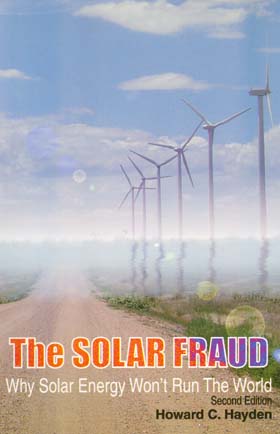
http://www.valeslake.com/covr2.jpg

When I mentioned the general current focus here, this book was just just now recommended to me by a client in my office. So I looked it up.

Book Review originally printed in Environmental News: (emphasis mine)

Written By: book review by Jay Lehr
Published In: Environment News
Publication Date: November 1, 2002
Publisher: The Heartland Institute


--------------------------------------------------------------------------------

The Solar Fraud: Why Solar Energy Won't Run the World
by Howard C. Hayden, PhD
Vales Lake Publishing, paperback, 224 pages


Howard Hayden, Professor Emeritus of Physics at the University of Connecticut, is the Mr. Wizard of alternative energy. Be it in the form of wind, hydropower, biomass, direct solar by photovoltaic cells, or solar collectors transmitting heat to a turbine, he explains the physics with joyful enthusiasm, but also objective reality.

Physics, we are often told, is dry enough to be a fire hazard. Physics underlies absolutely everything about solar energy. One would suppose, therefore, that solar energy must be boring beyond belief. Nothing could be farther from the truth.

Solar energy inspires passion, enthusiasm, and devotion, but unfortunately the litany of unrealistic, rosy predictions of a solar future constitute a fraud not founded on the unshakable physics that determines the sun's capacity to supply our energy. It involves lying with statistics and attempting to manipulate the public into accepting what could only become a world of brownouts.

Hayden explains that Our Daily Bread would not exist if we did not use energy to till the soil, grind the grain, move the flour to bakeries, and bake the bread. Energy drives the economy, but he says it is a serious error to imagine it's simply a matter of profits. We would need energy to transport goods even if there were no profit-minded corporations. We use energy to build not only our homes, but also everything in our homes. Energy drives society, and solar energy does indeed play a role.


The Solar Niche

There have always been water pumps in remote locations, operated by wind energy. Now there are photovoltaic cells operating other pumps where conventional electricity is not available. Scientists and engineers almost universally recognize that solar energy is extremely useful in such niche applications. They also recognize that solar energy?-using all conceivable technologies?-will not be adequate to run an industrialized world.

On June 29, 1979, President Jimmy Carter called for a "national commitment to solar energy," with the goal of producing 20 percent of the nation's energy from various solar sources by the year 2000. It did not come to pass. All the solar heat collection systems built in the United States since 1974 account for less than 0.02 percent of our energy consumption.

Moreover, the number of hydroelectric generating stations increased during this time?-from 3,275 in 1980 to 3,362 in 1995?-but hydro's share of our electric energy consumption fell, from 12.1 percent to 9.8 percent. Combined photovoltaics, wind power, wood burning, and waste burning accounted for merely 1.6 percent of the electricity used in the U.S. in 1998.

Hayden describes the large solar industry in the United States made of honest business people selling wind turbines, photovoltaic arrays, deep discharge storage batteries, solar heat collectors, wood stoves, and many other devices to enable people to collect solar energy in one form or another. They are meant for places where conventional energy is not available and for people passionate enough to own solar regardless of the cost.

None of these business people will ever tell you that solar can power the world. The people who do?-including the likes of Ralph Nader, Denis Hayes (Earth Day founder), the World Watch Institute (Lester Brown), the Union of Concerned Scientists, or Environmental Defense, to name but a few?-have an entirely different agenda uncomplicated by physics. They simply desire to destroy our industrialized society.

Hayden explains the limited capability of every solar-related energy source by relating how the laws of physics impose certain inescapable shortcomings. Along the way he precisely quotes the many well-known energy charlatans making statements that defy the laws of nature.


When it comes to wind, Hayden shows wind farms can generate electrical power at the rate of about 1.2 watts (W) per square meter (m2) for most sites, and up to 4 W/m2 in rare sites where the wind always comes from one direction. The goal is to generate enough energy to replicate a 1,000 megawatts power plant operating around the clock. To do that in California, for example, would require a wind farm one mile wide stretching all the way from Los Angeles to San Francisco.


To produce as much energy as a conventional 1,000 megawatt power plant using solar would require a 127 square mile field of solar mirrors collecting enough heat to turn a turbine. Now that would have quite an environmental impact!


For decades, there have been delirious proclamations that the world would soon run on solar energy. Those statements have always sounded too good to be true and, sure enough, they have always been false.

Solar Fraud will arm you with the basic knowledge to understand all the physics of energy utilization. Energy use creates the power to run society, as well as the statistics that track man's lack of progress when attempting to overturn the laws of nature through the use of impractical energy sources.

Additionally, Hayden's collection of quotes from the purveyors of the solar fraud, when set side-by-side with the physical facts, will convince you that society is not being victimized by well-meaning, wrongheaded people. Instead, the purveyors of the solar energy fraud are intent on bringing industrial society to its knees by stifling society's true, nearly inexhaustible sources of energy.
http://www.heartland.org/Article.cfm?artId=10648

So this explains why we aren't running any villages, much less any large cities, let alone any countries, on wind or solar power these days, and we should probably raise our eyebrows should any Pols suggest that should be our goal. Continue research and development of course. But there are no magic bullets that are going to solve our energy crisis and I will look most favorably on those who suggest we will need to learn to live peacefully with oil, natural gas, and coal for some time to come as well as reinstate nuclear programs.
0 Replies
 
ican711nm
 
  1  
Reply Fri 11 Jan, 2008 09:16 pm
Foxfyre, what is that "other thread" you participate in? You have referred to it here more than once? I'm interested in participating in it too.
0 Replies
 
Foxfyre
 
  1  
Reply Fri 11 Jan, 2008 10:16 pm
ican711nm wrote:
Foxfyre, what is that "other thread" you participate in? You have referred to it here more than once? I'm interested in participating in it too.


It's the
A first(?) thread on 2008: McCain,Giuliani & the Republicans
thread

http://www.able2know.org/forums/viewtopic.php?t=70220&start=2740

Right now they are discussing candidate stances on energy and that got us into solar and wind farms and nuclear and such rather than global warming perse'.
0 Replies
 
Walter Hinteler
 
  1  
Reply Sat 12 Jan, 2008 12:27 am
The Wind Turbine Power Calculator is a nice 'toy'.


Oh, and an article (and an interview) about Sir David King's new book in today's The Guardian won't pleade many

Science chief: greens hurting climate fight

The war on hot air

Quote:
He says: "There is a suspicion, and I have that suspicion myself, that a large number of people who label themselves 'green' are actually keen to take us back to the 18th or even the 17th century."
...
People say 'well, we'll just use less energy.' Come on," he says. "And then there's the real world, where everyone is aspiring to the sort of standard of living that we have, which is based on a large energy consumption."

King calls global warming the biggest challenge our civilisation has ever faced, and famously, in a 2004 article in the journal Science, berated the US for its inaction, describing climate change as "more serious even than the threat of terrorism". But his vocal support for nuclear power and genetically modified foods has led to tensions with environmental campaigners.

In a new book, The Hot Topic, he invites further hostility, arguing that aviation has been unfairly scapegoated, and that a localist approach to grocery shopping, aimed at reducing food miles, may sometimes result in bigger carbon dioxide emissions than purchasing food transported from overseas. Making people feel guilty about their energy use, the book argues, "makes them less likely to act, not more". "What I'm looking for are technological solutions to a technologically driven problem, so the last thing we must do is eschew technology as we move forward," says King, 68.

His book prescribes a barrage of technological measures based on nuclear energy, wind power, cutting emissions from cars and buildings, increasing the global area of solar panels by a factor of 700, and capturing and storing emissions from fossil fuel power generation. Only with a nuclear component, he argues, might Britain "just about manage" to reach its commitment to reduce CO2 emissions by 60% on 1990 levels by 2050.


Quote:
Global-warming denialists will find no solace here, but neither will hardline campaigners preaching austerity: that approach is dismissed as too alienating. Besides, King argues, "going green" in our personal lives, however radically, marginalises the issue. We should be thinking about our larger role in the economic revolution we must bring about.
0 Replies
 
Diest TKO
 
  1  
Reply Sat 12 Jan, 2008 01:48 pm
cjhsa wrote:
People are entitled to their opinion tko. Science is often a matter of opinion as well.


Says the non-scientist.

T
K
O
0 Replies
 
ican711nm
 
  1  
Reply Sat 12 Jan, 2008 08:22 pm
Foxfyre wrote:
ican711nm wrote:
Foxfyre, what is that "other thread" you participate in? You have referred to it here more than once? I'm interested in participating in it too.


It's the
A first(?) thread on 2008: McCain,Giuliani & the Republicans
thread

http://www.able2know.org/forums/viewtopic.php?t=70220&start=2740

Right now they are discussing candidate stances on energy and that got us into solar and wind farms and nuclear and such rather than global warming perse'.

Thanks!
0 Replies
 
blatham
 
  1  
Reply Mon 14 Jan, 2008 04:45 am
Quote:
Climatic changes appear to be destabilizing vast ice sheets of western Antarctica that had previously seemed relatively protected from global warming, researchers reported yesterday, raising the prospect of faster sea-level rise than current estimates.
http://www.washingtonpost.com/wp-dyn/content/article/2008/01/13/AR2008011302753.html?hpid=topnews
0 Replies
 
username
 
  1  
Reply Mon 14 Jan, 2008 07:54 am
Kudos to you, blatham, always on top of the news. Told ya the research showed Antarctica was melting. Told ya half of the continent was pretty much experiencing no net gain or loss, but the other half was melting faster than normal. Turns out the ice loss there has increased. Try reading something other than the head-in-the-sand denialists for a change, ican. Try looking at some of the actual research results. The Arctic, which denialists like Sallie Baliunas said would be the first affected and which they maintained was unaffected, is now undeniably melting. Greenland is melting. High-altitude glaciers, which are also "the canary in the coal mine" in terms of predictive signals say the glaciologists, are melting. The most vulnerable areas of Antarctica are melting. You are very shortly going to be sitting in a puddle of very cold water, ican. Okie too, for that matter.

http://www.msnbc.msn.com/id/22643132/page/2/
0 Replies
 
username
 
  1  
Reply Mon 14 Jan, 2008 07:55 am
Well, here, start from the beginning of the link, rather than page 2:
http://www.msnbc.msn.com/id/22643132/
0 Replies


Related Topics

 
Copyright © 2026 MadLab, LLC :: Terms of Service :: Privacy Policy :: Page generated in 0.09 seconds on 03/16/2026 at 09:42:10