I saw this video on TV yesterday. Like Bobby Darin's Softly, it also brought a tear to my eye. Actually, the events occurred about 35 years ago, but the video began circulating only relatively recently. It really is heartwarming--well, it was for me. The song is perfect for the subject matter.
http://www.youtube.com/watch?v=adYbFQFXG0U
ah, firefly. That did make me a bit teary. We all cry tears of happiness, no? Rather reminds me of Elsa, and to my surprise, I found that the situations are the same, but the circumstances different. While Elsa was born in Africa, Christian was born in England.
Thanks, dear. That was beautiful.
Here is another wonderful song. First the Portuguese; then the English.
http://www.youtube.com/watch?v=eN8XRbHn-YE
http://www.youtube.com/watch?v=FE6sw4tozZE&feature=related
Interesting clip on Romania, Letty.
It reminded me of a song called Romania which some comedian used to do. For some reason, Danny Kaye keeps popping into my head. Does anyone remember the song? Was it Danny Kaye?
I found the song on YouTube done by a Cantor, in a similar style to what I remember that comedian doing--singing it fairly fast, and holding the notes for comic effect. Once it gets going, it's a very lively song. Seems to me the comic that used to do it would collapse breathless at the end. The Cantor manages to remain upright.
 http://www.youtube.com/watch?v=Re5Iw6oZCwk
Letty, Christian was rehabilitated into the wild by George Adamson--of Elsa and Born Free fame.
http://www.kimbawlion.com/christian.htm
While reading about this lion, I learned Joy Adamson was murdered in 1980 and George Adamson was murdered in 1989. How awful.
firefly, love the cantor singing and he did remind me of Danny Kaye with that up tempo progression.
I realize about Elsa and Christian now, and thanks. When you have a chance, tell us how they were murdered. That is indeed a horrible revelation.
I couldn't find the song Romania by Danny Kaye, but he was a multi talented performer. I recall him best as Hans Christian Anderson.
Here is a clip from The Court Jester with a sweet and gentle song.
http://www.youtube.com/watch?v=plDSspVvdoM&feature=related
Back later, folks. Have some work business to do. (that's what my kids called it)
This is cyber space, WA2K radio
For Danny Glover's birthday, I thought we might listen to this Z.Z. Hill number which was featured on the soundtrack of Danny's film, To Sleep With Anger.
http://au.youtube.com/watch?v=yL114c40OOo&feature=related
And, Z.Z. Hill, and that song, are referenced in this number called Soul Heaven by Johnnie Taylor
http://au.youtube.com/watch?v=Zfgaxc4e2eo
firefly, What a great tribute to Danny. As Art Blakey observed, "Nothing but the soul.." Thanks, dear, for both of those songs. Knew most of the faces, but not all.
Well, it's time for me to say goodnight and I just found out that the song that was played in the movie Born Free was done by Matt Munro/Monro.
Really love that guy, so here it is and I hate that it ended so abruptly.
http://au.youtube.com/watch?v=IfRXNmMkfI0
Tomorrow, world,
From Letty with love
And yesterday was Isaac Stern's birthday and I clear forgot to post a tribute to him. Shame on me, because I always enjoy listening to his absolutely wonderful sound. So, to rectify my omission, here are two selections.
The first one is Stern both conducting and playing Mozart
http://au.youtube.com/watch?v=kflCBsO5C_c
The second is a fiddler who would always be welcome to come and play on my roof.
http://au.youtube.com/watch?v=zso2jYE-ctU&feature=related
Can't think of a better way to say goodnight.
Sweet dreams to all.
Good morning, WA2K radio audience.
firefly, what a wonderful combination of classics. Loved Mozart, of course, and I did a quick background check on Fiddler on the Roof and was surprised to find that they were a traditional Jewish family living in poverty in Tsarist Russia. Thanks for the memory jog, gal.
Today is the birthday of Janis Siegal of Manhattan Transfer and another check was quite a discovery. They took their name from John Dos Passos who was an intity unto himself. I was surprised to find that his mother was a member of an esteemed family in Virginia.
First, folks, a poem by John, then a song by Janis.
This isn't a poem
This is two men in grey prison clothes.
One man sits looking at the sick flesh of his hands?-hands that haven't worked for seven years
Do you know how long a year is?
Do you know how many hours there are in a day
when a day is twenty-three hours on a cot in a cell,
in a cell in a row of cells in a tier of rows of cells
all empty with the choked emptiness of dreams?
Do you know the dreams of men in jail?
They are dead now
The black automatons have won.
They are burned up utterly
their flesh has passed into the air of Massachusetts their dreams have passed into the wind.
"They are dead now," the Governor's secretary nudges the Governor,
"They are dead now," the Superior Court Judge nudges
the Supreme Court Judge,
"They are dead now," the College President nudges
the College President
A dry chuckling comes up from all the dead:
The white collar dead; the silkhatted dead;
the frockcoated dead
They hop in and out of automobiles
breathe deep in relief
as they walk up and down the Boston streets.
they are free of dreams now
free of greasy prison denim
their voices blow back in a thousand lingoes
singing one song
to burst the eardrums of Massachusetts
Make a poem of that if you dare!
http://www.youtube.com/watch?v=jRdIzAl3jSg
Actress/singer, Gloria DeHaven, was born into a show biz family. In 1938, long before she teamed with June Allyson for movie musicals, she was the lead singer with this man's orchestra. Wonder if she got a lot of wolf whistles from him? For Gloria's birthday, let's listen to his distinctive sound.
http://au.youtube.com/watch?v=oIbzGx6xJjU
Emil Jannings
From Wikipedia, the free encyclopedia
Born Theodor Friedrich Emil Janenz
July 23, 1884(1884-07-23)
Rorschach, Switzerland
Died January 3, 1950 (aged 65)
Strobl, Austria
Awards won
Academy Awards
Best Actor
1928 The Last Command and
The Way of All Flesh
Emil Jannings (July 23, 1884 - January 3, 1950) was a German actor and the first winner of the Academy Award for Best Actor. He won the 1928 Oscar for two films, The Way of All Flesh and The Last Command. He also starred in F. W. Murnau's The Last Laugh, a film notable in silent cinema for its lack of title cards, and in the 1922 film version of Shakespeare's Othello.
Christened Theodor Friedrich Emil Janenz in Rorschach, Switzerland, of a German mother and an American father, Jannings was a theater actor who had a promising Hollywood career come to an end when talkies made his thick German accent difficult to understand. He returned to Europe, where he starred opposite Marlene Dietrich in the classic 1930 film The Blue Angel, filmed in English simultaneously with its German version Der blaue Engel. He soon spotted that the unknown Dietrich was a star in the making, while his own career was past its peak, and he was especially spiteful to her throughout the filming, according to her.
Besides The Last Laugh, Jannings worked with Murnau on two other films, playing the title character in Herr Tartüff and Mephistopheles in Faust.
During the Third Reich, he starred in several films which were intended to promote Nazism, particularly the Führerprinzip: Der Herrscher ("The Ruler" 1937), The Youth of Frederick the Great (1935), and The Dismissal of Bismarck (1942). Minister of Propaganda Joseph Goebbels named him "Artist of the State" in 1941. His involvement with the Nazis ended any chance he may have had for a comeback in the United States.
When troops of the Allied Powers entered Germany in 1945, Jannings reportedly carried his 1928 Best Actor Oscar with him as proof of his former association with Hollywood. However, Jannings's active role in Nazi propaganda meant he was subject to denazification, and any comeback attempt was doomed. He then retired to his farm in Austria. Very proficient in money matters, Jannings was one of the highest paid actors of his time.
Jannings died in 1950 in Strobl, Austria, of cancer at the age of 65. His Best Actor Oscar is now on display at the Filmmuseum in Berlin, Germany.
Raymond Chandler
From Wikipedia, the free encyclopedia
Born July 23, 1888(1888-07-23)
Chicago, Illinois, United States
Died March 26, 1959 (aged 70)
San Diego, California, United States
Occupation Novelist
Nationality American
Writing period 1933-1959
Genres Crime
Raymond Thornton Chandler (July 23, 1888 - March 26, 1959) was an American author of crime stories and novels of immense stylistic influence upon modern crime fiction, especially in the style of the writing and the attitudes now characteristic of the genre. His protagonist, Philip Marlowe, is synonymous with "private detective," along with Dashiell Hammett's Sam Spade.
Early life
He was born in Chicago, Illinois, in 1888, but moved to Britain in 1895 with his Irish-born mother after they were abandoned by his father, an alcoholic civil engineer for an American railway company. His uncle, a successful lawyer, supported them.[1] In 1900, Chandler attended Dulwich College, London,[1] where he was classically educated. He did not attend university, instead spending time in France and Germany. In 1907, he was naturalised as a British subject in order to take the Civil Service examination, which he passed with the third-highest score. He then took an Admiralty job lasting slightly more than a year. His first poem was published during that time.
Chandler disliked the servile mindset of the civil service and quit, to the consternation of his family. He then was an unsuccessful journalist, published reviews, and continued writing Romantic poetry. Accounting for that checkered time he said that "It was the age of the clever young man, but I was distinctly not a clever young man."[2]
In 1912, he borrowed money from his uncle (who expected it repaid with interest), and returned to the U.S., eventually settling in Los Angeles. He strung tennis rackets, picked fruit and endured a lonely time of scrimping and saving. Finally, he took a correspondence bookkeeping course, finished ahead of schedule, and found a steady job. In 1917, when the U.S. entered World War I, he enlisted in the Canadian Army, served in France, and was in flight training in England at war's end.[1]
After the armistice, he returned to Los Angeles and his mother, and soon began a love affair with Cissy Pascal, a married woman eighteen years his senior.[1] Chandler's mother, who had opposed the union, died on 26 September 1923, and not long after, in 1924, Chandler and Pascal married.[3][1] By 1932, in the course of his bookkeeping career, he became a vice-president of the Dabney Oil syndicate, but a year later, his alcoholism, absenteeism, and a threatened suicide[1] provoked his firing.
Pulp writer
To earn a living with his creative talent, he taught himself to write pulp fiction; his first story, "Blackmailers Don't Shoot", was published in Black Mask magazine in 1933; his first novel, The Big Sleep, was published in 1939. Literary success led to work as a Hollywood screenwriter: he and Billy Wilder co-wrote Double Indemnity (1944), based upon on James M. Cain's novel of the same name. His only original screenplay was The Blue Dahlia (1946). Chandler collaborated on the screenplay of Alfred Hitchcock's Strangers on a Train (1951) - a story he thought implausible - based on Patricia Highsmith's novel. By then, the Chandlers had moved to La Jolla, California, a rich coastal town in San Diego.
Later life and death
In 1954, Cissy Chandler died after a long illness, during which time Raymond Chandler wrote The Long Goodbye. Lonely and depressed, he returned to drink, never quitting it for long, and the quality and quantity of his writing suffered.[1] In 1955, he attempted suicide; literary scholars documented that suicide attempt. In The Long Embrace: Raymond Chandler and the Woman He Loved, Judith Freeman says it was "a cry for help", given he called the police beforehand, saying he planned to kill himself. Raymond Chandler's personal and professional life was both helped and complicated by the women to whom he was attracted ?- notably Helga Greene (his literary agent); Jean Fracasse (his secretary); Sonia Orwell (George Orwell's widow); and Natasha Spender (Stephen Spender's wife), the latter two of whom assumed Chandler to be a repressed homosexual.[4] Note that Judith Freeman's book perpetuates errors dating back to the MacShane biography relating to the death of Florence Chandler and a number of residences.[3]
After time in England he returned to La Jolla, where he died of pneumonial peripheral vascular shock and pre-renal uremia in the Scripps Memorial Hospital per the death certificate. Helga Greene inherited the Chandler estate after a lawsuit with Jean Fracasse. Raymond Chandler is buried at Mount Hope Cemetery, San Diego, California, as per Frank MacShane, The Raymond Chandler Papers, Chandler directed he be buried next to Cissy, but wound up in the cemetery's Potter's field, because of the lawsuit over his estate.
Critical reception
Critics and writers, ranging from W. H. Auden to Evelyn Waugh to Ian Fleming greatly admired the finely wrought prose of Raymond Chandler.[1] Although his swift-moving, hardboiled style was inspired mostly by Dashiell Hammett, his sharp and lyrical similes are original: The muzzle of the Luger looked like the mouth of the Second Street tunnel; The minutes went by on tiptoe, with their fingers to their lips, defining private eye fiction genre, and leading to the coining of the adjective Chandleresque, which is subject and object of parody and pastiche. Yet, Philip Marlowe is not a stereotypical "tough guy", but a complex, sometimes sentimental man of few friends, who attended university, speaks some Spanish and, at times, admires Mexicans, is a student of classical chess games and classical music. He will refuse a prospective client's money if he is ethically unsatisfied by the job.
The high critical regard in which Chandler is usually held today makes poignant the critical pans that stung Chandler in his lifetime. In a March 1942 letter to Mrs. Blanche Knopf, published in Selected Letters of Raymond Chandler, Chandler complained: "The thing that rather gets me down is that when I write something that is tough and fast and full of mayhem and murder, I get panned for being tough and fast and full of mayhem and murder, and then when I try to tone down a bit and develop the mental and emotional side of a situation, I get panned for leaving out what I was panned for putting in the first time."
Chandler's short stories and novels are evocatively written, conveying the time, place, and ambience of Los Angeles and environs in the 1930s and 1940s.[1] The places are real, if pseudonymous: Bay City is Santa Monica, Gray Lake is Silver Lake, and Idle Valley a synthesis of rich San Fernando Valley communities.
Raymond Chandler also was a perceptive critic of pulp fiction; his essay "The Simple Art of Murder" is the standard reference work in the field.
All of his novels have been cinematically adapted, notably The Big Sleep (1946), by Howard Hawks, with Humphrey Bogart as Philip Marlowe; novelist William Faulkner was a co-screenplay writer. Raymond Chandler's few screen writing efforts and the cinematic adaptation of his novels proved stylistically and thematically influential upon the American film noir genre.
Arthur Treacher
From Wikipedia, the free encyclopedia
Born Arthur Veary Treacher
July 23, 1894(1894-07-23)
Brighton, East Sussex
Died December 14, 1975 (aged 81)
Manhasset, New York
Spouse(s) Virginia Taylor (1940-1975) (his death)
Arthur Veary Treacher (July 23, 1894 - December 14, 1975) was an English actor born in Brighton, East Sussex, England. He was a veteran of World War I.
After the war he established a stage career and in 1928 he went to America as part of a musical-comedy revue called Great Temptations. He began his film career in the 1930s, which included a role in three different Shirley Temple films: Stowaway (1936), Heidi (1937), and The Little Princess (1939). Scenes intentionally put the six-feet-four Treacher standing or dancing side-by-side with the tiny child actress, which could only make her cuter. Treacher filled the role of the ideal butler, and he portrayed P.G. Wodehouse's perfect valet character Jeeves in two movies, Thank You, Jeeves! (1936) and Step Lively, Jeeves (1937). He also played a valet or butler in several other films including: Personal Maids, Mister Cinderella, Bordertown, and Curly Top.
Treacher played the role of Constable Jones in Mary Poppins and made many guest appearances on U.S. television, in addition to being Merv Griffin's announcer and sidekick on the The Merv Griffin Show in the mid-1960s and early-1970s ("...and now, here's the dear boy himself, Meeeer-vin!") When Griffin switched from syndication to CBS, the network brass insisted that Treacher was too old for the show. Griffin fought to keep Treacher, but eventually relented and announced Treacher's retirement. No replacement was hired.
In 1964 Treacher played the role of Arthur Pinkney in two episodes of the TV series, The Beverly Hillbillies. His role was that of a stuffy English butler who mistakenly believed the hillbillies were the domestic servants of the family he was hired by to improve the quality of the eastates live-in staff, while the hillbillies believed Pinkney to be a boarder at their Beverly Hills Mansion. Once found out that he was at the wrong millionaire's home,it was concluded that Pinkney should remain as the boarder at the Clampet residence in hopes introducing the backwoods family to culture and refinement. It still remains two of the funniest episodes written for the TV show.
Arthur Treacher's Fish and Chips was also a popular restaurant chain in the 1970s named after him, although it is unclear if he had any financial investment in the chain. The chain continues to exist, though with only 45 franchises left throughout the United States.
Michael Wilding
From Wikipedia, the free encyclopedia
Born July 23, 1912(1912-07-23)
Westcliff-on-Sea, Essex, England
Died July 8, 1979 (aged 66)
Chichester, West Sussex, England
Years active 1933 - 1973
Spouse(s) Kay Young (1937-1951)
Elizabeth Taylor (1952-1957)
Susan Neill (1958-1962)
Margaret Leighton (1964-1976)
Michael Wilding (July 23, 1912 - July 8, 1979) was an English actor.
Biography
Early life
Born in Westcliff-on-Sea, Essex, England, Wilding was a successful commercial artist when he joined the art department of a London movie studio in 1933. He soon embarked on an acting career.
Career
He appeared in numerous British motion pictures, often opposite Anna Neagle, but had a less productive career in Hollywood. His screen performances include Sailors Three (1940), In Which We Serve (1942), Piccadilly Incident (1946), Spring in Park Lane (1948), Stage Fright (1950) and The World of Suzie Wong (1960).
His last appearance was in an uncredited, non-speaking cameo in Lady Caroline Lamb (1972), which co-starred his last wife, Margaret Leighton.
Personal life
Wilding had four wives, Kay Young (married 1937, divorced 1951), actress Elizabeth Taylor (married 1952, divorced 1957), Susan Neill (married 1958, divorced 1962), and actress Margaret Leighton (married 1964 until her death in 1976).
He and Taylor had two sons, Michael Howard Wilding (born January 6, 1953) and Christopher Edward Wilding (born February 27, 1955).
In the 1960s, he was forced to cut back on his movie appearances due to illness related to his lifelong epilepsy.
Michael Wilding died in Chichester, West Sussex, due to head injuries suffered from a fall down a flight of stairs during an epileptic seizure. His body was cremated and the ashes were scattered.
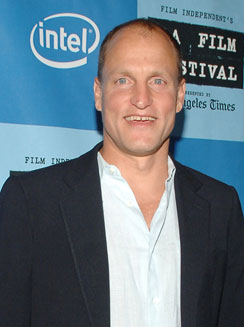
Woody Harrelson
From Wikipedia, the free encyclopedia
Born Woodrow Tracy Harrelson
July 23, 1961 (1961-07-23) (age 47)
Midland, Texas
Spouse(s) Laura Louie (1998-present)
Nancy Simon (1985-1986)
Awards won
Emmy Awards
Best Supporting Actor - Comedy Series
1989 Cheers
Golden Raspberry Awards
Worst Supporting Actor
1994 Indecent Proposal
Screen Actors Guild Awards
Best Cast - Motion Picture
2007 No Country for Old Men
Woodrow Tracy "Woody" Harrelson (born July 23, 1961) is an American Emmy Award-winning and Academy Award-nominated actor. He is probably best known for his role in the classic sitcom Cheers as Woody Boyd. Notable film roles include Roy Munson in Kingpin, Mickey Knox in Natural Born Killers, Larry Flynt in The People vs. Larry Flynt, Dusty in A Prairie Home Companion and Carson Wells in No Country for Old Men.
Biography
Early life
Harrelson was born in Midland, Texas, the son of Diane Lou (née Oswald) and Charles Voyde Harrelson, who divorced in 1964; he has two brothers, Jordan and Brett, the latter of whom is a professional motorcycle racer. In 1979, in San Antonio, Federal Judge John Howland Wood was shot and killed by rifle fire by Charles Harrelson, who was a free-lance contract killer.[1] He was convicted and eventually died during his life sentence in maximum security prison.[1]
Harrelson grew up in Lebanon, Ohio, with his mother. Harrelson attended Lebanon High School and later Hanover College in Indiana, becoming a member of the Sigma Chi Fraternity, and receiving a Bachelor of Arts in Theater Arts and English in 1983.
Career
After graduation, Harrelson moved to New York City. In 1985, he was cast as the naive but genial Midwestern bartender Woody Boyd on the classic television series Cheers, and won an Emmy for the role. His first film was 1986's Wildcats with Goldie Hawn. Harrelson became friends with Wesley Snipes and starred with him in the box-office hits White Men Can't Jump and Money Train. He appeared in mostly minor roles until he starred in Robert Redford's Indecent Proposal in 1993, a role which helped open doors for Harrelson in the film industry.
In 1994 Harrelson starred in arguably his best known role to date, Mickey Knox in Oliver Stone's Natural Born Killers. During this time he also starred in the Farrelly brothers cult classic Kingpin. In 1996, he starred in the title role of the controversial film The People vs. Larry Flynt, for which he received a nomination for the Academy Award for Best Actor. Following this performance Harrelson went to star in films such as Wag the Dog, EDtv, The Thin Red Line and Palmetto.
More recently, he had a fairly long run on the NBC sitcom Will & Grace as Grace's love interest Nathan and played FBI agent Stan in 2004's After the Sunset. His most recent films are A Prairie Home Companion, A Scanner Darkly, and No Country for Old Men which were released in June and July of 2006 and November of 2007, respectively.
Personal life
In 1985, Harrelson married Nancy Simon, daughter of playwright Neil Simon, in Tijuana. The two intended to divorce the following day, but the storefront marriage/divorce parlor was closed when they had returned to it, and the two remained married for ten months.[2]
On January 11, 1998, Harrelson married Laura Louie, his former assistant of two years and a co-founder of Yoganics, an organic food delivery service.[3] The couple, who have been together since 1990, have three daughters, Deni Montana (born February 28, 1993), Zoe Giordano (born September 22, 1996), and Makani Ravello (born June 3, 2006). When announcing Makani's birth, the couple referred to the three as their "goddess trilogy".[4]
Activist work
Harrelson is a supporter and activist for the legalization of marijuana and hemp in the US.[4] On June 1, 1996, he was arrested in Kentucky after he symbolically planted four hemp seeds to challenge state law that failed to distinguish between industrial hemp and marijuana. Harrelson won the case.
Harrelson is also an environmental activist. He once scaled the Golden Gate Bridge in San Francisco with members of North Coast Earth First! group to unfurl a banner that said, "Hurwitz. Aren't ancient redwoods more precious than gold?" in protest of PALCO CEO Charles Hurwitz, who once stated, "He who has the gold, makes the rules".[4] Harrelson, an ethical vegan and raw foodist, has also denounced animal experiments in the cosmetics industry.
He has travelled the American West Coast on a bike and domino caravan with a hemp oil-fueled biodiesel bus (the subject of the independent documentary, Go Further) and has narrated the documentary Grass. Harrelson briefly owned an oxygen bar in West Hollywood called "O2". He is also a peace activist and has often spoken publicly against the 2003 invasion of Iraq.
Sadly many men need a primer to inform them of the inner workings of the female mind. I hope this is helpful.
1. Don't imagine you can change a man - unless he's in diapers.
2. What do you do if your boyfriend walks-out? You shut the door.
3. If they put a man on the moon - they should be able to put them all up there.
4. Never let your man's mind wander - it's too little to be out alone.
5. Go for younger men. You might as well - they never mature anyway.
6. Men are all the same - they just have different faces, so that you can tell them apart.
7. Definition of a bachelor; a man who has missed the opportunity to make some woman miserable.
8. Women don't make fools of men - most of them are the do-it-yourself types.
9. Best way to get a man to do something, is to suggest they are too old for it.
10. Love is blind, but marriage is a real eye-opener.
11. If you want a committed man, look in a mental hospital.
12. The children of Israel wandered around the desert for 40 years. Even in biblical times, men wouldn't ask for directions.
13. If he asks what sort of books you're interested in, tell him checkbooks.
14. Remember a sense of humor does not mean that you tell him jokes, it means that you laugh at his.
15. Sadly, all men are created equal...
bobsmythhawk has just reminded us that it's Arthur Treacher's birthday. I never realized he was so tall. Here he performs with one of his leading ladies.
http://au.youtube.com/watch?v=t1gxYDxxd7I
Listening to Treacher's music hall song, I was reminded of Tessie O'Shea, who began her career in music halls at the age of 6. This became her theme song.
http://au.youtube.com/watch?v=JBXihp2cbEI
Did a bit of reading on Tessie and found that, in 1963, Nöel Coward created the role of fish-and-chips peddler "Ada Cockle" specifically for her in his Broadway musical, The Girl Who Came to Supper. That's funny, because Arthur Treacher's name became associated with a chain of fish and chips restaurants, so I guess there is some connection between these two.
BTW, I think the instument Tessie played in that clip is a banjolele, a four-stringed musical instrument with a small banjo-type body and a fretted ukulele neck. The instrument achieved its greatest popularity in the 1920s and '30s, and combines the small scale, tuning, and playing style of a ukulele with the construction and distinctive tone of a banjo, hence the name.
In P.G. Wodehouse's novel Thank You, Jeeves, valet Jeeves is driven to resign over his employer Bertie Wooster's decision to take up the banjolele. Guess who starred in the movie of the same name? Right--Arthur Treacher.
Amazing how Tessie and Arthur Treacher just seem to generate connections between them. Yet I really wasn't aware of these things when I thought about posting the Tessie O'Shea song. Strange how these things work.

Hey, firefly, thanks for the whistle song from The High and the Mighty. My word, I thought John Wayne did that himself. Also, appreciate all your other contributions and shall be back later to acknowledge each one.
Hey, BioBob, Thanks for all the background on the famous folks and unfortunately, all men are alike. Loved it, hawkman.
Couldn't find Emil, folks, but here is someone you all know doing a scene from Otello/Othello and I think it is right after he smothered Desdemona. It was impolite to have another back then, but methinks Shakespeare was making fun of such things.
http://www.youtube.com/watch?v=83cIOTWiIDY&feature=related
Hmmm, Perhaps your PD erred about Janis' birthday.
Good afternoon WA2K.
I just googled Janis, Letty. Today is her birthday.

I love the theme from The High and the Mighty and had no idea that Gloria DeHaven was once with that band, Firefly. The Arthur Treacher video is a gem.
Emil Jannings; Raymond Chandler, Michael Wilding and Woody Harrelson


Here's Emil:
http://au.youtube.com/watch?v=MjOxOAsnZbI&feature=related
and the song from that picture:
http://au.youtube.com/watch?v=kmUsZ3Jg56k&feature=related
