L. Frank Baum
From Wikipedia, the free encyclopedia
Born May 15, 1856(1856-05-15)
Chittenango, New York
Died May 6, 1919 (aged 62)
Hollywood, California
Occupation Author, Newspaper Editor, Actor, Screenwriter, Film Producer
Spouse Maud Gage
Children Frank Joslyn Baum
Robert Stanton Baum
Harry Neal Baum
Kenneth Gage Baum
Lyman Frank Baum (May 15, 1856 - May 6, 1919) was an American author, actor, and independent filmmaker best known as the creator, along with illustrator W. W. Denslow, of one of the most popular books in American children's literature, The Wonderful Wizard of Oz, better known today as simply The Wizard of Oz. He wrote thirteen sequels, nine other fantasy novels, and a plethora of other works (55 novels in total, 82 short stories, over 200 poems, an unknown number of scripts, and many miscellaneous writings), and made numerous attempts to bring his works to the stage and screen.
Baum's childhood and early life
Baum was born in Chittenango, New York in 1856, into a devout Methodist family of German (father's side) and Scots-Irish (mother's side) origin, the fifth of six children born to Cynthia Stanton and Benjamin Ward Baum, only three of whom survived into adulthood. He was named "Lyman" after his father's brother, but always disliked this name, and preferred to go by his middle name, "Frank". His mother, Cynthia Stanton, was a direct descendant of Thomas Stanton, one of the four Founders of what is now Stonington, Connecticut.
Benjamin Baum was a wealthy businessman, originally a barrel maker, who had made his fortune in the oil fields of Pennsylvania. Baum grew up on his parents' expansive estate, Rose Lawn, which he always remembered fondly as a sort of paradise. As a young child, he was tutored at home with his siblings, but at the age of 12 he was sent to study at Peekskill Military Academy. He was a sickly child given to daydreaming, and his parents may have thought he needed toughening up. But after two utterly miserable years at the military academy, he was allowed to return home. Frank Joslyn Baum claimed that this was following an incident described as a heart attack, though there is no contemporary evidence of this.
Baum started writing at an early age, perhaps due to an early fascination with printing. His father bought him a cheap printing press, and he used it to produce The Rose Lawn Home Journal with the help of his younger brother, Henry (Harry) Clay Baum, with whom he had always been close. The brothers published several issues of the journal and included advertisements they may have sold. By the time he was 17, Baum had established a second amateur journal, The Stamp Collector, printed an 11-page pamphlet called Baum's Complete Stamp Dealers' Directory, and started a stamp dealership with his friends.
At about the same time, Baum embarked upon his lifetime infatuation with the theater, a devotion which would repeatedly lead him to failure and near-bankruptcy. His first such failure occurred when a local theatrical company duped him into replenishing their stock of costumes, with the promise of leading roles that never came his way. Disillusioned, Baum left the theatre?-temporarily?-and went to work as a clerk in his brother-in-law's dry goods company in Syracuse. At one point, he found another clerk locked in a store room dead, an apparent suicide. This incident appears to have inspired his locked room story, The Suicide of Kiaros, first published in the literary journal, The White Elephant.
At the age of 20, Baum took on a new vocation: the breeding of fancy poultry, which was a national craze at the time. He specialized in raising a particular breed of fowl, the Hamburg chicken. In 1880 he established a monthly trade journal, The Poultry Record, and in 1886, when Baum was 30 years old, his first book was published: The Book of the Hamburgs: A Brief Treatise upon the Mating, Rearing, and Management of the Different Varieties of Hamburgs.
Yet Baum could never stay away from the stage long. He continued to take roles in plays, performing under the stage names of Louis F. Baum and George Brooks.
In 1880, his father built him a theatre in Richburg, New York, and Baum set about writing plays and gathering a company to act in them. The Maid of Arran, a melodrama with songs based on William Black's novel A Princess of Thule, proved a modest success. Baum not only wrote the play but composed songs for it (making it a prototypical musical, as its songs relate to the narrative), and acted in the leading role. His aunt, Katharine Gray, played his character's aunt. She was the founder of Syracuse Oratory School, and Baum advertised his services in her catalog to teach theatre, including stage business, playwriting, directing, and translating (French, German, and Italian), revision, and operettas, though he was not employed to do so. On November 9, 1882, Baum married Maud Gage, a daughter of Matilda Joslyn Gage, a famous women's suffrage activist. While Baum was touring with The Maid of Arran, the theatre in Richburg caught fire during a production of Baum's ironically-titled parlor drama, Matches, and destroyed not only the theatre, but the only known copies of many of Baum's scripts, including Matches, as well as costumes and props.
The South Dakota years
In July 1888, Baum and his wife moved to Aberdeen, Dakota Territory, where he opened a store, "Baum's Bazaar". His habit of giving out wares on credit led to the eventual bankrupting of the store, so Baum turned to editing a local newspaper, The Aberdeen Saturday Pioneer, where he wrote a column, Our Landlady. Baum's description of Kansas in The Wonderful Wizard of Oz is based on his experiences in drought-ridden South Dakota. During much of this time, Matilda Joslyn Gage was living in the Baum household. While he was in South Dakota, Baum sang in a quartet that included a man who would become one of the first Populist (People's Party) Senators in the U.S., James Kyle.
Baum becomes an author
After Baum's newspaper failed in 1891, he, Maud and their four sons moved to Chicago, where Baum took a job reporting for the Evening Post. For several years he edited a magazine for advertising agencies focused on window displays in stores. The major department stores created elaborate Christmas time fantasies, using clockwork mechanism that made people and animals appear to move. He also had to work as a traveling salesman.
In 1897 he wrote and published Mother Goose in Prose, a collection of Mother Goose rhymes written as prose stories, and illustrated by Maxfield Parrish. Mother Goose was a moderate success, and allowed Baum to quit his door-to-door job.
In 1899 Baum partnered with illustrator W. W. Denslow, to publish Father Goose, His Book, a collection of nonsense poetry. The book was a success, becoming the best-selling children's book of the year.
The Wonderful Wizard of Oz
In 1900, Baum and Denslow (with whom he shared the copyright) published The Wonderful Wizard of Oz to much critical and financial acclaim. The book was the best-selling children's book for two years after its initial publication. Baum went on to write thirteen more novels based on the places and people of the Land of Oz.
The Wizard of Oz: Fred R. Hamlin's Musical Extravaganza
Two years after Wizard's publication, Baum and Denslow teamed up with composer Paul Tietjens and director Julian Mitchell to produce a musical stage version of the book under Fred R. Hamlin. This stage version, the first to use the shortened title "The Wizard of Oz", opened in Chicago in 1902, then ran on Broadway for 293 stage nights from January to October 1903. It returned to Broadway in 1904, where it played from March to May and again from November to December. It successfully toured the United States with much of the same cast, as was done in those days, until 1911, and then became available for amateur use. The stage version starred David C. Montgomery and Fred Stone as the Tin Woodman and Scarecrow respectively, which shot the pair to instant fame. The stage version differed quite a bit from the book, and was aimed primarily at adults. Toto was replaced with Imogene the Cow, and Tryxie Tryfle, a waitress, and Pastoria, a streetcar operator, were added as fellow cyclone victims. The Wicked Witch of the West was eliminated entirely in the script, and the plot became about how the four friends, being allied with the usurping Wizard, were hunted as traitors to Pastoria II, the rightful King of Oz. It is unclear how much control or influence Baum had on the script; it appears that many of the changes were written by Baum against his wishes due to contractual requirements with Hamlin. Jokes in the script, mostly written by Glen MacDonough, called for explicit references to President Theodore Roosevelt, Senator Mark Hanna, and oil magnate John D. Rockefeller. Although use of the script was rather free-form, the line about Hanna was ordered dropped as soon as Hamlin got word of his death in 1904.
Beginning with the success of the stage version, most subsequent versions of the story, including newer editions of the novel, have been titled "The Wizard of Oz", rather than using the full, original title. In more recent years, restoring the full title has become increasingly common, particularly to distinguish the novel from the Hollywood film.
The Wizard of Oz on screen and back to stage
Following early film treatments in 1910 and 1925, and Baum's own venture, The Oz Film Manufacturing Company, Metro Goldwyn Mayer made the story into the now classic movie The Wizard of Oz (1939) starring Judy Garland as Dorothy Gale. Among other changes, the film was given an all-a-dream ending. (Baum used this technique only once, in Mr. Woodchuck, and in that case the title character explicitly told the dreamer that she was dreaming numerous times.) A completely new Tony Award-winning Broadway musical based on African-American musical styles, The Wiz was staged in 1975 with Stephanie Mills as Dorothy. It was the basis for a 1978 film by the same title starring Diana Ross as an adult Dorothy. The Wizard of Oz continues to inspire new versions such as Disney's 1985 Return to Oz, The Muppets' Wizard of Oz, Tin Man (a re-imagining of the story televised in late 2007 on the Sci Fi Channel), and a variety of animated productions. Today's most successful Broadway show, Wicked provides a backstory to the two Oz witches used in the classic MGM film. Wicked author Gregory Maguire chose to honor L. Frank Baum by naming his main character Elphaba -- a phonetic take on Baum's initials.
Later life and work
With the success of Wizard on page and stage, Baum and Denslow hoped lightning would strike a third time and in 1901 published Dot and Tot of Merryland. The book was one of Baum's weakest, and its failure further strained his faltering relationship with Denslow. It would be their last collaboration. Baum would work primarily with John R. Neill on his fantasy work beginning in 1904, but Baum met Neill few times (all before he moved to California) and often found Neill's art not humorous enough for his liking, and was particularly offended when Neill published The Oz Toy Book: Cut-outs for the Kiddies without authorization.
Several times during the development of the Oz series, Baum declared that he had written his last Oz book and devoted himself to other works of fantasy fiction based in other magical lands, including The Life and Adventures of Santa Claus and Queen Zixi of Ix. However, persuaded by popular demand, letters from children, and the failure of his new books, he returned to the series each time. All of his novels have fallen into public domain in most jurisdictions, and many are available through Project Gutenberg. Even so, his other works remained very popular after his death, with The Master Key appearing on St. Nicholas Magazine's survey of readers' favorite books well into the 1920s.
Because of his lifelong love of theatre, he often financed elaborate musicals, often to his financial detriment. One of Baum's worst financial endeavors was his The Fairylogue and Radio-Plays (1908), which combined a slideshow, film, and live actors with a lecture by Baum as if he were giving a travelogue to Oz. However, Baum ran into trouble and could not pay his debts to the company who produced the films. He did not get back to a stable financial situation for several years, after he sold the royalty rights to many of his earlier works, including The Wonderful Wizard of Oz. This resulted in the M.A. Donahue Company publishing cheap editions of his early works with advertising that purported that Baum's newer output was inferior to the less expensive books they were releasing. Baum had shrewdly transferred most of his property, except for his clothing, his library (mostly of children's books, such as the fairy tales of Andrew Lang, whose portrait he kept in his study), and his typewriter (all of which he successfully argued were essential to his occupation), into Maud's name, as she handled the finances, anyway, and thus lost much less than he could have.
His final Oz book, Glinda of Oz was published a year after his death in 1920 but the Oz series was continued long after his death by other authors, notably Ruth Plumly Thompson, who wrote an additional nineteen Oz books.
Baum made use of several pseudonyms for some of his other, non-Oz books. They include:
Edith Van Dyne (the Aunt Jane's Nieces series)
Laura Bancroft (Twinkle and Chubbins, Policeman Bluejay)
Floyd Akers (The Boy Fortune Hunters series, continuing the Sam Steele series)
Suzanne Metcalf (Annabel)
Schuyler Staunton (The Fate of a Crown, Daughters of Destiny)
John Estes Cooke (Tamawaca Folks)
Capt. Hugh Fitzgerald (the Sam Steele series)
Baum also anonymously wrote The Last Egyptian: A Romance of the Nile.
Baum continued theatrical work with Harry Marston Haldeman's men's social group, The Uplifters, for which he wrote several plays for various celebrations. He also wrote the group's parodic by-laws. The group, which also included Will Rogers, was proud to have had Baum as a member and posthumously revived many of his works despite their ephemeral intent. Prior to that, his last produced play was The Tik-Tok Man of Oz (based on Ozma of Oz and the basis for Tik-Tok of Oz), a modest success in Hollywood that producer Oliver Morosc decided did not do well enough to take to Broadway. Morosco, incidentally, quickly turned to film production, as would Baum.
In 1914, having moved to Hollywood years earlier, Baum started his own film production company, The Oz Film Manufacturing Company, which came as an outgrowth of the Uplifters. He served as its president, and principal producer and screenwriter. The rest of the board consisted of Louis F. Gottschalk, Harry Marston Haldeman, and Clarence R. Rundel. The films were directed by J. Farrell MacDonald, with casts that included Violet Macmillan, Vivian Reed, Mildred Harris, Juanita Hansen, Pierre Couderc, Mai Welles, Louise Emmons, J. Charles Haydon, and early appearances by Harold Lloyd and Hal Roach. Silent film actor Richard Rosson appeared in one of the films, whose younger brother Harold Rosson photographed The Wizard of Oz (1939). After little success probing the unrealized children's film market, Baum came clean about who wrote The Last Egyptian and made a film of it (portions of which are included in Decasia), but the Oz name had, for the time being, become box office poison and even a name change to Dramatic Feature Films and transfer of ownership to Frank Joslyn Baum did not help. Unlike with The Fairylogue and Radio-Plays, Baum invested none of his own money in the venture, but the stress probably took its toll on his health.
Baum died on May 6, 1919, aged 62, and was buried in the Forest Lawn Memorial Park Cemetery, in Glendale, California.
Baum's beliefs
Literary
Baum's avowed intentions with the Oz books, and other fairy tales, was to tell such tales as the Brothers Grimm and Hans Christian Andersen told, bringing them up to date by making the characters not stereotypical dwarfs or genies, and by removing both the violence and the moral the violence was to point to.[1] Although the first books contained a fair amount of violence, it decreased with the series; in The Emerald City of Oz, Ozma objected to doing violence even to the Nomes who threaten Oz with invasion.[2]
Another traditional element that Baum intentionally omitted was the emphasis on romance. He considered romantic love to be uninteresting for young children, as well as largely incomprehensible. In The Wonderful Wizard of Oz, the only element of romance lay in the backstory of the Tin Woodman, which explains his condition and does not otherwise affect the tale, and that of the Golden Cap; the only other stories with such elements were The Scarecrow of Oz and Tik-Tok of Oz, both based on dramatizations, which Baum regarded warily until his readers accepted them.[3]
Political
Women's Suffrage
Sally Roesch Wagner of The Matilda Joslyn Gage Foundation has published a pamphlet titled The Wonderful Mother of Oz describing how Matilda's radical feminist politics were sympathetically channelled by Baum into his Oz books. Much of the politics in the Republican Aberdeen Saturday Pioneer dealt with trying to convince the populace to vote for women's suffrage. Baum was the secretary of Aberdeen's Woman's Suffrage Club. When Susan B. Anthony visited Aberdeen, she stayed with the Baums. Nancy Tystad Koupal notes an apparent loss of interest in editorializing after Aberdeen failed to pass the bill for women's enfranchisement.
Some of Baum's contacts with suffragists of his day seem to have inspired much of his second Oz story, The Marvelous Land of Oz. In this story, General Jinjur leads the girls and women of Oz in a revolt by knitting needles, take over, and make the men do the household chores. Jinjur proves to be an incompetent ruler, but a female advocating equalism is ultimately placed on the throne. His Edith Van Dyne stories depict girls and young women engaging in traditionally masculine activities, and his girl sleuth Josie O'Gorman from The Bluebird Books is even less girly girl than Nancy Drew.
American Indian Genocide
During the events leading up to the Wounded Knee Massacre, Baum wrote an editorial for the Aberdeen Saturday Pioneer upon the death of Sioux Chief Sitting Bull. The entire editorial follows:
Sitting Bull, most renowned Sioux of modern history, is dead. He was not a Chief, but without Kingly lineage he arose from a lowly position to the greatest Medicine Man of his time, by virtue of his shrewdness and daring. He was an Indian with a white man's spirit of hatred and revenge for those who had wronged him and his. In his day he saw his son and his tribe gradually driven from their possessions: forced to give up their old hunting grounds and espouse the hard working and uncongenial avocations of the whites. And these, his conquerors, were marked in their dealings with his people by selfishness, falsehood and treachery. What wonder that his wild nature, untamed by years of subjection, should still revolt? What wonder that a fiery rage still burned within his breast and that he should seek every opportunity of obtaining vengeance upon his natural enemies. The proud spirit of the original owners of these vast prairies inherited through centuries of fierce and bloody wars for their possession, lingered last in the bosom of Sitting Bull. With his fall the nobility of the Redskin is extinguished, and what few are left are a pack of whining curs who lick the hand that smites them. The Whites, by law of conquest, by justice of civilization, are masters of the American continent, and the best safety of the frontier settlements will be secured by the total annihilation of the few remaining Indians. Why not annihilation? Their glory has fled, their spirit broken, their manhood effaced; better that they die than live the miserable wretches that they are.[4]
After the Massacre he wrote a second editorial. This second editorial ran on January 3, 1891 as follows:
The peculiar policy of the government in employing so weak and vacillating a person as General Miles to look after the uneasy Indians, has resulted in a terrible loss of blood to our soldiers, and a battle which, at best, is a disgrace to the war department. There has been plenty of time for prompt and decisive measures, the employment of which would have prevented this disaster. The PIONEER has before declared that our only safety depends upon the total extermination of the Indians. Having wronged them for centuries we had better, in order to protect our civilization, follow it up by one or more wrong and wipe these untamed and untamable creatures from the face of the earth. In this lies safety for our settlers and the soldiers who are under incompetent commands. Otherwise, we may expect future years to be as full of trouble with the redskins as those have been in the past. An eastern contemporary, with a grain of wisdom in its wit, says that 'when the whites win a fight, it is a victory, and when the Indians win it, it is a massacre." [4][5]
These two short editorials continue to haunt his legacy. Matilda Joslyn Gage, a white feminist who was later adopted into the Mohawk nation, was living with Baum at the time of the Wounded Knee massacre, and none of the Baum family letters or journals of the time suggest any home strife as a result of this writing. In 2006, however, descendants of Baum apologized to the Sioux nation for any hurt their ancestor had caused.[6]
These editorials are the only known occasion on which Baum expressed such direct views. For example, aside from the vocabulary, he did acknowledge many Americans of non-European ancestry in The Woggle Bug Book to an extent unheard of in other 1905 children's publications.[citation needed] The short story, "The Enchanted Buffalo", which purports to be a Native American fable, speaks respectfully of tribal peoples.[citation needed]
Political imagery in The Wizard of Oz
Although numerous political references to the "Wizard" appeared early in the 20th century, it was in a scholarly article in 1964 (Littlefield 1964) that there appeared the first full-fledged interpretation of the novel as an extended political allegory of the politics and characters of the 1890s. Special attention was paid to the Populist metaphors and debates over silver and gold.[7] As a Republican and avid supporter of Women's Suffrage, it is thought that Baum personally did not support the political ideals of either the Populist movement of 1890-92 or the Bryanite-silver crusade of 1896-1900. He published a poem[1] in support of William McKinley.
Since 1964 many scholars, economists and historians have expanded on Littlefield's interpretation, pointing to multiple similarities between the characters (especially as depicted in Denslow's illustrations) and stock figures from editorial cartoons of the period. Littlefield himself wrote the New York Times letters to the editor section spelling out that his theory had no basis in fact, but was developed simply as a tool to help bored summer school students remember their history lesson.
Baum's newspaper had addressed politics in the 1890s, and Denslow was an editorial cartoonist as well as an illustrator of children's books. A series of political references are included in the 1902 stage version, such as references by name to the President and a powerful senator, and to John D. Rockefeller for providing the oil needed by the Tin Woodman. Scholars have found few political references in Baum's Oz books after 1902.
When Baum himself was asked whether his stories had hidden meanings, he always replied that they were written to please children and generate an income for his family.
Many fans of the Oz books prefer to dismiss any political interpretation, and argue that Baum and Denslow had no interest in promoting any kind of political agenda.
Religious
Originally a Methodist, Baum joined the Episcopal Church in Aberdeen to participate in community theatricals. Later, he and his wife, encouraged by Matilda Joslyn Gage, became Theosophists, in 1897. Baum's beliefs are often reflected in his writing. The only mention of a church in his Oz books is the porcelain one which the Cowardly Lion breaks in the Dainty China Country in The Wonderful Wizard of Oz. The Baums also sent their older sons to "Ethical Culture Sunday School" in Chicago, which taught morality, not religion.
Joseph Cotten
From Wikipedia, the free encyclopedia
Born Joseph Cheshire Cotten
May 15, 1905(1905-05-15)
Petersburg, Virginia, U.S.
Died February 6, 1994 (aged 88)
Westwood, California, U.S.
Years active 1938 - 1981
Spouse(s) Lenore Kipp (1931-1960)
Patricia Medina (1960-1994)
Awards won
Other Awards
Volpi Cup for Best Actor
1949 Portrait of Jennie
Joseph Cheshire Cotten (May 15, 1905 - February 6, 1994) was an American actor of stage and screen. He was perhaps best known for his collaborations with Orson Welles, which included Citizen Kane, The Third Man, and Journey Into Fear, which Cotten wrote, and for his work with Alfred Hitchcock. He received his start on Broadway, starring in the original productions of The Philadelphia Story and Sabrina Fair, and became a recognizable Hollywood star in his own right with films such as Shadow of a Doubt and Portrait of Jennie.
Biography and career
Early life and career
Born in Petersburg, Virginia, Cotten worked as an advertising agent after graduating from the Washington, D.C., Hickman School, where he studied acting. His work as a theatre critic inspired him to become more involved in theatre productions, first in Virginia, and later in New York. Cotten made his Broadway debut in 1930, and soon befriended up-and-coming actor/director/producer Orson Welles. In 1937, he joined Welles' Mercury Theatre Company, starring in productions of Julius Caesar and Shoemaker's Holiday.
Cotten made his film debut in the Welles-directed short Too Much Johnson, a comedy based on William Gillette's 1890 play. The short was occasionally screened before or after Mercury productions, but never received an official release. Cotten returned to Broadway in 1939, starring as C.K. Dexter Haven in the original production of Philip Barry's The Philadelphia Story as well as the 1953 production of Sabrina Fair.
Citizen Kane
After the success of Welles' infamous War of the Worlds radio broadcast, Welles got an impressive contract with RKO Pictures. The two-picture deal promised full creative control for the young director, and Welles made sure to feature his Mercury players in whatever production he chose to bring to screen. However, after a year, production hadn't yet started on any of Welles' prospective projects. It took a meeting with writer Herman J. Mankiewicz for Welles to find a story to bring to the screen.
In mid 1940 filming began on Citizen Kane, which portrayed the life of a brilliant media mogul (played by Welles) who starts out as an idealist but eventually turns into a corrupt, lonely old man. The film featured Cotten prominently in the role of Kane's best friend, a drama critic for his print empire.
When released on May 1, 1941, Citizen Kane (based in part on the life of William Randolph Hearst) found little attention at theaters; Hearst owned the majority of the country's press outlets, and so forbade advertisements for the film. The film was nominated for nine Academy Awards in 1942, but was largely ignored by the Academy, only winning for Best Screenplay, for Welles and Mankiewicz. The film helped launch the careers of many other Mercury players, such as Agnes Moorehead (who played Kane's mother), Ruth Warrick (Kane's first wife), and Ray Collins (Kane's political opponent). However, Cotten was the only one of the four to find major success in Hollywood outside of Citizen Kane.
Collaborations with Welles
Despite Welles' reputation of being difficult to get along with, he and Cotten remained good friends. Cotten starred a year later in Welles' adaptation and production of The Magnificent Ambersons, supported by Moorehead. After the commercial disappointment of Citizen Kane, RKO was apprehensive about the new film, and cut nearly an hour off the running time before releasing it. Though at points the film came off as disjointed, the film was well received by critics. Despite the critical accolades Cotten received for his performance, he was again snubbed by the Academy (Moorehead was nominated for Best Supporting Actress).
In 1943, Cotten took control of the Nazi-related thriller Journey Into Fear. He wrote the screenplay with the help of Welles (who produced the film), and starred in the film. By the time production wrapped, Welles had been dropped from RKO, and, as part of the settlement, was required to edit the film to suitable length. The film was a minor hit, but separated the friends from professional collaboration for six years.
The last collaboration with Welles is widely considered as Cotten's best performance. In The Third Man, Cotten portrays a writer of pulp fiction who travels to post-war Vienna to meet his friend Harry Lime (Welles). When he arrives, he discovers that Lime has died, and is determined to prove to the police that it was murder, but uncovers an even darker secret. The film proved to be another technical achievement, but Cotten was passed over come Academy night.
The Forties and fifties
Cotten proved himself a versatile actor in Hollywood following the success of Citizen Kane. The characters he played onscreen during this period ranged from a serial killer in Hitchcock's Shadow of a Doubt (opposite Teresa Wright) to an eager police detective in 1944's Gaslight (opposite Ingrid Bergman, Charles Boyer and in her film debut, Angela Lansbury). Cotten starred with Jennifer Jones in four films: the wartime domestic drama Since You Went Away (1944), the romantic drama Love Letters (1945), the western Duel in the Sun (1946) and later in the critically acclaimed Portrait of Jennie (1948), in which he played a melancholy artist who becomes obsessed with a girl who may have died long ago.
Cotten's career cooled in the 1950s with a string of less high-profile roles in films such as the dark Civil War epic Two Flags West, the Joan Fontaine romance September Affair, and the Marilyn Monroe vehicle, Niagara. His last theatrical releases in the '50s were mostly film-noir outings and unsuccessful character studies. In 1956, Cotten left film for several years in exchange for a string of successful television ventures, such as the series On Trial, which was later called The Joseph Cotten Show. He was also featured in the successful series Alfred Hitchcock Presents and the General Electric Theater. He finished the decade with a cameo appearance in the Welles production Touch of Evil and a starring role in the 1958 film adaptation of Jules Verne's From the Earth to the Moon.
The Sixties and seventies
In 1960 he married British actress Patricia Medina, after his first wife, Lenore Kipp, died of leukemia earlier that year. After some time away from film, Cotten returned in 1964 in the horror classic Hush... Hush, Sweet Charlotte, opposite fellow screen veterans Bette Davis, Olivia de Havilland, and Agnes Moorehead. The rest of the decade found Cotten in a number of forgettable B-movies, foreign productions, and TV movies. He made guest appearances on the Ed Sullivan Show many times throughout the show's run.
In the early 1970s, Cotten followed a supporting role in Tora! Tora! Tora!, with several horror features such as The Abominable Dr. Phibes, opposite Vincent Price, and the classic Soylent Green (1973). Later in the decade, Cotten was featured in several all-star disaster outings, including Airport '77 opposite James Stewart and again with Olivia de Havilland and the nuclear thriller Twilight's Last Gleaming. On TV, he did a guest spot opposite James Garner on the 70's TV detective drama The Rockford Files.
Last years
One of Cotten's last films was 1980's infamous Heaven's Gate. Afterward, he appeared with Hollywood star Gloria Grahame in a twist-in-the-tale episode of the cult British TV show, Tales of the Unexpected.
Shortly after, the 75-year-old actor retired with his wife to their home in Westwood, California. Cotten published a popular autobiography, Vanity Will Get You Somewhere, in 1987. He died on February 6, 1994, of pneumonia, a complication of terminal (or metastasized) throat cancer at the age of 88, leaving behind his wife and stepdaughter. He was buried in Blandford Cemetery in Petersburg, Virginia.
Legacy
Cotten is considered one of the most underrated actors in Hollywood. He was never nominated for an Academy Award, despite his immense body of work, including many films that are considered classics today. The only notable acting award Cotten received throughout his career was a Venice Film Festival Award for Best Actor for his work in Portrait of Jennie.
Quotation
" Orson Welles lists Citizen Kane as his best film, Alfred Hitchcock opts for Shadow of a Doubt and Sir Carol Reed chose The Third Man - and I'm in all of them.
James Mason
From Wikipedia, the free encyclopedia
Born James Neville Mason
15 May 1909(1909-05-15)
Huddersfield, England, United Kingdom
Died 27 July 1984 (aged 75)
Lausanne, Switzerland
Spouse(s) Pamela Mason (1941-1964)
Clarissa Kaye-Mason (1971-1984)
Awards won
Golden Globe Awards
Best Actor - Motion Picture Musical/Comedy
1955 A Star Is Born
James Neville Mason (15 May 1909 - 27 July 1984) was a three-time Academy Award-nominated English actor who attained stardom in both British and American films.
Biography
Early life
Mason was born in Huddersfield, West Yorkshire, England to John and Mabel Mason; his father was a wealthy merchant. Mason had no formal training as an actor and initially embarked upon it as a lark. He studied architecture at Peterhouse, Cambridge, where he got a first degree, but got involved in stock theatre companies in his spare time before joining the Old Vic theatre in London under the guidance of Tyrone Guthrie and Alexander Korda who gave Mason a small film role in 1933 but fired him a few days into shooting.
Career
From 1935 to 1948 he starred in many British quota quickies. A conscientious objector during World War II (something which caused his family to break with him for many years), he became immensely popular for his brooding anti-heroes in the Gainsborough series of melodramas of the 1940s, including The Man in Grey and The Wicked Lady. He also starred with Deborah Kerr and Robert Newton in 1942's Hatter's Castle. In 1949 he made his first Hollywood film, Caught, and then went on to star in many more feature films and early TV shows. Nominated three times for an Oscar, he never won one.
Mason's distinctive voice enabled him to play a menacing villain as greatly as his good looks assisted him as a leading man. His roles include the declining actor in the 1954 version of A Star Is Born, a mortally wounded Irish revolutionary in Odd Man Out (1946), Brutus in Julius Caesar (1953), General Erwin Rommel twice - in The Desert Fox: The Story of Rommel (1951), and in The Desert Rats (1953) - Captain Nemo in 20,000 Leagues Under the Sea (1954), a small town school teacher driven insane by the effects of Cortisone in Bigger Than Life (1956), a suave master spy in North by Northwest (1959), a determined explorer in Journey to the Center of the Earth (also 1959), Humbert Humbert in Stanley Kubrick's Lolita (1962), a hired assassin sent to kill Peter O'Toole and thereby prevent him from leading a peasant uprising in Lord Jim (1965), the vampire's servant, Richard Straker, in Salem's Lot (1979), and a surreal pirate-ship captain in Yellowbeard (1981). One of his last roles, that of corrupt lawyer James Concannon in The Verdict (1982), earned him his third and final Oscar nomination.
Mason was once considered to play James Bond in a 1958 TV adaptation of From Russia with Love, which was ultimately never produced. Despite being in his fifties, he was still under consideration to play Bond in Dr. No before Sean Connery was cast. He was also approached to appear as Bond villain Hugo Drax in Moonraker (1979), however, he turned this down despite his renowned tendency to take any job offered him -- which led to appearances in films such as The Yin and the Yang of Mr. Go, Bloodline and Hunt the Man Down.
Throughout his career, Mason remained a powerful figure in the industry and he is now regarded as one of the finest film actors of the 20th century.
In the late 1970s, Mason became a mentor to up-and-coming actor Sam Neill.
Late in life, he served as narrator for a British television series on the films of Charlie Chaplin, Unknown Chaplin, which was aired in the U.S. on PBS and later issued on home video.[1]
Private life
Mason was a devoted lover of animals, particularly cats. He and Pamela Kellino Mason co-authored the book The Cats in Our Lives, which was published in 1949. James Mason wrote most of the book and also illustrated it. In The Cats in Our Lives, he recounted humorous and sometimes touching tales of the cats (as well as a few dogs) he had known and loved. An episode of the old Burns and Allen radio show featured Gracie Allen's attempts to impress new neighbor Mason by pretending to have cats of her own.
Mason was married twice:
British-American actress Pamela Mason (née Ostrer) (1941-1965); one daughter, the late Portland Mason Schuyler (1948-2004), and one son, Morgan (who is married to Belinda Carlisle, the former lead singer of The Go-Go's). Portland Mason was named after Portland Hoffa, the wife of the American film comedian Fred Allen; the Allens and the Masons were friends.
Australian actress Clarissa Kaye (1971-his death)
Mason's autobiography, Before I Forget, was published in 1981.
Death
Mason survived a major heart attack in 1959 and died as a result of another on July 27, 1984 in Lausanne, Switzerland. He was cremated, and (after a delay of 16 years) his ashes were buried in Corsier-sur-Vevey, Vaud, Switzerland. The remains of his old friend Charlie Chaplin are in a tomb a few steps away. James Mason Court, a road in the Marsh area of Huddersfield, is named after him.
References in popular culture
Graham Kennedy would use an imitation of James' distinctive voice as the default voice for an educated or English person on the Australian game show Blankety Blanks.
In 1991, Kelsey Grammer spoofed Mason as Captain Nemo in a skit while hosting Saturday Night Live. During the skit Nemo had to try to explain various units of nautical measurements while fighting off a giant squid.
For his audition for Saturday Night Live in 2005, Bill Hader gave an impersonation as Mason at a donut store trying to redeem an expired coupon.
British comedian Eddie Izzard often deliberately uses a James Mason impression as his standard "voice of God" in his standup routines.
In the film Broadway Danny Rose, one of the comedians in the Carnegie Deli remarks that he was trying, years before, to develop a British accent and wound up with a James Mason impression, an event that led him to become an impressionist.
On Freedy Johnston's 1994 album "This Perfect World", the song "Dolores" features the line "...I look like James Mason's ghost..."
On the DVD audio commentary of British Comedy The Mighty Boosh series two episode, "The Nightmare of Milky Joe" comedians Noel Fielding and Julian Barratt perform an impression of James Mason's voice. In early days of The Mighty Boosh, Rich Fulcher and Noel Fielding performed "duelling Masons" in the Hen and Chickens in Highbury, London. They also joke about Mason's clean-shaven appearance, quipping "You must shave twice a day" while both doing impressions of him. (This may also be in reference to a line from "Lolita" in which Mason's character specifically mentions having to shave twice a day")
In the Jack Mckinney Robotech novelizations, when Zentraedi commander Khyron was seen for the first time by humans, during his holding of Minmei hostage, someone noted that "he talks like that sixties actor, James Mason". This is very evident in the animated show on which the novels are based where his voice was performed by actor Greg Snegoff.
In their 60's radio show "Pop Go The Beatles", when the host was introducing the song, John Lennon suggested "Why don't you do it in your famous James Mason impersonation voice?"
His voice served as the inspiration for the Monkey Pick Ass joke on 93.3 WMMR Philadelphia's Preston and Steve morning show.
In Blackadder III, in the episode 'Amy and Amiability', the voice affected by elusive highwayman 'The Shadow' is clearly that of James Mason, a reference to The Wicked Lady, since The Shadow is later revealed to be a woman.
British tv comedy show Fonejacker uses a picture of Mason to represent the character of the The Flat Line respresentative.
In the novel "Olympos (novel)" by Dan Simmons, Tom Hockenberry - one of the main characters - comments that another character's (Asteague/Che's) voice is very similar to that of James Mason, later described as "Smooth but businesslike." (Pages 95, 454 of the Paperback)
Eddy Arnold
From Wikipedia, the free encyclopedia
Birth name Richard Edward Arnold
Also known as Tennessee Plowboy
Born May 15, 1918(1918-05-15)
Origin Henderson, Tennessee, USA
Died May 8, 2008 (aged 89)
Genre(s) Country Music
Pop Music
Occupation(s) Singer and Songwriter
Instrument(s) Acoustic Guitar
Years active 1945 - 2008
Label(s) RCA Records
MGM Records
Website
www.eddyarnold.com
Eddy Arnold (May 15, 1918 - May 8, 2008) was an American country music singer.
With 145 songs on the country charts -- including 28 number one hits -- Arnold ranks among the most popular country singers in U.S. history. Only George Jones had more individual hits on the country charts but, according to a formula derived by Joel Whitburn, Arnold is the all-time leader in an overall rankings for hits and their time on the charts.
Early years
Born Richard Edward Arnold in Henderson, Tennessee, he made his first radio appearance in 1936. During his childhood, he lost both his father and the family farm. When he turned 18, he left home to try to make his mark in the music world.
Arnold's formative musical years included early struggles to gain recognition until he landed a job as the lead male vocalist for the Pee Wee King band. By 1943, Arnold had become a solo star on the Grand Ole Opry. He was then signed by RCA Victor. In December 1944, he cut his first record. Although all of his early records sold well, his initial big hit did not come until 1946 with "That's How Much I Love You." In common with many other country and western singers of the time, he had a folksy nickname: "The Tennessee Plowboy."
Managed by Colonel Tom Parker (who later went on to control the career of Elvis Presley), Arnold began to dominate country music. In 1947-48, he had 13 of the top 20 songs. He successfully made the transition from radio to television, appearing frequently in the new medium.
In 1955, he upset many in the country music establishment by going to New York to record with the Hugo Winterhalter Orchestra. The pop-oriented arrangements of "Cattle Call" and "The Richest Man (in the World)", however, helped to expand his appeal beyond its country base.
With the advent of rock and roll, Arnold's record sales dipped in the late 1950s. Along with RCA Victor label-mate Jim Reeves, he continued to try to court a wider audience by using pop-sounding, string-laced arrangements, a style that would come to be known as the Nashville sound.
Second career
After Jerry Purcell became his manager in 1964, Arnold embarked on a "second career" that surpassed the success of the first one. In the process, he succeeded in his ambition of carrying his music to a more diverse audience. Already recorded by several other artists, "Make The World Go Away" was just another song until recorded by Arnold. Under the direction of producer Chet Atkins, and showcased by Bill Walker's arrangement and the talents of the Anita Kerr Singers and pianist Floyd Cramer, Arnold's rendition of "Make the World Go Away" became an international hit.
Bill Russell's precise, intricate arrangements provided the lush background for 16 straight Arnold hits through the late 1960s. Arnold started performing with symphony orchestras in virtually every major city. New Yorkers jammed prestigious Carnegie Hall for two concerts. Arnold appeared before the Hollywood crowd at the Coconut Grove and had long, sold-out engagements in Las Vegas and Lake Tahoe.
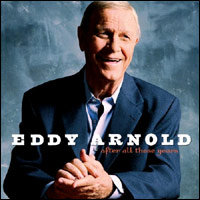
After having recorded for RCA Victor since the 1940s, Arnold left the label to record four albums for MGM Records in the 1970s, posting one hit ("If The Whole World Stopped Lovin' "). He then successfully returned to RCA Victor with both the album Eddy, and the hit single "Cowboy", which evoked stylistic memories of his classic "Cattle Call." After a few more RCA releases, he retired from active singing; however, he did release a new RCA album, After All These Years in 2005 at the age of 87.
Eddy performed his final concert on May 16, 1999, the day after his 81st birthday, at the Hotel Orleans in Las Vegas.
Reasons for success
There are several reasons for Arnold's great success. From the beginning he stood out from his contemporaries in the world of country singers. He never wore gaudy, glittering outfits. He sang from his diaphragm, not through his nose. He avoided the standard honky-tonk themes, preferring instead to sing songs that explored the intricacies of love.
Arnold also benefitted from his association with excellent musicians. The distinctive steel guitar of the late Roy Wiggins highlighted early recordings. Charles Grean, once employed by the Glenn Miller Orchestra, played bass and wrote early arrangements, adding violins for the first time in 1956. Chet Atkins played on many of Arnold's records, even after he started serving as producer. Bassist Bob Moore, the most recorded musician in history, first performed on the road with Arnold on the 1954 RCA Caravan and later performed on 75% of Arnold's hit recordings. Arnold also benefited from the management of Col. Parker, who guided his first career, and Purcell, who masterminded the second.
The most important factor for Arnold's success, however, was his voice. Steve Sholes, who produced all of Arnold's early hits, called him a natural singer, comparing him to the likes of Bing Crosby and Enrico Caruso. Arnold worked hard perfecting his natural ability. A review of his musical career shows his progression from fledgling singer to polished performer.
Arnold's longevity was exceptional. For more than 50 years, he transcended changing musical tastes. His later concerts attracted three generations of fans. To some he also served as a role model; in a field often awash with alcohol and drugs, he remained temperate.
Arnold was honored with induction into the Country Music Hall of Fame in 1966[1], was voted the first Country Music Association's Entertainer Of The Year the following year, and received the Academy of Country Music's Pioneer Award in 1985. Arnold has sold more than 85 million records and had 147 songs on the charts, including 28 No. 1 hits on Billboard's "Country Singles" chart. Among his recordings are songs for mothers and children, hymns, show tunes, and novelty numbers. Arnold is best known for his way with a love song.
In 2003, Arnold ranked #22 in CMT's 40 Greatest Men of Country Music.
Private life and death
Eddy Arnold married the former Sally Gayhart in November 1942. She preceded him in death in March 2008 following hip replacement surgery. Arnold died on May 8, 2008, in Franklin, Tennessee, just one week short of his 90th birthday. Both Eddy and Sally were survived by their children, "Dickie" and Jo Ann, as well as two grandchildren and four great-grandchildren.[2]
Joseph Wiseman
From Wikipedia, the free encyclopedia
Born May 15, 1918 (1918-05-15) (age 90)
Montreal, Quebec, Canada
Occupation Actor
Spouse(s) Pearl Lang
Joseph Wiseman (born May 15, 1918) is a Canadian actor who portrayed the title character, Doctor Julius No in the first James Bond film, Dr. No. He was born in Montreal, Quebec.
Biography
Wiseman had roles in a wide variety of films, including The Apprenticeship of Duddy Kravitz, Buck Rogers in the 25th Century, and the TV series Crime Story and The Twilight Zone. He has not been in a movie since 1988, but has appeared in TV shows such as MacGyver, L.A. Law, and Law & Order.
He has had a long career in live theatre, including the title roles in In the Matter of J. Robert Oppenheimer and Life of Galileo in New York City. His most recent Broadway appearance was in Judgement at Nuremberg in 2001.
He made several notable contributions to film in the 1950s. The first major one came in 1951's "Detective Story," where he recreated his performance from Broadway as an unstable small time hood. Soon after he played the bloodless opportunist who became Marlon Brando's enemy in "Viva Zapata!" (1952). Both performances rank among the most notable heavies of that decade.
Trini Lopez
From Wikipedia, the free encyclopedia
Trini Lopez (born Trinidad López III, 15 May 1937, Dallas, Texas) is a Mexican-American singer and guitarist. His first name is pronounced "Trinny."
Career
Lopez made his name on the club circuit of the Southwestern United States before being 'discovered' in 1962 by the record producer Don Costa, while playing at the PJ Club in Hollywood, California. Costa was greatly taken with Lopez's latinized versions of contemporary hits and signed him up to Frank Sinatra's record label, Reprise Records. His debut album, Trini Lopez Live at PJ's, was released in 1963. The album included a version of "If I Had a Hammer", which reached number one in 25 countries and was a radio favourite for many years. He also performed his own version of the traditional Mexican song "La Bamba" on this album.
His popularity led the Gibson Guitar Corporation to ask him in 1964 to design a guitar for them. He ended up designing two: The Trini Lopez Standard, a rock and roll model based on the Gibson ES-335 semi-hollow body, and the Lopez Deluxe, a variation of a Gibson jazz guitar designed by Barney Kessel.
He later recorded covers of other popular songs of the day, including "Lemon Tree" (1965), "I'm Coming Home Cindy" (1966) and "Sally Was a Good Old Girl" (1968).
During the 1960s and 1970s Lopez moved into acting as well as recording and playing, though his film career was not as successful as his music. His first film appearance was in Marriage On The Rocks (1965) where he appeared with Frank Sinatra and Dean Martin. He was one of The Dirty Dozen (1967) and starred in Antonio (1973). He continued his musical career with extensive tours of Europe and Latin America during this period, remaining firmly within his Latin music genre; an attempt to break out by releasing a disco album in the United Kingdom in 1978 proved an embarrassing flop.
Since then, Lopez has done charitable work and received honors such as being inducted into the International Latin Music Hall of Fame in 2003. He was still recording and appearing live in the early 2000s. Recently he announced a new CD album, and took part in a benefit concert to raise money for the victims of the 2004 Indian Ocean earthquake and tsunami.
Lainie Kazan
From Wikipedia, the free encyclopedia
Born May 15, 1940 (1940-05-15) (age 68)
New York City
Official website
Lainie Kazan (born May 15, 1940) is an American actress and singer.
Biography
Personal life
Kazan was born Lanie Levine in Brooklyn, New York City[1] to an Ashkenazi Jewish father who worked as a bookie and a Sephardic Jewish mother, Carole, whom Kazan has described as "neurotic, fragile and artistic".[2][3] She serves on the boards of the Young Musician's Foundation, AIDS Project LA, and B'nai Brith.
Career
Kazan made her Broadway debut in The Happiest Girl in the World in 1961, followed by Bravo Giovanni (1962). She served as understudy to Barbra Streisand in Funny Girl, finally getting to go on eighteen months into the run when the star was felled by a serious throat problem. Coincidentally, both had attended the same high school, Erasmus Hall High School in Brooklyn, New York. Kazan's mother alerted the press and, encouraged by rave reviews for her performance, she quit the show and set out to establish herself in a singing career.
As her popularity increased, Kazan posed for a spread in the October 1970 issue of Playboy. Her photographs inspired the look of Jack Kirby's DC Comics superheroine Big Barda.
Kazan appeared in numerous supper clubs across the country, and she guested on Dean Martin's variety series twenty-six times. Other television work includes a recurring role as Aunt Freida on the Fran Drescher sitcom The Nanny and as Kirstie Alley's mother on Veronica's Closet, and guest shots on St. Elsewhere (resulting in an Emmy nomination), The Paper Chase, Touched by an Angel, and Will & Grace. She also was featured in My Big Fat Greek Life, a short-lived series based on the Nia Vardalos hit film My Big Fat Greek Wedding.
Kazan returned to Broadway to recreate her film role for the musical adaptation of My Favorite Year, earning a Tony Award nomination for her performance. More recently she completed a stint in The Vagina Monologues. She has also appeared in regional productions of A Little Night Music, Man of La Mancha, Gypsy, Who's Afraid of Virginia Woolf?, Hello, Dolly!, and Fiddler on the Roof, among others.
Kazan's feature films include Francis Ford Coppola's One from the Heart (1982), My Favorite Year (1982), Lust in the Dust (1985), Harry and the Hendersons (1987), Beaches (1988), The Cemetery Club (1993), Safety Patrol (1998), My Big Fat Greek Wedding (2002), Gigli (2003), Red Riding Hood (2004), Whiskey School (2005), Bratz: The Movie (2007) and Beau Jest (2007).
In recent years, Kazan has kept busy performing on concert stages and in Las Vegas and Atlantic City showrooms.
Found this site showing how crazy some of our laws can be.
http://www.ahajokes.com/dumb_laws.html
Seeing that I am from Massachusetts I'll show you some of their follies. You may check your own state although I fear you have no chance of exceeding our ineptitude.
Massachusetts Crazy Law
Children may smoke, but they may not purchase cigarettes.
Taxi drivers are prohibited from making love in the front seat of their taxi during their shifts.
Affiliation with the Communist party is illegal.
No gorilla is allowed in the back seat of any car.
Bullets may not be used as currency.
Alcoholic drink specials are illegal.
Massachusetts liquor stores can only open on Sundays if they are in Berkshire, Essex, Franklin, Middlesex or Worcester counties and are within 10 miles of the Vermont or New Hampshire borders.
It's illegal to drive Texan, Mexican, Cherokee, or Indian cattle on a public road. (MGL Chapter 129 Section 35)
Tomatoes may not be used in the production of clam chowder.
Hunting on Sundays is prohibited.
It is illegal to go to bed without first having a full bath.
At a wake, mourners may eat no more than three sandwiches.
Public boxing matches are outlawed.
It is unlawful to injure a football goal post, doing so is punishable by a $200 fine.
It's illegal to keep a mule on the second floor of a building not in a city unless there are 2 exits. (MGL Chapter 272 section 86)
It's illegal to sell fewer than 24 ducklings at a time before May 1, or to sell rabbits, chicks, or ducklings that have been painted a different color. (MGL Chapter 272 Section 80D)
It's illegal to allow someone to use stilts while working on the construction of a building. (MGL Chapter 149 Section 129B)
Defacing a milk carton is punishable by a $10 fine.
It is illegal to frighten a pigeon.
An old ordinance declares goatees illegal unless you first pay a special license fee for the privilege of wearing one in public.
All men must carry a rifle to church on Sunday. (Repealed)
Tattooing and body piercing is illegal. (Repealed October 2000)
Quakers and witches are banned.
Snoring is prohibited unless all bedroom windows are closed and securely locked.
It is illegal to reproach Jesus Christ or the holy ghost. (MGL Chapter 272 section 36)
Boston
No one may take a bath without a prescription.
It is illegal for any citizen to own more than three dogs.
An old law prohibits the taking of baths on Sunday.
Duels to the death permitted on the common on Sundays provided that the Governor is present.
Women may not wear heels over 3 inches in length while on the common.
Anyone may let their sheep and cows graze in the public gardens/commons at any time except Sundays.
No more than two baths may be taken within the confines of the city.
No one may cross the Boston Common without carrying a shotgun in case of bears.
It is illegal to play the fiddle.
Two people may not kiss in front of a church.
It is illegal to eat peanuts in church.
Burlington
You may not walk around with a "drink".
Cambridge
It is illegal to shake carpets in the street, or to throw orange peels on the sidewalk (section 12.16.100).
It costs $50 extra for a permit for hurling, soccer or Gaelic football games in a public park on a Sunday. (section 12.20.030)
Hingham
You may not have colored lights on your house if it can be seen from Main Street. Only white lights may be visible.
If you live on Main Street and want to paint your house, the colors must be approved by the historical society.
Hopkinton
Though horses and cows are allowed on the common, dogs are prohibited.
Longmeadow
It is illegal for two men to carry a bathtub across the town green.
Marlboro
One may not detonate a nuclear device in the city.
Silly string is illegal in the city limits.
It is illegal for any citizen to own more than two dogs.
It is illegal to buy, sell or possess a squirt gun.
Milford
Peeping in the windows of automobiles is forbidden.
Newton
All families must be given a hog from the town's mayor.
North Andover
An ordinance prohibits the use of space guns.
Woburn
In bars, it is actually illegal to "walk around" with a beer in your hand. (Repealed)