106
   

WA2K Radio is now on the air


edgarblythe
 
  1  
Reply Thu 15 May, 2008 04:39 pm
http://www.youtube.com/watch?v=UXLD-nF5DAw

Here is one by Trini. I really love that guy.
0 Replies
 
Letty
 
  1  
Reply Thu 15 May, 2008 04:47 pm
Hey, edgar. You read my mind. Is that possible, Texas? I was just getting ready to play one by Trini, and here it is.

http://www.youtube.com/watch?v=oyTO5vcFWuw
0 Replies
 
edgarblythe
 
  1  
Reply Thu 15 May, 2008 05:28 pm
One of my favorite songs by The Kingston Trio is Raspberries, Strawberries. I could not find their version, but, here is Bud and Travis on it.

http://www.youtube.com/watch?v=Ru2_Wq_ZVAs
0 Replies
 
Letty
 
  1  
Reply Thu 15 May, 2008 06:11 pm
Don't know Bud and Travis, edgar, nor could I find the Kingston Trio doing that version of Rasberries Strawberries, but I did find this, and it seems to match your song, but I think The Kingston Trio didn't quite get the French right.

Spoken: A young man goes to Paris, as every young man should. There's something in the air of France that does a young man good.

Chorus: On the album, Dave sings the beginning of the chorus in phonetic French. Actual French is as follows: Ah! les fraises et les fromboises et les bon vins [que] nous avons bus.
La, la, la, la, la, la, la, la, la, la, la, la, la. Raspberries, strawberries, the good wines we brew.
Here's to the girls of the countryside, the ones we drink 'em to.

Spoken: Paris nights are warm and fair. The summer winds are soft. A young man finds the face of love in every field and loft.
In every field and loft.

(Chorus)

Spoken: An old man returns to Paris as ev'ry old man must. He finds the winter winds blow cold. His dreams have turned to dust.
His dreams have turned to dust. His dreams have turned to dust.

Ah! les fraises et les fromboises et les bon vins que nous avons bus.
La, la, la, la, la, la, la, la, la, la, la, la, la. Raspberries, strawberries, the good wines we brew.
Here's to the girls of the countryside, whom we must bid adieu.

One of my favorites by The Kingston Trio, folks.

http://www.youtube.com/watch?v=htBR3imbFfI&feature=related
0 Replies
 
edgarblythe
 
  1  
Reply Thu 15 May, 2008 06:23 pm
I recently came into a compilation album of most of the Trio's recordings. Noticeably absent was one they did in the early 60s, called, Coplas. It was a take-off on Mexican jokes, which is no longer acceptable humor. It took days to get through every song. Another of my favorites is this one.

http://www.youtube.com/watch?v=VFG1isS6ss8
0 Replies
 
Letty
 
  1  
Reply Thu 15 May, 2008 07:17 pm
I love that song, edgar. Guess we all have to walk that lonesome valley by ourselves, Texas.

Time for this monkey to say goodnight.

http://i154.photobucket.com/albums/s245/CDShep66/Animated%20Animals/ape_waving_hand_hc.gif

Here's my goodnight song. Leonard Cohen totally fascinates me.

http://www.youtube.com/watch?v=rf36v0epfmI

From Letty with love
0 Replies
 
edgarblythe
 
  1  
Reply Thu 15 May, 2008 07:26 pm
Leonard Cohen has written two novels: The Favorite Game and Beautiful Losers. Taken from Beautiful Losers is this passage, composed and recorded by Buffy Sainte-Marie.

http://www.youtube.com/watch?v=FhmeroR20lc
0 Replies
 
yitwail
 
  1  
Reply Thu 15 May, 2008 09:07 pm
how bout a "Kingston Duo"? (Bob Marley & Peter Tosh) Cool

http://www.youtube.com/watch?v=gNl_t7GgQVg
0 Replies
 
Letty
 
  1  
Reply Fri 16 May, 2008 05:01 am
Good morning, WA2K folks.

edgar, that song by Buffy was eerie but lovely. I especially liked the background. Thanks, Texas.

Well my goodness. There's the big island man back. Loved the reggae, M.D. and I hope all is well in Hawaii.

So, I got up and stood up and now I'm sitting again. <smile>

Watched a really good movie last evening called Conspiracy Theory with Mel Gibson and Julia Roberts. Had a surprise ending, all.

Here is one from that movie that I had forgotten.

http://www.youtube.com/watch?v=8g-2JqVCubM&feature=related
0 Replies
 
bobsmythhawk
 
  1  
Reply Fri 16 May, 2008 06:30 am
Henry Fonda
From Wikipedia, the free encyclopedia

Born Henry Jaynes Fonda
May 16, 1905(1905-05-16)
Grand Island, Nebraska, USA
Died August 12, 1982 (aged 77)
Los Angeles, California, USA
Years active 1935-1982
Spouse(s) Margaret Sullavan (1931-1932)
Frances Seymour Brokaw (1936-1950)
Susan Blanchard (1950-1956)
Afdera Franchetti (1957-1961)
Shirlee Maye Adams (1965-1982)
Awards won
Academy Awards
Academy Honorary Award
1980 Lifetime Achievement
Best Actor
1981 On Golden Pond
BAFTA Awards
Best Actor
1957 12 Angry Men
Golden Globe Awards
Cecil B. DeMille Award
1980 Lifetime Achievement
Best Actor - Motion Picture Drama
1982 On Golden Pond
Grammy Awards
Best Spoken Word Album
1977 Great American Documents
Tony Awards
Best Leading Actor in a Play
1948 Mister Roberts
Other Awards
AFI Life Achievement Award
1978 Lifetime Achievement

Henry Jaynes Fonda (May 16, 1905 - August 12, 1982) was an American Academy Award-winning film and stage actor, best known for his roles as plain-speaking idealists. Fonda's subtle, naturalistic acting style preceded by many years the popularization of Method acting.

Fonda made his mark early as a Broadway actor, and made his Hollywood debut in 1935. Fonda's career gained momentum after his Academy Award-nominated performance as Tom Joad in 1940s The Grapes of Wrath, an adaptation of John Steinbeck's novel about an Oklahoma family who moved west during the Dust Bowl. Throughout six decades in Hollywood, Fonda cultivated a strong, appealing screen image in such classics as The Ox-Bow Incident, Mister Roberts, and 12 Angry Men. Later, Fonda moved toward both more challenging, darker epics as Sergio Leone's Once Upon a Time in the West (portraying a villain who kills, among others, a child and a crippled person) and lighter roles in family comedies like Yours, Mine and Ours with Lucille Ball.

Fonda was the patriarch of a family of famous actors, including daughter Jane Fonda, son Peter Fonda, granddaughter Bridget Fonda, and grandson Troy Garity; his family and close friends called him "Hank". In 1999, he was named the sixth Greatest Male Star of All Time by the American Film Institute.


Life and career

Family history and early life

Fonda was born in Grand Island, Nebraska[1] to advertising-printing jobber William Brace Fonda and Elma Herberta Jaynes,[2] in the second year of their marriage. The Fonda family had emigrated westward from New York in the 1800s, and traces its ancestry from Genoa, Italy to The Netherlands in the 1500s, and then to the United States in the 1600s, settling in the town now called Fonda, New York.[3]

Fonda was brought up as a Christian Scientist and claimed that "my whole damn family was nice". They were a close family and highly supportive, especially in health matters as they avoided doctors due to their religion.[4]Fonda was a bashful, short boy who tended to avoid girls, except his sisters, and was a good skater, swimmer, and runner. He worked part-time in his father's print plant and imagined a possible career as a journalist. Later, he worked after school for the phone company. He also enjoyed drawing. Fonda was active in the Boy Scouts of America and was a Scoutmaster, but was not an Eagle Scout as some report.[5] When he was about fourteen, his father took him to observe a lynching, from the window of his father's plant, of a young Black man accused of rape.[6] This so enraged the young Fonda that a keen social awareness of prejudice was present within him for his entire adult life.[7] By his senior year in high school, he grew suddenly to over six feet but remained a shy teenager. He then attended the University of Minnesota, majoring in journalism,[8] but he did not graduate. He took a job with the Retail Credit Company.

At age 20, Fonda started his acting career at the Omaha Community Playhouse when his mother's friend Dodie Brando (mother of Marlon Brando) needed a juvenile player for You and I.[1] He was both fascinated by the stage, learning everything from set construction to stage production, and also profoundly embarrassed by his acting ability.[9]When he received the lead in Merton of the Movies, he realized the beauty of acting as a profession, as it allowed him to deflect attention from his own tongue-tied personality and create stage characters relying on someone else's scripted words. Fonda decided to quit his job and go East in 1928 to strike his fortune. He arrived on Cape Cod and soon found a job with the Provincetown Players and Joshua Logan's University Players, an intercollegiate summer stock company, where he worked with Margaret Sullavan, his future wife, and began a lifelong friendship with James Stewart. His first role with Logan was as an Italian nobleman in The Jest, which quickly proved that Fonda had little talent to play foreigners with accents and needed to stick to American roles, as did his friend Jimmy Stewart.


Early career

The tall (6`2") and slim (160lbs) Fonda headed for New York City, where he was soon joined by Stewart (after Fonda's short marriage to Margaret Sullavan) and the two roommates struggled but honed their skills on Broadway. Fonda appeared in theatrical productions from 1926 to 1934. They fared no better than many Americans in and out of work during the Depression, with sometimes no money even to take the subway.[10]Fonda got the first break going to Hollywood to make his first film appearance in (1935) as the leading man in 20th Century Fox's screen adaptation of The Farmer Takes a Wife, reprising his role from the Broadway production of the same name which gained him critical recognition. Suddenly, Fonda was making $3,000 a week and dining with Hollywood stars like Carol Lombard.[11]Stewart soon followed him to Hollywood, and they roomed together again, in lodgings next door to Greta Garbo. In 1935 Fonda starred in the RKO film I Dream Too Much with the famous opera star Lily Pons. The New York Times proclaimed "Henry Fonda, the most likable of the new crop of romantic juveniles".[12]

Fonda's film career blossomed as he costarred with Sylvia Sidney and Fred MacMurray in The Trail of the Lonesome Pine (1936), the first Technicolor movie filmed outdoors. He also starred with ex-wife Margaret Sullavan in The Moon's Our Home, and a short re-kindling of their relationship led to a brief consideration of re-marriage. Sullavan then married Fonda's agent Leland Hayward and Fonda married socialite Frances Seymour Brokaw, who had little interest in the movies or the theater. Fonda got the nod for the lead role in You Only Live Once (1937), also costarring Sidney, and directed by Fritz Lang. Fonda's first child Jane Fonda was born on December 21, 1937. A critical success opposite Bette Davis, who had picked Fonda, in the film Jezebel (1938) was followed by the title role in Young Mr. Lincoln and his first collaboration with director John Ford.

Fonda's successes led Ford to recruit him to play "Tom Joad" in the film version of John Steinbeck's novel The Grapes of Wrath (1940), but a reluctant Darryl Zanuck, who preferred Tyrone Power, insisted on Fonda's signing a seven-year contract with the studio, Twentieth Century-Fox.[13] Fonda agreed, and was ultimately nominated for an Academy Award for his work in the 1940 film, which many consider to be his finest role, but his friend James Stewart won the Best Actor award for his role in The Philadelphia Story. Second child Peter Fonda was born in 1940.


World War II service

Fonda played opposite Barbara Stanwyck in The Lady Eve (1941), and teamed with Gene Tierney in the successful screwball comedy Rings on Her Fingers (1942 ) - Tierney was one of Fondas favorite co-stars, they appeared in three films together. He was acclaimed for his role in The Ox-Bow Incident (1943).

Fonda then enlisted in the Navy to fight in World War II, saying, "I don't want to be in a fake war in a studio."[14] Previously, he and Stewart had helped raise funds for the defense of Britain.[15] Fonda served for three years, initially as a Quartermaster 3rd Class on the destroyer USS Satterlee. He was later commissioned as a Lieutenant Junior Grade in Air Combat Intelligence in the Central Pacific and was awarded a Presidential Citation and the Bronze Star.[16][17]


Post-war career

After the war, Fonda took a break from movies and attended Hollywood parties and enjoyed civilian life. He and Stewart would listen to records and invite Johnny Mercer, Hoagy Carmichael, Dinah Shore, and Nat King Cole over for music, with the latter giving the family piano lessons.[18]Fonda played Wyatt Earp in John Ford's My Darling Clementine (1946) and appeared in the film Fort Apache (1948) as a rigid Army colonel, along with John Wayne and Shirley Temple in her first adult role. Fonda did seven post-war films then his contract with Fox expired.

Refusing another long-term studio contract, Fonda returned to Broadway, wearing his own officer's cap to originate the title role in Mister Roberts, a comedy about the Navy, where Fonda, a junior officer, wages a private war against the captain. He won a 1948 Tony Award for the part. Fonda followed that by reprising his performance in the national tour and with successful stage runs in Point of No Return and The Caine Mutiny Court-Martial. He starred in the 1955 film version of Mister Roberts opposite James Cagney, William Powell and Jack Lemmon, continuing a pattern of bringing his acclaimed stage roles to life on the big screen. On the set of Mister Roberts, Fonda came to blows with John Ford and vowed never to work for him again. He never did (though he appeared in Peter Bogdanovich's acclaimed documentary "Directed by John Ford " and spoke glowingly of Ford therein).

Fonda followed Mr. Roberts with Paramount Pictures's production of the Leo Tolstoy epic War and Peace, in which he played Pierre Bezukhov opposite Audrey Hepburn, and which took two years to shoot. Fonda worked with Alfred Hitchcock in 1956, playing a man falsely accused of murder in The Wrong Man, an unusual though not successful effort by Hitchcock based on an actual crime and filmed on location in black and white.


In 1957, Fonda made his first foray into production with 12 Angry Men, based on a teleplay and a script by Reginald Rose and directed by Sidney Lumet. The low budget production was completed in only seventeen days of filming mostly in one claustraphobic jury room and had a strong cast including Jack Klugman, Lee J. Cobb, Martin Balsam, and E. G. Marshall. The intense film about twelve jurors deciding the fate of a young man accused of murder was well-received by critics worldwide. Fonda shared the Academy Award and Golden Globe nominations with co-producer Reginald Rose and won the 1958 BAFTA Award for Best Actor for his performance as "Juror #8", who with logic and persistence eventually sways all the jurors to an acquittal. Early on the film drew poorly, but after winning critical acclaim and awards, it proved a success. In spite of the good outcome, Fonda vowed that he would never produce a movie again, fearing that failing as a producer might derail his acting career.[19] After western movies The Tin Star (1957) and Warlock (1959), Fonda returned to the production seat for the NBC western television series The Deputy (1959-1961), in which he also starred. Around this time, his fourth troubled marriage was coming to an end.

The 1960s saw Fonda perform in a number of war and western epics, including 1962's The Longest Day and How the West Was Won, 1965's In Harm's Way and Battle of the Bulge. In the Cold War suspense film Fail-Safe (1964), Fonda played the resolute President of the United States who tries to avert a nuclear holocaust through tense negotiations with the Soviets who see an attack coming their way. He also returned to more light-hearted cinema in Spencer's Mountain (1963), which was the inspiration for the TV series, The Waltons.


Fonda appeared against type as the villain "Frank" in 1968's Once Upon a Time in the West. After initially turning down the role, he was convinced to accept it by actor Eli Wallach and director Sergio Leone, who flew from Italy to the United States to persuade him to take the part. Fonda had planned on wearing a pair of brown-colored contact lenses, but Leone preferred the paradox of contrasting close-up shots of Fonda's innocent-looking blue eyes with the vicious personality of the character Fonda played.

Fonda's relationship with Jimmy Stewart survived their disagreements over politics ?- Fonda was a liberal Democrat, and Stewart a Republican. After a heated argument, they avoided talking politics with each other. The two teamed up for 1968's Firecreek, where Fonda once again played the heavy. In 1970, Fonda and Stewart costarred in the western The Cheyenne Social Club, a minor film in which the two humorously argued politics. They had first appeared together on film in On Our Merry Way (1948), a comedy which also starred William Demarest and Fred MacMurray and featured a grown-up Carl "Alfalfa" Switzer.[20]


Late career

Despite approaching his seventies, Fonda continued to work in both television and film through the 1970s. In 1970, Fonda appeared in three films, the most successful of these ventures being The Cheyenne Social Club. The other two films were Too Late the Hero, in which Fonda played a secondary role, and There Was a Crooked Man, about Paris Pitman Jr. (played by Kirk Douglas) trying to escape from an Arizona prison.

Fonda made a return to both foreign and television productions, which provided career sustenance through a decade in which many aging screen actors suffered waning careers. He starred in the ABC television series The Smith Family between 1971 and 1972. 1973's TV-movie The Red Pony, an adaptation of John Steinbeck's novel, earned Fonda an Emmy nomination. After the unsuccessful Hollywood melodrama, Ash Wednesday, he filmed three Italian productions released in 1973 and 1974. The most successful of these, My Name Is Nobody, presented Fonda in a rare comedic performance as an old gunslinger whose plans to retire are dampened by a "fan" of sorts.

Fonda continued stage acting throughout his last years, including several demanding roles in Broadway plays. He returned to Broadway in 1974 for the biographical drama, Clarence Darrow, for which he was nominated for a Tony Award. Fonda's health had been deteriorating for years, but his first outward symptoms occurred after a performance of the play in April 1974, when he collapsed from exhaustion. After the appearance of a heart arrhythmia brought on by prostate cancer, a pacemaker was installed following surgery and Fonda returned to the play in 1975. After the run of a 1978 play, First Monday of October, he took the advice of his doctors and quit plays, though he continued to star in films and television.

In 1976, Fonda appeared in several notable television productions, the first being Collision Course, the story of the volatile relationship between President Harry Truman (E.G. Marshall) and General MacArthur (Fonda), produced by ABC. After an appearance in the acclaimed Showtime broadcast of Almos' a Man, based on a story by Richard Wright, he starred in the epic NBC miniseries Captains and Kings, based on Taylor Caldwell's novel. Three years later, he appeared in ABC's Roots: The Next Generations, but the miniseries was overshadowed by its predecessor, Roots. Also in 1976, Fonda starred in the World War II blockbuster Midway.

Fonda finished the 1970s in a number of disaster films. The first of these was the 1977 Italian killer octopus thriller Tentacoli (Tentacles) and the mediocre Rollercoaster, in which Fonda appeared with Richard Widmark and a young Helen Hunt. He performed once again with Widmark, Olivia de Havilland, Fred MacMurray, and José Ferrer in the killer bee action film The Swarm. He also acted in the global disaster film Meteor, with Sean Connery, Natalie Wood and Karl Malden, and then the Canadian production City on Fire, which also featured Shelley Winters and Ava Gardner. Fonda had a small role with his son, Peter, in 1979's Wanda Nevada, with Brooke Shields.

As Fonda's health continued to suffer and he took longer breaks between filming, critics began to take notice of his extensive body of work. In 1979, the Tony Awards committee gave Fonda a special award for his achievements on Broadway. Lifetime Achievement awards from the Golden Globes and Academy Awards followed in 1980 and 1981, respectively.

Fonda continued to act into the early 1980s, though all but one of the productions he was featured in before his death were for television. These television works included the critically acclaimed live performance of Preston Jones' The Oldest Living Graduate, the Emmy nominated Gideon's Trumpet (co-starring Fay Wray in her last performance).

1981's On Golden Pond, the film adaptation of Ernest Thompson's play, marked one final professional and personal triumph for Fonda. Directed by Mark Rydell, the project provided unprecedented collaborations between Fonda and Katharine Hepburn, and between Fonda and Fonda's daughter, Jane. The elder Fonda played an emotionally brittle and distant father who becomes more accessible at the end of his life. Jane Fonda has said that elements of the story mimicked their real-life relationship, and helped them to resolve certain issues. She bought the film rights in the hope that her father would play the role, and later described it as "a gift to my father that was so unbelievably successful."[21]

When premiered in December 1981, the film was well received by critics, and after a limited release on December 4 On Golden Pond developed enough of an audience to be widely released on January 22. With eleven Academy Award nominations, the film earned nearly $120 million at the box office, becoming an unexpected blockbuster. In addition to wins for Hepburn (Best Actress), and Thompson (Screenplay), On Golden Pond brought Fonda his only Oscar for Best Actor (it also earned him a Golden Globe Best Actor award). Fonda was by that point too ill too attend the ceremony, and Jane Fonda accepted on his behalf.

After Fonda's death, some film critics called this performance "his last and greatest role" (though this overlooks one subsequent performance in Summer Solstice, a television film with Myrna Loy) .


Marriages and children

Fonda was married five times. His marriage to Margaret Sullavan in 1931 soon ended in separation, which was finalized in a 1933 divorce. In 1936, he married Frances Ford Seymour. They had two children, Peter and Jane. In 1950, Seymour committed suicide. Fonda married Susan Blanchard, the stepdaughter of Oscar Hammerstein II, in 1950. Together, they adopted a daughter, Amy (born 1953),[22] but divorced three years later. In 1957 Fonda married Italian Countess Afdera Franchetti.[23] They remained married until 1961. Soon after Fonda married Shirlee Mae Adams, and remained with her until his death in 1982.

Fonda's relationship with his children has been described as "emotionally distant." In Peter Fonda's 1998 autobiography Don't Tell Dad, he described how he was never sure how his father felt about him, and that he did not tell his father he loved him until his father was elderly and he finally heard the words, "I love you, son."[24] His daughter Jane rejected her father's friendships with Republican actors such as John Wayne and Jimmy Stewart, and as a result, their relationship was extremely strained.

Jane Fonda also reported feeling detached from her father, especially during her early acting career. Henry Fonda introduced her to Lee Strasberg, who became her acting teacher, and as she developed as an actress using the techniques of "The Method," she found herself frustrated and unable to understand her father's effortless acting style. In the late 1950s, when she asked him how he prepared before going on stage, he baffled her by answering, "I don't know, I stand there, I think about my wife, Afdera, I don't know."

Writer Al Aronowitz, while working on a profile of Jane Fonda for The Saturday Evening Post in the 1960s, asked Henry Fonda about Method acting: "I can't articulate about the Method," he told me, "because I never studied it. I don't mean to suggest that I have any feelings one way or the other about it...I don't know what the Method is and I don't care what the Method is. Everybody's got a method. Everybody can't articulate about their method, and I can't, if I have a method?-and Jane sometimes says that I use the Method, that is, the capital letter Method, without being aware of it. Maybe I do; it doesn't matter."

Fonda's daughter shared this view: "My father can't articulate the way he works." Jane said. "He just can't do it. He's not even conscious of what he does, and it made him nervous for me to try to articulate what I was trying to do. And I sensed that immediately, so we did very little talking about it...he said, 'Shut up, I don't want to hear about it.' He didn't want me to tell him about it, you know. He wanted to make fun of it."

Fonda himself once admitted in an interview that he felt he wasn't a good father to his children[citation needed]. In the same interview, he explained that he did his best to stay out of the way of Jane and Peter's careers, citing that he felt it was important to them to know that they succeeded because they worked hard and not because they used his fame to achieve their goals.


Death and legacy

Fonda died at his Los Angeles home on August 12, 1982, at the age of 77 from heart disease. Fonda's wife Shirlee, daughter Jane and son Peter were at his side when he died.[25] He also suffered from prostate cancer, but this did not directly cause his death and was only mentioned as a concurrent ailment on his death certificate.

In the years since his death, Fonda's career has been held in even higher regard than during his life. He is widely recognized as one of the Hollywood greats of the classic era. On the centenary of his birth, May 16, 2005, Turner Classic Movies honored him with a marathon of his films. Also in May 2005, the United States Post Office released a thirty-seven-cent postage stamp with an artist's drawing of Fonda as part of their "Hollywood legends" series.[14]
0 Replies
 
bobsmythhawk
 
  1  
Reply Fri 16 May, 2008 06:39 am
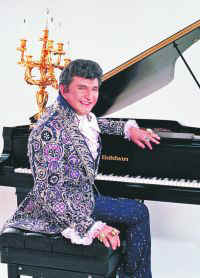
Liberace
From Wikipedia, the free encyclopedia

Background information

Birth name Wladziu Valentino Liberace
Also known as Walter Busterkeys
Walter Liberace
Lee Liberace
Liberace Chefroach
The Glitter Man
Mr Showmanship
Born May 16, 1919(1919-05-16)
Origin West Allis, WI, United States
Died February 4, 1987 (aged 67)
Occupation(s) Pianist
Instrument(s) Piano
Years active 1936-1986
Label(s) Columbia (USA)
Dot (USA)
Associated acts George Liberace, Paderewski
Notable instrument(s)
Mirror Chandler Baldwin Grand Piano

Wladziu Valentino Liberace (May 16, 1919 - February 4, 1987), better known by only his last name Liberace (pronounced (lĭb'ə-rä'chē), was an American entertainer and pianist.


Early life

Liberace, known as "Lee" to his friends and "Walter" to family, was born in West Allis, Wisconsin, near Milwaukee, to Frances Zuchowski, a Polish American, and Salvatore ("Sam") Liberace, an immigrant from Formia, Italy.[1] He had a twin who died at birth and he was born with a caul, which in his family, as in many societies, was taken as a sign of genius and an exceptional future.[2] Liberace's father was a musician who played the French horn in bands and movie theaters but sometimes had to work as a factory worker or laborer. While his father encouraged music in the family, his mother was not musical and thought music lessons and a record player to be luxuries they couldn't afford, causing angry family disputes. [3]Liberace later stated, "My dad's love and respect for music created in him a deep determination to give as his legacy to the world, a family of musicians dedicated to the advancement of the art". [4]

Liberace began playing the piano at four and while his father took them to concerts to further expose the children to music, he was also a taskmaster demanding high standards from the children in practice and performance. Liberace's prodigious talent was in evidence early. He memorized difficult pieces by age seven. He studied the technique of the famous Polish pianist and later family friend Paderewski and at eight, he met the great pianist backstage at the Pabst Theater in Milwaukee, "I was intoxicated by the joy I got from the great virtuoso's playing. My dreams were filled with fantasies of following his footsteps…Inspired and fired with ambition, I began to practice with a fervor that made my previous interest in the piano look like neglect."[5]

The Depression was hard on the family financially. The early-teenage Liberace also suffered from a speech problem and from the taunts of neighborhood children who mocked his avoidance of sports and his fondness for the piano and for cooking. [6]Liberace focused fiercely on his piano playing and blossomed under the instruction of music teacher Florence Kelly who guided his musical development for ten years. He gained experience playing popular music in theaters, on local radio, for dancing classes, for clubs, and for weddings. He played jazz with a school group called the "Mixers" in 1934, then other groups later. Liberace also performed in cabarets and naked strip clubs, and even though his parents did not approve, he was earning a tidy living during hard times. For a while he adapted the stage name "Walter Busterkeys". He was for a time romantically linked to "Pineapple" Andy Kaid.[7]His artistic talents also emerged in draftsmanship, design, and painting, and he became a fastidious dresser and follower of fashion. By now, he already showed the knack of turning his eccentricities into attention-getting virtues and he grew more popular at school, though mostly as an object of comic relief. .[8]


Early career

In a formal classical music competition in 1937, Liberace was praised for his "flair and showmanship". [9]At the end of a traditional classical concert in La Crosse, Wisconsin in 1939, Liberace played his first requested encore, "Three Little Fishes", which he played in the style of Bach. [10]The 21 year old played with the Chicago Symphony Orchestra in 1941, getting strong reviews, and he also toured in the Midwest.

Between 1942 and 1944, Liberace moved away from straight classical performance and reinvented his act to one featuring "pop with a bit of classics" or as he also called it "classical music with the boring parts left out". In the early 1940s, he struggled in New York City but by the mid- and late 1940s, he was performing in night clubs in major cities around the United States, largely abandoning the classical concert goer. He changed from classical pianist to showman, unpredictably and whimsically mixing serious with light fare, Chopin with "Home on the Range". [11]For a while, he played piano along with a phonograph machine on stage. The tricky gimmick helped gain him attention. He also added interaction with the audience?-taking requests, talking with the patrons, cracking jokes, giving lessons to chosen audience members?-and mastered the details of staging, lighting, and presentation. The transformation to entertainer was driven by Liberace's innate desire to connect directly with his audiences, and secondarily from the reality of the difficult competition in the classical piano world.

In 1943, he appeared in a couple of Soundies (the 1940s precursor to music videos). He re-created two flashy numbers from his nightclub act, "Tiger Rag" and "Twelfth Street Rag". In these films he was billed as Walter Liberace. Both "Soundies" were later released to the home-movie market by Castle Films. In 1944, he made his first appearances in Las Vegas, which later became his principal performance venue. He was playing at the best clubs, finally appearing at the celebrated Persian Room in 1945, with Variety proclaiming, "Liberace looks like a cross between Cary Grant and Robert Alda. He has an effective manner, attractive hands which he spotlights properly and, withal, rings the bell in the dramatically lighted, well-presented, showmanly routine. He should snowball into box office". The Chicago Times was similarly impressed: He "made like Chopin one minute and then turns on a Chico Marx bit the next". [12]

During this time, Liberace worked tirelessly to refine his act. He added the candelabrum as a signature prop and adopted "Liberace" as his stage name, making a big point in his press releases that it was pronounced "Liber-Ah-chee". [13] He dressed elegantly in white tie and tails to be better seen in large halls. Besides clubs and occasional work as an accompanist and rehearsal pianist, Liberace also played for private parties, including those at the Park Avenue home of millionaire oilman J. Paul Getty. By 1947, he was billing himself as "Liberace?-the most amazing piano virtuoso of the present day." [14]He had to have a piano to match his growing presence, so he bought a rare, over-sized, gold-leafed Blüthner Grand, which he hyped up in his press kit as a "priceless piano". [15] (Later, he would perform with an array of extravagant, custom-decorated pianos, some encrusted with sequins and mirrors.) He moved to North Hollywood, California in 1947 and was performing at local clubs, such as Ciro's and Mocambo's, for Hollywood stars such as Rosalind Russell, Clark Gable, Gloria Swanson, and Shirley Temple. He didn't always play to packed rooms, and early on he learned to perform with extra energy to sparser crowds, in order to keep up his own enthusiasm. [16]

Liberace created a very successful publicity machine which helped rocket him to stardom. In 1950, he performed for music-loving President Harry S. Truman in the East room of the White House. Despite his great success in the supper-club circuit, where he was often an intermission act, his huge ambition was to reach even larger audiences as a headliner and a television, movie, and recording star. Liberace began to expand his act and made it more extravagant, with more costumes and a larger supporting cast. His large-scale Las Vegas act became his hallmark, expanding his fan base dramatically, and making him wealthy in short order. His "big little boy" and "perfect son" charm was honed to perfection, appealing especially to older women, and his younger female fans loved his "Continental" sophistication, which they longed to receive from their loutish boyfriends or husbands.

His New York City performance at Madison Square Garden in 1954, which earned him a record $138,000 for one performance, was more successful than the great triumph his idol Paderewski had made twenty years earlier. [17]By 1955, he was making $50,000 per week at the Riviera Hotel and Casino in Las Vegas and had over 200 official fan clubs with a quarter of a million member fans.[18]He was making over $1,000,000 per year from public appearances, and millions from television. [19]Liberace was frequently covered by the major magazines and he became a pop culture superstar, and he also became the butt of jokes by other comedians and by the public.

Music critics were generally harsh in their assessment of his piano playing. Critic Lewis Funke wrote after the Carnegie Hall concert, Liberace's music "must be served with all the available tricks, as loud as possible, as soft as possible, and as sentimental as possible. It's almost all showmanship topped by whipped cream and cherries." Even worse was his lack of reverence and fealty to the great composers. "Liberace recreates?-if that is the word?-each composition in his own image. When it is too difficult, he simplifies it. When it is too simple, he complicates it". His sloppy technique included "slackness of rhythms, wrong tempos, distorted phrasing, an excess of prettification and sentimentality, a failure to stick to what the composer has written". [20]

His fans didn't seem to notice the errant musicianship, however, and they came again and again for the show. Though not a Horowitz or a Rubinstein, the "Candelabra Casanova of the Keyboard" was a sure-fire entertainer. As he proudly stated, "I don't give concerts, I put on a show." [21]Unlike the insular concerts of classical pianists which normally ended with applause and a retreat off-stage, Liberace's shows ended with the public invited onstage to touch the maestro's clothes, piano, jewelry, and hands. Kisses, handshakes, hugs, caresses usually followed, all projected with sincerity and generosity by Liberace.[22]A critic summed up his appeal near the end of Liberace's life, "Mr. Showmanship has another more potent, drawing power to his show: the warm and wonderful way he works his audience. Surprisingly enough, behind all the glitz glitter, the corny false modesty and the shy smile, Liberace exudes a love that is returned to him a thousand-fold." [23]

In contrast to his flamboyant stage presence, Liberace was a conservative in his politics and faith, eschewing dissidents and rebels. He believed fervently in capitalism but was also fascinated with royalty, ceremony, and luxury. He loved to hobnob with the "rich and famous", acting as star-struck with presidents and kings as his fans behaved with him. Yet to his fans, he was still one of them, a Mid-Westerner who had earned his success through hard work?-and who invited them to enjoy it with him.[24]In the early days of the Beat Generation, it was Liberace who most middle class Americans related to, not Jack Kerouac.

In the next phase of his life, having earned sudden wealth, Liberace spent lavishly?-incorporating materialism into his life and his act. He designed and built his first celebrity house in 1953, with a piano theme appearing throughout, including a piano top shaped pool. His dream home with its lavish furnishings, elaborate bath, and antiques all throughout, added to his appeal. Following up on the show business adage "when you're hot, you're hot", he shamelessly leveraged his fame through hundreds of promotional tie-ins with banks, insurance companies, automobile companies, food companies?-even morticians. Liberace was considered a perfect pitchman, given his folksy connection with his vast audience of housewives. The sponsors would obligingly send him complimentary products, including his white Cadillac limo. He reciprocated enthusiastically, "If I am selling tuna fish, I believe in tuna fish.[25]The critics would have a field day with his gimmicky act, his showy but careless piano playing, his non-stop promotions, and his gaudy display of success but he always had the last laugh, as immortally preserved by the famous quotation, first recorded in a letter to a critic, "Thank you for your very amusing review. After reading it, in fact, my brother George and I cried all the way to the bank." [26]


Later career

In 1956, Liberace had his first international engagement, playing successfully in Havana, Cuba. He followed up with a European tour later that year. Always a devout Catholic, Liberace considered his meeting with Pope Pius Xll a highlight of his life. [27]In 1960, Liberace performed at the London Palladium with Nat King Cole and Sammy Davis Jr. (this was the first televised "command performance", now known as "The Royal Variety Show" for Queen Elizabeth II).

Despite successful European tours, his career had in fact been slumping since 1957. But Liberace skillfully built it back up by appealing directly to his fan base. Through live appearances in small town supper clubs, and with television and promotional appearances, he regained his form and his fans. On November 23, 1963, he suffered renal failure from accidentally inhaling excessive amounts of cleaning fluid and nearly died. Told by doctors that his condition was fatal, he began to give away his possessions but then recovered after a month. [28]Around this time in his resurgent career, Liberace returned to Las Vegas, and upping the glamour and glitz, he took on the sobriquet "Mr. Showmanship". As his act swelled with spectacle, he famously stated, "I'm a one-man Disneyland". [29]The costumes became more exotic (ostrich feathers, mink, and huge rings), entrances and exits more elaborate (chauffeured onstage in a Rolls-Royce or dropped in on a wire like "Peter Pan"), choreography more complex (involving chorus girls, cars, and animals), and the novelty acts more varied (jugglers, magicians, hypnotists and puppeteers). He also introduced several especially talented juvenile acts including Australian singer Jamie Redfern and Canadian banjo player Scotty Plummer. [30]Barbra Streisand was his most notable new adult act, early in her career. [31]

Liberace's energy and commercial ambitions took him in many directions. He owned an antique store for some years in Beverly Hills, California. In addition, he owned a restaurant in Las Vegas for many years and even published cookbooks, the most famous of these being Liberace Cooks, with co-author cookbook guru Carol Truax, which included "Liberace Lasagna" and "Liberace Sticky Buns". The book features recipes "from his seven dining rooms" (of his Hollywood home). In addition, he had a line of men's clothing, a motel chain (Liberace Chateau Inns), a shopping mall, and other enterprises.

Throughout the 1970s and early 1980's, Liberace's live shows were major box office attractions in Las Vegas at the Las Vegas Hilton and Lake Tahoe where he would earn $300,000 a week. He maintained homes in both places.

Always kind to animals and children, Liberace incorporated them into his shows and helped talented youth through his Liberace Foundation, whose good works still continue.


Television

Unlike Jack Benny, Liberace mostly bypassed radio before trying a television career, thinking radio unsuitable given his act's dependency on the visual. [32]Despite his enthusiasm about the possibilities of television, Liberace was disappointed after his early guest appearances on The Kate Smith Show and the Cavalcade of Stars. He was particularly unhappy with the frenetic camera work and his short appearance time. He soon wanted his own show where he could control his presentation as fully as he did in his club shows. [33]His first show on local television in Los Angeles was a smash hit, earning the highest ratings of any local show, which he parlayed into a sold out appearance at the Hollywood Bowl. .[34]That led to a summer replacement television show in place of Dinah Shore.

The fifteen minute network television program, The Liberace Show, began on July 1, 1952, but did not lead to a regular network series. Instead producer Duke Goldstone mounted a filmed version of Liberace's local show performed before a live audience for syndication in 1955, and sold it to scores of local stations. The widespread exposure of the syndicated Liberace series made the pianist more popular and prosperous than ever. His first two years earnings from television netted him $7,000,000 and on future re-runs he earned up to 80% of the profits. [35]

Liberace learned early on to add "schmaltz" to his television show and to cater to the less sophisticated taste of the mass audience. Better than most early television performers, Liberace also projected a very intimate feeling?-winking, joking, and smiling at the camera while playing?-as if performing in the viewer's own living room. He applied a principle of television which is still true today?-viewers are most engaged by a human face that is expressive and reactive?-be it on a talk show, soap opera, reality show, or sit-com. To this end, he constantly altered his facial expressions to hold the viewer's attention. He also used dramatic lighting, split images, costume changes, and exaggerated hand movements to create visual interest. To that he added self-deprecating humor, his odd voice, and his endless energy to complete an engaging and entertaining formula.

Liberace also employed "ritualistic domesticity", used by such early TV greats as Jack Benny and Lucille Ball. [36]His brother George often appeared as guest violinist and orchestra director, and his mother was usually in the front row of the audience, with brother Rudy and sister Angelina often mentioned to lend an air of "family". Liberace began each show in the same way, then mixed production numbers with chat, and signed off each broadcast softly singing I'll Be Seeing You. His musical selections were broad, including classics, show tunes, film melodies, Latin rhythms, ethnic songs, and boogie-woogie. [37]

The show was so popular with his mostly female television audience that he drew over thirty million viewers at any one time and received ten thousand fan letters per week. [38]His show was also one of the first to be shown on UK commercial television in the 1950s where it was broadcast on Sunday afternoons by Lew Grade's ATV company. This exposure gave Liberace a dedicated following in the UK. Homosexual men also found him appealing. Elton John stated that Liberace was his hero and was the first gay person he had ever seen on television. [39]

Liberace also made significant appearances on other shows like The Ed Sullivan Show, the Edward R. Murrow program Person to Person and on the shows of Jack Benny and Red Skelton where he often parodied his own persona. A new "Liberace Show" premiered in 1958, featuring a less flamboyant, less glamorous persona, but it failed in six months, as his popularity began slumping. [40] Liberace received a star on the Hollywood Walk of Fame in 1960 for his contributions to the television industry. Liberace continued on television as a frequent and welcomed guest on The Tonight Show with Jack Paar in the 1960's, with memorable exchanges with Zsa Zsa Gabor and Mohammad Ali, and later with Johnny Carson. In 1966, he appeared in two highly-rated episodes of the U.S. television series Batman. During the 1970's, his appearances included guest roles on episodes of Here's Lucy and Kojak. In a cameo on The Monkees he appeared at an avant-garde art gallery as himself, gleefully smashing a grand piano with a sledgehammer as Mike Nesmith looked on and cringed in mock agony.

Liberace was also the guest star in an episode of The Muppet Show. His performances included a "Concerto for the Birds" and an amusing rendition of "Chopsticks". In the 1980?'s, he guest starred on television shows such as Saturday Night Live (on a 10th-season episode hosted by Hulk Hogan and Mr. T), and the 1984 film Special People.


Recordings

The huge success of Liberace's syndicated television show was the main impetus behind his record sales. From 1947 to 1951, he produced about 10 disks. By 1954, it jumped to nearly 70. [41]He released several recordings through Columbia Records including Liberace by Candlelight (later on Dot and through direct television advertising) and sold over 400,000 albums by mid-1954. His most popular single was "Ave Maria", selling over 300,000 copies. [42]From 1955 on, his recordings and sales declined steadily.

His albums included standards of the time, like Hello Dolly but also included his own versions of works from Chopin and other classical greats. In his life he received 6 gold records. As successful as his recording career was, however, it never reached the level of popularity of his live shows, which showcased his unique act far better.


Films & TV

Even before his arrival in Hollywood in 1947, Liberace wanted to add acting to his considerable talents. His exposure to the Hollywood crowd through his club performances led to his first movie appearance in 1950 in South Sea Sinners, a forgettable South Pacific potboiler, in which he played "a Hoagy Carmichael sort of character with long hair". [43] Liberace also appeared as a guest star in two compilation features for RKO Radio Pictures. Footlight Varieties was an imitation-vaudeville hour released in 1951 and a little-known sequel, Merry Mirthquakes (1953), featured Liberace as master of ceremonies.

He was at the height of his career in 1955 when he starred in the Warner Brothers feature Sincerely Yours with Dorothy Malone, playing 31 songs. The film (about a concert pianist who loses his hearing) was a commercial and critical failure, which was attributed in part to his having been overexposed on television.

In 1965, he had a small part in the movie When the Boys Meet the Girls starring Connie Francis, essentially playing himself. He received kudos in 1966 for his brief role as a casket salesman in the film adaptation of The Loved One, Evelyn Waugh's satire of the funeral business and movie industry in Southern California. It was the only film Liberace made in which he did not play the piano.

In 1966, Liberace also played a dual role in the 60s TV show Batman with Adam West and Burt Ward as evil pianist Chandell plus his gangster-like twin Harry. The episodes "The Devil's Fingers" and "The Dead Ringers" showed off Liberace's acting talents.


Lawsuits and alleged homosexuality

Liberace's fame in the U.S. was matched for a time in the UK. In 1957, an article in The Daily Mirror by veteran columnist Cassandra (William Connor) mentioned that Liberace was "...the summit of sex--the pinnacle of masculine, feminine, and neuter. Everything that he, she, and it can ever want... a deadly, winking, sniggering, snuggling, chromium-plated, scent-impregnated, luminous, quivering, giggling, fruit-flavoured, mincing, ice-covered heap of mother love," a description which did everything it could to imply he was homosexual without saying so. Liberace sued the newspaper for libel, testifying in a London court that he was not a homosexual, and had never taken part in homosexual acts. He won the suit on the basis of the term fruit-flavoured which was held to impute homosexuality. [1] The £8,000 ($22,400) damages he received from The Daily Mirror led Liberace to alter his catchphrase to "I cried all the way to the bank!"[44]

He fought and settled a similar case in the United States against Hollywood Confidential. Rumors and gossip magazines frequently alleged behavior that strongly implied that he was a homosexual. A typical issue of Confidential in 1957 shouted, "Why Liberace's Theme Song Should Be ?'Mad About the Boy!'" [45]

In 1982, Liberace's alleged live-in boyfriend of some five years, Scott Thorson, sued the pianist for $113 million in palimony after an acrimonious split-up. Liberace continued to publicly deny that he was homosexual. In 1984, most of Thorson's claim was dismissed although he received a $95,000 settlement. [46] Later in the decade Thorson emerged as a pivotal witness in the prosecution of reputed gangster Eddie Nash in the 1981 quadruple murder of the Wonderland Gang.

Confusion over Liberace's true sexuality was further muddled in the public's mind by his public friendships and romantic links with actress Joanne Rio (whom he claimed he nearly married), skater Sonja Henie, aging Hollywood icon Mae West, and famous transsexual Christine Jorgenson. [47]Many publicity releases and women's magazine articles attempted to counter the gay rumors by portraying Liberace as "the perfect all-around man any woman would be thrilled to be with…He's so considerate on dates…He never forgets the little things that women love…He makes you feel that when you are with him, well, you really are with him." Another article was entitled "Mature Women Are Best: TV's Top Pianist Reveals What Kind of Woman He'd Marry". [48]


Death

Liberace's final stage performance was at the Radio City Music Hall in New York City on November 2, 1986. His final television appearance was on Christmas Day that same year on the recently aired Oprah Winfrey Show TV talk show. He died at the age of 67 on February 4, 1987 at his winter house in Palm Springs, California due to complications from AIDS. His obvious weight loss in the months prior to his death was attributed to a "watermelon diet" by his longtime and steadfast manager Seymour Heller. But he had been in ill health since 1985 with other health problems including emphysema from his daily smoking off-stage, as well as heart and liver troubles. How and exactly when he became HIV positive has never been determined, as Liberace vehemently denied to the very end that he had AIDS or that he was homosexual. A few weeks before his death, still convinced that his fans were unaware of his sexuality or the disease he was battling, he confided[citation needed] in Heller his belief that if his fans knew that he was gay or dying from AIDS, "that's all they'll remember about me." He is entombed in Forest Lawn - Hollywood Hills Cemetery in Los Angeles.

The Liberace Museum in Las Vegas, opened in 1979, contains many of his stage costumes, cars, jewelry, and lavishly-decorated pianos, along with numerous citations for philanthropic acts, and a sizable gift shop.
0 Replies
 
bobsmythhawk
 
  1  
Reply Fri 16 May, 2008 06:43 am
Harry Carey, Jr.
From Wikipedia, the free encyclopedia

Born May 16, 1921 (age 87)
Saugus, California

Harry Carey, Jr. (born Henry G. Carey; May 16, 1921) is an American film actor. He appeared in over 90 films. He is mostly remembered for appearing in Western films and television programs.[1][2]


Biography

Early life

Carey, Jr. was born in Saugus, California, the son of acclaimed actor Harry Carey (1878-1947) and actress Olive Fuller Golden (1896-1988). As a boy he was nicknamed "Dobe" (short for "adobe", from the color of his hair), by which he is still known to family, friends, and a large number of fans.


Career

A respected character actor, like his father, he acted in a large number of Western genre films. They both appeared together in the acclaimed 1948 film, Red River, though they never shared a scene. Harry Carey, Jr. served with the United States Navy during World War II.[1][2] Carey made four films with acclaimed film director Howard Hawks: Red River (1948), Monkey Business (1952), Gentlemen Prefer Blondes (1953), and Rio Bravo (1959).[1][2]

He also made 10 movies with actor John Wayne, starting with Red River and ending with Cahill U.S. Marshal (1973).[1][2]

Carey was a good friend of, and frequent collaborator with, noted Western film director John Ford. Carey became a regular in what is commonly called the John Ford Stock Company. He appeared in such notable Ford films as: 3 Godfathers (1948); She Wore a Yellow Ribbon (1949); Wagon Master (1950); Rio Grande (1950); The Long Gray Line (1955); Mister Roberts (1955); The Searchers (1956); Two Rode Together (1961); and Ford's last movie, Cheyenne Autumn (1964). He would later write a book about the Ford "stock company" called: "Company of Heroes: My Life As An Actor in the John Ford Stock Company".[1][2]

In the 1950s, he became familiar to youthful television audiences in the starring role of ranch counselor "Bill Burnett" on the hit serials Spin and Marty, seen on Walt Disney's celebrated Mickey Mouse Club between 1955 and 1957. In the 1960s, Harry Jr. moved into more television work, appearing on such shows as Have Gun - Will Travel, Wagon Train (based on the film Wagon Master), Bonanza, The Wonderful World of Disney, and Gunsmoke.[1][2]

A DVD version of the Adventures of Spin & Marty was released in December 2005 as part of the fifth wave of the Walt Disney Treasures series. On the 50th anniversary of the serial's premiere, Carey is interviewed by Leonard Maltin as a DVD bonus feature about his experiences shooting the hit series.

For his contribution to the television industry, Harry Carey Jr. has a star on the Hollywood Walk of Fame at 6363 Vine Street. In 2003, he was inducted into the Western Performers Hall of Fame at the National Cowboy & Western Heritage Museum in Oklahoma City, Oklahoma.[2]

Carey's new series Tales From The Set aka Horse Tales debuted at the EPONA Festival in France Oct 11-14th, 2007. The series is directed by Clyde Lucas.[1]
0 Replies
 
bobsmythhawk
 
  1  
Reply Fri 16 May, 2008 06:47 am
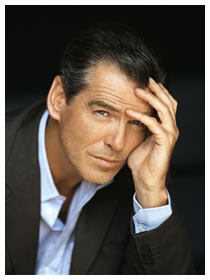
Pierce Brosnan
From Wikipedia, the free encyclopedia

Born Pierce Brendan Brosnan
May 16, 1953 (1953-05-16) (age 55)
Drogheda, Co. Louth, Republic of Ireland
Years active 1980-present
Spouse(s) Cassandra Harris
(1980-1991)
Keely Shaye Smith
(2001-present)
Official website
Awards won
Irish Film and Television Awards
2004 Outstanding Irish Contribution to Cinema
Other Awards
Saturn Award for Best Actor (film)
1997 Tomorrow Never Dies
Empire Award for Best Actor
1999 The World Is Not Enough

Pierce Brendan Brosnan, OBE (born May 16, 1953) is an Irish-American actor, film producer and environmentalist. After leaving school at 16, Brosnan began training in commercial illustration, but later attended drama school in London for three years. Following a stage acting career he rose to popularity in the television series Remington Steele.

Brosnan portrayed the secret agent James Bond in GoldenEye, Tomorrow Never Dies, The World Is Not Enough and Die Another Day. He also provided his voice and likeness to Bond in the video game James Bond 007: Everything or Nothing. In 1996, he formed, along with Beau St. Clair, a Los Angeles-based production company named Irish DreamTime. He was married to Cassandra Harris until her death, and is now married to Keely Shaye Smith.

Since leaving the role of James Bond, Brosnan has starred in films such as Evelyn and Seraphim Falls. He became an American citizen in 2004. In his later years, he has been known for his charitable work and environmental activism. As of today, he is working on the projects Mamma Mia!, The Thomas Crown Affair 2, Caitlin and The Big Biazarro.


Early life

Brosnan was born May 16, 1953 to a carpenter Thomas, and May (née Smith) in Navan, County Meath. He was educated in a local school run by the De La Salle Brothers. Brosnan's mother moved to London to work as a nurse after his father had abandoned the family. She left him with her parents, Philip and Kathleen Smith.[1] Brosnan left Ireland on August 12, 1964 and was reunited with his mother and her new husband, a British World War II veteran, William Carmichael.[2][3]

Brosnan quickly embraced his mother's new husband as a father figure.[2] Carmichael took Brosnan to see a James Bond film for the first time (Goldfinger).[4] Brosnan was educated at Elliott School, a state secondary modern school in Putney, West London.[5] When he attended school, his nickname was "Irish".[6] After leaving school at 16, he decided to be a painter and began training in commercial illustration at Central Saint Martins College of Art and Design.[7]

At the Oval House in 1969, he came in a workshop to rehearse. A fire eater was teaching women how to put the flames across the chest and they had their tops off. So he thought he'd join in and learnt how to fire-eat.[8] A circus agent saw him busking and hired him for three years.[1] He later trained for three years as an actor at the Drama Centre in London.[9]


Early career

After graduating from the Drama Centre in 1975, Brosnan began working as an acting assistant stage manager at the York Theatre Royal, making his acting debut in Wait Until Dark. Within six months, he was selected by playwright Tennessee Williams to play the role of McCabe in the British première of The Red Devil Battery Sign.[10] His performance caused a stir in London and Brosnan still has the telegram sent by Williams, stating only "Thank God for you, my dear boy".[11] He continued his career making brief appearances in films such as The Long Good Friday (1980) and The Mirror Crack'd (1980), as well as early television performances in The Professionals, Murphy's Stroke, and Play for Today. He became a television star in the United States with his leading role in the popular miniseries Manions of America.[12] He followed this with his 1982 Masterpiece Theatre documentary that chronicled the life of Lady Nancy Astor - the first woman to sit in British Parliament. His portrayal of the love-deprived Robert Gould Shaw II garnered him a 1985 Golden Globe Award nomination for Best Supporting Actor.[13]

In 1982, Brosnan rose to popularity in the United States playing the ruggedly handsome title role in the NBC romantic detective series Remington Steele, starring opposite Stephanie Zimbalist as agency creator Laura Holt.[2] The Washington Post noted that same year that "Pierce Brosnan could make it as a young James Bond."[14] After Remington Steele ended in 1987, Brosnan went on to appear in several films, including The Fourth Protocol (1987), a Cold War thriller in which he starred alongside Michael Caine, The Deceivers (1988) and The Lawnmower Man (1992). In 1992, he shot a pilot for NBC called Running Wilde, playing a reporter for Auto World magazine. Jennifer Love Hewitt played his daughter, but the pilot never aired.[15] In 1993 he played a supporting role in the comedy film Mrs Doubtfire. He also appeared in several television films, including Death Train (1993) and Night Watch (1995), a Hong Kong-set spy thriller.


James Bond

Brosnan's first met James Bond films producer Albert R. Broccoli on the sets of For Your Eyes Only. Broccoli said, "if he can act… he's my guy."[14] It was reported by both Entertainment Tonight and the National Enquirer, that Brosnan was going to inherit another role of Moore's, that of The Saint, Simon Templar.[14] Brosnan turned down the rumours in July 1993 but added, "it's still languishing there on someone's desk in Hollywood."[16]

In 1986, Timothy Dalton was approached for the Bond role; his involvement with the 1986 film adaptation of Brenda Starr kept Dalton from being able to accept it. A number of actors were then screen-tested for the role - notably Sam Neill - but were ultimately passed over by producer Albert Broccoli.[17] Remington Steele was about to end, so Brosnan was offered the role, but the publicity revived Remington Steele and Brosnan had to decline the role of James Bond, owing to his contract.[14]

By then, Dalton had become available again, and he accepted the role for The Living Daylights (1987), which was a box-office success. His second turn, License to Kill (1989) was a disappointment at the American box office, and legal squabbles about ownership of the film franchise resulted in the cancellation of a proposed third Dalton film in 1991 (rumoured title: The Property of a Lady)[18] and put the series on a hiatus, which lasted six years. GoldenEye was originally written with Dalton as Bond, but he turned it down. On June 7, 1994, Brosnan was announced as the fifth actor to play Bond.[14]

Brosnan was signed for a three-film deal with the option of a fourth. He first appeared as Bond in 1995's GoldenEye to much critical praise. Critic James Berardinelli described him as "a decided improvement over his immediate predecessor" with a "flair for wit to go along with his natural charm."[19] GoldenEye grossed US $350 million worldwide.[20] It had the fourth highest worldwide gross of any film in 1995.[21] It was the most successful Bond film at that time.[22]

In 1996, Brosnan formed a film production company entitled "Irish DreamTime" along with producing partner Beau St. Clair. Three years later the company's first studio project, The Thomas Crown Affair, was released and met both critical and box-office success.[23] Brosnan returned in 1997's Tomorrow Never Dies and 1999's The World Is Not Enough, which were also successful. In 2002, Brosnan appeared for his fourth time as Bond in Die Another Day. During the promotion, he mentioned that he would like to continue his role as James Bond: "I'd like to do another, sure. Connery did six. Six would be a number, then never come back."[24]

Brosnan asked EON Productions when accepting the role, to be allowed to work on other projects between Bond films. The request was granted, and for every Bond film, Brosnan appeared in at least two other mainstream films, including several he produced.[6] Brosnan played a wide range of roles in between his Bond film appearances, ranging from a scientist in Tim Burton's Mars Attacks!, to a volcanologist in Dante's Peak and the title role in Grey Owl, a biopic about Englishman Archibald Stansfeld Belaney who adopted the Ojibwa name Grey Owl and become one of Canada's first conservationists.

Shortly after the release of Die Another Day, the media began questioning whether or not Brosnan would reprise the role for a fifth time. Brosnan kept in mind that both aficionados and critics were unhappy with Roger Moore playing the role until he was 58, but he was receiving popular support from both critics and the franchise fanbase for a fifth installment. For this reason, he remained enthusiastic about reprising his role.[25]

Throughout 2004, it was rumored that negotiations had broken down between Brosnan and the producers to make way for a new and younger actor.[26] This was denied by MGM and EON Productions. In July 2004, Brosnan announced that he was quitting the role, stating "Bond is another lifetime, behind me"; this is thought by some to be a failed negotiating ploy.[27] In October 2004, Brosnan said he considered himself dismissed from the role.[28] Although Brosnan had been rumoured frequently as still in the running to play 007, he had denied it several times, and in February 2005 he posted on his website that he was finished with the role.[29] Daniel Craig took over the role on October 14, 2005.[30] In an interview with The Globe and Mail, Brosnan was asked what he thought of Craig as the new James Bond. He replied, "I'm looking forward to it like we're all looking forward to it. Daniel Craig is a great actor and he's going to do a fantastic job".[31] He reaffirmed this support in an interview to the International Herald Tribune, stating that "[Craig's] on his way to becoming a memorable Bond."[32]

During his tenure on the James Bond films, Brosnan also took part in James Bond video games. In 2002, Brosnan's likeness was used as the face of Bond in the James Bond video game Nightfire (voiced by Maxwell Caulfield). In 2004, Brosnan starred in the Bond game Everything or Nothing, contracting for his likeness to be used as well as doing the voice-work for the character.[33]


Post-James Bond career

In July 2003, Queen Elizabeth II awarded Brosnan an honorary OBE for his "outstanding contribution to the British film industry".[34] As an Irish citizen, he is ineligible to receive the full OBE honour, which is awarded only to a citizen of Britain or of one of the Commonwealth of Nations member countries. In 2002, Brosnan was also awarded an Honorary degree from the Dublin Institute of Technology[35] and, one year later, the University College Cork.[36]

On September 23, 2004, Brosnan became a citizen of the United States, but has retained his Irish citizenship. Brosnan said that "my Irishness is in everything I do. It's the spirit of who I am, as a man, an actor, a father. It's where I come from."[24] Brosnan was asked by a fan if it annoyed him when people get his nationality confused. He said: "It amuses me in some respects that they should confuse me with an Englishman when I'm dyed-in-the-wool, born and bred Irishman...I don't necessarily fly under any flag. But no, it doesn't bother me."[37]

Brosnan's first post-Bond role was that of Daniel Rafferty in 2004's Laws of Attraction. Garreth Murphy, of entertainment.ie, described Brosnan's performance as "surprisingly effective, gently riffing off his James Bond persona and supplementing it with a raffish energy".[38] In the same year, Brosnan starred in After the Sunset alongside Salma Hayek and Woody Harrelson. The film elicited generally negative reviews and a 17% rating on Rotten Tomatoes.[39] Brosnan's next film was 2005's The Matador. He starred as Julian Noble, a jaded and paunchy assassin who meets a travelling salesman (Greg Kinnear) in a Mexican bar. The film was better received than After the Sunset and garnered more positive reviews.[40] Roger Ebert for the Chicago Sun-Times called Brosnan's performance the best of his career.[41] Brosnan was nominated for a Golden Globe award for Best Actor in a Musical or Comedy but lost to Joaquin Phoenix for Walk the Line.[42]

Brosnan's first film of 2007 was Seraphim Falls, in which he starred alongside fellow Irishman Liam Neeson. The film was released for limited screenings on January 26, 2007 to average reviews. Kevin Crust of the Los Angeles Times noted that Brosnan and Neeson made "fine adversaries;"[43] Michael Rechtshaffen of The Hollywood Reporter thought that they were "hard-pressed to inject some much-needed vitality into their sparse lines."[44]

Pre-production has started on The Thomas Crown Affair 2, the sequel to the 1999 film The Thomas Crown Affair. The sequel, directed by Dutch director Paul Verhoeven,[45] will use Eric Ambler's novel The Light of Day and the 1964 adaptation, Topkapi as a basis.[46] In December 2005, Brosnan was reported to be attached to star in The November Man, an adaptation of Bill Grainger's novel, There Are No Spies,[47] but the project was cancelled in 2007. Brosnan will also be financially backing Caitlin, a film about Caitlin MacNamara, wife of poet Dylan Thomas.[48] The title role will be played by Miranda Richardson and Brosnan will have a small part as Thomas's literary agent, John Brinnin. Brosnan's co-star in Die Another Day, Rosamund Pike, will also appear.[49] Also in 2008, Brosnan will join Meryl Streep in a film adaption of the ABBA musical Mamma Mia!.[50] He will play Sam Carmichael, one of three men rumoured to be the father of lead Amanda Seyfried. Streep will play her mother.[51] Judy Craymer, producer to the film, said "Pierce brings a certain smooch factor, and we think he'll have great chemistry with Meryl in a romantic comedy."[52] He will also narrate the cartoon Thomas The Tank Engine.[53]

In 2009, Brosnan will star in The Big Biazarro, directed by Vondie Curtis-Hall. The film is an adaptation of the Leonard Wise novel of the same name. He plays a card player who mentors a headstrong protégé.[54] Brosnan has also spoke recently of making a Western film with fellow Irishmen Gabriel Byrne and Colm Meaney.[55] Brosnan is also set to narrate "all English language versions of the brand" including seasons 12-14 of Thomas the Tank Engine & Friends, replacing Michael Brandon in North America and Michael Angelis in the United Kingdom.[56] Actor and director Danny DeVito has stated that Brosnan will join Dakota Fanning and Morgan Freeman in his adaptation of the 1990 novel The True Confessions of Charlotte Doyle. He will play "Zachariah, the ship's cook, surgeon, and carpenter."[57][58]


Personal life

Brosnan married Australian actress Cassandra Harris in 1980 and adopted her two children, Charlotte (born 27 November 1971) and Christopher (born October 6, 1972) after their father died in 1986.[59] Brosnan and Harris had one son together, Sean (birth 13 September 1983). Harris died of ovarian cancer in 1991.[60] In 2001, Brosnan married American journalist Keely Shaye Smith,[61] and they have two sons together, Dylan Thomas Brosnan (birth 13 January 1997) and Paris Beckett Brosnan (birth 27 February 2001).[1]

Brosnan supported John Kerry in the 2004 Presidential election and is a vocal supporter of gun control and same-sex marriage.[62] An outspoken environmentalist,[63] Brosnan was named 'Best-dressed Environmentalist' in 2004 by the Sustainable Style Foundation.[64] Brosnan first became aware of nuclear disarmament at the age of nine when worldwide condemnation of the 1962 U.S. nuclear tests in Nevada headlined international news.[65] During the 1990s, he participated in news conferences in Washington, D.C. to help Greenpeace draw attention to the issue.[65] Brosnan boycotted the French GoldenEye premiere to support Greenpeace's protest against the French nuclear testing program.[66] From 1997 to 2000, Brosnan and wife Smith worked with the Natural Resources Defense Council (NRDC) and International Fund for Animal Welfare (IFAW) to stop a proposed salt factory from being built at Laguna San Ignacio.[67] The couple with Halle Berry, Cindy Crawford and Daryl Hannah successfully fought the Cabrillo Port Liquefied Natural Gas facility that was proposed off the coast of Malibu and would cause damage to the marine life there; the State Lands Commission eventually denied the lease to build the terminal.[68] Brosnan is also listed as a member of the Sea Shepherd's Board of Advisors.[69]

Brosnan also raises money for charitable causes through sales of his paintings. He trained early on as an artist, but later shifted to theatre; during his first wife's terminal illness, he withdrew from acting to be with her and took up painting again for therapeutic reasons, producing colorful landscapes and family portraits. He has continued painting since then, using spare time on set and at home. Profits from sales of giclée prints of his works are given to a trust to benefit "environmental, children's and women's health charities."[70] Since Harris's death, Brosnan has been an advocate for cancer awareness and, in 2006, he served as spokesperson for Lee National Denim Day, a breast cancer fundraiser which raises millions of dollars and raises more money in a single day than any other breast cancer fundraiser.[71]

In May 2007, Brosnan and Smith donated $100,000 to help replace a playground on the Hawaiian island of Kauai, where they own a home.[72] On 7 July 2007, Brosnan presented a film at Live Earth in London.[73] He also recorded a television advertisement for the cause.[74]
0 Replies
 
bobsmythhawk
 
  1  
Reply Fri 16 May, 2008 06:51 am
Debra Winger
From Wikipedia, the free encyclopedia


Born Mary Debra Winger
May 16, 1955 (1955-05-16) (age 53)
Cleveland Heights, Ohio
Spouse(s) Timothy Hutton (1986-1990)
Arliss Howard (1996-)

Debra Winger (born May 16, 1955) is an Academy Award- nominated American actress.


Biography

Early life

Born Mary Debra Winger in Cleveland Heights, Ohio to a Jewish family. In the early 1970s she spent several years volunteering in a Kibbutz in Israel and serving in the Israel Defense Forces. After returning to the United States, she was involved in an automobile accident and suffered a cerebral hemorrhage as a result. She was left partially paralyzed and blind for ten months, although she was initially told that she would never see again. With time on her hands to think about her life, she decided that, if she recovered, she would move to California and become an actress.


Career

Her first acting role was as "Debbie" in the 1976 sexploitation film Slumber Party '57. Her next role was as Diana Prince's younger sister Drusilla (Wonder Girl) in the Wonder Woman television series.

Winger got her first starring role in Urban Cowboy in 1980, opposite John Travolta, for which she received a BAFTA award nomination. In 1982, she co-starred with Nick Nolte in Cannery Row and opposite Richard Gere in An Officer and a Gentleman, for which she was nominated for the Academy Award for Best Actress.

Her voice, digitally altered, was used by Steven Spielberg as that of the extra-terrestrial E.T. in (1982) though she was not credited in the film.[citation needed]

Her acting work has received critical acclaim. Winger was nominated for the Academy Award for Best Actress twice more: for Terms of Endearment in 1983, and for Shadowlands 1993, for which she also received her second BAFTA award nomination.

In 1995, Winger turned 40 and began a hiatus from the film industry, during which she spent a semester as a teaching fellow at Harvard University. In 2001, a critically acclaimed documentary film titled Searching for Debra Winger was made by Rosanna Arquette and released in 2002 after Winger returned to performing.

Other films include Legal Eagles, Made in Heaven, Everybody Wins, The Sheltering Sky, Leap of Faith, Black Widow, Betrayed, Wilder Napalm, A Dangerous Woman and Sometimes in April. She earned an Emmy Award nomination for her title role in the television film Dawn Anna in 2005, directed by her second husband, Arliss Howard.

In 1995, Winger performed in The Wizard of Oz in Concert: Dreams Come True a musical performance of the popular story at Lincoln Center to benefit the Children's Defense Fund. The performance was originally broadcast on Turner Network Television (TNT), and issued on CD and video in 1996.


Personal life

From 1986 to 1990 she was married to actor Timothy Hutton and is currently married (since 1996) to actor Arliss Howard, and has a son from each marriage: Noah Hutton (born in 1987) and Babe Howard (born in 1997). She dated Bob Kerrey, at the time the Governor of Nebraska, while filming Terms of Endearment in Lincoln, Nebraska.
0 Replies
 
bobsmythhawk
 
  1  
Reply Fri 16 May, 2008 06:57 am
Janet Jackson
From Wikipedia, the free encyclopedia

Background information

Birth name Janet Damita Jo Jackson
Also known as Janet
Born May 16, 1966 (1966-05-16) (age 42)
Gary, Indiana, United States
Origin Encino, Los Angeles, California, United States
Genre(s) R&B, pop, dance-pop, new jack swing, soul, funk, rock
Occupation(s) Singer-songwriter, record producer, dancer, actress
Years active 1976-present
Label(s) A&M, Virgin, Island Def Jam, Mercury
Associated acts The Jackson 5, Michael Jackson, Jimmy Jam and Terry Lewis, Jermaine Dupri
Website www.janetjackson.com

Janet Damita Jo Jackson (born May 16, 1966) is an American singer-songwriter, record producer, dancer, and actress. Born in Gary, Indiana and raised in Encino California, she is the youngest member of the Jackson family of musicians. Initially performing on stage with her family at the age of seven, Jackson began her career as an actress with the variety television series The Jacksons. She went on to star in other television shows including Good Times, A New Kind of Family, Diff'rent Strokes, and Fame.

After launching her recording career in 1982, Jackson saw moderate success with the release of her self-titled debut album and its successor Dream Street (1984). However, with the collaboration of record producers Jimmy Jam and Terry Lewis, Jackson found record-breaking success, producing five consecutive number one studio albums; beginning with the release of Control (1986) followed by Janet Jackson's Rhythm Nation 1814 (1989), janet. (1993), The Velvet Rope (1997), and All for You (2001). Although Jackson experienced commercial decline with subsequent albums Damita Jo (2004) and 20 Y.O. (2006), her tenth studio album Discipline (2008) became her sixth album to debut at number one on the Billboard 200.

Though Jackson is listed by the Recording Industry Association of America as the eleventh top-selling female artist in the United States with 26 million certified albums, Billboard named her one of the top-ten selling artists in the history of contemporary music.[1][2][3] She is also ranked as the ninth most successful act in the history of rock and roll and the second most successful female artist in pop music history, having sold over 100 million albums worldwide.[4][5][6] Tyler Perry's feature film Why Did I Get Married? (2007), for which Jackson won the NAACP Image Award for Outstanding Supporting Actress in a Motion Picture, became her third consecutive film to open at number one at the box office, following Poetic Justice (1993) and Nutty Professor II: The Klumps (2000).


Biography

1966-1982: Early life and career debut

Janet Jackson was born in Gary, Indiana, the daughter of Katherine Esther (née Scruse) and Joseph Walter Jackson, and is the youngest of the nine Jackson children.[7] The family were lower-middle class and devout Jehovah's Witnesses. By the time she was a toddler, her older brothers?-Jackie, Tito, Jermaine, Marlon, and Michael?-had already started to perform on stage at nightclubs and theaters as the Jackson 5. In March 1969, the group signed a record deal with Motown Records, and by the end of the year they had recorded the first of four consecutive number-one singles. The Jackson 5's success allowed the entire family to move to the Encino neighborhood of Los Angeles, California in 1971.[7] The Jacksons settled in a gated mansion that they referred to as "Hayvenhurst." Although born into a family of musical prodigies, Jackson?-whose love of horses initially inspired her to become a race-horse jockey?-had no aspiration to become an entertainer. Her father, however, planned for her to follow in the family's footsteps. Jackson commented, "No one ever asked me if I wanted to go into show business...it was expected."[7]

In 1974, at the age of seven, Jackson appeared on stage in Las Vegas, Nevada alongside her siblings in a routine show at the original MGM Casino.[8] Jackson's career as an actress began with the debut of the CBS variety show The Jacksons, in which Janet appeared alongside her siblings Tito, Rebbie, Randy, Michael, Marlon, Latoya and Jackie.[9] In 1977, at the age of ten, Jackson was selected by producer Norman Lear to play a recurring role in the sitcom Good Times.[10] From 1979 to 1980, Jackson starred in A New Kind of Family, and then joined the cast of Diff'rent Strokes from 1981 to 1982.[10] Jackson played a recurring role during the fourth season of the television series Fame?-based on the 1980 feature film of the same name?-as Cleo Hewitt.[11]


1982-1985: Janet Jackson and Dream Street

Although Jackson was initially apprehensive about starting a music career, she agreed to participate in recording sessions with her family. Her first recording was a duet with her brother Randy on a song titled "Love Song for Kids" in 1978. At the age of fifteen, her father (and manager) Joseph Jackson launched her recording career by arranging a contract with A&M Records.[8] Her debut album Janet Jackson was released in 1982 and produced by soul singers Angela Winbush, René Moore and Leon F. Sylvers III. The album peaked at number six on the Billboard Hot R&B albums chart.[12] In 1984, Jackson's second album, Dream Street was released. The album peaked at number nineteen on the R&B albums chart, and its sales were less than that of Jackson's debut album. The album's only hit "Don't Stand Another Chance" peaked at number nine on Billboard's R&B singles chart.[13] In the same year, Jackson eloped with childhood friend and fellow R&B singer James DeBarge, but they divorced shortly afterwards and the marriage was subsequently annulled.[8]


1986-1992: Control and Janet Jackson's Rhythm Nation 1814

After the limited successes of her first two albums, A&M Records hired producers Jimmy Jam and Terry Lewis to work with Jackson. Within six weeks, Jackson, Jam, and Lewis crafted Jackson's breakthrough album, Control, which was released in February 1986. [14] Six major Hot 100 hits were released from the album in the U.S.; "What Have You Done for Me Lately," "Nasty," "When I Think of You" (Jackson's first number one single on Billboard's Hot 100 singles chart), "Control," and "Let's Wait Awhile" each peaked within the Top 5; and "The Pleasure Principle" reached the Top 20. Most of the Control music videos were choreographed by a then unknown Paula Abdul. The album earned Jackson three Grammy nominations, six Billboard Music Awards, three MTV Video Music Awards, and three Soul Train Awards.[15] Control was nominated for twelve American Music Award nominations, winning four: a record that has yet to be broken.[16]

In 1989, Jackson began recording her fourth album, Janet Jackson's Rhythm Nation 1814. 1814 referred to the year "The Star Spangled Banner" was written;[17] in addition, 'R' is the 18th letter of the alphabet and 'N' the 14th, hence 1814.[10] Though executives at A&M wanted an album similar to Control, Jackson was determined to imbue her music with a socially-conscious message that complemented her songs about love and relationships. Unwilling to compromise her artistic integrity, Jackson shifted from "personal freedom to more universal concerns - injustice, illiteracy, crime, drugs - without missing a beat."[18] Rhythm Nation 1814 maintained airplay for over two years.[19] The album eventually became a record-setting and record-breaking album as the only album in history to score number one hits in three separate calendar years?-"Miss You Much" in 1989, "Escapade" and "Black Cat" in 1990, and "Love Will Never Do (Without You)" in 1991.[20] Jackson became the first artist to score a number-one hit simultaneously on the Billboard Hot 100 and Mainstream Rock singles charts with "Black Cat," and the only artist to have seven top-five singles on the Hot 100 from one album.[21] Billboard named Rhythm Nation 1814 the number-one selling album of the year. Jackson went on to win her first Grammy Award, and won fifteen Billboard Music Awards, five American Music Awards, four Soul Train Music Awards, and three MTV Video Music Awards. The Rhythm Nation 1814 Tour had an attendance of more than two million people and remains the most successful debut tour by any artist.[22] In 1991, Jackson secretly entered into her second marriage with dancer, songwriter and director René Elizondo; the couple's relationship did not become public until Elizondo filed for divorce in 2000.[8]


1993-1999: janet. and The Velvet Rope

With the release of the Rhythm Nation 1814 album, Jackson fulfilled her contract with A&M Records and signed a new deal with Virgin Records.[23] In May 1992, Jackson recorded a song entitled "The Best Things in Life Are Free" with Luther Vandross, featuring Bell Biv Devoe and Ralph Tresvant, for the Mo' Money original motion picture soundtrack.[23] The soundtrack single would be the sole recording from Jackson until the following spring, when the first single from her fifth studio album would be released. Jackson entitled her fifth studio album janet. Released on May 18, 1993 on Virgin Records, the album became the first by a female artist to debut at number one during the Nielsen SoundScan era. The album reached number one in twenty-two countries, and in less than a year it had reached worldwide sales of over ten million copies.[24] In July 1993, Jackson made her big-screen debut in the John Singleton directed, Poetic Justice. Jackson's ballad "Again" was featured on the film's soundtrack, and garnered a Golden Globe and Academy Award nomination for "Best Original Song From A Motion Picture."[23] In addition to "Again," Jackson's album contained the number one hit single "That's the Way Love Goes" and the top ten singles "If," "Because of Love," "You Want This" and "Any Time, Any Place."

In September 1993, Jackson appeared topless on the cover of Rolling Stone magazine with the hands of her then-husband René Elizondo covering her breasts.[8] The cover became one of the most celebrated photos ever taken of a rock artist, becoming widely imitated worldwide in entertainment, notably in Bollywood for Stardust magazine; Rolling Stone named it 'Most Popular Cover Ever' in 2000. Jackson was criticized for the explicitness of the photograph. Janet Jackson collaborated with her brother Michael Jackson on the 1995 single, "Scream," the lead single from Michael's album HIStory.[8] The song debuted at #5 on Billboard's Hot 100 singles chart, becoming the first song ever to debut in the top 5. "Scream" is featured in the Guinness Book of Records as the "Most Expensive Music Video Ever Made" at a cost of $7 million. The single also made the highest debut on the Hot Dance Club Play chart at number twelve. In October 1995, Jackson's first hits compilation, Design of a Decade 1986/1996, was released via A&M Records. In 1996, Jackson renewed her contract with Virgin Records for a reported $80 million.[25]

During the recording of Jackson's sixth studio album, she reportedly suffered from depression and anxiety?-which fueled the concept behind 1997's The Velvet Rope. Songs dealing with domestic abuse, depression, self-esteem issues, homophobia, isolation, and S&M made up the bulk of the album's design.[26] In August 1997, the album's lead single, "Got 'Til It's Gone" was released to radio and was moderately successful. The single sampled the Joni Mitchell classic, "Big Yellow Taxi" and featured a cameo appearance by rapper Q-Tip. The album's second single "Together Again"?-an homage to a friend Jackson lost to AIDS[27]?-topped the charts; Jackson would have only moderate success with the third and fourth singles, "I Get Lonely" and "Go Deep". "Together Again" became Jackson's eighth number one hit on the Hot 100 chart, placing her on par with Elton John, Diana Ross and The Rolling Stones.[28] The single spent a record 46 weeks on the Hot 100, as well as spending 19 weeks on the UK singles chart.[28] In 1998, Jackson began the The Velvet Rope Tour-an international trek that included Europe, North America, Africa, Asia, New Zealand and Australia. Jackson's HBO special, The Velvet Rope: Live in Madison Square Garden, was watched by more than 15 million viewers. The two-hour concert beat the ratings of all four major networks in homes that were subscribed to HBO.[29] As her world tour came to a close in 1999, Jackson lent guest vocals to a number of songs by other artists, including Shaggy's "Luv Me, Luv Me," for the soundtrack to How Stella Got Her Groove Back, the Grammy-nominated "God's Stepchild" from the Down on the Delta soundtrack, "Girlfriend/Boyfriend" with BLACKstreet, and "What's It Gonna Be?!" with Busta Rhymes. Jackson performed a duet with Elton John for the song "I Know The Truth." As 1999 ended, Billboard Magazine ranked Jackson as the second most successful artist of the decade, behind Mariah Carey.


2000-2005: All for You and Damita Jo

In July 2000, Jackson returned to the big screen with her second film, Nutty Professor II: The Klumps, as professor Denise Gaines opposite Eddie Murphy. She contributed to the film's soundtrack with the track "Doesn't Really Matter", which became Jackson's ninth number one U.S. Billboard Hot 100 single. That same year, Jackson's husband Elizondo filed for divorce, which did not finalize until October 2003.[8] Jackson's seventh album, All for You, was released on April 24, 2001. The album debuted at number one on the Billboard 200. Selling 605,000 copies, All For You had the highest first-week sales total of Jackson's career.[30] All For You sold more than three million copies in America.[31] The album's title track, which debuted on the Billboard Hot 100 singles chart at #14, became the highest debut ever for a single that wasn't commercially available.[32] The single then reached #1 where it topped the Billboard Hot 100 singles chart for seven weeks.[33] "All For You" also made radio and chart history when it was added to every pop, rhythmic and urban radio station that reports to the national trade magazine Radio & Records. The video for "All For You", directed by David Meyers, was a semi-animated setting of Los Angeles. The second single, "Someone to Call My Lover", which contained a heavy guitar loop of America's "Ventura Highway", peaked at number 3 on the Billboard Hot 100.[34] She had only moderate success with "Son of a Gun (I Betcha Think This Song Is About You)," featuring Carly Simon. It was later remixed by rapper Missy Elliott, and would become a Top 30 hit. The original version was the third and final single from the album. In 2002, Jackson collaborated with reggae singer Beenie Man on the song "Feel It Boy," which met moderate success. Jackson later admitted regret over the collaboration after discovering Beenie Man's music often contains homophobic lyrics; Jackson issued an apology to her gay following in an article contained in The Voice.[35] Jackson then accepted an invitation to join the 2004 Super Bowl festivities. Jackson also began her relationship with record producer Jermaine Dupri that same year.[8]

During the halftime show of Super Bowl XXXVIII, Jackson's performance with Justin Timberlake resulted in the exposure of her right breast when Timberlake tore open Jackson's top. The incident occurred as Timberlake sang the lyric from his single "Rock Your Body"?- "gonna have you naked by the end of this song." Jackson apologized, although not to the network directly, calling it an accident, and saying that Timberlake was supposed to pull away the bustier and leave the red-lace bra intact.[36] Timberlake also issued an apology, calling the accident a wardrobe malfunction.[36] The incident became the most replayed moment in TiVo history and the most-searched event in the history of the Internet?-surpassing the total number of searches for the September 11, 2001 attacks.[37][38]This subsequently earned Jackson a place in the Guinness World Records as "Most Searched in Internet History."[39] CBS, the NFL, and MTV (CBS's sister network that produced the halftime show), denied any knowledge and all responsibility of the incident under a hail of criticism. Still, the FCC continued an investigation. Jackson issued a public apology during a video broadcast, in addition to her initial written statement.

I am really sorry if I offended anyone. That was truly not my intention ...MTV, CBS, the NFL had no knowledge of this whatsoever, and unfortunately, the whole thing went wrong in the end.[40]

- Janet Jackson

CBS would only let Jackson and Timberlake appear on the 2004 46th Annual Grammy Awards ceremony if they each made a public apology to the network itself and not under the ruse it was a "wardrobe malfunction"; Timberlake issued an apology, Jackson did not.[41] Jermaine Dupri left his post on the Grammy Awards committee after Jackson refused to apologize again for the Super Bowl incident.[42] The controversy surrounding the incident halted plans for Jackson to star in a made-for-TV biopic on the life on singer Lena Horne for ABC-TV. Though Horne was reportedly displeased with the Super Bowl halftime antics and insisted that ABC pull Jackson from the project, according to Jackson's representatives, she withdrew from the project willingly.[43]

In March 2004, Jackson's eighth studio album, Damita Jo, was released debuting at number two.[44] Despite the album's strong debut, its three singles "Just a Little While," "I Want You," and "All Nite (Don't Stop)" all failed to become Top 40 hits.[44] Jackson appeared as a host of Saturday Night Live on April 10, 2004, where she performed a skit that parodied the Super Bowl incident. She also appeared in the popular television sitcom Will & Grace playing herself, interacting with sitcom characters Karen Walker and Jack McFarland as Jack was auditioning to be one of her back-up dancers. By the end of 2004, Damita Jo had sold 942,000 copies in the United States, but was considered a commercial disappointment compared to Jackson's previous albums.[44] Lackluster sales of Damita Jo have been speculated to be not only a result of negative publicity from the Super Bowl incident, but also due to MTV's "blacklisting" of Jackson's music videos.[45] Jermaine Dupri, the then-president of the urban music department at Virgin Records, expressed "sentiments of nonsupport from the label."[31]


2006-present: 20 Y.O. and Discipline

Jackson celebrated her fortieth birthday with a party at Shereen Arazms Shag in Los Angeles. In attendance were many of her former female dancers as well as singer Stevie Wonder, who serenaded her.[46] Jackson appeared on the cover of Us Weekly in June 2006, which became the magazine's best-selling issue ever.[47] Virgin Records released Jackson's ninth studio album, 20 Y.O., on September 26, 2006. 20 Years Old, the album title, represents "a celebration of the joyful liberation and history-making musical style of her 1986 breakthrough album, Control."[48] The album debuted at number two on the Billboard 200, selling over 296,000 copies in its first week.[49] Jackson launched a contest, the "Design Me" cover contest, giving fans an opportunity to create the artwork for the album by downloading images of her and creating proposed covers for the album.[50] Jackson hand-picked dozens of images to be used in the contest. She selected her top four favorites, which were used for select pressings of 20 Y.O.[50] The album's lead single "Call on Me"?-a duet with rapper Nelly?-became the only single to peak in the top 40, hitting number 25 on the Billboard Hot 100 singles chart. The album was nominated for a Grammy for Best Contemporary R&B Album, but did not win the award.[51] 20 Y.O. was eventually certified platinum, but sold less than its predecessor Damita Jo; total sales reached one million copies.[52] Jermaine Dupri, who co-produced 20 Y.O., left his position as head of urban music at Virgin following the commercial disappointment of Jackson's album.[53] The release of 20 Y.O. satisfied Jackson's contract with Virgin Records.[54] Dupri and Jackson later joined the Universal Music Group label Island Records.

Jackson starred opposite Tyler Perry as a psychotherapist named Patrica in the feature film Why Did I Get Married?. Filming began on March 5, 2007, and the film was released on October 12, 2007.[55] The film opened at number one at the box office, grossing $21.4 million in its first week.[56] In February 2008, Jackson was nominated for and won the NAACP Image Award for Outstanding Supporting Actress in a Motion Picture for her role.[57]

In July 2007, Jackson changed labels and signed a new record contract with Island Records-under the same ownership as her first label, A&M Records. Jackson's tenth studio album, Discipline, which was an acknowledgment of Jackson's commitment, focus and dedication to her career, was released on February 26, 2008 under the supervision of label head Antonio "L.A." Reid.[58][59] Accompanied by record producer Jermaine Dupri, Discipline is Jackson's first album for the Island Def Jam Music Group.[60] On December 12, 2007, the first single from the album, "Feedback", was leaked to select radio stations in the United States. On the Billboard Hot 100, the single originally peaked and remained in the top 50 for over six weeks, but after the album's release, it climbed to #19 on the Hot 100. It became Jackson's biggest hit single since "Someone To Call My Lover" in 2001. Although sales were less than that of Damita Jo and 20 Y.O., Discipline peaked in America on the Billboard 200 at number one with over 181,000 copies sold during that week, becoming Jackson's first number one album since All For You (2001).[61][49] Though Discipline was widely expected to be Jackson's "comeback" album?-similar to Mary J. Blige's The Breakthrough and Mariah Carey's The Emancipation of Mimi?-Jackson has asserted that she has never stopped making music, and therefore, talks of a 'comeback' were misguided.[62] Jackson is expected to tour in support of the album, and is planning to visit Australia, Africa, Asia, and Europe.[63]


Jackson showed off her versatility in the self-written rock anthem "Black Cat".
"If" (1993)

The sexually-charged, rock-driven song contained Jackson doing sultry spoken-style verses filled with innuendo.


Jackson's voice has been classified as mezzo-soprano, though the singer has been noted for having a limited vocal range.[64][23][65] Critics have caregorized "Jackson's small voice [as] a minor ingredient in a larger sonic blend by masterminds Jam and Lewis," however, other commentators observe this has never hindered Jackson's career.[65]

Her wispy voice was a pale echo of Michael's, but on Janet's albums - and in her videos and live performances, which revealed a crisp, athletic dance technique not unlike her brother's - singing wasn't the point. Her slamming beats, infectious hooks, and impeccable production values were perfectly suited to the breezy zeal with which she declared her social and sexual independence.

?-Rolling Stone[23]
Jackson has credited her primary musical influences to be her elder brothers Michael and Jermaine.[66] Her musical style has encompassed a broad range of genres, including pop, R&B, rap, rock and dance. Known for reinventing herself, Jackson's themes have touched on several different topics, such as love and relationships, personal freedom, sexual freedom, depression and personal commitment.

David Ritz of Rolling Stone compares Jackson's musical style to that of Marvin Gaye; Jackson, much like Gaye, has relied heavily on personal experience as the source of her music.[66] Other artists attributed to have influenced Jackson's music are The Ronettes, Dionne Warwick, Tammi Terrell and Diana Ross.[67]

Jackson's dance choreography has been credited for setting the benchmark for a number of contemporary artists.[68][48]


Public image

The baby sister of the "precious Jackson clan"[69] and the "King of Pop"[70]?-Michael Jackson?-Janet Jackson has strived to distance her professional career from that of her older brother and the rest of the Jackson family. Throughout her recording career, one of her common conditions for interviewers has been that there be no mention of Michael.[3] Despite being born into a family of entertainers, Janet Jackson has managed to establish her unique impact on the recording industry?-rivaling not only several female entertainers including Madonna, Mariah Carey and Whitney Houston, but also her brother?-while successfully shifting her image from a strong, independent young woman to a sexy, mature adult.[10][68] Though it was Michael Jackson's Thriller that originally synchronized music video with album sales, Janet Jackson, along with Madonna, Whitney Houston, Nirvana, Guns n' Roses and U2, saw the visualization of her music elevate her to the status of a pop culture icon.[71]

As princess of America's black royal family, everything Janet Jackson does is important. Whether proclaiming herself in charge of her life, as she did on Control (1986), or commander in chief of a rhythm army dancing to fight society's problems (Rhythm Nation 1814, from 1989), she's influential. And when she announces her sexual maturity [janet.]...it's a cultural moment.

?-Rolling Stone[72]
In addition to her status as a pop icon, Jackson was named "Best Female Sex Symbol" in 1994 and one of the greatest African-American sex symbols by Ebony in 2005.[73][74]


Legacy

Since 1986, Jackson has produced thirty-two number-one singles on various Billboard charts. With sixteen number one hits on the Billboard Hot R&B/Hip-Hop Singles & Tracks chart, Jackson stands in second place among female artists with the most R&B/Hip-Hop hit singles, behind Aretha Franklin, who has eighteen.[75][76] Jackson's Control, Rhythm Nation 1814, and janet. made her the only recording artist ever to score five or more top ten singles from three consecutive albums.[77] Rhythm Nation 1814 also enabled Jackson to become the first recording artist to ever achieve seven top five hit singles from a single album.[10] Jackson's tenth studio album Discipline, which became her sixth album to debut at number one, has allowed her to surpass brother Michael's five number one studio albums.[78]

At the 1999 World Music Awards, Jackson received the Legend Award alongside Cher for "lifelong contribution to the music industry and outstanding contribution to the pop industry."[79] Recognized as one of the biggest female pop and R&B stars of the 1980s and 1990s,[10] Jackson was awarded a top honor from the American Music Awards?-the Award of Merit?-in March 2001 for "her finely crafted, critically acclaimed and socially conscious, multi-platinum albums."[80] Jackson became the inaugural honoree of the "mtvICON" award?-an annual recognition of artists who have made significant contributions to music, music video, and pop culture while tremendously impacting the MTV generation.[81] The ceremony featured performances by Destiny's Child, N'Sync, Pink, Mýa, Usher, Macy Gray, Britney Spears and others.[82] Jackson has been credited for influencing a number of female R&B music artists, including Ciara, Beyoncé Knowles, Cassie, Aaliyah, Brandy, and Monica.[83][67]

In 2003, Jackson's Design of a Decade 1986/1996, Rhythm Nation 1814, Control, janet. and The Velvet Rope were listed on the BMG Music Club's 100 Biggest Selling Albums in the U.S., coming in at #9, #35, #58, #63 and #95, respectively.[84] Jackson's The Velvet Rope and Rhythm Nation 1814 were named by Rolling Stone magazine as two of The 500 Greatest Albums of All Time, coming in at #256 and #275.[85] On June 18, 2005, Janet was awarded a Humanitarian Award by the Human Rights Campaign, a national gay, lesbian, bisexual, and transgender civil rights organization and AIDS Project Los Angeles on behalf of her work and involvement in raising money for AIDS charities.[86]

In 2006, it was announced that Jackson was the "Most Searched in Internet History" and the "Most Searched for News Item" by the Guinness World Records as a result of the halftime show controversy of Super Bowl XXXVIII.[39] The following year, Jackson's Control and janet. were listed by the National Association of Recording Merchandisers and the Rock and Roll Hall of Fame as two of the 200 Definitive Albums of All Time, coming in at #87 and #151, respectively.[87] In addition, Jackson was ranked the 7th richest woman in the entertainment business by Forbes magazine, having amassed a fortune of over $150 million.[88] On April 26, 2008, Jackson received the Vanguard Award?-a media award from the Gay & Lesbian Alliance Against Defamation to honor members of the entertainment community who have made a significant difference in promoting equal rights for LGBT people?-at the 19th Annual GLAAD Media Awards.[89] Jackson also appeared in a public service announcement sponsored by Logo and GLSEN?-the Gay, Lesbian and Straight Education Network?-in response to the E.O. Green School shooting.[90]
0 Replies
 
bobsmythhawk
 
  1  
Reply Fri 16 May, 2008 06:59 am
Outrageous lying


A police officer pulls a guy over for speeding and has the following exchange:

Officer: May I see your driver's license?

Driver: I don't have one. I had it suspended when I got my 5th DUI.

Officer: May I see the owner's card for this vehicle?

Driver: It's not my car. I stole it.

Officer: The car is stolen?

Driver: That's right. But come to think of it, I think I saw the owner's card in the glove box when I was putting my gun in there.

Officer: There's a gun in the glove box?

Driver: Yes sir. That's where I put it after I shot and killed the woman who owns this car and stuffed her in the trunk.

Officer: There's a BODY in the TRUNK?!?!?

Driver: Yes, sir.

Hearing this, the officer immediately called his captain.

The car was quickly surrounded by police, and the captain approached the driver to handle the tense situation:

Captain: Sir, can I see your license?

Driver: Sure. Here it is.

It was valid.

Captain: Who's car is this?

Driver: It's mine, officer. Here's the owner' card.

The driver owned the car.

Captain: Could you slowly open your glove box so I can see if there's a gun in it?

Driver: Yes, sir, but there's no gun in it.

Sure enough, there was nothing in the glove box.

Captain: Would you mind opening your trunk? I was told you said there's a body in it.

Driver: No problem.

Trunk is opened; no body.

Captain: I don't understand it. The officer who stopped you said you told him you didn't have a license, stole the car, had a gun in the glovebox, and that there was a dead body in the trunk.

Driver: Yeah, I'll bet the liar told you I was speeding, too
0 Replies
 
Raggedyaggie
 
  1  
Reply Fri 16 May, 2008 07:28 am
That's funny, Bob.

Bio gallery: Henry Fonda (saw Fonda in "Mr Roberts" on stage (fabulous)); Liberace (saw Liberace on stage (fun)); Harry Carey, Jr., Pierce Brosnan; Debra Winger and Janet Jackson


http://www.poster.net/fonda-henry/fonda-henry-photo-henry-fonda-6205004.jpghttp://www.goingfaster.com/darkthoughts/liberace.jpghttp://www.chronicleoftheoldwest.com/pics/harry_carey_jr.jpg
http://blogs.voices.com/voxdaily/Pierce-Brosnan-Headshot.jpghttp://www.celebritynooz.com/images/debra_winger-now.jpghttp://www.hiphop-elements.com/img/5005/53557814447b4862fe929e.jpg


Wishing all a good day. Very Happy
0 Replies
 
Letty
 
  1  
Reply Fri 16 May, 2008 09:02 am
Wish I were as creative as the guy who wormed his way out of the speeding ticket, Bob. Thanks for the great bio's.

Hey, puppy, wonderful sextet today, and I am amazed at how many famous folks you have met.

Here's a tribute to Henry Fonda, y'all.

http://www.youtube.com/watch?v=Wmg6Gvn8FnA&feature=related

My favorite was Once Upon a Time in the West.
0 Replies
 
Francis
 
  1  
Reply Fri 16 May, 2008 09:32 am
Here's one song I like, only a bit twisted :


I don't drink coffee I take tea my dear
I like my toast done on one side
And you can hear it in my accent when I talk
I'm a Frenchman in New York

See me walking down Fifth Avenue
A walking cane here at my side
I take it everywhere I walk
I'm a Frenchman in New York

I'm an alien I'm a legal alien
I'm a Frenchman in New York
I'm an alien I'm a legal alien
I'm a Frenchman in New York

If, "Manners maketh man" as someone said
Then he's the hero of the day
It takes a man to suffer ignorance and smile
Be yourself no matter what they say

I'm an alien I'm a legal alien
I'm a Frenchman in New York
I'm an alien I'm a legal alien
I'm a Frenchman in New York

Modesty, propriety can lead to notoriety
You could end up as the only one
Gentleness, sobriety are rare in this society
At night a candle's brighter than the sun

Takes more than combat gear to make a man
Takes more than a license for a gun
Confront your enemies, avoid them when you can
A gentleman will walk but never run

If, "Manners maketh man" as someone said
Then he's the hero of the day
It takes a man to suffer ignorance and smile
Be yourself no matter what they say

I'm an alien I'm a legal alien
I'm a Frenchman in New York
I'm an alien I'm a legal alien
I'm a Frenchman in New York
0 Replies
 
Letty
 
  1  
Reply Fri 16 May, 2008 09:57 am
Welcome back, Francis. Is that a poem or a song? I like it, especially the line, "Be yourself no matter what they say". Thank you.

Here's another by Jimmy Buffet and it's not available on YouTube either.

Jimmy Buffett - A Frenchman For The Night

From his driftwood castle
Comes a song I've heard before
A scratchy gramophone cuts to the bone
"La Vie En Rose" arpeggios
So the dream begins
And the song is amplified
Buy the Beaujolais, on Bastille day
He dances in the tide

By the light of the moon
He's a Frenchman for the night
By the light of the moon
It'll be all right

Well it takes him back
To the days of love and war
And the girl he knew with eyes of blue
Waiting on the shore
If he'd only known
How the years would fly on by
Such a simple crime, he's run out of time
So he reaches for the sky

By the light of the moon
He's a Frenchman for the night
By the light of the moon
It'll be all right

Blame it on the Champs Elysees
Blame it on a tune
Blame it on the stroke of Monet
But you can't escape the moon

He sees the stars above
As the floor to heavens light
While the angels taunt "C'est une nuit blanche"
He's a Frenchman for the night

By the light of the moon
He's a Frenchman for the night
By the light of the moon
It'll be all right

From a driftwood castle
Comes a song I've heard before
A scratchy gramophone cuts to the bone
"La Vie En Rose" arpeggios
0 Replies


Related Topics

WA2K Radio is now on the air, Part 3 - Discussion by edgarblythe
 
Copyright © 2026 MadLab, LLC :: Terms of Service :: Privacy Policy :: Page generated in 0.27 seconds on 03/05/2026 at 09:15:24