Good morning starshine
The earth says "Hello"
You twinkle above us
We twinkle below
Good morning starshine
You lead us along
My love and me as we sing
Our early morning singing song
Gliddy glup gloopy
Nibby nabby noopy la la la lo lo
Sabba Sibby sabba
Nooby abba nabba le le lo lo
Tooby ooby walla nooby abba nabba
Early morning singing song
Good morning starshine
You lead us along
My love and me as we sing
Our early morning singing song
Gliddy glup gloopy
Nibby nabby noopy la la la lo lo
Sabba Sibby sabba
Nooby abba nabba le le lo lo
Tooby ooby walla nooby abba nabba
Early morning singing song
Singing a song, humming a song
Singing a song, loving a song
Laughing a song
Sing the song, sing the song
Song the sing
Song, song, song, sing
Sing, sing, sing, song
0 Replies
Letty
1
Reply
Mon 8 Oct, 2007 05:31 am
I love that song, edgar, and thank you for the birthday wish for my daughter.
Although this version of the following song is by B.J. Thomas, we all probably know it's from Fiddler on the Roof.
Sunrise, Sunset
(Tevye)
Is this the little girl I carried?
Is this the little boy at play?
(Golde)
I don't remember growing older
When did they?
(Tevye)
When did she get to be a beauty?
When did he get to be so tall?
(Golde)
Wasn't it yesterday
When they were small?
(Men)
Sunrise, sunset
Sunrise, sunset
Swiftly flow the days
Seedlings turn overnight to sunflowers
Blossoming even as we gaze
(Women)
Sunrise, sunset
Sunrise, sunset
Swiftly fly the years
One season following another
Laden with happiness and tears
(Tevye)
What words of wisdom can I give them?
How can I help to ease their way?
(Tevye)
Now they must learn from one another
Day by day
(Perchik)
They look so natural together
(Hodel)
Just like two newlyweds should be
(Perchik & Hodel)
Is there a canopy in store for me?
(All)
Sunrise, sunset
Sunrise, sunset
Swiftly flow the days
Seedlings turn overnight to sunflowers
Blossoming even as we gaze
Sunrise, sunset
Sunrise, sunset
Swiftly fly the years
One season following another
Laden with happiness and tears
0 Replies
bobsmythhawk
1
Reply
Mon 8 Oct, 2007 10:51 am
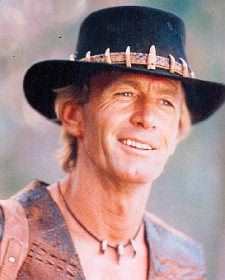
Paul Hogan
From Wikipedia, the free encyclopedia
Paul Hogan AM (born October 8, 1939 in Lightning Ridge, New South Wales) is an Australian actor and comedian.
Paul Hogan was a rigger working on the Sydney Harbour Bridge before he rose to fame in the early 1970s after a comical interview on A Current Affair. Hogan followed this with his own comedy sketch programme, The Paul Hogan Show, which he produced, co-wrote, and in which he played a panoply of characters with John Cornell. The series, which ran for 60 episodes between 1973 and 1984, proved to be popular both in his native country and in the UK and Ireland, and showcased his trademark lighthearted but laddish "Aussie" humor. In 1985, Hogan was awarded Australian of the Year and was also inducted into the Order of Australia.
During the early 1980s, Hogan filmed a series of television ads promoting the Australian tourism industry, which aired in the United States. Later in the decade, he appeared on British television in a long-running series of advertisements for Foster's Lager, in which he played an earthy Australian abroad in London. The character's most notable line (spoken incredulously at a ballet performance) "strewth, mate, there's a bloke down there with no strides on!" followed Hogan for years, and the popularity of its "fish out of water" humor was repeated with his next endeavor.
Hogan's first film, Crocodile Dundee (1986), featuring a similarly down-to-earth hunter travelling from the Australian Outback to New York City, was privately funded by Hogan and a group of private investors including much of its cast, entrepreneur Kerry Packer, and cricketers Greg Chappell, Dennis Lillee, and Rod Marsh.
1986's Crocodile Dundee proved to be the most successful Australian film ever, and launched Hogan's international film career. Crocodile Dundee won Paul Hogan a Golden Globe Award for Best Actor in a Comedy, as well as an Academy Award nomination for Best Original Screenplay, and a BAFTA Award nomination.
Hogan married his Dundee co-star Linda Kozlowski in 1990 after divorcing his first wife Noeline. He has five children from his first marriage, and one, Chance, from his second.
Recent activities
Hogan appeared in another instalment of Crocodile Dundee, entitled Crocodile Dundee in Los Angeles in 2001, and the critically panned Strange Bedfellows with Michael Caton in 2004.
He was recently under suspicion for tax evasion [1]. He also said that royalties from his most famous film Crocodile Dundee were becoming rare.
0 Replies
bobsmythhawk
1
Reply
Mon 8 Oct, 2007 10:58 am
Chevy Chase
From Wikipedia, the free encyclopedia
Birth name Cornelius Crane Chase
Born October 8, 1943 (1943-10-08) (age 64)
Woodstock, New York, USA
Other name(s) Chevy Chase
[show]Awards
Emmy Awards
Outstanding Writing in a Comedy-Variety or Music Series
1976 Saturday Night Live
Outstanding Writing in a Comedy-Variety or Music Special
1978 The Paul Simon Special Outstanding Continuing or Single Performance by a Supporting Actor in Variety or Music
1976 Saturday Night Live
Chevy Chase (born October 8, 1943) is an Emmy Award-winning American comedian, writer, and television and film actor. Born into a prominent family, Chase became a sensation as a cast member in the inaugural season of Saturday Night Live. He also hosted the Academy Awards twice (1987 and 1988) and briefly had his own late-night talk show, The Chevy Chase Show.
Early life and career
Chase was born Cornelius Crane Chase in Lower Manhattan, New York City, to Edward Tinsley ("Ned") Chase, a prominent Manhattan book editor and magazine writer, and Cathalene Parker Browning, whose father, Miles Browning, served a critical role at the Battle of Midway in World War II. His mother, a concert pianist, was adopted as a child by Cornelius Vanderbilt Crane, and took the name Cathalene Crane. Her mother was an opera singer who performed several times at Carnegie Hall. Chase is a 14th-generation New Yorker, and was listed in the Social Register at an early age. His mother's ancestors arrived at Manhattan starting in 1624. Among his ancestors are New York City mayors Stephanus Van Cortlandt and John Johnstone, John Morin Scott (General of the New York Militia during the American Revolution), Anne Hutchinson, dissident Puritan preacher and healer, and Mayflower passenger William Brewster. Chevy's paternal grandfather was artist/illustrator Edward Leigh Chase, and his granduncle was painter/teacher Frank Swift Chase.
Chase was named for his adoptive grandfather Cornelius, who lived at Castle Hill, Ipswich, Massachusetts, which was later used in the filming of The Witches of Eastwick. The name Chevy was a nickname bestowed by his grandmother. As a descendant of the Scottish Clan Douglas, who repelled an English invasion at the Battle of Cheviot Hills ("Chevy Chase") in 1436, the name "Chevy" seemed appropriate to her.[1] Chase's parents divorced when he was four; his father remarried into the Folgers coffee family, and his mother was remarried twice. Both his parents died in 2005. His mother, who later married Juilliard professor and composer Lawrence Widdoes, is buried at the Artists' Cemetery in Woodstock, New York. He made recent claims that he was abused as a child by his mother and stepfather, John Cederquist.[2]
Chase was expelled from private schools like New York City's Dalton School and Phillips Exeter Academy in New Hampshire. He did well at the Stockbridge School in Stockbridge, Massachusetts, and attended Riverdale Country School in The Bronx. He was valedictorian of his senior class and entered Haverford College, but was expelled (or 'separated') from it after one semester. He then transferred to Bard College in Annandale-on-Hudson, New York, where he studied a pre-med curriculum, dated actress Blythe Danner for several years, and graduated in 1967 with a bachelor of arts degree in English. An urban myth has it that he was suspended from Haverford for leading a cow to the second floor of his dormitory, knowing full well that a cow will go up a staircase willingly, but not down.
Chase did not enter medical school; instead he played drums for a time with the college band The Leather Canary, headed by school friends Walter Becker and Donald Fagen. At the time, Chase called the group "a bad jazz band," but Becker and Fagen went on to success after they changed their band's name to Steely Dan. Chase is gifted with absolute pitch.[1] He played drums and keyboards for a rock band called Chamaeleon Church, which recorded one album for MGM Records before disbanding in 1969. Before becoming famous as a writer, actor and comedian, Chase worked in many jobs including as a cab driver, truck driver, motorcycle messenger, construction worker, waiter, busboy, fruit picker, produce manager of a supermarket, audio engineer, salesman in a wine store, and a theater usher.
Early career
Chase began to branch out into comedy (he cited Ernie Kovacs as one of his biggest influences), making it a full time career by 1973, when Chase became a cast member of The National Lampoon Radio Hour, a syndicated satirical series aired on Sunday nights. (prior to this, he had been in an early underground comedy ensemble called Channel One which he co-founded in 1967, he had written a one-page spoof on Mission Impossible for Mad Magazine in 1970 and was a writer for the short lived Smothers Brothers TV show comeback in the early 1970s among other things) The Lampoon Radio Hour also featured John Belushi, another future "Not-Ready-For-Prime Time Player" on NBC's Saturday Night. The two also appeared at this time in National Lampoon's off-Broadway production of Lemmings, a sketch and musical send-up of popular youth culture (in which Chase also played the drums during the musical numbers). He appeared in theaters in The Groove Tube which was directed by another co-founder of the aforementioned Channel One comedy group, Ken Shapiro.
Saturday Night Live
Chase was one of the original cast members of Saturday Night Live, NBC's late night sketch television show. He was the original anchor for the Weekend Update segment, introducing himself with the catch phrase "I'm Chevy Chase, and you're not" and concluding with "good night, and have a pleasant tomorrow." It would be this opening and closing which Chase would be well known for, although he experimented with other openings to Weekend Update like saying "I'm Chevy Chase, and you can't" on one show and "I'm Chevy Chase, and I love you all very deeply" on another, even simply "I'm not". On October 6, 2007, he made a Weekend Update cameo appearence, opening with, "I'm still, and you're still not." He also traditionally opened each Update with him engaging in sexual innuendo laden talk with his girlfriend on the phone, not realizing he was on camera until it was comically too late. Chase wrote some jokes as well for Update, like The News For The Hard Of Hearing where Chase would read the top story of the day, aided by Garrett Morris, who would repeat the story by basically shouting it at the top of his lungs. Chase claimed his version of Weekend Update would later be the inspiration for shows like The Daily Show and The Colbert Report. [3] He also had a recurring gag as the Landshark. One of his early, and most memorable trademark moves were his pratfalls during many of the show's opening skits, which often poked fun at President Gerald Ford. Chase opened most SNL shows with "The Fall of the Week," after which he would exclaim "Live from New York, it's Saturday Night!". It was during one of these skits (during the second season) when he was injured on an unpadded podium, which bruised a testicle and forced him to broadcast two of the shows segments live from his hospital bed. His racially-charged "word association" skit opposite Richard Pryor from SNL's first season is frequently cited by television critics as one of the funniest (and most daring) skits in the history of SNL.
In a 1975 New York Magazine cover story which called him "The funniest man in America", NBC executives referred to Chase as "The first real potential successor to Johnny Carson" and claimed he would begin guest-hosting The Tonight Show Starring Johnny Carson within six months of the article. Chase actually never did guest host the Tonight Show during his early peak years of success, and in fact, didn't even appear on the program until 1978, when he was promoting a prime time special for NBC (his whirlwind success even got to the point where he was labeled "the next Cary Grant," a label to which he took exception). He was the first breakout star of SNL and was also the only cast member who actually identified himself by name in the first season, in the "Update" sketches, which only helped his immediate visibility. (The original show open only showed the names of the cast members on the same title card without their faces and without being introduced by Don Pardo by name). Chase was committed contractually to Saturday Night Live for only one year as a writer, not an SNL cast member. He had signed a one year writing contract and became a cast member during rehearsals just before the show's premiere. Nonetheless, he received two Emmy Awards and a Golden Globe Award for his comedy writing and live comic acting.
Feuds
Chase was the first member of the original SNL cast to leave the show in 1976, and has said that he regrets leaving after just a year-and-a-half. However, Chase was never friendly with most of the cast; a rivalry with John Belushi went all the way back to their work on the National Lampoon radio show. By the time he left, early in the second season, Chase couldn't even get along with Lorne Michaels, the show's creator and producer. After leaving SNL, Chase moved to Los Angeles and married his girlfriend, Jacqueline Carlin (Carlin had appeared in some sketches with Chase on SNL's first season). Chase continued to make the cameo appearance here and there as the second season wound down; one of the more memorable ones was when he appeared on "Jeopardy 1999", a sketch in which the popular game show was set in the future (at that time, 1976) and hosted by Steve Martin, who was that week's SNL host. One of the questions on the show was "His Career Fizzled After Leaving Saturday Night". The punchline was that nobody could answer the question, because no one could remember who that person was whose career fizzled after leaving SNL, even the character played by Chase. SNL didn't stop there at poking fun at his sudden departure; an episode featured a sketch in which Paul Simon is outside the NBC Studios in Rockefeller Center to find Chase begging for change.
Eventually, Chase was replaced by Bill Murray, who got into a legendary backstage brawl with Chase moments before the latter's scheduled 1978 hosting stint on SNL. Witnesses report that Murray initially provoked Chase about his "hated" status on the show, leading Chase to make fun of Murray's bad skin condition (comparing it to the surface of the moon). Laraine Newman, discussing the incident for authors Tom Shales and James Andrew Miller in their history of the show, Live From New York, said Murray took a shot at Chase's reported marital problems. Newman quoted Murray as saying, "Why don't you **** your wife once in awhile? She needs it." The two men were pulled apart by Dan Aykroyd and Belushi. Though the altercation occurred off the air, the story became so widely known that Chase and Murray duetted together during Chase's next hosting appearance, singing a "unity" medley including "We Write the Songs", "We Can't Get No Satisfaction", "We Shot the Sheriff" and "We Are the Walrus". Chase claims he and Murray have long since buried the hatchet on the incident, and appeared in Caddyshack together.
Chase also had a long running feud with Howard Stern prompted by Stern calling Chase's home and speaking with his housekeeper on the air. The segment was replayed on Labor Day, 2007 as a part of "Howard Stern's Tapes Blowout" special on SIRIUS Satellite Radio. The two ended the feud on Stern's radio show on September 18, 2007.
Hosting stints
Chase hosted SNL nine times after he left, but was banned from ever hosting the show again after the February 15, 1997 episode, due to his verbal abuse of the cast and crew during the week. Chase's rudeness to SNL cast members became legendary, particularly after his 1985 remarks to openly gay cast member Terry Sweeney suggesting that a perfect skit for Sweeney would be one in which Sweeney would play an AIDS victim who gets weighed every week. Chase recently told Time that this story is untrue, and that he has had gay friends his whole life.[4] Although Chase has not hosted the show since 1997, he appeared on the show's 25th anniversary special in 1999 and was interviewed for a 2005 NBC special on SNL's first five years. He also has made four cameo appearances: once in a Caddyshack skit (featuring Bill Murray), the October 25, 1997 episode with guest host Chris Farley, as the Land Shark in Weekend Update during the October 6, 2001 episode, and again on Weekend Update doing a shaky political news/commentary on the October 6, 2007 episode.
To this day, Chase admits that leaving SNL so soon was the biggest mistake of his career. He said as much when he appeared at the unveiling of Michaels' star on the Hollywood Walk of Fame. To Shales and Miller he put it this way: "I'm still hurting, I still grieve for all those years that I could have had there." Chase clarified to David Letterman that the reason he left SNL was for his girlfriend, Jaqueline. He stated that he was "infatuated" with her and moved to Los Angeles to marry her, because she wouldn't move to New York where SNL was taped.
Film career
Chase's early film roles included Tunnel Vision, Foul Play, and Oh Heavenly Dog. The role of Eric 'Otter' Stratton in National Lampoon's Animal House was originally written with Chase in mind, but he turned the role down to work on Foul Play. Chase said in an interview that he chose to do Foul Play so he could do "real acting" for the first time in his career instead of just doing "schtick".[5] The role went to Tim Matheson instead. Chase followed Foul Play with the successful Harold Ramis comedy Caddyshack, in 1980.
Chase narrowly escaped death by electrocution during the filming of Modern Problems in 1980. During a sequence in which Chase's character wears 'landing lights' as he dreams that he is an airplane, the current in the lights short-circuited and arced through Chase's arm, back, and neck muscles. The near-death episode caused Chase to experience a period of deep depression, as his marriage to Jacqueline had ended just prior to the start of filming. Chase continued his film career in 1983's National Lampoon's Vacation, directed by Ramis and written by John Hughes. He married Jayni Luke in 1983, and in 1985, he starred in Fletch, the first of two films based on Gregory Mcdonald's Fletch books. Chase joined SNL veterans Steve Martin and Martin Short in the Lorne Michaels-produced comedy ¡Three Amigos! in 1986, admitting in an interview that making ¡Three Amigos! was the most fun he has had on a film. The trio hosted SNL that year, the only time the show has had three hosts on one show.
At the height of his career in the late 1980s, Chase earned around $7 million per film and was a highly visible celebrity. He appeared alongside Paul Simon, one of his best friends, in Simon's 1986 second video for "You Can Call Me Al," in which he lip-syncs all of Simon's lyrics. Chase hosted the Academy Awards in 1987 and 1988, signing on to the proceedings in 1987 with the opener, "Good evening, Hollywood phonies!" Chase filmed a second sequel to Vacation, National Lampoon's Christmas Vacation, in 1989, which, thanks to its holiday theme, has become his most durable film, airing on NBC every December, and played saxophone onstage at Simon's free concert at the Great Lawn in Central Park in the summer of 1991. Later in 1991, he helped record and appeared in the music video "Voices That Care" to entertain and support U.S. troops involved in Operation Desert Storm, and supported the International Red Cross.
Later work
In 1980, Chase released a self-titled record album with cover versions of songs by Randy Newman, Barry White, Eric Clapton, the Beatles, Donna Summer, Tennessee Ernie Ford, The Troggs, and the Sugarhill Gang. The album was co-produced by Chase and Tom Scott. Among "short people" Chase names in his version of Newman's "Short People" is his friend Paul Simon, who features Chase in the video of "You Can Call Me Al." The Beatles' "Let It Be" is recorded a la Alvin and the Chipmunks.
Chase's career took a downturn in the 1990s. Few of Chase's subsequent films have been able to duplicate the critical or commercial success of his early career. As fellow SNL personality Paul Shaffer later joked, "You made us laugh so much... and then you inexplicably stopped in about 1978." In fact, Chase's film successes, Caddyshack, Fletch, and National Lampoon's Vacation, all were products of the 1980s. Chase had three consecutive film flops from his later period: 1991's Razzie award-nominated Nothing But Trouble, 1992's Memoirs of an Invisible Man, and 1994's Cops and Robbersons. The three releases grossed $34 million in the U.S., combined. Even the durable Vacation series ground to a halt, following 1997's Vegas Vacation installment, the only one without the National Lampoon imprimatur. Some of the more recent movies starring Chase (e.g., Vacuums, Rent-a-Husband, Goose!) have not been released in the United States.
In September 1993, Chase hosted The Chevy Chase Show, a weeknight talk show, for the Fox Broadcasting Company. The show was cancelled by FOX after only six weeks. Chase later appeared in a commercial for Doritos, airing during the Super Bowl, in which he made humorous reference to the show. He was Hasty Pudding's 1993 Man Of The Year, and received a star on the Hollywood Walk of Fame in 1994. He starred with Farrah Fawcett in Man of the House, which immortalized the YMCA Indian Guides program in 1995, and received Harvard Lampoon's Lifetime Achievement Award in 1996.
In 1998, Chase was offered the lead role of Lester Burnham in the Academy Award-winning drama, American Beauty, but he turned it down, fearing that it would tarnish his family-friendly image. The role went on to win Kevin Spacey the Academy Award for Best Actor.
Chase visited Cuba in the late 1990s. Afterward, self-proclaimed former Cuban intelligence officer Delfin Fernandez said that Chase's room was bugged with both video and audio recording devices, a claim dismissed as false by Cuban officials. Later at Earth Day 2000 in Washington, D.C., Chase stated that mixed economies can work, stating, "Socialism works. I think Cuba can prove that".[6] He was also investigated, but not charged, with using assets in countries where it is prohibited by the U.S. State Department. [7] He was roasted by the Friars Club in 2002, but the occasion was notable for the near-total disconnect between Chase's career and the list of performers who agreed to appear. In 2005, Chase was the keynote speaker at Princeton University's Class Day, part of commencement activities for the graduating class of 2005. Though he mentioned that he "left his written speech on the corner of the bathtub at home," he spoke for about 15 minutes about sense of humor and the perspective on life that it creates, while also proclaiming, "I strapped my dong down this morning," and discussing deleted scenes from the movie Dirty Work. Chase returned to mainstream movie-making in 2006, co-starring with Tim Allen and Courteney Cox in the comedy Zoom. Chase returned for a series of cameo's on SNL's Weekend Update segment for the Fall 2007 season, saying "it's a perfect political year" for him "to get in there and raise a little heck." His first appearance on the segment was on the October 6, 2007 episode.
Chase is an active environmentalist and charity fundraiser. He raised money and campaigned for Bill Clinton in the 1990s and John Kerry in the 2004 Presidential Election. Chase has harshly criticized President George W. Bush with comments like, "This guy in office is an uneducated, real lying schmuck... and we still couldn't beat him with a bore like Kerry." In the same speech he allegedly stunned the crowd at a People For the American Way benefit at the Kennedy Center, referring to the President as a "dumb ****". Several Bush detractors present at the event distanced themselves from Chase's comments, with Norman Lear remarking, "he'll live with it, I won't".[8]
Chase guest-starred as an anti-Semitic murder suspect in "In Vino Veritas", the November 3, 2006 episode of Law & Order, which was apparently inspired by actor/director Mel Gibson's notorious arrest for drunk driving in 2006. Chase himself was arrested for drunk driving in 1995 with a blood alcohol level of more than double the legal limit.
Personal life
Chase is the father of three girls, Cydney, Caley, and Emily. He lives with his wife, Jayni, in New York. He took part in Amnesty International's The Secret Policeman's Ball in 2006.
Chase is also an avid fan of jazz music. He publicly made this known when he hosted the 2007 Newport Jazz Festival in Newport, Rhode Island.
0 Replies
bobsmythhawk
1
Reply
Mon 8 Oct, 2007 11:01 am
Sigourney Weaver
From Wikipedia, the free encyclopedia
Birth name Susan Alexandra Weaver
Born October 8, 1949 (1949-10-08) (age 58)
Manhattan, New York City
Spouse(s) Jim Simpson (1984-)
[show]Awards
BAFTA Awards
Best Supporting Actress
1997 The Ice Storm
Golden Globe Awards
Best Actress - Motion Picture Drama
1989 Gorillas in the Mist: The Story of Dian Fossey
Best Supporting Actress - Motion Picture
1989 Working Girl
Other Awards
Saturn Award for Best Actress (film)
1986 Aliens
Sigourney Weaver (born Susan Alexandra Weaver on October 8, 1949 in New York City) is an Oscar-nominated American actress.
Early life
Weaver is the daughter of late NBC television executive Pat Weaver and Elizabeth Inglis, a British actress. Her uncle, Doodles Weaver, was a comedian and actor.
She began using the name Sigourney Weaver in 1963, after a character in F. Scott Fitzgerald's The Great Gatsby[citation needed] (in Chapter 3, golfer Jordan Baker tells Nick that her telephone number is listed under her aunt, Mrs. Sigourney Howard, who never appears in the book or movie). She attended the prestigious Ethel Walker School, a prep school in Simsbury, Connecticut, graduated from Stanford University, and studied law at Harvard Law School, then drama at Yale School of Drama, where she appeared in original plays by friend and classmate Christopher Durang. She later appeared in the 1981 off-Broadway production of his comedy Beyond Therapy.
Film career
Although Weaver has played a number of critically acclaimed roles in movies like Gorillas in the Mist, The Ice Storm, Dave, and The Year of Living Dangerously, she is best known for her appearances as Warrant Officer/Lieutenant Ellen Ripley in the blockbuster "Alien" movie franchise. Her first appearance as Ripley was in Ridley Scott's 1979 film Alien. She reprised the role in two sequels, Aliens and Alien³. She also played Ripley 8 (a clone of the original Ripley) in Alien: Resurrection. She was nominated for a Best Actress Academy Award for portraying Ripley in Aliens. Ripley was a breakthrough role: the first female action hero. Although Ripley is tender and nurturing with a cat or a child, she is tough and aggressive with adult humans and alien monsters, and ruthless enough to blow up her own ship or a planetary colony; in the third film, she destroys herself to prevent the xenomorph species from spreading.
Weaver also appeared in Ghostbusters and Ghostbusters II as Dana Barrett. She played the role of the agoraphobic criminal psychologist Helen Hudson in the 1995 movie Copycat, and went on to become the most highly paid actress of the 1990s. In addition to her trademark role as Ripley, Weaver has recently concentrated on smaller, more challenging roles such as 1999's A Map of the World and 2006's Snowcake. Critics have also noted her consistent performances in comedic roles, such as in Jeffrey (1994) and Heartbreakers (2001), in which she starred with Jennifer Love Hewitt.
In 1997, Weaver won the BAFTA Award for her supporting role in Ang Lee's "The Ice Storm."
In 2003, Weaver was voted 20th in Channel 4's countdown of the 100 greatest movie stars of all time. She was one of only two women in the top 20 (the other was Audrey Hepburn).
In 2006, Weaver returned to Rwanda for the BBC special Gorillas Revisited.
Bryan Singer originally wanted Weaver to play the lead villainess role of Emma Frost in X-Men: The Last Stand. But after Singer left the project to direct Superman Returns, the story changed considerably and the part of Emma Frost was dropped entirely from the script.[citation needed]
Dual nominations
In addition to her Academy Award nomination for Aliens, Weaver has received two other nominations in her career, both in 1988. This makes Weaver one of only ten actors and actresses to have received two nominations in the same year. Weaver received a Best Actress nomination for her role as gorilla conservationist Dian Fossey in Gorillas in the Mist and a Best Supporting Actress nomination for her role as Katharine Parker in Working Girl opposite Harrison Ford and Melanie Griffith. She did not win either nomination, but was awarded a Golden Globe for each role. By failing to win an Oscar in either category for 1988, she became the first person in history to lose twice in the same ceremony.
Personal life
Weaver married theater director Jim Simpson (The Flea Theater) in 1984. They have one child, Charlotte Simpson, who was born in 1990.
After making Gorillas in the Mist, she became a supporter of The Dian Fossey Gorilla Fund and is now the DFGFI's honorary chairperson.[1]
Weaver is an environmentalist. [2] In October 2006 she drew international attention through a news conference at the start of a United Nations General Assembly policy deliberation. She outlined the widespread threat to ocean habitats posed by deep-sea trawling, an industrial method for harvesting fish. She also narrated the Discovery Channel show Planet Earth, which focuses on the wonders of our world.[3] [4]
Weaver is notable for her stature, standing 6' (1.83 m) tall. She is also notable for her wardrobe: She appears at many awards shows, wearing dresses by famous designers. At one time in the 1990s, two magazines appointed her Best Dressed and Worst Dressed, respectively.[citation needed]
Popular culture
The Italian lesbian science-fiction comics character Legs Weaver is inspired by Sigourney Weaver's role in Alien.
In 2007, Weaver reprised her role of Ellen Ripley in a commercial for DirecTV. In the commercial, Weaver, in the power loader vehicle from the movie Aliens, is battling the queen xenomorph while explaining to watchers how DirecTV is a better deal than cable
0 Replies
bobsmythhawk
1
Reply
Mon 8 Oct, 2007 11:03 am
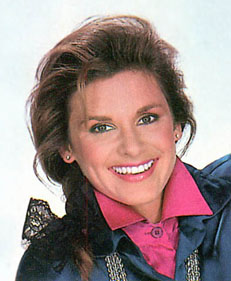
Stephanie Zimbalist
From Wikipedia, the free encyclopedia
Stephanie Zimbalist (born October 8, 1956 in New York City, New York) is an American actress.
Early life
Zimbalist comes from a highly successful and renowned family. Her father is Efrem Zimbalist, Jr., the actor, her grandfather Efrem Zimbalist was a concert violinist, teacher and composer and her grandmother, Alma Gluck was leading soprano. Her late aunt, Marcia Davenport, was an author and historian.
Her paternal heritage is Jewish, but her father became involved with Jews for Jesus, and they embraced its tenets.[citation needed] Stephanie's mother is Stephanie Spaulding Zimbalist. Zimbalist graduated from Foxcroft School in Middleburg, Virginia. She briefly attended the Juilliard School before commencing her acting career.
Career
Early television and movie appearances include Forever, The Triangle Factory Fire Scandal, The Awakening (with Charlton Heston) and The Golden Moment, in which she played a Soviet Olympic gymnast. She co-starred with her father, Efrem Zimbalist Jr., in the 1979 TV movie, The Best Place to Be, which also starred the late, Oscar-winning actress Donna Reed.
Television audiences know Zimbalist as detective Laura Holt in the American television series Remington Steele (1982 to 1987). Pierce Brosnan was her co-star in the romantic comedy-mystery series.
In the late 1980s and in the 1990s, Zimbalist took leading roles in several "made for television" movies. She played the title role in the Emmy-award winning television movie Caroline? in 1990. Zimbalist also took two roles in episodes of the popular American television program Touched by an Angel. Her performances, however, were not limited to the small screen. Zimbalist played opposite Tommy Tune in the touring musical My One and Only in the title role of "Sylvia."
Perhaps Stephanie Zimbalist's greatest and most memorable role was that of Ellie Zendt in the television mini-series of James A Michener's epic novel "Centennial," which was first televised on NBC between October 1978 and February 1979.
Since that time, her on-screen parts have been few and far between. Even so, Zimbalist can be seen, not infrequently, in plays. For instance, she has made several appearances with the Rubicon Theatre Company in California. Zimbalist won a 'Robby Award' for 'Best Actress in a Drama' in The Rainmaker, staged by Rubicon in February 2001.
Recently, Zimbalist has taken roles in plays concerning 19th century artists including Chopin, Tchaikovsky and Van Gogh. She has also released some audio books including "The Girls" and "Queen of the Underworld". "The Girls" received a Listen-Up award in 2006.
You can also see Zimbalist in the 2006 documentary, "Christa McAuliffe: Reach for the Stars." Zimbalist played the Teacher-Astronaut in the stage play "Defying Gravity." [1]
Zimbalist is a supporter of the Tennessee Williams Festival of New Orleans.
Zimbalist is an active supporter and contributor to the Republican Party.
0 Replies
bobsmythhawk
1
Reply
Mon 8 Oct, 2007 11:07 am
Matt Damon
From Wikipedia, the free encyclopedia
Birth name Matthew Paige Damon
Born October 8, 1970 (1970-10-08) (age 37)
Cambridge, Massachusetts U.S.
Occupation Actor, screenwriter, producer
Years active 1988 - present
Spouse(s) Luciana Bozán Barroso (2005-present)
[show]Awards
Academy Awards
Best Original Screenplay
1997 Good Will Hunting
Golden Globe Awards
Best Screenplay
1998 Good Will Hunting
Matthew Paige Damon (born October 8, 1970) is an American actor and screenwriter. He won the Academy Award for Best Original Screenplay for his screenwriting in Good Will Hunting and was nominated for his lead performance in the same film. Growing steadily in popularity from the film back in 1997 with many appearances alongside other A-list actors in mainstream films, today he is rated amongst the top actors in Hollywood.
Damon is currently married to Luciana Bozán Barroso and they have a daughter and a stepdaughter from Barroso's prior marriage. He has won multiple awards for his film performances and is one of the top twenty-five highest grossing actors of all time. Damon has been actively involved in several charitable organizations, including the ONE Campaign and H2O Africa Foundation. Damon currently has four upcoming films that will debut between 2007 and 2009. In his most recent roles, he portrayed Jason Bourne in The Bourne Ultimatum, and had an uncredited cameo in Youth Without Youth. His next upcoming role will be in Margaret, due in 2007.
Biography
Early life
Matt Damon was born in Cambridge, Massachusetts, the son of Kent Telfer Damon, a stockbroker, realtor, and tax preparer, and Nancy Carlsson-Paige, an early childhood education professor at Lesley University.[1] In an interview with Mail on Sunday, Damon responded that his grandfather is probably the most "impressive person he knows," stating, "He's Finnish, a very proud man, who would never take help from anybody. He came to America when he was a little boy, grew up during the Depression and sold shoes. He always used to tell us the story about getting a raise of three and a half cents, and how that was an incredible moment of success. He's extraordinary."[2] Damon has a brother, Kyle, who is an accomplished sculptor and artist.[3] Damon and his family lived in Newton for the first two years of his life, but after his parents divorced, Damon and his brother moved with his mother to Cambridge.[4]
Damon grew up next door to actor Ben Affleck and historian and author Howard Zinn.[4][5] Damon worked Zinn's popular book A People's History of the United States into his character's dialogue in the movie Good Will Hunting, saying: "That book will knock you on your ass."[6] Later he did the narration for Zinn's own biographical film You Can't Be Neutral on a Moving Train[7] and an audio version of A People's History of the United States.
Damon attended Cambridge Rindge and Latin School, the only public high school in Cambridge, and performed in several theater productions.[8] He graduated from the school in 1988 and began attending Harvard University in the same year. Damon could have graduated with the class of 1992, but kept leaving classes to pursue acting projects, including the TNT original film Rising Son and ensemble prep-school drama School Ties. While at Harvard, he concentrated in English and lived in Lowell House. He did not take part in student theater generally, but did appear in A... My Name is Alice (in one of the three male roles usually performed by women).[9] Damon dropped out of the university with twelve units left to graduate to pursue his acting career in Los Angeles after he expected (incorrectly) Geronimo: An American Legend to be a big success.[10]
Career
Damon's first film role came in 1988 when he was 16, with a single line of dialogue in the romantic comedy Mystic Pizza. Damon appeared in small roles before landing a big part in Geronimo: An American Legend with Gene Hackman and Jason Patric. He next appeared as a heroin-addicted soldier in 1996's Courage Under Fire. He was required to lose 40 pounds (18 kg) in 100 days (for only two days of filming).[11][12] After following a self-prescribed diet and fitness regimen to lose the weight, Damon was told after filming that he was fortunate his heart did not shrink.[12] Damon took medication for several years afterwards to correct the stress inflicted on his adrenal gland, and has stated that it was worthwhile to properly portray his character and show the industry how committed he was to the role.[12]
Damon and actor Ben Affleck, close personal friends as well as co-stars in several films, developed a thriller about a young math genius, which they pitched around Hollywood. Receiving advice from writer/director/actor Rob Reiner, screenwriter William Goldman, and their friend writer/director Kevin Smith,[10] the two changed the script around to focus on a young math genius trying to make his way in the world. This script eventually became Good Will Hunting, and received nine Academy Awards nominations, earning Damon and Affleck Oscars for Best Original Screenplay.[13] Damon was also nominated for an Academy Award for Best Actor for the same film (which netted an Oscar for Best Supporting Actor for co-star Robin Williams). Damon and Affleck were each paid salaries of $500,000, and the film grossed over $100 million at the box office.[10] Damon parodied his role in the film in Kevin Smith's Jay and Silent Bob Strike Back. After watching Good Will Hunting, director Steven Spielberg cast Damon in the World War II film Saving Private Ryan.[10]
Damon founded Project Greenlight with Affleck and Chris Moore to find and fund worthwhile film projects from novice filmmakers.[14] The televised documentary about the making of the film projects has been nominated for an Emmy three times.[10]
Damon has been known to choose a wide variety of film roles, from his portrayal of bisexual murderer Tom Ripley in The Talented Mr. Ripley, for which he received a Golden Globe nomination for Best Actor, to a fallen angel who discusses pop culture as intellectual subject matter in Dogma, in which he co-starred with Affleck (1999); from a conjoined twin in Stuck on You, to a film he co-wrote with friend Casey Affleck and Gus Van Sant with limited dialogue?-the low budget experimental film Gerry. Damon has been part of two major film franchises. He played amnesiac assassin Jason Bourne in the successful action movies The Bourne Identity, The Bourne Supremacy and The Bourne Ultimatum and starred as the youthful, optimistic thief, Linus Caldwell, opposite George Clooney, Brad Pitt, and Julia Roberts in Steven Soderbergh's remake of the Rat Pack's 1960 caper classic Ocean's Eleven. The successful crime dramedy spawned two sequels: Ocean's Twelve and Ocean's Thirteen.
Among other high profile roles, Damon played a fictionalized version of Wilhelm Grimm in Terry Gilliam's fantasy adventure The Brothers Grimm and an energy analyst in Syriana. He was recently onscreen in Robert DeNiro's The Good Shepherd as a career CIA agent, and played an undercover mobster working for the Massachusetts State Police in Martin Scorsese's Oscar-winning The Departed, a remake of the Hong Kong police thriller Infernal Affairs. He also has a supporting role in Kenneth Lonergan's film Margaret and an uncredited cameo in Francis Ford Coppola's Youth Without Youth, both due in 2007.
In 2007, rumors stated that producer J.J. Abrams was trying to get Damon to play James T. Kirk in the eleventh Star Trek feature film. Damon told IGN on July 20, 2007 that he would not be in the film, as the director was casting someone significantly younger, and speculation about his casting had been solely based on Internet rumors.[15]
Box office performance
In motion pictures that feature him as a leading actor or supporting co-star, his films have grossed a total of $1.92[16] to $2.28 billion[17] (based on counting his roles as strictly lead or including supporting roles) at the North American box office, placing him in the top twenty-five grossing actors of all time. In August 2007, financial magazine Forbes created a list of actors who generated the best box office performance related to their salaries. The list placed Damon as the most bankable star of the actors reviewed, revealing that Damon had averaged $29 at the box office for every dollar he earned for his last three films.[18]
Upcoming films
Damon's future projects include three films that will debut between 2007 and 2009. In 2007, he will portray Mr. Aaron in the drama Margaret. He also has signed on for The Informant, which currently does not have release date, but is scheduled to start filming on 15 April, 2008.[19] The film will have Damon rejoin Steven Soderbergh and is based on the true story of Mark Whitacre, a corporate whistleblower who wore a wire for two and a half years for the FBI. Whitacre was a high-level executive at a Fortune 500 company, Archer Daniels Midland (ADM), in one of the largest price-fixing cases in history.[20] However, the script for the movie was written by Scott Z. Burns using Kurt Eichenwald's book, The Informant. Kurt Eichenwald is the investigative reporter who recently lost his credibility and his career in journalism because of unethical payments, and possibly illegal, in a recent child pornography case.[21][22] The debate continues whether the filming will continue because of the Eichenwald child pornography controversy and his lack of credibility.[21][22] James Lieber, a lawyer who authored Rats in the Grain, painted a much different picture about Whitacre than Eichenwald, portraying Whitacre as an American hero who was overpowered by ADM's vast political clout.[23] Dean Paisley, formerly 25 years with the FBI and supervisor of the ADM case, has supported a Whitacre Pardon for several years which is more in line with Lieber's conclusion than Eichenwald's.[24]
Personal life
Damon has had relationships with several actresses throughout his career. Damon had a three-year relationship with actress Winona Ryder.[25] He also dated Odessa Whitmire, who has worked as a personal assistant for Billy Bob Thornton and Ben Affleck, from 2001 to 2003.[26] His relationship with Good Will Hunting co-star Minnie Driver reportedly ended when Damon announced their break-up on The Oprah Winfrey Show, though both actors have repeatedly denied this. Damon later stated that he was "sick and tired" of hearing the story, saying it was false. Driver's sister allegedly told Cosmo that the couple had broken up before the show was taped.[27] Although the media often claimed Damon dated actress Eva Mendes, both have denied any relationship, with Mendes saying "it wasn't true."[28][29]
Damon met Argentine-born Luciana Bozan Barroso in Miami, where she was working as a bartender.[30] They married in a private civil ceremony on December 9, 2005, in New York City Hall. Damon became stepfather to Barroso's young daughter, Alexia, from her previous marriage. The couple's first child together, daughter Isabella, was born on June 11, 2006.[31]
Philanthropy
Damon, along with frequent co-stars George Clooney and Brad Pitt, supports ONE, a campaign fighting AIDS and poverty in Third World countries. He has appeared in their print and television advertising.
Damon is a board member of GreenDimes.com, an organization that attempts to halt the tons of junk mail delivered to American homes each day.[32][33] Appearing on The Oprah Winfrey Show on April 20, 2007, Damon promoted the organization's efforts to prevent the trees used for junk mail letters and envelopes from being chopped down. Damon stated: "For an estimated dime a day they can stop 70 per cent of the junk mail that comes to your house. It's very simple, easy to do, great gift to give, I've actually signed up my entire family. It was a gift given to me this past holiday season and I was so impressed that I'm now on the board of the company."[34]
Damon is one of the founders of Not On Our Watch, an organization that focuses global attention and resources to stop and prevent mass atrocities such as in Darfur, along with George Clooney, Brad Pitt, Don Cheadle, and Jerry Weintraub.[35] He is also the founder of H2O Africa Foundation, the charitable arm of the Running the Sahara expedition.[10][36]
Interests and notable events
Comedian Jimmy Kimmel often says: "Our apologies to Matt Damon, we ran out of time" near the end of his ABC television show Jimmy Kimmel Live, a gag lampooning instances where shows cannot feature their last guest due to time constraints. On September 12, 2006, after a segment highlighting the running gag and a lengthy introduction by Kimmel, Damon finally appeared on the show, only for Kimmel to apologetically cut his interview and head to credits. Damon told him "to go and **** himself" and cursed Kimmel out during the credits. Kimmel later confirmed to USA Weekend that the skit was entirely planned and Damon willingly played along.[37] Kimmel's girlfriend, comedian Sarah Silverman, also used this line at the end of the 2007 MTV movie awards. This gag was also used again when Guillermo interviewed Matt at the Ocean's 13 premiere, with Damon asking "Are you with Kimmel?"
Damon appeared on Hardball with Chris Matthews in December 2006 and discussed the ongoing war in Iraq. Responding to Chris Matthews, Damon stated: "I don't think that it's fair, as I said before, that it seems like we have a fighting class in our country that's comprised of people who have to go for either financial reasons, or, I don't think that that is fair and if you're gonna send people to war ... then that needs to be shared by everybody."[38]
Awards and honors
Damon won multiple awards for Good Will Hunting, a film he co-wrote with Ben Affleck. He was nominated for the Academy Award "Best Actor in a Leading Role" and won "Best Writing, Screenplay Written Directly for the Screen".[39]
On July 25, 2007, Damon became the 2,343rd person to receive a star on the Hollywood Walk of Fame.[40] Damon reacted to the award, stating: "A few times in my life I've had these experiences that are just kind of too big to process and this looks like it's going to be one of those times."[41]
Damon has been nominated for four Screen Actors Guild awards and seven MTV Movie Awards for various films. Additionally, he has three Emmy nominations for his work on the first three seasons of Project Greenlight.[39]
0 Replies
bobsmythhawk
1
Reply
Mon 8 Oct, 2007 11:08 am
Wisdom of Larry, the Cable Guy
1. A day without sunshine is like night.
2. On the other hand, you have different fingers.
3. 42.7 percent of all statistics are made up on the spot.
4. 99 percent of lawyers give the rest a bad name.
5. Remember, half the people you know are below average.
6. He who laughs last, thinks slowest.
7. Depression is merely anger without enthusiasm.
8. The early bird may get the worm, but the second mouse gets the cheese in the trap.
9. Support bacteria. They're the only culture some people have.
10. A clear conscience is usually the sign of a bad memory.
11. Change is inevitable, except from vending machines.
12. If you think nobody cares, try missing a couple of payments.
13. How many of you believe in psycho-kinesis? Raise my hand.
14. OK, so what's the speed of dark?
15. When everything is coming your way, you're in the wrong lane.
16. Hard work pays off in the future. Laziness pays off now.
17. How much deeper would the ocean be without sponges?
18. Eagles may soar, but weasels don't get sucked into jet engines
19. What happens if you get scared half to death, twice?
20. Why do psychics have to ask you for your name?
21. Inside every older person is a younger person wondering, "What the hell happened?"
22. Just remember -- if the world didn't suck, we would all fall off.
23. Light travels faster than sound. That's why some people appear bright until you hear them speak.
0 Replies
Letty
1
Reply
Mon 8 Oct, 2007 11:56 am
Well, folks. I see that our Bob is back with his bio's and adages that make us think. Thanks, hawkman, for the celeb info, and I especially like:
"Eagels may soar, but weasels don't get sucked into jet engines." Does that include hawks?
I found one song that relates to Crocodile Hogan Dundee, so let's hear it.
by Mental as Anything
How can you see looking through those tears
Don't you know you're worth your weight in gold
I can't believe that you're alone in here
Let me warm your hands against the cold
A close encounter with a hardhearted man
Who never gave half of what he got
Has made you wish you'd never been born
That's a shame cause you got the lot
Hey THERE you with the sad face
Come up to my place and live it up
You beside the dance floor
What do you cry for let's live it up
If you smiled the walls would fall down
On all the people in this pickup joint
But if you laughed you'd level this town
Hey lonely girl that's just the point
Hey there you with the sad face
Come up to my place and live it up
You beside the dance floor
What do you cry for let's live it up
Just answer me the question why
You stand alone by the phone in the corner and cry
How can you see looking through those tears
Don't you know you're worth your weight in gold
I can't believe that you're alone in here
Let me warm your hands against the cold
If you smiled the walls would fall down
On all the people in this pickup joint
But if you laughed you'd level this town
Hey lonely girl that's just the point
Hey there you with the sad face
Come up to my place and live it up
You beside the dance floor
What do you cry for let's live it up
Let's live it up,
Live it up
Mmm live it up
Hey yeah you
With the sad face
Come up to my place
Come up to my place baby
Hey there you with the sad face
Come up to my place and live it up
You beside the dance floor
What do you cry for let's live it up
You with the sad face
Come up to my place and live it up
You beside the dance floor
What do you cry for let's live it up
0 Replies
Letty
1
Reply
Mon 8 Oct, 2007 12:59 pm
While we wait for our resident photographer to show us new photo's in our gallery, here is news from the world of medicine:
US, UK Scientists Win Nobel in Medicine
By KARL RITTER and MATT MOORE, Associated Press Writers
Monday, October 8, 2007
(10-08) 08:50 PDT STOCKHOLM, Sweden (AP) --
Two American scientists and a Briton won the 2007 Nobel Prize in medicine on Monday for groundbreaking discoveries that led to a powerful technique for manipulating mouse genes.
The widely used process has helped scientists use mice to study heart disease, diabetes, cancer, cystic fibrosis and other diseases.
The prize is shared by Mario R. Capecchi, 70, of the University of Utah in Salt Lake City; Oliver Smithies, 82, a native of Britain now at University of North Carolina in Chapel Hill, and Sir Martin J. Evans, 66, of Cardiff University in Wales.
The Nobel is a particularly striking achievement for Capecchi, (pronounced kuh-PEK'-ee). A native of Italy, he was separated from his mother at age 4 when she was taken to the Dachau concentration camp as a political prisoner during World War II.
For four years, Capecchi lived on the street or in orphanages, "and most of the time hungry," he recalled in a University of Utah publication in 1997. Malnutrition sent him to a hospital where his mother found him on his ninth birthday. Within two weeks they left for the United States, where he went to school for the first time, starting in third grade despite not knowing English.
The three scientists were honored for a technique called gene targeting.
Wishing Letty's daughter a Happy Birthday. My mother was born on October 6. Libra people are kind, loving and generous.
And the other celebs of the day:
0 Replies
Letty
1
Reply
Mon 8 Oct, 2007 02:28 pm
Well, Raggedy, Happy belated Birthday to your mom, PA, and thanks for the great quintet.
Chevy Chase did some really funny movies, y'all. I recall European Vacation when he knocked down Stone Henge.
Stephanie Zimbalist was in that detective show with Pierce Brosnan as Remington Steele. I had forgotten all about her, but in searching found that she did this song:
Song: Send in the Clowns
Isn't it rich?
Are we a pair?
Me here at last on the ground,
You in mid-air.
Send in the clowns.
Isn't it bliss?
Don't you approve?
One who keeps tearing around,
One who can't move.
Where are the clowns?
Send in the clowns.
Just when I'd stopped opening doors,
Finally knowing the one that I wanted was yours,
Making my entrance again with my usual flair,
Sure of my lines,
No one is there.
Don't you love farce?
My fault I fear.
I thought that you'd want what I want.
Sorry, my dear.
But where are the clowns?
Quick, send in the clowns.
Don't bother, they're here.
Isn't it rich?
Isn't it queer,
Losing my timing this late
In my career?
And where are the clowns?
There ought to be clowns.
Well, maybe next year.
0 Replies
edgarblythe
1
Reply
Mon 8 Oct, 2007 04:55 pm
They sat together in the park
As the evening sky grew dark,
She looked at him and he felt a spark tingle to his bones.
'Twas then he felt alone and wished that he'd gone straight
And watched out for a simple twist of fate.
They walked along by the old canal
A little confused, I remember well
And stopped into a strange hotel with a neon burnin' bright.
He felt the heat of the night hit him like a freight train
Moving with a simple twist of fate.
A saxophone someplace far off played
As she was walkin' by the arcade.
As the light bust through a beat-up shade where he was wakin' up,
She dropped a coin into the cup of a blind man at the gate
And forgot about a simple twist of fate.
He woke up, the room was bare
He didn't see her anywhere.
He told himself he didn't care, pushed the window open wide,
Felt an emptiness inside to which he just could not relate
Brought on by a simple twist of fate.
He hears the ticking of the clocks
And walks along with a parrot that talks,
Hunts her down by the waterfront docks where the sailers all come in.
Maybe she'll pick him out again, how long must he wait
Once more for a simple twist of fate.
People tell me it's a sin
To know and feel too much within.
I still believe she was my twin, but I lost the ring.
She was born in spring, but I was born too late
Blame it on a simple twist of fate.
Bob Dylan
0 Replies
Letty
1
Reply
Mon 8 Oct, 2007 05:09 pm
Ah, edgar. Dylan and his fait accompli. I especially like the line:
A saxophone someplace far off played. That I can hear!
E.A Robinson on fate, folks
Miniver Cheevy
Miniver Cheevy, child of scorn
Grew lean while he assailed the seasons;
He wept that he was ever born,
And he had reasons.
Miniver loved the days of old
When swords were bright and steeds were prancing;
The vision of a warrior bold
Would set him dancing.
Miniver sighed for what was not,
And dreamed, and rested from his labors;
He dreamed of Thebes and Camelot,
And Priam's neighbors.
Miniver mourned the ripe renown
That made so many a name so fragrant;
He mourned Romance, now on the town,
And Art, a vagrant.
Miniver loved the Medici,
Albeit he had never seen one;
He would have sinned incessantly
Could he have been one.
Miniver cursed the commonplace
And eyed a khaki suit with loathing;
He missed the mediæval grace
Of iron clothing.
Miniver scorned the gold he sought,
But sore annoyed was he without it;
Miniver thought, and thought, and thought,
And thought about it.
Miniver Cheevy, born too late,
Scratched his head and kept on thinking;
Miniver coughed, and called it fate,
And kept on drinking.
0 Replies
bobsmythhawk
1
Reply
Tue 9 Oct, 2007 04:47 am
Alastair Sim
From Wikipedia, the free encyclopedia
Born October 9, 1900(1900-10-09)
Edinburgh, Scotland, UK
Died August 19, 1976 (aged 75) (cancer)
London, England, UK
Occupation Actor
Spouse(s) Naomi Plaskitt (1932-1976)(his death)
Alastair Sim, CBE (October 9, 1900 - August 19, 1976) was a Scottish character actor, who appeared in a string of classic British films. He is best known for his role of Ebenezer Scrooge in the 1951 film Scrooge.
Born in Edinburgh, Scotland, into a family of tailors, he was educated at George Heriot's School. He become an elocution lecturer at New College, Edinburgh University from 1925 until 1930, and rector from 1948 until 1951.
Preferring the stage, Sim made his London début in Othello in 1930. He also appeared for a season at the Old Vic. He made his film debut in The Case of Gabriel Perry (1935). He spent the remainder of the decade playing supporting roles in films, and was often credited as "stealing the scene" from the leading actors. By the 1940s, he had progressed to leading roles, and in 1950, he was voted the most popular film actor in Britain in a national cinema poll.
His films include Waterloo Road (1944), Green for Danger (1946), Alfred Hitchcock's Stage Fright (1950), Laughter in Paradise (1951), Folly to be Wise (1953), The Belles of St. Trinian's (1954) and An Inspector Calls (also 1954). He played the headmistress Miss Fritton (and her brother Clarence) in the St. Trinian's series. Sim's performance as Mr. Squales in London Belongs to Me (1948) so impressed Alec Guinness that he based his own performance in The Ladykillers (1955) on it.[citation needed] He portrayed Captain Hook in six different productions of Peter Pan between 1941 and 1968. Probably his best-remembered performance, however, was as the title character in Scrooge, the 1951 adaptation of Charles Dickens' A Christmas Carol. In 1971, Sim revisited the Scrooge character by lending his voice to an Academy Award-winning animated version of Dickens' story. Prior to his death, he played the judge in the popular television series Misleading Cases by A. P. Herbert.
He married Naomi (1913-1999) in 1932; they remained together until his death in 1976. With his wife, he is credited with mentoring the acting career of George Cole and other young British actors.
Sim was always ambivalent about fame and never signed autographs.
In 1959, Sim successfully sued the perpetrators of a televised baked beans advertisement (which had a voiceover sounding uncannily like his), claiming he would not "prostitute his art" advertising anything.
Sim was made a Commander of the British Empire in 1953, but later refused a knighthood.
He died in London, England from cancer.
0 Replies
bobsmythhawk
1
Reply
Tue 9 Oct, 2007 05:09 am
John Lennon
From Wikipedia, the free encyclopedia
Background information
Birth name John Winston Lennon
Born 9 October 1940(1940-10-09)
Liverpool, England
Died 8 December 1980 (aged 40)
New York City, New York, United States
Genre(s) Rock, Pop, Experimental
Occupation(s) Singer-songwriter, Musician, Poet, Artist, Peace activist
Instrument(s) Guitar, Harmonica, Piano, Organ, Mellotron, Harmonium, Bass, Melodica, Banjo, Drums, Percussion
Years active 1957 - 1975, 1980
Label(s) Parlophone, Capitol, Apple, Vee-Jay, EMI, Geffen
Associated
acts The Beatles
Plastic Ono Band
The Dirty Mac
Website JohnLennon.com
Notable instrument(s)
Rickenbacker 325, Epiphone Casino, Gibson J-160E, Les Paul Junior
John Winston Ono Lennon, MBE (9 October 1940 - 8 December 1980), was an English songwriter, singer, musician, graphic artist, author and peace activist who gained worldwide fame as one of the founders of The Beatles. Lennon and Paul McCartney formed a critically acclaimed and commercially successful partnership writing songs for The Beatles and other artists.[1] Lennon, with his cynical edge and knack for introspection, and McCartney, with his storytelling optimism and gift for melody, complemented each other.[2] In his solo career, Lennon wrote and recorded songs such as "Imagine" and "Give Peace a Chance".
Lennon revealed his rebellious nature and irreverent wit on television, in films such as A Hard Day's Night (1964), in books such as In His Own Write, and in press conferences and interviews. He channelled his fame and penchant for controversy into his work as a peace activist, artist, and author.
He had two sons, Julian, with his first wife Cynthia, and Sean, with his second wife, avant-garde artist Yoko Ono. Lennon was murdered by Mark David Chapman in New York City on 8 December 1980 as he and Ono returned home from a recording session.
In 2002, respondents to a BBC poll on the 100 Greatest Britons voted Lennon into eighth place. In 2004, Rolling Stone ranked Lennon number 38 on their list of "The Immortals: The Fifty Greatest Artists of All Time"[3][4] and ranked The Beatles at number 1.
Early years: 1940-1957
John Winston Lennon was born on 9 October 1940, in the Oxford Street Maternity Hospital in Liverpool, to Julia Lennon (née Stanley) and Alfred "Freddie" Lennon,[5] during the course of a German air raid in World War II.[6] He was named after his paternal grandfather, John 'Jack' Lennon, and Winston Churchill.[6] Both parents played the banjo and sang (Freddie specialised in impersonating Al Jolson) though neither pursued music professionally.[7]The names Lennon and Linnane, are anglicized versions of O'Leannain, or O'Lionnain, names which historically have been prevalent in Fermanagh and Galway. However, Dublin was the birthplace in 1858 of John's grandfather, John (Jack) Lennon who, like many men of his time, emigrated to Liverpool to seek better prospects of employment [8] Freddie Lennon was not present at John's birth. He was a merchant seaman during the war and sent regular pay cheques to Julia, who was living with John in Newcastle Road, Liverpool. The cheques stopped when Freddie went AWOL.[9] As Freddie was seldom in Liverpool, Julia started going out to dance halls and met a Welsh soldier called 'Taffy' Williams[10] by whom she became pregnant in late 1944.[11] When Freddie Lennon eventually came home in 1944 he offered to look after Julia, John, and the expected baby, but Julia rejected the idea.[12] On 19 June 1945 she gave birth to a daughter, Victoria,[13] who was given up for adoption after intense pressure from Julia's family (the girl was later re-named Ingrid) .[12] Lennon was not told about his half-sister's birth and never knew of her existence.[14]
Julia later met John 'Bobby' Dykins and moved into a small flat with him.[15] After comments on the still-married Julia 'living in sin' with Dykins[16][17] and after considerable pressure from her sister, Mary "Mimi" Smith ?- who contacted Liverpool's Social Services and complained about John sleeping in the same bed as Julia and Dykins ?- Julia reluctantly handed the care of John over to Mimi.[17] (Julia later had two daughters - Julia and Jackie - with Dykins.)[18] In July 1946, Freddie visited Mimi and took John to Blackpool for a long 'holiday', secretly intending to emigrate to New Zealand with him.[19] Julia and Dykins found out and followed them, and after a heated argument Freddie made the five-year-old John choose between Julia or him. John chose Freddie (twice) and then Julia walked away, but John, crying, followed her.[14] Freddie then lost contact with the family until Beatlemania, when father and son met again.[20]
Throughout the rest of his childhood and adolescence, Lennon lived with his 'Auntie Mimi' and her husband George Smith (who had no children of their own) in a middle class area of Liverpool at 'Mendips' (251 Menlove Avenue). Family friends described Mimi as stubborn, impatient, and unforgiving,[20] but she also had a sense of humour. Often when she criticised Lennon he would respond with a joke, and the two of them would be "rolling around, laughing together".[21] Mimi confided to a relative that although she had never wanted children, she had always wanted John.[21] Mimi and George gave Lennon all of their attention:[21] Mimi bought volumes of short stories, and George, who was a dairyman at a local farm,[19] engaged John in solving crossword puzzles and bought him a harmonica.[22] Julia Lennon visited 'Mendips' almost every day and John often visited her; she taught John how to play the banjo and the piano.[23] She also played Elvis Presley's records to John, and would dance around her kitchen with him.[24] Lennon was later inspired by Elvis Presley, Chuck Berry, Buddy Holly and Little Richard.
Lennon was raised as an Anglican,[25][26] and like much of the population of Liverpool he had some Irish heritage. Lennon attended Dovedale County Primary School until he passed his Eleven-Plus exam. From September 1952 to 1957, he attended the Quarry Bank Grammar School in Liverpool[27] where he was a "happy-go-lucky" pupil,[28] known for drawing comical cartoons and making fun of his teachers by mimicking their odd characteristics.[29]
Julia bought Lennon his first guitar in 1957, a Gallotone Champion acoustic. It was an inexpensive model that was "guaranteed not to split", but insisted it be delivered to her house and not Mimi's.[30] Mimi hoped that John would soon grow bored with it - she was sceptical of Lennon's claim that he would be famous one day, and often told him, "The guitar's all very well, John, but you'll never make a living out of it." Years later, when The Beatles were successful, John presented Mimi with a silver platter engraved with those words.[31]
George Smith died in 1955.[32][33] On 15 July 1958, Julia was killed on Menlove Avenue ?- close to Mimi's house ?- when struck by a car driven by a drunken off-duty police officer.[34][32][35] Lennon was 17 at the time. Her death was one of the most traumatic events in John's life and one of the factors that cemented his friendship with McCartney, who had lost his own mother to breast cancer in 1956.[36] Lennon named his first-born son Julian after his mother, and later wrote the song, "Julia".
Lennon failed all his GCE O-level examinations by one grade. He was accepted into the Liverpool College of Art with help from his school's headmaster and his Aunt Mimi, who was insistent that John should have some sort of academic qualifications. It was there that he met his future wife, Cynthia Powell, when Lennon was a Teddy Boy.[37] Lennon failed his exams despite help from Powell, and was often disruptive in class with most of the teachers refusing to take him on in their classes.[38] He also picked on anyone who was in any way different, using his quick wit and sense of humour to bully them.[39]He dropped out before the last year of college.[40]
1957-1960: The Quarrymen and the Silver Beetles
Lennon started The Quarrymen, a skiffle band, in March 1957[41], while attending Quarry Bank Grammar School.[41] Their first engagement was on 9 June 1957 at an audition for impresario Carroll Lewis, known as "Mr. Star-Maker."[42] A few weeks later, on 6 July 1957, Lennon and The Quarrymen met guitarist Paul McCartney at the Woolton Garden fête held at St. Peter's Church.[43] McCartney's father later allowed the Quarrymen to rehearse in his front room at 20 Forthlin Road.[44][45] During their early friendship Lennon encouraged McCartney to steal cigarettes, sweets, or books from shops,[46] and they found a shared interest in playing jokes on the other band members and on their teachers.[29] It was around this time that Lennon and McCartney started writing songs with each other and separately. The first song that John completed was "Hello Little Girl" when he was eighteen years old. This later became a hit for the Fourmost.
McCartney convinced Lennon to allow George Harrison to join the Quarrymen - although Lennon considered Harrison to be too young - after Harrison played at a rehearsal in March 1958.[47] Harrison joined the group as lead guitarist,[48] and Stuart Sutcliffe (Lennon's art school friend) later joined as bassist.[49] The band soon switched to playing rock 'n' roll, using the name 'Johnny and the Moondogs', but Lennon found it too musically associated with skiffle.
In mid-1958, the Quarrymen made their first recording: a cover of That'll Be The Day by Buddy Holly and a McCartney-Harrison original called In Spite Of All The Danger.
In 1960, the band changed its name five times. Stuart Sutcliffe suggested 'the Beetles' as a form of tribute to Buddy Holly and The Crickets, which he and Lennon then thought of changing to the 'Beatals'. They changed their name again to the 'Silver Beats', The Silver Beetles, and the 'Silver Beatles', but Lennon shortened it to The Beatles, to avoid being introduced as "Long John Silver of the Silver Beatles", which was too similar to 'Johnny and the Moondogs'. After a tour with Johnny Gentle in Scotland,[50][51] they changed their name to the 'Beatles'.[52]
Lennon was considered the leader of The Beatles, as he founded the original group. McCartney said, "We all looked up to John. He was older and he was very much the leader - he was the quickest wit and the smartest and all that kind of thing."[53][54]
1960-1970: The Beatles
Allan Williams started to manage The Beatles in May 1960 after they had played in his Jacaranda club.[55]A few months later he booked them into Bruno Koschmider's Indra club in Hamburg, Germany.[56][57] Mona Best ran the Casbah Club in the basement of her home in Liverpool,[58] where The Beatles often played in 1959,[59] and Mona's son Pete Best joined The Beatles on drums as soon as their first Hamburg season was confirmed.[59] Aunt Mimi was horrified when Lennon told her about Hamburg. She pleaded with him to continue his studies, but was ignored.[60] The Beatles first played at the Indra[57] club - sleeping in small, dirty rooms in the Bambi Kino[57] - and after the closure of the Indra moved to the larger Kaiserkeller[57][61] In October 1960, they left Koschmider's club and worked at the "Top Ten Club",[62][57] which was run by Peter Eckhorn.[63] Koschmider reported McCartney and Best for arson after the two attached a condom to a nail in the 'Bambi' and set fire to it.[64] They were deported, as was George Harrison for working under-age.[65] Days later Lennon's work permit was revoked and he went home by train, but Sutcliffe had tonsillitis and flew home.[66] When Lennon got back to 'Mendips', his Aunt Mimi threw a cooked chicken (that Lennon had bought for her) and a hand-mirror at him for spending money on a leather coat for Cynthia Powell (John's girlfriend, and later his wife) whom she referred to as "a gangster's moll".[67]
In December 1960, The Beatles reunited, and on 21 March 1961, they played their first concert at Liverpool's Cavern club.[68][69] They went back to Hamburg in April 1961, and recorded 'My Bonnie' with Tony Sheridan.[70] Sutcliffe stayed with Astrid Kirchherr when it was time to go home, so McCartney took over bass.[71] When Lennon was nearly 21 in October 1961, his Aunt Mater (who lived in Edinburgh) gave him 100 pounds, which he spent on a holiday to Paris with McCartney.[72] Brian Epstein first saw The Beatles in the Cavern Club on 9 November 1961, and later signed them to a management contract.[73]
The Beatles were driven to London by their road manager, Neil Aspinall, on 31 December 1961 and auditioned the next day for Decca Records, who rejected them.[74] In April 1962 they returned to Hamburg to play at the Star-Club, but they learned that Stuart Sutcliffe had died a few hours before they arrived.[75] This was another shock for Lennon, after losing Uncle George and Julia.[75]
They finally signed a record contract on 9 May 1962, with Parlophone Records,[76] after having been turned down by many labels.[74] "Love Me Do" was released on 5 October 1962,[76] featuring Lennon on harmonica and McCartney singing solo on the chorus line.[77]
All Lennon-McCartney songs on the first pressing of Please Please Me album (recorded in one day on 11 February 1963)[78] as well as the single "From Me to You", and its B-side, "Thank You Girl", are credited to "McCartney-Lennon", but this was later changed to "Lennon-McCartney".[79] They usually needed an hour or two to finish a song, most of which were written in hotel rooms after a concert, at Wimpole Street, at Cavendish Avenue,[80] or at Kenwood (John Lennon's house).[81]
As recording technology improved, and they were doing more work in the studio than live, overdubbing was used so that Lennon might provide the harmony parts as well as the lead for his songs. The "Beatles" sound was a three-part harmony with Lennon or McCartney singing lead, and harmony provided by the others.
The group's decisions were democratic: if any member objected to an idea, the group wouldn't pursue it. The Beatles decided to stop touring after their San Francisco concert in 1966, and never performed a scheduled concert again.[82]
Lennon resented McCartney taking control of the band after Brian Epstein's death in 1967, and disliked some of the resulting projects such as Magical Mystery Tour and particularly Let It Be ("That film was set up by Paul, for Paul," as he said later to Rolling Stone). He was the first to break the band's all-for-one sensibility, and also the rule that no wives or girlfriends would attend recording sessions, as he brought Yoko into the studio.
Lennon was also the first member to quit the group, which he did in September 1969 (Starr had left during 1968, but was persuaded to return; Harrison stated he was "leaving the band" on 10 January 1969 during the rehearsal sessions for Let It Be, but returned after negotiations at two business meetings). Lennon agreed not to make an announcement while the band renegotiated their recording contract, and blasted McCartney months later (with the negotiations complete) for going public with his own departure in April 1970. Phil Spector's involvement in trying to revive the Let It Be material then drove a further wedge between Lennon (who supported Spector) and McCartney (who opposed him). With the public unaware of the details, McCartney appeared to be the one who dissolved the group, depriving Lennon of the formalities. Lennon told Rolling Stone, "I was a fool not to do what Paul did, which was use it to sell a record," and later wrote, "I started the band. I finished it."[83] Though the split would only become legal some time later, Lennon's and McCartney's partnership had come to a bitter end. McCartney soon made a press announcement, declaring he had quit The Beatles and promoting his new solo record. McCartney later admitted Lennon had been the first to quit, re-explaining the circumstances to CBS-TV's 48 Hours in 1989.
In 1970, Jann Wenner recorded an interview with Lennon that was played on BBC in 2005. The interview reveals his bitterness towards McCartney and the hostility he felt that the other members held towards Yoko Ono. Lennon said: "One of the main reasons The Beatles ended is because ... I pretty well know, we got fed up with being sidemen for Paul. After Brian Epstein died we collapsed. Paul took over and supposedly led us. But what is leading us when we went round in circles? Paul had the impression we should be thankful for what he did, for keeping The Beatles going. But he kept it going for his own sake."[84]
1970-1975: Solo career
Lennon had a varied recording career. Whilst still a Beatle, Lennon (along with Ono) recorded three albums of experimental music, Unfinished Music No.1: Two Virgins, Unfinished Music No.2: Life with the Lions, and Wedding Album. His first 'solo' album of popular music was Live Peace in Toronto 1969, recorded prior to the breakup of The Beatles, at the Rock 'n' Roll Festival in Toronto with The Plastic Ono Band. He also recorded three solo singles: the anti-war anthem "Give Peace a Chance", the heroin withdrawal report "Cold Turkey", and "Instant Karma!". Following The Beatles' split in 1970 Lennon released the John Lennon/Plastic Ono Band album. The song "God" lists people and things Lennon no longer believed in - ending with "Beatles". The album also included "Working Class Hero" which was banned from the airwaves for its use of the word "*******"[citation needed].
The album Imagine followed in 1971, and its title song soon became an anthem for anti-religion and anti-war movements. The song's video was filmed during Lennon's "white period" (white clothes, white piano, white room, and the like). He wrote "How Do You Sleep?" as an attack against McCartney, with George Harrison on slide guitar,[85] but later claimed that it was about himself.[86] On August 31 1971, Lennon left England for New York, never to return.
Some Time in New York City (1972) was loud, raucous, and explicitly political, with songs about prison riots, racial and sexual relations, the British role in Northern Ireland, and his own problems in obtaining a United States Green Card. Lennon had been interested in left-wing politics since the late 1960s, and was said to have given donations to the Trotskyist Workers Revolutionary Party.[87]
In 1972 Lennon released "Woman Is the Nigger of the World", which drew parallels between exploitation of women and discrimination against blacks. Radio stations refused to broadcast the song and it was banned nearly everywhere, though he managed to play it to television viewers during his second appearance on The Dick Cavett Show.[88]
On 30 August 1972 Lennon and his backing band, Elephant's Memory, staged two benefit concerts at Madison Square Garden in New York. These were to be his last full-length concert appearances. Lennon and Ono also did a week-long guest/co-hosting the Mike Douglas Show.[89]
Following Lennon's depression over the poor-selling Some Time In New York City album and Nixon's re-election as president (which would insure the continuance of Lennon's immigration problems),[original research?] Lennon and Ono decided to separate. He moved to California and embarked on a period he would later dub his "lost weekend" (despite the fact that it lasted approximately eighteen months). At Ono's suggestion he took May Pang along as his assistant and his lover during this period.[90]
Lennon released Mind Games in 1973, which was credited to "the Plastic U.F.Ono Band". It was the first solo album produced by Lennon with no input from Yoko. He wrote "I'm the Greatest" for Ringo Starr's album Ringo, and recorded his own version of the song (which appears on the John Lennon Anthology). Because of his excessive drinking, Lennon's behavior during this period was notoriously bad. [91] Some songs from this period (appearing on Mind Games and Walls and Bridges) took an apologetic tone that seem to be directed at Ono. Lennon released Walls and Bridges (1974), which featured a duet with Elton John on Lennon's only #1 (in his lifetime) hit single "Whatever Gets You Thru the Night". The album was released under the name "the Plastic Ono Nuclear Band". Another hit from the album was "#9 Dream" which features a vocal from Pang.
In March, 1974, during a jam session known as "The Jim Keltner Fan Club Hour," a most interesting lineup participated in what can be described as a "very loose" studio hour unfolded. The session, captured on tape and later released as a bootleg A Toot and a Snore in '74, featured Lennon on guitar and vocals, Harry Nilsson, Stevie Wonder, Jesse Ed Davis, Bobby Keys, Linda McCartney on keyboards and May Pang on tambourine. Paul McCartney played drums and the bass player was producer Ed Freeman[citation needed]. This was the one and only time Lennon and McCartney played together after the Beatles split.
During this period, Lennon produced Harry Nilsson's Pussy Cats album, and re-recorded his Beatle song Lucy in the Sky with Diamonds with Elton John in 1974. David Bowie achieved his first U.S. number one hit in 1975 with "Fame", co-written with Lennon (who contributed vocals and guitar) and Carlos Alomar.[92] Lennon also re-recorded Across the Universe with Bowie at this January, 1975 session. In October, 2007, Too Many Cooks, a song Lennon produced for Mick Jagger during this time, is released on Mick Jagger's Greatest Hits.
In February 1975, Lennon rush-released his Rock 'n' Roll album of cover versions, to combat the illegal mail-order version, John Lennon Sings The Great Rock N Roll Hits: ROOTS, by Morris Levy. Begun in December, 1973, this "simple" album became the most complex of Lennon's career, complicated by the unpredictable Phil Spector's involvement as producer and by several legal battles[citation needed]. It was completed with the same musicians from Walls and Bridges in October, 1974.
Lennon made a surprise guest appearance in November 1974 at an Elton John concert in Madison Square Garden where they performed "Lucy in the Sky with Diamonds", "Whatever Gets You Thru the Night" and "I Saw Her Standing There" together. It was to be his last-ever major concert appearance in front of a rock audience. Coincidentally, Yoko Ono happened to be present at the concert. Following this performance, George Harrison came to New York on his Dark Horse tour. Lennon was to join him on stage as well, but because of a disagreement between the two over Lennon not signing the Beatles dissolution agreement in New York City on December 19 (at a meeting in which McCartney was also present), Lennon didn't appear. Lennon travelled to Florida with Pang and son Julian for the Christmas holidays where he signed the papers legally dissolving The Beatles partnership in the unlikely backdrop of Disneyworld. In January, 1975, Lennon and Pang planned to visit Paul and Linda McCartney in New Orleans where the McCartneys were recording their "Venus And Mars" album. Lennon wanted to write a song with McCartney and spring it on the world unannounced. On the weekend of February 1, 1975, Lennon returned to live with Yoko Ono, who soon became pregnant with their first child[citation needed].
Lennon made his last public musical appearance on ATV's 18 April 1975 special A Salute to Lew Grade, performing "Imagine," and "Stand By Me" (which was cut from the televised edition) and "Slippin' and Slidin'" from his Rock 'n' Roll LP. Lennon's backup band was BOMF (billed as "Etc." that evening) and the band members were costumed in two-faced masks[citation needed]. The "two-faced" stunt, and the line "don't want to be your fool no more" (from "Slippin' and Slidin") were seen as digs at Grade, with whom Lennon and McCartney had been in conflict over his previous control of The Beatles' publishing concerns.[93] Dick James had sold Lennon's and McCartney's publishing rights to Grade in 1969. During "Imagine" Lennon interjected the line "and no immigration too" - a reference to his battle to remain in the United States[citation needed].
On 9 October 1975 - Lennon's 35th birthday - his son Sean Ono Lennon was born, and Lennon retired from the music business to care for him[citation needed].
1980: Starting over
Lennon's retirement came to an end in 1980, a year in which he wrote an impressive amount of material during a lengthy vacation in Bermuda and began to think about recording a new album. For this comeback, he and Ono produced Double Fantasy, a concept album focusing on their relationship. The name came from a species of freesia Lennon saw at the Bermuda Botanical Gardens; he liked the name and thought it was a perfect description of his marriage to Yoko[citation needed].
The Lennons once again began a series of interviews and video footage to promote the album. Although Lennon would say in interviews for the album that he had not touched a guitar for five years, several of the tunes, such as "I'm Losing You" and "Watching the Wheels", had been worked on at home in The Dakota in various stages with different lyrics from 1977 onward[citation needed]. "(Just Like) Starting Over" began climbing the singles charts, and Lennon started thinking about a brand new world tour[citation needed]. Lennon also commenced work on Milk and Honey, which he would leave unfinished. It was some time before Ono could bring herself to complete it[citation needed].
Towards the end of his life, Lennon expressed his displeasure with the scant credit he was given as an influence on George Harrison in the latter's autobiography, I Me Mine. According to Ono, he was also unhappy that McCartney's Beatles songs, such as "Yesterday", "Hey Jude" and "Let It Be" were more covered than his own contributions.
In a 1980 Playboy interview Lennon claimed that some of his Beatles songs were subconsciously sabotaged, and that the group put more work into and paid more attention to McCartney's songs, whereas with his they tended to experiment.[94] In the same interview, Lennon was ambivalent about his time with The Beatles and the group's legacy and was not interested in talking about them any more than he would about old high school buddies.[94] He was prompted that there was considerable speculation about whether The Beatles were now "dreaded enemies or the best of friends." He replied that they were neither, and that he had not seen any of The Beatles for "I don't know how much time."[94] He also said that the last time he had seen McCartney they had watched the episode of Saturday Night Live where Lorne Michaels made his $3000 cash offer to get The Beatles to reunite on the show.[95] The two had seriously considered going to the studio to appear on the show for a joke, but were too tired.[96] This event was fictionalized in the 2000 television film, Two of Us (2000 television).
Personal life
In one of his last major interviews, conducted in September 1980,[94] Lennon said that he'd always been very macho and had never questioned his chauvinistic attitudes towards women until he met Ono. Lennon was always distant with his first son (Julian) but was very close to his second son (Sean), and called him "my pride". Near the end of his life, he had embraced the role of househusband and even said that he had taken on the role of wife and mother in their relationship.[97]
Cynthia and Julian Lennon
Cynthia Powell met Lennon at the Liverpool Art College in 1957.[37] After hearing Lennon comment favourably about another girl who looked like Brigitte Bardot,[98] Powell changed the colour of her hair to blonde.[99] Their relationship started after a college party before the summer holidays when Lennon asked Cynthia to go a pub with him and some friends.[100] At this point Cynthia was already engaged to another man, a fact which she brought up when Lennon asked her to dance. Lennon replied, "I didn't ask you to ******* marry me, did I?" and stormed off.[101]Although Lennon ignored her for the rest of the party, he talked to her as she was ready to leave, and then grabbed her hand and took her to a room Stuart Sutcliffe was renting,[102] where they had sex.[103] If Sutcliffe's room was not available, they often had sex in alleyways or shop doorways, but Cynthia didn't enjoy those "snatched encounters".[104] Lennon's jealousy could manifest itself in cruel and aggressive behaviour towards Cynthia,[105] as when Lennon slapped her across the face (knocking her head against the wall) the day after he saw her dancing with Stuart Sutcliffe.[106] Cynthia broke up with Lennon for three months, but resumed their relationship after Lennon's profuse apology.[107] Cynthia visited Lennon in Hamburg for two weeks in 1960, but in 1961 Lennon left her at home and went to Paris with McCartney for a holiday.[72]
In mid-1962, Cynthia discovered she was pregnant.[108] Lennon proposed marriage, but when he told Mimi she screamed and raged at Lennon to stop him from going through with it.[109] Lennon and Cynthia were married on 23 August at the Mount Pleasant Register office in Liverpool. Mimi did not attend.[110]
On April 8, 1963, John Charles Julian Lennon was born in Sefton General Hospital. John did not see Julian until a week after he was born because of commitments with The Beatles. The birth of John's son and his marriage to Cynthia was kept secret from the public, due to Brian Epstein's insistence that it would harm John's image with The Beatles' female fans.
According to Cynthia, in a 1995 interview, there were problems throughout their marriage because of the pressures of The Beatles' fame and rigorous touring, and because of Lennon's increasing use of drugs.[111] Their marriage all but came to an end when Cynthia came back from a holiday in Greece with friends to find that John and Yoko had been in bed together. John did not deny the fact but when Cynthia left for a while he phoned her and said "I can't understand why you went off".[112] Cynthia found out about the definite end of their marriage when John refused to go on a family holiday with them and was later shown in a newspaper making his affair with Yoko public. To make matters worse Lennon sent a mutual friend to Italy to inform her that he was going to take their child and force her to leave their home. He also arranged for divorce, stating that she was the one who had committed adultery, not him..[113] In the ensuing court case Lennon refused to give his wife anymore than £75,000, telling her "What have you done to deserve it? Christ, it's like winning the bloody pools".[114] In the end, she got £100,000 plus £2,400 a year, custody of Julian and the house.
Lennon was distant to his son, Julian, who felt closer to McCartney than to him. The younger Lennon later said, "I've never really wanted to know the truth about how dad was with me. There was some very negative stuff talked about me ... like when he said I'd come out of a whiskey bottle on a Saturday night. Stuff like that. You think, where's the love in that? Paul and I used to hang about quite a bit ... more than dad and I did. We had a great friendship going and there seems to be far more pictures of me and Paul playing together at that age than there are pictures of me and my dad." When Lennon moved to New York in 1971, Julian did not see him until 1973. After encouragement from May Pang, it was finally arranged for Julian to visit John and her in Los Angeles[citation needed]. Lennon was said to be very nervous beforehand but the visit went well[citation needed]. After this point, Julian started to see his father more regularly, and played drums on "Ya Ya" from Lennon's 1974 album, Walls and Bridges.[115] Lennon also bought Julian a Gibson Les Paul guitar for Christmas in 1973 and encouraged his growing interest in music.[116]
Lennon was quoted as saying: "Sean was a planned child, and therein lies the difference. I don't love Julian any less as a child. He's still my son, whether he came from a bottle of whiskey or because they didn't have pills in those days. He's here, he belongs to me, and he always will."[citation needed]
According to Cynthia, after the break-up with John, McCartney visited Cynthia and jokingly suggested marriage, reportedly saying, "How's about you and me, Cyn?"[117]
In an interview shortly before his death, Lennon said he was trying to re-establish a connection with the then 17-year-old Julian, and confidently predicted that "Julian and I will have a relationship in the future."[118]
Both Julian and Sean Lennon went on to have recording careers years after their father's death.
Yoko Ono
On 9 November 1966, after The Beatles' final tour and just after he had finished filming How I Won the War, Lennon visited an art exhibit of Yoko Ono's at the Indica gallery in Mason's Yard, London. Lennon began his relationship with Ono in May 1968 after returning from India. Cynthia filed for divorce later that year, on the grounds of John's adultery with Ono which was evidenced by the latter's pregnancy and miscarriage of their son. Lennon and Ono became inseparable, even during Beatles sessions.
The press was unkind to Ono ?- writing unflattering articles about her, with frequently racist overtones ?- and one called her "ugly". This angered Lennon, who said that there was no John and Yoko, but they were one person; "JohnandYoko". Yoko's constant presence in the studio led to tension within The Beatles during the White Album recordings in 1968.
At the end of 1968, Lennon performed as part of Dirty Mac on the Rolling Stones Rock and Roll Circus. The supergroup, made up of Lennon, Eric Clapton, Keith Richards and Mitch Mitchell also backed Ono during the show. During Lennon's last two years in The Beatles, he spent much of his time with Ono partaking in public protests against the Vietnam War. Lennon sent back his MBE insignia, which Queen Elizabeth bestowed during the height of Beatlemania, "in protest against Britain's involvement in the Nigeria-Biafra thing [a reference to the Nigerian civil war of 1967-70], its support of America in Vietnam, and 'Cold Turkey' slipping down the charts." (Return of the insignia did not formally negate his appointment to the Order.)
On 14 March, as Lennon and Ono were being driven to Mimi's house, in Poole, Dorset, they asked if it was possible to get "married at sea".[119] On 20 March 1969, they were married in Gibraltar, and spent their honeymoon in Amsterdam in a "Bed-In" for peace. Behind their bed were posters that displayed the words "Hair Peace. Bed Peace." They held another "Bed-In", in Montreal, at the Queen Elizabeth Hotel, where they recorded "Give Peace a Chance", which became an anthem for the peace movement. They were mainly patronised as a couple of eccentrics by the media, yet they did a great deal for the peace movement, as well as for feminism and racial harmony. Lennon and Ono often combined advocacy with performance art, as in their "Bagism" introduced during a Vienna press conference. Shortly after, Lennon changed his name to John Ono Lennon. Lennon wrote "The Ballad of John and Yoko" about his marriage and the subsequent press coverage it generated.
The failed Get Back/Let It Be recording/filming sessions did nothing to improve relations within the band. After both Lennon and Ono were injured in the summer of 1969 in a car accident in Scotland, Lennon arranged for Ono to be constantly with him in the studio (including having a full-sized bed rolled in) as he worked on The Beatles' last album, Abbey Road. While the group managed to hang together to produce one last acclaimed musical work, soon thereafter business issues related to Apple Corps came between them.
House-husband
On 9 October 1975 ?- John Lennon's 35th birthday ?- Yoko Ono gave birth to a son, Sean Ono Lennon, after having suffered three miscarriages of babies fathered by John. Regretful of the limited relationship he had with first son, Julian, Lennon decided to retire from music so he could dedicate himself to family life: he thus became a house husband. Deeply aware, after his experience of Primal therapy, of the crucial importance of the parent-child bond, he devoted his energies to nurturing young Sean in every possible way. He also made a point of learning how to bake a loaf of bread, an accomplishment which he proudly showed off to visitors.
In 1976, Lennon's U.S. immigration status was finally resolved favourably, after a years-long battle with the Nixon administration that included an FBI investigation ?- a full-scale effort involving surveillance, wiretaps, and agents following Lennon around as he travelled. Lennon insisted that the investigation was politically motivated, a claim that was later proven true. With the departure of Nixon from the White House, the administration of his successor, Gerald Ford, showed little interest in continuing the battle.
When Jimmy Carter was inaugurated as President on 20 January 1977, Lennon and Ono were invited to attend the Inaugural Ball, signalling the end of hostilities between the U.S. government and Lennon. After that appearance, Lennon was rarely seen in public for the next 3½ years, until his 1980 comeback.
Estrangement from his father
At the time that Beatlemania took off, John had not seen or heard from his father, Freddie Lennon, since he was five years old. When Freddie realised that his son was the famous John Lennon of The Beatles, he pursued John until finally meeting him during a film shoot. John did not receive this visit well and told Freddie to leave him alone. John later warmed a bit to Freddie and they continued to see each other occasionally for the next few years, until 1969 when John ordered Freddie to get out of his house in a storming rage. John did not talk to his father again until 1976, when he heard that Freddie was dying. John telephoned Freddie on his deathbed, and they reconciled.[120]
Political and lifestyle controversies
Lennon's humour was often quoted during his time with The Beatles, but he later rejected the idea of being a "lovable mop-top" and concerned himself with drug experimentation, meditation, therapy cures, world peace, and was active for a range of anti-government causes.
Christianity
On 4 March 1966, Lennon was interviewed for the London Evening Standard by his friend Maureen Cleave and made an off-the-cuff remark regarding Christianity.[121]
"Christianity will go. It will vanish and shrink.... I don't know what will go first, rock 'n' roll or Christianity. We're more popular than Jesus now. Jesus was all right, but his disciples were thick and ordinary. It's them twisting it that ruins it for me."
The article was printed and nothing came of it ?- until five months later, when an American teen magazine called Datebook reprinted part of the quote on its front cover.[122]
A firestorm of protest erupted across the American Bible Belt in the South and Midwest, as conservative groups staged public burnings of Beatles records and memorabilia. (The Beatles at first viewed this in a wry way, saying, "They've got to buy them first before they burn 'em.") Many radio stations banned Beatles music, and some concert venues cancelled performances. On 11 August 1966, The Beatles held a press conference in Chicago, in order to address the growing controversy.[citation needed]
Lennon: I suppose if I had said television was more popular than Jesus, I would have got away with it, but I just happened to be talking to a journalist friend, and I used the words "Beatles" as a remote thing, not as what I think ?- as Beatles, as those other Beatles, like other people see us. I just said "they" are having more influence on kids and things than anything else, including Jesus. But I said it in that way, which is the wrong way.
Reporter: Some teenagers have repeated your statements ?- "I like The Beatles more than Jesus Christ." What do you think about that?
Lennon: Well, originally I pointed out that fact in reference to England. That we meant more to kids than Jesus did, or religion at that time. I wasn't knocking it or putting it down. I was just saying it as a fact, and it's true more for England than here. I'm not saying that we're better or greater, or comparing us with Jesus Christ as a person or God as a thing, or whatever it is. I just said what I said and it was wrong. Or it was taken wrong. And now it's all this.
Reporter: But are you prepared to apologise?
Lennon: I wasn't saying whatever they're saying I was saying. I'm sorry I said it really. I never meant it to be a lousy anti-religious thing. I apologise if that will make you happy. I still don't know quite what I've done. I've tried to tell you what I did do, but if you want me to apologise, if that will make you happy, then OK, I'm sorry.
The Vatican accepted his apology, but the Southern Baptist Convention did not.[123] Lennon wrote later, "I always remember to thank Jesus for the end of my touring days; if I hadn't said that The Beatles were 'bigger than Jesus' and upset the very Christian Ku Klux Klan, well, Lord, I might still be up there with all the other performing fleas! God bless America. Thank you, Jesus."[124]
Political activism and the deportation battle
Recording "Give Peace A Chance", by Roy Kerwood"Give Peace a Chance", recorded in 1969 at the height of the Vietnam War, marked Lennon's transformation from mop-top to anti-war activist, and began a process that culminated in 1972, when the Nixon Administration sought to silence him by ordering him deported from the US.
The Vietnam War mobilised a great many young people to take a stand opposing US government policy, but few pop stars joined them: antiwar protest was more common among folk musicians like Phil Ochs, Joan Baez and Bob Dylan (the British musician Donovan was a notable exception).
Lennon, however, was determined to use his power as a superstar to help end the war, especially after he left The Beatles and teamed up with Yoko. The couple declared their honeymoon at the Amsterdam Hilton, in March 1969, a "bed-in for peace," winning world-wide media coverage. At a second "bed-in" in Montreal, in June 1969, they recorded "Give Peace a Chance" in their hotel room.
The song quickly became the anthem of the anti-war movement, and was sung by as many as half a million demonstrators in Washington, D.C. at the second Vietnam Moratorium Day, in November 1969. They were led by the renowned folk singer Pete Seeger, who interspersed phrases like, "Are you listening, Nixon?" and "Are you listening, Agnew?", between the choruses of protesters singing, "All we are saying ... is give peace a chance".[125]
When Lennon and Ono moved to New York City in August 1971, they became friends with antiwar leaders Jerry Rubin, Abbie Hoffman, and others, and planned a national concert tour to coincide with the 1972 presidential election. It would have been the first U.S. tour by any of the ex-Beatles since the lads had waved farewell at Candlestick Park in San Francisco at the end of their 1966 tour. But it would not have been the usual rock tour. 1972 was the first year 18-year-olds had been given the right to vote in the U.S., and Lennon wanted to help persuade young people to register to vote and to vote against the war ?- which meant voting against Nixon. Thus, the planned tour was to combine rock music with anti-war organising and voter registration.
The Nixon Administration found out about Lennon's plans from an unlikely source: Republican Senator Strom Thurmond, who suggested in a February 1972 memo that "deportation would be a strategic counter-measure." The next month the Immigration and Naturalization Service began deportation proceedings against Lennon, arguing that his 1968 misdemeanour conviction for cannabis possession in London had made him ineligible for admission to the U.S. Lennon spent the next two years in and out of deportation hearings and constantly under a 60-day order to leave the country, which his attorney managed to get extended repeatedly.
The 1972 concert tour never happened, but Lennon and his friends did put on the "Free John Sinclair" concert in Ann Arbor, Michigan, in December 1971. Sinclair was a local antiwar activist and poet who was serving ten years in state prison for selling two joints of marijuana to an undercover cop. Lennon and Ono appeared on stage (in his first live appearance since The Beatles' breakup) along with Phil Ochs, Stevie Wonder and other musicians, plus antiwar radical Jerry Rubin and Bobby Seale of the Black Panthers. Lennon performed the song, "John Sinclair", which he had just written, calling on the authorities to "Let him be, set him free, let him be like you and me." Some 20,000 people attended the rally, and two days after the concert, the State of Michigan released Sinclair from prison. (A bootleg recording of the live performance circulated for years, but was later released on the 2-CD John Lennon Anthology [1998], and the album, Acoustic [2004]). Lennon performed the song on the David Frost Show accompanied by Ono and Jerry Rubin.
While his deportation battle was going on, Lennon spoke out against the Vietnam War - appearing at rallies in New York City and on TV shows, including a week hosting the Mike Douglas Show in February 1972, where Jerry Rubin and Bobby Seale appeared as his guests. He was tailed by a team of FBI agents, who concluded, "Lennon appears to be radically oriented however he does not give the impression he is a true revolutionist since he is constantly under the influence of narcotics."[citation needed]
Nixon left the White House after the Watergate scandal, and Lennon won his green card in 1975. After Lennon's murder, historian Jon Wiener filed a Freedom of Information request for FBI files on Lennon. The FBI admitted it had 281 pages of files on Lennon, but refused to release most of them, claiming they were national security documents. In 1983, Wiener sued the FBI with the help of the American Civil Liberties Union of Southern California. The case went to the Supreme Court before the FBI settled in 1997 ?- releasing all but ten of the contested documents.[126][127] The story is told in the documentary The U.S. vs. John Lennon, by David Leaf and John Scheinfeld, released in theatres in September 2006 and on DVD in February 2007. The final ten documents in Lennon's FBI file were finally released in December 2006.[128] and are available on the web.[129]
Recreational drug use
Perforated blotting paper for use with LSD.Although drinking beer was commonplace in Liverpool, Lennon was first given drugs in Hamburg, Germany.[130] The Beatles had to play long sets, and were often given "Prellies" (Preludin) (slimming pills) by customers or by Astrid Kirchherr, whose mother bought them for her.[130] McCartney would usually take one, but Lennon would often take four or five.[130] He later took amphetamines called 'Black Bombers' and 'Purple Hearts'.[131]
After having smoked cannabis with Bob Dylan in New York in 1964,[132] McCartney remembered all of The Beatles being "very high" and laughing a lot.[133]
Lennon largely abandoned his leadership role under the influence of LSD and Timothy Leary's book The Psychedelic Experience, believing he needed to "lose his ego" to become enlightened.[citation needed] His drug experiences, which his first wife Cynthia did not want to join him in were also a major factor in their divorce. He later dabbled in heroin and wrote about its effects in the song Cold Turkey.[134]
Meditation
On 24 August 1967, Lennon met the Maharishi Mahesh Yogi at the London Hilton, and later went to Bangor, in North Wales, to attend a weekend 'initiation' conference with The Beatles.[135] The time Lennon later spent in India at the Maharishi's ashram (with Cynthia) was highly productive, as practically all of the songs that would later be recorded for The White Album and Abbey Road were composed there by Lennon, McCartney, or both together.[136] Although later turning against the Maharishi, Lennon still advocated meditation when interviewed.[137]
Primal therapy
In 1970, Lennon (and Yoko Ono) went through Primal therapy with Dr. Arthur Janov, in Los Angeles, California, though he ended the sessions before completing a full course of therapy.[138] The influence of the therapy, which consists in part of screaming out the depths of one's emotional pain, is apparent in many of the songs on his album, John Lennon/Plastic Ono Band, including "Mother" ("Mama don't go!! / Daddy come home!!"), "Remember", "Isolation", "I Found Out", "My Mummy's Dead", and "Well Well Well".
Lennon's song, "God", opens with the simple observation that "God is a concept... by which we measure... our pain." The middle section, in which he dramatically names people and things he no longer believes in ?- such as Bible, Jesus, Kennedy, Buddha, and yoga ?- ends with an emphatic, "Beatles". Lennon's political radicalisation is evident in the song "Working Class Hero", whose lyrics also show traces of Primal therapy all the way through, beginning with, "As soon as you're born they make you feel small ... 'Til the pain is so big you feel nothing at all."
Lennon's Imagine album also featured songs that were influenced by Primal Therapy. "How?", a song that includes lines like, "How can I feel love, when love is something I ain't never had?", and "Oh My Love", which includes lines like, "Oh My Love for the first time in my life... my mind can feel," were both inspired in part by Lennon's Primal experience. "Crippled Inside", which is a continuation of the themes of "Working Class Hero" and "God", is a direct reference to those who are not "feeling" people.
Humour
Each of The Beatles was known, especially during Beatlemania, for his sense of humour. Lennon's style of humour was always to combine the normal with the absurd, and then make it appear as just a normal comment. After Starr said, "It's been a hard day's (work) night", Lennon laughed, but then turned it into a song.
During live performances of "I Want to Hold Your Hand", Lennon often changed the words to "I want to hold your gland", because of the difficulty hearing the vocals above the noise of screaming audiences.
Lennon's humour also showed up often in The Beatles' music and in his solo work. For instance, during the aborted Get Back sessions, he was recorded introducing "Dig a Pony" by shouting, "I dig a pygmy by Charles Hawtrey and the Deaf Aids, phase one in which Doris gets her oats!" The phrase was later edited to precede the first song on Let It Be, the McCartney-penned "Two of Us".
On one occasion, when asked if Ringo Starr was "the best drummer in the world", Lennon replied, "He isn't even the best drummer in The Beatles", showing again how he would turn things upside down to create laughter. Perhaps regretting the remark, Lennon in later years was outspoken in his conviction of Starr's importance to the band.
It was Lennon who, at the Royal Variety Show in 1963, in the presence of members of the British royalty, told the audience, "Those of you in the cheaper seats can clap your hands. The rest of you, if you'll just rattle your jewellery."
Lennon's humour was apparent during The Beatles' first American press conference, immediately after they stepped off the plane in February 1964.
Reporter: "Will you please sing something for us?" Lennon: "No, we need money first."
Reporter: "What is it about your music that excites people so much?" Lennon: "If we knew, we'd form another group and be managers."
Once, in an elevator of a hotel in New York where they were staying, Brian Epstein asked Lennon what a good title would be for the autobiography he was planning to write. He answered: "How about Queer Jew?" Epstein was extremely upset by his remark. [139] Later, when Lennon learned that the title of the book would be A Cellarful of Noise, John said to a friend: "More like A Cellarful of Boys." In his early years Lennon also liked to make fun of cripples and people who were disfigured.[139]
Lennon would sometimes use his humour to be extremely sarcastic and caustic in interviews. "We created Apple so someone wouldn't have to go down on their knees in an office ?- probably yours." Whilst the other Beatles laughed, he would glare to make his point, although nobody was quite sure if he was joking or not.
When Lennon once had put on a lot of weight after a time period when he was drinking heavily around 1965, he said, "I was eating and drinking like a pig, and I was fat as a pig, dissatisfied with myself, and subconsciously I was crying for help. It was my fat-Elvis period."[140]
Lennon's partnership in songwriting with McCartney involved him ?- many times ?- in opposing McCartney's upbeat, positive outlook, with a sarcastic counter-point, as seen, for example, in "Getting Better":
McCartney: I've got to admit it's getting better, a little better all the time.
Lennon: Can't get no worse.[141]
The Beatles often made fun of George Martin, as they once sang "tit-tit-tit", as backing vocals instead of "dit-dit-dit" on the 1965 song "Girl" from the LP Rubber Soul. When Martin (who was upstairs in the control room and could not see them) asked, "Boys, was that dit, or... tit?" "It was dit, George", Lennon replied, as the others doubled up in silent laughter. They thought of George Martin (who was always dressed in a suit and tie) as being part of the establishment and therefore open to jokes, but never ridicule.
Lennon's wit often reflected his strong political beliefs. While visiting Canada, which at the time was still flying the British Union Flag, Lennon was asked by a reporter what he thought of a country that did not have its own flag. Lennon replied, "It's a start."
Writing and art
Lennon's own self-drawn comic, "The Daily Howl"Lennon started writing and drawing early in life, with encouragement from his Uncle George (Mimi's husband).[21] He often drew caricatures of his school teachers; when he attended art school he penned love poems to Cynthia Lennon on scraps of paper, once writing, "Our first Christmas, I love you, yes, yes, yes."[104]
Lennon even created his own comic strip, which he called "The Daily Howl". This contained drawings, frequently of crippled people, and satirical writings, often with a play on words. For example, in one page, Lennon wrote a weather report saying that "Tomorrow will be Muggy, followed by Tuggy, Wuggy and Thuggy."[142]
When Liverpool's Mersey Beat magazine was founded, Lennon was often asked to contribute. His first piece was about the origins of The Beatles and contained the line, "A man appeared on a flaming pie, and said you are Beatles with an 'A'."[143]
Books written by Lennon, or with contributions. Some were published posthumously. The first three works here are generally considered to be unique examples of literary nonsense.
John Lennon (1964), In His Own Write.
John Lennon (1965), A Spaniard in the Works.
John Lennon (1986), Skywriting by Word of Mouth. New York: Harper Collins. ISBN 0-06-015676-7
John Lennon (1992), Ai: Japan Through John Lennon's Eyes: A Personal Sketchbook. Cadence Books. ISBN 0-929279-78-6 - Lennon's familiar drawings illustrating definitions of Japanese words.
John Lennon (1999), Real Love: The Drawings for Sean. New York: Random House Books for Young Readers. ISBN 0-375-80174-X
The Beatles Anthology. - includes writings, drawings, and interview transcripts by Lennon
Death
On the morning of December 8, 1980, Annie Leibovitz came over to the Ono and Lennon's apartment to do a photo shoot for the Rolling Stone magazine. She had promised Lennon it would make the cover[144] but she initially tried to get a picture with just Lennon alone. Leibovitz would recall that, "nobody wanted [Ono] on the cover".[145] When Lennon insisted that both be on the cover Leibovitz then tried to recreate the kissing scene from the Double Fantasy album cover, a picture that she loved.[145]
" What is interesting is she said she'd take her top off and I said, 'Leave everything on' ... not really preconceiving the picture at all. Then he curled up next to her and it was very, very strong. You couldn't help but feel that she was cold and he looked like he was clinging on to her[146]
... I shot some test Polaroids first and when I showed them to John and Yoko, John said, 'You've captured our relationship exactly'. I looked him in the eye and we shook on it.[144]
"
?- Annie Leibovitz
With the pictures in hand, Annie Leibovitz left their apartment.
Around 5 p.m., Lennon and Ono left the Dakota to supervise the transfer of some of the Double Fantasy album numbers to singles. David Geffen said that more than 700,000 album copies had already been sold up to that time. As they were leaving the Dakota, they were approached by several people seeking autographs. Among them was a young man later to be identified as Mark David Chapman, and Lennon signed his autograph on the Double Fantasy album cover for him. A picture was taken by another fan while Lennon was signing Chapman's album, capturing soon-to-be killer and victim on film only a few hours before Lennon's murder.
The Lennons spent several hours at the studio on West 44th Street before returning to the Dakota at about 10:50 p.m. Lennon was concerned about seeing five-year-old Sean before he went to sleep, so they returned to the Dakota instead of going out to eat.[147] They exited their limousine on 72nd Street, even though the car could have been driven into the courtyard. Jose Perdomo (who was the doorman at the entrance), an elevator operator, and a cab driver all saw Chapman standing in the shadows by the archway. The Lennons walked past, and Ono opened the inner door ?- leaving Lennon alone inside the entrance. Chapman called out, "Mr. Lennon!" As Lennon paused to turn around, Chapman dropped into a "combat stance"[148] and shot at Lennon five times with hollow point bullets from a .38 revolver. One shot missed, passing over Lennon's head and hitting a window of the Dakota building. Two shots struck Lennon in the left side of his back and two more in his left shoulder. All four wounds caused serious internal damage, and at least one of them fatally pierced Lennon's aorta.
Lennon staggered up six steps to the room at the end of the entrance used by the concierge, said, "I'm shot," and collapsed. Doorman Jay Hastings ran out from his inside office to assist Lennon and immediately dialled 911, as Chapman calmly sat down on the sidewalk and waited. The doorman walked to Chapman and reportedly shouted, "Do you know what you've done?" before kicking the revolver across the sidewalk. Chapman calmly replied, "I just shot John Lennon."
The first policemen to arrive were Steve Spiro and Peter Cullen, who were at 72nd Street and Broadway when they heard a report of shots fired at the Dakota. The officers found Chapman sitting "very calmly" on the sidewalk. They reported that Chapman had dropped the revolver to the ground, and was holding a paperback book (J.D. Salinger's The Catcher in the Rye), and a cassette recorder, along with more than ten audio cassettes, with 14 hours of Beatles' songs on them.
The second team ?- Officers Bill Gamble and James Moran, who arrived a few minutes later ?- upon arrival immediately carried Lennon into their squad car and rushed him to Roosevelt Hospital. Officer Moran said they stretched out Lennon (who was "moaning") on the back seat. Moran asked, "Do you know who you are?" Lennon nodded slightly and tried to speak, but could only manage to make a gurgling sound. According to Yoko Ono, he uttered no final words.[149] Lennon lost consciousness shortly thereafter.
Lennon was pronounced D.O.A. in the Emergency Room at the Roosevelt Hospital at 11:15 p.m. by Dr. Stephen Lynn. The cause of death was reported as hypovolemic shock, after losing more than 80% of blood volume. Dr. Elliott M. Gross (the Chief Medical Examiner) said that no one could have lived more than a few minutes with such multiple bullet injuries. Ono, crying "Oh no, no, no, no...tell me it's not true," was taken to Roosevelt Hospital and led away in shock after she learned that her husband was dead. Ono later issued a statement: "John loved and prayed for the human race. Please do the same for him."[150]
Shortly after local news stations reported the shooting, people began to gather at Roosevelt Hospital and in front of the Dakota - reciting prayers, singing Lennon's songs and burning candles. The first national transmission of the news across the U.S. was on the fledgling Cable News Network, on which anchorwoman Kathleen Sullivan reported that Lennon had been shot and was en route to a New York hospital (his death had not been confirmed). ABC was in the midst of airing an NFL game between the Miami Dolphins and New England Patriots. After hearing the news sent by ABC News chief Roone Arledge, sports announcer Howard Cosell (who had interviewed Lennon on Monday Night Football on 9 December 1974) announced the news of Lennon's murder. NBC announced the news during a comedy sketch on The Tonight Show Starring Johnny Carson. It was interrupted by an anonymous announcer voicing the news bulletin, and then returned to the sketch.
When reporters questioned Paul McCartney about his reaction, McCartney muttered "Drag, isn't it?" His response was criticised, but McCartney later stated in a Playboy interview that "I had just finished a whole day in shock and I said, 'It's a drag.' I meant drag in the heaviest sense of the word, you know: 'It's a ?- DRAG.' But, you know, when you look at that in print, it says, 'Yes, it's a drag.' Matter of fact." Ringo Starr and his wife flew to New York to comfort Ono. Lennon was cremated at Ferncliff Cemetery in Hartsdale, New York, and his ashes were kept by Ono. Chapman pleaded guilty to second degree murder and was sentenced to 20 years to life.
Lennon had a macabre sense of humour about dying, once saying, "We'll either go in a plane crash or we'll be popped off by some loony."[151] Although Lennon joked about it, several 1960s Beatles concerts in the United States and Canada did have heightened security because of death threats.
Memorials and tributes
Strawberry Fields Memorial in Central Park, New York City.On 14 December 1980, millions of people across the world responded to Ono's request to pause for ten minutes of silence to remember Lennon. Thirty thousand gathered in Liverpool, and the largest group - over 100,000 - converged on New York's Central Park, close to the scene of the shooting.[152]
On January 22, 1981, an Annie Leibovitz photo of Lennon, taken on the day he died, appeared on the cover of the Rolling Stone magazine (Issue #335). In October 2005 it was voted their best ever magazine cover. [153]
Lennon continues to be mourned throughout the world and has been the subject of numerous memorials and tributes, principally New York City's Strawberry Fields[154] - a memorial garden area in Central Park across the street from the Dakota building. After his death Ono donated $1 million for its maintenance. It has become a gathering place for tributes on his birthday and on the anniversary of his death, as well as at other times of mourning, such as after the September 11, 2001 attacks and George Harrison's death in November 2001. Every 8 December, there is a memorial in front of Capitol Records on Vine Street in Hollywood, California. It includes sp
0 Replies
bobsmythhawk
1
Reply
Tue 9 Oct, 2007 05:15 am
John Entwistle
From Wikipedia, the free encyclopedia
Background information
Birth name John Alec Entwistle
Also known as The Ox, Thunderfingers, Enty
Born 9 October 1944(1944-10-09)
Chiswick, London, England
Died 27 June 2002 (aged 57)
Las Vegas, Nevada, U.S.
Genre(s) Rock
Occupation(s) Musician, Songwriter
Instrument(s) Bass guitar, Vocals, Horn
Years active 1962 - 2002
Label(s) Polydor, MCA
Associated
acts The Who
Website johnentwistle.com
Notable instrument(s)
Fender Jazz Bass
Gibson Thunderbird
Alembic Explorer
Warwick Buzzard
John Alec Entwistle (October 9, 1944 - June 27, 2002) was an English bass guitarist, songwriter, singer, and horn player, who was best known as the bass guitarist for rock band The Who. He is regarded as one of the greatest and most influential rock bassists of all time,[1][2] creating an aggressive lead sound that helped influence contemporary and later bassists such as Steve Harris, Lemmy, Geddy Lee, John Paul Jones, Phil Lesh, Noel Redding, Billy Sheehan, Chris Squire, Markus Grosskopf and Mike Watt.
Entwistle helped uncover the potential of the bass guitar as a lead instrument, using aggressive pentatonic lead lines, and a trebly sound virtually unheard of in the early 1960s. He pioneered the use of roundwound steel bass strings, made to his personal specifications by RotoSound. His search for a sound to cut through The Who's sonic onslaught led him to experiment with more and different basses, leading him to amass a collection of over 200 instruments by the time of his death. His search for the perfect sound led him to experiment most notably with Alembic's basses in the 1970s, Warwick in the 1980s, and Status all-graphite basses in the 1990s.
Birth and early career
John Alec Entwistle was born in Chiswick, a London suburb in 1944 and attended Acton County Grammar School. He joined the Middlesex Youth Orchestra and his initial music training was on trumpet, french horn, and piano, all three of which would figure into his later rock playing. In the early 1960s, he played in several traditional jazz and dixieland outfits with schoolmate Pete Townshend in a duo The Confederates, and later joined Roger Daltrey's band the Detours. This band later became The Who.
He was nicknamed "The Ox" not for his size or his tendency to stand still during shows, but because of his strong constitution?-his seeming ability to "eat, drink or do more than the rest of them." Bill Wyman, bassist for the Rolling Stones, described him as "the quietest man in private but the loudest man on stage." For much the same reason, he was often known by the nickname "Thunderfingers" by his bandmates and Who fans.
Entwistle's Who songs, along with his solo material, reveal a dark sense of humor which was often incompatible with Pete Townshend's more introspective work. Though he continued to contribute material to all of The Who's albums with the exception of Quadrophenia, his frustration with having his material recorded by the band (largely with having to relinquish singing duties to Roger Daltrey) led him to release Smash Your Head Against the Wall in 1971. He was the first member of The Who to release a solo record.
Entwistle also contributed many backing vocals and horn performances to the group, most notably on Quadrophenia, where he layered several horns to create the impressive brass as heard on songs such as 5:15, among others.
Rarely captured well in the studio, his style and sound was fully developed by the time of The Who's performance of "A Quick One While He's Away" (singing the role of Ivor the Engine Driver) for the Rolling Stones' 1968 Rock and Roll Circus, as well as the seminal 1970 Live at Leeds concert recording. In concert, Entwistle and guitarist Pete Townshend frequently exchanged roles, with Entwistle providing rapid melodic lines and Townshend anchoring the song with rhythmic chord work. Indeed, Pete Townshend was often quoted that it was Entwistle who was the lead guitarist in the band, while he, being the rhythmic timekeeping element, was in effect the drummer. Moon, on the other hand, with all his flourishes round the kit, was considered by Townshend to be the equivalent of a keyboard player. Entwistle himself stated in many interviews (including one with Guitar Player's Chris Jisi in 1989) that, according to modern standards, "The Who haven't a proper bass player."
In the mid 1960s, Entwistle was one of the first to make use of Marshall stacks. Pete Townshend later remarked that John started using Marshalls in order to hear himself over Moon's drums, and Townshend himself also had to use them just to be heard over John. They both continued expanding and experimenting with their rigs, until (at a time when most bands used 50-100w amps with single cabinets) they were both using twin Stacks with new experimental prototype 200w amps. This, in turn, also had a strong influence on the band's contemporaries at the time, with Cream and the Jimi Hendrix Experience both following suit. Ironically, although they pioneered and directly contributed to the development of the "classic" Marshall sound (at this point their equipment was being built/tweaked to their personal specifications), they would only use Marshalls for a couple of years. Entwistle eventually switched to using a Sound City rig in search of his perfect sound, with Townshend also switching later on.
Entwistle also experimented throughout his career with "bi-amping," where the high and low ends of the bass sound are sent through separate signal paths, allowing for more control over the output. At one point his rig became so loaded with speaker cabinets and processing gear that it was dubbed "Little Manhattan."
His "full treble, full volume" approach to bass sound was originally supposed to be captured in the bass solo to "My Generation". According to Entwistle, his original intention was to feature the distinctive Danelectro bass, which had a very twangy sound, in the solo. During the third recording session (the first two excluded the solo), Entwistle had snapped all of the strings. To his dismay, not one store carried Danelectro strings, forcing him to cough up enough money for a second Danelectro. The fourth ended up the same. According to Entwistle, "As it was decided to press on and record 'My Generation' for a fifth time, I had no alternative but to go out and buy a third Danelectro bass." Eventually, during the fifth session, he recorded a simpler solo using a pick with a Fender Jazz Bass strung with LaBella tapewound strings. This solo bass break is important as it is one of the earliest (if not the first of) bass solos captured on a rock record. A live recording of The Who from this period (c1965) exists with Entwistle playing a Danelectro on "My Generation," giving an idea of what that solo would have sounded like.
Technique
Entwistle's technique ranged from using fingers, plectrums and tapping to utilizing harmonics in his passages. He would change the style of play between songs and even during songs to change the sound he produced. His fingering technique would involve pressing down on the string hard and releasing in an attempt to reproduce a trebly, twangy sound. Note however, that he would change his thumb position from pickup, to the E string and occasionally even allowing his thumb to float near the pickup. His plectrum technique would involve holding the plectrum between his thumb and forefinger, with the rest of his fingers outstretched for balance.
Entwistle also developed what he called a "typewriter" approach to playing the bass. It involved positioning the right hand over the strings so all four fingers could be used to tap percussively on the strings, causing them to strike the fretboard with a distinctive twangy sound. This gives the player the ability to play three or four strings at once, or to use several fingers on a single string. It allowed him to create passages that were very percussive and melodic. He used this approach to mimic the fills used by his drummers in band situations, sometimes sending the fills back at the drummers faster than the drummers themselves could play them. This method is unique and should not be confused with the hammer-on tapping techniques of Eddie Van Halen and Stu Hamm or the slapping technique of Larry Graham, and in fact pre-dates these other techniques. A demonstration of this approach to bass playing can be seen on a video called John Entwistle - Master Class, part of Arlen Roth's Hot Licks instructional series, as well as Mike Gordon's film, Rising Low.
Demonstrated in Mike Gordon's film, Rising Low is John's tendency to use his fore, middle and ring fingers on his right hand when playing. This would allow him to create "clusters of notes" in his bass lines, as well as play triplets with relative simplicity.
Notable in his left handed technique is his use of slides, positioning the left hand for octaves and his use of the pentatonic scale.
Entwistle identified his influences as a combination of his school training on French horn, trumpet, and piano (giving his fingers impressive strength and dexterity). Musicians who influenced him included rock & roll guitarists Duane Eddy and Gene Vincent, and American soul and R&B bassists such as James Jamerson. Like Jamerson, Entwistle is credited as a pioneer on the bass guitar.
In turn, Entwistle has been a massive influence on the playing styles and sounds used by generations of bass players that have followed him and continues to top 'best ever bass player' polls in musicians magazines. In 2000, Guitar magazine named him "Bassist of the Millennium" in a readers' poll.
Late career
Toward the end of his career, he formed "The John Entwistle Band" with longtime friend, drummer Steve Luongo. Godfrey Townsend (no 'h', no relation to Pete Townshend) played guitar and sang lead vocals. In 1996, the band went on the "Left for Dead" tour with Alan St. Jon on keyboards. After Entwistle toured with The Who for Quadrophenia in 1996-97, the Entwistle band set off on the "Left for Dead - the Sequel" tour in late 1998 now with Gordon Cotten on keyboards. After this second venture, the band released an album of highlights from the tour, called Left for Live.
In the mid-1990s Entwistle also toured and recorded with Ringo Starr in one of the incarnations of Ringo's "All-Starr Band". This one also featured Billy Preston and Mark Farner. In this ensemble, he played and sang "Boris the Spider" as his Who showpiece.
Towards the end of his career Entwistle used a Status Graphite Buzzard Bass, which he designed.
In 1999, 2000, and early 2002, John played as part of The Who.
In 2001 he played in Alan Parsons' Beatles tribute show "A Walk Down Abbey Road". The show also featured Ann Wilson of Heart, Todd Rundgren, David Pack of Ambrosia, Godfrey Townsend on guitar, Steve Luongo on drums, and John Beck on keyboards. That year he also played with The Who at The Concert for New York City.
In January-February 2002 John played his last concerts with The Who in a handful of dates in England, the last being 8 February in London's Royal Albert Hall.
In late 2002, an expanded 2-CD Left for Live Deluxe was released, further highlighting The John Entwistle Band performances.
Judas Priest guitarist Glenn Tipton has also released material recorded before John's death on the 2005 solo collection 'Edge of the World'
Death
John Entwistle died in a hotel room at the Hard Rock Hotel and Casino in Las Vegas on June 27, 2002 one day before the scheduled first show of The Who's 2002 US tour. The Las Vegas medical examiner determined that death was due to a heart attack induced by an undetermined amount of cocaine. Though the amount in Entwistle's bloodstream was not great, the drug caused his coronary arteries, already damaged due to a pre-existing heart condition, to contract. Entwistle used cocaine through much of his adult life.
Entwistle's funeral was held at Saint Edward's Church in Stow-on-the-Wold, Gloucestershire, England, on July 10, 2002. He was cremated and his ashes buried privately. A memorial service was held on October 24, 2002 at St. Martin-in-the-Fields, Trafalgar Square, London.
Entwistle's collection of guitars and basses was auctioned at Sotheby's in London by his son, Christopher Entwistle, to meet anticipated duties on his father's estate. Joy Division/New Order bassist Peter Hook is among those who acquired some of Entwistle's basses at the auction.
Entwistle's mansion in Stow-on-the-Wold in the Cotswolds and a number of his personal effects were later sold off to meet the demands of the Inland Revenue. Entwistle was a former employee of that department, only quitting his job when The Who became successful.
While The Who, including Entwistle and Moon, recorded with a multitude of instruments, they always performed as a four-piece band. Following his death, Moon was replaced not only by Small Faces/Faces drummer Kenny Jones and Zak Starkey (son of Ringo Starr), but The Who also added keyboardist John "Rabbit" Bundrick to the live band. Similarly, when Entwistle died, his place in the live band was filled by Pino Palladino, with second guitarist Simon Townshend (Pete Townshend's brother) having been added at rehearsals just weeks before Entwistle's death.
Welsh-born bassist Pino Palladino, who played on several of Pete Townshend's solo records, took over for Entwistle on stage when The Who resumed their postponed U.S. tour following his funeral. Pete Townshend and Roger Daltrey spoke at length about their reaction to Entwistle's death. Some of their comments can be found on the The Who Live in Boston DVD.
0 Replies
bobsmythhawk
1
Reply
Tue 9 Oct, 2007 05:16 am
"Priest Going Through Customs"
A distinguished young woman on a flight from
Switzerland asked the Priest beside her,
"Father, may I ask a favor?"
"Of course. What may I do for you?"
"Well, I bought an expensive woman's electronic
hair dryer for my mother's birthday. The dryer is
unopened and well over the Customs limits; and
I'm afraid they'll confiscate it. Is there any way
you could carry it through Customs for me?
Under your robes perhaps?"
"I would love to help you, dear, but I must warn
you: I will not lie."
"With your honest face, Father, no one will
question you." When they reached the
Customs area, she let the priest go ahead
of her. The official asked: "Father, do you
have anything to declare?"
"From the top of my head down to my waist,
I have nothing to declare."
The official thought this answer strange, so
a asked, "And what do you have to declare
from your waist to the floor?"
"I have a marvelous instrument designed to be
used on a woman, but which is, to date, unused."
Roaring with laughter, the official said,
"Go ahead, Father...... ......... ....Next! "
0 Replies
Letty
1
Reply
Tue 9 Oct, 2007 05:30 am
Bob, that gave us the laugh that we all need to start the day. "Romance at short notice was HIS speciality."
I have noticed, folks, in our vast audience that many think the following song by the Beatles is their best. What do you think?
I Saw Her Standing There
The Beatles
Lennon/McCartney
Well she was just seventeen
You know what I mean
And the way she looked
Was way beyond compare
So how could I dance with another,
Oh, when I saw her standing there
Well she looked at me
and I, I could see
That before too long
I'd fall in love with her
She wouldn't dance with another
Oh, when I saw her standing there
Well my heart went boom
When I crossed that room
And I held her hand in mine
Oh we danced through the night
And we held each other tight
And before too long
I fell in love with her
Now I'll never dance with another
Oh, when I saw her standing there
Well my heart went boom
When I crossed that room
And I held her hand in mine
Oh we danced through the night
And we held each other tight
And before too long
I fell in love with her
Now I'll never dance with another
Oh, when I saw her standing there
Oh, since I saw her standing there
Yeah, well since I saw her standing there
I, for one, think there are others that are far better.
Our Raggedy always makes observations about the celeb's far easier by displaying the faces of those who have "captured the world's imagination." So, we shall await further comment until then.