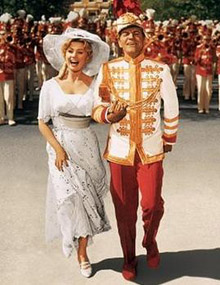
Got a whale of a tale to tell ya, lads
A whale of a tale or two
'Bout the flappin' fish and the girls I've loved
On nights like this with the moon above
A whale of a tale and it's all true
I swear by my tattoo
There was Mermaid Minnie, met her down in Madagaskar
She would kiss me, any time that I would ask her
Then one evening her flame of love blew out
Blow me down and pick me up!
She swapped me for a trout
Got a whale of a tale to tell ya, lads
A whale of a tale or two
'Bout the flappin' fish and the girls I've loved
On nights like this with the moon above
A whale of a tale and it's all true
I swear by my tattoo
There was Typhoon Tessie, met her on the coast of Java
When we kissed I bubbled up like molten lava
Then she gave me the scare of my young
Blow me down and pick me up!
She was the captain's wife
Got a whale of a tale to tell ya, lads
A whale of a tale or two
'Bout the flappin' fish and the girls I've loved
On nights like this with the moon above
A whale of a tale and it's all true
I swear by my tattoo
0 Replies
Letty
1
Reply
Thu 8 Jun, 2006 05:55 am
Good morning WA2K listeners and contributors.
edgar, that little blurb came from the pen of Nathaniel Hawthorne and is called Dr. Heidegger's Experiment. The theme of it simply involves the idea, that if we were given the opportunity to relive our lives, we would make the same mistakes and not even realize it. Love your little song, Texas. Must be from Voyage to the Bottom of the Sea
and now for some coffee. <smile>
0 Replies
Letty
1
Reply
Thu 8 Jun, 2006 06:54 am
This song is inspired by someone new in our audience. To me, folks, it summarizes the essence of a solid relationship:
Carl Withers
Sometimes in our lives we all have pain
We all have sorrow
But if we are wise
We know that there's always tomorrow
Lean on me, when you're not strong
And I'll be your friend
I'll help you carry on
For it won't be long
'Til I'm gonna need
Somebody to lean on
Please swallow your pride
If I have things you need to borrow
For no one can fill those of your needs
That you don't let show
Lean on me, when you're not strong
And I'll be your friend
I'll help you carry on
For it won't be long
'Til I'm gonna need
Somebody to lean on
If there is a load you have to bear
That you can't carry
I'm right up the road
I'll share your load
If you just call me
So just call on me brother, when you need a hand
We all need somebody to lean on
I just might have a problem that you'd understand
We all need somebody to lean on
Lean on me when you're not strong
And I'll be your friend
I'll help you carry on
For it won't be long
Till I'm gonna need
Somebody to lean on
Lean on me...
0 Replies
bobsmythhawk
1
Reply
Thu 8 Jun, 2006 09:03 am
Frank Lloyd Wright
From Wikipedia, the free encyclopedia
Personal Information
Name Frank Lloyd Wright
Birth date 8th June 1867
Birth place Richland Center, Wisconsin
Death date 9th April 1959
Significant Projects The Illinois
Awards and Prizes
Frank Lloyd Wright (June 8, 1867 - April 9, 1959) was one of the most prominent and influential architects of the first half of the 20th century. He not only developed a series of highly individual styles over his extraordinarily long architectural career (spanning the years 1887-1959), he influenced the whole course of American architecture and building. To this day he probably remains America's most famous architect.
Biography
Early years
Frank Lloyd Wright was born in the agricultural town of Richland Center, Wisconsin, U.S., on June 8, 1867, just two years after the end of the American Civil War. He was brought up with strong Unitarian and transcendental principles (eventually, in 1905, he would design the Unity Temple in Oak Park, Illinois). As a child he spent a great deal of time playing with the kindergarten educational blocks by Friedrich Wilhelm August Fröbel (popularly known as Froebel blocks) given by his mother. These consisted of various geometrically shaped blocks that could be assembled in various combinations to form three-dimensional compositions. Wright in his autobiography talks about the influence of these exercises on his approach to design. Many of his buildings are notable for the geometrical clarity they exhibit.
Wright commenced his formal education in 1885 at the University of Wisconsin School for Engineering, where he was a member of a fraternity, Phi Delta Theta. He took classes part time for two years while apprenticing under Allen Conover, a local builder and professor of civil engineering. In 1887, Wright left the university without taking a degree (although he was granted an honorary doctorate of fine arts from the university in 1955) and moved to Chicago, Illinois, where he joined the architectural firm of Joseph Lyman Silsbee. Within the year, he had left Silsbee to work for the firm of Adler and Sullivan. Beginning in 1890, he was assigned all residential design work for the firm. In 1893, after a falling-out that probably concerned the work he had taken on outside the office, Wright left Adler and Sullivan to establish his own practice and home in the Chicago suburb of Oak Park, IL. He had completed around fifty projects by 1901, including many houses in his hometown.[1]
His residential designs were "Prairie Houses" (extended low buildings with shallow, sloping roofs, clean sky lines, suppressed chimneys, overhangs and terraces, using unfinished materials), so-called because the design is considered to complement the land around Chicago. These houses are credited with being the first examples of the "open plan."
In fact, the manipulation of interior space in residential and public buildings, such as the Unitarian Unity Temple, in Oak Park, are hallmarks of his style.
He believed that humanity should be central to all design. Many examples of this work can be found in Buffalo, New York, resulting from a friendship between Wright and an executive from the Larkin Soap Company, Darwin D. Martin. In 1902 the Larkin Company decided to build a new administration building .
Wright came to Buffalo and designed not only the first sketches for the Larkin Administration Building (completed in 1904, demolished in 1950), but also three homes for the company's executives:
The houses considered the masterpieces of the late Prairie period (1907-9) are the Frederick Robie House and the Avery and Queene Coonley House, both in Chicago. The Robie House with its soaring, cantilevered roof lines, supported by a 110-foot-long channel of steel, is the most dramatic. Its living and dining areas form virtually one uninterrupted space. This building had a profound influence on young European architects after World War I and is sometimes called the "cornerstone of modernism." Wright's work, however, was not known to European architects until after 1910.
Europe and personal troubles
In 1904, Wright designed a house for a neighbor in Oak Park, Edwin Cheney, and immediately took a liking to Cheney's wife, Mamah Borthwick Cheney. The two fell in love, even though Wright had been married for over a decade. Often the two could be seen taking rides in Wright's automobile through Oak Park, and they became the talk of the town. Wright's wife, Kitty, would not grant him a divorce however, and at first, neither would Edwin Cheney grant one to Mamah. In 1909, even before the Robie House was actually completed, Wright and Mamah Cheney eloped to Europe. The scandal that erupted virtually destroyed Wright's ability to practice architecture in the United States.
Architectural historians have speculated on why Wright decided to turn his life upside-down. It has been said that he enjoyed living on the edge. Offered as proof of this are the facts that he was always digging himself into problems. He spent money almost as soon as he received it, and almost always seemed to be in debt. This argument has been coupled with speculation that Wright was himself having a professional midlife crisis (in 1907 he was already forty years old). Scholars argue that he felt by 1907-8 that he had done everything he could do with the Prairie Style, particularly from the standpoint of the one-family house. To illustrate, one can ask the question, "How many different permutations of the Prairie Style residence can you do without eventually feeling like you are going nowhere?" Wright was not getting larger commissions for commercial or public buildings, which frustrated him not only because of the desire for bigger and better work, but also because of his immense ego and desire to be recognized as the architectural genius he saw himself as.
Wright and Mamah Cheney traveled extensively throughout Europe, where Wright absorbed a great amount of architectural history. In 1910, during a stop in Berlin, Wright, with virtually all of his drawings, visited the publishing house of Ernst Wasmuth, who had agreed to publish his work there. In two volumes, the Wasmuth Portfolio was thus published, and created the first major exposure of Wright's work in Europe.
Wright remained in Europe for two years, though Mamah Cheney left for the United States a few times, and set up home in Fiesole, Italy. During this time, Edwin Cheney granted her a divorce, though Kitty Wright again refused to grant one to her husband. After Wright's return to the United States in 1911, he moved to Spring Green, Wisconsin, to land that was held by his mother's family, and began to build himself a new home, which he called Taliesin.
More personal turmoil
On August 15, 1914, while Wright was in Chicago completing a large project, Midway Gardens, Julian Carlton, a male servant whom he had hired several months earlier, set fire to the living quarters of Taliesin and murdered seven people with an ax as the fire burned. The dead were: Mamah, her two children John and Martha, a gardener, a draftsman, a workman, and the workman's son. Two people survived the mêleé, one of whom helped to put out the fire that almost completely consumed the residential wing of the house.
In 1923, Wright's mother, Anna, died. Wright wed Miriam Noel in November 1923, but her addiction to morphine led to the failure of the marriage in less than one year. In 1924, after the separation, Wright met Olga (Olgivanna) Lazovich Hinzenburg, at the Petrograd Ballet. They moved in together at Taliesin in 1925, but in 1926, Olga's ex-husband sought custody of his daughter. In Minnetonka, Minnesota, Wright and Olgivanna were accused of violating the Mann Act and arrested in October 1925. The charges were dropped in 1926. The couple married in 1928.
Enduring legacy
Wright is responsible for a concept or a series of extremely original concepts of suburban development united under the term Broadacre City. He proposed the idea in his book The Disappearing City in 1932, and unveiled a very large (12 by 12 feet) model of this community of the future, showing it in several venues in the following years. He went on developing the idea until his death.
It was also in the 1930s that Wright first designed "Usonian" houses. Essentially highly practical houses for middle-class clients, the designs were based on a simple, yet elegant geometry. He would later use similar, elementary forms in his First Unitarian Meeting House built in Madison, Wisconsin, between 1947 and 1950.
Wright was awarded the RIBA Royal Gold Medal in 1941.
The classic view of the classic FLLW residence, now a National Monument
Fallingwater, one of the most famous of Frank Lloyd Wright's worksHis most famous private residence was constructed from 1935 to 1939?-Fallingwater?-for Mr. and Mrs. E.J. Kaufmann Sr., at Bear Run, Pennsylvania. It was designed according to Wright's desire to place the occupants close to the natural surroundings, with a stream and waterfall running under part of the building. The construction is a series of cantilevered balconies and terraces, using limestone for all verticals and concrete for the horizontals. The house cost $155,000, including the architect's fee of $8,000. Kaufmann's own engineers argued that the design was not sound. They were overruled by Wright, but workmen secretly added extra steel to the horizontal concrete elements. There is a difference of opinion as to whether Wright's original design would have withstood the test of time. In 1994, Robert Silman and Associates examined the building and developed a plan to restore the structure. In the late 1990s, steel supports were added under the lowest cantilever until a detailed structural analysis could be done. In March 2002, post-tensioning of the lowest terrace was completed.
Wright practiced what is known as organic architecture, an architecture that evolves naturally out of the context, most importantly for him the relationship between the site and the building and the needs of the client. Houses in wooded regions, for instance, made heavy use of wood, desert houses had rambling floor plans and heavy use of stone, and houses in rocky areas such as Los Angeles were built mainly of cinder block. Wright's creations took his concern with organic architecture down to the smallest details. From his largest commercial commissions to the relatively modest Usonian houses, Wright conceived virtually every detail of both the external design and the internal fixtures, including furniture, carpets, windows, doors, tables and chairs, light fittings and decorative elements. He was one of the first architects to design and supply custom-made, purpose-built furniture and fittings that functioned as integrated parts of the whole design, and he often returned to earlier commissions to redesign internal fittings. His Prairie houses use themed, coordinated design elements (often based on plant forms) that are repeated in windows, carpets and other fittings. He made innovative use of new building materials such as precast concrete blocks, glass bricks and zinc cames (instead of the traditional lead) for his leadlight windows, and he famously used Pyrex glass tubing as a major element in the Johnson's Wax building. Wright was also one of the first architects to design and install custom-made electric light fittings, including some of the very first electric floor lamps, and his very early use of the then-novel spherical glass lampshade (a design previously not possible due to the physical restrictions of gas lighting).
One of his projects, Monona Terrace, originally designed in 1937 as City and County Offices for Madison, Wisconsin, was completed in 1997 on the original site, using a variation of Wright's final design for the exterior with the interior design altered by its new purpose as a convention center. The "as-built" design was carried out by Wright's apprentice Tony Puttnam. Monona Terrace was accompanied by controversy throughout the sixty-years between the original design and the completion of the structure.
Wright's personal life was a colorful one that frequently made headlines. He married three times: Catherine Lee Tobin in 1889, Miriam Noel in 1922, and Olga Milanov Hinzenberg (Olgivanna) in 1928. Olgivanna had been living as a disciple of Armenian mystic G. I. Gurdjieff, and her experiences with Gurdjieff influenced the formation and structure of Wright's Taliesin Fellowship in 1932. The meeting of Gurdjieff and Wright is explored in Robert Lepage's The Geometry Of Miracles. Olgivanna continued to run the Fellowship after Wright's death, until her own death in Scottsdale, Arizona in 1985. Despite being a high-profile architect and almost always in demand, Wright would find himself constantly in debt thanks in part to his lavish lifestyle. In one instance Wright was over $1,000 in debt, and reportedly would borrow $1,500 from a friend only to spend more than half of it on clothes, gifts, and trips.
Solomon R. Guggenheim Museum, Upper East Side, New YorkWright died on April 9, 1959, having designed an enormous number of significant projects including the Solomon R. Guggenheim Museum in New York City, a building which occupied him for 16 years (1943-59) and is probably his most recognized masterpiece. The building rises as a warm beige spiral from its site on Fifth Avenue; its interior is similar to the inside of a seashell. Its unique central geometry was meant to allow visitors to experience Guggenheim's collection of nonobjective geometric paintings with ease by taking an elevator to the top level and then viewing artworks by walking down the slowly descending, central spiral ramp, which features a floor embedded with circular shapes and triangular light fixtures, in order to compliment the geometric nature of the structure. Unfortunately, when the museum was completed, a number of important details of Wright's design were ignored, including his desire for the interior to be painted off-white. Furthermore, the Museum currently designs exhibits to be viewed by walking up the curved walkway rather than walking down from the top level.
1966 U.S. postage stamp honoring Frank Lloyd WrightWright built 362 houses. About 300 survive as of 2005. Three have been lost to forces of nature: the waterfront house for W. L. Fuller in Pass Christian, MS, which was destroyed by Hurricane Camille in August 1969, the Louis Sullivan Bungalow of Ocean Springs, Mississippi, which was destroyed by Hurricane Katrina in 2005, and the James Charnley Bungalow of Ocean Springs, Mississippi, which was also gutted by Hurricane Katrina in 2005. The Ennis House in California has also been damaged by earthquake and rain-induced ground movement. While a number of the houses are preserved as museum pieces and millions of dollars are spent on their upkeep, other houses have trouble selling on the open market due to their unique designs, generally small size and outdated features. As buildings age their structural deficiencies are increasingly revealed, and Wright's designs have not been immune from the passage of time. Some of his most daring and innovative designs have required major structural repair, and the soaring cantilevered terraces of Fallingwater are but one example. (A common joke was once how "Fallingwater" is falling into the water.) Some of these deficiencies can be attributed to Wright's pushing of materials beyond the state of the art, others to sometimes less than rigorous engineering, and still others to the natural wear and tear of the elements over time.
Many speculate that the character of Howard Roark, an architect in Ayn Rand's book The Fountainhead, is based, at least in part, on Frank Lloyd Wright. Rand, a Wright client herself, however, denied this.
In 1992 The Madison Opera in Madison, Wisconsin commissioned and premiered the opera Shining Brow, by composer Daron Hagen and librettist Paul Muldoon based on events early in Wright's life. The work has since received numerous revivals. In 2000, Work Song: Three Views of Frank Lloyd Wright, a play based on the relationship between the personal and working aspects of Wright's life, debuted at the Milwaukee Repertory Theater.
One of Wright's sons, Frank Lloyd Wright Jr., known as Lloyd Wright, was also a notable architect in Los Angeles. Lloyd Wright's son, (and Wright's grandson) Eric Lloyd Wright, is currently an architect in Malibu, California.
The Oscar-winning actress Anne Baxter was his granddaughter.
Wright also designed his own clothing. His fashion sense was unique and he usually wore very expensive suits, flowing neckties, and capes as well as driving a yellow convertible, which earned him many speeding tickets.
Influences on architecture
Wright responded to the transformation of domestic life that occurred at the turn of the twentieth century, when servants became a less prominent or completely absent feature of most American households, by developing homes with progressively more open plans. This allowed the woman of the house to work in her 'workplace', as he often called the kitchen, yet keep track of and be available for the children and/or guests in the dining room. Much of modern architecture, including the early work of Mies van der Rohe, can be traced back to Wright's innovative work.
His 'Usonian' homes set a new style for suburban design that was followed by countless developers. Many features of modern American homes date back to Wright; open plans, slab-on-grade footings, and simplified construction techniques that allowed more mechanization or at least efficiency in building are amongst his innovations.
Quotations
The interior of the Rosenbaum House"A doctor can bury mistakes, an architect can only advise their client to plant vines."
"I don't need to sign in, I'm the architect." - in response to a patron at Unity Temple asking him to add his name to the entry record.
"Continuously nature shows him the science of her remarkable economy of structure in mineral and vegetable constructions to go with the unspoiled character everywhere apparent in her forms."
"Give me the luxuries of life and I will gladly do without the necessities."
"Form follows function - that has been misunderstood. Form and function should be one, joined in a spiritual union."
"That's how you can tell it's a roof." -- in response to complaints about roof leaks in his buildings
"I'm all in favor of keeping dangerous weapons out of the hands of fools. Let's start with typewriters."
"I believe in God, only I spell it Nature."
"If it keeps up, man will atrophy all his limbs but the push-button finger."
"Less is only more where more is no good."
0 Replies
bobsmythhawk
1
Reply
Thu 8 Jun, 2006 09:23 am
Robert Preston
From Wikipedia, the free encyclopedia
Robert Preston Meservey (June 8, 1918 - March 21, 1987), better known as Robert Preston, was an American actor.
Early life
Preston was born in Newton, Massachusetts, the son of a garment worker. After attending Abraham Lincoln High School in Los Angeles, California, he studied acting at the Pasadena Community Playhouse. He would later serve as an intelligence officer with the U.S. 9th Air Force during World War II.
Career
Preston appeared in many Hollywood films, but is probably best remembered as "Professor" Harold Hill in Meredith Willson's musical, The Music Man (1962), for which he won a Tony Award for his performance in the original Broadway production. In 1974, he starred opposite Bernadette Peters in the Broadway musical "Mack and Mabel" as Mack Sennett, the famous silent film director.
Although he was not a singer, he appeared in several other stage and film musicals, notably Mame (1974) and Victor/Victoria (1982), for which he received an Academy Award nomination. His final role was in the TV movie Outrage! (1986). His final theatrical role was in The Last Starfighter, in which he played intergalactic con man/military recruiter "Centauri." He died of lung cancer at the age of 68.
Ya Got Trouble
(HAROLD)
Well, ya got trouble, my friend.
Right here, I say trouble right here in River City
Why, sure, I'm a billiard player
Certainly mighty proud to say,
I'm always mighty proud to say it
I consider the hours I spend with a cue in my hand are golden
Help you cultivate horse sense and a cool head and a keen eye
Didja ever take an' try an' give an iron clad leave
to yourself from a three-rail billiard shot?
But just as I say it takes judgement, brains and maturity
to score in a balk-line game
I say that any boob can take and shove a ball in a pocket
And I call that sloth,
the first big step on the road to the depths of degreda-
I say, first- medicinal wine from a teaspoon,
then beer from a bottle
And the next thing you know your son is playin'
for money in a pinchback suit
and listenin' to some big out-o'-town jasper
Hear him tell about horserace gamblin'
Not a wholesome trottin' race, no,
but a race where they set down right on the horse
Like to see some stuck up jockey boy sittin' on Dan Patch?
Make your blood boil, well I should say
Now, folks, let me show you what I mean
You got one, two, three, four, five, six pockets in a table
Pockets that mark the difference between a gentleman and a bum
With a capital 'B' and that rhymes with 'P' and that stands for 'pool'
And all week long, your River City youth'll be fritterin' away
I say, your young men'll be fritterin'
Fritterin' away their noontime, suppertime, choretime, too
Hit the ball in the pocket
Never mind gettin' dandelions pulled or the screen door patched
or the beefsteak pounded
Never mind pumpin' any water 'til your parents are caught
with a cistern empty on a Saturday night and that's trouble
Oh, ya got lots and lots o' trouble
I'm thinkin' of the kids in the knickerbockers shirttails,
young ones peekin' in the pool hall window after school
Ya got trouble, folks, right here in River City
with a capital 'T' and that rhymes with 'P' and that stands for 'pool'
Now I know all you folks are the right kind of parents
I'm gonna be perfectly frank
Would you like to know what kind of conversation goes on
while they're loafin' around that hall
They'll be tryin' out Bevo, tryin' out Cubebs,
tryin' out tailor-mades like cigarette fiends
And braggin' all about how they're gonna cover up
a tell-tale breath with Sen-Sen
Now one fine night they leave the pool hall
headin' for the dance at the Armory
Libertine men and scarlet women and ragtime
Shameless music that'll grab your son, your daughter
into the arms of a jungle animal instinct- massteria!
Friends, the idle brain is the devil's playground, trouble!
(TOWNSPEOPLE)
Oh, we got trouble
(HAROLD)
Right here in River City
(TOWNSPEOPLE)
Right here in River City
(HAROLD)
With a capital 'T' and that rhymes with 'P' and that stands for 'pool'
(TOWNSPEOPLE)
That stands for pool
(HAROLD)
We surely got trouble
(TOWNSPEOPLE)
We surely got trouble
(HAROLD)
Right here in River City
(TOWNSPEOPLE)
Right here
(HAROLD)
Gotta figure out a way to keep the young ones
moral after school
(TOWNSPEOPLE chant 'trouble')
(HAROLD talking)
Mothers of River City,
heed this warning before it's too late
Watch for the tell-tale signs of corruption
The minute your son leaves the house
does he rebuckle his knickerbockers below the knee?
Is there a nicotine stain on his index finger?
A dime novel hidden in the corncrib?
Is he starting to memorize jokes
from Cap'n Billy's Whizbang?
Are certain words creeping into his conversation?
Words like... swell?
And... 'so's your old man'?
Well if so, my friends...
Ya got trouble
(TOWNSPEOPLE)
Oh, we got trouble
(HAROLD)
Right here in River City
(TOWNSPEOPLE)
Right here in River City
(HAROLD)
With a capital 'T' and that rhymes with 'P' and that stands for 'pool'
(TOWNSPEOPLE)
That stands for pool
(HAROLD)
We've surely got trouble
(TOWNSPEOPLE)
We surely got trouble
(HAROLD)
Right here in River City
(TOWNSPEOPLE)
Right here
(HAROLD)
Remember the Maine, Plymouth Rock and the Golden Rule?
Oho, we got trouble
We're in terrible, terrible trouble
That game with the fifteen numbered balls is the devil's tool
(TOWNSPEOPLE)
Devil's tool
(HAROLD)
Yes, we've got trouble, trouble, trouble
(TOWNSPEOPLE)
Oh, yes, we got trouble here, we got big, big trouble
(HAROLD)
With a 'T'
(TOWNSPEOPLE)
With a capital 'T'
(HAROLD)
And that rhymes with 'P'
(TOWNSPEOPLE)
That rhymes with 'P'
(HAROLD)
And that stands for pool
(TOWNSPEOPLE)
That stands for pool
(HAROLD)
Remember my friends, listen to me,
because I pass this way but once
(TOWNSPEOPLE chant 'trouble', etc.)
0 Replies
bobsmythhawk
1
Reply
Thu 8 Jun, 2006 09:27 am
Alexis Smith
From Wikipedia, the free encyclopedia
Alexis Smith (June 8, 1921 - June 9, 1993) was an actress.
Born Gladys Smith in Penticton, British Columbia, Canada, after Mary Pickford she was the second Canadian born with the name "Gladys Smith" to make their way to stardom in New York City and Hollywood. She would say later in life that she preferred New York, while her husband favored California. She was quite tall, standing at least 5'9", and to fit her, the long, stylish dresses that former Warners' star Kay Francis had worn were allotted to her.
As stage actress Alexis Smith, she was signed to a contract by Warner Brothers Studios in Hollywood after being seen in a play. Her earliest film roles were uncredited bit parts and it took several years for her career to gain momentum, but her appearance in The Constant Nymph was well received and led to bigger parts. During the forties she appeared opposite some of the most popular male stars of the day such as Errol Flynn in San Antonio (1945), Humphrey Bogart in The Two Mrs. Carrolls (1947), and Cary Grant in the hyperfictionalized and ultrasanitized version of Cole and Linda Porter's life together in Night and Day (1946).
Some of her other films include Rhapsody In Blue (1945), Of Human Bondage (1946), and The Young Philadelphians (1959).
She made the cover of the May 3, 1971, issue of Time magazine with the announcement that she would be starring in the Hal Prince Broadway production of Follies. In 1972 she won a Tony Award for "Best Actress in a Musical" for her performance. She next appeared in the musical Platinum in which she earned good reviews, but the show quickly closed. Almost twenty years later she would be nominated for an Emmy Award for a guest appearance in the television sitcom Cheers in 1990.
Alexis Smith was married to the actor Craig Stevens from 1944 for 49 years until her death in Los Angeles, California from brain cancer on the day after her 72nd birthday. They had no children and he was her only survivor.
Her final film, The Age of Innocence (1993) was released shortly after her death.
Rumours of her sexuality began when lesbian author Rita Mae Brown dedicated her book about the life of a Florida lesbian, Rubyfruit Jungle, to Smith.
0 Replies
bobsmythhawk
1
Reply
Thu 8 Jun, 2006 09:34 am
Joan Rivers
From Wikipedia, the free encyclopedia
Joan Rivers on the video coverJoan Rivers (born June 8, 1933) is an American comedian, talk show host, and celebrity. She is known for her brash manner and loud, gruff voice with a heavy metropolitan New York accent. Like the ground-breaking Phyllis Diller whose career preceded and overlapped hers, Rivers' act relied heavily on poking fun at herself. A typical Rivers joke about her unattractiveness: "I used to stand by the side of the road with a sign, 'Last girl before freeway.'"
Biography
Early life and career
Joan Rivers was born as Joan Alexandra Molinsky to a Jewish family in Brooklyn, New York, and raised in Westchester County, New York, in 1933. After briefly attending Connecticut College, she graduated from Barnard College in 1954 with a B.A. in English and anthropology.
In the 1960s Rivers made television appearances as a comedian on the popular shows The Tonight Show and The Ed Sullivan Show, as well as hosting the first of her several talk shows. Later in that decade she made a brief but notable appearance opposite Burt Lancaster in the film, The Swimmer. She was a regular gag writer and performer on TV's Candid Camera show.
1970s
In the 1970s, Joan Rivers appeared often as a guest on various television comedy and variety shows. One notable appearance on The Carol Burnett Show had her spoofing Valerie Harper in Rhoda (Rivers' character was named "Rhonda"), to the delight of the audience.
In 1978, Rivers directed and wrote the film Rabbit Test starring her friend Billy Crystal. The avant garde movie about a man who gets pregnant bombed at the box office.
Rivers was the opening act for singer Helen Reddy on the Las Vegas Strip during the '70s. She would eventually become a headliner in her own right to standing room crowds continuing into the 1980s. Rivers also recorded a popular record album of her live standup act entitled Can We Talk?
1980s and 1990s
Joan Rivers continued to gain acclaim on television as she would often be brought in as a guest host of the Tonight Show throughout the 1980s.
In 1986 Rivers hosted her own evening talk show, The Late Show Starring Joan Rivers, on the then-fledgling Fox Television Network, one of the launch shows for the new network. The show lasted about a year. When it began, Rivers had already become the permanent guest host for Johnny Carson on The Tonight Show. Carson was so upset by her decision to leave without discussing it with him, that he banned her from his show, even after Rivers' show failed. Rivers reportedly tried to call Carson on the phone personally. When he answered, she talked to him, but Carson hung up on her. The two never reconciled before his 2005 death.
Soon after the cancellation of her series, Rivers saw a published interview claiming that her husband Edgar Rosenberg, who was a producer on her show, had tried to drive her insane during his illness. According to the interview, she was reported to have commented, "...I think things are just about finished with Edgar", and referred to her former boss at the Fox Network as "Barry (expletive) Diller". Rivers then went public with the news, saying in tears that a "Ben Hacker" had fabricated the story with what she called "vicious lies". A suit was filed against "Hacker", who turned out to be author and future game show host Ben Stein.
Not long after this Rosenberg committed suicide. Rivers was devastated by the loss, but eventually returned to television with a daytime talk show of her own, The Joan Rivers Show, which ran from 1989 until 1993. Her enormous stock of bored husband jokes could no longer be used. A Rivers favorite had been: "When Edgar and I were first married, we'd play 'catch me, catch me!' and we'd run around the house. We still play 'catch me, catch me!' but now we walk." She candidly wrote about her husband's passing in two autobiographical, motivational best-selling books published in the 1990s: Enter Talking and Still Talking.
2000s
As of 2005, Joan Rivers is a host for the TV Guide channel, often cohosting red carpet specials before awards shows with her daughter, Melissa Rivers, from whom she was estranged briefly after her husband's suicide. She previously worked for the E! Entertainment Television network in a similar role. In the movie Shrek 2, she cameoed as a computer-generated version of herself, hosting the parody ME! Medieval Entertainment Television channel.
When in New York, where she lives, Rivers appears weekly in workshop productions at the small venue The Cutting Room. She donates proceeds to the charities God's Love We Deliver (for which she is a board member) and Guide Dogs for the Blind.
Jewelry by Joan Rivers, a book by Rivers featuring photographs of her jewelry collection.Rivers is an avid and unapologetic user of plastic surgery to enhance her looks. She appeared in two episodes of the show Nip/Tuck during its second and third seasons. During her first appearance she wanted to find out what she would look like without all the plastic surgery she has gotten, and was horrified by the result. During her second appearance she wanted to invest in a post-surgical health spa. She is also an avid collector of jewelry. Rivers also appears regularly on television's QVC, selling her own line of jewelery under the brand name, "The Joan Rivers Collection," which in fact is one of that network's best selling lines. RIvers was a guest speaker at the opening of the American Operating Room Nurses' 2000 San Francisco Conference.
Rivers is a proud and involved grandmother to Edgar Cooper Endicott, who was born in 2000 during her daughter Melissa's brief marriage (1998-2003) to John Endicott.
Whilst touring in the UK, Rivers appeared on BBC Radio 4's Midweek programme and became involved in a heated on-air argument over the issue of race with broadcaster Darcus Howe. See the BBC News Transcript.
Together with Melissa, Rivers appeared in a special feature on the recently released season one DVD set of "The Golden Girls", commenting on the sometimes odd fashion styles in the popular show.
Both Joan and her daughter are frequent guests on the Howard Stern radio show.
As a guest host on Australia's Channel 9 Logies TV awards show in May 2006, Rivers swore repeatedly. On the 3rd occasion in the one speech (opposite music reporter Richard Wilkins), the man on the "BLEEP" button wasn't fast enough, and the phrase "I don't even know why the **** I'm here!" made it live to air.
Awards
Joan Rivers has been awarded the 1975 Georgie Award as "Best Comedienne", the Clio Award for "Best Performance in a TV Commercial" in 1976 and 1982, and the 1990 Daytime Emmy Award as "Best Talk Show Host".
In a 2005 BBC Channel 4 poll to find The Comedian's Comedian, she was voted amongst the top 50 comedy acts ever by fellow comedians and comedy insiders.
Joan co-hosted a segment of the the Australian 2006 Logie Awards. She was given a specially-commissioned pink Logie award. When given the award Joan threw the Logie over her shoulder and remarked "That is the ugliest award I have ever seen!".
0 Replies
bobsmythhawk
1
Reply
Thu 8 Jun, 2006 09:37 am
James Darren
From Wikipedia, the free encyclopedia
James Darren (born James William Ercolani on June 8, 1936, in Philadelphia, Pennsylvania) is an American television and film actor, television director, and singer.
Biography
Darren began his career as a teen idol. This encompassed roles in films, most notably his role as Moondoggie in Gidget in 1959, as well as a string of pop hits for Colpix Records, the biggest of which was "Goodbye Cruel World" (#3 on the Billboard Hot 100 in 1961). He is also featured in one of the Scopitone series of pop music video jukebox films ("Because You're Mine").
Darren's role in the gritty 1961 World War II film The Guns of Navarone was an attempt to break out of his teen image. He then achieved success co-starring as impulsive scientist and adventurer Tony Newman in the science fiction television series, The Time Tunnel (1966-67).
Later, Darren had a regular role as Officer James Corrigan on the television police drama T.J. Hooker from 1983-1986. Subsequently he worked as a director on many action-based television series, including Hunter, The A-Team, and Nowhere Man, as well as dramas such as Beverly Hills 90210 and Melrose Place.
James Darren as Vic Fontaine on Star Trek: Deep Space Nine.In 1998 he achieved renewed popularity as a singer through his appearances on Star Trek: Deep Space Nine in the role of holographic crooner and advice-giver Vic Fontaine; many of his performances on the show were recorded for the album This One's From the Heart (1999). A close friend of the late Frank Sinatra, the album showed Darren comfortably singing in the Sinatra style; the 2001 follow-up Because of You showed similar inspiration from Tony Bennett.
Some animation fans may know him as the singing voice of Yogi Bear in the 1964 animated film, Hey There, it's Yogi Bear, on the song "Ven-e, Ven-o, Ven-a". Prior to that, he was the singing and speaking voice of "Jimmy Darrock" on an episode of The Flintstones.
0 Replies
bobsmythhawk
1
Reply
Thu 8 Jun, 2006 09:40 am
Nancy Sinatra
From Wikipedia, the free encyclopedia
Nancy Sandra Sinatra Jr (born June 8, 1940, in Jersey City, New Jersey) is an American singer and actress. She is the daughter of the legendary singer Frank Sinatra and his first wife Nancy Barbato.
She began her career as a singer and actress in the early 1960s, initially with little success. In 1960, she married "teen idol" Tommy Sands but divorced him in 1965.
Her career peaked in the late 1960s with a string of pop music hits. Her best-known hit, "These Boots Are Made for Walkin'" ?- which popularized and made her synonymous with Go-Go boots ?- was written by Lee Hazlewood and included session drummer Hal Blaine and guitarist Billy Strange on the recording ?- as did most of her other hits. "These Boots Are Made for Walkin'" and the music video featuring shapely, young women in tight sweaters, go-go boots and mini-skirts is considered a classic example of high camp. She currently is under the label Attack Records.
Sinatra had 21 singles that charted on the Billboard Hot 100 in the mid- to late-1960s:
0 Replies
Cyracuz
1
Reply
Thu 8 Jun, 2006 09:41 am
The dandelions bloom
Ere seed takes to the air
And me, here in my swoon
I am dandelion's heir
Swift winds that carry forth
The blessed southern heat
Steal me from my cold north
The world is at my feet
But helpless in the air
On lofty breeze I soar
A soul without a care
Has nothing to live for
To earth my seedlings yearn
To walk and run and dance
Before the evening burns
The last of this romance
And ash is all that's served
In place of swelling fable
When at last I find the nerve
To approach the table
0 Replies
bobsmythhawk
1
Reply
Thu 8 Jun, 2006 09:42 am
Boz Scaggs
From Wikipedia, the free encyclopedia
Boz Scaggs (born William Royce Scaggs, June 8, 1944) is an Ohio-born Texan singer, songwriter and guitarist.
Biography
Scaggs was born in Canton, Ohio. After learning guitar at the age of 12, he met Steve Miller at St. Mark's School of Texas in Dallas. In 1959, he became the vocalist for Miller's band The Marksmen. The pair later attended the University of Wisconsin together, playing in blues bands like The Ardells and The Fabulous Knight Trains.
Leaving school, Scaggs briefly left Texas to join the burgeoning rhythm and blues scene in London. After singing in bands such as The Wigs and Mother Earth, he recorded his first solo album Boz in 1965, which was not a commercial success. He traveled to Sweden as a solo performer and did a brief stint with the band The Other Side with fellow American Jack Downing and Brit Mac MacLeod.
Returning to the US, Scaggs promptly headed for the booming psychedelic music center of San Francisco in 1967. Linking up with Steve Miller again, he appeared on the Steve Miller Band's first two albums Children of the Future and Sailor, which won over critical reviews. After being spotted by Rolling Stone publisher Jann Wenner, Scaggs secured a solo contract with Atlantic Records in 1968. Despite good reviews, his first Atlantic album was met with lukewarm sales, as were followup albums on Columbia Records. In 1976, he linked up with session musicians who would later form Toto and recorded his smash album Silk Degrees. The album reached number 2 on the US charts and number 1 in a number of countries across the world, spawning three hit singles: "Lowdown", "Lido Shuffle", and "What Can I Say", as well as the MOR standard "We're All Alone", later a hit for Rita Coolidge. A sellout world tour followed, but his follow-up album, the 1977 Down Two Then Left, lacked the cohesion of Silk Degrees. The 1980 album Middle Man would spawn two top 20 hits, "Breakdown Dead Ahead" and "Jojo," and Scaggs would enjoy two more hits over 1980 and 1981 ("Look What You've Done to Me" from the Urban Cowboy soundtrack, and "Miss Sun" from a greatest hits set). But Scaggs' lengthy hiatus from the music industry (his next LP, Other Roads, wouldn't appear until 1988) slowed his chart career down dramatically.
Scaggs has continued to record and tour sporadically throughout the 1980s and 1990s, although he has semi-retired from the music business and now owns the San Francisco nightclub Slim's.
Scaggs recorded Other Roads in the mid-1980s, took another hiatus and then came back with Some Change in 1994. He released Come On Home, an album of blues, and My Time, an anthology in the late 1990s. He garnered good reviews with Dig, although the CD, which was released on September 11, 2001, was lost in the post-911 melée. In May, 2003, Scaggs released But Beautiful, a collection of jazz standards that debuted at number 1 on the jazz charts.
He tours each summer, has a loyal cadre of fans, remains hugely popular in Japan, and released a DVD and a live CD in 2004.
In the animated television show Family Guy, Peter Griffin would receive a Boz Scaggs CD box set from Death at the end of their first encounter with each other.
0 Replies
bobsmythhawk
1
Reply
Thu 8 Jun, 2006 09:45 am
Keenen Ivory Wayans
From Wikipedia, the free encyclopedia
Keenen Ivory Wayans (born June 8, 1958 in New York, New York) is an American actor, comedian, director and writer best known as the host and creator of the groundbreaking FOX sketch comedy series In Living Color, which introduced the likes of Jim Carrey and Damon Wayans to the masses. He was also one of the first cast members to leave the show, citing creative differences. He went on to have a successful film career, directing broad comedies staring his brothers Shawn Wayans and Marlon Wayans. His film "Scary Movie" (2000) is the most successful feature ever directed by an African-American.
He attended college at Tuskegee University; however, he dropped out in his senior year to pursue a career in comedy. He married in June 2001 and has five children; however, in 2004, Wayans and wife Daphne separated and have formally filed for divorce. He is one of several Wayans family members who have become famous in Hollywood, including his siblings Damon Wayans, Kim Wayans, Marlon Wayans and Shawn Wayans. He is an uncle to Damon Wayans, Jr.. He is also a vegan.
Wayans is a prominent member of Alpha Phi Alpha, the first intercollegiate Greek-letter fraternity established for Blacks.
0 Replies
bobsmythhawk
1
Reply
Thu 8 Jun, 2006 09:48 am
KIDS ARE QUICK
TEACHER: Maria, go to the map and find North
America.
MARIA: Here it is.
TEACHER: Correct. Now class, who discovered
America?
TEACHER: John, why are you doing your math
multiplication on the floor?
JOHN: You told me to do it without using tables.
__________________________________________
TEACHER: Glenn, how do you spell "crocodile?"
GLENN: K-R-O-K-O-D-I-A-L"
TEACHER: No, that's wrong
GLENN: Maybe it is wrong, but you asked me how
I spell it.
____________________________________________
TEACHER: Donald, what is the chemical formula for
water?
DONALD: H I J K L M N O.
TEACHER: What are you talking about?
DONALD: Yesterday you said it's H to O.
__________________________________
TEACHER: Winnie, name one important thing we
have today that we didn't have ten years ago.
WINNIE: Me!
__________________________________________
TEACHER: Glen, why do you always get so dirty?
GLEN: Well, I'm a lot closer to the ground than you
are.
_______________________________________
TEACHER: Millie, give me a sentence starting with
"I."
MILLIE: I is...
TEACHER: No, Millie..... Always say, "I am."
MILLIE: All right... "I am the ninth letter of the
alphabet."
_________________________________
TEACHER: George Washington not only
chopped down his father's cherry tree, but
also admitted it. Now, Louie, do you know
why his father didn't punish him?
LOUIS: Because George still had the ax in his
hand.
______________________________________
TEACHER: Now, Simon, tell me frankly, do you say
prayers before eating?
SIMON: No sir, I don't have to, my Mom is a good
cook.
______________________________
TEACHER: Clyde, your composition on "My Dog" is
exactly the same as your brother's. Did you copy his?
CLYDE: No, teacher, it's the same dog.
___________________________________
TEACHER: Harold, what do you call a person who
keeps on talking when people are no longer
interested?
HAROLD: A teacher
0 Replies
Walter Hinteler
1
Reply
Thu 8 Jun, 2006 10:05 am
There's another birthday today:
100 years ago, the Braun tube (cathode-ray oscilloscope) was born - the Braun Tube was the forerunner of today's television and radar tubes. :wink:
Braun tube (cathode-ray oscilloscope): electronic-display device containing a cathode-ray tube (CRT) that generates an electron beam that is used to produce visible patterns, or graphs, on a phosphorescent screen. The graphs plot the relationships between two or more variables, with the horizontal axis normally being a function of time and the vertical axis usually a function of the voltage generated by the input signal to the oscilloscope. Because almost any physical phenomenon can be converted into a corresponding electric voltage through the use of a transducer, the oscilloscope is a versatile tool in all forms of physical investigation. The German physicist Ferdinand Braun developed the first cathode-ray oscilloscope in 1897.
Television sets, computers, automated teller machines, video game machines, video cameras, monitors, oscilloscopes and radar displays all contain cathode-ray tubes. Phosphor screens using multiple beams of electrons have allowed CRTs to display millions of colors.
(Sources: britannica, about.com)
0 Replies
Walter Hinteler
1
Reply
Thu 8 Jun, 2006 10:05 am
Throw away your television
Time to make this clean decision
Master waits for its collision now
Its a repeat of a story told
Its a repeat and its getting old
Throw away your television
Make a break big intermission
Recreate your super vision now
Its a repeat of a story told
Its a repeat and its getting old
[chorus:]
Renegades with fancy gauges
Slay the plague for its contagious
Pull the plug and take the stages
Throw away your television now
Throw away your television
Take the noose off your ambition
Reinvent your intuition now
Its a repeat of a story told
Its a repeat and its getting old
[chorus]
Throw away your television
Salivate to repetition
Levitate this ill condition now
Its a repeat
0 Replies
Letty
1
Reply
Thu 8 Jun, 2006 10:05 am
Hey, hawkman. Thanks again for the bio's, buddy. Love your clever kid responses, especially the dog essay.
Cyracuz, that was a lovely poem, Norway. I especially felt the line:
I am dandelion's heir. Sometimes, listeners, we feel as though we are spores carried by the wind, no?
Back later to review all of Bob's information.
0 Replies
Letty
1
Reply
Thu 8 Jun, 2006 10:14 am
Walter, my goodness, you slipped that bit of TV history and the accompanying song right between Cyracuz, Bob, and me.
Thanks, Germany.
Well, listeners, I know little of how television works, and still am fuzzy about radio, so...............
Robbie Williams:
He's stolen my Oscars
He trades on my jokes
He makes all my engines go oh oh oh oh
He puts an "e" in the arsenal
A comb in my 'fro
Devine retribution
And away we will go
Hey hey hey hey
Something's happening I can feel it
Moving out of time you'll hear it
Falling in the way you fear it
Jumping thumping shout out something
Jumping thumping shout out something
Listen to the radio
And you will hear the songs you know
Make it effervescent here
And you might have a job my dear
My dear
I'm searching for something
Beyond my understanding
Looking for meaning
Where nothing is demanding
There are no surprises
Where nothing is expected
If you offer nothing
Then everyone accepts
He's stolen my Oscars
He trades on my jokes
He makes all my engines go oh oh oh oh
He puts an "e" in the arsenal
A comb in my 'fro
Devine retribution
And away we will go
Hey hey hey hey
Something's happening I can feel it
Moving out of time you'll hear it
Falling in the way you fear it
Jumping thumping shout out something
Jumping thumping shout out something
Listen to the radio
And you will hear the songs you know
Make it effervescent here
And you might have a job my dear
My dear
Ouch
Ouch
Ouch
Radio
Ouch ouch
Ouch
Ouch
When our Raggedy arrives, I want to comment on her photo's. It's easier. <smile>
0 Replies
Raggedyaggie
1
Reply
Thu 8 Jun, 2006 11:29 am
Good afternoon.
Remembering:
0 Replies
Letty
1
Reply
Thu 8 Jun, 2006 11:49 am
Well, folks, there's our Raggedy with the music man. <smile> Thanks, PA. I was quite interested in Frank Lloyd Wright, as I was amazed at his checkered personal life. Also, folks, I thought The Fountainhead by Ayn Rand was about the man. How very interesting that he denied it.
Last evening, I caught bits and pieces of the ghosts at Waverly Hills Sanitorium, and had the distinct impression that George Orwell had died there of TB. Not so, as he died in England. We get lots of misinformation about stuff, right?
Let's hear one for George by Mea Culpa:
George Orwell Must Be Laughing His "Arse" Off
In my room the cameras sit on every side of me
Silently I sit and watch the death of privacy
What I eat and buy and think gets traded back and forth
And I can't keep from feeling like I've heard this all before
Where have I heard this before?
I know I've heard this before
I'm afraid of what's behind that door
Strap the ratcage to my face
Hey, welcome to 1984
2 2 don't equal 5, guess I'm just no fun
And suddenly the mall looks just like Room 101
State suported sitcoms gonna keep me in my place
With all their pretty people like a boot right in my face
(CHORUS)
We all stay distracted stapled to our telescreens
Keeping us convinced we're not just cogs in a machine
Enemies with perfect timing keep us all in line
While Dawsn's Creek and Abercrombie sanitize our minds
If I don't consume enough here come the thought police
To put me in designer clothes and put me on my knees
We thought the evil empire had vanished from our door
We've made ourselves a worse big brother then we had before