Richard Wagner
From Wikipedia, the free encyclopedia
Richard WagnerWilhelm Richard Wagner (May 22, 1813 in Leipzig[1] - February 13, 1883 in Venice[2]) was an influential German composer, conductor, music theorist, and essayist, primarily known for his operas (or "music dramas" as he later came to call them). His compositions, particularly those of his later period, are notable for their contrapuntal texture, rich chromaticism, harmonies and orchestration, and elaborate use of leitmotifs: themes associated with specific characters, locales, or plot elements. Wagner's chromatic musical language prefigured later developments in European classical music, including extreme chromaticism and atonality. He transformed musical thought through his idea of Gesamtkunstwerk ("total artwork"), epitomized by his monumental four-opera cycle Der Ring des Nibelungen (1876). His concept of leitmotif and integrated musical expression was also a strong influence on many 20th century film scores. Wagner was and remains a controversial figure, both for his musical and dramatic innovations, and for his anti-semitic and political opinions.
Works
Opera
Wagner's music dramas are his primary artistic legacy. These can be divided chronologically into three periods.
Wagner's early stage began at age 19 with his first attempt at an opera, Die Hochzeit (The Wedding), which Wagner abandoned at an early stage of composition in 1832. Wagner's three completed early-stage operas are Die Feen (The Fairies), Das Liebesverbot (The Ban on Love), and Rienzi. Their compositional style was conventional, and did not exhibit the innovations that marked Wagner's place in musical history. Later in life, Wagner said that he did not consider these immature works to be part of his oeuvre; he was irritated by the ongoing popularity of Rienzi during his lifetime. These works are seldom performed, though the overture to Rienzi has become a concert piece.
Wagner's middle stage output is considered to be of remarkably higher quality, and begins to show the deepening of his powers as a dramatist and composer. This period began with Der fliegende Holländer (The Flying Dutchman), followed by Tannhäuser and Lohengrin. These works are widely performed today.
Wagner's late stage operas are his masterpieces that advanced the art of opera. Some are of the opinion that Tristan und Isolde (Tristan and Iseult) is Wagner's greatest single opera. Die Meistersinger von Nürnberg (The Mastersingers of Nuremberg) is Wagner's only comedy (apart from his early and forgotten Das Liebesverbot) and one of the lengthiest operas still performed. Der Ring des Nibelungen, commonly referred to as the Ring cycle, is a set of four operas based loosely on figures and elements of Germanic paganism, particularly from later period Norse mythology. Spanning roughly 16 hours in performance, the Ring cycle has been called the most ambitious musical work ever composed. Wagner's final opera, Parsifal, which was written especially for Wagner's Bayreuth Festival and which is described in the score as a "Bühnenweihfestspiel" (festival play for the consecration of the stage), is a contemplative work based on the Christian legend of the Holy Grail.
Through his operas and theoretical essays, Wagner exerted a strong influence on the operatic medium. He was an advocate of a new form of opera which he called "music drama", in which all the musical and dramatic elements were fused together. Unlike other opera composers, who generally left the task of writing the libretto (the text and lyrics) to others, Wagner wrote his own libretti, which he referred to as "poems". Most of his plots were based on Northern European mythology and legend. Further, Wagner developed a compositional style in which the orchestra's role is equal to that of the singers. The orchestra's dramatic role includes its performance of the leitmotifs, musical themes that announce specific characters, locales, and plot elements; their complex interleaving and evolution illuminates the progression of the drama.
Wagner's musical style is often considered the epitome of classical music's Romantic period, due to its unprecedented exploration of emotional expression. He introduced new ideas in harmony and musical form, including extreme chromaticism. In Tristan und Isolde, he explored the limits of the traditional tonal system that gave keys and chords their identity, pointing the way to atonality in the 20th century. Some music historians date the beginning of modern classical music to the first notes of Tristan, the so-called Tristan chord.
Early stage
(1832) Die Hochzeit (The Wedding) (abandoned before completion)
(1833) Die Feen (The Fairies)
(1836) Das Liebesverbot (The Ban on Love)
(1837) Rienzi, der Letzte der Tribunen (Rienzi, the Last of the Tribunes)
Middle stage
(1843) Der fliegende Holländer (The Flying Dutchman)
(1845) Tannhäuser
(1848) Lohengrin
Late stage
(1859) Tristan und Isolde (Tristan and Iseult)
(1867) Die Meistersinger von Nürnberg (The Mastersingers of Nuremberg)
Der Ring des Nibelungen (The Ring of the Nibelung), consisting of:
(1854) Das Rheingold (The Rhinegold)
(1856) Die Walküre (The Valkyrie)
(1871) Siegfried (previously entitled Jung-Siegfried or Young Siegfried, and Der junge Siegfried or The young Siegfried)
(1874) Götterdämmerung (Twilight of the Gods) (originally entitled Siegfrieds Tod or The Death of Siegfried)
(1882) Parsifal
Non-operatic music
Apart from his operas, Wagner composed relatively few pieces of music. These include a single symphony (written at the age of 19), and some overtures, choral and piano pieces, and a re-orchestration of Gluck's Iphigénie en Aulide. Of these, the most commonly performed work is the Siegfried Idyll, a chamber piece written for the birthday of his second wife, Cosima. The Idyll draws on several motifs from the Ring cycle, though it is not part of the Ring. The next most popular are the Wesendonck Lieder, properly known as Five Songs for a Female Voice, which were composed for Mathilde Wesendonck while Wagner was working on Tristan.
After completing Parsifal, Wagner apparently intended to turn to the writing of symphonies. However, nothing substantial had been written by the time of his death.
The overtures and orchestral passages from Wagner's middle and late-stage operas are commonly played as concert pieces. For most of these, Wagner wrote short passages to conclude the excerpt so that it does not end abruptly. This is true, for example, of the Parsifal prelude and Siegfried's Funeral Music. A curious fact is that the concert version of the Tristan prelude is unpopular and rarely heard; the original ending of the prelude is usually considered to be better, even for a concert performance.
One of the most popular wedding marches played as the bride's processional in English-speaking countries, popularly known as "Here Comes the Bride", takes its melody from the "Bridal Chorus" of Lohengrin. In the opera, it is sung as the bride and groom leave the ceremony and go into the wedding chamber. The calamitous marriage of Lohengrin and Elsa, which reaches irretrievable breakdown twenty minutes after the chorus has been sung, has failed to discourage this strange use of the piece.
Writings
Wagner was an extremely prolific writer, authoring hundreds of books, poems, and articles, as well as a massive amount of correspondence. His writings covered a wide range of topics, including politics, philosophy, and detailed analyses (often mutually contradictory) of his own operas. Essays of note include "Oper und Drama" ("Opera and Drama", 1851), an essay on the theory of opera, and "Das Judenthum in der Musik" ("Jewishness in Music", 1850), a polemic directed against Jewish composers in general, and Giacomo Meyerbeer in particular. He also wrote an autobiography, My Life (1880).
Theatre Design and Operation
Wagner was responsible for several theatrical innovations developed at the Bayreuth Festspielhaus, an opera house specially constructed for the performance of his operas. These innovations include darkening the auditorium during performances, and placing the orchestra in a pit out of view of the audience. The Bayreuth Festspielhaus is the venue of the annual Richard Wagner Festival, which draws thousands of opera fans to Bayreuth each summer.
Biography
Early life
Richard Wagner was born in Leipzig, Germany, on May 22, 1813. His father, Friedrich Wagner, who was a minor municipal official, died six months after Richard's birth. In August 1814 his mother, Johanne Pätz, married the actor Ludwig Geyer, and moved with her family to his residence in Dresden. Geyer, who, it has been claimed, may have been the boy's actual father, died when Richard was six. Wagner was largely brought up by a single mother.
At the end of 1822, at the age of 9, he was enrolled in the Kreuzschule, Dresden, (under the name Wilhelm Richard Geyer), where he received some small amount of piano instruction from his Latin teacher, but could not manage a proper scale and mostly preferred playing theater overtures by ear.
Young Richard Wagner entertained ambitions to be a playwright, and first became interested in music as a means of enhancing the dramas that he wanted to write and stage. He soon turned toward studying music, for which he enrolled at the University of Leipzig in 1831. Among his earliest musical enthusiasms was Ludwig van Beethoven.
In 1833, at the age of 20, Wagner composed his first complete opera, Die Feen. This opera, which clearly imitated the style of Carl Maria von Weber, would go unproduced until half a century later, when it was premiered in Munich shortly after the composer's death in 1883.
Meanwhile, Wagner held brief appointments as musical director at opera houses in Magdeburg and Königsberg, during which he wrote Das Liebesverbot, based on William Shakespeare's Measure for Measure. This second opera was staged at Magdeburg in 1836, but closed after the second performance, leaving the composer (not for the last time) in serious financial difficulties.
On November 24, 1836, Wagner married actress Christine Wilhelmine "Minna" Planer. They moved to the city of Riga, then in the Russian Empire, where Wagner became music director of the local opera. A few weeks afterward, Minna ran off with an army officer who then abandoned her, penniless. Wagner took Minna back, but this was but the first debâcle of a troubled marriage that would end in misery three decades later.
By 1839, the couple had amassed such large debts that they fled Riga to escape from creditors (debt would plague Wagner for the rest of his life). During their flight, they and their Newfoundland dog, Robber, took a stormy sea passage to London, from which Wagner drew the inspiration for Der Fliegende Holländer (The Flying Dutchman). The Wagners spent 1840 and 1841 in Paris, where Richard made a living writing articles and arranging operas by other composers, largely on behalf of the Schlesinger publishing house. He also completed Rienzi and Der Fliegende Holländer during this time.
Dresden
Wagner completed writing his third opera, Rienzi, in 1840. Largely through the agency of Meyerbeer, it was accepted for performance by the Dresden Court Theatre (Hofoper) in the German state of Saxony. Thus in 1842, the couple moved to Dresden, where Rienzi was staged to considerable success. Wagner lived in Dresden for the next six years, eventually being appointed the Royal Saxon Court Conductor. During this period, he wrote and staged Der fliegende Holländer and Tannhäuser, the first two of his three middle-period operas.
The Wagners' stay at Dresden was brought to an end by Richard's involvement in left-wing politics. A nationalist movement was gaining force in the independent German States, calling for constitutional freedoms and the unification of the weak princely states into a single nation. Richard Wagner played an enthusiastic role in this movement, receiving guests at his house that included his colleague August Röckel, who was editing the radical left-wing paper Volksblätter, and the Russian anarchist Mikhail Bakunin.
Widespread discontent against the Saxon government came to a boil in April 1849, when King Frederick Augustus II of Saxony dissolved Parliament and rejected a new constitution pressed upon him by the people. The May Uprising broke out, in which Wagner played a minor supporting role. The incipient revolution was quickly crushed by an allied force of Saxon and Prussian troops, and warrants were issued for the arrest of the revolutionaries. Wagner had to flee, first to Paris and then to Zürich. Röckel and Bakunin failed to escape and were forced to endure long terms of imprisonment.
Exile, Schopenhauer, and Mathilde Wesendonck
Wagner spent the next twelve years in exile. He had completed Lohengrin before the Dresden uprising, and now wrote desperately to his friend Franz Liszt to have it staged in his absence. Liszt, who proved to be a friend in need, eventually conducted the premiere in Weimar in August 1850.
Nevertheless, Wagner found himself in grim personal straits, isolated from the German musical world and without any income to speak of. The musical sketches he was penning, which would grow into the mammoth work Der Ring des Nibelungen, seemed to have no prospects of seeing performance. His wife Minna, who had disliked the operas he had written after Rienzi, was falling into a deepening depression. Finally, he fell victim to erysipelas, which made it difficult for him to continue writing.
Wagner's primary output during his first years in Zürich was a set of notable essays: "The Art-Work of the Future" (1849), in which he described a vision of opera as Gesamtkunstwerk, or "total artwork", in which the various arts such as music, song, dance, poetry, visual arts, and stagecraft were unified; "Judaism in Music" (1850), an anti-Semitic tract directed against Jewish composers; and "Opera and Drama" (1851), which described ideas in aesthetics that he was putting to use on the Ring operas.
In the following years, Wagner came upon two independent sources of inspiration, leading to the creation of his celebrated Tristan und Isolde. The first came to him in 1854, when his poet friend Georg Herwegh introduced him to the works of the philosopher Arthur Schopenhauer. Wagner would later call this the most important event of his life. His personal circumstances certainly made him an easy convert to what he understood to be Schopenhauer's philosophy - a deeply pessimistic view of the human condition. He would remain an adherent of Schopenhauer for the rest of his life, even after his fortunes improved.
One of Schopenhauer's doctrines was that music held a supreme role amongst the arts, since it was the only one unconcerned with the material world. Wagner quickly embraced this claim, which must have resonated strongly despite its direct contradiction with his own arguments, in "Opera and Drama", that music in opera had to be subservient to the cause of drama. Wagner scholars have since argued that this Schopenhauerian influence caused Wagner to assign a more commanding role to music in his later operas, including the latter half of the Ring cycle which he had yet to compose. Many aspects of Schopenhauerian doctrine undoubtedly found its way into Wagner's subsequent libretti. For example, the self-renouncing cobbler-poet Hans Sachs in Die Meistersinger, generally considered Wagner's most sympathetic character, is a quintessentially Schopenhauerian creation (despite being based on a real person).
Wagner's second source of inspiration was the poet-writer Mathilde Wesendonck, the wife of the silk merchant Otto von Wesendonck. Wagner met the Wesendoncks in Zürich in 1852. Otto, a fan of Wagner's music, placed a cottage on his estate at Wagner's disposal. By 1857, Wagner had become infatuated with Mathilde. Though Mathilde seems to have returned some of his affections, she had no intention of jeopardising her marriage, and kept her husband informed of her contacts with Wagner. Nevertheless, the affair inspired Wagner to put aside his work on the Ring cycle (which would not be resumed for the next twelve years) and begin work on Tristan und Isolde, based on the Arthurian love story of the knight Tristan and the (already-married) Lady Isolde.
The uneasy affair collapsed in 1858, when Minna intercepted a letter from Wagner to Mathilde. After the resulting confrontation, Wagner left Zürich alone, bound for Venice. The following year, he once again moved to Paris to oversee production of a new revision of Tannhäuser, staged thanks to efforts of Princess de Metternich. The premiere of the new Tannhäuser in 1861 was an utter fiasco, due to disturbances caused by aristocrats from the Jockey Club. Further performances were cancelled, and Wagner hurriedly left the city.
In 1861, the political ban against Wagner was lifted, and the composer settled in Biebrich, Prussia, where he began work on Die Meistersinger von Nürnberg. Remarkably, this opera is by far his sunniest work. (His second wife Cosima would later write: "when future generations seek refreshment in this unique work, may they spare a thought for the tears from which the smiles arose.") In 1862, Wagner finally parted with Minna, though he (or at least his creditors) continued to support her financially until her death in 1866.
Patronage of King Ludwig II
Richard and Cosima WagnerWagner's fortunes took a dramatic upturn in 1864, when King Ludwig II assumed the throne of Bavaria at the age of 18. The young King, an ardent admirer of Wagner's operas since childhood, had the composer brought to Munich. He settled Wagner's considerable debts, and made plans to have his new opera produced. After grave difficulties in rehearsal, Tristan und Isolde premiered to enormous success at the Munich Court Theatre on June 10, 1865.
In the meantime, Wagner became embroiled in another affair, this time with Cosima von Bülow, the wife of the conductor Hans von Bülow, one of Wagner's most ardent supporters and the conductor of the Tristan premiere. Cosima was the illegitimate daughter of Franz Liszt and the famous Countess Marie d'Agoult, and 24 years younger than Wagner. Liszt disapproved of his daughter seeing Wagner, though the two men were friends. In April 1865, she gave birth to Wagner's illegitimate daughter, who was named Isolde. Their indiscreet affair scandalized Munich, and to make matters worse, Wagner fell into disfavor amongst members of the court, who were suspicious of his influence on the King. In December 1865, Ludwig was finally forced to ask the composer to leave Munich. He apparently also toyed with the idea of abdicating in order to follow his hero into exile, but Wagner quickly dissuaded him.
Ludwig installed Wagner at the villa Triebschen, beside Switzerland's Lake Lucerne. Die Meistersinger was completed at Triebschen in 1867, and premiered in Munich on June 21 the following year. In October, Cosima finally convinced Hans von Bülow to grant her a divorce. Richard and Cosima were married on August 25, 1870. (Liszt would not speak to his new son-in-law for years to come.) On Christmas Day of that year, Wagner presented the Siegfried Idyll for Cosima's birthday. The marriage to Cosima lasted to the end of Wagner's life. They had another daughter, named Eva, and a son named Siegfried.
It was at Triebschen, in 1869, that Wagner first met the philosopher Friedrich Nietzsche, who quickly became a firm friend. Wagner's ideas were a major influence on Nietzsche, who was 31 years his junior. Nietzsche's first book, Die Geburt der Tragödie ("The Birth of Tragedy", 1872), was dedicated to Wagner. The relationship eventually soured, as Nietzsche became increasingly disillusioned with various aspects of Wagner's thought, such as his pacifism and anti-Semitism, and with Wagner's uncritical followers. In Der Fall Wagner ("The Case of Wagner", 1888) and Nietzsche Contra Wagner ("Nietzsche vs. Wagner", 1889), he conceded the power of Wagner's music but condemned Wagner as decadent and corrupt, even criticizing his earlier adulatory views of the composer.
Bayreuth
Richard Wagner at Bayreuth. Liszt, who was also his father-in-law, can be seen at the piano.Wagner, settled into his newfound domesticity, turned his energies toward completing the Ring cycle. At Ludwig's insistence, "special previews" of the first two works of the cycle, Das Rheingold and Die Walküre, were performed at Munich, but Wagner wanted the complete cycle to be performed in a new, specially-designed opera house.
In 1871, he decided on the small town of Bayreuth as the location of his new opera house. The Wagners moved there the following year, and the foundation stone for the Bayreuth Festspielhaus ("Festival House") was laid. In order to raise funds for the construction, "Wagner societies" were formed in several cities, and Wagner himself began touring Germany conducting concerts. However, sufficient funds were only raised after King Ludwig stepped in with another large grant in 1874. Later that year, the Wagners moved into their permanent home at Bayreuth, a villa that Richard dubbed Wahnfried ("Peace/freedom from delusion/madness", in German).
The Festspielhaus finally opened in August 1876 with the premiere of the Ring cycle and has continued to be the site of the Bayreuth Festival ever since.
Final years
Wagner completed Parsifal in January 1882, and a second Bayreuth Festival was held for the new opera. Wagner was by this time extremely ill, having suffered through a series of increasingly severe angina attacks. During the sixteenth and final performance of Parsifal on August 29, he secretly entered the pit during Act III, took the baton from conductor Hermann Levi, and led the performance to its conclusion.
After the Festival, the Wagner family journeyed to Venice for the winter. On February 13, 1883, Richard Wagner died of a heart attack in the Palazzo Vendramin on the Grand Canal. His body was returned to Bayreuth and buried in the garden of the Villa Wahnfried.
Franz Liszt's memorable piece for pianoforte solo, La lugubre gondola, evokes the passing of a black-shrouded funerary gondola bearing Richard Wagner's mortal remains over the Grand Canal.
Wagner and religion
Wagner's own religious views were idiosyncratic. He admired Jesus, but insisted that He was of Greek origin rather than Jewish. He also argued that the Old Testament had nothing to do with the New Testament, that the God of Israel was not the same God as the father of Jesus, and that the Ten Commandments lacked the mercy and love of Christian teachings. Like many German Romantics, Schopenhauer above all, Wagner was also fascinated by Buddhism, and for many years contemplated a Buddhist opera, Die Sieger ("The Victors"), based on Sârdûla Karnavadanaan, an avadana of the Buddha's last journey. Aspects of Die Sieger were finally absorbed into Parsifal, which depicts a peculiar, "Wagnerized" version of Christianity; for instance, the ritual of transubstantiation in the Communion is subtly reinterpreted, becoming something closer to a pagan ritual than a Christian one. In short, Wagner adhered to a distorted ethnic interpretation of the Christian writings that conformed to his romantic aesthetic standards and tastes.
Anti-Semitism and Nazi appropriation
During the latter-part of the 20th century, public perception of Wagner increasingly centered, especially in the United States, on his anti-semitism, due in large part to an event that began fifty years after the composer's death: the appropriation of his music and name by the Nazi party during the 1930s.
Wagner frequently accused Jews, particularly Jewish musicians, of being a harmful alien element in German culture. His first and most controversial anti-Semitic essay was "Das Judenthum in der Musik" ("Jewishness in Music"), originally published under the pen-name "K. Freigedank" ("free thought") in 1850 in the Neue Zeitschrift für Musik. The essay purported to explain "popular dislike" of Jewish composers, such as Wagner's contemporaries (and rivals) Felix Mendelssohn and Giacomo Meyerbeer. Wagner wrote that the German people were repelled by Jews due to their alien appearance and behavior ?- "freaks of Nature" with "creaking, squeaking, buzzing" voices ?- so that "with all our speaking and writing in favour of the Jews' emancipation, we always felt instinctively repelled by any actual, operative contact with them." He argued that Jewish musicians were only capable of producing music that was shallow and artificial, because they had no connection to "the genuine spirit of the Volk".
In the conclusion to the essay, he wrote of the Jews that "only one thing can redeem you from the burden of your curse: the redemption of Ahasuerus ?- going under!" Although this has been taken to mean actual physical annihilation, in the context of the essay it refers to the eradication of Judaism, jewishness. In essence, Wagner was calling for the abandonment of Jewish culture and the assimilation of the Jews into general culture. The initial publication of the article attracted little attention, but Wagner republished it as a pamphlet under his own name in 1869, leading to several public protests at performances of Die Meistersinger von Nürnberg. Wagner repeated similar views in several later articles, such as "What is German?" (1878).
During the late 20th century, scholars such as Robert Gutman advanced the claim that Wagner's anti-semitism was not limited to his articles, and that the operas contain hidden anti-Semitic messages. For example, characters such as Mime in the Ring and Sixtus Beckmesser in Die Meistersinger are supposedly anti-Semitic stereotypes, even though they are not explicitly identified as Jews. Such claims are much disputed. The purported "hidden messages" are often convoluted, and may be the result of biased over-interpretation. Wagner was not above putting digs and insults to specific individuals into his work, but it was always plainly obvious when he did. It should be noted that Wagner, over the course of his life, produced a huge amount of written material analyzing every aspect of himself, including his operas and his views on Jews (as well as practically every other topic under the sun); these purported anti-Semitic messages are never mentioned.
Despite his very public anti-Semitic views, Wagner maintained an extensive network of Jewish friends and colleagues. One of the most notable of these was Hermann Levi, a practising Jew and son of a Rabbi, whose talent was freely acknowledged by Wagner. Levi's position as Kapellmeister at Dresden meant that he was to conduct the premiere of Parsifal, Wagner's last opera. Wagner initially had strong objections to this and even suggested that Levi become baptized before conducting Parsifal, (presumably due to its religious content); he later dropped the issue, doubtless less from sensitivity than from a desire to keep on the right side of King Ludwig. Levi however held Wagner in adulation, although acknowledging Wagner's obsession with Jews, and was asked to be a pallbearer at the composer's funeral.
Some writers have suggested that Wagner himself may have been part-Jewish; there is no evidence of this. During his childhood Wagner was known by the surname of his stepfather (and possible biological father), Ludwig Geyer. Geyer is a common surname among German Jews, though Ludwig himself, descended from a long line of Church musicians, had no known Jewish ancestors. Wagner may not have known this. His own physiognomy was later caricatured in a manner that resembles anti-Semitic images of the time (hooked nose and over-large head). The possibility that Geyer may have been his real father, combined with sensitivity about his looks, may have been a motive for Wagner's intense desire to stress his rejection of Jewishness and commitment to Germanness.
Around the time of Wagner's death, European nationalist movements were losing the Romantic, idealistic egalitarianism of 1848, and acquiring tints of militarism and aggression, due in no small part to Bismarck's takeover and unification of Germany in 1871. After Wagner's death in 1883, Bayreuth increasingly became a focus for right-wing German nationalists attracted by the mythos of the operas, who came to be known as the Bayreuth circle. This group was endorsed by Cosima, whose anti-Semitism was considerably less complex and more virulent than Richard's. One of the circle was Houston Stewart Chamberlain, the author of a number of 'philosophic' tracts which later became required Nazi reading. Chamberlain married Wagner's daughter, Eva. After the deaths of Cosima and Siegfried Wagner in 1930, the operation of the Festival fell to Siegfried's widow, English-born Winifred, who was a personal friend of Adolf Hitler. Hitler was an admirer of Wagner's music, and sought to incorporate it into his heroic mythology of the German nation (a nation that had no formal identity prior to 1871). Hitler held many of Wagner's original scores in his Berlin bunker during World War II, despite the pleadings of Wieland Wagner to have these important documents put in his care; the scores perished with Hitler in the final days of the war.
Some scholars have argued that Wagner's views, particularly his anti-Semitism, influenced the Nazis, but these claims are controversial, and, according to historian Richard J. Evans, there is no evidence that Hitler even read any of Wagner's writings. Wagner's works do not inherently support Nazi notions of heroism. For example, Siegfried, the ostensible "hero" of the Ring cycle, may appear (and often does so in modern productions) a shallow and unappealing lout - although this is certainly not how Wagner himself conceived him; the opera's sympathies may seem to lie instead, in these circumstances, with the world-weary womaniser Wotan. Such ambivalence - between what the music can tell us and what we know of Wagner the man - lies at the heart of the debate on Wagner's supposed 'proto-Nazism'. Many aspects of Wagner's personal philosophy would certainly have been unappealing to the Nazis, such as his pacifism and support for Jewish assimilation. For example, Goebbels banned Parsifal in 1939, shortly before the outbreak of total war, due to the pacifistic overtones of the opera.
For the most part, the Nazi fascination with Wagner was limited to Hitler, sometimes to the dismay of other high-ranking Nazi officials, including Goebbels. In 1933, for instance, Hitler ordered that each Nuremberg Rally open with a performance of the Meistersinger overture, and he even issued one thousand free tickets to Nazi functionaries. When Hitler entered the theater, however, he discovered that it was almost empty. The following year, those functionaries were ordered to attend, but they could be seen dozing off during the performance, so that in 1935, Hitler conceded and released the tickets to the public.
In general, while Wagner's music was ubiquitous throughout the Third Reich, his popularity actually declined in favor of Italian composers such as Verdi and Puccini. By the 1938-1939 season, Wagner had only one opera in the list of fifteen most popular operas of the season, with the list headed by Italian composer Ruggiero Leoncavallo's Pagliacci.[3]
Hitler's admiration for Wagner could not have been returned because Wagner died six years before Hitler was born (on April 20, 1889). The political philosopher Leo Strauss has written about the absurdity of feeling that one should dislike something just because Hitler liked it (or vice versa) ?- what he called the Reductio ad Hitlerum. This would entail, for example, despising vegetarianism just because Hitler practiced it.
Nevertheless, Wagner's operas have never been staged in the modern state of Israel, and the few instrumental performances that have occurred have evoked much controversy. Although his works are commonly broadcast on government-owned radio and television stations, attempts at staging public performances have been halted by protests, which have included protests from Holocaust survivors. For instance, after Daniel Barenboim conducted a passage from Tristan und Isolde as an encore at the 2001 Israel Festival, a parliamentary committee urged a boycott of the conductor, and an initially scheduled performance of Die Walküre had to be withdrawn. On another occasion, Zubin Mehta played Wagner in Israel in spite of walkouts and jeers from the audience. One of the many ironies reflecting the complexities of Wagner and the responses his music provokes is that, like many German-speaking Jews of the pre-Hitler epoch, Theodore Herzl, a founder of modern Zionism, was an avid admirer of Wagner's work.
Wagner's influence and legacy
Richard Wagner's Bust in "Festspielpark Bayreuth"Wagner's contributions to art and culture are undeniable and monumental. In his lifetime, and for some years after, Wagner inspired fanatical devotion amongst his legions of fans, and was often considered by them to have a near god-like status. His music, Tristan und Isolde especially, broke important new ground. For years afterward, many composers felt compelled to align themselves with or against Wagner. Anton Bruckner and Hugo Wolf are indebted to him especially, as are Cesar Franck, Henri Duparc, Ernest Chausson, Jules Massenet, Alexander von Zemlinsky, Hans Pfitzner and dozens of others. Gustav Mahler said, "There was only Beethoven and Wagner". The twentieth century harmonic revolutions of Claude Debussy and Arnold Schoenberg (tonal and atonal modernism, respectively) can be traced to Tristan. That peculiar brand of Italian operatic realism known as verismo owes much to Wagnerian reconstruction of musical form. It was Wagner who first demanded that the lights be dimmed during a dramatic performance of any kind, and it was his theater at Bayreuth which first made use of the orchestra pit, which at Bayreuth is entirely concealed from the audience. Wagner dreamt of an "invisible theatre" in which his works could be experienced in the imagination of the listener. With high-fidelity sound recordings, his dream has perhaps become reality.
Wagner's theory of musical drama has shaped even completely new art forms, including modern film scores and video game soundtracks. Notable works in those categories are the internationally popular American film Star Wars, with music by John Williams, and the similarly popular Japanese video game Final Fantasy VII, with music by Nobuo Uematsu and many references to Norse mythology. Both of these works use elaborate leitmotifs to enhance the emotional power of themes of suffering and love. The movie "The Ring of the Nibelungs" drew both from historical sources and Wagner's work as well, and set a ratings record when aired as a two-part mini-series on German television. It was subsequently released in other countries under a variety of names, including "Dark Kingdom: The Dragon King" in the USA. The rock subgenre of heavy metal music also bears a strong paganistic stamp from Romantic and Wagnerian influence.
Wagner's influence on literature and philosophy is also significant. Friedrich Nietzsche, author of the influential The Birth of Tragedy, initially worshipped Wagner as a fellow Schopenhauerian, seeing in his music the possible rejuvenation of the European spirit. Nietzsche then broke with him in the late 1870s, believing that Wagner's final phase represented a pandering to Christian pieties and a surrender to the new German Reich. In the twentieth century, W. H. Auden once called Wagner "perhaps the greatest genius that ever lived", while James Joyce, Thomas Mann and Marcel Proust were heavily influenced by him and discussed Wagner in their novels. Wagner is one of the main subjects of T. S. Eliot's The Waste Land, which quotes from his operas. Charles Baudelaire, Stéphane Mallarmé and Paul Verlaine worshipped Wagner. Many of the ideas his music brought up, such as the association between love and death (or Eros and Thanatos) in Tristan, predated their investigation by Sigmund Freud.
Not all reaction to Wagner was positive. For a time, German musical life divided into two factions, Wagner's supporters and those of Johannes Brahms; the latter, with the support of the powerful critic Eduard Hanslick, championed traditional forms and led the conservative front against Wagnerian innovations, though the schism seems like sibling rivalry from today's perspective. Even those who, like Debussy, opposed him ("that old poisoner"), could not deny Wagner's influence. Indeed, Debussy was one of many composers who felt the need to break with Wagner precisely because his influence was so unmistakable and overwhelming. Tchaikovsky was another.
In his later works, Debussy created such long spans and deep pulses that to appreciate the music fully requires listeners to yield to Wagner's concept of time. Many resisted, including Rossini ("Wagner has wonderful moments, and dreadful quarters of an hour"), whose own "Guillaume Tell" is, at over four hours, comparable to Wagner's operas in length. Wagner's ideals, from the "blonde beast" heroism of Siegfried to his enthusiastic reading of Schopenhauer and his fascination with death and apotheosis, are deeply unfashionable. Still, his operas continue to command a strong following.
Arthur Conan Doyle
From Wikipedia, the free encyclopedia
Sir Arthur Conan DoyleSir Arthur Ignatius Conan Doyle, DL (22 May 1859 - 7 July 1930) was a Scottish author most noted for his stories about the detective Sherlock Holmes, which are generally considered a major innovation in the field of crime fiction. He was a prolific writer whose other works include science fiction stories, historical novels, plays and romances, poetry, and non-fiction.
Conan was originally a middle name but he used it as part of his surname in his later years.
Life
Arthur Conan Doyle was born on 22 May 1859, in Edinburgh, to Irish parents Charles Altamont Doyle and Mary Doyle. He was sent to the Jesuit preparatory school Stonyhurst at the age of nine, and by the time he left the school in 1875 he rejected Christianity to become an agnostic.
From 1876 to 1881 he studied medicine at the University of Edinburgh, including a period working in the town of Aston (now a district of Birmingham). Following his term at university he served as a ship's doctor on a voyage to the West African coast, and then in 1882 he set up a practice in Plymouth. He achieved his doctorate concerning Tabes Dorsalis in 1885 (available in the Edinburgh Research Archive [1]).
His medical practice was not very successful; So while waiting for patients, he began writing stories. His first literary experience came in Chambers's Edinburgh Journal before he was 20.
It was only after he subsequently moved his practice to Southsea that he began to indulge more extensively in literature. His first significant work was A Study in Scarlet which appeared in Beeton's Christmas Annual for 1887 and featured the first appearance of Sherlock Holmes who was modelled after Doyle's former university professor, Joseph Bell. Interestingly, Rudyard Kipling congratulated Doyle on his success, asking "Could this be my old friend, Dr. Joe?". While living in Southsea he helped form Portsmouth AFC, the city's first football club, playing as the club's first goalkeeper and occasionally as a right back between 1884 and 1890.
In 1885 he married Louisa Hawkins, who suffered from tuberculosis and eventually died in 1906. He married Jean Leckie in 1907, whom he had first met and fallen in love with in 1897 but had maintained a platonic relationship with her out of loyalty to his first wife. Doyle had five children, two with his first wife (Mary and Kingsley), and three with his second wife (Jean, Denis, and Adrian).
In 1890 Doyle studied the eye in Vienna, and, in 1891 moved to London to set up a practice as an ophthalmologist and wrote in his autobiography that not a single patient crossed his door. This also gave him more time for writing, and in November 1891 he wrote to his mother: "I think of slaying Holmes... and winding him up for good and all. He takes my mind from better things." In December 1893, he did so in order to dedicate more of his time to more "important" works (namely his historical novels), pitting Holmes against his arch-nemesis Professor Moriarty.
They apparently plunged to their deaths together down a waterfall in the story "The Final Problem". Public outcry led him to bring the character back?-Doyle returned to the story in "The Adventure of the Empty House", with the ingenious explanation that only Moriarty had fallen, but, since Holmes had other dangerous enemies, he had arranged to be temporarily "dead" also. Holmes eventually appears in a total of 56 short stories and four Doyle novels (he has since appeared in many novels and stories by other authors).
Following the Boer War in South Africa at the turn of the 20th century and the condemnation from around the world over the United Kingdom's conduct, Doyle wrote a short pamphlet titled The War in South Africa: Its Cause and Conduct which justified the UK's role in the Boer war, and was widely translated.
Doyle believed that it was this pamphlet that resulted in his being knighted and appointed as Deputy-Lieutenant of Surrey in 1902. He also wrote the longer book The Great Boer War in 1900. During the early years of the 20th century Sir Arthur twice ran for Parliament as a Liberal Unionist, once in Edinburgh and once in the Border Burghs, but although he received a respectable vote he was not elected.
Arthur Conan Doyle statue in CrowboroughConan Doyle was involved in the campaign for the reform of the Congo Free State, led by the journalist E. D. Morel and the diplomat Roger Casement. He wrote The Crime of the Congo in 1909, a long pamphlet in which he denounced the horrors in Congo. He become acquainted with Morel and Casement, taking inspiration from them for two of the main characters of the novel The Lost World (1912).
He broke with both when Morel (who was rather left-wing) became one of the leaders of the pacifist movement during the First World War, and when Casement committed treason against the UK during the Easter Rising out of conviction for his Irish nationalist views. Doyle tried, unsuccessfully, to save Casement from the death penalty, arguing that he had been driven mad and was not responsible for his actions.
Doyle was also a fervent advocate of justice, and personally investigated two closed cases, which led to two imprisoned men being released. The first case, in 1906, involved a shy half-British, half-Indian lawyer named George Edalji, who had allegedly penned threatening letters and mutilated animals. Police were set on Edalji's conviction, even though the mutilations continued even after their suspect was jailed.
It was partially as a result of this case that the Court of Criminal Appeal was established in 1907, so not only did Conan Doyle help George Edalji, his work helped to establish a way to correct other miscarriages of justice. The story of Conan Doyle and Edalji is told in fictional form in Julian Barnes's 2005 novel, Arthur & George.
The second case?-that of Oscar Slater, a German Jew and gambling-den operator convicted of bludgeoning an 82-year-old woman in Glasgow in 1908?-excited Doyle's curiosity because of inconsistencies in the prosecution case and a general sense that Slater was framed.
In his later years, Doyle became involved with spiritualism, to the extent that he wrote a Professor Challenger novel on the subject, The Land of Mist. One of the odder aspects of this period of his life was his book The Coming of the Fairies (1921). He was apparently totally convinced of the veracity of the Cottingley fairy photographs, which he reproduced in the book, together with theories about the nature and existence of fairies and spirits. In his The History of Spiritualism (1926) Doyle highly praised the psychic phenomena and spirit materializations produced by Eusapia Palladino and Mina Crandon, Margery, based on the investigations of scientists who refused to listen to well informed conjurors.
After the death of his wife Louisa in 1906, and the tragic deaths of his son Kingsley, his brother, his two brothers-in-law, and his two nephews in World War I, Doyle sank into depression. Ironically, perhaps understandably, the creator of Sherlock Holmes lost his creation's penchant for skepticism and found solace supporting spiritualism and its alleged scientific proof of existence beyond the grave.
His work on this topic was one of the reasons that one of his short story collections, The Adventures of Sherlock Holmes, was banned in the Soviet Union in 1929 for supposed occultism. This ban was later removed.
Doyle was friends for a time with the American magician Harry Houdini, a prominent opponent of the Spiritualist movement. Although Houdini insisted that Spiritualist mediums employed trickery (and consistently attempted to expose them as frauds), Doyle became convinced that Houdini himself possessed supernatural powers, a view expressed in Doyle's The Edge of the Unknown. Houdini was apparently unable to convince Doyle that his feats were simply magic tricks, leading to a bitter, public, falling-out between the two.
Richard Milner, an American historian of science, has presented a case that Doyle may have been the perpetrator of the Piltdown man hoax of 1912, creating the counterfeit hominid fossil that fooled the scientific world for over 40 years. Milner says that Doyle had a motive, namely revenge on the scientific establishment for debunking one of his favourite psychics, and that The Lost World contains several encrypted clues regarding his involvement in the hoax (see [2]).
Samuel Rosenberg's 1974 book Naked is the Best Disguise purports to explain how Doyle left, throughout his writings, open clues that related to hidden and suppressed aspects of his mentality.
Sir Arthur Conan Doyle died of a heart attack in 1930, aged 71, and is buried in the Church Yard at Minstead in the New Forest, Hampshire, England.
A statue has been erected in Sir Arthur Conan Doyle's honour. It may be seen at Crowborough Cross in Crowborough, East Sussex, England, where Sir Arthur lived for 23 years. There is also a statue of Sherlock Holmes in Picardy Place, Edinburgh, Scotland - close to the house where Conan Doyle was born.
Laurence Olivier
From Wikipedia, the free encyclopedia
Born May 22, 1907
Dorking, Surrey, England
Died July 11, 1989
Stenyning, West Sussex, England (complications from a muscle disorder)
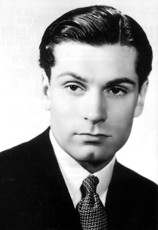
Laurence Kerr Olivier, Baron Olivier, OM (22 May 1907-11 July 1989) was an Academy Award-winning English actor and director. He was regarded by many critics as the greatest actor of the 20th century.
Early career
Olivier was born in Dorking, Surrey. He was educated at St Edward's School, Oxford and he attended the Central School of Speech and Drama. It was his father, Gerard Kerr Olivier, an Anglican priest, who decided that Laurence ?- or Kim as the family called him ?- would become an actor. His stage breakthroughs were in Noel Coward's Private Lives in 1930, and in Romeo and Juliet in 1935, alternating the roles of Romeo and Mercutio with John Gielgud. His film breakthrough was his portrayal of Heathcliff in the 1939 film, Wuthering Heights, which co-starred Merle Oberon and Geraldine Fitzgerald.
Later career
Olivier narrated the famous The World at War miniseries on British television, an extensive documentary of the Second World War. His understated performance was well-received critically and the series continues to air regularly in many markets around the world. In a list of the 100 Greatest British Television Programmes drawn up by the British Film Institute in 2000, voted for by industry professionals, The World at War was placed 19th.
Private life
Olivier with his future second wife, Vivien Leigh, in Fire Over England (1937)Olivier's biographer Donald Spoto described his first wife Jill Esmond as "a diffident lesbian." They were married in 1930 and had one son, Tarquin, born in 1936. They were divorced on 29 January 1940. By 1938, he had embarked on a torrid affair with Vivien Leigh, who was also married. Finally divorced by their respective spouses, they married on 31 August 1940, at the San Ysidro Ranch in Santa Barbara, California, with Katharine Hepburn as maid of honour. They were divorced on 2 December 1960. Olivier married his third wife, Joan Plowright, on St. Patrick's Day, 1961.
Esmond named Leigh as co-respondent in her divorce on grounds of adultery. Leigh named Plowright as co-respondent in her divorce, also on grounds of adultery. Plowright said, "I have always resented the comments that it was I who was the homewrecker of Larry's marriage to Vivien Leigh. Danny Kaye was attached to Larry far earlier than I," referring to biographer Donald Spoto's claim that Kaye and Olivier were lovers [citation needed]. He was reportedly also intimate with playwright Noel Coward.
Terry Coleman's authorised biography of Olivier suggests a relationship between Olivier and an older actor, Henry Ainley, based on correspondence from Ainley to Olivier, although some of Olivier's family dispute this interpretation.
In his book Melting the Stone: A Journey Around My Father [1], Olivier and Plowright's son, Richard, described his father as being more interested in his work than in his children, and would become depressed when he didn't have a job.
In 1967 Olivier underwent radiation treatment for prostate cancer, and was also hospitalised with pneumonia. For the remainder of his life, he would suffer from many different health problems, including bronchitis, amnesia and pleurisy. After being gradually forced out[citation needed] of his role as director of the National Theatre, Olivier became concerned that he had not done enough to provide for his family after he died. As a result between 1973 and 1986 when his health gave out he did many films and TV specials on a "pay cheque" basis on the condition that he would not have to promote the film on release. In 1974 he was diagnosed with a degenerative muscle disorder, and nearly died in the following year.
He died in Steyning, West Sussex, England, from cancer in 1989, at the age of 82. Lord Olivier is interred in Poets' Corner in Westminster Abbey, London, only the second actor to be accorded that honour.
Fifteen years after his death, Olivier once again received star billing in a movie. Through the use of computer graphics, footage of him as a young man was integrated into the 2004 film Sky Captain and the World of Tomorrow in which Olivier "played" the villain.
Honours
He was the founding director of the Chichester Festival Theatre (1962-1966) and of the Royal National Theatre of Great Britain (1962-1973) for which he received his life peerage.
He was knighted in 1947, and created a life peer in 1970 (the first actor to be accorded this distinction) as Baron Olivier, of Brighton in the County of Sussex. He was admitted to the Order of Merit in 1981. The Laurence Olivier Awards, organised by The Society of London Theatre, were renamed in his honour in 1984.
Charles Aznavour
From Wikipedia, the free encyclopedia
Charles Aznavour.Charles Aznavour (born May 22, 1924) is a French singer, songwriter and actor, who besides being one of France's most popular and enduring singers, is that country's most well-known singer abroad. He has sold over 100 million records. [1]
Biography
Aznavour was born Chahnour Varinag Aznavourian in Paris, the son of Armenian immigrants. At an early age, his artistic parents introduced him to the world of theatre.
He began to perform at age nine and soon took the stage name Aznavour. His big break came when the singer Édith Piaf heard him sing and arranged to take him with her on tour in France and to the United States.
Often described as the "Frank Sinatra of France", almost all of Aznavour's songs deal with love. He has written more than a thousand songs as well as musicals, made more than one hundred records, and has appeared in sixty movies. Aznavour sings in six languages (French, English, Italian, Spanish, German, and Russian), which has helped him perform at Carnegie Hall and other major venues around the world.
In the 1970s Aznavour became a major success in the United Kingdom with his song "She" going to Number One in the charts. His other well known song in the UK was "Dance in the Old Fashioned Way".
A friend of Quebec, he has helped the career of Quebec singer-songwriter Lynda Lemay in France, and has a house in Montreal.
Since the 1988 earthquake in Armenia, Aznavour has been helping the country with his charity, Aznavour for Armenia. There is a square named after him in central Yerevan on Abovian Street.
Charles Aznavour was appointed as "Officier" (Officer) of the Légion d'honneur in 1997.
Aznavour's nickname is "Charles Aznavoice", used both by critics and affectionately by some fans. The name of Char Aznable, the main villain of the original Mobile Suit Gundam, was derived from Aznavour.
Film career
Charles Aznavour Statue in Gyumri, Armenia.Aznavour has had a long and varied parallel career as an actor, appearing in over 60 films. In 1960 Aznavour starred in François Truffaut's Tirez sur le pianiste, playing a character called Édouard Saroyan. He also put in a critically acclaimed performance in the 1974 movie And Then There Were None. Aznavour starred in the 2002 movie Ararat playing Edward Saroyan, a movie director.
He also appeared in the first season of The Muppet Show.
Hier Encore :: Charles Aznavour
Hier encore, j'avais vingt ans
Je caressais le temps et jouais de la vie
Comme on joue de l'amour
Et je vivais la nuit
Sans compter sur mes jours qui fuyaient dans le temps
J'ai fait tant de projet qui sont restés en l'air
J'ai fondé tant d'espoirs qui se sont envolés
Que je reste perdu ne sachant ou aller
Les yeux cherchant le ciel mais le coeur mis en terre
Hier encore j'avais vingt ans
Je gaspillais le temps en croyant l'arreter
et pour le retenir, même le devancer
Je n'ai fait que courir et me suis essouffler
Ignorant le passé, conjuguant au futur
Je precedais de moi toute conversation
et donnais mon avis que je pensais le bon
Pour critiquer le monde avec désinvolture
Hier encore j'avais vingt ans
Mais j'ai perdu mon temps a faire des folies
Qui ne me laissent au fond rien de vraiment precis
Que quelques rides au front et la peur de l'ennui
Car mes amours sont mortes avant que d'exister
Mes amis sont partis et ne reviendront pas
Par ma faute j'ai fait le vide autour de moi
Et j'ai gaché ma vie et mes jeunes années
Du meilleur et du pire en jettant le meilleur
J'ai figé mes sourirs et j'ai glacé mes peurs
Ou sont-ils a present, a present mes vingts ans?
Yesterday, When I Was Young (Hier Encore)
by Charles Aznavour
Yesterday when I was young,
The taste of life was sweet as rain upon my tongue,
I teased at life as if it were a foolish game,
The way the evening breeze may tease a candle flame;
The thousand dreams I dreamed,
The splendid things I planned I always built, alas,
on weak and shifting sand;
I lived by night and shunned the naked light of day
And only now I see how the years ran away.
Yesterday
When I was young,
So many drinking songs were waiting to be sung,
So many wayward pleasures lay in store for me
And so much pain my dazzled eyes refused to see,
I ran so fast that time and youth at last ran out,
I never stopped to think what life was all about
And every conversation I can now recall concerned itself with me,
and nothing else at all.
Yesterday the moon was blue,
and every crazy day brought something new to do,
I used my magic age as if it were a wand,
and never saw the waste and emptiness beyond;
The game of love I played with arrogance and pride
and every flame I lit too quickly, quickly died;
The friends I made all seemed somehow to drift away
And only I am left on stage to end the play.
There are so many songs in me that won't be sung,
I feel the bitter taste of tears upon my tongue,
The time has come for me to pay
for Yesterday When I was Young.