Democrats Now Favored to Take Over DeLay's Old Seat
By Greg Giroux | 7:05 PM; Aug. 28, 2006 | Email This Article
The Texas Republican Party establishment has rallied around a single candidate, Houston City Councilwoman Shelley Sekula-Gibbs, in their unusual write-in campaign to salvage the 22nd Congressional District seat vacated in June by Tom DeLay, the former House majority leader.
But the extreme rarity of successful write-in campaigns for Congress and the presence of a solid Democratic nominee on the ballot in former Rep. Nick Lampson has prompted CQPolitics.com to change its rating on the 22nd District race to Leans Democratic from No Clear Favorite.
Orlando Sentinel columnist Mike Thomas is urging Floridians to vote for Katherine Harris in next week's Republican primary for one reason and one reason only: the entertainment value. Denying Harris a shot at Democratic Bill Nelson in November would be like "yanking 'Desperate Housewives' halfway through the season," Thomas writes.
"Our very own Bree Van de Kamp puts on that peach sweater, screws a smile on her face and bravely carries on even as her ungrateful Republican family stabs her in the back and the world disintegrates around her. Do you want to miss the meltdown in the season finale? Do you want to miss a debate between Katherine and Bill, with Tim Russert as moderator?"
GOP's Hold on House Shakier
As Labor Day gets the campaign in full swing, Democrats are counting on voters unhappy with one-party rule and Bush's leadership.
By Janet Hook, Times Staff Writer
September 3, 2006
WASHINGTON ?- Raye Haug, a retired librarian in northern Virginia, for years happily voted to reelect her longtime congressman, Republican Frank R. Wolf. But the GOP record of the last six years ?- on foreign policy, the economy and the environment ?- has so soured Haug that she wants to vote for a Democrat in this year's midterm election.
Any Democrat.
"I don't think I've ever before been willing to vote for someone just because of their party affiliation," said Haug, who walked precincts one sweltering Saturday for Judy Feder, Wolf's Democratic opponent, even though she knew little about her.
As Labor Day signals the start of intense campaigning for the Nov. 7 election, the political landscape is crowded with disgruntled voters like Haug, who tell pollsters they don't like the direction the country has taken under President Bush and Republican rule in Congress.
Most voters are just now beginning to pay attention to the campaign, but candidates and their advisors have been mobilized for months. After 12 years of Republican dominance, Democrats have their best shot in years at winning control of Congress ?- especially the House.
Early this year, the nonpartisan Cook Political Report identified 42 House Republican seats as competitive; now it lists 55. The analysis sees only 20 House Democrats in competitive races. Democrats, who need to gain 15 seats to win control, also have narrowed Republicans' traditional advantage in fundraising.
The mood of the electorate continues to be clouded by deteriorating conditions in Iraq.
"That's a recipe for a GOP disaster, and there is no reason to believe that things will change dramatically between now and election day to improve Republican prospects," said Stuart Rothenberg, editor of a nonpartisan newsletter that recently predicted a Democratic takeover of the House.
The Senate remains more firmly in Republican hands, but even GOP strategists fear their party could reduce their 55-45 margin of control.
The winds are blowing so strongly against the GOP that it raises a new question: If Democrats cannot win control of Congress under these circumstances, when will they?
If they do not triumph in such a hospitable climate, it will be a tribute to the strength of the political machine the GOP has built to cement the realignment that has given them control of Congress since 1994 and the White House since 2000. The party's agenda is tailored to mobilize its base, and its campaign machinery has made a fine art of getting Republican voters to the polls.
And most House members are protected by district boundaries that have been drawn by political bosses to keep seats safely in one party's control.
"If we do endure this cycle with a majority in both chambers, you have to argue this has been an unbelievable 12-year run," said Bill McInturff, a Republican pollster. "You'd have to give Bush and his administration credit. That is an enduring legacy..."
More GOP Districts Counted as Vulnerable
Number Doubled Over the Summer
By Dan Balz and David S. Broder
Washington Post Staff Writers
Sunday, September 3, 2006; Page A01
Facing the most difficult political environment since they took control of Congress in 1994, Republicans begin the final two months of the midterm campaign in growing danger of losing the House while fighting to preserve at best a slim majority in the Senate, according to strategists and officials in both parties.
Over the summer, the political battlefield has expanded well beyond the roughly 20 GOP House seats originally thought to be vulnerable. Now some Republicans concede there may be almost twice as many districts from which Democrats could wrest the 15 additional seats they need to take control.
Democrats Now Favored to Take Over DeLay's Old Seat
| 7:05 PM; Aug. 28, 2006 |
.......But the extreme rarity of successful write-in campaigns for Congress and the presence of a solid Democratic nominee on the ballot in former Rep. Nick Lampson has prompted CQPolitics.com to change its rating on the 22nd District race to Leans Democratic from No Clear Favorite.
War Turns Southern Women Away From GOP
By THE ASSOCIATED PRESS
Published: September 7, 2006
Filed at 6:08 a.m. ET
MACON, Ga. (AP) -- President Bush's once-solid relationship with Southern women is on the rocks. ''I think history will show him to be the worst president since Ulysses S. Grant,'' said Barbara Knight, a self-described Republican since birth and the mother of three. ''He's been an embarrassment.'' In the heart of Dixie, comparisons to Grant, a symbol of the Union, is the worst sort of insult, especially from a Macon woman who voted for Bush in 2000 but turned away in 2004.
In recent years, Southern women have been some of Bush's biggest fans, defying the traditional gender gap in which women have preferred Democrats to Republicans. Bush secured a second term due in large part to support from 54 percent of Southern female voters while women nationally favored Democrat John Kerry, 51-48 percent.
''In 2004, you saw an utter collapse of the gender gap in the South,'' said Karen Kaufmann, a professor of government at the University of Maryland who has studied women's voting patterns. White Southern women liked Bush because ''he spoke their religion and he spoke their values.''
Now, anger over the Iraq war and frustration with the country's direction have taken a toll on the president's popularity and stirred dissatisfaction with the Republican-held Congress.
Republicans on the ballot this November have reason to worry. A recent Associated Press-Ipsos poll found that three out of five Southern women surveyed said they planned to vote for a Democrat in the midterm elections. With control of the Senate and House in the balance, such a seismic shift could have dire consequences for the GOP.
A recent Associated Press-Ipsos poll found that three out of five Southern women surveyed said they planned to vote for a Democrat in the midterm elections.
Minnesota U.S. Senate: Klobuchar 47%, Kennedy 40%
September 4, 2006
[A]ccording to the latest poll by Rasmussen Reports. 47 per cent of respondents in Minnesota would vote for [Democrat Amy] Klobuchar, while 40 per cent would support Republican Mark Kennedy. A late August poll by Gallup gave Klobuchar a 10-point advantage over Kennedy. [..]
Mark Dayton?-a Democrat?-won the 2000 U.S. Senate election in Minnesota, with 49 per cent of the vote against Republican incumbent Rod Grams. Dayton will not seek a new term in office.
Missouri U.S. Senate: McCaskill 47%, Talent 46%
September 7, 2006
[A]ccording to the latest poll by Research 2000 [..] 47 per cent of respondents in the Show Me State would vote for Democrat [challenger] Claire McCaskill, while 46 per cent would support Republican incumbent Jim Talent. A late August survey by Gallup gave Talent a six-point edge over McCaskill. [..]
New Jersey U.S. Senate: Kean 44%, Menendez 39%
September 7, 2006
Tom Kean holds the lead in New Jersey's election to the United States Senate, according to the latest survey by Rasmussen Reports. 44 per cent of respondents in the Garden State would vote for the Republican, while 39 per cent would support Democrat Robert Menendez. A late August Fairleigh Dickinson University PublicMind poll gave Kean a four-point edge over Menendez. [..]
Menendez was first elected to the U.S. House of Representatives in 1992. Born to Cuban parents, he is currently one of only three Hispanics in the upper house.
Washington U.S. Senate: Cantwell 48%, McGavick 43%
September 6, 2006
Democrat Maria Cantwell could win a new six-year term as one of Washington's representatives to the United States Senate, according to the latest poll by Strategic Vision [a Republican-affiliated pollster - nimh]. 48 per cent of respondents would vote for the incumbent, while 43 per cent would support Republican challenger Mike McGavick. A late August poll by SurveyUSA gave Cantwell a 17-point edge over McGavick. [..]
Cantwell was elected to the U.S. Senate in 2000, defeating incumbent Republican Slade Gorton by just over 2,000 ballots.
Arizona U.S. Senate: Kyl 46%, Pederson 36%
September 6, 2006
Republican Jon Kyl could earn a new six-year term as one of Arizona's representatives to the United States Senate, according to the latest poll by the Walter Cronkite School of Journalism and Mass Communication at Arizona State University. 46 per cent of respondents [..] would vote for Kyl in this year's election, while 36 per cent would support Democrat Jim Pederson. A late August poll by Rasmussen Reports gave Kyl a 17-point edge over Pederson.
Kyl was first elected to the U.S. Senate in 1994, and earned a new six-year term in 2000, defeating three independent candidates with 79 per cent of all cast ballots. [..] No Arizona Democrat has served in the U.S. Senate since the retirement of Dennis W. DeConcini in 1995.
Rhode Island Gov.: Fogarty 46%, Carcieri 41%
September 7, 2006
Democrat [challenger] Charles Fogarty could become the new governor of Rhode Island, according to the latest poll by Rasmussen Reports. 46 per cent of respondents in the Ocean State would vote for Fogarty, while 41 per cent would support Republican incumbent Don Carcieri. An early August Rasmussen Reports survey had the two candidates tied with 43 per cent.
Carcieri?-a Republican?-was elected in November 2002, defeating Democrat challenger Myrth York with 55 per cent of the vote. Carcieri took over in January 2003 from fellow GOP member Lincoln Almond. Fogarty is the current lieutenant governor, and had previously served as a state senator and director of the Rhode Island Small Business Administration.
Rhode Island Senate: Whitehouse (D) 44% Chafee 42%
rasmussenreports.com
Tue Sep 5
Rhode Island Senator Lincoln Chafee (R) has pulled to within two points of challenger Sheldon Whitehouse in his bid for re-election. The latest Rasmussen Reports poll in Rhode Island shows Whitehouse earning support from 44% of voters while Chafee attracts 42%. Whitehouse had a six point lead last month.
Based upon this poll we are shifting the Rhode Island Senate race from "Leans Democrat" to "Toss-Up" in ur Senate Balance of Power ratings. Rhode Island is the fifth race in the Toss-Up category.
Though he has his sights set on Whitehouse, Chafee must first face off against his primary challenger, Cranston Mayor Stephen Laffey. The Providence Journal reports that Chafee has outspent Laffey $2.85 million to $1.18 million thus far as they head toward the September 12 showdown. The Whitehouse campaign will be cheering for Laffey on primary night, as the current poll shows Whitehouse leading that potential head-to-head contest 58% to 31%.
If Laffey defeats Chafee in the Republican Primary, this race will immediately be shifted to the Democrats column in our Senate Balance of Power ratings. [..]
Interestingly, equal percentages of voters say they have "very favorable" (20%) and "very unfavorable" (18%) opinions of both Chafee and Whitehouse. Even more interesting is the fact that Chafee gets better marks from Democrats than Republicans. Twenty-one percent (21%) of Democrats have a "very favorable" opinion of Chafee compared to only 14% of the GOP faithful.
Overall, the sitting senator is up with voters from both parties. Sixty-three percent (63%) of GOP voters and 28% of Democrats now say they support Chafee. Those numbers were 59% and 19%, respectively, in the last poll.
Most Rhode Island voters (54%) view Chafee as politically moderate. Twenty-nine percent (29%) see their Senator as liberal and 11% say he's a conservative.
For Whitehouse, the numbers are 39% liberal, 34% moderate, and 8% conservative.
Both candidates are seen as far to the left of President Bush who is seen as politically conservative by 66% of Rhode Island voters. Distance from the President is a good thing in this left leaning state that doesn't place much confidence in the performance of the President.
When asked who they trust more on matters relating to national security and the war in Iraq, 56% say the Democrats in Congress and 36% choose President Bush. The numbers diverge even further when it comes to managing the economy; 60% choose Congressional Democrats and slightly less than one-third (31%) choose the President.
Rhode Island is one of five states now listed in the Toss-Up Category for Election 2006. Three of the other four are also held by Republicans (Montana, Missouri, and Ohio). The only Toss-Up race for seat currently held by Democrats is in New Jersey.
Fifty-seven percent of the respondents said they think it would be good for the country "if the Democrats in Congress were able to conduct official investigations into what the Bush administration has done in the past six years." Forty-one percent said such probes would be bad for the country. Half of the sample was asked this question, also.
High Spending Not Enough to Shake Sanders From Top of Polls
Congressional Quarterly
Sep. 05, 2006
Vermont ranks 49th of the 50 states in population, with just more than 600,000 residents.And yet the three major candidates for the state's open Senate seat ?- Democratic-allied Independent Rep. Bernard Sanders and Republicans Rich Tarrant and Greg Parke ?- have so far spent a combined total of more than $9.5 million dollars in the run-up to the Sept. 12 primary.
That's about $15 per resident, and it will be a much higher ratio to actual voters in the contest to succeed retiring Independent Sen. James M. Jeffords. And there's still more than two months to go until the Nov. 7 general election.
As a point of comparison, President Bush and Democratic challenger John Kerry combined to spend about $2.40 per resident nationwide in the 2004 presidential race.
Tarrant, a multimillionaire businessman and political centrist favored to win the Republican nomination, is the source for much of this campaign spending inflation.
Stating early on that he would not accept any money from political action committees, Tarrant has almost completely self-financed his campaign ?- to a tune of $5.25 million through Aug. 23, the close of the Federal Election Commission's pre-primary reporting period for Vermont. By comparison, he received just less than $100,000 in contributions from other individuals.
But Tarrant also had spent most of that money, leaving him with only $490,000 cash on hand as of Aug. 23. He had little choice but to do so: Sanders, a staunch liberal whose knack for constituent service over eight House terms has given him broad appeal, has held dominant leads in polls throughout the Senate campaign.
Tarrant has used his treasury to produce at least 19 television commercials. The first of his ads had the feel of a Ken Burns documentary, chronicling Tarrant's rise to success as the co-founder of IDX Systems, a medical software company that was sold last year to GE Healthcare, a subsidiary of General Electric.
Lately, his ads have taken on a much harsher tone, featuring attacks on Sanders' voting record. The ads seek to portray Sanders as soft on crime, specifically raising questions about his votes dealing with child pornography and the "Amber Alert" program to locate abducted children.
Yet there is some evidence that the tenor of the campaign, in a state where voters have generally shown an aversion to negative ads, may be having an unexpected effect on Vermont voters ?- and not the one that Tarrant intended.
Tarrant's commercials are sometimes shown back to back with an ad for Republican House candidate Martha Rainville, the front-runner for the GOP nomination to succeed Sanders, which shows her signing a "Clean Campaign Pledge." According to Eric Davis, a professor of political science at Middlebury College, "Her ads may be making Tarrant look bad."
Sanders, during his first successful House campaign in 1990, was similarly targeted by attack ads run by Republican incumbent Peter Smith that criticized Sanders' record as mayor of Burlington. But Sanders defended himself, declined to run negative ads in retaliation, and unseated Smith by a comfortable margin.
It appears Sanders is pursuing the same strategy in response to Tarrant's ad onslaught.Sanders has run a single ad asking voters to visit his Web site to check his record.
On his site, Sanders explains that he voted against the full funding of Amber Alerts and another piece of legislation dealing with child pornography because the bills contained what he viewed as "unconstitutional provisions," and said he was vindicated on that stand by subsequent Supreme Court decisions. The statement also says, "Bernie Sanders has always fought against child predators and will continue his fight for children in the United States Senate."
Although he lacks the kind of deep pockets that Tarrant has, Sanders has nearly kept pace in fundraising, As of Aug. 23, Sanders had $5 million in receipts, much of which came from individual contributions. He was also the most frugal of the candidates, leaving him with about $1.7 million cash on hand.
This fundraising effort was a quantum jump for Sanders, whose previous high was just more than $1 million for his 1996 House campaign.
Part of the reason for his past modest fundraising is his popularity, which has spared him from threatening opposition for years.
Sanders, since his arrival in the House has caucused with the Democrats, and state Democrats in turn have tacitly endorsed Sanders in his campaigns for Vermont's at-large House seat. (State Democratic officials this year obtained his consent to place him on the Sept. 12 Democratic Senate primary ballot, even though he has said he will renounce the nomination to retain his independent status even in the likely event that he wins.)
Republicans have offered little more resistance, putting up a series of little-known House challengers who Sanders leveled with well more than 60 percent of the vote.
The latest of these was Parke, who this year is Tarrant's underdog rival for the Republican Senate nomination.
Parke, a professional pilot and retired Air Force lieutenant colonel, lost to Sanders in 2004 by a whopping 43 percentage-point margin. He has cleared the $1 million mark in campaign receipts by a wide margin ?- in part through an intensive e-mail national fundraising campaign aimed at Republicans who share his strongly conservative agenda ?- and is banking on his rightward leanings to appeal more to Vermont's small Republican primary electorate than Tarrant's moderation.
Yet Parke's campaign spending does not appear to have made him a serious threat to Tarrant, and he has not given up his job to campaign full-time. [..]


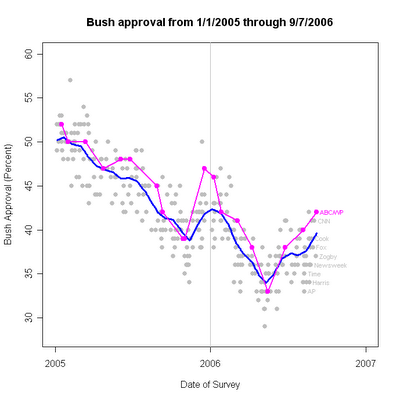
What looked like looming disaster for November, with a President in the low 30s or even the high 20s, now looks like a midterm with a President who has low, but not disasterously low, approval ratings.
The current handicapping by Charlie Cook and others is that the Democratic position has strengthened in a number of House races, with some analysts suggesting a 20+ seat gain is not out of the question for the Democrats.
If that happens, it will have much to do with the strength of the local candidates, and rather less to do with a wildly unpopular president.
[Goedker] says it isn't because his opponent is gay. But he's making an explicit appeal to voters whose values guide them in the voting booth.
"People of high moral values and integrity must rally and support candidates who will work to bring ethics, morals and family values back into government," Goedker's brother Gene, his campaign treasurer, wrote in a fundraising letter. [..]
Goedker [also] said he wouldn't vote for Koering in the general election.
"In my opinion I think it'd be tough to be gay and to be somebody I'd vote for based on some of the life choices they make," Goedker said.
No effect noticeable in the polls on individual states that I can see, but when it comes to the national mood there's some good news for Republicans as Bush is enjoying a distinct upturn:
In other words, in the last few months he's gone up about four points or so.
When it comes to Presidents, typically they have 40% against them, 40% for them, and the middle 20% decides the balance. Bush's rise toward 40% is quite predictable, as some Republicans who are disgusted with him return to the fold as Election Day nears. It is unlikely that he is going to get much past that, though.
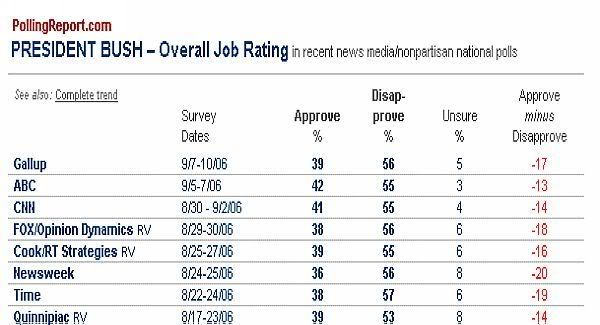
Here are the last eight polls from Pollingreport.com. I sure don't see any wildly encouraging news for Republicans here.