@Holiday20310401,
H20310401,
Some thoughts, if I may.
Quote: Reality is dualistic and actuality is monistic?
Works for me! Assuming "Reality" to be epistemic, what we can perceive and know; and "Actuality" to be ontological, the ultimate grounding. I.e., the dualism / monism paradox of J. Habermas.
Habermasian Reflections: Epistemic dualism vs. Ontological monism
The Language Game of Responsible Agency and the Problem of Free Will: How can epistemic dualism be reconciled with ontological monism? - Philosophical Explorations: An International Journal for the Philosophy of Mind and Action
Quote:And I'd say that if we could know every piece of information of the environment, know every bit of potential of the environment, the environment would be linear, thus we'd know the future.
I.e., the Laplacian block universe. "Deterministic chaos" is arguably predictable, or hypothetically predictable, given that if you start from the same exact conditions including all dynamics and relationships, you'll get identical results over the same relative time line. If you knew the starting condition and had a limitless computer, you could do the simulation before the reality actually occurred, and know the numbers, however random they are relative to each other.
But at some point, "true random" effects from the quantum world would derail even this train. These would be relevant in those instances, however rare, where our macro-world is influenced by a tiny quantum event (akin to Schr?dinger's Cat awaiting its quantum throw of the dice). With most things and events in our world it doesn't matter, but there are non-linear systems which are very sensitive to initial conditions, which greatly amplify the slightest perturbation; thus, at some point a non-predictable quantum event will change the macro world.
Also -- Heisenberg uncertainty is a prime example, perhaps THE prime example, of the fundamentally unknowable at the quantum level, the inherent "limit of knowledge" about nature.
Quote:Chaos is only a point of view I thought, subjective.
If chaos implies randomness, then there are some objective measures, e.g. perfect lack of correlation in a number series, or amount of information needed to describe random outcomes being non-compressible.
However with randomness, I see the universe becomes more random as we reach the quantum side, thus more linear. (ex. entanglement, because particles acting the same way are not very chaotic, but at the same time they are in undefined states)
Perhaps there's some difference between unknowability, as required by Heisenberg, and randomness, which appears to drive much of what we can know about a quantum thing (or more precisely, about our observations of a quantum thing). We can't challenge the unknowable (e.g. the Heisenberg pairings such as location and momentum); but as to randomness, arguably there could still be more pattern mixed in with the noise than we have detected to date, as per the late, great David Bohm and his hidden variable ideas; although some randomness would always remain. As you imply, phase entanglements, although relatively weak, may conceivably impart some order amidst sets of quantum particles that have interacted and remain within some proximity range.
Quote:Maybe it is because we know less of the environment of the quantum side that it appears random.
Yes, again consistent with Heisenberg. But, what we do know (from our observations, our sample of interactions with particles) seems to have elements of strong temporal non-correlation (its state jumps around a lot), and lack of correlation with anything near-by (its state can't be fully explained by the other particle state-observations made near it). I.e., even what we are allowed to know despite Heisenberg's principle still has randomness. Maybe not as much as we think, maybe we aren't able yet to detect all possible relationships; but some pure residual randomness seems thinkable.
Quote:
So, what causes us to understand less?
If anyone could satisfactorily explain Heisenberg uncertainty at the deepest ontological level, they'd sell a lot of books! :Glasses:
Quote:Other dimension, perhaps M theory; even though I hate the theory.
Well, those extra dimensions are hard to swallow, admittedly. But as science has taken our "reality" closer to "actuality" over the past few centuries, it always seems to get weirder and weirder. It's an interesting question as to whether the extra M theory dimensions modifies Heisenberg uncertainty or not. My quick review of Wikipedia indicates that string theory grounds itself in strings and not points just because definitive points would violate uncertainty; IIUC, strings have an inherent tension akin to a stretched rubber band, which fights against whatever is enlarging it; conceptually, strings "want" to shrink all the way back to a point. But uncertainty keeps them stretched out into a band made of probability cloud. Neat! :cool: Without the uncertainty, everything goes zero-D!!! Since the extra dimensions of M theory supposedly just go around in tiny circles, we arguably can't explain away inherent uncertainty as the result of unperceived but effective dimensions (think about the 3D being interacting with the 2D plane world in Flatland). These dimensions wouldn't seem to offer an alternate route from point A to point B, or a way to hide part of a hyper-body from our universe. So the fuzziness and jumpiness and uncertainty of quantum particles arguably isn't because they're ducking into hyper-spaces then coming back to our space, or keeping parts of themselves hidden outside of our space.
String theory - Wikipedia, the free encyclopedia
Quote:Perhaps gravity is the only force that really can subjectively provide perception of order, rather than the other forces, because of its link to space time.
IIRC, gravity is the force with the lowest amount of effect and yet the highest degree of spatial range of the fab four forces (or three, given the merger between electromagnetism and the weak nuclear force). It is the thing that warps spacetime; although, IIRC, the other forces warp space a little for short intervals and distances, but obviously do not cause grand celestial effects like planets orbiting suns, multiple suns orbiting each other, billions of suns swirling along in the arms of the galaxies, etc. And then there is the black hole, where all bets are off, at the core anyway.
Quote:We rely upon those for perception thus causality, and order is proportional to the influence of the force of gravity on the gauge of perception. (Being that of micro, macro).
Hmmmm, well . . . we're pretty dependent upon electromagnetic forces for perception (photons, light), and to order atoms into molecules. And the strong force keeps our atoms organized. But gravity does seem to orchestrate the grand cosmic show (along with dark energy), and obviously helps to keep the bigger things in order for us on this planet. We can adopt to extremely low-gravity situations, as in a space station; we can impose order there through crafty use of light, magnetism, and molecular forces. But life as we know it seems to require a planetary situation with gravity as a primary organizing force.
Quote:I have to admit, its a pretty weak statement and I don't agree with my thoughts here.
Well, agree or not, when I myself think about randomness and uncertainty and their place in the dynamics of our universe, I start to sense that without them, the substances and properties that led to life and to consciousness would not have happened. Something about their tension with the energies that tend things towards order and equilibrium (especially gravity but including electrical charges, magnetism and nuclear forces) gave us a reality with lots of potential. (Sorry for the hyper-intentionalist description here, hard to avoid). And perhaps even "free will", or better said, a will determined (on its better days) by the purest cause of sentient being.
Regards,
Jim G.


 .
.
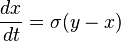

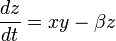 ... and rather than being two distinct examples, this is two examples in one - not only is this an example of a nonlinear system of equations, but this is also an example of a nonlinear system of equations that exhibit deterministic chaos! :a-ok: