2
   

Evolution, Selection, Silver Foxes and Adrenaline


Reply Fri 15 Dec, 2006 09:17 am
I thought this was interesting...

An article on Dmitri Belyaev

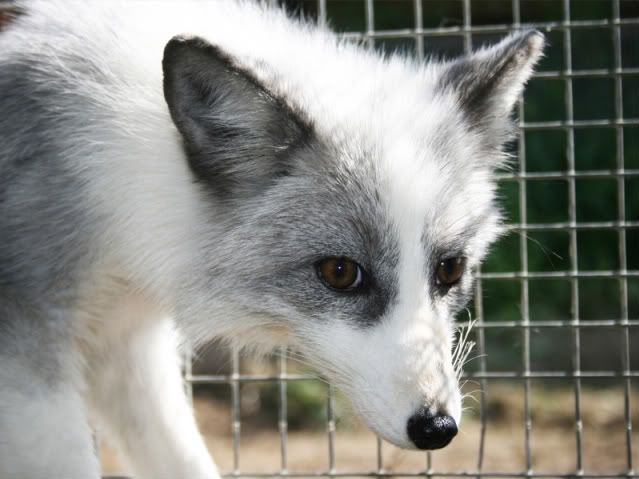
50 years ago a russian scientist named Dmitri Belyaev decided to breed silver foxes, artificially selecting only those foxes with tame characteristics.

What he got was not only foxes with a tame temperment, but he also got foxes with more and more dog-like physical characteristics. At first they had trouble understanding why a selection for temperment would also result in color changes and other physical changes, until they realized that tamability was associated with adrenal chemicals and those systems were near the same gene with melatonin and other skin related hormones.

Selection for tameness resulted in a disruption of the glandular genes, which resulted in a cascade of physical changes associated with those genes.

This is almost certainly what happened to wolves as natural selection affected those which spent more time around humans, eventually resulting in the vast array of dogs we have today.

Additional information on the Silver Fox project
 
  1  
Reply Sat 16 Dec, 2006 10:36 am
Obviously, the third leg f Darwins natural selection stool(the Malthusian relationship) is overwhelmed by artificial selection methods and hence, breeding wich artificially "stirs up " the genetic profiles.


"Tame fox" to me , is like a "tame wolverine" Dont never turn your back on the little bastard.
0 Replies
 
View Profile sozobe
 
  1  
Reply Sat 16 Dec, 2006 10:38 am
Interesting!
0 Replies
 
  1  
Reply Sat 16 Dec, 2006 03:55 pm
farmerman wrote:
Obviously, the third leg f Darwins natural selection stool(the Malthusian relationship) is overwhelmed by artificial selection methods and hence, breeding wich artificially "stirs up " the genetic profiles.


I found the whole thing very interesting.

I'm still trying to understand how cascades of change seem to occur in some organisms; Bats as an example of a large scale evolutionary change, and Dogs as a very small scale change (though very visible).

Evolution isn't only controlled by the macroscopic world (involving natural selection), it's also affected by the 'environment' of the DNA strand.
0 Replies
 
  1  
Reply Sat 16 Dec, 2006 05:15 pm
Studying my ophtho notes right now, and it is remarkable how essential pigment appears to be (or, rather, something tied to pigment, which is itself tied to the adrenal stuff) in the formation of the globe. Merle animals clearly have some weird pgiment stuff going on -- and they also are prone to a number of ocular agenesis problems (small eyes, incomplete iris formation, and the like).
0 Replies
 
  1  
Reply Sat 16 Dec, 2006 07:01 pm
patiodog wrote:
Studying my ophtho notes right now, and it is remarkable how essential pigment appears to be (or, rather, something tied to pigment, which is itself tied to the adrenal stuff) in the formation of the globe. Merle animals clearly have some weird pgiment stuff going on -- and they also are prone to a number of ocular agenesis problems (small eyes, incomplete iris formation, and the like).


It was my impression that the connection between various attributes was their location on the DNA strand. I believe the comment from one of the people interviewed on the PBS program said something about 'destabilizing' the DNA in a particular area.

How does a segment of DNA become 'unstable'? What does he mean exactly?
0 Replies
 
  1  
Reply Sat 16 Dec, 2006 08:26 pm
Dunno. What I've been going over may be tied up in neural crest cell migration, so a single mutation could have effects on a number of different systems.

I can imagine that particular regions of a genome could be unstable -- sequence mutations that cause misfolding somehow, susceptibility to transposons or retroviruses -- but I don't know anywhere near enough about genetics to posit a guess. I do seem to remember that distance from the acrosome affects its chances of recombination during meiosis, and genes near a site of translocation would certainly be susceptible to change...

Out of my depth, though, especially these days.
0 Replies


Related Topics

What is a Light Year? - Question by Dorothy Parker
Does Space Exploration Make Sense? - Question by thegalacticemperor
inverted flight - Question by paps
SINGLE CELL FOSSIL - Discussion by hamburger
rocks and minerals chemistry quiz - Discussion by farmerman
 
  1. able2know
  2. » Evolution, Selection, Silver Foxes and Adrenaline
Copyright © 2009 Horizontal Verticals :: Page generated in 0.33 seconds on 11/09/2009 at 09:41:51 Top End