Jack Of All Parades
Elvis Costello
When we first met I didn't know what to do
My old love lines were all worn out on you
And the world walked round at my mouth
They lit me up and they snuffed me out
And I was everybody's boy
But soon that thrill just fades
To be the love of one true heart
Or the Jack of all parades
You won't know who to thank
You won't know who to blame
It's just a part of the Murdering Game
'Cos down in the fleshpots
Where they pay you in pounds
They're laughing like drains
And baying like bloodhounds
For the Jack of all parades
The Jack of all parades
Once I knew a girl
That looked so much like Judy Garland
That people would stop and give her money
And everybody was Frankie, Jimmy or Bobby
Not the Jack, the Jack of all Parades,
Oh the Jack, the Jack of all Parades,
Oh the Jack, of all Parades.
Now the way that I feel is no longer news
You know my love and how to refuse it
Cause you know where the door is
And how to use it
Oh you know you do
But from my chequered past
To this shattered terrace
Where you can't keep your mind off
the Crimes of Paris
And you can't keep your peace
And try to forget it
And I can't forgive you
For things you haven't done yet
Oh I was anybody's boy
But soon that thrill just fades
To be the love of one true heart
Or the Jack of all parades
When we first met I didn't know what to do
My old love lines were all worn out on you
And the world walked 'round my mouth
I didn't mean to say it
I just blurted it out
As you pretended not to notice
Or be taken aback
And I loved you there and then
It's as simple as that
Oh I was everybody's boy
But soon that thrill just fades
To be the love of one true heart
Or the Jack of all parades
To be the love of one true heart
Or the Jack of all parades
Oh the Jack of all parades
Ah, yes, edgar. Zorba the Greek and that dance; the otherGreek dance was hilarious, Texas.
dj, Don't you recall that your mini gathering was right here on our radio?
There was Bo with his chin whiskers, you, Setanta, and ehBeth.
Bo is the one who introduced me to Diana Krall and lo and behold, you just played Elvis, her mate, twice.
Incidentally, Anthony Quinn was also a painter.
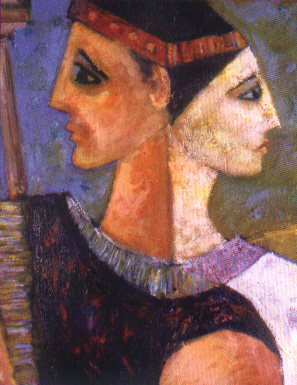
and that shall be our art offering for today.
With a cloud of dust and a hearty "Hi yo Silver"
A person who was born on February 29 may be called a "leapling". In non-leap years they may celebrate their birthday on 28 February or 1 March.
For legal purposes, their legal birthdays depend on how different laws count time intervals. In England and Wales the legal birthday of a leapling is 28 February in common years (see Leap Years, above). In Taiwan the legal birthday of a leapling is also February 28 in common years. In both cases, a person born on February 29 1980 would have legally reached 18 years old on February 28, 1998.
"If a period fixed by weeks, months, and years does not commence from the beginning of a week, month, or year, it ends with the ending of the day which proceeds the day of the last week, month, or year which corresponds to that on which it began to commence. But if there is no corresponding day in the last month, the period ends with the ending of the last day of the last month.[2]"
There are many instances in children's literature where a person's claim to be only a quarter of their actual age turns out to be based on counting their leap-year birthdays. A similar device is used in the plot of Gilbert and Sullivan's 1879 comic opera The Pirates of Penzance: As a child, Frederic was apprenticed to a band of pirates until the the age of 21. Now, having passed his 21st year, he leaves the pirate band and falls in love. However, it turns out that the pirate indenture says that his apprenticeship does not end until his 21st birthday, and since he was born on February 29, that day will not arrive until he is in his eighties, and so he must leave his fianceé and return to the pirates.
Gioachino Rossini
From Wikipedia, the free encyclopedia
Gioachino Antonio Rossini [1] (Pesaro, February 29, 1792 - Passy, November 13, 1868) was a popular Italian composer who wrote 39 operas as well as sacred music and chamber music. His best known works include Il barbiere di Siviglia (The Barber of Seville), La Cenerentola and Guillaume Tell (William Tell).
Biography
Gioachino Antonio Rossini was born into a family of musicians in Pesaro, a town on the Adriatic coast of Italy. His father, Giuseppe, was a horn player and inspector of slaughterhouses, his mother, Anna, was a singer and baker's daughter. Rossini's parents began his musical training early, and by the age of six he was playing the triangle in his father's band.
Rossini's father was sympathetic to the French Revolution and welcomed Napoleon's troops when they arrived in Northern Italy. This became a problem when the Austrians restored the old regime in 1796. Rossini's father was sent to prison, and his mother took him to Bologna, earning her living as a leading singer at various theatres of the Romagna region, where she was ultimately joined by her husband. During this time, he was frequently left in the care of his ageing grandmother, who was unable to effectively control the boy.
He remained at Bologna in the care of a pork butcher, while his father played the horn in the orchestras of the theatres at which his wife sang. The boy had three years' instruction in the harpsichord from Prinetti of Novara, who played the scale with two fingers only, combined his profession of a musician with the business of selling liquor, and fell asleep while he stood, so he was a fit subject for ridicule by his critical pupil.
Education
He was taken from Prinetti and apprenticed to a smith. In Angelo Tesei he found a congenial master, and learned to sight-read, to play accompaniments on the pianoforte, and to sing well enough to take solo parts in the church when he was ten years of age. At thirteen he appeared at the theatre of the Commune in Paër's Camilla ?- his only public appearance as a singer (1805). He was also a capable horn player in the footsteps of his father.
In 1806, age 14, Rossini became a student of the cello under Cavedagni at the Conservatorio of Bologna. In 1807 he was admitted to the counterpoint class of Padre P. S. Mattei. He learned to play the cello with ease, but the pedantic severity of Mattei's views on counterpoint only served to drive the young composer's views toward a freer school of composition. His insight into orchestral resources is generally ascribed not to the strict compositional rules he learned from Mattei, but to knowledge gained independently while scoring the quartets and symphonies of Haydn and Mozart. At Bologna he was known as "il Tedeschino" ("the Little German") on account of his devotion to Mozart.
Early career
Through the friendly interposition of the Marquis Cavalli, his first opera, La Cambiale di Matrimonio, was produced at Venice when he was a youth of eighteen. But two years before this he had already received the prize at the Conservatorio of Bologna for his cantata Il pianto d'Armonia sulla morte d'Orfeo. Between 1810 and 1813, at Bologna, Rome, Venice, and Milan, Rossini produced operas of varying success. All memory of these works is eclipsed by the enormous success of his opera Tancredi.
The libretto was an arrangement of Voltaire's tragedy by A. Rossi. Traces of Paër and Paisiello were undeniably present in fragments of the music. But any critical feeling on the part of the public was drowned by appreciation of such melodies as "Di tanti palpiti... Mi rivedrai, ti rivedrò," which became so popular that the Italians would sing it in crowds at the law courts until called upon by the judge to desist.
Rossini continued to write operas for Venice and Milan during the next few years, but their reception was tame and in some cases unsatisfactory after the success of Tancredi. In 1815 he retired to his home at Bologna, where Barbaja, the impresario of the Naples theatre, concluded an agreement with him by which he was to take the musical direction of the Teatro San Carlo and the Teatro Del Fondo at Naples, composing for each of them one opera a year. His payment was to be 200 ducats per month; he was also to receive a share of Barbaja's other business, popular gaming-tables, amounting to about 1000 ducats per annum. This was an extraordinarily lucrative arrangement for any professional musician at that time.
Some older composers in Naples, notably Zingarelli and Paisiello, were inclined to intrigue against the success of the youthful composer; but all hostility was made futile by the enthusiasm which greeted the court performance of his Elisabetta, regina d'Inghilterra, in which Isabella Colbran, who subsequently became the composer's wife, took a leading part. The libretto of this opera by Schmidt was in many of its incidents an anticipation of those presented to the world a few years later in Sir Walter Scott's Kenilworth. The opera was the first in which Rossini wrote the ornaments of the airs instead of leaving them to the fancy of the singers, and also the first in which the recitativo secco was replaced by a recitative accompanied by a string quartet.
The Barber of Seville (Il barbiere di Siviglia)
Rossini's most famous opera was produced on February 20, 1816 at the Teatro Valle in Rome. The libretto by Cesare Sterbini, a version of Beaumarchais' infamous stage play Le Barbier de Seville, was the same as that already used by Giovanni Paisiello in his own Barbiere, an opera which had enjoyed European popularity for more than a quarter of a century. Much is made of how fast Rossini's opera was written, scholarship generally agreeing upon two weeks, a miracle by any standard. Later in life, Rossini claimed to have written the opera in only twelve days. When the opera made its debut as Almaviva, Paisiello's admirers were extremely indignant, sabotaging the production by whistling and shouting during the entire first act. However, not long after the second performance, the opera became so successful that the fame of Paisiello's opera was transferred to Rossini's, to which the title The Barber of Seville passed as an inalienable heritage.
Marriage and mid-career
Between 1815 and 1823 Rossini produced 20 operas. Of these Otello formed the climax to his reform of serious opera, and offers a suggestive contrast with the treatment of the same subject at a similar point of artistic development by the composer Giuseppe Verdi. In Rossini's time the tragic close was so distasteful to the public of Rome that it was necessary to invent a happy conclusion to Otello.
Conditions of stage production in 1817 are illustrated by Rossini's acceptance of the subject of Cinderella for a libretto only on the condition that the supernatural element should be omitted. The opera La Cenerentola was as successful as Barbiere. The absence of a similar precaution in the construction of his Mosè in Egitto led to disaster in the scene depicting the passage of the Israelites through the Red Sea, when the defects in stage contrivance always raised a laugh, so that the composer was at length compelled to introduce the chorus "Dal tuo stellato Soglio" to divert attention from the dividing waves.
In 1822, four years after the production of this work, Rossini married the coloratura soprano Isabella Colbran. In the same year, he directed his Cenerentola in Vienna, where Zelmira was also performed. After this he returned to Bologna; but an invitation from Prince Metternich to come to Verona and "assist in the general re-establishment of harmony" was too tempting to be refused, and he arrived at the Congress in time for its opening on October 20, 1822. Here he made friends with Chateaubriand and Dorothea Lieven.
In 1823, at the suggestion of the manager of the King's Theatre, London, he came to England, being much fêted on his way through Paris. In England he was given a generous welcome, which included an introduction to King George IV and the receipt of £7000 after a residence of five months. In 1824 he became musical director of the Théâtre italien in Paris at a salary of £800 per annum, and when the agreement came to an end he was rewarded with the offices of Chief Composer to the King and Inspector-General of Singing in France, to which was attached the same income. At the age of 32, Rossini was able to go into semi-retirement with essentially financial independence.
End of his career
The production of his Guillaume Tell in 1829 brought his career as a writer of opera to a close. The libretto was by Étienne Jouy and Hippolyte Bis, but their version was revised by Armand Marrast. The music is remarkable for its freedom from the conventions discovered and utilized by Rossini in his earlier works, and marks a transitional stage in the history of opera. Though a very good opera, it is rarely heard uncut today, as the original score runs more than four hours in performance.
In 1829 he returned to Bologna. His mother had died in 1827, and he was anxious to be with his father. Arrangements for his subsequent return to Paris on a new agreement were upset by the abdication of Charles X and the July Revolution of 1830. Rossini, who had been considering the subject of Faust for a new opera, returned, however, to Paris in the November of that year.
Six movements of his Stabat Mater were written in 1832 and the rest in 1839, the year of his father's death. The success of the work bears comparison with his achievements in opera; but his comparative silence during the period from 1832 to his death in 1868 makes his biography appear almost like the narrative of two lives ?- the life of swift triumph, and the long life of seclusion, of which biographers give us pictures in stories of the composer's cynical wit, his speculations in fish culture, his mask of humility and indifference.
Later years
His first wife died in 1845, and on August 16, 1846 he married Olympe Pélissier, who had sat for Vernet for his picture of Judith and Holofernes. Political disturbances compelled Rossini to leave Bologna in 1848. After living for a time in Florence he settled in Paris in 1855, where his house was a centre of artistic society. He died at his country house at Passy on Friday November 13, 1868 and was buried in Père Lachaise Cemetery, Paris, France. In 1887 his remains were moved to the Basilica di Santa Croce di Firenze, in Florence, where they now rest.
Honors
He was a foreign associate of the Institute, grand officer of the Legion of Honour, and the recipient of innumerable orders.
Notes
In his compositions Rossini plagiarized even more freely from himself than from other musicians, and few of his operas are without such admixtures frankly introduced in the form of arias or overtures. For example, in Il Barbiere there is an aria for the Count (often omitted) 'Cessa di piu resistere', which Rossini used (with minor changes) in Le Nozze di Teti e di Peleo and in La Cenerentola (the cabaletta for Angelina's Rondo is almost unchanged).
A characteristic mannerism in his orchestral scoring, a long, steady build of sound, creating "tempests in teapots by beginning in a whisper and rising to a flashing, glittering storm" [2] earned him the nickname of "Signor Crescendo".
Jimmy Dorsey
From Wikipedia, the free encyclopedia
Birth name Jimmy Dorsey
Born February 29, 1904(1904-02-29) in Shenandoah, Pennsylvania, USA
Died June 12, 1957 (aged 53)
Genre(s) Big Band, Swing, Dixieland
Occupation(s) Bandleader
Instrument(s) Saxophone, Clarinet, Trumpet
Years active 1920s - 1950s
Associated acts Tommy Dorsey, California Ramblers, The Dorsey Brothers, The Charleston Chasers, Dorsey's Novelty Six
James "Jimmy" Dorsey (February 29, 1904 - June 12, 1957) was a prominent American jazz clarinetist, saxophonist, trumpeter and big band leader.
Jimmy Dorsey was born in Shenandoah, Pennsylvania, the son of a music teacher and older brother of Tommy Dorsey who also became a prominent musician. He played trumpet in his youth, appearing on stage in a Vaudeville act as early as 1913. He switched to alto saxophone in 1915, and then learned to double on clarinet.
With his brother Tommy playing trombone, he formed Dorsey's Novelty Six, one of the first jazz bands to broadcast. In 1924 he joined the California Ramblers (who were based in New York City). He did much free lance radio and recording work throughout the 1920s. The brothers also appeared as session musicians on many jazz recordings. He joined Ted Lewis's band in 1930, with whom he toured Europe.
After returning to the USA he worked briefly with Rudy Vallee and several other bandleaders, in addition to the Dorsey Brothers Orchestra with Tommy. Tommy broke off to form his own band in 1935 after a musical dispute with Jimmy. The Dorsey Brothers Orchestra became the Jimmy Dorsey Orchestra, and included musicians such as Bobby Byrne, Ray McKinley, and Skeets Herfurt along with vocalists Bob Eberly and Kay Weber.
In 1939 Jimmy hired Helen O'Connell as his female singer. She and Eberly possessed a "boy and girl next door" charm and their pairing produced several of the band's biggest hits. Many of the Eberly-O'Connell recordings were arranged in an unusual 3-section "a-b-c" format. The three-part format was reportedly developed at the insistence of a record producer who wanted to feature both singers and the full band in a single 3-minute 78 rpm recording. Eberly sang the first minute, usually as a slow romantic ballad, the next minute featured the full band backing Jimmy's saxophone, and the last minute was sung by O'Connell in a more up-tempo style, sometimes with lyrics in Spanish.
Jimmy continued leading his own band until the early 1950s. In 1953 he joined Tommy's Orchestra, renamed "The Fabulous Dorseys"; he took over leadership of the orchestra after Tommy's death. Jimmy survived his brother by only a few months and died of lung cancer, aged 53, in New York City. Shortly before his death he was awarded a gold record for "So Rare". However, contrary to popular belief, Jimmy did not do the alto sax solo on this recording; it was done instead by the great saxophonist Dick Stabile. That track also has the distinction of reaching to the number-two spot in Billboard Magazine's popularity rankings, becoming the highest-rated song by a big band during the first decade of the rock-and-roll era.
Jimmy Dorsey appeared in a number of Hollywood motion pictures, including That Girl From Paris, Shall We Dance?, The Fleet's In, Lost in Harlem, I Dood It, and the bio-pic with his brother Tommy, The Fabulous Dorseys.
Dorsey is considered one of the most prominent alto saxophone players of the pre-bebop era.
Dinah Shore
From Wikipedia, the free encyclopedia
Background information
Birth name Frances Rose Shore
Born February 29, 1916(1916-02-29)
Origin Winchester, Tennessee
Died February 24, 1994 (aged 77), Beverly Hills, California
Genre(s) Pop Music
Occupation(s) Singer, Actress
Instrument(s) Vocals
Years active 1940s-1994
Associated acts Doris Day, Buddy Clark, Tony Martin
Website Dinah Shore's Fan Club Website
Dinah Shore (born Frances Rose Shore February 29, 1916 - February 24, 1994) was an American singer, actress and television personality. She was most popular during the Big Band era of the 1940s and 1950s. After failing singing auditions for the bands of Benny Goodman and both Jimmy Dorsey and his brother Tommy Dorsey, Dinah struck out on her own to become the first singer of her era to achieve huge solo success. She enjoyed a long string of over 80 charted popular hits lasting from 1940 into the late '50s, and after appearing in a handful of films went on to a four-decade long career in American television, starring in her own music and variety shows in the '50s and '60s and hosting two talk shows in the '70s. TV Guide magazine ranked her at #16 on their list of the top fifty television stars of all time. Stylistically, Dinah Shore was often compared to two popular singers who followed her in the mid-to-late '40s and early '50s, Doris Day and Patti Page.
Childhood and rise to success
Born to Solomon and Anna Stein Shore, Jewish immigrants from Russia, young Frances Rose lived in Winchester, Tennessee. When she was two years old, she was stricken with polio (infantile paralysis), a disease that was not preventable at the time, and for which treatment was limited to bedrest. Her parents provided intensive care for her and she recovered and overcame the disease. However, she continued to have a slightly deformed foot and limp, which did not physically impede her. As a small child she loved to sing, encouraged by her mother, a contralto with operatic aspirations. Her father would often take her to his store where she would perform impromptu songs for the customers.[1] In 1924 the Shore family (which included Dinah's only sibling, older sister Bessie) moved to Nashville, Tennessee, where her father had opened a department store. Although shy because of her limp, she became actively involved in sports and was a cheerleader at Hume-Fogg High School and involved in many other activities. At 14, Shore debuted as a torch singer at a Nashville night club only to find her parents sitting ringside. having been tipped off to their daughter's performance ahead of time. They allowed her to finish, but put her professional career on hold. She was paid $10.
When Shore was 16, her mother died unexpectedly of a heart attack, and Shore decided to pursue her education. She went to Vanderbilt University, where she participated in many events and activities. She graduated from the university in 1938 with a degree in Sociology. She also visited the Grand Ole Opry and made her radio debut on Nashville's WSM (AM) radio station in these years. She decided to return to pursuing her career in singing, so she went to New York City to audition for orchestras and radio stations, first on a summer break from Vanderbilt, and after graduation, for good. In many of her auditions, she sang the popular song "Dinah." When disc jockey Martin Block could not remember her name, he called her the "Dinah girl," and soon after the name stuck, becoming her stage name. She eventually was hired as a vocalist at radio station WNEW, where she sang with Frank Sinatra. She also recorded and performed with the Xavier Cugat orchestra. She signed a recording contract with RCA Victor records in 1940.
Career in the 1940s and 1950s
In March 1939, Dinah debuted on national radio on the Sunday afternoon CBS radio program, Ben Bernie's Orchestra. In February 1940, Dinah Shore became a featured vocalist on the NBC Radio program The Chamber Music Society of Lower Basin Street, a showcase for traditional dixieland and blues songs. With Shore, the program became so popular that it was moved from 4:30 Sunday afternoon to a 9:00 Monday night time slot in September. In her prime-time debut for "the music of the Three Bs, Barrelhouse, Boogie-woogie and the Blues", she was introduced as "Mademoiselle Dinah 'Diva' Shore, who starts a fire by rubbing two notes together!" [2]. She recorded with the two Basin Street bands for RCA Victor; one of her records was the eponymous "Dinah's Blues."
Shore's singing came to the attention of Eddie Cantor, and he signed her as a regular on his popular radio show, Time to Smile, in 1940. Shore credits him for teaching her self-confidence, comedic timing, and the ways of connecting with an audience.[3] Eddie Cantor bought the rights to an adapted Russian folk song with new lyrics by Jack Lawrence for Dinah Shore to record for RCA Victor's Bluebird label. This song, "Yes, My Darling Daughter," became her first major hit, selling 500,000 copies in a matter of weeks, which was unusual for that time.
Shore soon became a successful singing star with her own radio show in 1943, Call to Music. Also in 1943, she appeared in her first movie, Thank Your Lucky Stars. The movie starred Eddie Cantor, and she soon went to another radio show, Paul Whiteman Presents. During this time, the United States was involved in World War II and Shore became a favorite with the troops. She had major record hits, including Blues In the Night, Jim, You'd Be So Nice To Come Home To and I'll Walk Alone, the first of her number-one hits. To support the troops overseas, who liked her singing, she participated in USO tours to Europe. She met a young actor ready to go into military service named George Montgomery. They married on December 3, 1943. Despite their marriage, Montgomery soon went into service. When he returned from the service, they settled in San Fernando, California. In 1948, their first child was born, a daughter named Melissa Ann, and they also adopted a son in 1954 named John David before moving to Beverly Hills.
Shore continued appearing in radio shows throughout the 1940s. She performed in radio shows including Birds Eye-Open House and Ford Radio Show. In early 1946, she moved to another label, Columbia Records. At Columbia, Dinah Shore enjoyed the greatest commercial success of her recording career, starting with her first Columbia single release Shoo Fly Pie And Apple Pan Dowdy and peaking with the most popular song of 1948, Buttons and Bows, which was number one for ten weeks. Other number one hits at Columbia included The Gypsy and The Anniversary Song. One of her most popular recordings was the holiday perennial Baby It's Cold Ouside with Buddy Clark from 1949. The song was covered by many other artists, Ella Fitzgerald, for example. Other hits during her four years at Columbia included Laughing on the Outside (Crying on the Inside), I Wish I Didn't Love You So, I Love You (For Sentimental Reasons), Doin' What Comes Naturally, and Dear Hearts And Gentle People. She was a regular with Jack Smith on his quarter-hour radio show on CBS. She went into several movies. As an actress, Shore appeared in films such as Follow the Boys and Up in Arms (both in 1944), Belle of the Yukon (1945), and Till the Clouds Roll By (1946). She lent her musical voice to two Disney films: Make Mine Music (1946) and Fun and Fancy Free (1947). Her last starring film role was for Paramount in Aaron Slick from Punkin Crick (1952), co-starring Alan Young and Metropolitan Opera star Robert Merrill.
In 1950 Dinah went back to RCA with a reported deal to record 100 sides for $1,000,000. The hits kept coming, but with less frequency, and weren't charting as high as in the '40s. Dinah's biggest hits of this era were My Heart Cries for You and Sweet Violets, both peaking at number three in 1951. Several duets with Tony Martin did well with A Penny A Kiss being the most popular, reaching number eight on the charts. Blue Canary was a 1953 hit and Dinah's covers of Changing Partners and If I Give My Heart To You were popular top twenty hits. Love and Marriage and Whatever Lola Wants were top twenty hits from 1955. Chantez, Chantez was Dinah's last top twenty hit, staying on the charts for over twenty weeks in 1957. Dinah stayed with RCA until 1959, and during that time released several albums including Bouquet of Blues, Once in a While, and Vivacious, which were collections of singles with different orchestras and conductors such as Frank DeVol and Hugo Winterhalter. Moments Like These, a studio album from 1958, recorded in stereo, with orchestra solely under the musical direction of Harry Zimmerman, who performed the same duties on The Dinah Shore Chevy Show, being the exception.
Recording career after the 1950s
In 1959 Dinah was successfully wooed away from RCA by Capitol Records. She recorded only one "almost" hit for her new label, I Ain't Down Yet, which "bubbled under the hot 100" on Billboards pop chart, peaking at 102 in 1960. However, she recorded six classic albums which remain her strongest recording legacy. These were carefully thought out "theme" albums that paired Dinah with master arranger Nelson Riddle (Dinah, Yes Indeed!) gifted conductor and sensitive accompanist Andre Previn (Somebody Loves Me and Dinah Sings, Previn Plays) and jazz great Red Norvo (Dinah Sings Some Blues With Red). Her final two albums for Capitol at this time were Dinah, Down Home and The Fabulous Hits (Newly Recorded).
Dinah Shore left Capitol in 1962 and recorded only a handful of albums over the next two decades, including Lower Basin Street Revisited for pal Frank Sinatra's Reprise label in 1965,Songs For Sometime Losers (Project 3, 1967), Country Feelin' (Decca, 1969), and Once Upon A Summertime (Stanyan, 1975). Her final studio album was released in 1979, Dinah! Visits Sesame Street, for the Children's Television Workshop. In 2006, DRG released For The Good Times, a CD reissue of "DINAH!," an album recorded for Capitol that had a very limited Reader's Digest release in 1976. Dinah recorded this album at the height of her talk show fame, and it featured her take on contemporary hits such as 50 Ways To Leave Your Lover, The Hungry Years, and Do You Know Where You're Going To (Theme from "Mahogany").
Early television career
Soon after she arrived in New York in 1937, Dinah Shore made her first television appearances on experimental broadcasts for NBC. Twelve years later, In 1949 she made her official television show debut on the Ed Wynn Show and also made a guest appearance on Bob Hope's first television show in 1950. After being on many other people's television shows, she got her own, The Dinah Shore Show in 1951. She did two fifteen minute shows a week for NBC. She won her first, of many, Emmy awards for the show in 1955. The show was sponsored by Chevrolet automobiles. The sponsor's theme song ("See The U.S.A. In Your Chevrolet") became the singer's signature piece.
In 1956 she hosted a monthly series of one-hour full-color spectaculars as part of NBC's "Chevy Show" series. These proved so popular that the show was renamed "The Dinah Shore Chevy Show" the following season, with Dinah becoming the full-time host, helming three out of four weeks in the month. Broadcast live and in NBC's famous "Living Color," this classic variety show was one of the most honored and popular of the 1950s and early 1960s and featured the television debuts of many great stars of the era, such as Yves Montand and Maureen O'Hara, and featured Dinah in now-classic performances alongside Ella Fitzgerald, Mahalia Jackson, Peggy Lee, Frank Sinatra and Pearl Bailey. "The Dinah Shore Chevy Show" ran through the 1960-61 season, after which Chevrolet dropped sponsorship and the show continued for two more seasons as a series of monthly broadcasts sponsored by "The American Dairy Association" and "S&H Green Stamps." Simply called "The Dinah Shore Show," Dinah's guests included Nat "King" Cole, Bing Crosby, Jack Lemmon, and a very young Barbra Streisand. Over twelve seasons, from 1951-1963, Dinah Shore made 125 hour-long programs and 444 fifteen-minute shows.
Dinah famously ended her televised programs by throwing an enthusiastic kiss directly to the cameras (and viewers) and exclaiming "MWAH!" to the audience as if to be extending a kiss to everyone in gratitude for being with her. It was always said by Frank Sinatra that, "Dinah blows the best kisses!"[citation needed]
Later television career
From 1970 through 1980, Shore hosted two daytime programs, Dinah's Place (1970-1974) on NBC and Dinah! (later Dinah and Friends) in syndication from 1974 through 1980 and a third cable program from 1989-1992.
"Dinah's Place" was a 30-minute Monday through Friday program broadcast over NBC, her network home since 1939. Dinah described this show as a "Do-Show" as opposed to a chat show because she would always have her guest show off an unexpected skill, whether it be Frank Sinatra sharing his spaghetti sauce recipe, Spiro Agnew showing off his keyboard chops by accompanying Dinah on "Sophisticated Lady," or Ginger Rogers showing Dinah how to throw a clay pot on a potter's wheel. Though "Dinah's Place" featured famous guest stars, just as often you would find Dinah grilling lesser-known lifestyle experts on nutrition, exercise or "homemaking." Despite being one of the more popular programs in NBC's morning lineup, this show famously left the air in 1974 after NBC sent a telegram to Dinah congratulating her on her Emmy win at the same time informing her the show was cancelled, because it broke up a "game show programming block," thus ending the network's 35-year association with Miss Shore.
Dinah bounced back that fall with "Dinah!" a syndicated 60-90 minute daily talk show that put the focus clearly on top guest stars and entertainment. This show was strong competition for both Mike Douglas and Merv Griffin, whose shows had both been on the air for over 10 years when "Dinah!" debuted. Frequent guests included show-biz greats Lucille Ball, Bob Hope and James Stewart as well as regular contributors like lifestyle guru Dr. Wayne Dyer. There were unexpected classic rock performances on this show, the most famous being the appearances of David Bowie and Iggy Pop. Equally notoriously, Dinah had the misfortune of interviewing the comedian Andy Kaufman in his Tony Clifton guise on this show. He took deliberate offense at her questions and eventually tipped a pan of eggs over her head. This program was taped live in front of a studio audience and the "Egg" segment was never aired and it's believed that the offending footage was destroyed. Shore's producers suprimposed titles such as "This is a put on" over the footage that was eventually aired, including an uncomfortable duet between a game Dinah and a belligerent Tony of "Anything You Can Do", and his solo of "On The Street Where You Live." Shooting was stopped and Kaufman was escorted out of the studio.
Shore, with her Dixie drawl and demure manner, was always identified with the South, and guests on her shows often commented on it. She famously spoofed this image by playing Melanie in Went with the Wind, the famous Gone with the Wind parody for The Carol Burnett Show. In the summer of 1976, Dinah Shore hosted "Dinah and her New Best Friends", an eight-week summer replacement series for The Carol Burnett show that featured a cast of young hopefuls such as Diana Canova, Leland Palmer, and Gary Muledeer along with guests such as CBS stars Jean Stapleton and Linda Lavin.
Shore guest starred on Pee-wee's Playhouse Christmas Special, calling Pee-wee on his picturephone and singing The 12 Days of Christmas. Throughout the special, Pee-wee walks past the picturephone, only to hear her going past the original 12 days ("...on the 500th day of Christmas...")
Dinah Shore finished her television career hosting "A Conversation with Dinah" from 1989-1992 on the cable network TNN (The Nashville Network). This half-hour show consisted of one-on-one interviews with showbiz greats ( Bob Hope), former boyfriends (Burt Reynolds in a special one-hour episode) and political figures (President Gerald Ford and his wife, Betty.) In a coup, Dinah got former First Lady Nancy Reagan's first post-White House interview for this show. Her last television special, "Dinah Comes Home," (TNN 1991) brought Dinah Shore's career full circle, taking her back to the stage of the Grand Ol' Opry, which she first visited some 60 years earlier.
Shore won nine Emmys, a Peabody Award and a Golden Globe.
Romantic life
In her early career, while in New York, Dinah Shore was briefly involved with famed drummer Gene Krupa. After Dinah relocated to Hollywood she became involved with James Stewart and it was rumored that a Las Vegas elopement was aborted en route. Dinah's flirtation with General George Patton was much commented on when he escorted her for a portion of her tour to entertain the troops in England and France during World War II.
Shore was married to actor George Montgomery from 1943 to 1962. In the book "Mr. S," the author, Frank Sinatra's longtime valet George Jacobs alleges that Dinah Shore and Frank Sinatra had a long-standing affair in the 1950s. After her divorce from Montgomery, she briefly married Maurice Smith. Romances of the later 1960s involved comedian Dick Martin, singer Eddie Fisher and actor Rod Taylor.
In the early 1970s, Shore had a long and happy public romance with actor Burt Reynolds, who was 20 years her junior. The relationship gave Shore an updated, sexy image, and took some of the pressure off Reynolds in maintaining his image as a ladies' man. The couple were often featured in the tabloids and after the relationship cooled, the tabloids often paired Dinah with other younger men, from Wayne Rogers, Andy Williams and "Tarzan" Ron Ely, to more age appropriate gentlemen such as novelist Sidney Sheldon, Dean Martin and former New York Governor Hugh Carey.
Golf
Shore, who played golf herself, was a long-time supporter of women's professional golf. In 1972, she helped found the Colgate Dinah Shore golf tournament, which today, now known as the Kraft Nabisco Championship, remains as one of the four major golf tournaments on the LPGA Tour. The tournament is held each March near Shore's home in Rancho Mirage, California.
Shore was also the first female member of the famed Hillcrest Country Club in Los Angeles.
In acknowledgment of her contributions to golf, Shore was made an honorary member of the World Golf Hall of Fame in 1994.
Death and legacy
Dinah Shore died in Beverly Hills, California of ovarian cancer at age 77. Her ashes were divided and she has two burial sites. Half were interred in the Hillside Memorial Park Cemetery in Culver City, California and the other half interred at Forest Lawn Cemetery (Cathedral City) near her beloved second home in Palm Springs, California.
Shore's legacy resonates posthumously, with a 1998 album featuring the arrangement skills of Andre Previn combined with the re-releasing of some of her classic recordings like April in Paris, and My Funny Valentine, garnering moderate success.
Dinah's daughter, Melissa Montgomery, is the owner of the rights to most of Shore's television series. In March of 2003, PBS presented "MWAH! The Best of The Dinah Shore Show 1956-1963," an hour-long special consisting of rare, early color videotape footage of Dinah in full duets with guests Ella Fitzgerald, Jack Lemmon, Frank Sinatra, Bing Crosby, Pearl Bailey, George Burns, Groucho Marx, Peggy Lee, and Mahalia Jackson. It was rumored that this was an attempt to persuade PBS to broadcast full episodes of the classic series. Fans of Dinah Shore hope that, through network or cable broadcast, or home DVD release, these classic television moments will be made available to the public.
Arthur Franz
From Wikipedia, the free encyclopedia
Arthur Franz (b. February 29, 1920 in Perth Amboy, New Jersey - d. June 17, 2006) was a B-movie actor who appeared in a number of films in the 1950s including Invaders from Mars (1953), Abbott and Costello Meet the Invisible Man (1951) and The Unholy Wife (1957) playing a priest. In 1952's The Sniper, Franz played a rare movie lead in the films title role as a tormented killer. In addition to films, Franz was a familiar face on American television, appearing on dozen of television programs including Perry Mason, The F.B.I., The Mod Squad, The Virginian and Rawhide. Franz's last film role was in That Championship Season (1982).
Franz's interest in acting developed when he was a high school student.
During World War II, Franz served as a B-24 Liberator navigator in the United States Army Air Forces. He was shot down over Romania and incarcerated in a POW camp, from which he escaped.
Franz died June 17, 2006 in Oxnard, California at the age of 86 from emphysema and heart disease.
"The Half-wit"
A man owned a small farm in Indiana. The Indiana
State Wage and Hour Department claimed he was
not paying proper wages to his help and sent an
agent out to interview him.
"I need a list of your employees and how much
you pay them," Demanded the agent.
"Well," replied the farmer, "there's my farm hand
who's been with me for 3 years. I pay him $200
a week plus free room and board.
"The cook has been here for 18 months, and I
pay her $150 per week plus free room and board.
"Then there's the half-wit who works about 18
hours every day and does about 90% of all the
work around here. He makes about $10 per
week, pays his own room and board, and I
buy him a bottle of bourbon every Saturday
night. He also sleeps with my wife occasionally. "
"That's the guy I want to talk to... the half-wit,"
says the agent.
"That would be me," replied the farmer.

