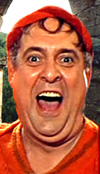
Charles Durning
From Wikipedia, the free encyclopedia
Born February 28, 1923 (1923-02-28) (age 85)
Highland Falls, New York
Years active 1963 - present
Awards won
Golden Globe Awards
Best Supporting Actor - Series, Miniseries or TV Movie
1991 The Kennedys of Massachusetts
Tony Awards
Best Featured Actor in a Play
1990 Cat on a Hot Tin Roof
Other Awards
NBR Award for Best Supporting Actor
1975 Dog Day Afternoon
NBR Award for Best Cast
2000 State and Main
Charles Durning (born February 28, 1923) is a Golden Globe Award-winning American actor of stage and screen.
Biography
Early life
Durning was born in Highland Falls, New York, the son of Louise and James Durning. He was raised in an impoverished family, and left his home as soon as possible to ease the financial pressure on his mother.[citation needed]
Military service
Durning served as a soldier in World War II, during which he was awarded a Silver Star, three Purple Heart medals, and a Good Conduct Medal. He was drafted into the U.S. Army at the age of 21, and landed on D-Day in the Normandy Invasion on June 6, 1944. Some sources state he was in the 1st Infantry Division at the time, but it is unclear if he was a rifleman or in an artillery unit by 1944.
On Omaha Beach itself, Pvt. Charles Durning was among the first troops to land. Drafted early in the war, he was first assigned as a rifleman with the 398th Infantry Regiment, but later served overseas with the 3rd Army Support troops and the 386th Anti-aircraft Artillery (AAA) Battalion.
Durning was wounded by an "S" Mine on June 15, 1944, at Les Mare des Mares. He was transported by the 499th Medical Collection Company to the 24th Evacuation Hospital. By June 17, he was back in England at the 217th General Hospital. Although severely wounded by shrapnel in the left and right thigh, right hand, the frontal region of the head and the interior left chest wall, Durning recovered quickly and was determined to be "fit for duty" on December 6, 1944. Durning was present for the Battle of the Bulge, the German counter-offensive in December 1944.[1]
He was taken prisoner during the Battle of the Bulge, and was one of the few survivors of the infamous Malmedy massacre of American POWs, perpetrated by a battlegroup under Joachim Peiper of the 1st SS Division Leibstandarte SS Adolf Hitler. "He escaped with two others, and returned to find the remainder murdered."[1]
After being wounded in the chest, Durning was repatriated to the United States where he remained in army hospitals, receiving treatment for both physical and psychological wounds, until discharged with the rank of Private First Class on January 30, 1946.
Durning has said that he still suffers from nightmares about his war experiences (which is common among veterans living with post-traumatic stress disorder, although Durning himself is not confirmed to have suffered PTSD).[citation needed] He was nominated for an Emmy Award for his extraordinary portrayal of a Marine veteran in "Call of Silence", an unusual episode of the television series NCIS, first broadcast November 23, 2004. Clearly drawing on his first-hand knowledge of the lingering effects of battle-induced stress, Durning's character turns himself in to authorities, insisting that he must be prosecuted for having murdered his buddy during ferocious combat on Iwo Jima six decades earlier.[2] The real truth of the incident only becomes known for certain when the guilt-stricken veteran goes through a cathartic reliving of the battlefield events.
Durning is well-known for participating in various functions to honor American veterans. He was the chairman one year of the U.S. National Salute to Hospitalized Veterans.[3]
Film career
Durning's breakthrough film performance was in the 1973 Best Picture, The Sting. In the film, Durning plays a corrupt policeman, Lieutenant Snyder, who polices and hustles professional con artists. He doggedly pursues the young grifter Johnny Hooker (Robert Redford), only to become the griftee in the end. Since then he has amassed over 100 film and TV credits, including Queen of the Stardust Ballroom, Dog Day Afternoon (with Al Pacino), the sci-fi classic The Final Countdown, and The Best Little Whorehouse in Texas. In 1979, he played Doc Hopper, the main villain in The Muppet Movie. In Tootsie he plays a suitor to a cross-dressing Dustin Hoffman. The two actors worked together again in a 1985 TV production of Death of a Salesman. In 1993, Durning guest starred in the Sean Penn-directed music video for "Dance with the One That Brought You" by Shania Twain.
More recently he has played a benevolent father to Holly Hunter in Home for the Holidays (1995), a savvy southern state governor ("Pappy" O'Daniel) in O Brother, Where Art Thou, and as Victor Rasdale in Dirty Deeds. In 1996 he played Lew in the romantic comedy One Fine Day and Santa Claus in the Sesame Street home video "Elmo Saves Christmas". He played town doctor Harlan Eldridge on the Burt Reynolds sitcom Evening Shade (1990-1994). He subsequently had a recurring role on Everybody Loves Raymond (1996 - 2005) as the Barone family's long-suffering parish priest, Father Hubley. He also played the voice of recurring character Francis Griffin in the animated series Family Guy until the episode Peter's Two Dads where the character died.
For his roles on television, Durning has earned eight Emmy Award nominations. He has also received Academy Award for Best Supporting Actor nominations for The Best Little Whorehouse in Texas in 1982 and for To Be or Not to Be in 1983. He won a Golden Globe in 1990 for his supporting role in the television miniseries The Kennedys of Massachusetts.
He can currently be seen on the FX television series Rescue Me, playing Mike Gavin, the retired firefighter father of Denis Leary's character. The character died in the Season 4 finale. His daughter Jeanine Durning is a well known New York-based modern dance performer and choreographer.
Charles Durning was honored with the Life Achievement Award at the 14th Annual Screen Actors Guild Award Ceremony on January 27, 2008.
His upcoming roles include two action films with Steven Seagal. The first one if the barbarian epic "The Destroyer of Souls", directed by Albert Pyun and starring Seagal as "Klangor", a barbarian warrior who sets to avenge the death of his dragon by a cult of dragon slayers led by Tom Selleck's character. It will also star Lorenzo Lamas and Ralph Macchio. Durning will then join Seagal again for the action movie "Hard Panda", about an Ex-PETA agent (Seagal) hell bent on avenging the death of his Panda, killed by Chechen warriors in the wilderness of Alaska. Durning will provide the voice of Tommy Lee the Panda. Tom Selleck plays an oil agency tycoon who befriends Seagal.
Bernadette Peters
From Wikipedia, the free encyclopedia
Born Bernadette Lazzara
February 28, 1948 (1948-02-28) (age 60)
Ozone Park, Queens, New York, United States
Spouse(s) Michael Wittenberg
(1996-2005) (his death)
Official website
Awards won
Golden Globe Awards
Best Actress - Motion Picture Musical/Comedy'
1982 Pennies From Heaven
Tony Awards
Best Leading Actress - Musical'
1986 Song and Dance
1999 Annie Get Your Gun
Bernadette Peters (born February 28, 1948) is an American actress and singer. Over the course of an enduring career starting at an early age, she has performed in musical theatre, films and television, as well as in solo concerts and recordings. Peters first performed on the stage in the 1960s and in the 1970s in film and television. In the 1980s she returned to the theatre, where she has been, for over two decades, one of the most critically acclaimed Broadway stars, being nominated for seven Tony Awards and winning two. Peters also continues to act in films and on television, where she has been nominated for Emmy Awards for three of her appearances. Four of the Broadway cast albums on which she has starred have won Grammy Awards.
Peters is particularly noted for her starring roles in the stage musicals Song and Dance, Annie Get Your Gun, Sunday in the Park with George, and Into the Woods, becoming closely associated with the composers Stephen Sondheim and Andrew Lloyd Webber, and in films including The Jerk and Pennies from Heaven.
Early career
She was born Bernadette Lazzara to an Italian-American family in Queens, New York, the youngest of three children. Her mother Marguerite started her in show business by putting her on the television show Juvenile Jury at the age of three-and-a-half. She later appeared on the television shows Name That Tune and The Horn and Hardart Children's Hour. In her teen years, she attended the Quintano School for Young Professionals.
At age nine she obtained her Actors Equity Card in the name of Bernadette Peters to avoid ethnic stereotyping, with the stage name taken from her father's first name. She made her stage debut at nine in This is Goggle, a comedy directed by Otto Preminger that closed during out-of-town tryouts before reaching New York. She first appeared on the New York stage at age 10 in the New York City Center revival of The Most Happy Fella (1959). At 13 she was an understudy for Dainty June and one of the ensemble in a touring company of Gypsy. Upon graduation from high school, she started working steadily, appearing Off-Broadway in the musicals The Penny Friend (1966) and Curley McDimple (1967) and as an understudy on Broadway in The Girl in the Freudian Slip (1967). She made her Broadway debut in Johnny No-Trump in 1967. She appeared next as George M. Cohan's sister opposite Joel Grey in George M! (1968), winning the Theatre World Award.
It was Peters' performance as "Ruby" in the 1968 off-Broadway Dames at Sea, a spoof of 1930s musicals, that brought her critical acclaim and her first Drama Desk Award. She had appeared in an earlier 1966 version of Dames at Sea at the off-off-Broadway performance club Caffe Cino. Peters had starring roles in her next Broadway vehicles ?- Gelsomina in La Strada (1969), Hildy in On the Town (1971), and Mabel Normand in Mack and Mabel (1974), all of which were short-lived. She moved to Los Angeles in the early 1970s to concentrate on television and film work.
Theatre
Peters returned to the New York stage after an eight-year absence in the off-Broadway Manhattan Theatre Club production, of the comedy-drama Sally and Marsha (1982), for which she was nominated for a Drama Desk Award. She then returned to Broadway as Dot/Marie in the Stephen Sondheim ?- James Lapine musical Sunday in the Park with George (1984), followed by Andrew Lloyd Webber's Song and Dance (1985), Sondheim-Lapine's Into the Woods (1987), and Neil Simon's The Goodbye Girl with music by Marvin Hamlisch (1993).
Peters is "considered by many to be the premier interpreter of his [Sondheim's] work," according to writer Alex Witchel.[1] Raymond Knapp writes that Peters "achieved her definitive stardom" in Sunday in the Park With George and Into the Woods.[2] Sondheim has said of Peters, "Like very few others, she sings and acts at the same time," he says. "Most performers act and then sing, act and then sing ... Bernadette is flawless as far as I'm concerned. I can't think of anything negative."[3] Peters continued her association with Sondheim with a 1995 benefit concert of Anyone Can Whistle. Additionally, she performed at several concerts featuring Sondheim's work, and performed for him at his 1993 Kennedy Center Honors ceremony.
In the PBS broadcast of Sunday in the Park with GeorgeIn her latest Broadway stage role, Peters took on the role of Mama Rose in the 2003 revival of Gypsy. Ben Brantley in his New York Times review of Gypsy wrote, "Working against type and expectation under the direction of Sam Mendes, Ms. Peters has created the most complex and compelling portrait of her long career, and she has done this in ways that deviate radically from the Merman blueprint."[4] Arthur Laurents said: "But in 2003 there was a new Rose on Broadway: Bernadette Peters! Brilliant, original, totally unlike any of the others.[5]
In February 2006, she participated in a reading of the Sondheim-Weidman musical Bounce. On September 24, 2007, Peters participated in a one-time only charity reading of the play Love Letters with her former Gypsy co-star, John Dossett.[6]
Peters has been nominated for the Tony Award seven times and won twice. She has also been nominated for the Drama Desk Award eight times and won three times (Annie Get Your Gun, Song and Dance, and Dames at Sea). Her first Tony Award for Best Lead Actress in a Musical was for her performance as Emma in Song and Dance. Theater critic Frank Rich wrote in an otherwise negative review of the show that Peters "has no peer in the musical theater right now."[7] Peters won her second Tony for her performance as Annie Oakley in the 1999 revival of Annie Get Your Gun opposite Tom Wopat. Critic Lloyd Rose of the Washington Post wrote: "...she [Peters] banishes all thoughts of Ethel Merman about two bars into her first number, 'Doin' What Comes Natur'lly.' Partly this is because Merman's Annie was a hearty, boisterous gal, while Peters plays an adorable, slightly goofy gamine... For anyone who cares about the American musical theater, the chance to see Peters in this role is reason enough to see the show."[8]
Film appearances
Peters has appeared in 31 feature films or television movies, including the musical Annie and Pink Cadillac, in which she co-starred with Clint Eastwood. She was nominated for a Golden Globe Award (Best Motion Picture Actress in a Supporting Role) for her work in the 1976 Mel Brooks film Silent Movie.
She appeared opposite Steve Martin, whom she dated for a period of time, in the The Jerk (1979) and Pennies From Heaven (1981), for which she won the Golden Globe Award as Best Motion Picture Actress in a Comedy or Musical. In 1981 she also appeared on the cover and inside spread of the December issue of Playboy Magazine, in which she posed in lingerie designed by Bob Mackie.
Peters appeared with three generations of the Kirk Douglas family in the 2003 film It Runs in the Family. In May 2006 she filmed a movie Come le formiche (Wine and Kisses) with F. Murray Abraham in Italy; the DVD was released on June 22, 2007 in Italy.[9]
Television appearances
Peters was nominated for Emmy Awards for her guest-starring roles on the Fox situation comedy Ally McBeal (2001), and The Muppet Show (1977).[10] She was also nominated for a Daytime Emmy Award, Outstanding Performer in a Children's Special, for her work in the made-for-television movie Bobbie's Girl. She won the 1987 "CableACE Award" for her role as Dot in the television version of Sunday in the Park With George.
She has appeared in many variety shows with stars as diverse as Sonny and Cher and George Burns, has performed on the Academy Awards broadcasts, both presented at and co-hosted the Tony Awards, and hosted Saturday Night Live. She made some 12 guest appearances on the various versions of The Carol Burnett Show[11] as well as appearing with Burnett in the made-for-television version of Once Upon a Mattress and the 1982 film Annie. She also performed at the Kennedy Center Honors ceremony for Burnett (2003). Peters appeared often on the Tonight Show Starring Johnny Carson and on the day time talk show Live with Regis and Kelly, both as a co-host and a guest. Peters voiced stray cat Rita in the Rita and Runt segments of the animated series Animaniacs. Rita often sang on the show, sometimes in parodies of songs from Broadway musicals.
Peters has co-starred in a number of television movies, including The Last Best Year with Mary Tyler Moore, Cinderella with Brandy, and Prince Charming with Martin Short. (Peters was nominated for the "Golden Satellite Award", Best Performance by an Actress in a Supporting Role in a Mini-Series or Motion Picture Made for Television for Cinderella.) She co-starred in her own television series, All's Fair, with Richard Crenna in 1976-77, for which Peters was nominated for a Golden Globe award. In March 2005, she made a pilot for an ABC sitcom series titled Adopted, co-starring with Christine Baranski, but it was not picked up.[12]
Peters has recently made guest appearances on several popular television series, appearing as a judge on the ABC series, Boston Legal (May 2007), as a defense attorney on the NBC series, Law & Order: Special Victims Unit (November 2006), and as the sharp-tongued sister of Karen Walker (Megan Mullally) on the penultimate episode of NBC's Will & Grace ("Whatever Happened to Baby Gin?").
Concerts and recordings
Peters has been performing her one-woman concert in the United States and Canada for many years. She made her solo concert debut at Carnegie Hall in New York City in 1996, devoting the second half to the work of Stephen Sondheim.[13] She performed a similar concert in London, which was taped and released on video, and also aired on U.S. Public Television stations in 1999. She continues to perform her solo concert around the U.S., performing at venues such as the Adrienne Arsht Center for the Performing Arts in Miami, and with symphony orchestras such as the Los Angeles Philharmonic and the Dallas Symphony.
In a review of her 2002 Radio City Music Hall concert, Steven Holden of the New York Times described Peters as "the peaches-and-cream embodiment of an ageless storybook princess... inside a giant soap bubble floating toward heaven. A belief in the power of the dreams behind Rodgers and Hammerstein's songs, if not in their reality, was possible."[14]
Brian Jones
From Wikipedia, the free encyclopedia
Background information
Birth name Lewis Brian Hopkin Jones
Born 28 February 1942(1942-02-28)
Cheltenham, Gloucestershire, England
Died 3 July 1969 (aged 27)
Hartfield, Sussex, England
Genre(s) Rhythm and blues, Rock and roll, Psychedelic rock, World
Occupation(s) Musician
Instrument(s) Guitar, Appalachian dulcimer, Mellotron, Harmonica, Sitar, Tambura, Recorder, Percussion, Saxophone, organ, Accordion
Years active 1962 - 1969
Label(s) Decca, London
Associated acts The Rolling Stones
Notable instrument(s)
Vox Mark III
Gibson Firebird
Lewis Brian Hopkin Jones (28 February 1942 - 3 July 1969) was a founding member, guitarist and multi-instrumentalist in the English rock group The Rolling Stones.
Jones was known for his skills on multiple instruments, fashionable mod image, and his excessive drug use. His death at age 27 made him one of the first members of music's infamous 27 Club.
Biography
Early life
Jones was born in the Park Nursing Home in Cheltenham, Gloucestershire, during World War II. He suffered from asthma all his life. His middle-class parents, Lewis Blount and Louisa Beatrice Jones, were of Welsh descent. Brian had two sisters: Pamela, who was born on 3 October 1943 and who died on 14 October 1945 of leukaemia; and Barbara, born in 1946.[1]
Both Jones's parents were interested in music and their interest had a profound effect on him. In addition to his job as an aeronautical engineer, Lewis Jones played piano and organ and led the choir at the local church and Louisa was a piano teacher. Jones eventually took up the clarinet, becoming first clarinet in his school orchestra at the age of 14.[2]
In 1957, Jones was exposed to the jazz musician Charlie Parker and developed a lifelong interest in jazz music. Jones persuaded his parents to buy him a saxophone, and two years later, his parents gave him his first acoustic guitar as a 17th-birthday present.[3]
Jones attended local schools, including the Dean Close School, from 1949 to 1953 and Cheltenham Grammar School for Boys, which he entered in September 1953 after passing the Eleven-plus exam. He was an exceptional student, earning high marks in all of his classes while doing little work. He enjoyed badminton and diving but otherwise was not skilled at sports. In 1957, Jones reportedly obtained nine O-levels passes. Despite his academic ability, however, he found school too regimented and refused to conform. He was known to eschew wearing the school uniforms and angered teachers with his behaviour, though he was popular among the other students. His open hostility to authority figures got him suspended from school on two occasions.[4]
According to Dick Hattrell, a childhood friend:
" He was a rebel without a cause, but when examinations came he was brilliant.[4] "
In the spring of 1959, Jones's 16-year-old girlfriend, a Cheltenham schoolgirl named Valerie Corbett, became pregnant. She later married one of Jones' friends, Graham Ride, an author. She was four months younger than Jones, who encouraged her to have an abortion. As a result, she wanted no further contact with Jones and chose to place the baby boy for adoption. The child was given to an infertile couple and never knew his father.[3]
Brian quit school in disgrace and left home, travelling through northern Europe and Scandinavia for a summer. During this period, he lived a bohemian lifestyle, busking and playing guitar on the streets for money, living off the kindness of others. While Jones was fond of telling others about his trip throughout Europe, it remains uncertain how much of his descriptions were real and how much embellishment. Other friends claimed that Jones merely stayed with friends and relatives outside the UK. [5]
Jones grew up listening to classical music, but supposedly always preferred blues, (particularly Elmore James and Robert Johnson). He began playing at local blues and jazz clubs in addition to busking and working various odd jobs. He was also known to steal small amounts of money to pay for cigarettes, which tended to get him fired.[6]
In November 1959, Jones went to the Wooden Bridge Hotel in Guilford to see a band. He met a young, married woman named Angeline, and the two had a one-night stand that resulted in a pregnancy. Angeline and her husband decided to have the baby.[5]
Despite the fact that he had fathered two children at a young age, both with women to whom he was not married, Jones showed no sign of changing his lifestyle. In fact, in October of 1961, he became the father of a third child, named Julian Mark Andrews, the mother being Jones's girlfriend Pat Andrews. Jones sold his record collection to buy flowers for Pat and clothes for the newborn and lived with them for a while.[5]
Forming the Rolling Stones
Jones left Cheltenham and moved to London where he befriended fellow musicians Alexis Korner, future Manfred Mann singer Paul Jones, future Cream bassist Jack Bruce and others who made up the small London Rhythm n' Blues scene that the Rolling Stones soon dominated. He became a blues musician, for a brief time christening himself "Elmo Lewis", and Bill Wyman claimed he was one of the first guitarists in the UK to play slide guitar.[6]
In spring 1962, Jones recruited Ian "Stu" Stewart and singer Mick Jagger into his band ?- who, with Jagger's childhood friend Keith Richards, met Jones when he and Paul Jones were playing Elmore James' "Dust My Broom" with Korner's band at The Ealing Club.[7]
On his initiative, Jagger brought guitarist Richards with him to rehearsals; Richards then joined the band. Jones' and Stewart's acceptance of Richards and the Chuck Berry songs he wanted to play coincided with the departure of blues purists Geoff Bradford and Brian Knight, who had no tolerance for Chuck Berry. [8]
As Keith Richards tells it, Jones came up with the name "The Rollin' Stones" (later with the 'g') while on the phone with a venue owner.
" The voice on the other end of the line obviously said, 'What are you called?' Panic. 'The Best Of Muddy Waters' album was lying on the floor ?- and Track One was 'Rollin' Stone Blues.'[9] "
The Stones had their first gig on 12 July 1962 in the Marquee Club in London with Jagger, Richards, Jones, Stewart, bass player Dick Taylor (later of The Pretty Things) and drummer Mick Avory (later of The Kinks).[10]
Throughout 1962 and 1963 Jones, Jagger and Richards shared an apartment (referred to by Richards as "a beautiful dump")[9] in Chelsea, London at 102 Edith Grove with James Phelge, a future photographer whose last name would later be used in some of the band's writing credits. While there, Jones and Richards spent day after day playing guitar while listening to blues records (notably Jimmy Reed, Muddy Waters & Howlin' Wolf), and Jones showed Jagger how to play the harmonica.
The four Rollin' Stones then went searching for a bassist and drummer, and after several auditions they settled on Bill Wyman on bass (because he had a spare VOX AC30 guitar amp and cigarettes). After playing with Mick Avory later of the Kinks, Tony Chapman and Carlo Little for a few gigs, they chose jazz-influenced Charlie Watts, considered by fellow musicians to be one of the best drummers of the London music scene, from the Alexis Korner group Blues Incorporated.
Watts described Brian's role in these early days, "Brian was very instrumental in pushing the band at the beginning. Keith and I would look at him and say he was barmy. It was a crusade to him to get us on the stage in a club and be paid a half-crown and to be billed as an R&B band."[9]
The group played at local blues and jazz clubs, forming fans despite resistance from traditional jazz musicians who felt threatened by their popularity. While Jagger was the lead singer, Jones, in the group's embryonic period, was the leader - promoting the band, getting shows and negotiating with venue owners. Jones often acted more as an entertainer, playing guitar and harmonica. During live performances, and especially at the Crawdaddy Club in Richmond, Jones supposedly was a more animated and engaging performer than even Mick Jagger. Jagger initially stood still while singing - mainly by necessity, as there was hardly any room for him to move.[9]
While business manager, Jones arranged to have himself paid £5 pounds sterling more than the other members of the group, a practice which did not sit well with the rest of the band and created resentment against him [9].
Fame and Fortune
As the Stones' notoriety grew, they came to the attention of Andrew Loog Oldham, who met the band on April 28, 1963 at the suggestion of Record Mirror music writer Peter Jones (no relation) and became, with Eric Eastman, their co-manager.[11] Oldham, who had worked as the Beatles publicist, was an admirer of Anthony Burgess' novel A Clockwork Orange, as well as the film Expresso Bongo, cultivated an image for the band as unruly and slightly menacing, a blues-inflected, rough-edged answer to the more amiable Beatles, using the novel's protagonist and his gang as inspiration. It was Oldham who coined the phrase "Would you let your daughter marry a Rolling Stone?", although inadvertently because, according to his autobiography Stoned, the original question was "Would you let your daughter go out with a Rolling Stone?" He said he was delighted when he was misquoted because it sounded better.
Piano player Ian Stewart was pushed into the background by Oldham for two reasons: Oldham felt that Stewart, a burly Scotsman, did not fit the image he wanted; and Oldham felt six members were too many for audiences to remember. Stewart was fired from the band and became the Stones' road manager and occasional keyboard player until his death in 1985.[12]
Until this time the songs in the group's repertoire were blues covers or instrumentals credited to "Nanker Phelge" ?- a credit that indicated the song was a Jagger/Jones/Richards/Watts/Wyman composition. Through a publishing construction Oldham would also benefit from the Nanker/Phelge moniker.
Oldham's arrival also marked the beginning of Jones' slow estrangement from the band, one which saw his prominent role diminished as Oldham sought to shift the Stones's centre from Jones to Jagger and Richards. Oldham, and everybody in the group, recognised the advantages of writing their own songs, as exemplified by the Lennon/McCartney team, as well as that playing covers won't keep a band in the limelight for long. Further, Oldham wanted to make Jagger's charisma and flamboyance a central focus of the band's live performances. Jones saw his influence over the Stones's direction slide as their repertoire comprised fewer of the blues covers he would have preferred, and more Jagger-and-Richards originals, and as Oldham began asserting increasing managerial control, displacing Jones from another key role. [13]
On 23 July 1964 Jones fathered another child out of wedlock, this time to girlfriend Linda Lawrence. Jones named this child Julian Brian Lawrence. (Julian adopted the surname Leitch after Linda Lawrence married the folk singer Donovan on 2 October 1970.) Jones is said to have named both sons Julian in tribute to the jazz saxophonist Julian "Cannonball" Adderley.
Jones playing his custom mando-guitarThroughout his career, Jones showed exceptional musical aptitude, being able to play many instruments at a level that could be used on Stones' recordings. As soon as the Stones earned enough money to record in professional studios like Olympic Studio and the RCA and Sunset Sound Recorders in Los Angeles, and undoubtedly influenced by The Beach Boys 1966 album Pet Sounds and The Beatles experimentation with Indian music (most notably George Harrison's use of the sitar and tamboura), Jones started experimenting with different wind and stringed instruments.
Throughout his years with the band he played stringed instruments (guitar, sitar, tamboura, Appalachian dulcimer), keyboards (organ, mellotron), wind instruments (recorder, harmonica) and several other instruments like xylophone and marimba.
Jones' main guitar in the early years was a Gretsch Double Anniversary in two tone green, but Jones is known for his signature teardrop-shaped prototype Vox Phantom Mark III. From late 1965 until his death, Jones used Gibson models (various Firebirds, ES-330, and a Les Paul model), as well as two Rickenbacker 12-String models.
Jones contributed to the 1960s sound of the Stones, playing slide guitar on "I Wanna Be Your Man", "Little Red Rooster", "Jigsaw Puzzle" and "No Expectations", harmonica on "Come On", "Dear Doctor", "Prodigal Son", "2120 South Michigan Avenue", "I Just Want to Make Love to You", "Look What You've Done" and "Not Fade Away", tambura and sitar on "Street Fighting Man" and "Paint It, Black", organ on "Let's Spend The Night Together", "Complicated" and "2000 Man", marimba on "Under My Thumb" and "Yesterday's Papers", recorder on "Ruby Tuesday", saxophone on "Child of the Moon", dulcimer on "Lady Jane", accordion on "Backstreet Girl", harpsichord, saxophone and oboe on "Dandelion", harpsichord on Lady Jane, mellotron on "She's A Rainbow", "Stray Cat Blues", "We Love You" and on "2000 Light Years from Home", tambourine on "Can I Get a Witness" and "Tell Me (You're Coming Back), and autoharp on "You Got the Silver".
In the Stones' early years, Jones was also a harmony singer, mainly from 1962-1965. Notable examples are "I Wanna Be Your Man", "Can I Get A Witness" and "Walking The Dog". Jones' somewhat raspy and gruff backing vocals can also be heard on "Come On", "Bye Bye Johnny", the 12 X 5 recording of "Time Is On My Side", "You Better Move On", "Money", "Everybody Needs Somebody To Love", "Tell Me (You're Coming Back)" (alongside Jagger, Richards and Wyman), "Empty Heart" (alongside Jagger and Richards), and "It's All Over Now" (with Richards).
Keith Richards maintains that what he and Jones called "guitar weaving" grew out of this period, from listening to Jimmy Reed albums:
" We listened to the teamwork, trying to work out what was going on in those records; how you could play together with two guitars and make it sound like four or five.[9] "
Jones and Richards excelled on guitar weaving that has become a signature part of the sound of the Rolling Stones. It involves both guitarists playing rhythm and lead parts at the same time, without differentiating between the two styles. This is also known as the "Chicago" style, as it can be heard on albums by Jimmy Reed, Muddy Waters and Howlin' Wolf, with Hubert Sumlin as the main exponent.
Jones and Richards perfected what they heard on the 1950s Chicago Blues albums. The best examples can be heard on the first album The Rolling Stones and Out of Our Heads. Starting with the 1966 album Aftermath, the 1967 albums Between the Buttons and Their Satanic Majesties Request showcase Jones' multi-instrumental talents throughout. The 1968 album Beggars Banquet and the 1969 Let it Bleed album has Jones mostly missing, instead featuring guitar weaving by either Richards alone or with session musicians such as Ry Cooder and Dave Mason.
In November 1968, Jones purchased Cotchford Farm in East Sussex, formerly owned by Winnie-the-Pooh author A. A. Milne.
Estrangement from the Rolling Stones
The days on the road, the money and fame, and the feeling of being alienated from the group resulted in Jones' overindulgence in alcohol and other drugs. He frequently used LSD, cocaine and cannabis, and was a heavy drinker. These excesses did nothing good for Jones' physical health. He suffered from asthma and was never health-conscious. On several occasions he was in the hospital while the rest of the group was elsewhere, contributing to his paranoia and separating him from his bandmates.
Jones was arrested for drug use for the first time on 10 May 1967, shortly after the Redlands incident at Richards' Sussex home. Authorities found marijuana, cocaine, and methamphetamine. He confessed to marijuana use but claimed he did not use hard drugs. Like the arrests of his bandmates, protesters appeared outside court demanding that Jones be freed, and he was not kept in jail for long. He was fined, given probation, and ordered to see a counsellor.
In June 1967, Jones attended the Monterey Pop Festival. He attended the festival with singer Nico, with whom he had a brief relationship. Here he met Frank Zappa and Dennis Hopper, and went on stage to introduce the Jimi Hendrix Experience, then unknown in the U.S. One review referred to Jones as "the unofficial 'king' of the festival."
Hostility grew between Jones and the Jagger/Richards duo, alienating Jones from the group. Although by many accounts Jones was a friendly and outgoing person, Wyman commented that Jones could be cruel and difficult to get along with. By most accounts, Jones' attitude changed frequently, one minute caring and generous, the next making an effort to anger everyone.
As bandmate Wyman observed in his book Stone Alone:
" There were two Brians
one was introverted, shy, sensitive, deep-thinking
the other was a preening peacock, gregarious, artistic, desperately needing assurance from his peers
he pushed every friendship to the limit and way beyond. "
In an Interview with Empire Magazine On the Film Stoned, a film about Jones' final days, Keith Richards cited him as "the nicest bunch of blokes you'd ever meet".[citation needed]
Tensions grew between Jagger, Richards, and Jones, and his drug use and drinking did not help. His contributions became more sporadic. Richards began to play more guitar, while Jones, bored with the instrument, would find something exotic to play, though he was frequently absent from recordings. During the last years of his career, the most important of his little notable guitar parts was slide guitar on No Expectations in 1968. Jones' gradual decline started around 1967 and continued until May 1968, when he recorded his last substantial contributions. Clips in the 1967 promotional film for "We Love You" show him slumped and barely able to keep his eyes open, most likely due to the effects of Mandrax (quaalude), a popular drug at the time. However, Jones maintained close relationships with many others outside of the Stones camp, including Bob Dylan, John Lennon, Jimi Hendrix, George Harrison, and Steve Marriott.
In March 1967, Jones' girlfriend Anita Pallenberg ran off with Richards while Jones was hospitalised, damaging Jones' and Richards' friendship. Pallenberg claimed Jones was hospitalised after a fight during which Jones hit her and broke his wrist; although as Richards remembers it, Brian simply "fell ill."[9]
Richards later made the following remarks about the incident:
" That was the final nail in the coffin with me and Brian. He'd never forgive me for that and I don't blame him, but, hell, **** happens.[9] "
Jones' last substantial sessions with the Stones were in the spring and summer of 1968, when the Stones produced the classic "Jumpin' Jack Flash" and the Beggars Banquet album. Jones can be seen in the Jean-Luc Godard film One Plus One, playing acoustic guitar, chatting and sharing cigarettes with Richards, although Jones is generally neglected in the music-making. The film chronicles the making of the song "Sympathy for the Devil." While he played acoustic guitar for the backing track, it is not in the final released version, though occasionally audible in the film through the microphones of the film crew.
At this time, it was becoming clear Jones was not long for the group. Whereas he would once have played multiple instruments on many tracks, he was now no longer an ubiquitous presence on the album. He plays acoustic slide guitar on "No Expectations", harmonica on "Dear Doctor" and "Prodigal Son", sitar and tambura on "Street Fighting Man", and mellotron on "Stray Cat Blues".
Jones' last formal appearance was in the December 1968 The Rolling Stones Rock and Roll Circus, a part concert, part circus-act film organized by the band. It went unreleased for 25 years because Mick Jagger was unhappy with the band's performance compared to other bands in the film, such as Jethro Tull, The Who, and Taj Mahal. In the film Jones appears uninterested and at times intoxicated. While introducing concert pianist Julius Katchen, his speech was slurred and inarticulate. During the Stones set he appears distant and his playing is inaudible except for a beautiful rendition of "No Expectations." Extra material on the DVD release of the film indicates that almost everyone at the concert knew that the end of Jones' time with the Stones was near, and Pete Townshend of The Who states he thought it would be Jones' last musical live performance.
Other contributions
In 1966 Jones produced, played on and wrote the soundtrack for the film "Mord und Totschlag" (aka "A Degree Of Murder"), an avant-garde German film with Anita Pallenberg. He hired musicians to play on the soundtrack, among them guitarist Jimmy Page. Jones and Pallenberg attracted controversy during the making of the film when Jones posed in a Nazi uniform while standing on a naked doll for a photograph, along with Pallenberg.
Jones played alto saxophone on a Beatles song, "You Know My Name (Look Up the Number)", not released until after his death.
In the summer of 1968, Jones recorded the Morocco-based ensemble, the Master Musicians of Joujouka. In 1971, Brian Jones Presents The Pipes Of Pan At Joujouka, was posthumously released; it remains a World Music landmark. Jagger and Richards traveled to Jajouka in 1989 after recording the track "Continental Drift" for the Stones album Steel Wheels with the Master Musicians of Jajouka featuring Bachir Attar in Tangier. Bachir Attar, son of the leader of the Jajouka musicians that Jones had recorded had coincidentally written to the Rolling Stones at that time, and Jagger, Richards, Ron Wood, and Matt Clifford (who was working on the album with them) flew to meet him and the Jajouka musicians. This encounter is documented in a rarely seen BBC television film called "Rolling Stones in Morocco", later released on cassette. The homage to Brian Jones "Brian Jones Joujouka very Stoned" by Mohamed Hamri the painter who brought him to his home village to record appeared on Joujouka Black Eyes by Master Musicians of Joujouka in 1995.
Death
Jones was arrested a second time, on 21 May 1968, for marijuana possession. Jones claimed the marijuana was left by previous owners of his home. He was facing a long jail sentence if found guilty, owing to his probation. Wyman commented, "The fact that the police had secured a warrant with no evidence showed the arrest was part of a carefully orchestrated plan. Brian and the Stones were being targeted in an effort to deter the public from taking drugs." The jury found him guilty, but the judge had sympathy for Jones; instead of fining and jailing him, the judge said, "For goodness sake, don't get into trouble again or it really will be serious."
Brian's legal troubles, estrangement from his bandmates, substance abuse, sporadic contributions, and mood swings became too much. The Stones wanted to tour the United States in 1969 for the first time in three years, but Jones's second arrest exacerbated problems with US immigration. Jones was unable to acquire a work visa.
In addition, the Stones' music was heavily based on the two weaving guitars; Brian's penchant for exotic instrumentation worked to complement Richards' guitar work. Now, however, Brian was rarely coming to the studio; when he did, he rarely contributed anything musically, or his guitar would be switched off by his bandmates, leaving Richards playing nearly all the guitars. According to Gary Herman, he was "literally incapable of making music; when he tried to play harmonica, his mouth started bleeding".[14]
This behaviour began to wreak havoc during the Beggar's Banquet sessions but had fully flourished by the time the band commenced Let It Bleed. While the band was recording "You Can't Always Get What You Want", Jones meekly asked an agitated Jagger, "What can I play?" Jagger's terse response was "I don't know, Brian, what can you play?" From this point he made himself scarce, rarely attending sessions. By May, he had made two contributions to the work in progress: an autoharp on "You Got the Silver" and percussion on the epic "Midnight Rambler", which remains inaudible on the released version. Jones was informed by Jagger that he would be dismissed from the band if he did not appear at a photo shoot for the compilation album Through The Past Darkly. Looking frail, he showed.
The Stones decided that following the release of the Let it Bleed album (scheduled for a July 1969 release in the USA) they would start a North American tour in November 1969, the first in three years. However, the Stones management was informed that Jones would not receive a permit due to his drug convictions. At the suggestion of pianist and road manager Ian Stewart, the Stones decided to add a new guitarist, and on 8 June 1969, Jones was visited by Mick Jagger, Keith Richards and Charlie Watts, and was told that the group he had formed would continue without him.
To the public, it appeared as if Jones had left voluntarily; the others told him that although he was being asked to leave, it was his choice how to break it to the public. Jones released a statement on 9 June 1969 announcing his departure. In the statement he said, among other things, that
" I no longer see eye-to-eye with the others over the discs we are cutting. "
Ironically, this would come as the Stones were returning to their blues roots, which Jones had always emphasized. Jones was replaced by 21-year-old guitarist Mick Taylor (formerly of John Mayall's Bluesbreakers), who started sessions with the Stones at once.
At this point Jones stayed at Cotchford Farm, with intentions to form another band. He did visit Olympic studios the next week to discuss the future with his former bandmates, Bill Wyman noting that he was "excited about his own plans".[1] He is known to have contacted Ian Stewart, Mitch Mitchell, Alexis Korner and Jimmy Miller. He toyed with joining Korner's New Church band, but Korner suggested Jones form his own band.
There is uncertainty as to the mental and physical state Jones was in at this time. The last known photographs, taken by schoolgirl Helen Spittal on June 23, 1969, shortly after his departure from the Stones, are not flattering; Jones appears bloated, with deep-set eyes. People who visited (particularly Alexis Korner) were surprised, however, by Jones's state in late June. Korner noted that Jones was "happier than he had ever been"[1] at this time, and supposedly Jimmy Miller was surprised to find Jones in good spirits.
At around midnight on 3 July 1969, Jones was discovered motionless at the bottom of his swimming pool at his home in Hartfield, Sussex, England. His girlfriend, Anna Wohlin, is convinced he was alive when they took him out, insisting he still had a pulse. However, when the doctors arrived, it was too late and he was pronounced dead. The coroner's report stated "Death by misadventure", and noted his liver and heart were heavily enlarged by drug and alcohol abuse.[1]Some felt it was suicide, however, blaming Jagger and Richards for his state of mental depression.
Wohlin claimed in 1999 that Jones had been murdered by a builder who had been renovating the house the couple shared. The builder, Frank Thorogood, allegedly confessed to the murder on his deathbed to the Rolling Stones' driver, Tom Keylock; however, there were no other witnesses. In ("The Murder Of Brian Jones") Wohlin alleges that Thorogood behaved suspiciously and showed little sympathy when Jones was discovered in the pool (he was the last to see Brian alive), but she admits she was not present at Jones's death. Witnesses who claim to have seen the 'murder' have been interviewed by journalists; however, these witnesses have almost always used pseudonyms, and none has been willing to go on record or report to the police.
Many items, such as instruments and expensive furniture, were stolen from the home after Jones's death, most likely by Thorogood, driver Tom Keylock, and others who worked on the property. Rumours also exist that recordings by Jones for his future projects were stolen but nothing has surfaced to date. A watch given by Alexis Korner to Brian, with a personal inscription, surfaced at Christie's in New York.
Upon his death, Pete Townshend wrote a poem titled "A Normal Day For Brian, A Man Who Died Every Day" (printed in The Times), Jimi Hendrix dedicated a song to him on U.S. television, and Jim Morrison of The Doors wrote a published poem entitled Ode To L.A. While Thinking Of Brian Jones, Deceased.
The Rolling Stones performed a free concert in Hyde Park on 5 July 1969, two days after his death. The concert had been scheduled weeks earlier as an opportunity to present the new guitarist. However, critics accused the band of being callous about their former bandmate. In response, the band dedicated the concert to Jones. Before the concert began, Jagger read excepts from "Adonais", a poem by Percy Shelley about the death of his friend John Keats. Their manager had come up with a plan to release thousands of white doves upon the sky of Hype Park to remember the memory of Jones. The Stones opened with a Johnny Winter song that was one of Brian's favourites, "I'm Yours And I'm Hers".
Jones was reportedly buried 12 feet (3.7 m) deep in Cheltenham Cemetery (to prevent exhumation by trophy hunters) in a lavish casket sent for his funeral in Cheltenham by friend Bob Dylan. The Stones asked fans to stay away, and of the group only Watts and Wyman attended. Mick Jagger and Marianne Faithfull did not attend as they were travelling to Australia to begin a movie and claimed the producers prohibited their attendance upon threat of having their contract severed. Keith Richards and Anita Pallenberg did not attend, afraid their presence would raise an uproar by fans.
Writing credits
In contrast to Jagger and Richards, Jones was not known to write songs for the Rolling Stones. Jones was admittedly unsure and insecure as a composer, and although reports differ as to how many released compositions he co-wrote or proposed to the group, Jones was no prolific songwriter.
Allegedly, when the Stones first met him, Andrew Oldham tried to set up a songwriting partnership between Jones and Gene Pitney, the American crooner-songwriter-pianist. Wyman has stated in many interviews that although Jagger and Richards were protective of their roles as writers, they would be open to ideas, and he names his "In Another Land" and "Downtown Suzie" as examples. Wyman commented that Jones was "an incredibly gifted musician, but not a song writer". Ron Wood has also commented in interviews that he is proud that he was able to get about two dozen songs recorded and released, and Wood also mentioned the protective nature of the Jagger/Richards songwriting partnership. In any case, the Jagger/Richards originals laid the foundation of the success of The Stones.
To date, only one officially released song is credited to Jones, the 30-second "Rice Krispies" jingle for Kellogg's, co-written with J. W. Thompson in 1963 and which the group performed incognito. The fact that Jones took sole credit for the track did not sit well with the rest of the Stones, as they felt it was a group effort and all should benefit equally. It is known that 14 Stones songs were credited to "Nanker Phelge", a pseudonym indicating that all members of the group (including Jones) authored the song. They would retire the pseudonym after 1965. A 'Nanker' was a strange face Jones and Richards would often make, and Phelge came from their former roommate James Phelge.
A second song, "Sure I Do", is reportedly written, recorded, and sung completely by Jones in 1963, but it remains unreleased. A vinyl disc with a label containing the title remains in Wyman's "Sticky Fingers" restaurant; however, it is unclear whether the song exists.
One of the best examples of the dispute is "Ruby Tuesday". Brian's recorder is a key musical ingredient, as is Jack Nitzsche's piano and Richards' and Wyman's combined double-bass effort. Some fans suggest Jones should have received a writing credit for his recorder part. Bill Wyman and Glyn Johns state that Richards wrote the song, and Richards has stated in various interviews (as well as his own website) that he wrote the song in a hotel room in Los Angeles in early 1966. He also explained the title of the song being the name of a hotel he visited on tour in the US, and the song's story being about a groupie. Mick Jagger stated of 'Ruby Tuesday', when discussing the songs he wrote with Richards in Rolling Stone "Beautiful lyrics and music, neither of which I wrote". One source claims Jones wrote the song; Marianne Faithfull states in her book that Jones composed the song's basic melody as a mix between medieval music and Skip James's blues numbers.
When asked in 1965 if he had written songs, Jones replied "Always tried. I've written quite a few, but mostly in blues style." Richards had this to say : "No, no. Absolutely not. That was the one thing he would never do. Brian wouldn't show them to anybody within the Stones. Brian as far as I know never wrote a single finished song in his life; he wrote bits and pieces but he never presented them to us. No doubt he spent hours, weeks, working on things, but his paranoia was so great that he could never bring himself to present them to us." However, he did compose the soundtrack to a German film, A Degree Of Murder, in which his name is mentioned during the movie's opening credits. The soundtrack is the only thing the public has ever heard of a Brian Jones solo recording.
Public image and legend
Brian Jones enjoyed high status as a fashion icon, exemplified by his rebellious, outlandish style. As the most photogenic member of the early Rolling Stones, his style of dress and manner did more to influence the fashion scene of swinging 1960s London than, perhaps, that of any other musician.
He was 1.68 metres tall with blue-grey eyes and blond hair, yet he was a pioneer in moulding the "surly rock star" image. He was known to walk deliberately in crowded streets until girls would start chasing him, at which point he would run away as fast as he could.
Brian Jones, like Jagger, was politically inclined, and stated in an interview that abortion and recreational drugs should be legal, and expressed his support for gay rights. He gave interviews frequently and is regarded as the most eloquent of the group. His intellect, combined with outspoken dislike of socially imposed constraints, made him one of the earliest English rock stars of the British Invasion.
His death at 27 made him the first major death of the Sixties rock movement, and when Jimi Hendrix, Janis Joplin, and Jim Morrison found their own drug-related deaths at the same age within the next two years (the last, Morrison, dying exactly two years after Jones), Brian Jones was immortalised as a member (the founder?) of the 27 Club, and since the notoriety of this "club" lives on (Kurt Cobain "joining" it in 1994), his current fame is much greater than could have been foreseen at his death, as he was neither the major star or songwriter of the Rolling Stones.
The Psychic TV song "Godstar" is about the death of Jones, as is the Robyn Hitchcock song "Trash."
The 2005 film Stoned is a fictional account of Jones and his role in the Rolling Stones.
The Brian Jonestown Massacre was named partially after Jones.
In 2001, Jones was mentioned in the lyrics to De Phazz's "Death By Chocolate" album in the song "Something Special".
In 1969, acclaimed Scottish artist Pat Douthwaite paid tribute to Jones' life and work with her Homage to Brian Jones.
Appearance on The Fairly Odd Parents]
Jones once "made a cameo" in an episode in the animation series The Fairly Odd Parents. Juandissimo was poofed back in time into The Rolling Stones Rock and Roll Circus by Jordon von Strangle for punishment after wreaking havoc in Fairy World. When he appears at the circus, all the musicians are in their circus costumes, have their instruments, and are bowing to the cheering audience after playing "Entry of the Gladiators." They are all annoyed and muttering when Juandissimo floats around them, wondering if "any of these artists are dead already." Mick Jagger (whom himself voiced his 1968 image) then suggests "Ugh! Brian, can you please try to distract this idiot by playing that flute really loudly?" Jones, annoyed as well, does indeed play the flute in high notes, causing Juandissimo to become very irritated. Butch Hartman designed this scene with the humans very realistically, while Juandissimo remained in his animated design.