“The message of the Gospel is quite clear: blessed are the peacemakers. I will not shy away from proclaiming the message of the Gospel. To equate my message with what the President is trying to do here is to fail to understand the message of the Gospel,” Pope Leo said.
I have some doubts that the Catholic Vance will agree here

I guess a zealot, by nature, can’t hide — too extreme are his convictions, too grand his designs, too consuming his arrogance. And so, over recent weeks, Pete Hegseth has fully revealed himself.
He has made clear that every missile the United States fires, every bomb it drops, every Iranian it kills, is for Jesus. Praise be the Lord, who has given America the power to wipe out an entire civilization. That’s what President Trump threatened to do — in an intermittently jaunty social media post, no less — and Hegseth gave no indication of unwillingness to execute that order.
He brandishes assertions about God’s will with the exaggerated brio of an electronics merchant pressing fliers on pedestrians passing by his new megastore: Have I got a holy war for you. Embrace the death. Exult over the destruction. What only looks like hell is a ticket to heaven.
Not everyone agrees. In this era of the extraordinary, Pope Leo XIV has taken the unusual step of publicly and specifically rebuking the Trump administration’s assertion of divine approval for the war against Iran.
In a social media post on Friday, he wrote: “God does not bless any conflict. Anyone who is a disciple of Christ, the Prince of Peace, is never on the side of those who once wielded the sword and today drop bombs.”
That was hardly the pope’s first reprimand. During a Mass just before Easter, he voiced his concern that the Christian mission had been “distorted by a desire for domination, entirely foreign to the way of Jesus Christ.” And before that, he cautioned that Jesus “does not listen to the prayers of those who wage war, but rejects them.”
The pope’s preoccupation obviously reflects all the talk of God, God, God from Hegseth and from Trump, whose piety is profound when that’s convenient. Hegseth at one point used a Pentagon news conference in which he celebrated Iranians’ experience of “death and destruction from above” to beseech Americans to pray for our troops daily, on bended knee, “in the name of Jesus Christ.”
As my Times colleagues Greg Jaffe and Elizabeth Dias wrote: “More than any top American military leader in recent history, Mr. Hegseth has framed U.S. military operations in the Middle East, Africa and Latin America as bigger than politics or foreign policy. Often he has imbued these actions with a Christian moral underpinning that suggests they are divinely sanctioned.”
“Suggests” is gentle. And that article was published before Hegseth volubly likened the rescue of an American airman shot down over Iran to the Resurrection of Jesus. “A pilot reborn, all home and accounted for, a nation rejoicing,” Hegseth said at a news conference. “God is good.”
Hegseth has a tattoo on his right biceps that says “Deus vult,” Latin for “God wills it.” He has described that phrase as a battle cry during the Crusades, which, of course, pitted Christians against Muslims. He titled his 2020 book “American Crusade” — notice any fixation? — and wrote in it that Americans must fight “like our fellow Christians 1,000 years ago.”
He belongs to the Communion of Reformed Evangelical Churches, which exalts patriarchy and descends from a movement that argues that the Bible’s edicts should prevail over secular law.
He tugs church into state. As Michelle Boorstein wrote recently in The Washington Post: “Every month at the Pentagon, Hegseth hosts evangelical worship services that legal experts say are unprecedented. His social media profile and public comments routinely espouse his understanding of Christianity, which is one that would dominate American life and cast those who disagree with him as God’s enemies. He has brought clergy from his small Christian denomination to preach at the Pentagon, including a prominent pastor who says women shouldn’t have the right to vote.”
How exactly did he become secretary of defense, to use the traditional title for the job? (Ever the overcompensating showboat, he prefers “secretary of war.”) It’s astonishing to look back at the period in early 2025 before his Senate confirmation hearing and recall all the worry about the allegations of his public drunkenness in the past, of his gross mismanagement of the groups Vets for Freedom and Concerned Veterans for America, of his sexually abusive behavior. (He disputed all of this.) Those were, indeed, blaring alarms. But they were no more concerning than his theocratic bent, which was minimized in the shuffle.
That’s how it goes with Trump and his tribe: The scandals and outrages pile too high for even a small fraction of them to be noticed properly. Besides which, Christian nationalism had embedded itself too deeply in the MAGA movement and the evolving Trump administration for Hegseth’s version of it to stand out as boldly as it should. He has faded into the crowd of holy rollers.
In normal times, under a normal president, we would be talking nonstop about the fact that the lethal behemoth of the United States military is under the supervision of someone who holds such extreme religious beliefs and not only admits but brags about the extent to which they define and drive him.
In normal times, under a normal president, we would gasp at the messianic, bellicose timbre of a government video, distributed last year, that wed a montage of our military arsenal to a soundtrack of Hegseth’s voice reciting the Lord’s Prayer. It didn’t merely imply that ours was an army of God. It trumpeted that — with unsettling fervor, with chilling grandiosity.
Hegseth’s is a gospel of carnage, and I have so many questions about it. How does he square his Christianity with references to “no quarter, no mercy” for enemies of the United States? That’s not how Jesus talked.
How does he reconcile his certainty that he and his spiritual brethren stand at the zenith of all righteousness, empowered to cast unforgiving judgment on all who don’t subscribe to their faith, with the Christian virtue of humility, which Jesus exemplified?
Hegseth exemplifies vanity, and I’m not referring to the shirtless photos and shellacked hair. I mean the insistence that his way is His way and the only way. That God has bestowed a unique blessing on America, whose might proves its right and whose killing is a kind of grace.
What a strange religion. But then there’s so much about Hegseth — and America right now — that I find bizarre.
"He titled his 2020 book “American Crusade” ... and wrote in it that Americans must fight “like our fellow Christians 1,000 years ago.”
As far as I could find out, there's no congrats from Trump until now, too.
On April 12, the day of Hungary’s parliamentary elections, the Conservative Political Action Conference (CPAC) posted on social media that it was closely watching the election and stood firmly behind Prime Minister Viktor Orbán.
As a major networking event and ideological trendsetter for the radical right in the United States, CPAC has been instrumental in celebrating Orbán’s Hungary as the center of the effort to destroy the liberal democracy of the United States and Europe in order to replace it with what Orbán called “illiberal democracy,” or “Christian democracy.” His system replaced the multiculturalism at the heart of democracy with Christian culture, stopped the immigration that he believes undermines Hungarian culture, and rejected “adaptable family models” in favor of “the Christian family model.”
Today Péter Magyar, the man who will replace Orban after winning the election in a blowout, revealed that Orbán was using government money to finance CPAC. Orbán has clearly been working for the benefit of Russia’s president Vladimir Putin, and just days before the election, news broke that last October, Orbán told Putin, “In any matter where I can be of assistance, I am at your service.”
So it appears that CPAC was funded by a foreign government that was working closely with Vladimir Putin. In a speech today, Magyar told reporters that the outgoing foreign minister, who has been accused of working closely with Russian foreign minister Sergey Lavrov, was shredding confidential documents.
The influence of Orbán on the U.S. right wing marked a change in Republican politics.
Before Trump won the presidency in 2016, the modern-day Republican Party was well on its way to endorsing oligarchy. It had followed the usual U.S. historical pattern to that point. In the 1850s, 1890s, 1920s, and then again in the modern era, wealthy people had come around to the idea that society worked best if a few wealthy men ran everything.
Although those people had been represented by the Democrats in the 1850s and the Republicans in the 1890s, 1920s, and 2000s, they had gotten there in the same way: first a popular movement had demanded that the government protect equality of opportunity and equal justice before the law for those who had previously not had either, and that popular pressure had significantly expanded rights.
Then, in reaction, wealthier Americans began to argue that the expansion of rights threatened to take away their liberty to run their enterprises as they wished. To tamp down the expansion of rights, they appealed to the racism of the poorer white male voters whose votes they needed to maintain control of the government, telling them that legislation to protect equal rights was a plan to turn the government over to Black or Brown Americans, or immigrants from southern Europe or Asia, who would use their voting power to redistribute wealth.
The idea that poor men of color voting meant socialism resonated with white voters, who turned against the government’s protecting equal rights and instead supported a government that favored men of property. As wealth moved upward, popular culture championed economic leaders as true heroes, and lawmakers suppressed voting in order to “redeem” American society from “socialists” who wanted to redistribute wealth. Capital moved upward until a very few people controlled most of it, and then, usually after an economic crash made ordinary Americans turn against the system that favored the wealthy, the cycle began again.
When Trump was elected, the U.S. was at the place where wealth had concentrated among the top 1%, Republican politicians denigrated their opponents as un-American “takers” and celebrated economic leaders as “makers,” and the process of skewing the vote through gerrymandering and voter suppression was well underway. Republican leaders wanted a small government that kept taxes low and left business to do what it wished, but they still valued the rule of law and the rules-based international order.
It’s impossible to run a successful business without a level legal playing field, as businessmen realized after the 1929 Great Crash made it clear that insider trading had meant that winners and losers were determined not by the market but by cronyism. And it’s impossible to do business without freedom of the seas and the stability of international rules.
But when Orbán took office for the second time in 2010, he courted the right wing with promises not to get the government out of their way, as right-wing politicians in the U.S. had done since the 1980s, but to use the government to impose their cultural values on the country at large. He established control over the media, cracking down on those critical of his party and rewarding those who toed the party line. In 2012 his supporters rewrote Hungary’s constitution to strengthen his hand, and extreme gerrymandering gave his party more power while changes to election rules benefited his campaigns.
Increasingly, Orbán used the power of the state to concentrate wealth among his cronies, and he reworked the country’s judicial system and civil service system to stack it with his loyalists. By 2026, Hungary still had elections, but state control of the media and the apparatus of voting made it very difficult for Orbán’s opponents to take power.
That model proved irresistible for right-wing leaders in the U.S. who courted radical white evangelicals and who recognized that their ideology was unpopular enough that the only way to make it the law of the land was to impose it through the power of the state. In Florida, Governor Ron DeSantis, who took office in 2019, followed Orbán’s model right down to the laws prohibiting discussion of LGBTQ+ issues and DeSantis’s attempt to strip Disney of its governance structure when it refused to adhere to the “Don’t Say Gay” law.
Orbán’s idea that the power of the state must be used to overturn democracy in order to enable a small group of leaders to restore virtue to a nation inspired the far-right figures that took charge of the Republican Party under Trump. As Heritage Foundation president Kevin Roberts put it: “Modern Hungary is not just a model for conservative statecraft but the model.”
Calling for “institutionalizing Trumpism,” Roberts pulled together dozens of right-wing institutions behind the Heritage Foundation’s Project 2025 to create a blueprint for a second Trump term that uses the power of the government to impose right-wing religious values on the U.S. In his foreword for a 2024 book by Roberts, then-senator and vice presidential candidate J.D. Vance made it clear he saw himself and Roberts as working together to create “a fundamentally Christian view of culture and economics.”
Since taking power, Trump and Vance have followed Orbán’s model both at home and internationally. Instead of working with our traditional allies, they have attacked Europe and aligned the U.S. with Hungary and Russia.
Establishment Republicans who wanted a smaller government liked Trump’s tax cuts and deregulation, but they did not like the threat of government intervention in their business decisions to force them to adhere to right-wing moral values. They are also not keen on Trump’s rejection of Europe and destruction of the rules-based international order under pressure from Putin. That order facilitates international trade.
In an op-ed in Fox News online today, Senator Mitch McConnell (R-KY), the old leader of the establishment Republicans, tried to sideline the MAGA Republicans when he wrote: “Watching this from Kentucky, it is hard to understand how some on the American right thought that staking U.S. influence on the outcome of a parliamentary election in a small, central European country was putting America’s interests first. To the extent that what happens in Hungary matters to America, it is a question of whether its actions on the world stage—not its social policies—align with America’s strategic interests.” By that, he tried to recall the Republican Party to his faction rather than that of the MAGA Republicans by pointing out that Magyar’s government seems more likely to resist America’s adversaries and work with America’s allies than Orbán was.
But the model that Hungarian voters’ dramatic rejection of Orbán offers to the U.S. is a more sweeping rejection of the whole radical right than McConnell suggests. Rather than centering an elite as lawmakers, as right-wing ideology does, it centers the people. Those who know Hungarian politics say that Magyar’s party won because voters recognized that Orbán’s vow to purify Hungarian society turned out to be a cover for extraordinary corruption of party leaders and cronies, while the destruction of the economy hurt everyday people.
Magyar and his party reminded Hungarians of the good in their country and reawakened their national pride. They promised voters a democratic state with the rule of law under a government that worked for the people.
Just as there is a blueprint for destroying democracy, there is also one for rebuilding it. “Let us now and here highly resolve to resume the country’s interrupted march along the path of real progress, of real justice, of real equality for all of our citizens, great and small,” New York governor Franklin Delano Roosevelt said to the delegates at the Democratic National Convention in 1932 as American democracy struggled to resist fascism.
“Out of every crisis, every tribulation, every disaster, mankind rises with some share of greater knowledge, of higher decency, of purer purpose,” FDR said. “Today we shall have come through a period of loose thinking, descending morals, an era of selfishness, among individual men and women and among Nations…. Let us be frank in acknowledgment of the truth that many amongst us have made obeisance to Mammon, that the profits of speculation, the easy road without toil, have lured us from the old barricades. To return to higher standards we must abandon the false prophets and seek new leaders of our own choosing.”
“I pledge you, I pledge myself, to a new deal for the American people,” FDR concluded. “Let us all here assembled constitute ourselves prophets of a new order of competence and of courage. This is more than a political campaign; it is a call to arms. Give me your help, not to win votes alone, but to win in this crusade to restore America to its own people.”
Vance insisted, however, that his efforts to bolster the lagging campaign of the rightwing, populist leader – whose “illiberal democracy” has long been seen as an inspiration for the Maga movement – did not constitute foreign interference. “I find it darkly ironic that people are accusing me of engaging in some kind of foreign influence,” he said.
In an interview with Fox News on Monday, Mr. Vance said he had no regrets about making the trek to Hungary to campaign for Mr. Orban, even though he knew “there was a very good chance that Viktor would lose that election.”
“We went because it’s the right thing to do to stand behind a person who had stood by us for a very long time,” Mr. Vance said.
There are signs the political game has changed in the United States since Hungarian voters rejected Prime Minister Viktor Orbán’s leadership on Sunday, April 12. His party’s loss of control of the government to a supermajority of its opponents undermined the belief that right-wing authoritarianism was an unstoppable force in world politics. Since MAGA Republicans had tied themselves to Orbán and his movement, his loss also weakened their own claims to inevitable victory over those trying to protect democracy.
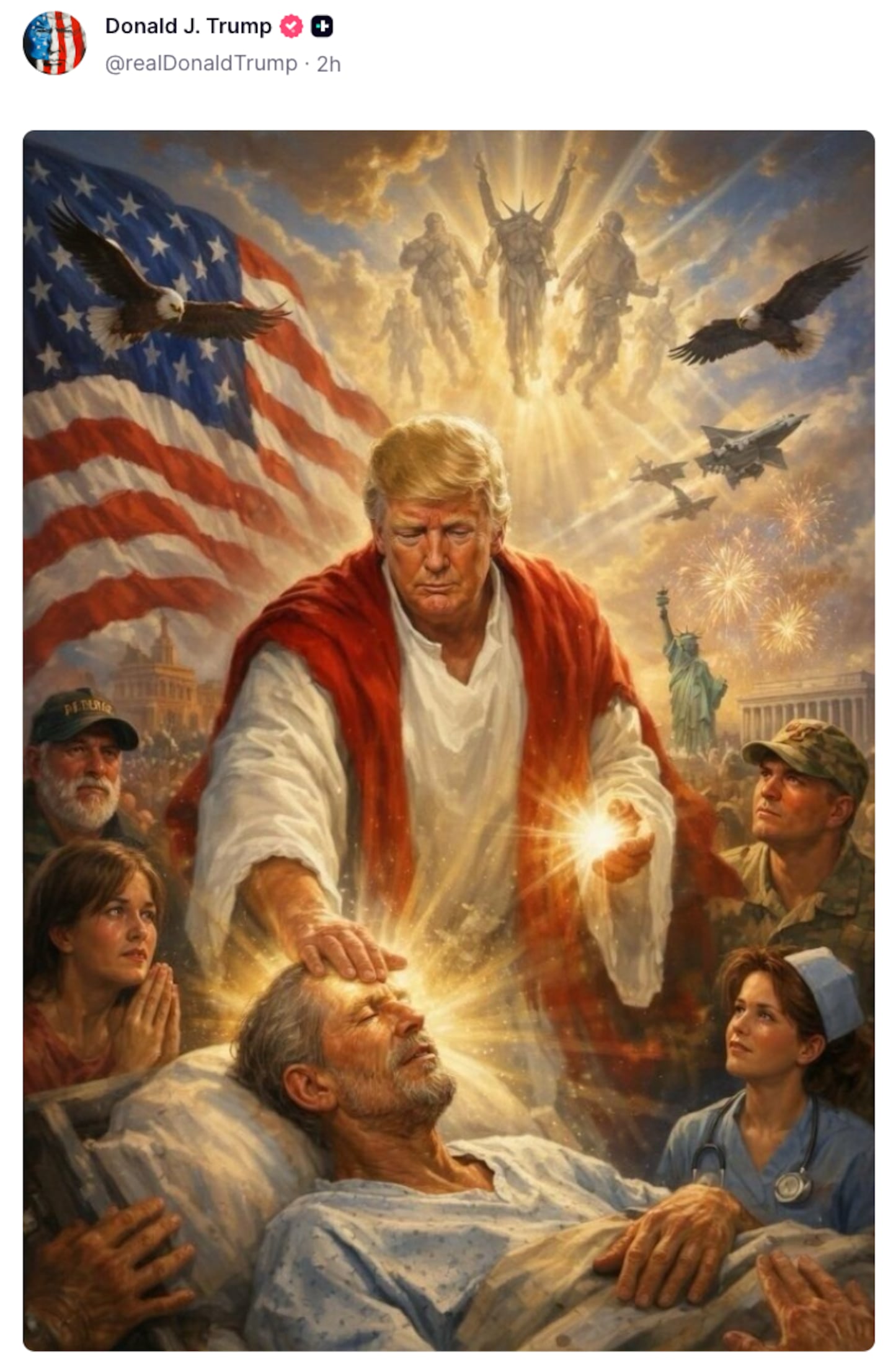
On Sunday night, President Donald J. Trump appeared to melt down on social media. In The Atlantic today, Tom Nichols noted that Trump’s “emotional state seems to be fraying: This weekend, he attacked Pope Leo XIV, presented himself as Jesus Christ, and then jabbed at his phone until dawn.” Nichols notes that after Trump attacked the Pope and portrayed himself as Jesus, he posted an AI version of a Trump Tower on the moon. (“Sure,” Nichols writes. “Why not?”)
Then Trump posted a meme of how senators Bernie Sanders (I-VT) and Chuck Schumer (D-NY), and former president Joe Biden all look old—unlike Trump—and then posted clips from Newsmax. The postings continued throughout the night. “This is not the behavior of a stable, healthy leader,” Nichols writes. “The American people must not look away…. They must pay attention to the president’s deterioration, and insist that the House and Senate start acting like functioning branches of the government by asking the White House to explain what is happening, without insults or evasions, before the eyes of the country and the world.”
Trump has tried to explain away the AI image he posted on social media on Sunday depicting himself as Jesus, clothed in robes, bathed in radiant light, and apparently healing a man in bed. After an extraordinary outcry over the image from his evangelical Christian followers, he took the image down, telling reporters “I thought it was me as a doctor” and claiming that “only the fake news” could suggest the image showed him as Jesus. He added: “I do make people better.”
With the House back in session today, Representative Jamie Raskin (D-MD), the top-ranking Democrat on the Judiciary Committee, introduced a bill to establish an independent commission to evaluate the president’s mental state. The Twenty-fifth Amendment to the Constitution establishes a process by which either a majority of the Cabinet or a majority of a body created by Congress to evaluate the president’s fitness can declare that a president is “unable to discharge the powers and duties of his office.” In a press release, Democrats on the House Judiciary Committee expressed concern about “Trump’s escalating erratic conduct.” The bill has fifty Democratic co-sponsors.
“Public trust in Donald Trump’s ability to meet the duties of his office has dropped to unprecedented lows as he threatens to destroy entire civilizations, unleashes chaos in the Middle East while violating Congressional war powers, aggressively insults the Pope of the Catholic Church and sends out artistic renderings online likening himself to Jesus Christ. We are at a dangerous precipice, and it is now a matter of national security for Congress to fulfill its responsibilities under the 25th Amendment to protect the American people from an increasingly volatile and unstable situation,” Raskin said in a statement.
Trump’s deteriorating mental state has become impossible to overlook, but Republicans are making excuses for it. Cabinet members, who owe their positions to Trump and who likely recognize they will never rise to such power again in a merit-based system, will probably not question Trump’s mental acuity. But Raskin’s measure will force Republicans in Congress either to vote for an independent commission to evaluate Trump or to own his increasingly erratic behavior themselves.
Today, when asked if he were comfortable with Trump’s threat of last week that an entire civilization would die if it did not meet his demands, Senate majority leader John Thune (R-SD) changed the subject by saying: “You’ve got to…look at what the president is doing, and I think right now he’s trying to open the Strait of Hormuz, which…we are all supportive of.” The strait was, of course, open before Trump attacked Iran.
The Lincoln Project accused Republicans of “ignoring Trump’s sharp mental decline the same way they’ve ignored his crimes.”
Trump’s erratic behavior has led the U.S. into disaster by striking Iran, which in turn attacked its neighbors and closed the Strait of Hormuz. After unsuccessfully bullying other nations to force Iran to reopen the strait to all ships, not just to those of certain nations, Trump last week declared a ceasefire and a framework for an agreement, then suggested the U.S. and Iran would together manage the strait. When Iran continued to maintain control of it, Trump announced the U.S. would blockade the strait to make sure no ships at all could cross through it, with the idea that the U.S. can withstand the economic pain that closure will cause for a longer time than Iran can.
Data released today show that wholesale inflation has risen to 4%, the highest annual rate in three years. Today Marta Pacheco of EuroNews reported that the last of the vessels that left the Strait of Hormuz before the U.S. and Israel struck Iran have reached Europe. Analysts expect a new surge in energy prices. In Talking Points Memo today, David Kurtz points out that the economic mess in which the U.S., and the world, finds itself is entirely Trump’s fault. The trade wars, unjustified war in the Middle East, and attacks on U.S. science, universities, and immigration that are throttling economic growth are all a product of Trump’s personal choices.
As the war enters its seventh week, Minority Leader Chuck Schumer said today that Senate Democrats will repeatedly force votes on war powers resolutions designed to force Trump to get congressional authorization before any further military action in Iran. “Forty-five days into this war, Congress has been sidelined because our Republican colleagues refuse to take a strong stand against this war and duck it completely because they’re afraid of Trump,” Schumer said today.
Thune and other Republicans countered with the belief that the war won’t go on much longer, and they support Trump’s actions.
Today former attorney general Pam Bondi was scheduled to testify under oath before the House Oversight and Reform Committee about the Department of Justice’s handling of the release of the Epstein files. The DOJ has released only about half of those files despite a law requiring it to produce them all no later than December 19 of last year. Many of the records it did release are heavily redacted, despite the very few and very specific conditions under which Congress allowed such redactions.
Bondi did not show up.
The Department of Justice is taking the position that since she was subpoenaed as attorney general and no longer holds that position, the subpoena was no longer in force.
Democrats on the committee disagree.
Representative Jasmine Crockett (D-TX), who was a prosecutor before she entered the House, posted: “Pam Bondi refused to show up for today’s Oversight deposition—defying our lawful subpoena. We couldn’t care less that she was fired from her job as Attorney General. She is responsible for leading the White House cover-up of the Epstein files. Since she didn’t show up, Oversight Democrats will move to hold her in contempt of Congress. The survivors deserve justice—and we will get answers. Enough is enough.”
Representative Robert Garcia (D-CA), the top Democrat on the Oversight Committee, told the Weeknight: “People have to be held accountable for the laws that we pass in the Congress and the subpoenas that we put in place.”
To have spent any amount of time observing President Trump over the last month is to conclude that he is in far over his head.
The president is struggling with the consequences of his actions, raging in protest of the fact that for all its firepower, the United States cannot bomb Tehran into submission. When Trump launched his “short-term excursion” into Iran, he assumed that it would be — in the words of a Pentagon official in the last Republican administration to launch a Middle East war — a “cakewalk.”
That, as Trump’s own intelligence agencies told him, was a mistake. Now, he is stuck. And he lacks the skill and patience to find a way out of his self-inflicted catastrophe. Unable to will a better outcome into existence — there are limits to the power of positive thinking — and frustrated by his own impotence, his response, familiar to anyone who must manage the emotions of a young child, is to throw a tantrum.
Over the last few days, Trump has denounced “the Fake News Media” as “CRAZY, or just plain CORRUPT!” for its reporting on the war. He attacked Pope Leo XIV in a bizarre rant calling him “WEAK on Crime” and “terrible for Foreign Policy.” And he posted an A.I. image of himself as Jesus, surrounded by devotees, healing an unnamed man.
This is not a man in control of himself, or a president in control of the situation around him.
I’ve written before about the irony of a strongman president so uninterested in governing that he has handed his power over to a handful of deputies. Trump’s behavior as he faces failure in Iran underscores another such irony.
Sign up for the Opinion Today newsletter Get expert analysis of the news and a guide to the big ideas shaping the world every weekday morning. Get it sent to your inbox.
Months before Trump won his second term, and well before he took office, the Supreme Court handed him the reins of the unitary executive — the promise of an active, energetic administration free of what the court deemed unnecessary constraints. The president has used this power to run wild, trampling over constitutional government. But he has also, at the same time, shown himself to be the weakest and most ineffectual president of recent memory, less a man of commanding authority than, well, a buffoon.
This is not to say that Trump has been an inconsequential president, that he hasn’t presided over the wholesale destruction of large parts of the federal government, or that he hasn’t turned the sharp edge of the state against the most vulnerable people in the country.
First under the Department of Government Efficiency and then under the direction of Russell Vought, director of the Office of Management and Budget, the administration summarily liquidated a number of key agencies, among them: the Consumer Financial Protection Bureau, the U.S. Agency for International Development, the United States Institute of Peace, the National Endowment for the Humanities and the Corporation for Public Broadcasting. Trump’s White House has also slashed hundreds of millions of dollars in taxpayer funding for new medicines and technologies in a crushing blow to scientific research in the United States.
Under the direction of Stephen Miller, a White House deputy chief of staff and the architect of the president’s deportation program, the administration has used its court-sanctioned authority to build a roving secret police of armed immigration agents, used both to terrorize the president’s political enemies and remove as many immigrants from the country as possible, regardless of legal status.
But these grim facts of Trump’s tenure should not blind us to the way his unilateral action betrays the weakness of his regime. Trump works almost exclusively through executive orders — presidential directives used to shape the priorities of the federal bureaucracy. This allows him to move quickly. But there are also limits to his reach. In areas where Trump cannot compel political actors to obey his demands — where there is no legal basis for his authority — he struggles to do anything of consequence.
Consider his effort to impose a new citizenship requirement for voting, as well as a national voter ID. He has issued two executive orders that purport to change federal elections to suit his demands. But neither has much in the way of legal force. Presidential power does not extend to election administration. There is the SAVE Act — a bill that would write these restrictions into law — but other than writing posts on his social media website, Trump has done little to nothing to push that bill through Congress.
He’s done little to nothing with Congress, period. He’s taken few, if any, steps to work with the supine Republican majority to consolidate his transformation of the executive branch through legislation. Some of this is no doubt strategy, with destruction as a fait accompli. But most of it reflects his inability to engage the legislative process. The weakness we see abroad is the weakness we see at home, and vice versa.
Politically, the president’s unilateralism has been a disaster. His universal tariffs — a vanity project as much as an economic program — are a drag on both the economy and his approval rating.
The same goes for his immigration policies, which also started with a broad assertion of executive authority. They then produced an enormous backlash from Americans under siege by ICE and Customs and Border Protection. The resistance in Minnesota in particular, underscored the extent to which the president cannot withstand significant pushback. And it ultimately forced him to fire his secretary of Homeland Security, Kristi Noem, sideline the face of his efforts, Greg Bovino, and execute a strategic retreat.
Nothing underscores Trump’s weakness as an executive more than the war in Iran. This is not to downplay the president’s decision to circumvent Congress and start a war without so much as a nod to democratic decision-making. It is the imperial project of a would-be authoritarian. But like many such projects throughout history, it is a showcase for the pathologies and dysfunctions of the regime in question. Initial operational success has given way to what is essentially a stalemate, with Trump screaming at the world, unwilling to do much else.
For as much as Trump is uniquely unsuited for the tremendous power of his office, it is also true that the idea of the unitary executive rests on a fundamental misunderstanding of the American political system. It imagines that government can be managed by a single figure, directing each part of the executive branch as an extension of his person. But the American system rests on consensus and collaboration. It depends on an active relationship between the three branches, each working to steer the affairs of a state and each entitled to its influence.
As weak as Trump is, it’s not clear that any president could unilaterally govern the country with any success. Even our strongest and most aggressive presidents — Franklin Roosevelt come to mind — worked in conjunction and cooperation with congressional majorities and allies within and outside the federal government. They understood that American governance was a partnership and that collaboration is necessary if one wants a durable and lasting legacy.
This raises what is already the most important question of the Trump years thus far: Will his legacy be durable and lasting? Does it represent a new template for American government going forward? Or is it more like an unfortunate detour into a dark alley?
There is a decent chance that Trump is the beginning of something, and not the end. But if we can escape these years intact and respond accordingly, we may find that Trump stands less as an example and more as a cautionary tale of what happens when you embraces unaccountable, unilateral authority.
In the end, it just doesn’t work.
This Is Not a Man in Control of Himself

{...]
The “masters of war” pretend not to acknowledge that “it only takes a moment to destroy, yet often a lifetime is not enough to rebuild.” The Pope lamented how those in power turn a blind eye to the billions of dollars spent on killing and devastation, “yet the resources needed for healing, education and restoration are nowhere to be found.”
[...]
The Holy Father called for “a decisive change of course – a true conversion – that will lead us in the opposite direction, onto a sustainable path rich in human fraternity.” The world is “being ravaged by a handful of tyrants, yet it is held together by a multitude of supportive brothers and sisters.”
On the evening of April 14, 1865, President Abraham Lincoln and First Lady Mary Todd Lincoln went to Ford’s Theater in Washington, D.C., to see a production of the comedy Our American Cousin. The Lincolns had spent the afternoon taking a carriage ride together and discussing the future, including the travel they hoped for, to Europe and to California to see the Pacific Ocean.
One of the last men to speak with the president before he left for the theater said it seemed the cares of the previous four years were melting away. The Confederacy was all but defeated, and the nation seemed to be on its way to a prosperous, inclusive new future.
The very heavens seemed to reflect the dawn of a new era. Poet Walt Whitman noted that after months of fog and clouds, the weather had cleared. “The western star, Venus, in the earlier hours of evening, has never been so large, so clear,” he wrote. “It seems as if it told something as if it held rapport indulgent with humanity, with us Americans.”
When the Lincolns and their guests arrived at the theater at about 8:30, the people in the audience leaped to their feet to applaud and the actors stopped the production while the orchestra played “Hail to the Chief.” About a half-hour later, the president felt chilly and put on his overcoat but was clearly relaxed and enjoying the play. Shortly after 10:00 the Lincolns were holding hands, and Mrs. Lincoln worried their public affection would scandalize the young Clara Harris, daughter of New York senator Ira Harris, who shared their box with her fiance, Major Henry Rathbone. Mrs. Lincoln whispered to her husband that she wondered what Clara would think of them holding hands, and Lincoln answered: “She won’t think anything about it.”
They would be the last words he ever spoke. On the stage, the play had just reached its best joke, and as the audience roared with laughter, actor John Wilkes Booth entered the presidential box and shot Lincoln in the head, then slashed Rathbone’s arm as the officer tried to stop him from getting away. He jumped to the stage, breaking his leg, and shouted the state motto of Virginia, “Sic Semper Tyrannis,” thus always to tyrants.
As Booth escaped, news spread that Secretary of State William Henry Seward had also been attacked, and in the days to follow, the euphoria of the last days of the war gave way to grief. The windows in Washington, D.C., were hung with black garlands. And then the rain came back. In New York City, Whitman wrote in his diary: “Lincoln’s death—black, black, black—as you look toward the sky—long broad black like great serpents slowly undulating in every direction—New York is distinguished for its countless gay flags—every house seems to have a flag staff—on all these the colors were at half mast.”
At first, Americans wanted revenge against the men who had slain their president. After a two-week investigation in which they questioned hundreds of people, investigators identified ten people they believed responsible for Lincoln’s death. Booth himself had been killed on April 26 as officers tried to take him into custody. Another conspirator had fled the country. The other eight stood trial for seven weeks before a military commission in May and June 1865. Four were sentenced to death by hanging; four were imprisoned.
But while Americans mourned Lincoln, the new president, Andrew Johnson, restored the political power of Confederates. On May 28, he issued a blanket pardon for most former Confederates except certain leaders and wealthy southern planters. Those he said could apply to him directly for a presidential pardon, which he promised would be “liberally extended.” They were. By December 1865 he had pardoned all but about 1,500 former Confederate leaders.
At the same time, Johnson either looked the other way or cheered as southern state legislatures passed Black Codes, laws that worked to push Black Americans back into subservience. Congress had adjourned in March 1865, the day of Lincoln’s second inauguration, and Johnson refused to call it back into emergency session after Lincoln’s death. When it convened in December, Johnson told the congressmen that Reconstruction was over. Northern congressmen simply had to seat newly elected southern congressmen—some of whom had led the Confederacy less than a year before—to end the unpleasantness of the war years.
Congress fought back, trying to protect the principles for which Lincoln had died, but with no accountability for a war that had left 620,000 Americans dead and cost more than $5 billion, the ideas of the Confederacy never became odious. Former Confederates still talked to newspapermen, gave speeches, ran for office, and garnered support.
By the 1870s, after the establishment of the Department of Justice meant that discrimination based on race could result in federal charges, former Confederates switched their rhetoric from race to economics. Because most Black men were impoverished, their votes for roads and schools and hospitals translated into tax levies on white men with property. Former Confederates argued that Black voting was just a redistribution of wealth from white taxpayers to Black Americans, a form of socialism.
That rhetoric appealed to northern Americans who worried about immigrants voting in cities. Increasingly, they listened as former Confederates began to argue that their fight had not been to spread human enslavement—despite their many declarations saying exactly that—but to preserve individualism from a grasping federal government.
By the 1890s, towns not only across the South but also in the North and West were putting up statues of Confederate soldiers as symbols of true America.
In the 1930s, with the southern economy dependent on New Deal programs from the federal government, Confederate iconography fell out of sight, but it sprang back to popularity after President Harry S. Truman, a Democrat, ordered the integration of the U.S. military in 1948. That year, the Democratic Party split in two as half of the party followed Truman and half refused. Southern racists under then–South Carolina governor Strom Thurmond—who had fathered the child of his family’s teenaged Black housekeeper in 1925—formed the segregationist States Rights Democratic Party, called “Dixiecrat” in a play on the South’s nickname, and took the Confederate battle flag as their party flag.
The ruling of a unanimous Supreme Court that racial segregation in the public schools was unconstitutional in the May 1954 Brown v. Board of Education of Topeka, Kansas, decision resurrected Confederate ideology more widely. In Georgia the Ku Klux Klan had reformed near Stone Mountain outside of Atlanta in the early twentieth century, and the United Daughters of the Confederacy set out to create a giant carving of Confederate leaders on the side of the mountain. The plan had been abandoned by 1928 as interest in the project waned, but it was reborn after Brown v. Board. Vice President Spiro Agnew dedicated the monument, which features Confederate leaders Jefferson Davis, Robert E. Lee, and Stonewall Jackson, in May 1970.
The idea that those embracing the iconography of the Confederacy were simply defending individual liberty against an overreaching government became an article of faith among the radical right, especially as the Republican Party complained that the taxes necessary to run a modern government that included everyone were promoting socialism.
Former Army gunner Timothy McVeigh wrote to a newspaper in 1992, saying: “Taxes are a joke. More taxes are always the answer to government mismanagement…. Is a Civil War Imminent? Do we have to shed blood to reform the current system? I hope it doesn’t come to that. But it might.”. Three years later, McVeigh set off a bomb at the Alfred P. Murrah Federal Building in Oklahoma City, Oklahoma, killing 168 people, including nineteen children younger than six, and wounding more than 800 others. When captured, he was wearing a T-shirt with a picture of Abraham Lincoln and the words “Sic Semper Tyrannis.”
In 2009, Elmer Stewart Rhodes, a lawyer and former paratrooper who had been a staffer for Representative Ron Paul (R-TX), started a right-wing gang called the “Oath Keepers.” Claiming to take their inspiration from the patriots who stood against the British regulars on Lexington Green in 1775, they pledged to stand against what they considered a tyrannical government.
In 2021, Rhodes and the Oath Keepers, along with the right-wing Proud Boys, were part of the planning and execution of the January 6 attack on the U.S. Capitol when they tried to stop the counting of the electoral votes that would make Democrat Joe Biden president. Biden had won both the electoral vote and the popular vote by more than 7 million votes, but the insurrectionists wanted their own leader, President Donald Trump, to stay in office. One of the rioters accomplished what the southern troops during the Civil War had never been able to: he carried the Confederate flag into the United States Capitol.
In November 2022 a federal jury convicted Rhodes of seditious conspiracy for using force and violence to try to stop the process of the democratic election of a president. Juries found at least a dozen other Oath Keepers guilty of seditious conspiracy or other serious crimes.
As soon as he retook office in 2025, Trump issued a sweeping pardon to the participants in the January 6 attack who had been convicted of crimes, including the crimes of using a deadly weapon and causing serious bodily injury to an officer, removing accountability for their attempt to overturn the nation’s democratic process and releasing them back into the streets. At the time, he commuted the sentence of fourteen of the leading Oath Keepers and Proud Boys, ending prison sentences that had been as long as 22 years.
Because he did not pardon those leaders, but commuted their sentences, their cases continued to work their way through the appeals court. Yesterday the Department of Justice moved to wipe out the seditious conspiracy convictions altogether. “The United States has determined in its prosecutorial discretion that dismissal of this criminal case is in the interests of justice,” Assistant U.S. Attorney Daniel Lenerz of the U.S. Attorney’s Office in Washington, D.C., wrote.
Exactly 161 years before, on the night of April 14, 1865, bystanders at Ford’s Theater had carried the grievously wounded Lincoln to a boardinghouse across the street, where members of his Cabinet crowded around his bed. At 7:22 on the morning of April 15, 1865, President Abraham Lincoln breathed his last. His secretary of war, Edwin Stanton, stood heartbroken by the bedside of the man who had tried to preserve American democracy and said, “Now he belongs to the ages.”
When he tried to put his own loss, and that of the nation, to poetry, Walt Whitman thought back to the heady days of Spring 1865 when the heavens themselves seemed to promise a glorious democratic future, and their contrast to what came after.
“When lilacs last in the dooryard bloom’d,” he wrote, “And the great star early droop’d in the western sky in the night,
“I mourn’d, and yet shall mourn with ever-returning spring.”
Congress is back in session, and there is a frantic feel in the air. Republicans appear to be assessing the fall of Hungarian prime minister Victor Orbán, Trump’s increasingly erratic behavior along with his abysmal job approval numbers, rising prices, and an unpopular war in Iran that currently does not appear to have a solution that will not result in the U.S. losing face.
In Hungary, incoming prime minister Péter Magyar is setting a bar as he appears to want no part of playing business as usual with Orbán’s cronies. A center-right politician, Magyar appeared as a guest on state television after his party’s dramatic win—Orbán’s state media had not let him appear on it before the election—and said he intended to suspend the station’s news service because state media does not provide the journalism that the country deserves. He said that he would end the state subsidies for Orbán’s right-wing-allied university and that Hungarian president Tamas Sulyok, a close ally of Orbán, was “unfit to serve as the guardian of legality” and “must leave office immediately.”
Republicans appear to be trying to grab all the turf they can before the midterm elections.
Today the Senate passed House Joint Resolution 140, a bill that overturns a 20-year mining ban upstream from the Boundary Waters Canoe Area Wilderness (BWCA) in Minnesota. Representative Pete Stauber (R-MN) introduced the measure, which passed the House in January. It clears the way for a subsidiary of Chilean mining giant Antofagasta to engage in copper-sulfide mining, which produces sulfuric acid, above the pristine BWCA. Those waters include 1,175 lakes and over 1,200 miles of rivers and streams. According to outdoor writer Wes Siler, about 165,000 people visit the BWCA annually, generating $1.1 billion in economic activity and supporting 17,000 jobs.
The Republicans’ attack on the BWCA for the benefit of a foreign billionaire feeds President Donald J. Trump’s ongoing crusade against Minnesota. Trump’s secretary of transportation, Sean Duffy, is targeting New York today as well, saying that the federal government will withhold $73.5 million from the state because it has refused to review the commercial driver’s licenses of almost 33,000 immigrants. New York officials say they are complying with federal law.
Trump is also continuing to try to exert his personal power over the government, threatening again to fire Federal Reserve chair Jerome Powell, whose term as chair ends in May but who has said he will continue on the board until the administration drops its trumped-up criminal investigation of him over alleged cost overruns on the renovations of Treasury buildings.
As Jacob Rosen and Olivia Gazis of CBS News noted, Director of National Intelligence Tulsi Gabbard is supporting Trump’s attacks on those he perceives to be his enemies by sending to the Department of Justice two criminal referrals yesterday. One is for the former government official who was the whistleblower over the July 2019 phone call in which Trump told Ukraine president Volodymyr Zelensky he would release money the U.S. Congress had appropriated for Ukraine’s defense against Russia’s 2014 incursion…but only after Zelensky did him the “favor” of smearing Democratic presidential candidate Joe Biden.
The whistleblower told the intelligence community inspector general: “I have received information from multiple U.S. Government officials that the President of the United States is using the power of his office to solicit interference from a foreign country in the 2020 U.S. election. This interference includes, among other things, pressuring a foreign country to investigate one of the President’s main domestic political rivals.”
Gabbard’s second referral is for the inspector general, Michael Atkinson, who found the complaint “credible” and “urgent” and set in motion the process of sharing it with the congressional intelligence committees, which led to Trump’s first impeachment.
As Representative Jim Himes (D-CT), the top-ranking Democrat on the House Intelligence Committee, noted, the effort to criminalize whistleblowing from 2019 for what was Trump’s well-established behavior is most likely an attempt to chill future whistleblower complaints.
There certainly appears to be concern on the part of MAGA loyalists that they are in danger of losing power, and that might mean legal repercussions. Testifying before the Senate Budget Committee today, Director of Office of Management and Budget Russell Vought denied that he had held back funds Congress had appropriated. Doing so is called “impoundment,” and it is illegal, but the administration has been engaged in it since it took office in January 2025.
Vought is a Christian nationalist and a key author of Project 2025, which sets out to dismantle the federal government. Today Vought said his job was to make sure money was spent “consistent with our agenda.” Senator Jeff Merkley (D-OR) told Emine Yücel of Talking Points Memo: “They absolutely impounded. He just lied to America.” “He has no respect for the American Constitution and the separation of powers,” Merkley said. “This is an authoritarian government operating as if the president is king. And if we want to save our democracy, we have to save ourselves from the strategy that Mr. Vought implemented.” Republican senator Chuck Grassley (IA) also reminded Vought: “Congress has appropriated money, and you don’t have the authority to impound it.”
Today Representative Thomas Massie (R-KY) posted on social media that an opinion from the Foreign Intelligence Surveillance Court, which reviews and approves surveillance warrants against foreign actors and agents in the U.S., “raises serious concerns about FBI implementation of FISA 702,” the law that allows warrantless surveillance. Senator Ron Wyden (D-OR) reposted Massie’s comment and added that he, Wyden, has sent “a classified letter to House and Senate colleagues about a secret interpretation of surveillance law that every American should be concerned about.”
This exchange seems to suggest that FBI director Kash Patel has authorized FBI agents to use surveillance on Americans without a warrant, illegally.
Churchill Ndonwie of the Miami Herald and Garrett Shanley of the Times/Herald Tallahassee Bureau reported yesterday that attorneys for the immigrants being held at the Florida detention center called “Alligator Alcatraz” said in court that after a judge protected the detainees’ right to use their phone and access their lawyers, the guards cut off their access to phones and beat and pepper-sprayed detainees, openly defying court orders to respect their civil rights. The facility is operated by the Florida Division of Emergency Management but must operate according to Department of Homeland Security standards.
Prosecutors in Minnesota today charged Immigration and Customs Enforcement officer Gregory Donnell Morgan Jr. with two counts of second-degree assault after he pulled alongside a car on a highway in Minnesota and pulled a gun on the occupants. There is a nationwide warrant for his arrest. Hennepin County Attorney Mary Moriarty told reporters: “There is no such thing as absolute immunity for federal agents who violate the law in the state of Minnesota.”
Today the new Department of Homeland Security secretary, Markwayne Mullin, announced that acting director of ICE Todd Lyons will be leaving his position at the end of May. Illinois governor J.B. Pritzker posted: “Todd Lyons led a secret police force for Trump where masked agents attacked our own American streets, violated Constitutional rights, and shot our own citizens. We’ll hold you accountable too.”
Josh Kovensky of Talking Points Memo noted that in their panic over polls and the popularity of Democratic candidates, Republicans are trying to reclaim their base by turning back to Islamophobia and hoping a culture war will drown out concerns about gas prices, corruption, the Iran war, and Trump’s erratic behavior. Representative Andy Ogles (R-TN) posted that Muslims—who first came to the American colonies in the early 1600s, by the way—“don’t belong in American society,” and House speaker Mike Johnson (R-LA) called “the demand to impose Sharia Law in America…a serious problem.”
But there are signs that Trump is weakened enough that even past supporters are sliding away. At the beginning of his administration, Trump favored Chinese billionaire Justin Sun, who flattered Trump and poured as much as $90 million into the Trump family’s cryptocurrency ventures, becoming one of the largest investors in World Liberty Financial, founded by Trump’s sons. The Securities and Exchange Commission had sued Sun for securities and market manipulation in 2023, but in March 2026 it quietly settled the lawsuit for a payment of a $10 million fine.
On Tuesday, Sun accused Trump’s World Liberty Financial of setting up a trapdoor that allows company officers to freeze accounts. Sun says he has been unable to sell since September 2025, a freeze that a blockchain tracking group says has cost Sun about $80 million. On social media, Sun called out “the bad actors at [World Liberty Financial].”
According to Rob Wile of NBC News, World Liberty Financial responded by suggesting Sun himself had engaged in misconduct. “See you in court pal,” it posted.
Saudi Arabia’s Public Investment Fund, a sovereign wealth fund, was reviewing its investments even before the Iran war hit its finances, and yesterday Andrew Beaton of the Wall Street Journal reported that it is “on the verge of pulling” its funding from LIV Golf, the rival to the PGA Tour it launched with Trump’s blessing—and mostly on his golf courses—in 2022.
Meanwhile, Trump posted four screeds about the proposed White House ballroom today after U.S. District Judge Richard Leon, appointed by Republican president George W. Bush, stopped its above-ground construction but permitted construction of the below-ground bunker to continue. In one of his missives, Trump complained:
“The White House doesn’t have a Ballroom (No Taxpayer Money!), which Presidents have desperately wanted and desired for over 150 years, but a Trump Hating, Washington, D.C. District Court Judge, a man who has gone out of his way to undermine National Security, and to make sure that this Great Gift to America gets delayed, or doesn’t get built, is attempting to prevent future Presidents and World Leaders from having a safe and secure large scale Meeting Place, or Ballroom, one with Bomb Shelters, a State of the Art Hospital and Medical Facilities, Protective Partitioning, Top Secret Military Installations, Structures, and Equipment, Protective Missile Resistant Steel, Columns, Roofs, and Beams, Drone Proof Ceilings and Roofs, Military Grade Venting, and Bullet, Ballistic, and Blast Proof Glass—which all means that no future President, living in the White House without this Ballroom, can ever be Safe and Secure at Events, Future Inaugurations, or Global Summits. This Magnificent Space will allow them to carry out their vital duties as the Leader of our Nation. Furthermore, the Ballroom, which is being constructed on budget and ahead of schedule, is needed now. Almost all material necessary for its construction is being built and/or on its way to the site, ready for installation and erection. Much of it has already been paid for, costing Hundreds of Millions of Dollars. If somebody, especially one with no standing, had a complaint—Why wasn’t it filed many months earlier, long before Construction was started? The Public Record was open for all to see. Everybody knew that it was planned, and going to be built. This highly political Judge, and his illegal overreach, is out of control, and costing our Nation greatly. This is a mockery to our Court System! The Ballroom is deeply important to our National Security, and no Judge can be allowed to stop this Historic and Militarily Imperative Project. Thank you for your attention to this matter! President DONALD J. TRUMP”