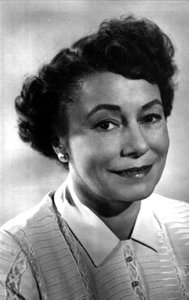
Jack Benny
From Wikipedia, the free encyclopedia
Born
February 14, 1894
Chicago, Illinois, USA
Died
December 26, 1974
Los Angeles, California, USA
Jack Benny (born Benjamin Kubelsky, February 14, 1894 - December 26, 1974), an American comedian, vaudeville performer, and radio, television, and film actor, was arguably the biggest star in classic American radio and was also a major television attraction.
He may have been the first standup comedian as the term is known, as well as one of the first to work with what became the situation comedy; he was renowned for his flawless comic timing and (especially) his ability to get laughs with either a pregnant pause or a single expression. In hand with his great "rival" Fred Allen ?- their long-running "feud" was one of the greatest running gags in comedy history ?- Jack Benny on radio helped establish a basic palette from which comedy since has rarely deviated, no matter how extreme or experimental it has become in their wake.
Early career
Benny grew up in Chicago and Waukegan, Illinois, the son of a Jewish saloon keeper. He began studying the violin, an instrument that would become his trademark, when he was six. By fourteen, he was playing in local dance bands as well as in his high school orchestra. After he found an opportunity to play the instrument in local theaters for $8 a week, he quit school and eventually began a career in vaudeville.
In 1911, he was playing in the same theater as the young Marx Brothers, whose mother was so enchanted with Benny that she invited him to be their permanent accompanist. The plan was foiled by Benny's parents, who refused to let their son, then seventeen, go on the road, but it was the beginning of his long friendship with Zeppo Marx.
The following year, Benny formed a vaudeville musical duo with pianist Cora Salisbury. This provoked famous violinist Jan Kubelik, who thought that the young vaudeville entertainer with a similar name (Kubelsky) would damage his reputation. Finally, Benjamin Kubelsky agreed to change his name to Ben K. Benny (sometimes spelled Bennie). He also found a new pianist, Lyman Woods. He left show business briefly in 1917 to join the Navy during World War I, but even then, he often entertained the troops. One evening, he was booed by the troops, so he began telling Navy jokes on stage. He was a big hit, earning himself a reputation as a comedian as well as a musician.
After the war, Benny returned to vaudeville and changed his first name to Jack. He had several romantic encounters, including with a dancer, Mary Kelly, whose devoutly Catholic family forced her to turn down Benny's proposal because he was Jewish. In 1922, he accompanied Zeppo Marx to a Passover seder where he met Sadie Marks, whom he married in 1927. Adopting the stage name Mary Livingstone, she became Benny's collaborator throughout most of his career. They had an adopted daughter, Joan.
Radio
Benny had been only a minor vaudeville star, but he became an enormously successful national figure with The Jack Benny Program, a weekly radio show which ran from 1932 to 1948 on NBC and from 1948 to 1955 on CBS, and was consistently among the most highly rated programs during most of that run, often as not proving to be the highest rated program in radio.
The Characters
Benny's stage character was a clever inversion of his actual self. Though the character was Jack Benny, he was also just about everything Benny himself wasn't. The character was cheap, petty, vain, and self-congratulatory, and all these elements remained vital to the character even though the skinflint aspect became the linchpin to the Benny show's overall humour. Benny set himself up as the foil as much as the primary laughgetter, allowing his supporting characters to draw laughs at the expense of his stinginess, vanity, and pettiness. And, by allowing such a character to be seen almost completely as human and vulnerable, in an era where very few male characters with or without such vanities allowed that kind of vulnerability to be that obvious, Benny made what should have been a despicable character into a kind of Everyman character.
The supporting characters who amplified that vulnerability only too gladly included wife Mary Livingstone as his wisecracking and not especially deferential steady girl friend (as the saying went in those years); rotund announcer Don Wilson (who also served as announcer for Fanny Brice's hit, Baby Snooks); bandleader Phil Harris as a jive-talking, wine-and-women type whose repartee was rather risque for its time (Harris and Mahlon Merrick shared the actual musical chores of the show); boy tenor Dennis Day, who was cast as a sheltered, naive youth who still got the better of his boss as often as not; and, especially, Eddie Anderson as valet-chauffeur Rochester van Jones ?- who was practically as popular as Benny himself.
And that was itself a radical proposition for the era: unlike the protagonists of Amos 'n' Andy, Rochester was a black man portrayed by an actual African-American ... and, by being allowed to one-up his skinflint, vain boss in more ways than one, with his mock-befuddled one-liners and his sharp retorts, he broke a barrier down for his race. Unlike many African-American supporting characters of the time, Rochester was depicted and treated as a regular member of Benny's fictional household; Benny, in character, tended if anything to treat Rochester more like an equal partner than a hired domestic (even though gags about Rochester's flimsy salary were a regular part of the show), while Rochester seemed to see right through his boss's vanities and knew how to prick them without overdoing it. Benny deserves credit for allowing this character and the actor who played him (it's difficult if not impossible to picture any other performer giving Rochester what Anderson gave him) to transcend the era's racial stereotype and for not discouraging his near-equal popularity. A New Year's Eve episode, in particular, shows the love each performer had for the other, quietly toasting each other with champagne.
Other cast included character actors Sheldon Leonard (later a hugely successful televison producer and creator), Joseph Kearns (best remembered as cantankerous Mr. Wilson on the television version of Dennis the Menace), Frank Nelson, singer/bandleader Bob Crosby (who succeeded Phil Harris when Harris entered the Navy during World War II), and the remarkably versatile Mel Blanc, who provided several characters' voices, as well as the famous sound of Benny's aging auto, an early century Maxwell that was always on the verge of collapsing with a phat-phat-bang! Blanc is probably remembered best, however, as Benny's perpetually frustrated violin teacher, who was as likely to throw his own and Benny's instrument into the fireplace as he was to have a nervous breakdown before he was out the door. Other musical contributions came in later years from a singing quartet known as the Sportsmen.
The Situations
The Jack Benny Program evolved from a variety show blending sketch comedy and musical interludes into the situation comedy form we know even now, crafting particular situations and scenarios from the fictionalization of Benny the radio star. Anything, from hosting a party to Christmas shopping, to income tax time to a night on the town, was good for a Benny show situation, and somehow the writers and star would find the right ways and places to insert musical interludes from Phil Harris and Dennis Day. (With Day, invariably, it would be a brief sketch that ended with Benny ordering Day to sing the song he planned to do on that week's show.)
In 1936, after a few years broadcasting from New York, Benny moved the show to Los Angeles, allowing him to bring in guests from among his show business friends - guests as diverse as Frank Sinatra, James Stewart, Barbara Stanwyck, Bing Crosby, Burns & Allen (Benny's best friend in show business was probably George Burns), and many others. Orson Welles, Burns & Allen, and other stars guest hosted several episodes in March and April of 1943 when Benny was seriously ill with pneumonia, while Ronald Colman and his wife Benita Hume appeared frequently in the 1940s as Benny's neighbors.
The Sponsors
In the early days of radio (and in the early television era, often as not), the airtime was owned by the sponsor, and Benny made a point of incorporating the commercials into the body of the show. Sometimes the sponsors were the butt of jokes, though Benny didn't deploy this device as frequently as his friend and "rival" Fred Allen did at the time, or his cast member Phil Harris later did on his own successful radio sitcom.
In fact, the show wasn't officially called The Jack Benny Program for many years; usually, the primary name of the show tied to the sponsor. Benny's first sponsor was Canada Dry Ginger Ale from 1932 to 1933, Chevrolet from 1933 to 1934, General Tire in 1934, and Jell-O from 1934 to 1942. The Jell-O Show Starring Jack Benny was so successful in selling Jell-O, in fact, that General Foods could not manufacture it fast enough when sugar shortages arose in the early years of World War II, and the company had to stop advertising the popular dessert mix. General Foods switched the Benny program from Jell-O to Grape Nuts and Grape Nuts Flakes cereals from 1942 to 1944, and it became, naturally, The Grape Nuts Show Starring Jack Benny. Benny's longest-running sponsor, however, was the American Tobacco Company's Lucky Strike cigarettes, from 1944 to 1955, and it was during Lucky Strike's sponsorship that the show became, at last, The Jack Benny Program once and for all.
The Writers
Benny was notable for employing a small group of writers, most of whom stayed with him for many years. This was very much in contrast to other successful radio or television comedians, such as Bob Hope, who would change writers frequently. Historical accounts (like those by longtime Benny writer Milt Josefsberg) indicate that Benny's role, like that of Fred Allen, was essentially that of both head writer and director of his radio programs, though he was not credited in either capacity.
During his early radio shows, Benny adopted a medley of "Yankee Doodle Dandy" and "Love in Bloom" as his theme song, opening every show. The latter song later became the theme of his television show as well. His radio shows often ended with the orchestra playing "Hooray for Hollywood."
"I'm thinking it over!"
A master of the carefully timed, pregnant pause, Benny and his writers used it to set up perhaps the longest laugh in radio history, in a sketch calling for a street robber to accost Benny, demanding, "Your money or your life!" Benny paused, and the studio audience - knowing his skinflint character - laughed loud and long. The robber then repeated his demand: "Look, pal! I said your money or your life!" And that's when Benny snapped back without a break, "I'm thinking it over!" This time, the audience laughed louder and longer than they had during the pause.
The punchline came forth almost by accident. During the writing sessions for this episode, Benny and crew agonized over the scene, stuck for a punchline to the second "Your money or your life!", when one of the writers prodded another who had been particularly quiet. "I'm thinking it over," the second writer replied - and, at once, Benny and his staff burst out laughing. They had found the skinflint the perfect punch line.
The Benny-Allen "Feud"
In 1937 Benny began his famous radio "feud" with rival Fred Allen. Allen kicked the "feud" off on his own show, after a child violinist gave a performance credible enough that Allen wisecracked about "a certain alleged violinist" who should by comparison be ashamed of himself. Benny - who either listened to the Allen show or was told about the crack - answered in kind on his own show, and the two comedians (who were actually good friends in real life) were off. For a decade, the two went at it back and forth, so convincingly that fans of either show could have been forgiven for believing they had become blood enemies. But Benny and Allen often appeared on each other's show during the thick of the "feud"; a very close listening should show that, often as not, when one guested on the other's show the guest usually got the better laugh-lines.
Perhaps the climax of the "feud" came during Fred Allen's hilarious (and brilliant) parody of popular quiz-and-prize show Queen for a Day, which was barely a year old when Allen decided to have a crack at it. Calling the sketch "King for a Day," Allen played the host and Benny a contestant who snuck onto the show under an assumed identity. Benny answered the prize-winning question correctly and Allen crowned him "king" and showered him with a passel of almost meaningless prizes, climaxing when a professional pressing-iron was wheeled on stage to press Benny's suit properly. The problem: Benny was still in the suit. Allen instructed his aides to remove Benny's suit, one item at a time, ending with his trousers, each garment's removal provoking louder laughter from the studio audience. As his trousers began to come off, Benny howled, "Allen, you haven't seen the end of me!" At once Allen shot back, "It won't be long now!"
The laughter was so loud and chaotic at the chain of events that the Allen show announcer, Kenny Delmar, was cut off the air while trying to read a final commercial and the show's credits. Allen, who was notorious for running overtime thanks to his ad-lib virtuosity, had overrun the clock again.
The Great CBS Talent Raid
While Benny was top of the proverbial heap on NBC, CBS czar William S. Paley cast a hungry eye upon the comedian. Paley apparently had good reason to believe Benny could be had: he learned that NBC refused to deal with Benny in terms of buying Benny's holding company package (a tax break major entertainers usually enjoyed in those years), since "Jack Benny" was the star's real name. Paley reached out to Benny and offered him a deal that would allow that package-buy - a tremendous capital gains tax break for Benny at a time when World War II had meant taxes as high as 90% at certain high income levels.
But Paley, according to CBS historiographer Robert Metz, also learned that Benny chafed under what he came to see as NBC's almost indifferent attitude toward the talent that brought the listeners. NBC, under the leadership of David Sarnoff, seemed at the time to think that listeners were listening to NBC because of NBC itself. To Paley, according to Metz, that was foolish thinking at best: Paley believed listeners were listening because of the talent, not because of which platform hosted them. When Paley said as much to Benny, the comedian agreed. Because Paley also took a personal interest in the Benny negotiations, as opposed to Sarnoff (who had actually never met his top-rated star), Benny was convinced at last to make the jump - and, in turn, he convinced a number of his fellow NBC performers (notably Burns & Allen and Kate Smith) to join him.
To sweeten the deal for a very nervous sponsor, Paley also agreed to make up the difference to American Tobacco if Benny's Hooper rating (the radio version of today's Nielsens) on CBS fell a certain level below his best NBC Hooper rating. But Benny's CBS debut bested his top NBC rating by several points. NBC, for its part, its smash Sunday night lineup now broken up in earnest, became nervous enough to offer prompt and lucrative new deals to two of those Sunday night hits, The Fred Allen Show and The Phil Harris-Alice Faye Show (Benny's former bandleader and his singing actress wife now starred in their own hit sitcom), before they, too, got any ideas about jumping ship.
The ironic postscript, according to Metz: Benny and Sarnoff finally met, several years later, and became good friends, with Benny saying that if he could have had this kind of relationship with Sarnoff all those years earlier, when he was Sarnoff's number one radio star, he never would have left NBC in the first place.
Television
The television version of The Jack Benny Program ran from October 28, 1950 to 1965. The show appeared infrequently during its first two years on TV, then ran every fourth week for the next two years. From 1955 to 1960 it appeared every other week, and from 1960 to 1965 it was seen weekly. (During the years it overlapped the old radio show, in fact, the radio show alluded frequently to the television show. Often as not, Benny would sign off the radio show in such circumstances with a line like, "Well, good night, folks. I'll see you on television.")
When Benny moved to television, audiences learned that his verbal talent was matched by his assortment of facial expressions and physical gestures. The program was similar to the radio show (several of the radio scripts were recycled for television, as was somewhat common with other radio shows that moved to television) but with the addition of visual gags. Lucky Strike was the sponsor. But the television viewers learned to live without Mary Livingstone, who was afflicted by a striking case of stage fright - after she had been in show business for many years already. Livingstone appeared rarely if at all on the television show (for the last few years of the radio show, she pre-recorded her lines and the Bennys' daughter, Joan, stood in for the live broadcast as the pre-recordings were played), and finally retired from show business permanently in 1958.
In due course the ratings game finally got to Benny, too. CBS dropped the show in 1964, citing Benny's lack of appeal to the younger demographic the network began courting, and he went to NBC, his original network, in the fall, only to be out-rated by CBS's Gomer Pyle, U.S.M.C. NBC dropped Benny at the end of the season, though he continued to make periodic specials into the 1970s.
In fairness, Benny himself shared Fred Allen's ambivalence about television, though not quite to Allen's extent. "By my second year in television, I saw that the camera was a man-eating monster," Benny wrote in his posthumously published memoir, Sunday Nights at Seven, which his daughter, Joan, finished after his death. "It gave a performer close-up exposure that, week after week, threatened his existence as an interesting entertainer."
Movies
Benny also acted in movies, including the Academy Award-winning The Hollywood Revue of 1929, Broadway Melody of 1936 (as a benign nemesis for Eleanor Powell and Robert Taylor), and notably, Charley's Aunt (1941) and To Be or Not to Be (1942). The failure of one Benny vehicle, The Horn Blows at Midnight, became a running gag on his radio program.
Benny also was caricatured in several Warner Brothers cartoons including Daffy Duck and the Dinosaur (1939, as Caspar the Caveman), Slap-Happy Pappy (1940, as Jack Bunny), Malibu Beach Party (1940, as himself), and The Mouse That Jack Built (1959). The last of these is probably the most memorable: animation giant Chuck Jones engaged Benny and his actual cast (Mary Livingstone, Eddie Anderson and Don Wilson) to do the voices for the mouse versions of their characters, with Mel Blanc - the usual Warner Brothers cartoon voicemeister - reprising his old vocal turn as the always-aging Maxwell, always a phat-phat-bang! away from collapse. In the cartoon, Benny and Livingstone agree to spend their anniversary at the Kit-Kat Club - which they discover the hard way is inside the mouth of a live cat. Before the cat can devour the mice, Benny himself awakens from his dream, then shakes his head, smiles wryly, and mutters, "Imagine, me and Mary as little mice." Then, he glances toward the cat lying on a throw rug in a corner and sees his and Livingstone's cartoon alter egos scampering out of the cat's mouth. The cartoon ends with a classic Benny look of befuddlement.
The Final Years
After his broadcasting career ended at last, Benny performed live as a standup comedian and also returned to films, appearing in It's a Mad, Mad, Mad, Mad World in 1963 and preparing to star in the film version of Neil Simon's The Sunshine Boys when his health failed. In fact, he prevailed upon his longtime best friend, George Burns, to take his place on a nightclub tour while preparing for the film. (Burns ultimately had to replace Benny in the film as well; he won an Academy Award for his performance, and the surprising but endearing career revival of George Burns lasted until his own death two decades hence.)
Then, in October 1974, Benny cancelled a performance in Dallas after suffering a dizzy spell and a feeling of numbness in his arms. Despite a battery of tests, Benny's ailment could not be determined. When he complained of stomach pains in early December, a first test showed nothing but a subsequent one showed he had inoperable pancreatic cancer. Choosing to spend his final days at home, he was visited by celebrities such as Bob Hope, Frank Sinatra and Johnny Carson. Two days after his death, he was buried in the Hillside Memorial Park Cemetery in Culver City, California.
His wife Mary Livingstone passed away nine years later and was buried alongside her husband. A cultural arts center, called the Jack Benny Center, was created in his memory in his hometown of Waukegan, Illinois. An enormous volume of Benny's classic radio shows remains available to old-time radio collectors even today, likewise video offerings of his television show. And many of the installments have transcended the limits of their time and place to prove one of the most enduring repertoires in American comedy.
Running Gags
Benny teamed with Fred Allen, of course, for the best-remembered running gag in classic radio history, in terms of character dialogue. (By far, the best-remembered running gag of sound was Fibber McGee's clattering, cluttered closet.) But Benny alone sustained a classic repertoire of running gags in his own right, including his skinflint radio and television persona, his continuing age of 39, and his (ahem) atonal violin playing. (His periodic violin teacher, Professor LeBlanc - played by future "Man of a Thousand Voices" Mel Blanc - often cried during their lessons ... when he didn't throw up his hands and threaten some variation of suicide or nervous breakdown.)
Benny even had a sound-based running gag of his own: his famous basement vault alarm, ringing off with a shattering cacophony of whistles, sirens, bells, and blasts, before ending invariably with the sound of a foghorn. The alarm rang off even when Benny opened his safe with the correct combination. The vault also featured a guard who had been on post down below since, apparently, the end of the Civil War. In one episode of the Benny radio show, the guard, named Ed, actually agreed when Jack invited him to take a break and come back to the surface world - only to discover that modern conveniences and transportation, which hadn't been around since the last time he'd been to the surface, terrorised and confused him. (Poor Ed thought a crosstown bus was "a red and yellow dragon.") Finally, Ed decides to return down to his post by the fathoms-below vault and stay there.
http://en.wikipedia.org/wiki/Jack_Benny