106
   

WA2K Radio is now on the air


Letty
 
  1  
Reply Fri 27 Jan, 2006 05:25 am
Oops, I missed edgar's Bobby Darin songs. That's another one played behind commercials about crusin'.

I am not certain who does that version of Le Mer, but his pronunciation of certain words is odd.

News from the world of "sting"


SALT LAKE CITY - A scorpion lived for 15 months without food or water inside the plaster mold of a dinosaur fossil, breaking free only when a scientist broke open the mold.


Don DeBlieux, a paleontologist for the Utah Geological Survey, said he was sawing open the plaster mold when the scorpion wriggled from a crack in a sandstone block.

DeBlieux is still chipping away at the 1,000-pound rock to expose the horned skull of an 80-million-year-old plant eater ?- a species of dinosaur he says is new to science.

The scorpion "must have been hanging out in a crack the day we plastered him," DeBlieux said Thursday.

Later, listeners, a song by Sting. Razz
0 Replies
 
djjd62
 
  1  
Reply Fri 27 Jan, 2006 06:08 am
McTag wrote:
djjd62 wrote:
how strange the change
from major to minor

Ev'ry Time We Say Goodbye
Annie Lennox

Ev'ry time we say goodbye I die a little
Ev'ry time we say goodbye I wonder why a little
Why the gods above me who must be in the know
think so little of me they allow you to go.

When you're near there's such an air of spring about it
I can hear a lark somewhere begin to sing about it
there's no love finer, but how strange the change from
major to minor...

- Ev'ry time we say goodbye.


i can usually take or leave videos, but the video for this song is so haunting and beautiful, i'd love to see it again

annie stands in front of one of those old pull down movie screens for showing 35 mm home movies, she's wearing a simple white blouse, the movie being projected on to her and the screen is a shot of new york harbour, shot from a ship as it leaves dock, the film has that wonderful colour that only older films can mange, the skyline slips away as she sings


So Annie Lennox is a Scot

What's wrong with Ella Fitzgerald?


i like ella's version just fine
0 Replies
 
Lord Ellpus
 
  1  
Reply Fri 27 Jan, 2006 06:11 am
Good morning, Letty (well, it's just turned afternoon here, actually)

I would like to dedicate the following song to Gus and Farmerman, who may be rather unkempt and a trifle on the ugly side, but they mean well.


To the tune of "I've got a brand new pair of roller skates"..........and to be sung in a good old Cornish accent.


COMBINE HARVESTER (by The Wurzels)


I drove my tractor through your haystack last night
(ooh aah ooh aah)
I threw me pitchfork at your dog to keep quiet
(ooh aah ooh aah)
Now something's telling me
That you're avoiding me
Come on now darlin' you've got something I need

Cuz oi got a brand new combine harvester
An' oi'll give you the key
Come on now let's get together
In perfect harmony
Oi got twenty acres
An' you got forty-three
Now oi got a brand new combine harvester
An' oi'll give you the key

I'll stick by you, I'll give you all that you need
(ooh aah ooh aah)
We'll 'ave twins and triplets
I'm a man built for speed
(ooh aah ooh aah)
And you know I'll love you darlin'
So give me your hand
But what I want the most
Is all your acres of land

Cuz oi got a brand new combine harvester
An' oi'll give you the key
Come on now let's get together
In perfect harmony
Oi got twenty acres
An' you got forty-three
Now oi got a brand new combine harvester
An' oi'll give you the key

For seven long years I've been alone in this place
(ooh aah ooh aah)
Eat, sleep, in the kitchen, it's a proper disgrace
(ooh aah ooh aah)
Now if I cleaned it up... would you change your mind
Oi'll give up drinking scrumpy and that lager and lime

Cuz oi got a brand new combine harvester
An' oi'll give you the key
Come on now let's get together
In perfect harmony
Oi got twenty acres
An' you got forty-three
Now oi got a brand new combine harvester
An' oi'll give you the key

Weren't we a grand couple at that last wurzel dance
(ooh aah ooh aah)
I wore brand new gaters and me cordouroy pants
(ooh aah ooh aah)
In your new Sunday dress with your perfume smelling grand
We had our photos took, with us holdin' hands

Now oi got a brand new combine harvester
An' oi'll give you the key
Now that we be both past our fifties I think that you and me
Should stop this galavanting and will you marry me
Coz oi got a brand new combine harvester
An' oi'll give you the key

...."Aahh yu're a fine looking woman and I can't wait to get me 'ands on your land"...................
0 Replies
 
Letty
 
  1  
Reply Fri 27 Jan, 2006 06:52 am
Good afternoon, me Lord. Great cockney response to Gus and Farmerman. I know that rollerskate song in its original form, Brit, but I was amazed at how many second hand songs there are in the realm of music.

Here's one, listeners:


Artist: Sting & Police Lyrics
Song: The Windmills of Your Mind Lyrics


Round,
Like a circle in a spiral
Like a wheel within a wheel
Never ending or beginning
On an ever-spinning reel
Like a snowball down a mountain
Or a carnival balloon
Like a carousel that’s turning
Running rings around the moon
Like a clock whose hands are sweeping
Past the minutes on it’s face
And the world is like an apple
Whirling silently in space
Like the circles that you find
In the windmills of your mind

Like a tunnel that you follow
To a tunnel of it’s own
Down a hollow to a cavern
Where the sun has never shone
Like a door that keeps revolving
In a half-forgotten dream
Like the ripples from a pebble
Someone tosses in a stream
Like a clock whose hands are sweeping
Past the minutes on it’s face
And the world is like an apple
Whirling silently in space
Like the circles that you find
In the windmills of your mind

Keys that jingle in your pocket
Words that jangle in your head
Why did summer go so quickly?
Was it something that I said?
Lovers walk along a shore
And leave their footprints in the sand
Was the sound of distant drumming
Just the fingers of your hand?
Pictures hanging in a hallway
Or the fragment of a song
Half-remembered names and faces
But to whom do they belong?
When you knew that it was over
Were you suddenly aware
That the autumn leaves were turning
To the colour of her hair?

Like a circle in a spiral
Like a wheel within a wheel
Never ending or beginning
On an ever-spinning reel
As the images unwind
Like the circles that you find
In the windmills of your mind.

The French beat the Brits and the Americans to that one. <smile>
0 Replies
 
Raggedyaggie
 
  1  
Reply Fri 27 Jan, 2006 07:40 am
And remember ,you probably heard it (Windmills of Your Mind) first in the original "Thomas Crown Affair" with Steve McQueen and Faye Dunaway. You probably also heard it in the remake with Pierce Brosnan. I like Noel Harrison's (Rex's son) version the best.

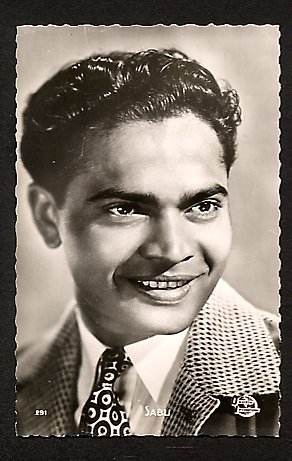
And today, remembering the Jungle Book, Arabian Nights, Indian:

Sabu: (1924-1963)

http://www.powell-pressburger.org/Images/People/Sabu.jpg
http://www.powell-pressburger.org/Images/47_BN/Sabu.jpg

and wishing a Happy 58th Birthday to:

http://www.culturevulture.net/Dance/Baryshnikov2x.jpghttp://www.smc.edu/madison/endorsements/endorsements_images/m_baryshnikov.jpg

and a Good Day to all.
0 Replies
 
Letty
 
  1  
Reply Fri 27 Jan, 2006 07:51 am
Ah, listeners, there's our Raggedy with pictures and memories. Thanks, PA. Actually, youngun, I had no idea that Steve and Faye did that first. WOW, but it must be in my collective unconsciousness somewhere.

I do wonder if there is anyone here who has NOT read Kipling's Jungle Books. Anyone remember the name of the tiger?

Speaking of which:

Artist: Survivor Lyrics
Song: Eye Of The Tiger Lyrics


Risin' up, back on the street
Did my time, took my chances
Went the distance, now I'm back on my feet
Just a man and his will to survive

So many times, it happens too fast
You change your passion for glory
Don't lose your grip on the dreams of the past
You must fight just to keep them alive

Chorus:
It's the eye of the tiger, it's the cream of the fight
Risin' up to the challenge of our rival
And the last known survivor stalks his prey in the night
And he's watchin' us all in the eye of the tiger

Face to face, out in the heat
Hangin' tough, stayin' hungry
They stack the odds 'til we take to the street
For we kill with the skill to survive

chorus

Risin' up, straight to the top
Have the guts, got the glory
Went the distance, now I'm not gonna stop
Just a man and his will to survive

chorus

The eye of the tiger (repeats out)...
0 Replies
 
Walter Hinteler
 
  1  
Reply Fri 27 Jan, 2006 07:52 am
Thanks for the good night song, Letty.

It's afternoon here,too (sunny and bitter cold: only - 7°C/19°C now, at nearly 3 PM).


One of my favourites by Gilbert Bécaud


Et maintenant


Et maintenant que vais-je faire
De tout ce temps que sera ma vie
De tous ces gens qui m'indiffèrent
Maintenant que tu es partie

Toutes ces nuits, pourquoi pour qui
Et ce matin qui revient pour rien
Ce cœur qui bat, pour qui, pourquoi
Qui bat trop fort, trop fort

Et maintenant que vais-je faire
Vers quel néant glissera ma vie
Tu m'as laissé la terre entière
Mais la terre sans toi c'est petit

Vous, mes amis, soyez gentils
Vous savez bien que l'on n'y peut rien
Même Paris crève d'ennui
Toutes ses rues me tuent

Et maintenant que vais-je faire
Je vais en rire pour ne plus pleurer
Je vais brûler des nuits entières
Au matin je te haïrai

Et puis un soir dans mon miroir
Je verrai bien la fin du chemin
Pas une fleur et pas de pleurs
Au moment de l'adieu

Je n'ai vraiment plus rien à faire
Je n'ai vraiment plus rien ...
0 Replies
 
Letty
 
  1  
Reply Fri 27 Jan, 2006 08:01 am
ah, folks, there's our Walter. Lovely song, I think. <smile>

Come on and translate for us dumb Americans.

Speaking of eyes, listeners:

From the Rolling Stones:
Far Away Eyes

I was driving home early Sunday morning through Bakersfield
Listening to gospel music on the "people of color" radio station
And the preacher said, "You know you always have the
Lord by your side"
And I was so pleased to be informed of this that I ran
Twenty red lights in his honor
Thank you Jesus, thank you lord
I had an arrangement to meet a girl, and I was kind of late
And I thought by the time I got there she'd be off
She'd be off with the nearest truck driver she could find
Much to my surprise, there she was sittin in the corner
A little bleary, worse for wear and tear
Was a girl with far away eyes
So if you're down on your luck
And you can't harmonize
Find a girl with far away
And if you're downright disgusted
And life ain't worth a dime
Get a girl with far away eyes
Well the preacher kept right on saying that all I had to do was send
Ten dollars to the church of the sacred bleeding heart of Jesus
Located somewhere in Los Angeles, California
And next week they'd say my prayer on the radio
And all my dreams would come true
So I did, the next week, I got a prayer with a girl
Well, you know what kind of eyes she got
So if you're down on your luck
I know you all sympathize
Find a girl with far away eyes
And if you're downright disgusted
And life ain't worth a dime
Get a girl with far away eyes.
0 Replies
 
Letty
 
  1  
Reply Fri 27 Jan, 2006 08:10 am
News from the art world:


Fed's Greenspan becomes a true work of art in NY By Christian Wiessner
Tue Jan 24, 4:03 PM ET


NEW YORK (Reuters) - Outgoing U.S. Federal Reserve Chairman Alan Greenspan has never met painter Erin Crowe, but she is probably more familiar with the nuances of his face than nearly anyone else.


That's because Crowe has created 30 oil-on-canvas portraits of the financial world icon, who will retire as head of the U.S. central bank after an 18-year reign at the end of the month. She will unveil her works on Thursday at a gallery in Manhattan's Soho district.

The show is fittingly called "Good-bye...Greenspan."

Crowe told Reuters in an interview that she stumbled upon Greenspan as a subject when she did six paintings of him for a small art festival in her native Virginia which had the U.S. dollar sign as its festival theme.

"I was just fascinated with the way people reacted," the 25-year-old artist said. "Some of the people that bought the works were in banking, and this guy had been a formidable force in their lives for almost their whole careers."

http://images.chron.com/content/news/photos/05/09/05/greenspan-2.jpg
0 Replies
 
Walter Hinteler
 
  1  
Reply Fri 27 Jan, 2006 08:12 am
Letty wrote:

Come on and translate for us dumb Americans.


Music written by Gilbert Bécaud and English lyrics penned by Carl Sigman.
(Original French lyrics by Pierre Delanoë.)
:wink:

What now my love?
Now that you've left me
How can I live Through another day?
Watching my dreams Turning to ashes
And my hopes Into bits of clay

Once I could see
Once I could feel
Now I'm numb
I've become unreal
I walk the night
Without a goal
Stripped of my heart
My soul

What now my love?
Now that it's over
I feel the world
Closing in on me
Here come the stars
Tumbling around me
There's the sky
Where the sea should be

What now my love?
Now that you're gone
I'd be a fool
To go on and on
No one would care
No one would cry
If I should live
Or die

What now my love?
Now there is nothing
Only my last Good-bye
0 Replies
 
Letty
 
  1  
Reply Fri 27 Jan, 2006 09:16 am
Ah, Walter. I know that song. Thanks for the translation.

We do learn things on our little radio, no?

Does he have a charmed life?


Joaquin Phoenix Uninjured in Car Accident Fri Jan 27, 7:07 AM ET


LOS ANGELES - Joaquin Phoenix's car overturned on a canyon road and collided with another vehicle after his brakes went out, but there were no reports of injury, police said.


Phoenix, the 31-year-old star of the Johnny Cash biopic "Walk the Line," was driving eastbound above Sunset Strip about 2:50 p.m. when he realized his brakes were not working, said Officer Jason Lee, a police spokesman.

Phoenix lost control of his car, which overturned and hit another vehicle also headed eastbound, Lee said.

His publicist, Susan Patricola, said in a statement that Phoenix was wearing his seat belt and walked away from the scene after being helped out of his vehicle by a passer-by.

http://www.arnadal.no/film/actors/images/phoenix_joaquin.jpg
0 Replies
 
NickFun
 
  1  
Reply Fri 27 Jan, 2006 11:15 am
Another "victim" of wealth and fame! Maybe he's still trying to live the "Johnny Cash" lifestyle.
0 Replies
 
yitwail
 
  1  
Reply Fri 27 Jan, 2006 11:42 am
shere khan, even though i haven't read Jungle Book.
0 Replies
 
Letty
 
  1  
Reply Fri 27 Jan, 2006 11:45 am
Well, hey, Nick. You are such fun. Have you ever noticed that scar on Joaquin's lip? I wonder if he was the victim of a cleft palate?

I was rather disappointed in his interp of Johnny Cash. Like you sig line incidentally.
0 Replies
 
Letty
 
  1  
Reply Fri 27 Jan, 2006 11:57 am
Wow! There's our turtle man, folks, and with the right answer. I recall Sabu saying, " I shall kill shere Kahn, and bring back his yellow hide."

See what you started Raggedy? Razz

Another second hand song, folks:

Yellow by Coldplay


Look at the stars; look how they shine for you
And everything you do
Yeah, they were all yellow

I came along; I wrote a song for you
And all the things you do
And it was called yellow

So then I took my turn
Oh what a things I've done
And it was all yellow

And Your skin, oh yeah your skin and bones
Turn into something beautiful
D'you know?
You know I love you so

I swam across; I jumped across for you
Oh what a thing to do
'Cos you were all yellow

I drew a line; I drew a line for you
Oh what a thing to do
And it was all yellow

And your skin, oh yeah your skin and bones
Turn into something beautiful
D'you know?
For you I bleed myself dry

It's true
Look how they shine for you
Look how they shine for(you)
Look how they shine for you
Look how they shine

Look at the stars
Look how they shine for you
0 Replies
 
Letty
 
  1  
Reply Fri 27 Jan, 2006 12:23 pm
er, editor, make that I like YOUR sig line:

http://www.bigcatrescue.org/images/000BigCatPhotos/TigerPhotos/sherekhantoday.jpg
0 Replies
 
bobsmythhawk
 
  1  
Reply Fri 27 Jan, 2006 12:31 pm
Wolfgang Amadeus Mozart
From Wikipedia, the free encyclopedia.

Wolfgang Amadeus Mozart (born Johann Chrysostom Wolfgang Theophilus Mozart) (January 27, 1756 - December 5, 1791) is among the most significant and enduringly popular composers of European classical music. His enormous output includes works that are widely acknowledged as pinnacles of symphonic, chamber, piano, operatic, and choral music. Many of his works are part of the standard concert repertory and are widely recognized as masterpieces of the classical style.

Life


Family and early childhood years

Mozart was born on January 27th, 1756, in the city of Salzburg, the capital of the independent archbishopric of Salzburg, which today is part of Austria, to Leopold and Anna Maria Pertl Mozart. He was baptized the day after his birth at St. Rupert's Cathedral. The baptismal record gives his name in Latinized form as Johannes Chrysostomus Wolfgangus Theophilus (Gottlieb) Mozart. Of these names, the first two were saint's names not employed in everyday life and the fourth was variously translated in Mozart's lifetime as Amadeus (Latin), Gottlieb (German), and Amadé (French); Mozart himself preferred the third (see Mozart's name).

Mozart's musical ability became apparent when he was about three years old. His father Leopold was one of Europe's leading musical pedagogues, whose influential textbook Versuch einer gründlichen Violinschule ("Essay on the fundamentals of violin playing") was published in 1756, the year of Mozart's birth. Mozart received intensive musical training from his father,

The years of travel

Leopold realized that he could earn a substantial income by showcasing his son as a Wunderkind in the courts of Europe. Mozart soon gained fame as a musical prodigy capable of such feats as playing blindfolded or competently improvising at length on difficult passages. His older sister Maria Anna (Nannerl) was a talented pianist and accompanied her brother on the earlier tours. Mozart wrote a number of piano pieces, in particular duets and duos, to play with her. On one occasion when Mozart became very ill, Leopold expressed more concern over the loss of income than over his son's well-being.

During his formative years, Mozart completed several journeys throughout Europe, beginning with an exhibition in 1762 at the Court of the Elector of Bavaria in Munich, then in the same year at the Imperial Court in Vienna. A long concert tour spanning three and a half years followed, taking him with his father to the courts of Munich, Mannheim, Paris, London, The Hague, again to Paris, and back home via Zürich, Donaueschingen, and Munich. They went to Vienna again in late 1767 and remained there until December 1768.


After one year in Salzburg, three trips to Italy followed: from December 1769 to March 1771, from August to December 1771, and from October 1772 to March 1773. During the first of these trips, Mozart met Andrea Luchesi in Venice and G.B. Martini in Bologna and was accepted as a member of the famous Accademia Filarmonica. A highlight of the Italian journey, now an almost legendary tale, occurred when he heard Gregorio Allegri's Miserere once in performance in the Sistine Chapel then wrote it out in its entirety from memory, only returning to correct minor errors; he thus produced the first illegal copy of this closely-guarded property of the Vatican [source documents].

On July 3, 1778, accompanied by his mother, Mozart began a tour of Europe that included Munich, Mannheim, and Paris, where his mother died.

During his trips, Mozart met a great number of musicians and acquainted himself with the works of other great composers. A particularly important influence was Johann Christian Bach, who befriended Mozart in London in 1764-65. Bach's work is often taken to be an inspiration for the distinctive surface texture of Mozart's music, though not its architecture or drama.

Even non-musicians caught Mozart's attention. He was so taken by the sound created by Benjamin Franklin's glass harmonica that he composed several pieces of music for it.

Mozart in Vienna

In 1781 Mozart visited Vienna in the company of his employer, the harsh Prince-Archbishop Colloredo, and soon fell out with him. According to Mozart's own testimony, he was dismissed - literally - "with a kick in the seat of the pants." Mozart chose to settle and develop his career in Vienna after its aristocracy began to take an interest in him.

On August 4, 1782, against his father's wishes, he married Constanze Weber (1762-1842) (also spelled "Costanze"), a would-be cousin of Carl Maria von Weber. Although they had six children, only two survived infancy. Neither of these two, Karl Thomas (1784-1858) and Franz Xaver Wolfgang (1791-1844; later a minor composer himself), married or had children.

The year 1782 was an auspicious one for Mozart's career; his opera Die Entführung aus dem Serail ("The Abduction from the Seraglio") was a great success and he began a series of concerts at which he premiered his own piano concertos as conductor and soloist.

During 1782-83, Mozart became closely acquainted with the work of J.S. Bach and Georg Frideric Handel as a result of the influence of Baron Gottfried van Swieten, who owned many manuscripts of works by the Baroque masters. Mozart's study of these works led first to a number of works imitating Baroque style and later had a powerful influence on his own personal musical language, for example the fugal passages in Die Zauberflöte ("The Magic Flute") and the Symphony No. 41.

In 1783, Wolfgang and Constanze visited Leopold in Salzburg, but the visit was not a success, as his father did not take to Constanze. However, the visit saw the composition of one of Mozart's great liturgical pieces, the Mass in C Minor, which was premiered in Salzburg, and is presently one of his best known works.

In his early Vienna years, Mozart met Joseph Haydn and the two composers became friends. When Haydn visited Vienna, they sometimes played in an impromptu string quartet. Mozart's six quartets dedicated to Haydn date from 1782-85, and are often judged to be his response to Haydn's Opus 33 set from 1781. Haydn was soon in awe of Mozart, and when he first heard the last three of Mozart's series he told Leopold, "Before God and as an honest man I tell you that your son is the greatest composer known to me either in person or by name. He has taste, and what is more, the most profound knowledge of composition."

During the years 1782-1785, Mozart put on a series of concerts in which he appeared as soloist in his piano concertos, widely considered among his greatest works. These concerts were financially successful. After 1785 Mozart performed far less and wrote only a few concertos. Maynard Solomon conjectures that he may have suffered from hand injuries; another possibility is that the fickle public ceased to attend the concerts in the same numbers.

Mozart was influenced by the ideas of the eighteenth century European Enlightenment as an adult, and became a Freemason (1784). His lodge was a specifically Catholic rather than a deistic one and he worked fervently and successfully to convert his father before the latter's death in 1787. His last opera, Die Zauberflöte, includes Masonic themes and allegory. He was in the same Masonic Lodge as Haydn.

Mozart's life was fraught with financial difficulty and illness. Often, he received no payment for his work, and what sums he did receive were quickly consumed by his extravagant lifestyle.

Mozart spent 1786 in Vienna in an apartment (in the "Mozarthaus") which may be visited today at Domgasse 5 behind St Stephen's Cathedral; it was here that Mozart composed Le nozze di Figaro. He followed this in 1787 with one of his greatest works, Don Giovanni.


Mozart and Prague

Mozart had a special relationship with Prague and the people of Prague. The audience here celebrated their Figaro with the much deserved reverence he was missing in his hometown Vienna. His quote "My Praguers understand me" (Meine Prager verstehen mich) became very famous in the Bohemian lands. Many tourists follow his tracks in Prague and visit the Mozart Museum of the Villa Bertramka where they can enjoy a chamber concert. In Prague, Don Giovanni premiered on October 29, 1787 at the Theatre of the Estates. In the later years of his life, Prague provided Mozart many financial resources from commissions. German poet Eduard Mörike's well-known novella Mozart auf der Reise nach Prag ("Mozart on the way to Prague") is a fantasy about the composer's trip to that city in order to present Don Giovanni (the story, however, relates episodes that happen along the way, not in Prague itself).

Final illness and death

Mozart's final illness and death are difficult topics of scholarship, obscured by romantic legends and replete with conflicting theories. Scholars disagree about the course of decline in Mozart's health?-particularly at what point Mozart became aware of his impending death and whether this awareness influenced his final works. The romantic view holds that Mozart declined gradually and that his outlook and compositions paralleled this decline. In opposition to this, some contemporary scholarship points out correspondence from Mozart's final year indicating that he was in good cheer, as well as evidence that Mozart's death was sudden and a shock to his family and friends. The actual cause of Mozart's death is also a matter of conjecture. His death record listed "hitziges Frieselfieber" ("severe military fever"), a description that does not suffice to identify the cause as it would be diagnosed in modern medicine. Dozens of theories have been proposed, including trichinosis, mercury poisoning, and rheumatic fever. The contemporary practice of bleeding medical patients is also cited as a contributing cause.

Mozart died around 1 a.m. on December 5, 1791 in Vienna, while he was working on his final composition, the Requiem. A younger composer, and Mozart's only pupil at the time Franz Xaver Süssmayr, was engaged by Constanze to complete the Requiem. He was not the only composer asked to complete the Requiem but is associated with it over others due to his significant contribution.

According to popular legend, Mozart was penniless and forgotten when he died, and was buried in a pauper's grave. In fact, though he was no longer as fashionable in Vienna as before, he continued to have a well-paid job at court and receive substantial commissions from more distant parts of Europe, Prague in particular. Many of his begging letters survive but they are evidence not so much of poverty as of his habit of spending more than he earned. He was not buried in a "mass grave" but in a regular communal grave according to the 1784 laws. Though the original grave in the St. Marx cemetery was lost, memorial gravestones (or cenotaphs) have been placed there and in the Zentralfriedhof. New DNA testing is being performed to determine if a skull in an Austrian Museum is actually his, using DNA samples from the marked graves of his father and Mozart's sister.

In 1809, Constanze married Danish diplomat Georg Nikolaus von Nissen (1761-1826). Being a fanatical admirer of Mozart, he edited vulgar passages out of many of the composer's letters and wrote a Mozart biography.


Works, musical style, and innovations


Style

Mozart, along with Haydn and Beethoven, was a central representative of the classical style. His works spanned the period during which that style transformed from a predominantly simple musical language, as exemplified by the stile galant of his contemporaries such as Sammartini and Johann Stamitz, to a mature style which began to incorporate some of the contrapuntal complexities of the late Baroque, complexities against which the galant style was a reaction. Mozart's own stylistic development closely paralleled the maturing of the classical style as a whole. In addition, he was a prolific composer and wrote in almost every major genre, including symphony, opera, the solo concerto, chamber music including string quartet and string quintets, and the keyboard sonata. While none of these genres were new, the piano concerto was almost single-handedly developed and popularized by Mozart. Mozart also wrote a great deal of religious music including masses. He also composed many dances, divertimenti, serenades, and other forms of light entertainment.

The central traits of the classical style can all be identified in Mozart's music. Clarity, balance, transparency, and uncomplicated harmonic language are his hallmark, although in his later works he explored chromatic harmony to a degree rare at the time. Mozart is commonly named along with Schubert as having a gift for pure, simple, and memorable melody, and to many listeners this is his most definitive characteristic.

From his earliest life Mozart had a gift for imitating the music he heard; since he travelled widely, he acquired a rare collection of experiences from which to create his unique compositional language. When he went to London as a child, he met J.C. Bach and heard his music; when he went to Paris, Mannheim, and Vienna, he heard the work of composers active there, as well as the spectacular Mannheim orchestra; when he went to Italy, he encountered the Italian overture and the opera buffa, both of which were to be hugely influential on his development. Both in London and Italy, the galant style was all the rage: simple, light music, with a mania for cadencing, an emphasis on tonic, dominant, and subdominant to the exclusion of other chords, symmetrical phrases, and clearly articulated structures. This style, out of which the classical style evolved, was a reaction against the complexity of late Baroque music. Some of Mozart's early symphonies are essentially Italian overtures, with three movements running into each other; many are "homotonal" (each movement in the same key, with the slow movement in the tonic minor). Others mimic the works of J.C. Bach, and others show the simple, rounded binary forms commonly being written by composers in Vienna.

As Mozart matured, he began to incorporate some features of the abandoned Baroque styles into his music. For example, the Symphony No. 29 in A Major K. 201, uses a contrapuntal main theme; in addition, in it he began to experiment with irregular phrase lengths, something a galant composer such as Sammartini never did. Some of his quartets from 1773 have fugal finales, probably influenced by Haydn, who had just published his opus 20 set. The influence of the Sturm und Drang ("Storm and Stress") period in German literature, with its brief foreshadowing of the Romantic era to come, is evident in some of the music of both composers at that time.

In Mozart's hands, sonata form transformed from the binary models of the Baroque into the fully mature form of his later works, with a multiple-theme exposition, extended, chromatic and contrapuntal development, recapitulation of all themes in the tonic key, and coda.

Throughout his life Mozart switched his focus from writing instrumental music to writing operas, and back again. He wrote operas in each style current in Europe: opera buffa, such as The Marriage of Figaro or Così fan tutte; opera seria, such as Idomeneo or Don Giovanni; and Singspiel, of which Die Zauberflöte is probably the most famous example by any composer. In his later operas, he developed the use of subtle and slight changes of instrumentation, orchestration, and tone colour to express or highlight psychological or emotional states and dramatic shifts. Here his advances in opera and instrumental composing interacted upon one another. The increasing sophistication of his use of the orchestra in his symphonies and concerti served as a resource in his operatic orchestration, and his developing subtlety in using the orchestra to psychological effect in his operas was reflected in his later non-operatic compositions.


Influence


Many important composers since Mozart's time have worshipped or at least been in awe of Mozart. Rossini averred, "He is the only musician who had as much knowledge as genius, and as much genius as knowledge." Beethoven's admiration for Mozart is clear: Beethoven used Mozart as a model a number of times: Beethoven's A-major Quartet from Op. 18 makes careful use of Mozart's Quartet in A K. 464. Beethoven even copied out most of the Mozart quartet before he wrote his own A-major quartet, just to figure out how Mozart put the music together. A plausible story--not corroborated--has one of Beethoven's students looking through a pile of music in Beethoven's apartment. The student pulls out the Mozart A-major Quartet, Beethoven notices, and says, "Ah, that piece. That's Mozart saying 'here's what I could do, if only you had ears to hear!'"; Beethoven's own Piano Concerto No. 3 in C minor is an obvious tribute to Mozart's Piano Concerto No. 24 in C minor, and yet another plausible--if unconfirmed--story has Beethoven at a concert with his sometime-student Ries. They're listening to Mozart's C-minor concerto Piano Concerto No. 24. The coda of the last movement is quite unusual, for various reasons, and when it arrives, Beethoven supposedly says to Ries "We'll never think of anything like that"! Beethoven's Quintet for Piano and Winds is another obvious tribute to Mozart, similar to Mozart's own Quintet of the same kind. Beethoven also paid homage to Mozart by writing sets of variations on several of his themes: for example, the two sets of variations for cello and piano on themes from Mozart's Magic Flute, and cadenzas to several of Mozart's piano concertos, most notably the Piano Concerto No. 20, K466 (see below for this system and an explanation). After the only meeting between the two composers, Mozart noted that Beethoven would "give the world something to talk about." As well, Tchaikovsky wrote his Mozartiana in praise of him; and Mahler died with the name "Mozart" on his lips. The variations theme of the opening movement of the A major piano sonata (K331) was used by Max Reger for his Variations and Fugue on a Theme of Mozart, written in 1914 and among his best-known works in turn.


The Köchel catalogue

Main article: Köchel-Verzeichnis

In the decades after Mozart's death there were several attempts to catalogue his compositions, but it was not until 1862 that Ludwig von Köchel succeeded in this enterprise. Many of his famous works are referred to by their Köchel catalogue number; for example, the Piano Concerto in A major (Piano Concerto No. 23) is often referred to simply as "K.488" or "KV.488". The catalogue has undergone six revisions.


Myths and controversies

Mozart is unusual among composers for being the subject of an abundance of legend, much due to the problem that none of his early biographers knew him personally. They often resorted to fiction in order to produce a work. Many myths began soon after Mozart died, but few have any basis in fact. An example is the story that Mozart composed his Requiem with the belief it was for himself. Sorting out fabrications from real events is a vexing and continuous task for Mozart scholars mainly because of the prevalence of legend in scholarship. Dramatists and screenwriters, free from responsibilities of scholarship, have found excellent material among these legends.

An especially popular case is the supposed rivalry between Mozart and Antonio Salieri, and, in some versions, the tale that it was poison received from the latter that caused Mozart's death; this is the subject of Aleksandr Pushkin's play Mozart and Salieri, Nicolai Rimsky-Korsakov's opera Mozart and Salieri, and Peter Shaffer's play Amadeus. The last of these has been made into a feature-length film of the same name, which won eight Oscars. Shaffer's play attracted criticism for portraying Mozart as vulgar and loutish, a characterization felt by many to be unfairly exaggerated.

According to an essay by A. Peter Brown, "the Mozart mania of the 1980s was initiated by Peter Shaffer's play Amadeus. It and the subsequent film directed by Miloš Forman did more for Mozart's case than anything else in the two hundred years since the composer's death." The same could be said of the popular myths currently surrounding Mozart, many of which are firmly rooted in the film.

However, Shaffer and Forman have never claimed that Amadeus was based in fact, as pointed out by Shaffer himself: "From the start we agreed on one thing: we were not making an objective Life of Wolfgang Mozart. This cannot be stressed too strongly. Obviously Amadeus on stage was never intended to be a documentary biography of the composer, and the film is even less of one."

Shaffer and Forman are equally quick to defend elements of the film which they believe are accurate but are disputed by Mozart historians. Shaffer has detailed in many interviews, including one featured as an extra on the DVD release of the film, how the dramatic narrative was inspired by the biblical story of Cain and Abel?-one brother loved by God, and the other scorned. Transcribed as creative rivalry between Mozart and Salieri, the notion of divine blessing and murderous jealousy provides the basic premise for Amadeus, although there is no historical evidence of any rivalry between the two composers. Conversely, it is well documented that Salieri frequently lent Mozart musical scores from the court library, and Mozart selected Salieri to teach his son, Franz Xaver. One of the more detailed essays on the "dramatic licenses" present in Amadeus is written by Gregory Allen Robbins, titled "Mozart & Salieri, Cain & Abel: A Cinematic Transformation of Genesis 4".

Another area of debate involves Mozart's prodigy as a composer from childhood until his death. While some have criticised many of his earlier works as simplistic or forgettable, others revere even Mozart's juvenilia. The image of Mozart as the divinely inspired effortless creator, popularized by the film Amadeus, is generally believed to be an exaggeration. Quite the contrary, Mozart was a studiously hard worker, and by his own admission his extensive knowledge and abilities developed out of many years' close study of the European musical tradition.

It has been speculated that Mozart suffered from Tourette syndrome. Letters he wrote to his cousin Maria Anna Thekla ("Bäsle") between 1777 and 1781 contain scatological language and he wrote canons titled Leck mich im Arsch ("Lick my ass") or variations thereof (including the pseudo-Latin Difficile lectu mihi mars).

Since 1902, the Mozarteum in Salzburg has preserved a controversial "Mozart's skull". Genetic analysis revealed in January 2006 that this skull was unrelated to the bones of Mozart's family members buried at St. Sebastian Cemetery. However, those bones were also shown to be unrelated to each other, so the mystery remains. [1]

http://en.wikipedia.org/wiki/Wolfgang_Amadeus_Mozart
0 Replies
 
bobsmythhawk
 
  1  
Reply Fri 27 Jan, 2006 12:35 pm
Lewis Carroll
From Wikipedia, the free encyclopedia.

Charles Lutwidge Dodgson (January 27, 1832 - January 14, 1898), better known by the pen name Lewis Carroll, was a British author, mathematician, logician, Anglican clergyman and photographer.

His most famous writings are Alice's Adventures in Wonderland and its sequel Through the Looking-Glass, as well as the comic poem The Hunting of the Snark, and the nonsense poem Jabberwocky.

His facility at word play, logic, and fantasy has delighted audiences ranging from the most naïve to the most sophisticated. His works have remained popular since they were published and have influenced not only children's literature, but also a number of major 20th century writers such as James Joyce and Jorge Luis Borges.

There are societies dedicated to the enjoyment and promotion of Lewis Carroll's works in many parts of the world including North America, Japan, the United Kingdom and New Zealand.


Upbringing

Dodgson's family was predominantly northern English, with some Irish connections. Conservative and High Church Anglican, most of Dodgson's ancestors belonged to the two traditional English upper-middle class professions: the army and the Church. His great-grandfather, also Charles Dodgson, had risen through the ranks of the church to become a bishop; his grandfather, another Charles, had been an army captain, killed in action in 1803 while his two sons were hardly more than babies.

The elder of these?-yet another Charles?-reverted to the other family business and took holy orders. He went to Westminster School, and thence to Christ Church, Oxford. He was mathematically gifted and won a double first degree which could have been the prelude to a brilliant academic career. Instead he married his first cousin in 1827 and retired into obscurity as a country parson.

Young Charles was born in the little parsonage of Daresbury in Warrington, Cheshire, the oldest boy but already the third child of the four-and-a-half year old marriage. Eight more were to follow and, remarkably for the time, all of them?-seven girls and four boys?- survived into adulthood. When Charles was 11 his father was given the living of Croft-on-Tees in north Yorkshire, and the whole family moved to the spacious Rectory. This remained their home for the next 25 years.

Dodgson senior made some progress through the ranks of the church: he published some sermons, translated Tertullian, became an Archdeacon of Ripon Cathedral, and involved himself, sometimes influentially, in the intense religious disputes that were dividing the Anglican church. He was High Church, inclining to Anglo-Catholicism, an admirer of Newman and the Tractarian movement, and he did his best to instil such views in his children.

In the early years young Charles was educated at home. His "reading lists" preserved in the family testify to a precocious intellect: at the age of seven the child was reading The Pilgrim's Progress. It is often said that he was naturally left-handed and suffered severe psychological trauma by being forced to counteract this tendency, but there is no documentary evidence to support this. Charles also suffered from another disability, a stutter that often influenced his social life throughout his years. At twelve he was sent away to a small private school at nearby Richmond, where he appears to have been happy and settled. But in 1845, young Dodgson moved on to Rugby School, where he was evidently less happy, for as he wrote some years after leaving the place:

I cannot say ... that any earthly considerations would induce me to go through my three years again ... I can honestly say that if I could have been ... secure from annoyance at night, the hardships of the daily life would have been comparative trifles to bear.

The nature of this nocturnal 'annoyance' will probably never now be fully understood, but it may be that he is delicately referring to some form of sexual molestation. Scholastically, though, he excelled with apparent ease. "I have not had a more promising boy his age since I came to Rugby" observed R.B. Mayor, the Maths master.


Academic life

He left Rugby at the end of 1850 and, after an interval which remains unexplained, went on in January 1851 to Oxford, attending his father's old college, Christ Church. He had only been at Oxford two days when he received a summons home. His mother had died of "inflammation of the brain"?-perhaps meningitis or a stroke?-at the age of forty-seven.

Whatever Dodgson's feelings may have been about this death, he did not allow them to distract him too much from his purpose at Oxford. He may not always have worked hard, but he was exceptionally gifted and achievement came easily to him. The following year he received a first in Honour Moderations, and shortly after he was nominated to a Studentship (the Christ Church equivalent of a fellowship), by his father's old friend Canon Edward Pusey.

His early academic career veered between high-octane promise and irresistible distraction. Through his own laziness, he failed an important scholarship, but still his clear brilliance as a mathematician won him the Christ Church Mathematical Lectureship, which he continued to hold for the next 26 years. The income was good, but the work bored him and his stammer hampered him. Many of his pupils were older and richer than he was, and almost all of them were uninterested. They didn't want to be taught; he didn't want to teach them. Mutual apathy ruled.

At Oxford he was also diagnosed as an epileptic, then a considerable social stigma to bear. However, recently John R. Hughes, director of the University of Illinois at Chicago's epilepsy clinic, has argued that Carroll may have been misdiagnosed.


Photography


In 1856, Dodgson took up the new art form of photography, first under the influence of his uncle Skeffington Lutwidge, and later his Oxford friend Reginald Southey and art photography pioneer Oscar Rejlander.

Dodgson soon excelled at the art, and it became an expression of his very personal inner philosophy; a belief in the divinity of what he called beauty, by which he seemed to mean a state of moral or aesthetic or physical perfection. He found this divine beauty not simply in the magic of theatre, but in the poetry of words, in a mathematical formula and perhaps supremely, in the human form; in the body-images that moved him.

When he took up photography he sought with his own representations to combine the ideals of freedom and beauty into the innocence of Eden, where the human body and human contact could be enjoyed without shame. In his middle age, he was to re-form this philosophy into the pursuit of beauty as a state of Grace, a means of retrieving lost innocence. This, along with his lifelong passion for the theatre, was to bring him into confrontation with Victorian morality and his own family's High Church beliefs. As his main biographer Morton Cohen noted... "He rejected outright the Calvinist principle of original sin and replaced it with the notion of inborn divinity." PUSSIO

The definitive work on his photography (Roger Taylor's Lewis Carroll, Photographer (2002) exhaustively lists every surviving print, and Taylor calculates that just over fifty percent of his surviving work depicts young girls. However it should be noted that less than a third of his original portfolio has survived (see below). His favourite girl model was Alexandra Kitchin ("Xie"), whom he photographed around fifty times from the age of four until the age of about 16. In 1880 he was striving to be allowed to photograph the 16 year old Xie in 'bathing dress', but was not allowed this liberty. Most of his girl subjects would write their name on the corner of the print in coloured ink. It's assumed that Dodgson either destroyed or returned the nude photographs to the families of the girls he had photographed. They were long presumed lost, but six nudes have since surfaced, four of which have been published and another two of which little is known. Dodgson's practice of photographing or sketching nude girls has added to speculation that he was a pedophile (see below). There is a clear difference between Dodgson's girls and depictions by other Victorian artists; in almost all of his solo portraits of girls they are depicted unburdened by the heavy weight of Victorian symbolism, and are simply and strongly themselves.


He also found photography to be a useful entré into higher social circles. Once he had a studio of his own, he made portraits of notable sitters such as John Everett Millais, Ellen Terry, Dante Gabriel Rossetti, Julia Margaret Cameron and Alfred, Lord Tennyson. He also made some landscapes and anatomy studies.

Dodgson abruptly ceased to photograph in 1880. Over 24 years he had completely mastered the medium, set up his own studio at the top of Tom Quad, and created around 3,000 images. Less than 1000 have survived time and deliberate destruction. He spent several hours each day creating a diary detailing the circumstances surrounding the making of each photograph, but this register was later destroyed.

With the advent of Modernism tastes changed, and his photography became forgotten from around 1920 until the 1960s. He is now considered one of the very best Victorian photographers, and is certainly the one who has had the most influence on modern art photographers.


Character

The young adult Charles Dodgson was about six foot tall, slender and handsome in a soft-focused dreamy sort of way, with curling brown hair and blue eyes. At the unusually late age of seventeen, he suffered a severe attack of whooping cough which left him with poor hearing in his right ear and was probably responsible for his chronically weak chest in later life. The only overt defect he carried into adulthood was what he referred to as his "hesitation"?-a stammer he had acquired in early childhood and which was to plague him throughout his entire life.

The stammer has always been a potent part of the myth. It is part of the mythology that Dodgson only stammered in adult company, and was free and fluent with children, but there is no evidence to support this idea. Many children of his acquaintance remembered the stammer while many adults failed to notice it. It came and went for its own reasons, but not as a clichéd manifestation of fear of the adult world. Dodgson himself was far more acutely aware of it than most people he met. Although his stammer troubled him ?- even obsessed him sometimes ?- it was never bad enough to stop him using his other qualities to do well in society.

He was naturally gregarious and egoistic enough to relish attention and admiration. At a time when people devised their own amusements and singing and recitation were required social skills, the young Dodgson was well-equipped as an engaging entertainer. He could sing tolerably well and was not afraid to do so in front of an audience. He was adept at mimicry and story-telling. He was reputedly quite good at charades.

There are brief hints at a soaring sense of the spiritual and the divine; small moments that reveal a rich and intensely lived inner life. 'That is a wild and beautiful bit of poetry, the song of "call the cattle home",' he suddenly observed, in the midst of an analysis of Charles Kingsley's novel Alton Locke:

I remember hearing it sung at Albrighton: I wonder if any one there could have entered into the spirit of Alton Locke. I think not. I think the character of most that I meet is merely refined animal... How few seem to care for the only subjects of real interest in life.

He was also quite socially ambitious, anxious to make his mark on the world in some way, as a writer, or as an artist. It was perhaps the realisation that his talent as an artist was not sufficient that he eventually turned to photography. His scholastic career was seen as something of a stop-gap to other more exciting attainments that he desired.

In the interim between his early published writing and the success of Alice, he began to move in the Pre-Raphaelite social circle. He first met John Ruskin in 1857 and became friendly with him. Dodgson developed a close relationship with the Dante Gabriel Rossetti and his family, and also knew William Holman Hunt, John Everett Millais and Arthur Hughes among other artists. He also knew the fairy-tale author George MacDonald well - it was the enthusiastic reception of "Alice" by the young MacDonald daughters that convinced him to submit the work for publication.

Writing career

During his writing career, Carroll wrote poetry and short stories, sending them to various magazines and enjoying moderate success. Between 1854 and 1856, his work appeared in the national publications, The Comic Times and The Train, as well as smaller magazines like the Whitby Gazette and the Oxford Critic.

Most of his output was humorous, sometimes satirical. But his standards and his ambitions were exacting. "I do not think I have yet written anything worthy of real publication (in which I do not include the Whitby Gazette or the Oxonian Advertiser), but I do not despair of doing so some day," he wrote in July 1855. Years before Alice, he was thinking up ideas for children's books that would make money: 'Christmas book [that would] sell well... Practical hints for constructing Marionettes and a theatre'. The ideas got better as he got older, but his canny mind, with an eye to income, was always there.

In 1856 he published his first piece of work under the name that would make him famous. A very predictable little romantic poem called "Solitude" appeared in The Train under the authorship of 'Lewis Carroll'. This pseudonym was a play on his real name, Lewis being the anglicised form of Ludovicus, which was the Latin for Lutwidge, and Carroll being an anglicised version of Carolus, the Latin for Charles.


In the same year, a new Dean, Henry Liddell, arrived at Christ Church, bringing with him a young wife and children, all of whom would figure largely in Dodgson's life over the following years. He became close friends with the mother and the children, particularly the three sisters Lorina, Alice and Edith. It seems there became something of a tradition of his taking the girls out on the river for picnics at Godstow or Nuneham.

It was on one such expedition, in 1862, that Dodgson invented the outline of the story that eventually became his first and largest commercial success ?- the first Alice book. Having told the story and been begged by Alice Liddell to write it down, Dodgson eventually presented Alice with a hand-written, illustrated manuscript entitled Alice's Adventures Under Ground (now in the British Library, Add. MS 46700). Later he took the little book to Macmillan the publisher, who liked it immediately. After the possible alternative titles Alice Among the Fairies and Alice's Golden Hour were rejected, the work was finally published as Alice's Adventures in Wonderland in 1865 under the Lewis Carroll pen-name Dodgson had first used some nine years earlier. The illustrations this time were by Sir John Tenniel; Dodgson evidently realised that a published book would need the skills of a professional artist.

With the immediate, phenomenal success of Alice, the story of the author's life becomes effectively divided in two: the continuing story of Dodgson's real life and the evolving myth surrounding "Lewis Carroll." Carroll quickly became a rich and detailed alter ego, a persona as famous and deeply embedded in the popular psyche as the story he told. To him belongs a large part of the image of little girls and strange otherworldliness that we know from the author of Alice.

It is undisputed that throughout his growing wealth and fame, he continued to teach at Christ Church until 1881, and that he remained in residence there until his death. He published Through the Looking-Glass and what Alice Found There in 1872; his great Joycean mock-epic The Hunting of the Snark, in 1876 (inspired by and dedicated to his other great child-friend after Alice Liddell, Gertrude Chataway), and his last novel, the two-volume Sylvie and Bruno, in 1889 and 1893 respectively.


Drug use

An allegation arose at some point that Carroll used the fungus ergot, which is what LSD was eventually derived from. It can induce psychoactive experiences at large enough quantities, and was used as a medical treatment during the 19th century. While some artists and poets have been inspired by hallucinogenic drugs, there is no factual evidence for the allegation that Carroll took psychoactive drugs. However, Carroll was a fairly heavy cannabis smoker[1]. According to one source, he regularly bought hash oil, which was legal at the time.


Allegations of pedophilia

Dodgson's undeniable fondness for little girls (especially Alice Liddell, from whom it is often said he may have derived his own "Alice", a suggestion backed up by the acrostic of Alice's full name that appears at the end of Through the Looking Glass, though Dodgson himself later denied his 'little heroine' was based on any real child), the sheer number of his child friends, his collection of the early child photographs by Oscar Rejlander, his love of the London theatres before the child-actress reforms, and psychological readings of his work ?- especially his photographs of nude or semi-nude girls and his sketchbooks featuring his own drawings of such ?- have all led to speculation that he was a pedophile, albeit probably a celibate one.

The issue has been contentious, with some arguing that child nudes were not uncommon during the era. (Other notable Victorian-era photographers who took images of nude children include Julia Margaret Cameron and Francis Meadow Sutcliffe.)

According to the 'controversial' investigation by Karoline Leach into what she calls the 'Carroll Myth' (see below), the first hints of allegations that Dodgson was a pedophile seem to have appeared in 1932, in The Life of Lewis Carroll by Langford Reed. According to Leach, Reed was the first to claim that all of Carroll's female friendships ended when the girls reached puberty (around 16 in 1870s England), though Reed apparently only intended to suggest that Dodgson was thereby a pure man untainted by touch of lust for adult flesh. This claim that Dodgson lost interest in girls once they reached puberty was later caught up by other biographers, who remained unaware of the evidence to the contrary since Dodgson's family refused to publish his diaries and letters.

The view of Dodgson as having no adult life and being preoccupied with children persisted among his biographers, including Florence Becker Lennon (Victoria Through the Looking-Glass - UK title "Lewis Carroll"), 1945) and the highly influential Alexander Taylor (The White Knight, 1952). The debate tended to veer between those who believed Dodgson to have been asexually obsessed with children and those who believed this obsession to have been pedophilic.

The issue was rekindled in 1995 with the authoritative Lewis Carroll, a Biography by Morton Cohen. Cohen writes:

"We cannot know to what extent sexual urges lay behind Charles's preference for drawing and photographing children in the nude. He contended the preference was entirely aesthetic. But given his emotional attachment to children as well as his aesthetic appreciation of their forms, his assertion that his interest was strictly artistic is naïve. He probably felt more than he dared acknowledge, even to himself. Certainly he always sought to have another adult present when nude prepubescents modelled for him."

Cohen further notes that the children's mothers were encouraged to be present, and asks if these precautions were the result of Dodgson "insuring himself against slip-ups." (p 228-229) Cohen concedes that Dodgson "apparently convinced many of his friends that his attachment to the nude female child form was free of any eroticism," but adds that "later generations look beneath the surface" (p 229).

The only recorded instance of trouble associated with the nudes of children was Dodgson's experience with the Mayhew family. In 1879, Dodgson wrote what have been called by Cohen "several curious letters ... to the family of Andrew Mayhew, an Oxford colleague ... He asked permission to take nude photographs of the three Mayhew daughters, ages 6, 11, and 13, with no other adults present." The Mayhew parents, who had previously allowed Dodgson to photograph their children, refused, and Cohen notes this same period saw a "sudden break in the friendship" between Dodgson and the Mayhew family (p. 170). Leach suggests that the problem lay with his desire to study the older daughters in frontal positions and not with the younger children.


Karoline Leach's work and the 'Carroll Myth'

A new analysis of Dodgson's sexual proclivities (and indeed the evolution of the entire process of his biography) appears in Karoline Leach's 1999 book, In the Shadow of the Dreamchild. She claims that the image of Dodgson's alleged pedophilia was built out of a failure to understand Victorian morals, as well as the mistaken idea that Dodgson had no interest in adult women which evolved out of the minds of various biographers. She termed this simplified, often frankly fictional image 'the Carroll Myth'.

According to Leach, who cites much prima facie evidence, Dodgson's real life was very different from the accepted biographical image. He was in fact keenly interested in adult women and apparently enjoyed several relationships with women, married and single. Some of these were his child friends with whom he retained good relations into adulthood (in complete refutation of the mythic idea that he 'lost interest' in any girl over the age of 14), but others ?- like Catherine Lloyd, Constance Burch, Edith Shute, Gertrude Thomson (to name but a few) ?- were women he met as adults and with whom he shared very close and meaningful friendships. Suggestions of pedophilia only evolved many years after his death, when his well-meaning family had suppressed all evidence of these adult friendships in order to try to preserve his reputation, thus giving a false impression of a man only interested in little girls. This serves to repudiate some of the classical evidence for the claims of pedophilia.

Dodgson's problems with societal disapproval, Leach says, stemmed not from his usage of nude child models but his attempts to get slightly older models to pose in 'bathing dress' and other immodest clothing. These studies of scantily-dressed older models have all disappeared, leaving commentators only the photos of young girls to comment on.

In a review of the title in Victorian Studies (Vol.43, No.4) reviewer Donald Rackin wrote, "As a piece of biographical scholarship, Karoline Leach's In the Shadow of the Dreamchild is difficult to take seriously". However, for all the emotional intensity of his attack, he visibly failed to detail any actual errors in her work. Nor have any errors been pointed out so far by any other authorities, and many now regard her work as an important step towards a better understanding of Carroll. Her work has been paralleled by that of Hugues Lebailly whose studies of Dodgson's artistic and social interests also support the idea that the image of his 'obsession' with little girls was largely simplistic or mythic in origin.

Jack the Ripper theories

Many wild theories have been woven around the life of Lewis Carroll. Perhaps the most extreme emerged in 1996 when author Richard Wallace published a book titled Jack the Ripper, Light-Hearted Friend accusing Lewis Carroll and his colleague Thomas Vere Bayne of being Jack the Ripper. It was largely based upon anagrams Wallace constructed from Carroll's writing. Carroll and Bayne have strong alibis for most of the nights of the Ripper murders, and Wallace's theory has not found support from other scholars.

Carroll did show some interest in the Jack the Ripper case, but this is hardly unusual, given the profound publicity surrounding the crimes. A passage in his diary dated August 26, 1891, reports that he spoke that day with an acquaintance of his about his "very ingenious theory about 'Jack the Ripper'". No other information about this theory has been found.

Inventions

Lewis Carroll seems to have thought a lot about how to solve some common technical problems of the day. The fact that he was able to understand and use new technologies is amply demonstrated by his use of the camera, which was not as user-friendly as it is today.

One such invention, as cited in his journal on September 24, 1891 and as published in, was a system of writing called Nyctography and a tool called the Nyctograph. He invented this because he would be unable to sleep at night and would want to write down his ideas to clear his head. But, wanting to go quickly back to bed, he did not want to go through all the mechanical steps involved in lighting a lamp. He designed a card with square holes in a regular grid. One would always make a dot in the upper-left corner and then make other dots and/or strokes. These symbols were designed to look somewhat like the letters or numbers they represented. This did not seem to be used for any longer writings, since no writings with these symbols survive. But it is probable that Lewis Carroll himself would use this to make short notes to jog his memory, and then he would probably write the idea out in his journal. He also invented the pencil and paper game Word Ladder.

http://en.wikipedia.org/wiki/Lewis_Carroll
0 Replies
 
bobsmythhawk
 
  1  
Reply Fri 27 Jan, 2006 12:37 pm
erome Kern
From Wikipedia, the free encyclopedia.


Jerome David Kern (January 27, 1885 - November 11, 1945) was an American popular composer. He wrote around 700 songs and more than 100 complete scores for shows and films in a career lasting from 1902 until his death.

Jerome Kern was born in New York City. His parents, Fanny and Henry Kern, were both German Jews. They named him Jerome because they lived near Jerome Park, a favourite place of theirs (Jerome Park was named after Leonard Jerome, who was the father of Jennie Jerome, mother of British Prime Minister Winston Churchill). Fanny encouraged her son to take piano lessons. Henry was a merchandiser and sold pianos among other things. Although Henry wanted his son to go into business with him, Jerome insisted on staying with music.

He grew up on East 56th Street in Midtown Manhattan, where he attended public schools. He studied at the New York College of Music and then in Heidelberg, Germany. When he came back to New York, he started working as a rehearsal pianist, but it didn't take long for him to become a prominent and renowned composer. By 1915, he was represented in many Broadway shows. In 1920, he wrote "Look for the Silver Lining" for the musical Sally.

1925 was a major turning point in Kern's career, for he met Oscar Hammerstein II, with whom he would entertain a lifelong friendship and collaboration. Their first show (written together with Otto Harbach) was Sunny. Together, they produced next the famous Show Boat in 1927, which includes the well-known songs "Ol' Man River" and "Can't Help Lovin' Dat Man". Based on the book of the same name by Edna Ferber, "Showboat" was the first musical comedy to integrate plot, music and choreography into a cohesive story deviating from the usual musical revue of that era. The musical Roberta (1933) gave us "Smoke Gets In Your Eyes" and starred Bob Hope.

In 1935, Jerome Kern moved to Hollywood and started working on music for films but continued working on Broadway productions, too. His last Broadway show was the rather unsuccessful Very Warm For May in 1939; the score included another Kern-Hammerstein classic, "All The Things You Are".

Kern's Hollywood career was successful indeed. For Swing Time (starring Ginger Rogers and Fred Astaire), he wrote "The Way You Look Tonight" (with lyrics by Dorothy Fields), which won the Academy Award in 1936 for the best song. In 1941, he and Hammerstein wrote "The Last Time I Saw Paris", a homage to the French city just recently occupied by the Germans. The song was introduced in the movie Lady Be Good and won another Oscar for Best Song.

Jerome Kern died from a heart attack at the age of 60 in New York.

http://en.wikipedia.org/wiki/Jerome_Kern
0 Replies
 
bobsmythhawk
 
  1  
Reply Fri 27 Jan, 2006 12:39 pm
.
Donna Reed
From Wikipedia, the free encyclopedia.

Donna Reed (January 27, 1921 - January 14, 1986) was an American actress. Born Donna Belle Mullenger to William Richard Mullenger (whose paternal grandparents were born in England) and Hazel Jane Shives on a farm near Denison, Iowa.

Reed is probably best remembered for her roles as the wholesome housewife "Donna Stone" on television's The Donna Reed Show and as "Mary Bailey" in Capra's It's a Wonderful Life. She won a Best Supporting Actress Academy Award for playing a prostitute in 1953's From Here to Eternity.

In her later years she temporarily replaced an ailing Barbara Bel Geddes as "Miss Ellie" in the television series Dallas in the 1984-1985 season. When Bel Geddes was well enough to return to the role, Reed was fired. She sued the show's production company and received an undisclosed seven-figure settlement, but it was not long before her own death.

She died at age 64 in Beverly Hills, California from pancreatic cancer, and was interred in the Westwood Village Memorial Park Cemetery in Los Angeles, California.

The Donna Reed Foundation for the Performing Arts, based in Reed's hometown of Denison, was organized after Reed's death in 1986. The non-profit organization grants scholarships for performing arts students, runs an annual festival of performing arts workshops, and operates The Donna Reed Center for the Performing Arts. The performing arts center was formerly an opera house built in 1914, and later renovated into the Ritz Movie Theater where Donna Reed, as a young girl in Denison, first fell in love with movies.

http://en.wikipedia.org/wiki/Donna_Reed
0 Replies


Related Topics

WA2K Radio is now on the air, Part 3 - Discussion by edgarblythe
 
Copyright © 2026 MadLab, LLC :: Terms of Service :: Privacy Policy :: Page generated in 0.25 seconds on 03/07/2026 at 02:04:32