Brian Dennehy
From Wikipedia, the free encyclopedia
Born Brian Mannion Dennehy
July 9, 1938 (1938-07-09) (age 70)
Woodstock, Connecticut, USA
Occupation Actor
Years active 1977 - present
Spouse(s) Judith Scheff (1959-1974)
Jennifer Arnott (1988-present)
Awards won
Golden Globe Awards
Best Performance by an Actor in a Mini-Series or Motion Picture Made for TV
2001 Arthur Miller's Death of a Salesman
Laurence Olivier Awards
Best Actor
2006 Death of a Salesman
Screen Actors Guild Awards
Outstanding Performance by a Male Actor in a Miniseries or Television Movie
2001 Arthur Miller's Death of a Salesman
Tony Awards
Best Performance by a Leading Actor in a Play
1999 Death of a Salesman
2003 Long Day's Journey Into Night
Brian Mannion Dennehy (born July 9, 1938) is an American two-time Tony Award-winning actor who has appeared in movies, on television, and performed in live theater.
Biography
Early life
Dennehy was born in Bridgeport, Connecticut, the son of Hannah and Edward Dennehy, who was a wire service correspondent for the Associated Press; he has two brothers, Michael and Edward.[1][2] The family relocated to Long Island, New York, where Dennehy attended Chaminade High School in the town of Mineola.
Rather than immediately chase his dreams of stage and screen, Dennehy enlisted in the U.S. Marine Corps in 1959, actively serving until 1963. He went on to attend Columbia on a football scholarship to major in history, where he also became a member of the Sigma Chi fraternity, before moving on to Yale to study dramatic arts. He played rugby for Old Blue RFC.
Film
Dennehy is primarily known as a dramatic actor. His breakthrough role was as the overzealous Sheriff Will Teasle in First Blood (1982) opposite Sylvester Stallone as Rambo. His other roles include a corrupt sheriff in the western Silverado, and an alien in Cocoon, both released in 1985. He later played memorable supporting parts in such films as Legal Eagles (1986), F/X - Murder By Illusion (1986), Presumed Innocent (1990) and F/X2 - The Deadly Art Of Illusion (1991).
During the 1980s, Dennehy gradually became a valuable character actor in films and subsequently gained leading man status in the thriller Best Seller (1987) co-starring James Woods. He gained his arthouse spurs when he starred in the Peter Greenaway film The Belly of an Architect, for which he won the Best Actor Award at the 1987 Chicago International Film Festival. Commenting upon this unusual venture, Dennehy said, "I've been in a lot of movies but this is the first film I've made."
Perhaps one of his most well known roles was in the 1995 Chris Farley-David Spade comedy Tommy Boy as Big Tom Callahan.
Two of his earliest roles were in 10 with Bo Derek and Dudley Moore and Foul Play with Chevy Chase. Later, he would again star with Bo Derek in "Tommy Boy."
He also has had a role in the recent movie Ratatouille as Django, Remy the rat's (the main protagonist voiced by Patton Oswalt) father.
Television
Dennehy began his professional acting career is small guest roles in such 1970s and 1980s series as Kojak, Lou Grant, Dallas and Dynasty. He also appeared in an episode of "Miami Vice" during the 1987-88 season. Dennehy portrayed Sergeant Ned T. "Frozen Chosen" Coleman in the television movie A Rumor of War (1980) opposite Brad Davis. He continued to appear such high profile television movies as Skokie (1981), Day One (1989), A Killing in a Small Town (1990) opposite Barbara Hershey, In Broad Daylight (1991) and Scott Turow's The Burden of Proof. He also played a convincing Jackie Presser in HBO's Teamster Boss: The Jackie Presser Story.
He also had a lead role as fire chief/celebrity dad Leslie "Buddy" Krebs in the short-lived 1982 series Star Of The Family. Despite his notoriety, that show was cancelled after only two seasons.
He was nominated for Emmy Awards six times for his television movies including one for his performance as John Wayne Gacy, for which he was nominated for Outstanding Lead Actor in a Miniseries or TV Movie. He was also nominated that same year in a different category, Outstanding Supporting Actor in a Miniseries or TV Movie, for The Burden of Proof (1992). He was also nominated for an Emmy Awards for his work in A Killing in a Small Town, Murder in the Heartland (1993) and, most recently, for the Showtime cable TV movie Our Fathers (2005), which was about the Roman Catholic Church sex abuse scandal.
In 2000, Dennehy was nominated for an Emmy for Outstanding Lead Actor in a Miniseries or TV Movie for a television presentation of his performance as Willy Loman in Arthur Miller's Death of a Salesman which he had performed on Broadway. Although he did not win the Emmy (he has yet to win an Emmy), he did receive a Golden Globe award for the presentation.
He has starred in the popular crime drama Jack Reed TV movies. His also guest starred as a recurring character in the NBC sitcom Just Shoot Me!
Dennehy was parodied in South Park: Bigger, Longer & Uncut (1999). He interrupts the song "What Would Brian Boitano Do?", asking if someone called his name. When he's rudely and bluntly told to leave, he says bye and leaves. In the episode "Jaws Wired Shut" of the Fox animated series The Simpsons while waiting for a film to start in a theater, the screen revealed a silhouette of an actor and the anagram "MOT HANKS". Lisa, believing it to be "obviously" Tom Hanks, is surprised when it is in fact Otm Shank, who Apu explains is "India's answer to Brian Dennehy".
In January 2007, he starred as a retired criminal who wants to reconnect with his daughter and admit his crimes thus eventually clearing a wrongfully imprisoned inmate on Law & Order: Special Victims Unit. In April 2008, Dennehy guest-starred as a Teamster boss named "Mickey" in an episode of "30 Rock".
Dennehy is currently shooting footage for his upcoming mini-series on the History Channel called "Brian Dennehy's America." The show follows Dennehy as he explores the states, from his boyhood home in New England, all the way to the Pacific Northwest, interviewing the locals about why they love their state.
Theater
Dennehy has won two Tony Awards, both times for Best Lead Actor in a Play. The first win was for Death of a Salesman (for which he also won a Laurence Olivier Award for the production's London run), in 1999, and the second was for Eugene O'Neill's Long Day's Journey into Night in 2003. Both productions were directed by Robert Falls and were originally produced at the Goodman Theatre company in Chicago.
On stage, Dennehy has made frequent performances in the Chicago theatre world, and made his Broadway debut in 1995 in Brian Friel's Translations. In 1999, he was the first male performer to be voted the Sarah Siddons Award for his work in Chicago theatre. He made a return to Broadway in 2007 as Matthew Harrison Brady in Inherit the Wind opposite Christopher Plummer. In 2008, Dennehy will appear at the Stratford Shakespeare Festival in Canada, appearing in All's Well That Ends Well and a double bill of plays by Samuel Beckett and Eugene O'Neill.
Fabrication of military service in Vietnam
In 1989, Dennehy told the New York Times that he received shrapnel wounds in the Vietnam War. In 1993, he told Playboy that he served five years in Vietnam. It was revealed, however, that he never served in Vietnam at all. In actuality, he served during peacetime in the Marine Corps from 1959-1963; with Okinawa being his only overseas service. In 1999, Dennehy apologized for the fabricated stories.[citation needed]
Personal life
At one point, Dennehy resided at West Gilgo Beach, Long Island NY and is currently a resident of Woodstock, Connecticut. He is the father of actresses Elizabeth Dennehy and Kathleen Dennehy.
Dennehy has undergone the Lap Band weight loss procedure, being an early entry on the growing list of celebrity lap band recipients.
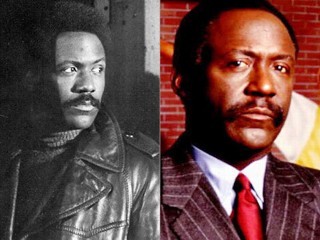
Richard Roundtree
From Wikipedia, the free encyclopedia
Born July 9, 1942 (1942-07-09) (age 66)
New Rochelle, New York
Occupation Film, stage, TV actor
Richard Roundtree (born July 9, 1942) is an American actor and former male fashion model known for portraying John Shaft in the film Shaft (1971) and in its two sequels, Shaft's Big Score (1972) and Shaft in Africa (1973).
Biography
Personal life
Roundtree was born in New Rochelle, New York, the son of Kathryn, a nurse and housekeeper, and John Roundtree, a caterer and garbage collector.[1] He attended Southern Illinois University.[2] Roundtree was diagnosed with breast cancer in 1993 and underwent a double mastectomy and chemotherapy.[3]
Career
Roundtree was a leading man in early 1970s Blaxploitation films. He also played a role in the 1977 television series Roots (TV miniseries), in the role of the slave Sam Bennett. Prior to becoming an actor, he was a football player and a model. Although Roundtree worked through the 1990s, many of his more recent films were not well-received, but he was able to find success in stage plays.
Since 1990, however, he reemerged as a cult icon. Roundtree appeared in David Fincher's critically acclaimed 1995 movie Se7en, the 2000 remake of Shaft as John Shaft's uncle, and guest-starred in several episodes of the first season of Desperate Housewives as an amoral private detective. He also appeared in 1997's George of the Jungle, as well as playing a high school vice-principal in the 2005 (General release: 2006) movie Brick Panic Button 2007 film. His voice was also utilized as the title character in the hit Play Station game Akuji the Heartless, where Akuji must battle his way out of the depths of hell at the bidding of the Baron himself.
In 1997, Roundtree had a leading role in the short-lived FOX ensemble drama 413 Hope St. He portrayed Booker T. Washington in the 1999 television movie Having Our Say: The Delany Sisters' First 100 Years.
He has appeared in the television series Heroes as Simone's terminally ill father, Charles Deveaux. Next he appearred in an episode of Lincoln Heights. Most recently, Roundtree has a supporting role in the 2008 Speed Racer film as a racer-turned-commentator who is an icon and hero to Speed.
Edy Williams
From Wikipedia, the free encyclopedia
Born Edwina Beth Williams
July 9, 1942 (1942-07-09) (age 66)
Salt Lake City, Utah, U.S.
Other name(s) Edie Williams
Edythe Williams
Years active 1962-Present
Spouse(s) Russ Meyer (June 27, 1970 - November 7, 1975)
Edwina Beth Williams (born July 9, 1942) is an American television and film actress. She is sometimes credited as Edie Williams or Edythe Williams.
Early years
Born in Utah and raised in Oregon and Southern California, Williams began her career as a model and beauty pageant contestant. After winning several local pageants, Williams was signed as a contract player by 20th Century Fox.[1]
Career
Throughout the 1960s, Williams appeared in several television series and film including roles in The Beverly Hillbillies, Batman, Adam-12, Lost in Space, The Naked Kiss, and the Sonny & Cher film, Good Times.
In 1970, she appeared as Ashley St. Ives in Russ Meyer's first mainstream film Beyond the Valley of the Dolls, followed by his second mainstream film The Seven Minutes (1971). Meyers and Williams married in 1970, shortly after the release of Beyond the Valley of the Dolls.
In March 1973, she was photographed for Playboy in a full color photo spread by then-husband Russ Meyer.[2]
After her divorce from Meyer in 1977, Williams continued acting, mainly appearing in films, many of which involving nudity.
In 1982, she appeared on an episode of The People's Court as a defendant in a case titled "The Star Who Wouldn't Pay". Williams was sued for payment for publicity work the plaintiff had done for her. She counter-sued for half of the retainer she'd paid him.[3]
After her appearance on The People's Court, Williams was sporadically active in films during the 1980s and early 1990s.
Later years
Since the 1990s, Williams has traditionally appeared at both the Academy Awards and the Cannes Film Festival in revealing and flamboyant outfits.[4]
Jimmy Smits
From Wikipedia, the free encyclopedia
Born July 9, 1955 (1955-07-09) (age 53)
Brooklyn, New York, USA
Spouse(s) Barbara Smits (1981-1987)
Emmy Awards
Supporting Actor - Drama Series
1990 L.A. Law
Golden Globe Awards
Best Performance by an Actor in a TV-Series - Drama
1996 NYPD Blue
Jimmy Smits (born July 9, 1955) is an American Golden Globe- and Emmy-winning actor. Smits is perhaps best known for his long-running roles on the 1980s legal drama L.A. Law as Richard Dysart's youngest uptight law partner, Victor Sifuentes, who was also the firm's pro-bono lawyer (a role he played from 1986 to 1991), and as Dennis Franz's second partner, Det. Bobby Simone, in NYPD Blue (a role he played from 1994 to 1998), a police officer who was a widower, as well as his role on The West Wing as congressman and presidential candidate Matt Santos, opposite Alan Alda, Bradley Whitford, and Martin Sheen. He most recently played Alex Vega, the main character on CBS's prime-time serial, Cane. As an actor, he is noted for his portrayal of earnest, honest men with deep moral convictions.
Biography
Early life
Smits was born in Brooklyn, New York City. His father, Cornelis Smits, was a Surinamese immigrant of Dutch descent who managed a silk-screening factory. His mother, Emilina, was a Puerto Rican who worked as a nurse.[1][2] He has 2 sisters, Yvonne and Diana. He grew up in a devoutly Catholic family[1] in a working-class neighborhood and spent time in Puerto Rico during his childhood.[3][4] Smits earned a bachelor's degree from Brooklyn College in 1980 and an MFA from Cornell University in 1982. Though born in New York, Smits has deep Puerto Rican roots and frequently visits the island. He was arrested for his participation in protests against U.S. Navy bombing practices in the Puerto Rican offshore island of Vieques.[5]
Career
A wider audience became aware of Smits for his appearance as Senator Bail Organa of Alderaan who becomes Princess Leia's adoptive father, in the films Star Wars: Episode II Attack of the Clones and Star Wars: Episode III Revenge of the Sith.
He also starred in the multigenerational story of a Chicano family in My Family/Mi Familia in 1995. Smits also played the Conky Repairman on Pee-wee's Playhouse as one of the show's memorable characters, and in one of his earliest roles. Another notable early role played by Smits was that of Eddie Rivera in the series premiere of Miami Vice. In the episode, he was Sonny Crockett's original partner, only to be shortly killed off in a sting gone wrong.
Smits was to have hosted the 2001 Latin Grammy Awards broadcast, but it was called off because of the terrorist attacks that day. He instead hosted a non-televised press conference to announce the winners.
Smits played the role of Congressman Matt Santos of Houston, Texas in the final two seasons of the American television drama The West Wing, joining fellow L.A. Law alumnus John Spencer. Smits's character eventually ran for and won the US Presidency in the series.
For the third season of Dexter, Smits has signed on to play the role of Miguel Prado, an attorney general who will at times team with Dexter on the hunt for a murderer.[6]
Personal life
Smits was married to Barbara Smits from 1981 until their divorce in 1987. They have two children, Taina (born in 1973) and Joaquin (born in 1983). Since 1986, Smits has been in a relationship with actress Wanda De Jesus. They reside in Los Angeles. Smits helped found the National Hispanic Foundation for the Arts[7] to advance the presence of Latinos in the media, telecommunications and entertainment industries. Jimmy is also an advocate for diagnostic colorectal screening and has appeared in a public service commercial.
Tom Hanks
From Wikipedia, the free encyclopedia
Born Thomas Jeffrey Hanks
July 9, 1956 (1956-07-09) (age 52)
Concord, California, USA
Occupation Actor, producer, director, voice over artist, writer
Years active 1979 - present
Spouse(s) Rita Wilson (1988-present)
Samantha Lewes (1978-1987)
Awards won
Academy Awards
Best Actor
1993 Philadelphia
1994 Forrest Gump
Emmy Awards
Outstanding Directing - Miniseries, Movie/Dramatic Special
2002 Band of Brothers
Outstanding Miniseries
1998 From The Earth To The Moon
2002 Band of Brothers
Golden Globe Awards
Best Actor - Motion Picture Drama
1994 Philadelphia
1995 Forrest Gump
2001 Cast Away
Best Actor - Motion Picture Musical or Comedy
1989 Big
Screen Actors Guild Awards
Best Actor - Motion Picture
1994 Forrest Gump
Best Cast - Motion Picture
1995 Apollo 13
Other Awards
Saturn Award for Best Actor (film)
1988 Big
Berlin Silver Bear for Best Actor
1994 Philadelphia
NYFCC Award for Best Actor
2000 Cast Away
AFI Life Achievement Award
2002 Lifetime Achievement
LAFCA Award for Best Actor
1988 Big; Punchline
Thomas Jeffrey "Tom" Hanks (born July 9, 1956) is an American film actor, director, voice-over artist, writer and film producer. Hanks worked in television and family-friendly comedies before achieving success as a dramatic actor portraying several notable roles, including Andrew Beckett in Philadelphia, the title role in Forrest Gump, Captain John H. Miller in Saving Private Ryan and Michael Sullivan in Road To Perdition. Hanks is the third most successful actor in terms of box office totals which exceed USD$3.3 billion.[1]
Biography
Early life
Hanks was born in Concord, California. His father, Amos Mefford Hanks, was a chef and a distant relation of President Abraham Lincoln's mother, Nancy Hanks Lincoln. His mother, Janet Marylyn (née Frager), was a hospital worker; the two divorced in 1960.[2] The family's three oldest children, Sandra, (now Sandra Hanks Benoiton, a writer),[3][4] Larry (now Lawrence M. Hanks, Ph.D., an entomology professor at the University of Illinois at Urbana-Champaign),[5] and Tom, went with their father; while the youngest, Jim, now an actor and film maker, remained with his mother in Red Bluff, California. Both parents remarried. The first stepmother for Sandra, Larry, and Tom came to the marriage with five children of her own. Hanks once told Rolling Stone magazine: "Everybody in my family likes each other. But there were always about fifty people at the house. I didn't exactly feel like an outsider, but I was sort of outside it". That marriage ended in divorce after just 2 years, and Amos Hanks became a single parent, working long hours and relying on the children to fend for themselves often, an exercise in self-reliance that served the siblings well. In school, Hanks was unpopular with students and teachers alike, telling Rolling Stone magazine: "I was a geek, a spaz. I was horribly, painfully, terribly shy. At the same time, I was the guy who'd yell out funny captions during filmstrips. But I didn't get into trouble. I was always a real good kid and pretty responsible". Amos Hanks remarried in 1965 to Frances Wong, a San Francisco native of Chinese descent. Frances had three children, two of whom lived with Tom during his high school years. Tom acted in school plays, including South Pacific, while attending Skyline High School in Oakland, California. Hanks studied theater at Chabot College, and after two years, transferred to California State University, Sacramento. Hanks told the New York Times: "Acting classes looked like the best place for a guy who liked to make a lot of noise and be rather flamboyant. I spent a lot of time going to plays. I wouldn't take dates with me. I'd just drive to a theater, buy myself a ticket, sit in the seat, and read the program, and then get into the play completely. I spent a lot of time like that, seeing Bertolt Brecht, Tennessee Williams, Henrik Ibsen, and all that."
It was during his years studying theater that Hanks met Vincent Dowling, head of the Great Lakes Theater Festival in Cleveland. At Dowling's suggestion, Hanks became an intern at the Festival, which stretched into a three-year experience that covered everything from lighting to set design to stage management. Such a commitment required that Hanks drop out of college, but with this under his belt, a future in acting was in the cards. Hanks won the Cleveland Critics Circle Award for best actor for his performance as Proteus in Shakespeare's The Two Gentlemen of Verona, one of the few times he played a villain.
Early career
In 1979, Hanks moved to New York City, where he made his film debut in the low-budget slasher film, He Knows You're Alone, and got a part in a television movie entitled Mazes and Monsters. Early in 1979, Hanks was cast in the lead role of Callimaco in the Riverside Shakespeare Company's production of Niccolò Machiavelli's The Mandrake, directed by Daniel Southern, featuring an original jazz score by Michael Wolff, original masks and costumes designed by Broadway designer Jane Stein, and was produced by W. Stuart McDowell and Gloria Skurski. This remains Hank's only New York stage performance to date; as a high profile Off Off Broadway showcase, the production helped Tom land an agent, Joe Ohla with the J. Michael Bloom Agency. The next year Hanks landed a lead role on an ABC television pilot called Bosom Buddies, playing the role of Kip Wilson. Hanks moved to Los Angeles, California where he was teamed with Peter Scolari as a pair of young advertising men forced to dress as women so they could live in an inexpensive all-female hotel. He had previously partnered with Scolari in the 1970s game show, Make Me Laugh. Bosom Buddies ran for two seasons, and, although the ratings were never strong, television critics gave the program high marks. "The first day I saw him on the set", the show's co-producer, Ian Praiser told Rolling Stone, "I thought, 'Too bad he won't be in television for long.' I knew he'd be a movie star in two years." But if Praiser knew it, he was not able to convince Hanks. "The television show had come out of nowhere", Hanks' best friend Tom Lizzio told Rolling Stone. "Then out of nowhere it got canceled. He figured he'd be back to pulling ropes and hanging lights in a theater."
It was Bosom Buddies and a guest appearance on a 1982 episode of Happy Days ("A Case of Revenge") where he played a disgruntled former classmate of The Fonz that drew director Ron Howard to contact Hanks. Howard was working on Splash (1984), a romantic comedy fantasy about a mermaid who falls in love with a human. At first, Howard considered Hanks for the role of the main character's wisecracking brother, a role which eventually went to John Candy. Instead, Hanks got the lead role and a career boost from Splash, which went on to become a box-office hit, grossing more than US$69 million. He also had a sizable hit with the sex comedy Bachelor Party, also in 1984.
From 1983-84, Hanks made three guest appearances on Family Ties as Elyse Keaton's alcoholic brother Ned Donnelly. Hanks also appears for a moment as an uncredited extra in the movie Real Genius (1985), when the lead character, Mitch, bumps into him in a crowd.
Period of hits and misses
More film roles followed, but none clicked with audiences. With Nothing in Common (1986)?-about a young man alienated from his parents who must re-establish a relationship with his father, played by Jackie Gleason?-Hanks began to establish the credentials of not only a comic actor but of someone who could carry a serious role. "It changed my desires about working in movies", Hanks told Rolling Stone. "Part of it was the nature of the material, what we were trying to say. But besides that, it focused on people's relationships. The story was about a guy and his father, unlike, say, The Money Pit (1986), where the story is really about a guy and his house."
After three more flops, Hanks succeeded with the fantasy Big (1988), both at the box office and within the industry, establishing Hanks as a major Hollywood talent. It was followed later that year by Punchline, in which he co-starred with Sally Field as a pair of struggling stand-up comedians, which grossed a respectable US$21 million. Hanks's character, Steven Gold, a failing medical student trying to break into standup, was somewhat edgy and complex, offering a glimpse of the far more dramatic roles Hanks would master in films to come. Hanks's next project was the 1989 movie Turner and Hooch. In a 1993 issue of Disney Adventures, Hanks said, "I saw Turner and Hooch the other day in the SAC store and couldn't help but be reminiscent. I cried like a babe." He did admit to making a couple of "bum tickers", however, and blamed his "...deductive reasoning and decision making skills."
Hanks had another pile of box-office failures. First, there was The 'Burbs (1989), then Joe Versus the Volcano (1990) and finally The Bonfire of the Vanities (1990), which saw Hanks as a greedy Wall Street type who gets enmeshed in a hit-and-run accident.
Progression into dramatic roles
Hanks again climbed back to the top with his portrayal of an unsuccessful baseball manager in A League of Their Own (1992). Hanks admits that his acting in earlier roles was not great and that he has improved. In an interview with Vanity Fair, Hanks called the work that he's done since his "modern era of moviemaking ... because enough self-discovery has gone on.... My work has become less 'pretentiously fake and over the top."
This "modern era" welcomed in a spectacular 1993 for Hanks, first with Sleepless in Seattle and then with Philadelphia. The former was a blockbuster success about a widower who finds true love (in the character of Meg Ryan) over the airwaves. Richard Schickel of Time called his performance "charming", and most agreed that his portrayal ensured him a place among the premiere romantic-comedy stars of his generation, making him bankable. In Philadelphia Hanks played a gay lawyer with AIDS who sues his firm for discrimination (Hanks lost thirty-five pounds and thinned his hair in order to appear sickly for the role.) In a review for People, Leah Rozen stated "Above all, credit for "Philadelphia's" success belongs to Hanks, who makes sure that he plays a character, not a saint. He is flat-out terrific, giving a deeply felt, carefully nuanced performance that deserves an Oscar."
Hanks won the 1993 Academy Award for Best Actor for his role in Philadelphia. During his acceptance speech he revealed that his high school drama teacher Rawley Farnsworth and former classmate John Gilkerson were gay.[6] The revelation inspired the 1997 film In & Out, starring Kevin Kline as an English Literature teacher who is outed by a former student in a similar way.
Forrest Gump
Hanks followed Philadelphia with the 1994 summer hit Forrest Gump, where the lead character moves in and out of cultural events in American history from the '50s onward.
Hanks explained what appealed to him about the script: "When I read the script for Gump, I saw it as one of those kind of grand, hopeful movies that the audience can go to and feel ... some hope for their lot and their position in life... I got that from the movies a hundred million times when I was a kid. I still do."
Hanks won his second Best Actor Academy Award for his role in Forrest Gump, becoming only the second actor to have accomplished the feat of winning back-to-back Best Actor Oscars. (Spencer Tracy was the first, winning in 1937-38. Hanks and Tracy were the same age at the time they received their Academy Awards: 37 for the first and 38 for the second.)
Apollo 13 and on
Hanks's next project reunited him with Ron Howard in the movie Apollo 13, in which he played astronaut and commander James Lovell. Critics generally applauded the film and the performances of the entire cast, which included actors Kevin Bacon, Bill Paxton, Gary Sinise, Ed Harris, and Kathleen Quinlan. The movie also earned nine nominations for an Academy Award in 1996, winning two. That same year, Hanks starred in the animated blockbuster Toy Story as the voice of Sheriff Woody.
Hanks turned to directing and producing with his next movie That Thing You Do!, about a 1960s pop group which Hanks co-stars as a music producer. Hanks and producer Gary Goetzman went on to create Playtone, a record and film production company named for the record company in the film.
Hanks executive produced, co-wrote and co-directed the HBO docudrama From the Earth to the Moon. The twelve-part series chronicles the space program from its inception, through the familiar flights of Neil Armstrong and Jim Lovell, to the personal feelings surrounding the reality of moon landings. The Emmy Award-winning US$68 million project is one of the most expensive ventures taken for television. Hanks' next project was no less expensive.
For Saving Private Ryan he teamed up with Steven Spielberg to make a film about D-Day, the landing at Omaha Beach, and a quest through war-torn France to bring back a soldier who has a ticket home. It earned the praise and respect of the film community, critics, and the general public; it was labeled one of the finest war films ever made, earning Spielberg his second Academy Award for direction and Hanks a Best Actor nomination. Later in 1998, Hanks re-teamed with his Sleepless in Seattle co-star Meg Ryan for another romantic comedy, You've Got Mail, a remake of 1940's The Shop Around the Corner, which starred Jimmy Stewart and Margaret Sullavan.
In 1999, Hanks starred in an adaptation of Stephen King's novel The Green Mile. He also returned as the voice of Woody in Toy Story 2. The following year he won a Golden Globe for Best Actor and an Academy nomination for his portrayal of a shipwrecked FedEx systems analyst in Robert Zemeckis's Cast Away. In 2001, Hanks helped direct and produce the acclaimed HBO mini-series Band of Brothers. He also appeared in the September 11 television special America: A Tribute to Heroes and the documentary Rescued From the Closet.
Next he teamed up with American Beauty director Sam Mendes for the adaptation of Max Allan Collins's and Richard Piers Rayner's graphic novel Road to Perdition, in which he played an anti-hero role as a hitman on the run with his son. That same year, Hanks collaborated with director Spielberg again, starring opposite Leonardo DiCaprio in the hit crime comedy Catch Me if You Can, based on the true story of Frank Abagnale, Jr. The same year, he and wife Rita Wilson produced the hit movie My Big Fat Greek Wedding. In August 2007, he along with co-producers Rita Wilson and Gary Goetzman, and writer and star Nia Vardalos, initiated a legal action against the production company Gold Circle Films for their share of profits from the movie.[7][8] At the age of 45, he became the youngest ever recipient of the American Film Institutes's Life Achievement Award on June 12, 2002.
Hanks was absent from the screen in 2003; in 2004, he appeared in three films: The Coen Brothers' The Ladykillers, another Spielberg helmed film, The Terminal, and The Polar Express, a family film from Robert Zemeckis. In a USA Weekend interview, Hanks talked about how he chooses projects: "[Since] A League of Their Own, it can't be just another movie for me. It has to get me going somehow.... There has to be some all-encompassing desire or feeling about wanting to do that particular movie. I'd like to assume that I'm willing to go down any avenue in order to do it right". In August 2005, Hanks was voted in as vice president of the Academy of Motion Picture Arts and Sciences.[9]
Hanks next starred in the highly anticipated film The Da Vinci Code, based on the bestselling novel by Dan Brown. The film was released May 19, 2006 in the US and grossed over US$750 million worldwide. In Ken Burns's 2007 documentary "The War", Hanks did voice work, reading excerpts from World War II-era columns by Al McIntosh. In 2006, Hanks topped a 1,500-strong list of 'most trusted celebrities' compiled by Forbes magazine.[10] Hanks next appeared in a cameo role as himself in The Simpsons Movie, in which he appears in an advertisement claiming that the US government has lost its credibility and is hence buying some of his. He also makes an appearance in the credits, stating that he wishes to be left alone when he is out in public.
In 2007, Hanks starred in Mike Nichols' film Charlie Wilson's War (written by acclaimed screenwriter Aaron Sorkin) in which he plays Democratic Texas Congressman Charles Wilson. The film opened on December 21, 2007 and Hanks got a Golden Globe nomination for his acting.
In a play on the expression "art imitating life", Hanks will play an on screen dad to a young man (Colin Hanks) who chooses to follow in the footsteps of a fading magician (John Malkovich) in The Great Buck Howard. Hanks' character is less than thrilled about his son's career decision. A film adaptation of Angels and Demons, the prequel to The Da Vinci Code, has been announced, and on April 11, 2007 it was revealed that Hanks would reprise his role as Robert Langdon and that he reportedly will receive the highest salary ever for an actor.[11][12]
Personal life
Hanks was married to Samantha Lewes from 1978 to 1987. The couple had two children, son Colin Hanks (now also an actor) and daughter Elizabeth Ann.[13][14] In 1988, Hanks married actress Rita Wilson; raised in several different Christian denominations, Hanks converted from Roman Catholicism to Eastern Orthodox Christianity when marrying Wilson.[15] The two first met on the set of Hanks's television show Bosom Buddies but later developed a romantic interest while working on the film Volunteers. They have two sons: Chester, or "Chet" (who has a small part as a student in Indiana Jones and the Kingdom of the Crystal Skull), and Truman.
He is a big sports fan, and as a teenager he was a peanut vendor at The Oakland Coliseum, home of the Oakland Athletics.[16][17] His favorite team is the Oakland Athletics.[16] Hanks is also a fan of the Oakland Raiders football team,[18] English Premier League football team Aston Villa.[19][20][21] Hanks lists "old manual typewriters" as a hobby on his MySpace page, owning about 80 of the classic mechanical types and traveling with one where ever he goes.[22][23]
Other activities
A fan of NASA's manned space program, Hanks said that he originally wanted to be an astronaut but "didn't have the math." Hanks is a member of the National Space Society, serving on the Board of Governors of the nonprofit educational space advocacy organization founded by Dr. Wernher Von Braun and was the producer of the HBO miniseries From the Earth to the Moon about the Apollo program to send astronauts to the moon. In addition, Hanks co-wrote and co-produced Magnificent Desolation: Walking on the Moon 3D, an IMAX film about the moon landings. Hanks also provided the voice over for the first new planetarium show following the opening of the new Rose Center for Earth & Space in the Hayden Planetarium at the American Museum of Natural History in New York.
In June 2006 Hanks was inducted as an honorary member of the United States Army Rangers Hall of Fame for his accurate portrayal of a Captain in the movie Saving Private Ryan; Hanks, who was unable to attend the induction ceremony, was the first actor to receive such an honor.[24] In addition to his role in Saving Private Ryan, Hanks was cited for serving as the national spokesperson for the World War II Memorial Campaign, for being the honorary chairperson of the D-Day Museum Capital Campaign, and for his role in writing and helping to produce the Emmy Award-winning miniseries, Band of Brothers.
While he gives money to many Democratic politicians, Hanks usually keeps his opinions about politics to himself, though he has been open about his support for environmental causes and alternative fuels.[25] Hanks, however, has made public his candidate choice in the 2008 election, when he uploaded a video to his MySpace in which he announced his endorsement of Senator Barack Obama. [26]
Hanks is one of several celebrities who frequently participate in planned comedy bits on Late Night with Conan O'Brien while they are guests. On one visit, Hanks asked Conan to join his run for president on the "Bad Haircut Party" ticket, with confetti and balloons and a hand held sign with the slogan "You'd be stupid to vote for us". On another, O'Brien, noting that Hanks was missing Christmas on his promotional tour, brought the season to him, including a gift (the skeleton of Hooch), and a mass of snow burying them both. On yet another episode, Conan gave Hanks a painting he had commissioned reflecting two of his interests: Astronauts landing on the beach at Normandy.
Hanks appeared on Late Night with Conan O'Brien to publicize his new film, The Da Vinci Code. He told the audience he had met, had a conversation with, and given a present to the Japanese Prime Minister, "Fujimori". The Japanese Prime Minister Hanks met was Junichiro Koizumi; Alberto Fujimori was the former President of Peru.
On March 10, 2008, Tom Hanks was on hand at the Rock & Roll Hall of Fame to induct sixties sensation The Dave Clark Five. He praised the group for both the joy of their music and for never signing away their publishing rights. During the speech he also mentioned his boyhood hero Marshal J whom he grew up watching on local San Francisco television station KGO. "Time is not told by watches or clocks but by whatever is on TV. After Marshal J and the cartoons you go to school."[27
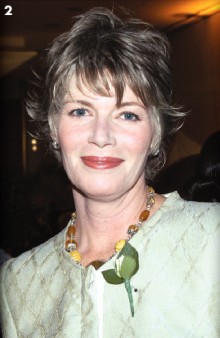
Kelly McGillis
From Wikipedia, the free encyclopedia
Born Kelly Ann McGillis
July 9, 1957 (1957-07-09) (age 51)
Newport Beach, California, United States
Spouse(s) Boyd Black (1979-1981)
Fred Tillman (1989-2002)
Awards won
BAFTA Awards
Nominated: Best Actress in a Leading Role
1985 Witness
Golden Globe Awards
Nominated: Best Supporting Actress - Motion Picture
1986 Witness
Kelly Ann McGillis (born July 9, 1957)[1] is an American actress, whose notable movies include Witness (for which she received a Golden Globe nomination), Top Gun, and The Accused.
Biography
Career
She attended The Juilliard School's Drama Division, graduating in 1983. There, she performed in William Congreve's "Love for Love" directed by John Blatchley. In 2004, she appeared in the stage play The Graduate as Mrs. Robinson, touring the United States. In 2007, according to Variety Magazine, she joined the cast of Showtime's The L Word for its fifth season.
Personal life
McGillis was born in Newport Beach, California, the daughter of Joan (née Snell), a homemaker, and Donald McGillis, a general practitioner of medicine.[2] She married Boyd Black in 1979, divorcing in 1981. She married Fred Tillman in 1989, and they had two daughters: Kelsey and Sonora. The couple divorced in 2002 and she is currently single. She and her daughter Sonora live in Mohnton, PA.[3]
In 1982, McGillis and her roommate were assaulted and raped in their home by the escaped rapist Leroy Johnson after McGillis came home from work.[4] This experience encouraged the actress to pursue her film role as the lawyer who supports Jodie Foster's character in The Accused. McGillis was originally approached for the role of the rape victim in that film. She turned it down, feeling it would be too close to her real life ordeal. The part eventually went to Jodie Foster, who won an Oscar for her performance.
McGillis had once owned Kelly's, a restaurant in Key West, Florida, that she and her ex-husband founded. Although the restaurant is still open, she says she is "no longer a part of that restaurant at all," since her second divorce, according to a 2006 TV interview on "Good Day Sacramento".
The supermarket had a sale on boneless chicken breasts. I intended to stock up. At the store, however, I was disappointed to find only a few skimpy prepackaged portions of the poultry, so I complained to the butcher lady.
"Don't worry," she said, "I'll pack some more trays and have them ready for you by the time you finish shopping."
Several aisles later, I heard the lady butcher's voice boom over the public-address system: "Will the gentleman who wanted bigger breasts please meet me at the back of the store."
well, folks, we truly enjoyed edgar's funny little bit between Merle and Marty. Thanks for the smile, Texas.
firefly, I really loved Nana's lovely song, and it did faintly resemble Elvis' "I Can't Help Falling in Love with You."
Hope all went well with your karaoke, Bio Bob, and thanks for the humorous story about life's embarrassing moments. We always learn something from your background on famous folks, and we do appreciate your efforts.
Although this man was not among the hawkman's biographies, I found that today was his birthday as well. Let's listen to this one, shall we?
http://www.youtube.com/watch?v=ByU0RjEnOkw&feature=related