Booker T and the MGs
Primarily remembered for being a one hit wonder, with Green Onions, the group has recorded many times. Here is their version of the theme music to "Hang 'em High."
0 Replies
Letty
1
Reply
Tue 27 May, 2008 06:17 am
I saw that movie, edgar, but don't recall many of the details. At one time, I watched all of Clint Eastwood's movies. Thanks, buddy. That was really great.
This is another song from his movie, The Unforgiven. Love the acoustic guitar.
Dashiell Hammett
From Wikipedia, the free encyclopedia
Born Samuel Dashiell Hammett
May 27, 1894(1894-05-27)
Saint Mary's County, Maryland
Died January 10, 1961 (aged 66)
New York City, New York
Occupation Novelist
Nationality United States
Writing period 1929-1951
Genres Hardboiled crime fiction,
detective fiction
Influenced
Raymond Chandler, Chester Himes, Mickey Spillane, Ross Macdonald, John D. MacDonald, Robert B. Parker, Sara Paretsky, James Ellroy, Sue Grafton, Walter Mosley, William Gibson, Rian Johnson, Richard K. Morgan
Samuel Dashiell Hammett (May 27, 1894?-January 10, 1961) was an American author of hardboiled detective novels and short stories. Among the enduring characters he created are Sam Spade (The Maltese Falcon), Nick and Nora Charles (The Thin Man), and the Continental Op (Red Harvest and The Dain Curse). In addition to the significant influence his novels and stories had on film, Hammett "is now widely regarded as one of the finest mystery writers of all time"[1] and was called, in his obituary in the New York Times, "the dean of the... 'hard-boiled' school of detective fiction".[2]
Early life
Hammett was born on a farm called "Hopewell and Aim" off Great Mills Road, St. Mary's County, in southern Maryland.[3] His parents were Richard Thomas Hammett and Annie Bond Dashiell. (The Dashiells are an old Maryland family, the name being an Americanization of the French De Chiel; it is pronounced "da-SHEEL", not "DASH-el".) He grew up in Philadelphia and Baltimore. "Sam", as he was known before he began writing, left school when he was 13 years old and held several jobs before working for the Pinkerton National Detective Agency. He served as an operative for the Pinkerton Agency from 1915 to 1921, with time off to serve in World War I. However, the agency's role in union strike-breaking eventually disillusioned him.[4]
During World War I, Hammett enlisted in the U.S. Army and served in the Motor Ambulance Corps. However, he became ill with the Spanish flu and later contracted tuberculosis. He spent the war as a patient in a hospital in America. He married a nurse, Josephine Dolan, in 1921 and had two daughters with her: Mary Jane, born in 1921 and Josephine, born in 1926. Shortly after the birth of their second child, Health Services nurses informed Josephine that due to Hammett's tuberculosis, she and the children should not live with him. So they rented a place in San Francisco. Hammett would visit on weekends, but the marriage soon fell apart. Hammett still supported his wife and daughters financially with the income he made from his writing.
Hammett turned to drinking, advertising, and eventually, writing. His work at the detective agency provided him the inspiration for his writings.
Early work
Later novels
As Hammett's literary style matured, he relied less and less on the super-criminal and turned more to the kind of realistic, hardboiled fiction seen in The Maltese Falcon or The Thin Man. In The Simple Art of Murder, Hammett's successor in the field, Raymond Chandler, summarized Hammett's accomplishments:
Hammett was the ace performer... He is said to have lacked heart; yet the story he himself thought the most of [The Glass Key] is the record of a man's devotion to a friend. He was spare, frugal, hard-boiled, but he did over and over again what only the best writers can ever do at all. He wrote scenes that seemed never to have been written before.
Later years
From 1929 to 1930 Dashiell was romantically involved with Nell Martin, an author of short stories and several novels. He dedicated The Glass Key to her, and in turn, she dedicated her novel Lovers Should Marry to Hammett.
In 1931, Hammett embarked on a thirty-year affair with playwright Lillian Hellman. He wrote his final novel in 1934, and devoted much of the rest of his life to left-wing activism. He was a strong anti-fascist throughout the 1930s and in 1937 he joined the American Communist Party.[5] As a member of the League of American Writers, he served on its Keep America Out of War Committee in January 1940 during the period of the Hitler-Stalin pact.[6]
Service in World War Two
In 1942, after Pearl Harbor, Hammett enlisted in the United States Army. Though he was a disabled veteran of WWI, and a victim of tuberculosis, he pulled strings in order to be admitted to the service. He spent most of World War Two as an Army Sergeant in the Aleutian Islands, where he edited an Army newspaper. He came out of the war suffering from emphysema.
Post-war political activity
After the war, Hammett returned to political activism, "but he played that role with less fervor than before."[7] He was elected President of the Civil Rights Congress of New York on 5 June 1946 at a meeting held at the Hotel Diplomat in New York City, and "devoted the largest portion of his working time to CRC activities."[7] In 1946, a bail fund was created by the CRC "to be used at the discretion of three trustees to gain the release of defendants arrested for political reasons."[8] Those three trustees were Hammett, who was chairman, Robert W. Dunn, and Frederick Vanderbilt Field, "millionaire Communist supporter."[8] On 3 April 1947, the CRC was designated a Communist front group on the Attorney General's List of Subversive Organizations, as directed by U.S. President Harry S. Truman's Executive Order 9835.[9]
Imprisonment and the blacklist
The CRC's bail fund gained national attention on 4 November 1949, when bail in the amount of "$260,000 in negotiable government bonds" was posted "to free eleven men appealing their convictions under the Smith Act for criminal conspiracy to teach and advocate the overthrow of the United States government by force and violence."[8] On 2 July 1951, their appeals exhausted, four of the convicted men fled rather than surrender themselves to Federal agents and begin serving their sentences. "At that time the U.S. District Court, Southern District of New York, issued subpoenas for the trustees of the CRC bail fund in an attempt to learn the whereabouts of the fugitives...".[8] Hammett testified on 9 July 1951 in front of United States District Court Judge Sylvester Ryan, facing questioning by U.S. District Attorney Irving Saypol, described by Time as "the nation's number one legal hunter of top Communists".[8] During the hearing Hammett refused to provide the information the government wanted, specifically, the list of contributors to the bail fund, "people who might be sympathetic enough to harbor the fugitives."[8] Instead, on every question regarding the CRC or the bail fund, Hammett took the Fifth Amendment, refusing to even identify his signature or initials on CRC documents the government had subpoenaed. As soon as his testimony concluded, Hammett was immediately found guilty of contempt of court.[8][10][11][12]
During the 1950s he was investigated by Congress (see McCarthyism), and testified on March 26, 1953 before the House Committee on Un-American Activities. Although he testified to his own activities, he refused to cooperate with the committee, and was blacklisted.
Death
On January 10, 1961, Hammett died in New York City's Lenox Hill Hospital, of lung cancer, diagnosed just two months prior. As a veteran of two World Wars, he was buried at Arlington National Cemetery.
0 Replies
bobsmythhawk
1
Reply
Tue 27 May, 2008 10:19 am
Rachel Carson
From Wikipedia, the free encyclopedia
Born May 27, 1907(1907-05-27)
Springdale, Pennsylvania
Died April 14, 1964 (aged 56)
Silver Spring, Maryland
Occupation marine biologist, writer
Nationality American
Writing period 1937-1964
Genres nature writing
Subjects marine biology, ecology, pesticides
Notable work(s) Silent Spring
Rachel Louise Carson (May 27, 1907 - April 14, 1964) was an American marine biologist and nature writer whose writings are credited with advancing the global environmental movement.
Carson started her career as a biologist in the U.S. Bureau of Fisheries, and became a full-time nature writer in the 1950s. Her widely praised 1951 bestseller The Sea Around Us won her financial security and recognition as a gifted writer. Her next book, The Edge of the Sea, and the republished version of her first book, Under the Sea-Wind, were also bestsellers. Together, her sea trilogy explores the whole of ocean life, from the shores to the surface to the deep sea.
In the late 1950s, Carson turned her attention to conservation and the environmental problems caused by synthetic pesticides. The result was Silent Spring (1962), which brought environmental concerns to an unprecedented portion of the American public. Silent Spring spurred a reversal in national pesticide policy?-leading to a nationwide ban on DDT and other pesticides?-and the grassroots environmental movement it inspired the creation of the Environmental Protection Agency. Carson was posthumously awarded the Presidential Medal of Freedom.
Life and work
Carson's childhood home now is preserved as the Rachel Carson Homestead
Early life and education
Rachel Carson was born on May 27, 1907, on a small family farm near Springdale, Pennsylvania, just up the Allegheny River from Pittsburgh. As a child, she spent many hours learning about ponds, fields, and forests from her mother, who taught Rachel and her older brother and sister the lessons of nature-study. Carson was an avid reader, and, from a remarkably young age, a talented writer. She also spent a lot of time exploring around her 65-acre farm. She began writing stories (often involving animals) at age eight, and had her first published story at age ten. She especially enjoyed the St. Nicholas Magazine (which carried her first published stories), the works of Beatrix Potter, and the novels of Gene Stratton Porter, and in her teen years, Herman Melville, Joseph Conrad and Robert Louis Stevenson. The natural world, particularly the ocean, was the common thread of her favorite literature. Carson attended Springdale's small school through tenth grade, then completed high school in nearby Parnassus, Pennsylvania, graduating in 1925 at the top of her class of forty-four students.[1]
At the Pennsylvania College for Women (today known as Chatham University), as in high school, Carson was somewhat of a loner. She originally studied English, but switched her major to biology in January 1928, though she continued contributing to the school's student newspaper and literary supplement. Though admitted to graduate standing at Johns Hopkins University in 1928, she was forced to remain at the Pennsylvania College for Women for her senior year due to financial difficulties; she graduated magna cum laude in 1929. After a summer course at the Marine Biological Laboratory, she continued her studies in zoology and genetics at Johns Hopkins in the fall of 1929.[2]
After her first year of graduate school, Carson became a part-time student, taking an assistantship in Raymond Pearl's laboratory, where she worked with rats and Drosophila, to earn money for tuition. After false starts with pit vipers and squirrels, she completed a dissertation project on the embryonic development of the pronephros in fish. She earned a master's degree in zoology in June 1932. She had intended to continue for a doctorate, but in 1934 Carson was forced to leave Johns Hopkins to search for a full-time teaching position to help support her family. In 1935, her father died suddenly, leaving Carson to care for her aging mother and making the financial situation even more critical. At the urging of her undergraduate biology mentor Mary Scott Skinker, she settled for a temporary position with the U.S. Bureau of Fisheries writing radio copy for a series of weekly educational broadcasts entitled "Romance Under the Waters". The series of fifty-two seven-minute programs focused on aquatic life and was intended to generate public interest in fish biology and in the work of the bureau?-a task the several writers before Carson had not managed. Carson also began submitting articles on marine life in the Chesapeake Bay, based on her research for the series, to local newspapers and magazines.[3]
Carson's supervisor, pleased with the success of the radio series, asked her to write the introduction to a public brochure about the fisheries bureau; he also worked to secure her the first full-time position that became available. Sitting for the civil service exam, she outscored all other applicants and in 1936 became only the second woman to be hired by the Bureau of Fisheries for a full-time, professional position, as a junior aquatic biologist.[4]
Early career and publications
At the U.S. Bureau of Fisheries, Carson's main responsibilities were to analyze and report field data on fish populations, and to write brochures and other literature for the public. Using her research and consultations with marine biologists as starting points, she also wrote a steady stream of articles for The Baltimore Sun and other newspapers. However, her family responsibilities further increased in January 1937 when her older sister died, leaving Carson as the sole breadwinner for her mother and two nieces.[5]
In July 1937, the Atlantic Monthly accepted a revised version of an essay, "The World of Waters", that she had originally written for her first fisheries bureau brochure; her supervisor had deemed it too good for that purpose. The essay, published as "Undersea", was a vivid narrative of a journey along the ocean floor. It marked a major turning point in Carson's writing career. Publishing house Simon & Schuster, impressed by "Undersea", contacted Carson and suggested that she expand it into book form. Several years of writing resulted in Under the Sea-Wind (1941), which received excellent reviews but sold poorly. In the meantime, Carson's article-writing success continued?-her features appeared in Sun Magazine, Nature, and Collier's.[6]
Carson attempted to leave the Bureau (by then transformed into the Fish and Wildlife Service) in 1945, but few jobs for naturalists were available as most money for science was focused on technical fields in the wake of the Manhattan Project. In mid-1945, Carson first encountered the subject of DDT, a revolutionary new pesticide (lauded as the "insect bomb" after the atomic bombings of Hiroshima and Nagasaki) that was only beginning to undergo tests for safety and ecological effects. DDT was but one of Carson's many writing interests at the time, and editors found the subject unappealing; she published nothing on DDT until 1962.[7]
Carson rose within the Fish and Wildlife Service, supervising a small writing staff by 1945 and becoming chief editor of publications in 1949. Though her position provided increasing opportunities for fieldwork and freedom in choosing her writing projects, it also entailed increasingly tedious administrative responsibilities. By 1948, Carson was working on material for a second book and had made the conscious decision to begin a transition to writing full-time. That year, she took on a literary agent, Marie Rodell; they formed a close professional relationship that would last the rest of Carson's career.[8]
Oxford University Press expressed interest in Carson's book proposal for a life history of the ocean, spurring her to complete the manuscript of what would become The Sea Around Us by early 1950.[9] Chapters appeared in Science Digest and the Yale Review?-the latter chapter, "The Birth of an Island", winning the American Association for the Advancement of Science's George Westinghouse Science Writing Prize?-and nine chapters were serialized in The New Yorker. The Sea Around Us remained on the New York Times bestseller list for 86 weeks, was abridged by Reader's Digest, won the 1952 National Book Award and the Burroughs Medal, and resulted in Carson being awarded two honorary doctorates. She also licensed a documentary film to be based on The Sea Around Us. The book's success led to the republication of Under the Sea-Wind, which also became a best-seller. With success came financial security, and Carson was able to give up her job in 1952 to concentrate on writing full time.[10]
Carson was inundated with speaking engagements, fan mail and other correspondence regarding The Sea Around Us, along with work on the documentary script that she had secured the right to review.[11] She was extremely unhappy with the final version of the script by writer, director and producer Irwin Allen; she found it untrue to the atmosphere of the book and scientifically embarrassing, describing it as "a cross between a believe-it-or-not and a breezy travelogue."[12] She discovered, however, that her right to review the script did not extend to any control over its content. Allen proceeded in spite of Carson's objections to produce a very successful documentary. It won the 1953 Oscar for Best Documentary, but Carson was so embittered by the experience that she never again sold film rights to her work.[13]
Relationship with Dorothy Freeman
Carson moved with her mother to Southport Island, Maine in 1953, and in July of that year met Dorothy Freeman (1898-1978)?-the beginning of an extremely close relationship that would last the rest of Carson's life. The nature of the relationship between Carson and Freeman has been the subject of much interest and speculation. It is probably best described as a romantic friendship. Carson met Freeman, a summer resident of the island along with her husband, after Freeman had written to Carson to welcome her. Freeman had read The Sea Around Us, a gift from her son, and was excited to have the prominent author as a neighbor. Carson's biographer Linda Lear writes that "Carson sorely needed a devoted friend and kindred spirit who would listen to her without advising and accept her wholly, the writer as well as the woman."[14] She found this in Freeman. The two women had a number of common interests, nature chief among them, and began exchanging letters regularly while apart. They would continue to share every summer for the remainder of Carson's life, and meet whenever else their schedules permitted.[15]
Though Lear does not explicitly describe the relationship as romantic, others (such as the encyclopedia glbtq[16]) have noted that Carson and Freeman knew that their letters could be interpreted as lesbian, even though "the expression of their love was limited almost wholly to letters and very occasional farewell kisses or holding of hands."[17] Freeman shared parts of Carson's letters with her husband to help him understand the relationship, but much of their correspondence was carefully guarded.[18] Shortly before Carson's death, she and Freeman destroyed hundreds of letters. The surviving correspondence was published in 1995 as Always, Rachel: The Letters of Rachel Carson and Dorothy Freeman, 1952-1964: An Intimate Portrait of a Remarkable Friendship, edited by Freeman's granddaughter. According to one reviewer, the pair "fit Carolyn Heilbrun's characterization of a strong female friendship, where what matters is 'not whether friends are homosexual or heterosexual, lovers or not, but whether they share the wonderful energy of work in the public sphere'".[19]
The Edge of the Sea and transition to conservation work
In early 1953 Carson began library and field research on the ecology and organisms of the Atlantic shore.[20] In 1955, she completed the third volume of her sea trilogy, The Edge of the Sea, which focuses on life in coastal ecosystems (particularly along the Eastern Seaboard). It appeared in The New Yorker in two condensed installments shortly before the October 26 book release. By this time, Carson's reputation for clear and poetical prose was well-established; The Edge of the Sea received highly favorable reviews, if not quite as enthusiastic as for The Sea Around Us.[21]
Through 1955 and 1956, Carson worked on a number of projects?-including the script for an Omnibus episode, "Something About the Sky"?-and wrote articles for popular magazines. Her plan for the next book was to address evolution, but the publication of Julian Huxley's Evolution in Action?-and her own difficulty in finding a clear and compelling approach to the topic?-led her to abandon the project. Instead, her interests were turning to conservation. She considered an environment-themed book project tentatively entitled Remembrance of the Earth and became involved with The Nature Conservancy and other conservation groups. She also made plans to buy and preserve from development an area in Maine she and Freeman called the "Lost Woods".[22]
Early in 1957, family tragedy struck a third time when one of the nieces she had cared for in the 1940s died at the age of 31, leaving a five-year-old orphan son, Roger Christie. Carson took on that responsibility, adopting the boy, alongside continuing to care for her aging mother; this took a considerable toll on Carson. She moved to Silver Spring, Maryland to care for Roger, and much of 1957 was spent putting their new living situation in order and focusing on specific environmental threats.[23]
By fall 1957, Carson was closely following federal proposals for widespread pesticide spraying; the USDA planned to eradicate fire ants, and other spraying programs involving chlorinated hydrocarbons and organophosphates were on the rise.[24] For the rest of her life, Carson's main professional focus would be the dangers of pesticide overuse.
Silent Spring
Research and writing
Starting in the mid-1940s, Carson had become concerned about the use of synthetic pesticides, many of which had been developed through the military funding of science since World War II. It was the USDA's 1957 fire ant eradication program, however, that prompted Carson to devote her research, and her next book, to pesticides and environmental poisons. The fire ant program involved aerial spraying of DDT and other pesticides (mixed with fuel oil), including the spraying of private land. Landowners in Long Island filed a suit to have the spraying stopped, and many in affected regions followed the case closely. Though the suit was lost, the Supreme Court granted petitioners the right to gain injunctions against potential environmental damage in future; this laid the basis for later successful environmental actions.[25]
The Washington, D.C. chapter of the Audubon Society also actively opposed such spraying programs, and recruited Carson to help make public the government's exact spraying practices and the related research.[26] Carson began the four-year project of what would become Silent Spring by gathering examples of environmental damage attributed to DDT. She also attempted to enlist others to join the cause: essayist E. B. White, and a number of journalists and scientists. By 1958, Carson had arranged a book deal, with plans to co-write with Newsweek science journalist Edwin Diamond. However, when The New Yorker commissioned a long and well-paid article on the topic from Carson, she began considering writing more than simply the introduction and conclusion as planned; soon it was a solo project. (Diamond would later write one of the harshest critiques of Silent Spring.)[27]
As her research progressed, Carson found a sizable community of scientists who were documenting the physiological and environmental effects of pesticides. She also took advantage of her personal connections with many government scientists, who supplied her with confidential information. From reading the scientific literature and interviewing scientists, Carson found two scientific camps when it came to pesticides: those who dismissed the possible danger of pesticide spraying barring conclusive proof, and those who were open to the possibility of harm and willing to consider alternative methods such as biological pest control.[28]
By 1959, the USDA's Agricultural Research Service responded to the criticism of Carson and others with a public service film, Fire Ants on Trial; Carson characterized it as "flagrant propaganda" that ignored the dangers that spraying pesticides (especially dieldrin and heptachlor) posed to humans and wildlife. That spring, Carson wrote a letter, published in The Washington Post, that attributed the recent decline in bird populations?-in her words, the "silencing of birds"?-to pesticide overuse.[29] That was also the year of the "Great Cranberry Scandal": the 1957, 1958, and 1959 crops of U.S. cranberries were found to contain high levels of the herbicide aminotriazole (which caused cancer in laboratory rats) and the sale of all cranberry products was halted. Carson attended the ensuing FDA hearings on revising pesticide regulations; she came away discouraged by the aggressive tactics of the chemical industry representatives, which included expert testimony that was firmly contradicted by the bulk of the scientific literature she had been studying. She also wondered about the possible "financial inducements behind certain pesticide programs".[30]
Research at the Library of Medicine of the National Institutes of Health brought Carson into contact with medical researchers investigating the gamut of cancer-causing chemicals. Of particular significance was the work of National Cancer Institute researcher and founding director of the environmental cancer section Wilhelm Hueper, who classified many pesticides as carcinogens. Carson and her research assistant Jeanne Davis, with the help of NIH librarian Dorothy Algire, found evidence to support the pesticide-cancer connection; to Carson the evidence for the toxicity of a wide array of synthetic pesticides was clear-cut, though such conclusions were very controversial beyond the small community of scientists studying pesticide carcinogenesis.[31]
By 1960, Carson had more than enough research material, and the writing was progressing rapidly. In addition to the thorough literature search, she had investigated hundreds of individual incidents of pesticide exposure and the human sickness and ecological damage that resulted. However, in January, a duodenal ulcer followed by several infections kept her bedridden for weeks, greatly delaying the completion of Silent Spring. As she was nearing full recovery in March (just as she was completing drafts of the two cancer chapters of her book), she discovered cysts in her left breast, one of which necessitated a mastectomy. Though her doctor described the procedure as precautionary and recommended no further treatment, by December Carson discovered that the tumor was in fact malignant and the cancer had metastasized.[32] Her research was also delayed by revision work for a new edition of The Sea Around Us, and by a collaborative photo essay with Erich Hartmann.[33] Most of the research and writing was done by the fall of 1960, except for the discussion of recent research on biological controls and investigations of a handful of new pesticides. However, further health troubles slowed the final revisions in 1961 and early 1962.[34]
It was difficult finding a title for the book; "Silent Spring" was initially suggested as a title for the chapter on birds. By August 1961, Carson finally agreed to the suggestion of her literary agent Marie Rodell: Silent Spring would be a metaphorical title for the entire book?-suggesting a bleak future for the whole natural world?-rather than a literal chapter title about the absence of birdsong.[35] With Carson's approval, editor Paul Brooks at Houghton Mifflin arranged for illustrations by Louis and Lois Darling, who also designed the cover. The final writing was the first chapter, "A Fable for Tomorrow", which was intended to provide a gentler introduction to what might otherwise be a forbiddingly serious topic. By mid-1962, Brooks and Carson had largely finished the editing, and were laying the groundwork for promoting the book by sending the manuscript out to select individuals for final suggestions.[36]
Argument
As biographer Mark Hamilton Lytle writes, Carson "quite self-consciously decided to write a book calling into question the paradigm of scientific progress that defined postwar American culture." The overriding theme of Silent Spring is the powerful?-and often negative?-effect humans have on the natural world.[37]
Carson's main argument is that pesticides have detrimental effects on the environment; they are more properly termed "biocides", she argues, because their effects are rarely limited to the target pests. DDT is a prime example, but other synthetic pesticides come under scrutiny as well?-many of which are subject to bioaccumulation. Carson also accuses the chemical industry of intentionally spreading disinformation and public officials of accepting industry claims uncritically. Most of the book is devoted to pesticides' effects on natural ecosystems, but four chapters also detail cases of human pesticide poisoning, cancer, and other illnesses attributed to pesticides.[38] About DDT and cancer, the subject of so much subsequent debate, Carson says only a little:
" In laboratory tests on animal subjects, DDT has produced suspicious liver tumors. Scientists of the Food and Drug Administration who reported the discovery of these tumors were uncertain how to classify them, but felt there was some "justification for considering them low grade hepatic cell carcinomas." Dr. Hueper [author of Occupational Tumors and Allied Diseases] now gives DDT the definite rating of a "chemical carcinogen."[39] "
Carson predicts increased consequences in the future, especially as targeted pests develop resistance to pesticides while weakened ecosystems fall prey to unanticipated invasive species. The book closes with a call for a biotic approach to pest control as an alternative to chemical pesticides.[40]
Promotion and reception
Carson and the others involved with publication of Silent Spring expected fierce criticism. They were particularly concerned about the possibility of being sued for libel. Carson was also undergoing radiation therapy to combat her spreading cancer, and expected to have little energy to devote to defending her work and responding to critics. In preparation for the anticipated attacks, Carson and her agent attempted to amass as many prominent supporters as possible before the book's release.[41]
Most of the book's scientific chapters were reviewed by scientists with relevant expertise, among whom Carson found strong support. Carson attended the White House Conference on Conservation in May, 1962; Houghton Mifflin distributed proof copies of Silent Spring to many of the delegates, and promoted the upcoming New Yorker serialization. Among many others, Carson also sent a proof copy to Supreme Court Justice William O. Douglas, a long-time environmental advocate who had argued against the court's rejection of the Long Island pesticide spraying case (and who had provided Carson with some of the material included in her chapter on herbicides).[42]
Though Silent Spring had generated a fairly high level of interest based on pre-publication promotion, this became much more intense with the serialization in The New Yorker, which began in the June 16, 1962 issue. This brought the book to the attention of the chemical industry and its lobbyists, as well as a wide swath of the American populace. Around that time Carson also learned that Silent Spring had been selected as the Book-of-the-Month for October; as she put it, this would "carry it to farms and hamlets all over that country that don't know what a bookstore looks like?-much less The New Yorker."[43] Other publicity included a positive editorial in The New York Times and excerpts of the serialized version in Audubon Magazine, with another round of publicity in July and August as chemical companies responded. The story of the birth defect-causing drug thalidomide broke just before the book's publication as well, inviting comparisons between Carson and Frances Oldham Kelsey, the Food and Drug Administration reviewer who had blocked the drug's sale in the United States.[44]
The Book-of-the-Month Club edition of Silent Spring, including an endorsement by William O. Douglas, had a first print run of 150,000 copies, two-and-a-half times the combined size of the two conventional printings of the initial release [45]In the weeks leading up to the September 27 publication there was strong opposition to Silent Spring. DuPont (a main manufacturer of DDT and 2,4-D) and Velsicol Chemical Company (exclusive manufacturer of chlordane and heptachlor) were among the first to respond. DuPont compiled an extensive report on the book's press coverage and estimated impact on public opinion. Velsicol threatened legal action against Houghton Mifflin as well as The New Yorker and Audubon Magazine unless the planned Silent Spring features were canceled. Chemical industry representatives and lobbyists also lodged a range of non-specific complaints, some anonymously. Chemical companies and associated organizations produced a number of their own brochures and articles promoting and defending pesticide use. However, Carson's and the publishers' lawyers were confident in the vetting process Silent Spring had undergone. The magazine and book publications proceeded as planned, as did the large Book-of-the-Month printing (which included a pamphlet endorsing the book by William O. Douglas).[46]
American Cyanamid biochemist Robert White-Stevens and former Cyanamid chemist Thomas Jukes were among the most aggressive critics, especially of Carson's analysis of DDT.[47] According to White-Stevens, "If man were to follow the teachings of Miss Carson, we would return to the Dark Ages, and the insects and diseases and vermin would once again inherit the earth."[48] Others went further, attacking Carson's scientific credentials (because her training was in marine biology rather than biochemistry) and her personal character. White-Stevens labeled her "a fanatic defender of the cult of the balance of nature",[49] while former Secretary of Agriculture Ezra Taft Benson?-in a letter to Dwight D. Eisenhower?-reportedly concluded that because she was unmarried despite being physically attractive, she was "probably a Communist".[50]
Many critics repeatedly asserted that she was calling for the elimination of all pesticides.[citation needed] Yet Carson had made it clear she was not advocating the banning or complete withdrawal of helpful pesticides, but was instead encouraging responsible and carefully managed use with an awareness of the chemicals' impact on the entire ecosystem.[51] In fact, she concludes her section on DDT in Silent Spring not by urging a total ban, but with advice for spraying as little as possible to limit the development of resistance.[52]
The academic community?-including prominent defenders such as H. J. Muller, Loren Eisley, Clarence Cottam, and Frank Egler?-by and large backed the book's scientific claims; public opinion soon turned Carson's way as well. The chemical industry campaign backfired, as the controversy greatly increased public awareness of potential pesticide dangers, as well as Silent Spring book sales. Pesticide use became a major public issue, especially after the CBS Reports TV special "The Silent Spring of Rachel Carson" that aired April 3, 1963. The program included segments of Carson reading from Silent Spring and interviews with a number of other experts, mostly critics (including White-Stevens); according to biographer Linda Lear, "in juxtaposition to the wild-eyed, loud-voiced Dr. Robert White-Stevens in white lab coat, Carson appeared anything but the hysterical alarmist that her critics contended."[53] Reactions from the estimated audience of ten to fifteen million were overwhelmingly positive, and the program spurred a congressional review of pesticide dangers and the public release of a pesticide report by the President's Science Advisory Committee.[54] Within a year or so of publication, the attacks on the book and on Carson had largely lost momentum.[55]
In one of her last public appearances, Carson had testified before President Kennedy's Science Advisory Committee. The committee issued its report on May 15, 1963, largely backing Carson's scientific claims.[56] Following the report's release, she also testified before a Senate subcommittee to make policy recommendations. Though Carson received hundreds of other speaking invitations, she was unable to accept the great majority of them. Her health was steadily declining as her cancer outpaced the radiation therapy, with only brief periods of remission. She spoke as much as she was physically able, however, including a notable appearance on The Today Show and speeches at several dinners held in her honor. In late 1963, she received a flurry of awards and honors: the Paul Bartsch Award (from the Audubon Naturalist Society), the Audubon Medal (from the American Geographical Society), and induction into the American Academy of Arts and Letters.[57]
Weakened from breast cancer and her treatment regimen, Carson became ill with a respiratory virus in January 1964. Her condition worsened from there: in February, doctors found that she had severe anemia from her radiation treatments, and in March they discovered that the cancer had reached her liver. She died of a heart attack on April 14, 1964, at the age of 56.[58]
Legacy
Collected papers and posthumous publications
Carson bequeathed her manuscripts and papers to Yale University, to take advantage of the new state-of-the-art preservations facilities of the Beinecke Rare Book and Manuscript Library. Her longtime agent and literary executor Marie Rodell spent nearly two years organizing and cataloging Carson's papers and correspondence, distributing all the letters to their senders so that only what each correspondent approved of would be submitted to the archive.[59]
In 1965, Rodell arranged for the publication of an essay Carson had intended to expand into a book: A Sense of Wonder. The essay, which was combined with photographs by Charles Pratt and others, exhorts parents to help their children experience the "lasting pleasures of contact with the natural world", which "are available to anyone who will place himself under the influence of earth, sea and sky and their amazing life."[60]
In addition to the letters in Always Rachel, in 1998 a volume of Carson's previously unpublished work was published as Lost Woods: The Discovered Writing of Rachel Carson, edited by Linda Lear. All of Carson's books remain in print.[60]
Grassroots environmentalism and the EPA
Carson's work had a powerful impact on the environmental movement. Silent Spring, in particular, was a rallying point for the fledging social movement in the 1960s. According to environmental engineer and Carson scholar H. Patricia Hynes, "Silent Spring altered the balance of power in the world. No one since would be able to sell pollution as the necessary underside of progress so easily or uncritically."[61] Carson's work, and the activism it inspired, are at least partly responsible for the deep ecology movement, and the overall strength of the grassroots environmental movement since the 1960s. It was also influential on the rise of ecofeminism and on many feminist scientists.[62]
Carson's most direct legacy in the environmental movement was the campaign to ban the use of DDT in the United States (and related efforts to ban or limit its use throughout the world). Though environmental concerns about DDT had been considered by government agencies as early as Carson's testimony before the President's Science Advisory Committee, the 1967 formation of the Environmental Defense Fund was the first major milestone in the campaign against DDT. The organization brought lawsuits against the government to "establish a citizen's right to a clean environment", and the arguments employed against DDT largely mirrored Carson's. By 1972, the Environmental Defense Fund and other activist groups had succeeded in securing a phase-out of DDT use in the United States (except in emergency cases).[63]
The creation, in 1970, of the Environmental Protection Agency addressed another concern that Carson had brought to light. Until then, the same agency (the USDA) was responsible both for regulating pesticides and promoting the concerns of the agriculture industry; Carson saw this as a conflict of interest, since the agency was not responsible for effects on wildlife or other environmental concerns beyond farm policy. Fifteen years after its creation, one journalist described the EPA as "the extended shadow of Silent Spring". Much of the agency's early work, such as enforcement of the 1972 Federal Insecticide, Fungicide, and Rodenticide Act, was directly related to Carson's work.[64]
Criticisms of environmentalism and DDT restrictions
Carson and the environmental movement were?-and continue to be?-criticized by some conservatives, who argue that restrictions placed on pesticides have caused needless deaths and hampered agriculture, and more generally that environmental regulation unnecessarily restricts economic freedom.[65][66] For example, the conservative magazine Human Events gave Silent Spring an honorable mention for the "Ten Most Harmful Books of the 19th and 20th Centuries".[67] In the 1980s, the Reagan administration sought to undo as much of the environmental legacy of the 1960s and 1970s as possible, and Carson and her work were obvious targets.[68]
Carson's attack on DDT has come under the most intense fire. Political scientist Charles Rubin was one of the most vociferous critics in the 1980s and 1990s, though he accused her merely of selective use of source and fanaticism (rather than the more severe criticism Carson received upon Silent Spring's release). In the 2000s, critics have claimed that Carson is responsible for millions of malaria deaths, because of the DDT bans her work prompted. Biographer Mark Hamilton Lytle finds these estimates unrealistic, even assuming that Carson can be "blamed" for worldwide DDT policies, and suggests that malaria is much less significant than a number of other widespread preventable public health problems in Africa.[69] Carson never actually called for an outright ban on DDT.[70]
Some experts have argued that restrictions placed on the agricultural use of DDT have increased its effectiveness as a tool for battling malaria. According to pro-DDT advocate Amir Attaran the result of the 2004 Stockholm Convention banning DDT's use in agriculture "is arguably better than the status quo For the first time, there is now an insecticide which is restricted to vector control only, meaning that the selection of resistant mosquitoes will be slower than before."[71] But though Carson's legacy has been closely tied to DDT, Roger Bate of the DDT advocacy organization Africa Fighting Malaria warns that "A lot of people have used Carson to push their own agendas. We just have to be a little careful when you're talking about someone who died in 1964."[72]
Posthumous honors
A variety of groups ranging from government institutions to environmental and conservation organizations to scholarly societies have celebrated Carson's life and work since her death. Perhaps most significantly, on June 9, 1980 Carson was awarded the Presidential Medal of Freedom, the highest civilian honor in the United States, in recognition of her influence on President Kennedy and her foundational role in the environmental movement.[73] A U.S. postage stamp was issued in her honor the following year; several other countries have since issued Carson postage as well.[74]
The Rachel Carson Bridge in PittsburghCarson's birthplace and childhood home in Springdale, Pennsylvania?-now known as the Rachel Carson Homestead?-became a National Register of Historic Places site, and the nonprofit Rachel Carson Homestead Association was created in 1975 to manage it.[75] Near Pittsburgh, a 35.7 miles (57 km) hiking trail, maintained by the Rachel Carson Trails Conservancy, was dedicated to Carson in 1975.[76] A Pittsburgh bridge was also renamed in Carson's honor as the Rachel Carson Bridge.[77] The Pennsylvania Department of Environmental Protection State Office Building in Harrisburg is named in her honor. An elementary school in Gaithersburg, Montgomery County, MD, built in 1990, was named in her honor[78], as was a middle school in Herndon, VA[79].
A number of conservation areas have been named for Carson as well. Between 1964 and 1990, 650 acres (3 km²) near Brookeville in Montgomery County, Maryland were acquired and set aside as the Rachel Carson Conservation Park, administered by the Maryland-National Capital Park and Planning Commission.[80] In 1969, the Coastal Maine National Wildlife Refuge became the Rachel Carson National Wildlife Refuge; expansions will bring the size of the refuge to about 9,125 acres (37 km²).[81] In 1985, North Carolina renamed one of its estuarine reserves in honor of Carson, in Beaufort.[82]
Carson is also a frequent namesake for prizes awarded by philanthropic, educational and scholarly institutions. The Rachel Carson Prize, founded in Stavanger, Norway in 1991, is awarded to women who have made a contribution in the field of environmental protection.[83] The American Society for Environmental History has awarded the Rachel Carson Prize for Best Dissertation since 1993.[84] Since 1998, the Society for Social Studies of Science has awarded an annual Rachel Carson Book Prize for "a book length work of social or political relevance in the area of science and technology studies."[85]
Centennial events
The celebration of the 100th anniversary Carson's birth in Springdale, Pennsylvania2007 was the centennial of Carson's birth. On Earth Day (April 22, 2007), Courage for the Earth: Writers, Scientists, and Activists Celebrate the Life and Writing of Rachel Carson was released as "a centennial appreciation of Rachel Carson's brave life and transformative writing", thirteen essays by prominent environmental writers and scientists.[86] Democratic Senator Benjamin L. Cardin, Maryland, had intended to submit a resolution celebrating Carson for her "legacy of scientific rigor coupled with poetic sensibility" on the 100th anniversary of her birth. The resolution was blocked by Republican Senator Tom Coburn, Oklahoma,[87] who said that "The junk science and stigma surrounding DDT?-the cheapest and most effective insecticide on the planet?-have finally been jettisoned."[88] The Rachel Carson Homestead Association held a May 27 birthday party and sustainable feast at her birthplace and home in Springdale, Pennsylvania, and planned several other events throughout the year.
0 Replies
bobsmythhawk
1
Reply
Tue 27 May, 2008 10:23 am
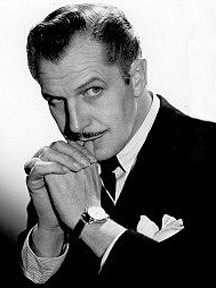
Vincent Price
From Wikipedia, the free encyclopedia
Born Vincent Leonard Price, Jr.
May 27, 1911(1911-05-27)
St. Louis, Missouri, US
Died October 25, 1993 (aged 82)
Los Angeles, California, US
Occupation Film actor
Spouse(s) Edith Barrett (1938-1948)
Mary Grant Price (1949-1973)
Coral Browne (1974-1991)
Vincent Leonard Price, Jr. (May 27, 1911 - October 25, 1993) was an American film actor, remembered for his distinctive voice, his tall 6-foot 4-inch stature and serio-comic attitude in a series of horror films.
Biography
Early life and career
Price was born in St. Louis, Missouri, the son of Marguerite Cobb (née Willcox) and Vincent Leonard Price, Sr., who was the president of the National Candy Company.[1][2] His grandfather, Vincent Clarence Price, invented "Dr. Price's Baking Powder", the first cream of tartar baking powder, and secured the family's fortune.[3]
Price attended St. Louis Country Day School. He was further educated at Yale in art history and fine art. He was a member of Alpha Sigma Phi Fraternity and the Courtauld Institute, London. He became interested in theater in the 1930s, appearing professionally on stage from 1935.
He made his film debut in 1938 with Service de Luxe and established himself as a competent actor, notably in Laura (1944), opposite Gene Tierney, directed by Otto Preminger. He also played Joseph Smith, Jr. in the movie Brigham Young (1940), as well as a pretentious priest in The Keys of the Kingdom (1944).
Price's first venture into the horror genre was in the 1939 Boris Karloff film Tower of London in which his character was murdered by Karloff's. The following year he portrayed the title character in the film The Invisible Man Returns (a role he reprised in a vocal cameo at the end of 1948's horror-comedy spoof Abbott and Costello Meet Frankenstein).
In 1946 Price reunited with Gene Tierney in two notable films, Dragonwyck and Leave Her to Heaven. There were also many villainous roles in slick film noir thrillers like The Web (1947), The Long Night (1947), Rogues Regiment (1948) and The Bribe (1949) with Robert Taylor, Ava Gardner and Charles Laughton. He was also active in radio, portraying the Robin Hood-inspired crime-fighter Simon Templar, aka. The Saint, in a series that ran from 1943 to 1951.
In the 1950s, he moved into horror films, with a role in House of Wax (1953), the first 3-D film to land in the year's top ten at the North American box office, and then the monster movie The Fly (1958). Price also starred in the original House on Haunted Hill (1959) as the eccentric millionaire Fredrick Loren. (Geoffrey Rush, playing the same character in the 1999 remake, was not only made to resemble Price, but was also renamed Steven Price.)
1960s
In the 1960s, Price had a number of low-budget successes with Roger Corman and American International Pictures (AIP) including the Edgar Allan Poe adaptations House of Usher (1960), The Pit and the Pendulum (1961), Tales of Terror (1962), The Raven (1963), The Masque of the Red Death, and The Tomb of Ligeia (1965). He also starred in The Last Man on Earth (1964), a film based on the Richard Matheson novel. In 1968 Price gave an iconic, coldly menacing, performance as Matthew Hopkins the "Witchfinder General" in the film of the same name.[4]
He also starred in comedy films, notably the cult-classic Dr. Goldfoot and the Bikini Machine (1965). In 1968 he played the part of an eccentric artist in the musical Darling of the Day opposite Patricia Routledge, displaying an adequate if untrained singing voice.
He often spoke of his pleasure at playing "Egghead" on the Batman television series. Another of his co-stars, Yvonne Craig (Batgirl), often said Price was her favorite co-star. In an often-repeated anecdote from the set of Batman, Price, after a take was printed, started throwing eggs at series stars Adam West and Burt Ward, and when asked to stop replied, "With a full artillery? Not a chance!", causing an eggfight to erupt on the soundstage. This incident is reenacted in the behind-the-scenes telefilm Return to the Batcave: The Misadventures of Adam and Burt.
It was also in the 1960s that he began his role as a guest on the game show The Hollywood Squares, even becoming a semi-regular in the 1970s, including being one of the guest panelists on the finale in 1980.[5] He was known for usually making fun of Rose Marie's age, and using his famous voice to answer maliciously to questions.
Later career
During the early 1970s, Price hosted and starred in BBC Radio's horror and mystery series The Price of Fear. Price accepted a cameo part in the children's television program The Hilarious House of Frightenstein (1971) in Hamilton, Ontario Canada, on the local television station CHCH. In addition to the opening and closing monologues, his role in the show was to recite poems about the show's various characters, sometimes wearing a cloak or other costumes.[6] He has also appeared in The Abominable Dr. Phibes (1971) and Theatre of Blood (1973), in which he created a series of campy, tongue-in-cheek villains. Price also recorded dramatic readings of Poe's short stories and poems, which were collected together with readings by Basil Rathbone.
He greatly reduced his film work from around 1975, as horror itself suffered a slump, and increased his narrative and voice work, as well as advertising Milton Bradley's Shrunken Head Apple Sculpture. Price's voiceover is heard on Alice Cooper's first solo album, Welcome to My Nightmare from 1975, as well as the TV special entitled Alice Cooper-The Nightmare. He also starred for a year in the early 1970s in a syndicated daily radio program, Tales of the Unexplained. He also made guest appearances in a 1970 episode of Here's Lucy showcasing his art expertise and in a 1972 episode of The Brady Bunch, in which he played a deranged archaeologist.
In the summer of 1977, he began performing as Oscar Wilde, in the one man stage play Diversions and Delights. Written by John Gay and directed by Joe Hardy, the play is set in a Parisian theatre on a night about one year before Wilde's death. In an attempt to earn some much-needed money, he speaks to the audience about his life, his works and, in the second act, about his love for Bosie, Lord Alfred Douglas, which led to his downfall.
The original tour of the play was a success in every city that it played, except for New York City. In the summer of 1979, Price performed it at the Tabor Opera House in Leadville, Colorado on the same stage that Wilde had spoken to the miners about art some 96 years before. Price would eventually perform the play worldwide and to many, including his daughter Victoria, it was the best acting that he ever did.
In 1982, Price provided the narrator's voice in Vincent, Tim Burton's six-minute film about a young boy who flashes from reality into a fantasy where he is Vincent Price. That same year, he performed a sinister "rap" on the title track of Michael Jackson's Thriller album. A behind the scenes recording of the second verse of Vincent's rap can be heard on the Thriller 25 album.
In 1983, Price played the Sinister Man in the British spoof horror film Bloodbath at the House of Death starring Kenny Everett. One of his last major roles, and one of his favorites, was as the voice of Professor Ratigan in Walt Disney Pictures' The Great Mouse Detective from 1986.
From 1981 to 1989, he hosted the PBS television series Mystery!. Also, in 1985, he was voice talent on the Hanna-Barbera series The 13 Ghosts of Scooby-Doo as the mysterious Vincent Van Ghoul, who aided Scooby-Doo and the gang in capturing thirteen evil demons into an ancient chest. During this time (1985-1989), he appeared in horror-themed commercials for Tilex bathroom cleanser. In 1989, Price was inducted into the St. Louis Walk of Fame. His last significant film work was as the inventor in Tim Burton's Edward Scissorhands (1990).
A witty raconteur, Price was a frequent guest on Johnny Carson's Tonight Show, where he once demonstrated how to poach a fish in a dishwasher. He also was a frequent panelist on Hollywood Squares during its initial run. Price was also a noted gourmet cook and art collector. From 1962 to 1971, Sears, Roebuck offered the Vincent Price Collection of Fine Art, selling about 50,000 pieces of fine art to the general public. Price selected and commissioned works for the collection, including works by Rembrandt, Pablo Picasso, and Salvador Dalí.[7] He also authored several cookbooks and hosted a cookery TV show, Cooking Pricewise.
Family
Price was married three times and fathered a son, named Vincent Barrett Price, with his first wife, former actress Edith Barrett. Price and his second wife Mary Grant Price donated hundreds of works of art and a large amount of money to East Los Angeles College in the early 1960s in order to endow the Vincent and Mary Price Gallery there. Their daughter, Victoria, was born in 1962.
Price's last marriage was to the Australian actress Coral Browne, who appeared with him (as one of his victims) in Theatre of Blood (1973). He converted to Catholicism to marry her, and she became a U.S. citizen for him.
Death
Price was a lifelong smoker. He had long suffered from emphysema and Parkinson's disease, which had forced his role in Edward Scissorhands to be much smaller than intended.
His illness also contributed to his retirement from Mystery, as his condition was becoming noticeable on-screen. He died of lung cancer on October 25, 1993. The Arts & Entertainment Network aired an episode of Biography highlighting Price's horror career the next night, but because of its failure to clear copyrights, the show was never aired again. Four years later, A&E produced its updated episode, a show titled Vincent Price: The Versatile Villain, which aired on October 12, 1997; it is often rebroadcast and is available on DVD. The script was by Lucy Chase Williams, author of The Complete Films of Vincent Price (Citadel Press, 1995). In early 1991, Tim Burton was developing a personal documentary with the working title Conversations With Vincent, in which interviews with Price were shot at the Vincent Price Gallery, but the project was never completed and was eventually shelved.
Legacy
In 1951, impressed by the spirit of the students and the community's need for the opportunity to experience original art works firsthand, Price donated some 90 pieces from his own collection to East Los Angeles College in Monterey Park, California, thus establishing the first "teaching art collection" owned by a community college in the U.S. Today, the Vincent Price Art Gallery continues to present world-class exhibitions, and remains one of the actor's most enduring legacies. The collection contains over 2,000 pieces and has been valued in excess of five million dollars. (On exhibit at The Vincent Price Gallery on the ELAC campus for free. Mon-Thu 12:00pm-3:00pm behind the F-5 Building)
Price was an Honorary Board Member and strong supporter of the Witch's Dungeon Classic Movie Museum located in Bristol, Connecticut until his death. The museum features detailed life-size wax replicas of characters from some of Price's films, including The Fly, The Abominable Dr. Phibes and The Masque of the Red Death.[8]
A black box theater at Price's alma mater, St. Louis Country Day School, is named after him.
Director Tim Burton directed a short stop-motion film as a tribute to Vincent Price called Vincent, about a young boy named Vincent Malloy who was obsessed with the grim and macabre. It is narrated by Price. Vincent Twice, Vincent Twice was a Price parody on Sesame Street. He was parodied in an episode of The Simpsons ("Sunday, Cruddy Sunday"). Price even had his own Spitting Image puppet, who was always trying to be "sinister" and lure people into his ghoulish traps, only for his victims to point out all the obvious flaws. Starting in November 2005, featured cast member Bill Hader of the NBC sketch comedy/variety show Saturday Night Live has played Price in a recurring sketch where Vincent Price hosts botched holiday specials filled with celebrities of the late 1950s-early 1960s. Other cast members who have played Price on SNL include Dan Aykroyd and Michael McKean (who played Price when he hosted a season 10 episode and again when he was hired as a castmember for the 1994-1995 season). The October 2005 episode of the Channel 101 series Yacht Rock featured comedian James Adomian as Vincent Price during the recording of Michael Jackson's "Thriller".
In 1999, a frank and detailed biography of Price, written by his daughter Victoria Price, was published by St Martin's Griffin Press.
0 Replies
bobsmythhawk
1
Reply
Tue 27 May, 2008 10:27 am
Christopher Lee
From Wikipedia, the free encyclopedia
Born Christopher Frank Carandini Lee
May 27, 1922 (1922-05-27) (age 86)
Belgravia, London, England
Years active 1948 - present
Spouse(s) Birgit Kroencke (1961 - present)
Official website
Awards won
Screen Actors Guild Awards
Outstanding Cast - Motion Picture
2003 The Lord of the Rings: The Return of the King
Other Awards
NBR Award for Best Cast
2003 The Lord of the Rings: The Return of the King
Christopher Frank Carandini Lee, CBE, CStJ (born May 27, 1922) is an English actor. He initially portrayed villains and became famous for his role as Count Dracula in a string of Hammer Horror films. Other notable roles include Lord Summerisle in The Wicker Man, Francisco Scaramanga in The Man with the Golden Gun, Count Dooku in the Star Wars prequel trilogy as well as Saruman in the Lord of the Rings film trilogy. Lee's most important role, according to him, was his portrayal of Pakistan's founder Muhammad Ali Jinnah in the biopic Jinnah. His most recent film is The Golden Compass, where he plays the Magisterium's First High Counselor.[1] Despite a critically acclaimed career that spans over seven decades, Lee has never been nominated for an Academy Award. At his peak he was 6'5" tall and is ranked along with Vince Vaughn as the tallest leading actor of all time.
Christopher Lee is also one of the favorite actors of Tim Burton & has became a regular in many of Tim Burton's films
Biography
Early life
Lee was born in Belgravia, England, the son of Italian Marchesina Estelle Marie (née Carandini di Sarzano) and Lieutenant-Colonel Geoffrey Trollope Lee of the 60th King's Royal Rifle Corps.[2][3] Lee's mother was a famous Edwardian beauty who was painted by Sir John Lavery, as well as Oswald Birley and Olive Snell, and was sculpted by Clare F. Sheridan, a cousin of Sir Winston Churchill. Lee's maternal grandfather had been an Italian political refugee who had sought refuge in Australia.
His parents separated when he was very young and his mother took him and his sister to Switzerland. Here Lee's family fell upon relatively hard times and there were rumours that he had to work on a fondue stand to make extra cash for his family. After enrolling in Miss Fisher's Academy in Wengen, he played his first villainous role as Rumpelstiltskin. The family returned to London where Christopher attended Wagner's private school. His mother then married Harcourt "Ingle" Rose, a banker and uncle of the James Bond author Ian Fleming. Lee then attended Wellington College where he won scholarships in classics. He volunteered to fight for the Finnish forces during the Winter War against the Soviet Union in 1939; however, as Lee admits in his autobiography, he and his fellow British volunteers were in Finland only a fortnight and kept well away from the Russian forces the whole time. He went on to serve in the Royal Air Force and intelligence services during [[World War II] including serving as an Intelligence officer with the Long Range Desert Group]. He trained in South Africa as a pilot but eyesight problems forced him to drop out. He eventually ended up in North Africa as Cipher Officer for No. 260 Squadron RAF and was with it through Sicily and Italy. Additionally, he has mentioned serving in Special Operations Executive. Lee retired from the RAF after the end of the War with the rank of Flight Lieutenant.
Career as an actor
In 1946, Lee gained a seven-year contract with Rank Organisation after discussing his interest in acting with his mother's second cousin Nicolò Carandini, the Italian Ambassador. Carandini related to Lee that performance was in his blood as his great-grandmother Marie Carandini had been a successful opera singer in Australia, a fact of which Lee was unaware. He made his film debut in Terence Young's Gothic romance, Corridor of Mirrors, in 1948.
In 1948, Lee made an uncredited appearance in Laurence Olivier's film of Hamlet as a spear carrier (marking his first film with frequent costar Peter Cushing, who played Osric). Throughout the next decade, he made nearly thirty films, playing mostly stock action characters.
Lee's first film for Hammer, made in 1957 with his close friend Peter Cushing, was The Curse of Frankenstein in which he played Frankenstein's monster. That led to his first appearance as the infamous Transylvanian bloodsucker in the 1958 film Dracula (known as Horror of Dracula in the US). Stories vary as to why Lee did not feature in the 1960 sequel The Brides of Dracula. Some state Hammer were unwilling to pay Lee his current fee but most tend to believe that he simply did not wish to be typecast. Lee did, however, return to the role in Hammer's Dracula: Prince of Darkness 1965. He may be considered to be the best actor ever in this role. Lee's performance is notable in that he has no lines, merely hissing his way through the film. Again, stories vary as to the reason for this: Lee states he refused to speak the poor dialogue he was given, but writer Jimmy Sangster claims that the script did not contain any lines for the character. This film set the standard for most of the Dracula sequels in the sense that half the film's running time was spent on telling the story of Dracula's resurrection and the character's appearances were brief. Lee has gone on record to state that he was virtually 'blackmailed' by Hammer into starring in the subsequent films; unable or unwilling to pay him his going rate, they would resort to reminding him of how many people he would put out of work if he did not take part.
His performances in the following three films (1968's Dracula Has Risen from the Grave, 1969's Taste the Blood of Dracula and 1970's Scars of Dracula) all gave the character very little to do but were each commercially successful. Although Lee may not have liked what Hammer were doing with the character, worldwide audiences embraced the films which are now considered classics of the genre. Lee starred in two further Dracula films for Hammer in the early 70's, both of which attempted to bring the character into the modern day era. Neither was commercially successful. Lee's other work for Hammer included performances as The Mummy (1959), Rasputin in Rasputin, the Mad Monk (Lee apparently met Rasputin's assassin Felix Yussupov when he was a child), and Sir Henry Baskerville to Cushing's Sherlock Holmes in The Hound of the Baskervilles. He was also responsible for bringing acclaimed occult author Denis Wheatley to Hammer. The company made two films from Wheatley's novels, both starring Lee. The first, 1967's The Devil Rides Out, is generally considered to be one of Hammer's crowning achievements. According to Lee, Wheatley was so pleased with it that he offered the actor the film rights to his remaining black magic novels free of charge. However, the second, 1976's To the Devil a Daughter, was fraught with production difficulties, and was disowned by its author. Although financially successful, it was Hammer's last horror film, and marked the end of Lee's long association with the studio that brought him fame.
Lee also co-starred with Boris Karloff in the 1958 film Corridors of Blood. Like Cushing, he also appeared in horror films for other companies during the 20 year period from 1957 to 1977. Notable performances included the Jekyll and Hyde roles in I, Monster (1971), The Creeping Flesh (1972) and Lee's personal favourite The Wicker Man. Lee was attracted to the latter role by screenwriter Antony Schaffer and apparently gave his services for free as the budget was so small.
Since the mid 70s Lee has eschewed horror roles almost entirely, proving himself to be an extremely able and versatile actor. He played in the well-known James Bond series. Ian Fleming, author of the James Bond spy novels, had offered him the role of the title character in the first official Bond film Dr. No. Lee enthusiastically accepted, but the producers had already chosen Joseph Wiseman for the part. In 1974, Lee finally got to play a James Bond villain when he was cast as the deadly assassin Francisco Scaramanga in The Man with the Golden Gun.
Because of his filming schedule in Bangkok, film director Ken Russell was unable to sign Lee to play The Specialist in Tommy (1975). That role was eventually given to Jack Nicholson. According to an AMC documentary on Halloween, John Carpenter states that he offered the role of Sam Loomis to Peter Cushing and Christopher Lee before Donald Pleasance took the role. Years later, Lee would meet Carpenter and tell him that the biggest regret of his career was not taking the role of Dr. Loomis. In 1978, Lee surprised many people with his deft comedy timing and willingness to go along with a joke as guest host on NBC's Saturday Night Live.
Lee also appeared in the series of Fu Manchu films from 1965 to 1969, starring as the eponymous villain in heavy oriental make-up. In 1998, Lee starred in the role of Muhammad Ali Jinnah, founder of modern Pakistan, in the film Jinnah.
He auditioned for a role in The Longest Day but was turned down as he did not look like a military man (despite having served in the RAF during World War II). Lee acted in the 1970 movie Eugenie unaware that it was softcore pornography, because the sex scenes were shot separately and edited in with his own appearances afterwards. Lee has played roles in over 220 films since 1948. He has had many notable television roles, including that of Flay in the BBC television miniseries, based on Mervyn Peake's novels, Gormenghast, and Stefan Cardinal Wyszyński in the 2005 CBS film John Paul the Second.
Lee starred as Saruman in the Lord of the Rings movie trilogy. (In the commentary he states he was approached to play Gandalf, but said he was too old. Gandalf was then given to Ian McKellen and Lee played Saruman.) Lee had met Tolkien once (making him the only person in the Lord of the Rings film trilogy to have done so), and makes a habit of reading the novels at least once a year.[4] In addition, he performed for the album The Lord of the Rings: Songs and Poems by J. R. R. Tolkien in 2003.[5] Lee had his appearance in the third film cut, resulting in a frosty friendship with Peter Jackson, however, it was reinstated in the extended edition.
The Lord of the Rings marked the beginning of a small revival of his career that continued in Star Wars Episode II: Attack of the Clones and Star Wars Episode III: Revenge of the Sith in which he played Count Dooku, a name allegedly chosen to reflect his fame playing Count Dracula. His autobiography states that he did much of the swordplay himself, though a double was required for the more vigorous footwork. His good friend and frequent co-star, Peter Cushing, portrayed the equally icy Grand Moff Tarkin in Star Wars Episode IV: A New Hope. In the fantasy movie Charlie and the Chocolate Factory, Lee played the role of Dr. Wilbur Wonka, the strict father of the star character Willy Wonka.
He was slated to appear as a ballad soloist called The Gentleman Ghost in Tim Burton's film version of the Stephen Sondheim musical, Sweeney Todd. However, shortly after filming began Tim Burton made the decision to omit all chorus singing, as it did not work in the context of a film. As a result, his character, as well as the characters of eight other actors, were cut before they were filmed.[6] However, according to Tim Burton, Lee, as well as the rest of the ballad soloists, were present for the recording session and did, in fact, record their musical numbers.[7]
A rare appearance with his head shaved to look bald can be seen in 1970 film The Private Life of Sherlock Holmes, directed by Billy Wilder. According to the Oracle of Bacon website at the University of Virginia, Lee is ranked second (just behind Rod Steiger) as the "Center of the Hollywood Universe" due to his large number of films with a correspondingly large number of different castmates.[8]
In addition to more than a dozen feature films together for Hammer Films, Amicus Productions and other companies, Lee and Peter Cushing both appeared in Hamlet (1948) and Moulin Rouge (1952) albeit in separate scenes; and in separate installments of the Star Wars films, Cushing as Grand Moff Tarkin in the original film, Lee years later as Count Dooku. The last project which united them in person was a documentary, Flesh and Blood, the Hammer Heritage of Horror, which they jointly narrated. It was the last time they saw each other as Cushing died two months later. While they frequently played off each other as mortal enemies onscreen ?- Lee's Count Dracula to Cushing's Professor Van Helsing ?- they were close friends in real life.
Lee appeared on the cover of the Wings album Band on the Run along with other people, including chat show host Michael Parkinson, movie actor James Coburn, world boxing champion John Conteh and broadcaster Clement Freud.
Christopher Lee is also one of the favorite actors of Tim Burton & has became a regular in many of Tim Burton's films
Lee is also credited by the Guiness Book of World Records as being the world's tallest living actor (a distinction he actually shares with actor Vince Vaughn). But, this record has been recently broken by actor/wrestler Tyler Mane who stands 6'8".
Voice work
Lee sings on the The Wicker Man soundtrack, performing Paul Giovanni's psych folk composition, "The Tinker of Rye".[9] He also sings the closing credits song of the 1994 horror movie Funny Man.[10] His most notable musical work on film, however, appears in the strange superhero comedy/rock musical The Return of Captain Invincible (1983) which Lee steals with a raucous song and dance number called "Name Your Poison", written by Richard O'Brien.
Lee provided the off-camera voice of "U.N. Owen," the mysterious host who brings disparate characters together in Agatha Christie's Ten Little Indians (1965). The film was produced by Harry Alan Towers, for whom Lee had worked repeatedly in the 1960s. Even though he is not credited on the film, the voice is unmistakable.
Lee appears on Peter Knight and Bob Johnson's (of Steeleye Span) 1970s concept album The King of Elfland's Daughter. Lee also provided the voices for the roles of DiZ (Ansem the Wise) in the video game Kingdom Hearts II and of Pastor Galswells in Tim Burton's Corpse Bride.
He contributed his voice, as Death, in the animated versions of Terry Pratchett's Soul Music and Wyrd Sisters and reprised the role in the Sky One live action adaptation The Colour of Magic, taking over the role from the late Ian Richardson.
He is fluent in English, Italian, French, Spanish and German, and moderately proficient in Swedish, Russian and Greek .[1] He was the original voice of Thor in the German dubs in the Danish 1986 animated movie Valhalla, and of King Haggard in the 1982 animated adaptation of The Last Unicorn.[11][12]
Lee bridged two disparate genres of music by performing a heavy metal variation of the Toreador Song from the opera Carmen with the band Inner Terrestrials.[13] Lee narrated and sang for the Danish musical group The Tolkien Ensemble, taking the role of Treebeard, King Théoden and others in the readings or singing of their respective poems or songs.[14]. Lee also appeared as a narrator for Italian symphonic fantasy power metal band Rhapsody of Fire, playing the Wizard King in the latest two albums, Symphony of Enchanted Lands II: The Dark Secret and Triumph or Agony. He narrates several tracks in the two albums, as well as singing a duet with lead vocalist Fabio Lione in the single "The Magic of the Wizard's Dream" from the Symphony of Enchanted Lands II album.
Lee was the voice of Lucan D'Lere in the trailers for Everquest II, also as a Tim Burton regular he is one of the voices for Corpse Bride where he voiced Pastor Galswells.
Some thirty years after playing Francisco Scaramanga in The Man with the Golden Gun, Lee provided the voice of Scaramanga in the video game GoldenEye: Rogue Agent.[15]
In 2007, Lee voiced the transcript of The Children of Húrin, by J.R.R. Tolkien for the audiobook version of the novel.
Honours
In 2001, Lee was appointed Commander of The Most Excellent Order of the British Empire (CBE) by Queen Elizabeth II.[16] Lee was named 2005's 'most marketable star in the world' in a USA Today newspaper poll, after three of the films he appeared in grossed US$640 million.[17]
Family
The Carandinis, Lee's maternal ancestors, were given the right to bear the coat of arms of the Holy Roman Empire by the Emperor Frederick Barbarossa. Cinemareview cites: "Cardinal Consalvi was Papal Secretary of State at the time of Napoleon and is buried at the Pantheon in Rome next to the painter Raphael. His painting, by Lawrence, hangs in Windsor Castle".[1] Lee's great-grandparents formed Australia's first opera company, performing before miners in towns in the outback.[18]
Lee is a step-cousin of Ian Fleming, author of the James Bond spy novels. He has been married to the Danish model Birgit Kroencke (also known as Gitte Lee) since 1961. They have a daughter named Christina (born 23 November 1963).[18] He is also the uncle of the British actress Harriet Walter.[1]
Personal
Lee is a known cigar aficionado with a love for the Cuban cigar brand Montecristo. He once said "What are these? I do not smoke cigars such as these, I only smoke Montecristo!" as an answer to an offer to smoke a different kind of cigar. His Montecristo of choice is the No 1, a Lonsdale.
0 Replies
bobsmythhawk
1
Reply
Tue 27 May, 2008 10:30 am
Lee Meriwether
From Wikipedia, the free encyclopedia
Born Lee Ann Meriwether
May 27, 1935 (1935-05-27) (age 73)
Los Angeles, California, U.S.
Spouse(s) Frank Aletter (1958 - 1974, divorced); Marshall Borden (1986 - present)
Lee Ann Meriwether (born May 27, 1935 in Los Angeles, California) is Miss America 1955, and an American actress, appearing in movies, soap operas, game shows and television. The brunette Meriwether is known for her roles as Buddy Ebsen's daughter-in-law and crime-solving partner, Betty Jones, in the long-running 1970s crime drama Barnaby Jones, and as Catwoman in the 1966 film version of Batman.
Early life
Lee Meriwether was born to Claudius Gregg Meriwether (13 October 1904, Oregon - 15 July 1954, San Francisco, California) and Ethel Eve Mulligan (25 March 1903, Oregon - 21 May 1996, Los Angeles, California). She has one brother, Don Brett Meriwether, born 14 May 1938, in Los Angeles. She grew up in San Francisco after the family moved there from Phoenix, Arizona. She attended George Washington High School, where one of her classmates was Johnny Mathis. She later attended San Francisco City College, where one of her classmates was fellow actor Bill Bixby.
After winning Miss San Francisco, Meriwether won Miss California, then Miss America with her recital of a John Millington Synge monologue. After her reign, she joined The Today Show. An 1 August 1956 International News wire photo of Meriwether and Joe DiMaggio announced their engagement. According to DiMaggio biographer Richard Ben Cramer, it was a rumor started by Walter Winchell.
Career
Her feature film debut came in 1959 as Linda Davis in 4D Man, starring Robert Lansing.
Meriwether portrayed Catwoman for the 1966 Batman movie and co-starred as scientist Dr. Ann MacGregor in the 1966-1967 television series The Time Tunnel. She appeared in the Star Trek episode "That Which Survives". In films, she joined John Wayne and Rock Hudson for The Undefeated, and Andy Griffith in Angel in My Pocket in 1969. In the same year, she played IMF spy Tracy Fielding in six Mission: Impossible episodes, after Barbara Bain's departure.
She began her best-known role as private detective Betty Jones in the 1973-1980 series Barnaby Jones, opposite Buddy Ebsen. During the show's eight-year run, she enjoyed an on- and off-screen chemistry with the elder Ebsen. During the show's run, she was reunited with former classmate and best friend Bill Bixby on one episode. After her stint on Barnaby Jones, Meriwether became best friends and kept Ebsen in touch for many years until his own death on July 6, 2003. She is best known in the UK for her portrayal of Lily Munster in the 1988 remake of The Munsters, The Munsters Today, in which she starred alongside Jason Marsden, John Schuck, Howard Morton and Hilary Van Dyke.
In the 1970s and 1980s, Meriwether appeared on Circus of the Stars four times. She also served as a panelist on the game show Match Game.
Starting January 8, 1971, Lee Meriwether accompanied Andy Griffith in a short-lived series called The New Andy Griffith Show, as his wife Lee (along with their two children).
Between 1988-91, she had a three-year run as Lily Munster opposite John Schuck's Herman in The Munsters Today.
In the 1990s, she appeared as herself on an episode of Space Ghost: Coast to Coast. She had a memorable exchange with Zorak, in which she said, "For my money, Eartha [Kitt] was the best Catwoman." Zorak, portraying the evil Batmantis, replied, "Give me your money," followed by a Batman-esque sound effect.
In 1996, Meriwether took over for Mary Fickett in the role of Ruth Martin on the soap opera All My Children. Fickett had occupied the role since its inception in 1970. After 26 years she wanted to go into semi-retirement as a recurring cast member. Negotiations with higher powers broke down and Meriwether was recast as Ruth Martin. In 1999, ABC deemed that they were at an impasse with Meriwether's agents. Mary Fickett was then brought back as a recurring cast member. Fickett called it quits for good in December 2000. ABC wanted to bring back the character of Ruth Martin in 2002 but Fickett remained in retirement. Meriwether was brought back and has been on periodically to date.
She also appeared Off-Broadway in the interactive comedy, Grandma Sylvia's Funeral.
The actress lent her voice as EVA in the upcoming video game Metal Gear Solid 4: Guns of the Patriots for the PlayStation 3.
Personal life
Meriwether was married on April 20, 1958 to Frank Aletter, a TV and film actor. They divorced in 1974 and are the parents of actors Kyle Aletter-Oldham born May 31, 1960 in Los Angeles, California and Lesley A. Aletter, born November 12, 1963 in Los Angeles. Meriwether remarried September 21, 1986 to current husband Marshall Borden (Ryan's Hope, Luke Jackson #1 on One Life to Live).
0 Replies
bobsmythhawk
1
Reply
Tue 27 May, 2008 10:33 am
Louis Gossett, Jr.
From Wikipedia, the free encyclopedia
Born Louis Cameron Gossett, Jr.
May 27, 1936 (1936-05-27) (age 71)
Brooklyn, New York, USA
Spouse(s) Hattie Glascoe
Christina Mangosing (1973-1975)
Cyndi James (1987-1992)
Awards won
Academy Awards
Best Supporting Actor
1982 An Officer and a Gentleman
Emmy Awards
Outstanding Lead Actor - Miniseries or a Movie
1977 Roots
Daytime Emmy - Outstanding Children's Special
1998 In His Father's Shoes
Golden Globe Awards
Best Supporting Actor - Motion Picture
1983 An Officer and a Gentleman
Best Supporting Actor - Series/Miniseries/TV Movie
1992 The Josephine Baker Story
NAACP Image Awards
Outstanding Actor in a Motion Picture
1982 An Officer and a Gentleman
Outstanding Supporting Actor in a Drama Series
1998 Touched by an Angel
Louis Cameron Gossett, Jr. (born May 27, 1936) is an American Emmy, Golden Globe, and Academy Award winning actor.
Biography
Early life
Louis Gossett, Jr. was born in Sheepshead Bay, Coney Island, Brooklyn, New York. He was raised by his mother Hellen Rebecca Wray Gossett and his father, Louis Gossett, Sr. A sports injury left Gossett, Jr. with no choice but to take an acting class, and at 16 he made his stage debut in the school's production of You Can't Take It with You.
After graduating from Abraham Lincoln High School (New York) in 1954, he attended New York University, on an athletic scholarship. Standing 6'4', he became a star basketball player during his college years at NYU. The New York Knicks were so impressed with Gossett's athletic ability, that they offered a professional contract upon graduation. He played with them briefly in 1958, before choosing to focus completely on his acting career.
Career
After leaving the New York Knicks, Gossett stepped into the world of cinema in the Sidney Poitier vehicle A Raisin in the Sun in 1961.
Since his film debut, Gossett has continued working. He has starred in numerous film productions such as The Deep, An Officer and a Gentleman, Jaws 3-D (as SeaWorld manager Calvin Bouchard), Enemy Mine, the Iron Eagle series, Toy Soldiers and The Punisher. His role as Gunnery Sergeant Emil Foley in the 1982 film An Officer and a Gentleman (opposite Richard Gere) showcased his talent and garnered him an Academy Award for Best Supporting Actor. In 1986, he starred in another role as a military man in the film Iron Eagle. It was followed by three sequels.
Gossett's Broadway theatre credits include A Raisin in the Sun (1959), Golden Boy (1964), and Chicago (2002).
He also has performed in other media, including television productions. In fact, it was his Emmy award-winning role of "Fiddler" in the 1977 groundbreaking television miniseries Roots that first brought Gossett to the audience's attention. In 1983, Gossett was cast in the title role in Sadat, a miniseries which chronicled the life and assassination of Anwar Sadat. While filming An Officer and a Gentleman, Gossett was also starring in the 1982-1983 science fiction series, The Powers of Matthew Star.
Gossett also co-wrote the antiwar folk song "Handsome Johnny" with Richie Havens.
Gossett is the voice of the Vortigaunts in the video game Half-Life 2 (although he did not return for a later instalment in the series, "Half-Life 2: Episode Two") and is also the Free Jaffa Leader (Gerak) in Season 9 of Stargate SG-1.
He also played the role of US President Gerald Fitzhugh in the movie Left Behind: World at War.
As of June 2007, Gossett recorded several commercials for a (Nashville) based diabetic company, AmMed Direct, LLC.
Gossett provides the voice of Lucius Fox in The Batman.
In 1997 Louis presented When Animals Attack! 4 a one hour special on Fox.
Philanthropy
In 2007, Lou Gossett, Jr., was the honored guest and keynote speaker for the alumni hall of fame gala benefiting Boys & Girls Clubs of the Suncoast, St. Petersburg, Florida. Mr. Gossett has appeared every year supporting the Boys and Girls Clubs of America. He is an alumnus himself and has continued to work for and with the organization.
0 Replies
bobsmythhawk
1
Reply
Tue 27 May, 2008 10:35 am
The Lawyer and the Blonde
A lawyer and a blonde are sitting next to each other on a long flight from LA to NY. The lawyer leans over to her and asks if she would like to play a fun game. The blonde just wants to take a nap, so she politely declines and rolls over to the window to catch a few winks. The lawyer persists and explains that the game is really easy and a lot of fun. He explains "I ask you a question, and if you don't know the answer, you pay me $5, and visa-versa." Again, she politely declines and tries to get some sleep.
The lawyer, now some what agitated, says, "Okay, if you don't know the answer you pay me $5, and if I don't know the answer, I will pay you $50!" figuring that since she is a blonde that he will easily win the match. This catches the blonde's attention and, figuring that there will be no end to this torment unless she plays, agrees to the game.
The lawyer asks the first question. "What's the distance from the earth to the moon?" The blonde doesn't say a word, reaches in to her purse, pulls out a $5 bill and hands it to the lawyer. Now, it's the blonde's turn. She asks the lawyer: "What goes up a hill with three legs, and comes down with four?" The lawyer looks at her with a puzzled look. He takes out his laptop computer and searches all his references. He taps into the Airphone with his modem and searches the Net and the Library of Congress. Frustrated, he sends e-mails to all his coworkers and friends. All to no avail.
After over an hour, he wakes the blonde and hands her $50. The blonde politely takes the $50 and turns away to get back to sleep. The lawyer, who is more than a little miffed, wakes the blonde and asks, "Well, so what IS the answer!?" Without a word, the blonde reaches into her purse, hands the lawyer $5, and goes back to sleep.
0 Replies
Raggedyaggie
1
Reply
Tue 27 May, 2008 11:19 am
Good one, Bob.
Good afternoon WA2K.
Matching Bob's bios:
Dashiell Hammett; Rachel Carson; Vincent Price Christopher Lee; Lee Meriwether and Louis Gosset, Jr.
and a Good Day to all.
0 Replies
Letty
1
Reply
Tue 27 May, 2008 02:44 pm
and a good late afternoon to everyone.
Well, Bob, that blonde didn't prove to be so dumb after all. Thanks for the bio's. We always learn a lot from them.
and, of course, our Raggedy has delightful faces to match. Thanks PA.
Well, edgar, I don't know about the rest of our listeners, but that was one great "Musical Depreciation.". Listened to Chloe as well, and Red Ingles is really good, compromised only by Spike.
Time for me to say goodnight, folks, and this shall be my goodnight song, and I am truly surprised that a young Pat Boone sounds great singing it.
Although Memorial day is passed, my brother did this one, too.
I've always thought Pat Boone had a wonderful voice anyway. His one mistake was at times selecting songs to record that did not match his natural voice and style.
From the roaring twenties, when the vocals were secondary to the orchestra.
0 Replies
Letty
1
Reply
Wed 28 May, 2008 04:02 am
Good morning, WA2K radio audience.
edgar, The era of the roaring 20's made a resurgence in popularity in the 50's and the dance called the Charleston was truly in vogue. Loved "Baby Face", Texas, and here is one that I heard for the first time when I lived in Virginia. I woke up during the night to the movie "My Own Little Idaho" with River Phoenix and it was playing in the background.