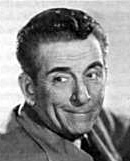
Just the lyrics, folks, as we already know the melody.(bad recording so I erased it)
HOMER & JETHRO
I'M MOVIN' ON NO. 2
As recorded by Homer & Jethro
(To The Tune Of I'm Movin' On) Written by Hank Snow
The old hound dog was feelin' fine
Till he fell in a barrel of turpentine
He's a-movin' on, he's a-movin' on
He passed the gate, like an eighty-eight
He's a-movin' on.
There was a smart guy from the city
And he picked up a stripe'd kitty
He's a-movin' on, he's a-movin' on
We held our nose, as we burried his clothes
We're a-movin' on.
I let a man work on my car
Then he grabbed a-hold of a spark plug wire
He's a-movin' on, he's a-movin' on
He turned it loose, when he felt the juice
He's a-movin' on.
The old Tom cat was a-feelin' mean
When he caught his tail in the sewin' machine
He's a-movin' on, he's a-movin' on
He ripped a stitch, when he hit the ditch
He's a-movin' on.
The old man's face got white as a sheet
When he slipped and fell in his cream of wheat
He's a-movin' on, he's a-movin' on
He flapped his ears, as he shifted gears
He's a-movin' on.
Uncle John got awful clean
When he fell into the washing machine
He's a-movin' on, he's a-movin' on
He couldn't straddle, that doggone paddle
He's a-movin' on.
We travel a lot to make our showin'
The way we sing we have to keep goin'
We're a-movin' on, we're a-movin' on
We've gotta go, here comes Hank Snow
We're a-movin' on.
edgar, I am not familar with Sunny and the Sunliners, but it seems that they are a TexMex group. Thanks, buddy, for the song by them
dj, I listened to every one of your pogues' Irish songs. Marvelous tribute for St. Patrick's Day. Actually, I am rather surprised that someone didn't do a complete green thread as a salute to the Irish.

We have always touted Italian tenors on our radio station, but this is the day for Irish tenors who are wonderful.
I really don't think this song is Irish, but my father loved it, so let's listen.
http://www.youtube.com/watch?v=L3clZUq8P5s
Good morning, WA2K radio audience.
edgar, that was a lovely song. Johnny Cash was a talented man and his daughter sang that beautifully, Texas.
Well, the wearing of the green has past, but this poem by Robert Burns set to music will always be present-past-and future.
http://tw.youtube.com/watch?v=-R8mcJ-UkVQ
Flow gently, sweet Afton,
amang thy green braes,
Flow gently, I'll sing thee
a song in thy praise;
My Mary's asleep
by thy murmuring stream,
Flow gently, sweet Afton,
disturb not her dream.
Thou stock dove whose echo
resounds thro' the glen,
Ye wild whistly blackbirds
in yon thorny den,
Thou green crested lapwing
thy screaming forbear,
I charge you, disturb not
my slumbering fair.
How lofty, sweet Afton,
thy neighboring hills,
Far mark'd with the courses
of clear winding rills;
There daily I wander
as noon rises high,
My flocks and my Mary's
sweet cot in my eye.
How pleasant thy banks
and green valleys below,
Where, wild in the woodlands,
the primroses blow;
There oft, as mild evening
weeps over the lea,
The sweet-scented birk shades
my Mary and me.
Thy crystal stream, Afton,
how lovely it glides,
And winds by the cot where
my Mary resides;
How wanton thy waters
her snowy feet lave,
As, gathering sweet flowerets,
she stems thy clear wave.
Flow gently, sweet Afton,
amang thy green braes,
Flow gently, sweet river,
the theme of my lays;
My Mary's asleep
by thy murmuring stream,
Flow gently, sweet Afton,
disturb not her dreams.
Nikolai Rimsky-Korsakov
From Wikipedia, the free encyclopedia
Nikolai Rimsky-KorsakovNikolai Andreyevich Rimsky-Korsakov (Russian: Никола́й Андре́евич Ри́мский-Ко́рсаков, Nikolaj Andreevič Rimskij-Korsakov), also Nikolay, Nicolai, and Rimsky-Korsakoff, (March 6 (N.S. March 18), 1844 - June 8 (N.S. June 21) 1908) was a Russian composer, one of five Russian composers known as The Five, and was later a teacher of harmony and orchestration. He is particularly noted for a predilection for folk and fairy-tale subjects, and for his extraordinary skill in orchestration, which may have been influenced by his synesthesia. The first part of his surname, Rimsky, is due to the fact that some of his forefathers undertook a pilgrimage to Rome.[citation needed]
Early years
Rimsky-Korsakov was born at Tikhvin, 200 km east of St. Petersburg, into an aristocratic family. He showed musical ability from an early age. His parents did not appreciate his precocity, looking upon his music-making "as a prank."[1] Becoming a composer was considered unsuitable for someone of his family's social station and a rejection of the traditions of his class.[2] On his parents' insistence, he studied at the School for Mathematical and Navigational Sciences in St. Petersburg and subsequently joined the Imperial Russian Navy. It was only when he met Mily Balakirev in 1861 that he began to concentrate more seriously on music.
Balakirev encouraged him to compose and taught him when he was not at sea.[3] He also prompted Rimsky-Korsakov to enrich himself in other areas, as well. "I heard from him, for the first time in my life, that one must read, must look after one's own education, must become acquainted with history, polite literature, and criticism. Many thanks to him for it!"[4] Through Balakirev he also met the other composers that would form "The Mighty Handful" (better known in English-speaking countries as "The Five"). He listened to their opinions and accepted them without question.[5] With their encouragement, he began considering a career in music.[6]
In 1862, Rimsky-Korsakov sailed on a three-year world cruise. He completed three movements of his First Symphony in the months before the cruise.[7][8] He wrote the slow movement during a stop in England, then mailed the score to Balakirev berore going back to sea.[9] Upon his return to St. Petersburg in 1865, Balakirev suggested Rimsky-Korsakov renew work on the symphony. He did, writing a trio for the Scherzo and reorchestrating the whole work.[10] Balakirev conducted the successful premiere of the symphony in December, 1865.[11] Rimsky-Korsakov appeared on stage in uniform to acknowledge the applause (regulations demanded that officers remain in uniform even when off-duty). Seeing him, the audience was surprised a naval officer had written such a work.[12]
Active composer
Rimsky-Korsakov's naval duties now occupied only two or three of hours a day.[13] This left considerable time for both composition and a social life.[13] He completed the first version of his orchestral pieces Sadko (1867) and Antar (1868). He became friends with Alexander Borodin, whose music astonished him.[14] He spent time with him[14], Balakirev[15] and, increasingly, Modest Mussorgsky.[16] They critiqued one another's works-in-progress and sometimes also collaborated on new pieces. By the spring of 1868 their circle included the Purgold family and met for musical evenings at the Purgold household.[17] Balakirev and Mussorgsky played piano four-hands.[18] The middle of the three Purgold daughters, Alexandra, was a talented singer.[18] The youngest daughter, Nadezhda, was an accomplished pianist.[19] She would arrange Sadko and Antar for piano four-hands for the publisher Bessel.[20]
In 1868 Rimsky-Korsakov also met Pyotr Ilyich Tchaikovsky.[21] Because Tchaikovsky had been trained at the Western-oriented St. Petersburg Conservatory instead of by Balakirev, he "was viewed rather negligently if not haughtily by our circle.[22] At Balakirev's request Tchaikovsky played the opening movement of his First Symphony. "t proved quite to our liking ... although Tchaikovsky's Conservatory training still constituted a considerable barrier between him and us."[23] Rimsky-Korsakov would be even more impressed with the finale of Tchaikovsky's Second Symphony, the Little Russian, at a January 7, 1873 gathering at his home. In this work Tchaikovsky would come closest, in its original version, to composing along the same principles as "The Five."[24] Nevertheless, as Tchaikovsky's brother Modest observed, relations between Tchaikovsky and The Five, including Rimsky-Korsakov, resembled "those between two friendly neighboring states ... cautiously prepared to meet on common ground, but jealously guarding their separate interests." [25]
In the fall of 1871, Rimsky-Korsakov moved into his brother's former apartment, inviting Mussorgsky as a roommate. The working arrangement they agreed upon was that Mussorgsky used the piano in the mornings while Rimsky-Korsakov either copied or orchestrated something out. Mussorgsky left for his civil service job at noon. This left afternoons for Rimsky-Korsakov to use the piano. Time in the evenings was allotted by mutual agreement.[26] "That autumn and winter the two of us accomplished a good deal," Rimsky-Korsakov wrote, "with constant exchange of ideas and plans. Mussorgsky composed and orchestrated the Polish act of Boris Godunov and the folk-scene 'Near Kromy.' I orchestrated and finished my Maid of Pskov."[27]
The Maid of Pskov proved difficult initially to have approved for performance by the Russian censors, and Rimsky-Korsakov had to actively lobby them on behalf of his opera. The biggest problem lay in cne of the characters in his opera being Ivan the Terrible. An 1837 law prohibited depiction of the tsar in an opera.[28] This rule differed slightly for plays. In spoken drama, it was only rulers of the Romanov dynasty who were proscribed[28] When Rimsky-Korsakov questioned this discrepency, he was told, "And suppose the Tsar should should suddenly sing a ditty; well, it would be unseemly."[29]After the composer appealed to the grand duke Konstantin, the censors allowed The Maid of Pskov to be staged?-after some amendments.[30] This episode eased the way for Mussorgsky's Boris Godunov to be produced, though Mussorgsky also had to make changes to mollify the censors.[31]
Professor
In 1871, Rimsky-Korsakov became Professor of Practical Composition and Instrumentation (orchestration) at the St. Petersburg Conservatory, as well as leader of the Orchestra Class.[32] Mikhaíl Azanchevsky, who had taken over that year as director,[33] had wanted new blood to freshen up teaching in those subjects.[34] Balakirev, who had formerly opposed academicism with tremendous vigor,[35] had encouraged him to assume the post[36]. Nevertheless, Rimsky-Korsakov was painfully aware of his technical shortcomings, writing later, "I was a dilettante and knew nothing,..."[37] Moreover, he had come to a creative dead-end upon completing The Maid of Pskov and realized that developing a solid musical technique was the only way he could continue composing.[38]
In his first years of teaching, he bluffed his way through classes,[39] aided, he wrote, "by the fact that at first none of my pupils could imagine that I knew nothing; and by the time they had learned enough to begin to see through me, I had learned something myself!"[39] Meanwhile, with Tchaikovsky's encouragement, he assiduously studied harmony and counterpoint, becoming an excellent teacher and a fervent believer in academic training in the process.[40][41][42][43]
Marriage
With Rimsky-Korsakov's professorship came financial security.[13] This encouraged him to settle down and to start a family.[13] In December 1871 he proposed to Nadezhda Purgold. They married in July 1872[13]; Mussorgsky was his best man. The Rimsky-Korsakovs would eventually have seven children. One of their sons, Andrei, would become a musicologist, marry the composer Yuliya Veysberg and write a multi-volume study of his father's life and work.
Nadezhda was to become a musical as well as domestic partner with her husband, much as Clara Schumann had been on her husband Robert.[13] Beautiful, capable, stong-willed and far better trained musically than her husband at the time they married,[13] she proved a good critic of his work. Together they played four-hand arrangements of his pieces, "work-shopping" them in a manner similar to his earlier years with his circle of friends. She also arranged the second version of Antar for piano four-hands in 1875.[44] This arrangement was published by Bessel.[44] (She had arranged the original version of Antar for piano four-hands in 1869-70, before she married Rimsky-Korsakov.)[45]
Inspector of bands
Even while a professor at the conservatory, Rimsky-Korsakov remained in active service as a naval officer. In the spring of 1873, the navy remedied this situation. Rimsky-Korsakov was appointed to the new post of Inspector of Music Bands of the Navy Department. He was to inspect navy bands throughout Russia, supervising the bandmasters and their appointments, repertoire and quality of instruments. He would also be in charge of a complement of musician pupils who would be holders of navy fellowships at the conservatory. He was to write a study program for these students and to act as an intermediary between the navy and the conservatory.[46]
The post came with a promotion to Collegiate Assessor. This would be a civilian rank. Rimsky-Korsakov would still be on the navy payroll and listed on the roster of the Chancellery of the Navy Department. Otherwise, he would no longer be considered under military service. "Henceforth I was a musician officially and incontestably," he wrote. "I was in ecstasy; so were my friends. Congratulations were showered on me."[47]
His appointment encouraged him to fulfill a long-standing desire to familiarize himself with the construction and playing technique of orchestral instruments. These studies in turn prompted him to write a textbook on orchestration.[48] While his realization of both the enormity of the task and the quickness with which his text could become outdated led him to give up work on it, he considered the knowledge amassed worthwhile. He applied it to his compositions and strove to give his conservatory students "a clear conception, if not a full knowledge, of instruments of the orchestra."[49]
He used the privileges of rank to freely exercise and expand upon his knowledge. He orchestrated for military bands and arranged a number of works by other composers.[50] He also asked band leaders to arrange pieces he selected.[51] He then organized and led a concert of combined navy bands at Kronstadt in October 1874.[52] The concert's success convinced the navy to let Rimsky-Korsakov plan and direct two or three such concerts each year during his tenure as inspector.[52] For these concerts he wrote a set of variations on a theme of Glinka for oboe, a concerto for trombone and a Konzertstück for clarinet, all with the accompaniment of wind band.[53]
In March 1884, an Imperial Order abolished the navy office of Inspector of Bands, and Rimsky-Korsakov was relieved of his duties.[54] "Accordingly," he wrote, "my government service was confined exclusively the Chapel?-that is, the court Department."[55] He worked under Balakirev in the Court Chapel as a deputy. This post gave him the chance to study Russian Orthodox church music. He worked there until 1894.
Creative impasse
His studies and change in attitude on music education brought Rimsky-Korsakov the scorn of his fellow nationalists. They felt he was throwing away his Russian heritage to compose fugues and sonatas.[56] Alexander Borodin called it "apostasy," adding, "Many are grieved at present by the fact that Korsakov has turned back, has thrown himself into a study of musical antiquity. I do not bemoan it. It is understandable...."[57] Mussorgsky was harsher: "[T]he mighty Koocha had degenerated into soulless traitors."[58]
Tchaikovsky, on the other hand, fully aplauded what Rimsky-Korsakov was doing, writing that he admired his artistic modesty and strength of character.[59] Tchaikovsky also saw the danger Rimsky-Korsakov risked of letting too much academia choke off his natural gift for musical fantasy.[43] He wrote his patroness Nadezhda von Meck, "Either a great master will come out of him, or he will finally become bogged down in contrapuntal tricks."[43]
For a while, though, bogged down was what Rimsky-Korsakov remained. After striving "to crowd in as much counterpoint as possible" into his Third Symphony[60], he applied his newly-acquired knowledge to chamber works in which he adhered strictly to classical models. These included a string sextet, a string quartet in F minor and a quintet for flute, clarinet, horn, bassoon and piano. The reaction of his fellow nationalists did not help. They showed little enthusiasm for the Third Symphony, less still for the quartet.[61] He wrote, "[T]hey began, indeed, to look down upon me as one on the downward path."[61] Worse still was Anton Rubinstein, the nationaists' arch-nemesis, commeting after hearing the quartet that now Rimsky-Korsakov "might amount to something" as a composer.[61] Rimsky-Korsakov became paralyzed creatively several times during this period, with his progress as a composer coming to a standstill from 1881 to 1888. He kept busy by editing Mussorgsky's works and completing Borodin's Prince Igor.[62]
Russian Symphony Concerts
Rimsky-Korsakov became acquained with capitalist and budding music patron Mitrofan Belyayev (M. P. Belaieff) at the weekly "quartet Fridays" ("Les Vendredis") held at Belayev's home. Belayev had already taken a keen interest in the musical fututre of the teenage Alexander Glazunov,[63] who had been one of Rimsky-Korsakov's composition students. In 1884, Belayev rented out a hall and hired an orchestra to play Glazunov's First Symphony plus an orchestral suite Glazunov had just composed.[64] Glazunov was to conduct part of this concert.[64] Seeing he was not ready to do this, Rimsky-Korsakov volunteered to take his place.[64] This "rehearsal," as Rimsky-Korsakov called it, went well and pleased both Belayev and the invited audience.[65] Buoyed by the success of the rehearsal, Belayev decided the following season to give a public concert of works by Glazunov and other composers.[66] Rimsky-Korsakov's piano concerto was played, along with Glazunov's symphonic poem Stenka Razin.[66]
Both the rehearsal the previous year and this concert gave Rimsky-Korsakov the idea of offering several concerts per year featuring Russian compositions.[67] The number of orchestral compositions was growing, and there were always diffficulties in having the Russian Musical Society and other organizations program them.[67] Rimsky-Korsakov mentioned the idea to Belayev. Belayev liked it,[67] inagurating the Russian Symphony Concerts during the 1886-1887 season.[68] Rimsky-Korsakov shared conducting duties for these concerts.[67]
He finished his revision of Mussorgsky's Night on Bald Mountain and conducted it at the opening concert.[69] In addition, the Russian Symphony Concerts coaxed him out of his creative drought. He wrote Sheherazade, Capriccio espagnol and the Russian Easter Overture specifically for them.[70] He noted that these three works "show a considerable falling off in the use of contrapuntal devices ... [replaced] by a strong and virtuoso development of every kind of figuration which sustains the technical interest of my compositions."[71]
Later years
In 1892 Rimsky-Korsakov suffered a second creative drought,[72] brought on by bouts of depression and alarming physical symptoms?-rushes of blood to the head, confusion, memory loss and unpleasant obsessions.[73] The medical diagnosis was neurasthenia.[74] He resigned from both the Russian Symphony Concerts and the Court Chapel.[73] He also considered giving up composition permanently.[72] However, the death of Tchaikovsky in late 1893 presented a two-fold opportunity?-to write for the Imperial Theaters and to compose an opera based on Nikolai Gogol's short story "Christmas Eve", a work on which Tchaikovsky had based his opera Vakula the Smith. Rimsky-Korsakov's Christmas Eve was a success and restored his creativity. He completed an opera approximately every 18 months?-a total of 11 between 1893 and 1908.[75]
In 1905 approximately 100 conservatory students were expelled for taking part in the February Revolution. Rimsky-Korsakov sided with the students and was removed from his professorship. Several faculty members resigned in protest, including Glazunov and Anatoly Lyadov. Eventually, over 300 additional students walked out of the conservatory in solidarity with Rimsky-Korsakov. By December he had been reinstated.[76], but the political controversy continued with his opera The Golden Cockerel. Its implied criticism of monarchy, Russian imperialism and the Russo-Japanese War gave it little chance of passing the censors. The premiere was delayed until 1909, after the composer's death. Even then, it was performed in an adapted version.[77]
Beginning around 1890, Rimsky-Korsakov suffered from angina.[73] While this ailment initially wore him down gradually, the stresses concurrent with the February Revolution and its aftermath greatly accelerated its progress. Especially after December 1907, his illness became severe, preventing all work.[78] He died in Lyubensk in 1908, and was interred in Tikhvin Cemetery at the Alexander Nevsky Monastery in St. Petersburg.
Legacy
Compositions
Rimsky-Korsakov was a prolific composer. Even in his leaner times, creatively speaking, he kept busy. "Tchaikovsky and Rimsky-Korsakov didn't like each other and agreed on very few things," Shostakovich said, "but they were of one opinion on this: you had to write constantly. If you can't write a major work, write minor trifles. If you can't write at all, orchestrate something."[79] Rimsky-Korsakov may have revised virtually all of his works?-some, like Antar and Sadko, more than once.
Like his compatriot Cui, his greatest efforts were expended on his operas. There are fifteen operas to his credit, including Kashchey the Immortal and The Tale of Tsar Saltan. The subjects of the operas range from historical melodramas like The Tsar's Bride, to folk operas, such as May Night, to fairytales and legends like Snowmaiden. In juxtaposed depictions of real and fantastic, the operas invoke folk melodies, realistic declamation, lyrical melodies, and artificially-constructed harmonies with effective orchestral expression. Most of Rimsky-Korsakov's operas remain in the standard repertoire in Russia to this day. While the operas themselves are not well-known in the West, many selections are familiar to Western audiences. These excerpts include "The Dance of the Tumblers" from Snowmaiden, "Procession of the Nobles" from Mlada, "Song of the Indian Guest" (or, less accurately, "Song of India,") from Sadko, and "Flight of the Bumblebee" from Tsar Saltan, as well as suites from The Golden Cockerel and The Legend of the Invisible City of Kitezh and the Maiden Fevroniya.
Rimsky-Korsakov's status in the West has long been based on his orchestral compositions. Best known among these are Capriccio espagnol, Russian Easter Festival Overture, and the symphonic suite Scheherazade. Scheherazade is often cited as a textbook example of Russian orientalism.[80] Likewise, while Capriccio espagnol could be considered a continuation of Glinka's Spanish Fantasies pittoresques, the vibrancy of Rimsky-Korsakov's orchestration far outshines Glinka's effort. It also served as a model for Maurice Ravel's Rapsodie espagnole .[81]
Smaller-scaled works incude dozens of art songs, arrangements of folk songs, some chamber and piano music, and a considerable number of choral works, both secular and for Russian Orthodox Church service, including settings of portions of the Liturgy of St. John Chrysostom (the latter despite the fact that he was a staunch atheist[82][83][84]).
Books
His autobiography and his books on harmony and orchestration have been translated into English and published. They provide remarkable insights into his life and work. He wrote his book on harmony after finding Tchaikovsky's book on the subject unsatisfactory.[85]. He left his book on orchestration unfinished at his death. His son-in-law Maximilian Steinberg completed it posthumously in 1912.
Students
In his decades at the Conservatory, Rimsky-Korsakov taught many composers who would later find fame, including Alexander Glazunov, Sergei Prokofiev, Igor Stravinsky, Ottorino Respighi, and Artur Kapp.
Stravinsky, who studied privately with Rimsky-Korsakov before entering the conservatory, wrote about his teacher:
I worked with him in this way. He would give me some pages of the piano score of a new opera he had just finished (Pan Voyevoda), which I was to orchestrate. When I had orchestrated a section, he would show me his own instrumentation of the same passage. I had to compare them, and then he would ask me to explain why he had done it differently. Whenever I was unable to do so, it was he who explained.
Rimsky-Korsakov himself left a brief outline for a course of study for talented students like Stravinsky:
In fact, a talented student needs so little; it is so simple to show him everything needed in harmony and counterpoint to set him on his feet in that work, it is so simple to direct him in understanding the forms of composition, if one goes about it the right way. Just one or two years of systematic study in the development of technique, a few exercises in free composition and orchestration, assuming a good knowledge of the piano?-and the studies are over.[86]
He carried this attitude into his conservatory classes. Conductor Nikolai Malko remembered that Rimsky-Korsakov began the first class of the term by saying, "I will speak, and you will listen. Then I will speak less, and you will start to work. And finally I will not speak at all, and you will work."[87] Malko added that his class followed exactly this pattern. "Rimsky-Korsakov explained everything so clearly and simply that all we had to do was to do our work well."[87]
Rimsky-Korsakov would sit at the piano in class, looking through all the exercises in counterpoint his students had brought. He played endless preludes, fugues, canons and arrangements. However, he refused to review a student's work if it was written in pencil. "I do not wish to go blind because of you," he would declare. (Dmitri Shostakovich would also insist that his composition students write their scores in ink.)[88]
Because of Rimsky-Korsakov's fame, his classes were large. This irritated the 15-year-old Prokofiev, who wanted the master's undivided attention and had trouble breaking through the crowd. Nevertheless, he admitted that those students who knew how much they could learn from Rimsky-Korsakov got the benefit despite the crowding.[89]
Editing "The Five"'s work
Rimsky-Korsakov's legacy goes far beyond his compositions and his teaching career. His tireless efforts in editing the works of other members of The Five are significant, if controversial. These include the completion of Alexander Borodin's opera Prince Igor (with Alexander Glazunov), orchestration of passages from César Cui's William Ratcliff for the first production in 1869, and the complete orchestration of Alexander Dargomyzhsky's swansong, The Stone Guest. This effort was a practical extension of the fact that Rimsky-Korsakov's early works had been under the intense scrutiny of Balakirev and that the members of The Five during the 1860s and 1870s experienced each other's compositions-in-progress and even collaborated at times.
While the effort for his colleagues is laudable, it is not without its problems for musical reception. In particular, after the death of Modest Mussorgsky in 1881, Rimsky-Korsakov took on the task of revising and completing several of Mussorgsky's pieces for publication and performance. In some cases these versions helped to spread Mussorgsky's works to the West, but Rimsky-Korsakov has been accused of pedantry for "correcting" matters of harmony, etc., in the process. Rimsky-Korsakov's arrangement of Mussorgsky's Night on Bald Mountain is the version generally performed today. However, critical opinion of Mussorgsky has changed over time so that his style, once considered unpolished, is now valued for its originality. This has caused some of Rimsky-Korsakov's other revisions, such as that of Boris Godunov, to fall out of favour and be replaced by productions more faithful to Mussorgsky's original manuscripts. Rimsky-Korsakov likely foresaw this might happen when he wrote this statement:
If Moussorgsky's compositions are destined to live unfaded for fifty years after their author's death (when all his works will became the property of any and every publisher), such an archeologically accurate edition will always be possible, as the manuscripts went to the Public Library on leaving me. For the present, though, there was need of an edition for performances, for practical artistic purposes, for making his colossal talent known, and not for the mere studying of his personality and artistic sins.
Synesthesia
Rimsky-Korsakov had synesthesia, a condition in which normally separate senses are not separate but rather are cross-wired. In the case of Rimsky-Korsakov, he perceived colors associated with major keys, as follows [90][91]:
Tonic note Color
C white
D yellow
E flat dark bluish-grey
E sparkling sapphire
F green
G rich gold
A rosy colored
Edward Everett Horton
From Wikipedia, the free encyclopedia
Edward Everett Horton (March 18, 1886 - September 29, 1970) was an American character actor with a long career including motion pictures, theater, radio, television and voice work for animated cartoons.
Horton was born in Brooklyn, New York, to Isabella S. Diack and Edward Everett Horton. His mother was born in Matanzas, Cuba to Mary Orr and George Diack, immigrants from Scotland.[1] Horton attended Brooklyn Polytechnic and Columbia University, where he was a member of Phi Kappa Psi Fraternity.
Horton started his stage career in 1906, singing and dancing and playing small parts in Vaudeville and in Broadway productions. In 1919, he moved to Los Angeles, California, and started getting roles in Hollywood films. His first starring role was in the 1922 comedy film Too Much Business, and he portrayed the lead role of an idealistic young classical composer in Beggar on Horseback in 1925. In the late 1920s he starred in two-reel silent comedies for Educational Pictures, and made the transition to talking pictures with Educational in 1929. As a stage-trained performer, he found more movie work easily, and appeared in some of Warner Brothers' early talkies, including The Hottentot and Sonny Boy.
Horton originally went under his given name, Edward Horton. His father persuaded him to adopt his full name professionally, reasoning that there might be other actors named Edward Horton, but only one named Edward Everett Horton.
Horton's screen character was instantly defined from his earliest talkies: pleasant and dignified, but politely hesitant when faced with a potentially embarrassing situation. Horton soon cultivated his own special variation of the time-honored double take (an actor's reaction to something, followed by a delayed, more extreme reaction). In Horton's version, he would smile ingratiatingly and nod in agreement with what just happened; then, when realization set in, his facial features collapsed entirely into a sober, troubled mask.
Horton starred in many unpretentious comedy features in the 1930s, usually playing a mousy fellow who put up with domestic or professional problems up to a certain point, and then finally asserted himself for a happy ending. The actor is best known, however, for his work as a character actor in supporting roles. Some of his noteworthy films include The Front Page, Trouble in Paradise, Top Hat (one of several Astaire - Rogers movies Horton was in), Holiday, Lost Horizon, Here Comes Mr. Jordan, Arsenic and Old Lace, and Pocketful of Miracles.
Horton continued to appear in stage productions, often in summer stock. His performance in the play "Springtime for Henry" became a perennial in summer theaters.
In the 1950s Horton started doing television work. One of his most famous appearances is an I Love Lucy episode, where he is cast against type as a frisky, amorous suitor. (Horton, a last-minute replacement for another actor, received a special, appreciative credit in this episode.) Beginning in 1959 he narrated the "Fractured Fairy Tales" segment of the Rocky & Bullwinkle cartoon show. In 1965 he played the medicine man, Roaring Chicken, in the sitcom F Troop. He parodied this role, portraying "Chief Screaming Chicken" on Batman as a pawn to Vincent Price's "Egghead" in the villain's attempt to take control of Gotham City. His last role, as a moribund tobacco company president in a wheelchair, was in the motion picture Cold Turkey, released after his death.
Edward Everett Horton died of cancer at age 84 in Encino, California.
Shortly after he died, the city of Los Angeles, California renamed a portion of Amestoy Avenue, the dead-end street where he lived in the district of Encino, "Edward Everett Horton Lane"[1].

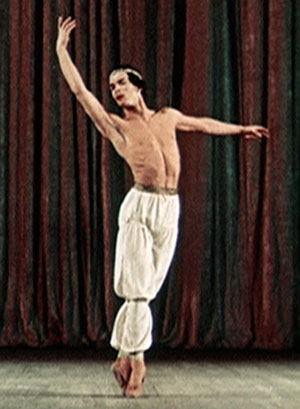




 ) - the last 4 minutes are the best, here's one for Rudy: