Al Hirt
From Wikipedia, the free encyclopedia
Alois Maxwell Hirt (November 7, 1922 - April 27, 1999) was a popular American trumpeter and bandleader.
Hirt was born in New Orleans, Louisiana, the son of a police officer, and was known as "Al" or "Jumbo." At the age of six, he was given his first trumpet, which had been purchased at a local pawnshop. He would play in the Junior Police Band with the children of Alcide Nunez, and by the age of 16, Hirt was playing professionally, often with his friend Pete Fountain. During this time, he was hired to play at the local horse racing track, beginning a six-decade connection to the sport.
In 1940 Hirt went to Cincinnati, Ohio to study at the Cincinnati Conservatory of Music with Dr. Frank Simon (a former soloist with the John Philip Sousa Orchestra). After a stint as a bugler in the United States Army during World War II, Hirt performed with various Swing big bands, including those of Tommy Dorsey, Jimmy Dorsey, Benny Goodman, and Ina Ray Hutton. In 1950 he became first trumpet and soloist with Horace Heidt's Orchestra.
Hirt then returned to New Orleans, working with various Dixieland groups and leading his own bands. Despite Hirt's statement years later "I'm not a jazz trumpet and never was a jazz trumpet" he made a few recordings where he demonstrated ability to play in that style during the 1950s, notably with bandleader Monk Hazel and a few other recordings on the local Southland Records label.
Hirt's virtuoso dexterity and fine tone on his instrument soon attracted the attention of national labels. Hirt had 22 different record albums on the Billboard Pop charts in the 1950s and 1960s. The albums Honey In The Horn and Cotton Candy were both in the top 10 best sellers for 1964, the same year Hirt scored a top hit single with his cover of Allen Toussaint's tune Java, and later won a Grammy award for the same recording.
Hirt's top 40 charted hit single of Sugar Lips in 1964 would be later used as the theme song for the NBC daytime game show Eye Guess, hosted by Bill Cullen and originally airing during the mid-to-late 1960s. Hirt was chosen to record the frenetic theme for the 1960s TV show "The Green Hornet", by famed arranger and composer Billy May. Thematically reminiscent of Nikolai Rimsky-Korsakov's Flight of the Bumblebee, it showcased Hirt's technical prowess. The recording again gained public attention in 2003 when it was used in the film Kill Bill.
Planting deep roots in his community, Hirt opened up a club on Bourbon Street in the French Quarter in 1962, which he ran until 1983. He also become a minority owner in the NFL expansion New Orleans Saints in 1967.
On February 8, 1970, while performing in a Mardi Gras parade in New Orleans, Hirt was injured while riding on a float. It is popularly believed that he was struck in the mouth by a thrown piece of concrete or brick. Documentation of factual details regarding the incident are vague. Hirt underwent surgery and had to wait a while and then practice slowly to make a return to the club scene.
In 1987 Hirt played a solo rendition of Ave Maria for Pope John Paul II's visit to New Orleans, a performance Hirt considered one of his most important.
Hirt died in New Orleans of liver failure after spending the previous year in a wheelchair due to edema in his leg. Despite the bout with edema, Hirt continued to play in local clubs including Chris Owens Club. His remains were buried in Metairie Cemetery.
Other nicknames include "Al (He's the King!) Hirt", "Sugar Lips" (after one of his most popular pieces) and "The Round Mound of Sound".
Al Hirt had 8 children, 10 grandchildren, and 6 great-grandchildren. In 1990, Al married Beverly Estabrook Essel, a friend of 40 years. According to one trivia source, Hirt had the names of his children engraved on his trumpet.
Retrieved from "http://en.wikipedia.org/wiki/Al_Hirt"
Joan Sutherland
From Wikipedia, the free encyclopedia
Dame Joan Sutherland OM, AC, DBE (born November 7, 1926) is an Australian dramatic coloratura soprano noted for her contribution to the bel canto revival of the 1950s and 1960s.
She was hailed La Stupenda after an Alcina performance in La Fenice in 1960.
Early life and career
Joan Sutherland was born in Sydney. Her mother was a mezzo soprano who had given up her career. She learned a lot from her mother, with whom she used to sing and listen to many recordings. She attended St Catherine's School, Waverley, the oldest Anglican girls' school in Sydney. When Sutherland was 18, she started to study singing seriously. She made her debut in Australia as Dido in Purcell's Dido and Aeneas, in 1952. Previously, in 1950, she had won Australia's most important competition, The Sun Aria and went to London to study at the Opera School of the Royal College of Music. In 1951, she sang in performances of Eugène Goossens's Judith. She made her European debut as the First Lady in Die Zauberflöte at the Royal Opera House, Covent Garden, on October 28, 1952. In November of the same year she gave five more performances at Covent Garden in Bellini's Norma in the role of Clotilde, with Maria Callas as Norma.
During her early career, she was training to be a Wagnerian dramatic soprano, following the steps of Kirsten Flagstad, whom she considers the best singer ever. In 1952, she sang her first leading role at the Royal Opera House: Amelia in Un Ballo in Maschera. Later, she sang Aida. Also in 1953, she sang in the world premiere of Benjamin Britten's Gloriana. In 1954, she married the conductor and pianist, Richard Bonynge. He convinced her to concentrate on the bel canto repertoire, since she had great ease at the high notes and coloratura. From 1954 to 1958, she sang successfully a large repertoire, from Eva in Die Meistersinger, Agathe in Der Freischütz, Desdemona in Otello, Gilda in Rigoletto, to Donna Anna in Don Giovanni and many others.
In 1957, she made her debut as Handel's Alcina, starting her work on rediscovering the forgotten operas from the Baroque and Bel Canto eras. In 1958, she sang Madame Lidoine in the English premiere of Francis Poulenc's Dialogues of the Carmelites.
La Stupenda
In 1959, she was invited to sing Lucia di Lammermoor at the Royal Opera House in a production conducted by Tullio Serafin and staged by Franco Zeffirelli. It was a breakthrough for Sutherland's career, and as soon as she finished the famous Mad Scene, she was a star. In 1960, she recorded the album The Art of the Prima Donna, which is still one of the most recommended opera albums ever recorded; the double LP set won a Grammy Award the following year. This album, which is a collection consisting mainly of coloratura arias, shows the young Sutherland at her very best at the beginning of her international career. It displays perfectly her effortless coloratura abilities and high notes, as well as her perfect trill, which she is widely admired for.
In 1960, Sutherland was already known as a vocal miracle and a great diva. She sang Lucia to great acclaim in Paris and, in 1961, at La Scala and the Metropolitan Opera. In 1960, she sang a superb Alcina at La Fenice, Venice, where she was nicknamed La Stupenda (The Stupendous One). Sutherland would soon be called La Stupenda all around the world. She also sang Alcina at the Dallas Opera, with which she made her US debut the same year.
Joan Sutherland added the greatest heroines of bel canto in her repertoire: Violetta (La Traviata), Amina (La Sonnambula) and Elvira (I Puritani) in 1960; Beatrice di Tenda in 1961; Marguerite de Valois (Les Huguenots) and Semiramide in 1962; Norma and Cleopatra (Giulio Cesare) in 1963. She later added Marie (La Fille du Régiment), which is one of her most admired roles, because of her perfect coloratura and lively, funny interpretation.
During the 1970s, her voice became more expressive and she improved her diction. Then, she added dramatic roles like Donizetti's Maria Stuarda and Lucrezia Borgia and Massenet's extremely difficult Esclarmonde. She even recorded a successful Turandot in 1972, though she never performed the role on stage.
Sutherland's early recordings show her to be possessed of a crystal-clear voice and excellent diction. However, by the early-1960s, her voice lost some of this clarity in the middle register, and she often came under fire for having extremely poor diction. Some have attributed this to sinus surgery; however, her major sinus surgery was done in 1959, immediately after her breakthrough Lucia at Covent Garden. [1] In fact, her first commercial recording of the first and final scene of Lucia reveals her voice and diction to be just as clear as prior to the sinus procedure. She clearly took the criticism to heart, since within a few years, her diction improved markedly and she continued to amaze and thrill audiences throughout the world.
In the late-1970s, Sutherland's voice started to decline. However, thanks to her vocal flexibility and flawless technique, she continued singing the most difficult roles amazingly well. During the 1980s, she added Anna Bolena, Amelia in I masnadieri and Adriana Lecouvreur to her repertoire. Her last performance was as Marguerite de Valois (Les Huguenots) in 1990, at the age of 64. However, her last public appearance took place in a gala performance of Die Fledermaus on New Year's Eve, 1990, at Covent Garden, with her friends, Luciano Pavarotti and Marilyn Horne. Since then she has made few public appearances, preferring a life of quiet rest.
Honours and awards
During her career and after, Sutherland received many prizes. In 1961, Sutherland was made a Commander of the British Empire. She was further elevated from Commander to Dame Commander on December 30, 1978. On June 9, 1975, Dame Joan was made a Companion of the Order of Australia. On November 29, 1991, the Queen bestowed on Dame Joan the Order of Merit, one of Britain and Australia's highest honours and within the Queen's personal gift.
In 2004, she received a Kennedy Center Honour for her outstanding achievement throughout her career. Joan Sutherland appears in many international vocal competitions and is the patron of the famous BBC Cardiff Singer of the World competition. She made many studio recordings, mostly for the Decca/London label.
Both Sutherland House at St Catherine's School, Sydney and The Joan Sutherland Performing Arts Centre (JSPAC), Penrith are named in honour of her.
Johnny Rivers
From Wikipedia, the free encyclopedia
Born November 7, 1942
New York City, NY, U.S.
Genre(s) Rock and Roll
Years active 1962?-present
Label(s) Imperial
United Artists
Atlantic
RSO
Soul City
Website JohnnyRivers.com
Johnny Rivers (born John Henry Ramistella, 7 November 1942, in New York) is an American rock and roll singer, songwriter, guitarist, and record producer. He was versatile enough to do folk songs, blues, covers of old-time rock 'n' roll songs, and some original material, all of them in his own unique style. Rivers's greatest success came in the mid and late 1960s with a string of hit songs (including "Seventh Son," "Poor Side of Town" and "Secret Agent Man"), but he has continued to record and perform to the present.
Career
1950s
The Ramistella family moved from New York to Baton Rouge, Louisiana when John was five years old. Without any formal music lessons, he began playing guitar--learned from his father)--at the age of eight, and was influenced by the distinctive music of Louisiana.
Ramistella formed his own band, The Spades, in junior high school and made his first record at age 14.[citation needed] Some of their material was recorded on the Suede label as early as 1956.
On a trip back to New York in 1958, he met Alan Freed who advised him to change his name, so Johnny Ramistella became Johnny Rivers after the Mississippi River that flows near Baton Rouge.[citation needed] Freed also helped Rivers score some recording contracts on the Gone label. From March 1958 to March 1959, Rivers released three records which did not sell well.[citation needed]
In 1959, Rivers returned to Baton Rouge. While playing throughout the American South, in Birmingham Rivers met Audrey Williams, the widow of Hank Williams.[citation needed] She took Rivers to Nashville, where he recorded two more records. They were not successful either, but Johnny stayed in Nashville as a songwriter and demo singer for $25 a demo. [citation needed] While in Nashville, Rivers worked alongside Roger Miller.[citation needed]
1960s
In 1960, Rivers met fellow Louisianan James Burton, the guitar player for Ricky Nelson. Burton later recommended one of Rivers's songs to Nelson, who went on to record it. In 1961, Rivers went to Los Angeles to meet Nelson, and ended up relocating there, working as a songwriter and studio musician.[citation needed] In 1963, Rivers's big break came when he temporarily filled in for a jazz combo at Bill Gazzari's night club; the temporary gig became long-term due to positive customer response.[citation needed]
In 1964, Elmer Valentine gave Rivers a one-year contract to open his new club, Whisky a Go Go, on Sunset Strip in West Hollywood. The Whisky a Go Go opened three days before The Beatles released "I Want to Hold Your Hand" [citation needed] and the British Invasion knocked almost every American artist off the top of the charts. But Rivers was so popular, producer Lou Adler decided to issue Johnny Rivers Live At The Whiskey A Go Go. The live album reached #12 on the charts and the single "Memphis" (a Chuck Berry cover) reached #2. Rivers made the successful transition from nightclub entertainer to chart-busting pop singer and had created the Go Go sound,[citation needed] part of a scene which included Go-Go dancers.
Into 1965, Rivers continued to record mostly live, Go Go style records including "Maybellene" (another Berry cover), which he followed "Mountain of Love", "Midnight Special", "Seventh Son" (written by Willie Dixon) and "Where Have All the Flowers Gone?" (written by Pete Seeger), all of which were hits.[citation needed]
Rivers wanted to try something different and adopted a more idiosyncratic approach as from 1966. Characterized by his smooth, soulful voice, he produced hit portrayals as "Poor Side Of Town", which would be his biggest hit ever and his only number one record. Into another hit was "Secret Agent Man", the theme from Secret Agent television series (written by P.F. Sloan and Steve Barri). He also started his own record company, Soul City Records, where he won a Grammy Award as the producer of the 5th Dimension, which eventually recorded "Aquarius/Let the Sunshine In" and "Wedding Bell Blues", two number-one hits on Rivers's label. Johnny is also credited with giving songwriter Jimmy Webb a major break, when they recorded Webb's song "Up, Up, and Away". Jim Hendricks wrote "Summer Rain", a song that Rivers recorded and turned into a hit.
Johnny Rivers continued to record more hits, including "Baby I Need Your Lovin'" (cover of the Four Tops) and "The Tracks of My Tears" (cover of the Miracles), both went Top 10 in 1967. In 1968, Rivers released what many fans consider his best album, Realization, a number-five album on the LP charts. The album was evocative of the psychedelic influences of the time and marked a subtle change in his musical direction, with more thoughtful types of songs, included such ballads as "Going Back to Big Sur".
1970s
In the 1970s, Rivers continued to record more songs and albums which were a success with music critics, but did not sell as well as some of his earlier hits. One of these albums, "L.A. Reggae" in 1972, reached the LP charts as a result of the top 10 "Rockin' Pneumonia and the Boogie Woogie Flu" (cover of Huey (Piano) Smith And The Clowns). Other hits at that time were "Blue Suede Shoes" (cover of Carl Perkins), in 1973, which would reach the top 40 on the Billboard Hot 100, and "Help Me Rhonda" in 1975 (cover of The Beach Boys) on which Brian Wilson helped with backup vocals. His last Top 10 entry was "Swayin' to the Music (Slow Dancing)" (cover of the Funky Kings), followed by his last Hot 100 entry, "Curious Mind (Um, Um, Um, Um, Um, Um)" (cover of Major Lance), both from 1977. He also sang the title song to the late night concert influenced TV show "The Midnight Special".
1980s to current
Rivers continued recording into the 1980s (e.g., 1980's Borrowed Time LP), although his recording career wound down somewhat. Despite his music not having reached the best seller charts for quite a while, Rivers is still touring, doing 50 to 60 shows a year. Increasingly he has returned to the blues that inspired him initially.
In 1998, Rivers reactivated his Soul City imprint and released Last Train to Memphis.
In early 2000, Johnny recorded with Eric Clapton, Tom Petty, and Paul McCartney on a tribute album dedicated to Buddy Holly's backup band, "The Crickets".
In all, Rivers had nine Top 10 hits on the Billboard Hot 100 and 17 in the Top 40 from 1964 to 1977. In total, he has sold well over 30 million records.
Joni Mitchell
From Wikipedia, the free encyclopedia
Birth name Roberta Joan Anderson
Born November 7, 1943 (1943-11-07) (age 64)
Origin Saskatoon, Saskatchewan, Canada
Genre(s) Folk, pop, rock, jazz, world music
Occupation(s) Songwriter, producer, musician, painter
Instrument(s) vocals, piano, guitar, dulcimer
Years active 1967-present
Label(s) Reprise, Asylum, Geffen, Nonesuch, Hear Music
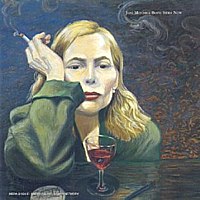
Joni Mitchell, CC (born Roberta Joan Anderson on November 7, 1943) is a Canadian musician, songwriter, and painter.[3]
Mitchell's singing began in small nightclubs and busking on the streets of Toronto and in her native Western Canada. She subsequently became associated with the burgeoning folk music scene of the mid-1960s in New York City. Mitchell achieved fame in the late 1960s and was considered a key part of the Southern California folk rock scene. Throughout the 1970s, she explored and combined the pop and jazz genres. Mitchell has amassed a body of work that is highly respected by both critics and fellow musicians.[1]
Mitchell is also an accomplished visual artist. She has, through photography or painting, created the artwork for each of her albums and, in 2000, in an interview with the Toronto Globe and Mail, described herself as a "painter derailed by circumstance". A blunt critic of the music industry, Mitchell had stopped recording over the last several years, focusing mainly on her visual art, but in 2007 released Shine, her first album of new songs in nine years.
Early life
Joni Mitchell was born Roberta Joan Anderson on November 7, 1943, in Fort Macleod, Alberta, Canada, to Bill Anderson and Myrtle Anderson (née McKee). Her mother was a teacher, and her father a Royal Canadian Air Force airman. During the war years, she moved with her parents to a number of bases in western Canada. After the war, her father began working as a grocer, and his work took the family to Saskatchewan to the towns of Maidstone and North Battleford. When she was 11, the family settled in Saskatoon, Saskatchewan, which Mitchell considers her hometown.
At the age of nine, Mitchell contracted polio during a Canadian epidemic, but recovered after a stay in the hospital, during which she first became interested in singing. She was hospitalized during the long Canadian winter, and remembered:
"They said I might no[t] walk again, and that I would not be able to go home for Christmas. I wouldn't go for it. So I started to sing Christmas carols and I used to sing them real loud....The boy in the bed next to me, you know, used to complain. And I discovered I was a ham." [2]
Mitchell also took up cigarette smoking at the same age, which may explain the unique texture to her voice.
She began taking piano lessons at age seven, and immediately felt the creative instinct to write her own music. Meanwhile, she excelled at art in school. In grade 7 her English teacher, Mr. Kratzman, told her: "If you can paint with a brush, you can paint with words." As a teenager, she taught herself guitar and ukulele and began performing at parties. This eventually led to busking and gigs playing in coffeehouses and other venues in Saskatoon. After finishing high school, she attended the Alberta College of Art and Design in Calgary for a year, but then left and returned to the coffeehouse scene.
As Mitchell prepared to leave her home in Saskatoon to relocate to Toronto, she became pregnant. Seeing no other alternatives, she gave her daughter, Kelly Dale Anderson (born February 19, 1965), up for adoption. The experience remained private for most of her career, but she made allusions to it in several songs, most notably the song "Little Green" (from Blue), and, years later, the song "Chinese Cafe" from "Wild Things Run Fast" ("Your kids are coming up straight/My child's a stranger/I bore her/But I could not raise her"). Her daughter, renamed Kilauren Gibb, began a search for her as an adult, and the two were reunited in 1997. [3]
Career
1960s folk singer
Mitchell took her surname from a brief marriage to folksinger Chuck Mitchell in 1965. She performed frequently in coffeehouses and folk clubs and, by this time creating her own material, became well known for her unique songwriting and her innovative guitar style. Personal and often self-consciously poetic, her songs were strengthened by her extraordinarily wide-ranging voice (with a range in pitch at one time covering over four octaves [citation needed]) and her striking guitar technique, which makes extensive use of alternative tunings.
While she was playing one night in "The Gaslight South" [4], a club in Florida, David Crosby walked in and was immediately struck by her ability and her appeal as an artist. He took her back to Los Angeles, where he set about introducing her and her music to his friends.
Much of her initial acclaim was as a result of other artists covering her songs. Her first songwriting credit to hit the charts, "Urge for Going," was a success for country singer George Hamilton IV and for folk singer Tom Rush; it also appeared many years later as a B-side by the Scottish band Travis. Irish singer Luka Bloom also recorded the song to great effect, as has classical violinist Nigel Kennedy with a gentle, lilting instrumental version.[citation needed] Mitchell's own 1967 recording of the song was released on the flip side of the 1972 single "You Turn Me On I'm A Radio", but was not released on an album until the Hits compilation in 1996. In any version, "Urge for Going" was an audacious piece of songwriting, painting an extremely evocative picture of the oncoming of dread winter. Not surprisingly for someone from the Canadian prairies, Mitchell had a finely developed sense for the passings of seasons and comings of age, themes that would appear on her "The Circle Game", which Tom Rush recorded in 1968.
Mitchell's songwriting reached its highest visibility when Judy Collins had a top-ten hit in early 1968 with "Both Sides Now". British folk rock group Fairport Convention included "Chelsea Morning" and "I Don't Know Where I Stand" on their debut album, recorded in late 1967, and the otherwise unreleased "Eastern Rain" on their second album the following year.
The songs on Mitchell's first two solo albums, Song to a Seagull (1968) and Clouds (1969), were archetypes of the nascent singer-songwriter movement of the time.
Early and mid-1970s chart success
Mitchell moved to California in late 1967. By the time of her third album, Ladies of the Canyon (1970), maturity brought a record infused with the spirit of California life (the canyon of the title refers to perhaps both Topanga Canyon and Laurel Canyon, Los Angeles) as well as containing her first major hit single, the environmentalist "Big Yellow Taxi", and "Woodstock", about the music festival, which was later a hit for both Crosby, Stills, Nash and Young and Matthews Southern Comfort. Mitchell wrote the song after missing and then hearing about Woodstock. She had cancelled her appearance at the festival on the advice of her manager for fear that she would miss a scheduled appearance on The Dick Cavett Show (and the fact that the only way she could get to Woodstock was by helicopter, the roads being impassible), and has since said the decision to miss the concert was one of the biggest regrets of her life. "For Free" is the first of Mitchell's many songs that underscore the dichotomy between the benefits of her stardom and its costs, both in terms of its pressure and of the loss of privacy and freedom it entails.
Mitchell's confessional approach deepened on Blue (1971), widely considered the best of this period, as well as a template for confessional songwriting. Mitchell later said of the album, "At that period of my life, I had no personal defenses. I felt like a cellophane wrapper on a pack of cigarettes. I felt like I had absolutely no secrets from the world and I couldn't pretend in my life to be strong."[2] Exploring the various facets of relationships, from infatuation on "A Case of You" to insecurity on "This Flight Tonight", the songs featured an increasing use of Appalachian dulcimer on "Carey" , "California", "All I Want", and "A Case of You" and piano (due in part to her admiration for Laura Nyro's work).
Some of the piano-led songs featured the rhythms associated with rock music. However, her Canadian past was not left behind: "River" found her in warm climes at Christmastime, only to say, "I wish I had a river / I could skate away on." In the 2000s "River" would be rediscovered by the plethora of all-Christmas-music holiday programming radio stations. Remakes of this song have been recorded by numerous artists including Aimee Mann, Indigo Girls, Robert Downey Jr., Allison Crowe, Sarah McLachlan, Dianne Reeves, Rachael Yamagata, James Taylor, and a duet by Madeleine Peyroux and k.d. lang.
The more straightforward rock influence was still strong on her next two albums, recorded for new label Asylum. For the Roses (1972), whose title track continued her exploration of the themes of "For Free", sold well, supported by the country-influenced hit single "You Turn Me On, I'm a Radio".
However, it was Court and Spark (1974), a hybrid of pop, rock, and folk with a jazzy sheen, that proved to be a huge success, producing such classic songs as "Free Man in Paris" (inspired by stories told by her manager, label founder and then-friend David Geffen), "Car On A Hill" and, most notably, "Help Me", which, to this day, remains her best selling single (it reached the top ten).Court and Spark was also notable for the first echoes of the influence of jazz on Mitchell's work, and despite the commercial success of that album and the subsequent live record Miles of Aisles, backed by the 70s pop-jazz outfit L.A. Express, she spent the rest of the decade following that muse and creating more free-form, jazz-inflected music.
Mid to late 1970s jazz experimentation
Mitchell's 1975 album The Hissing of Summer Lawns was the first album to stylistically depart from the folk/pop foundation Mitchell had developed. It was also a lyrical departure, with the confessional style replaced by a series of vignettes, from mobsters and nightclub dancers ("Edith and the Kingpin") to the bored wives of the wealthy ("The Hissing of Summer Lawns" and "Harry's House/Centerpiece"). The album was stylistically diverse, with complex vocal harmonies set with African drumming (the Warrior Drums of Burundi making up the foundation of "The Jungle Line"). Although many fans and other artists often cite Hissing as their favourite Mitchell work, it was not well received at the time of its release. A common legend holds that Rolling Stone magazine declared it the "Worst Album of the Year"; in truth it was called only the year's worst album title.[4] (Mitchell and Rolling Stone have had a contentious relationship, initiated years earlier when RS featured a "tree" illustrating all of Mitchell's alleged romantic partners, primarily other musicians, which the singer said "hurt my feelings terribly at the time.")[5]
During 1975 Mitchell also participated in several concerts in the Rolling Thunder Revue tours featuring Bob Dylan and Joan Baez, and in 1976, she performed as part of "The Last Waltz" by The Band.
Hejira (1976) continued Mitchell's trend toward jazz. The instrumentation is very intimate, usually consisting only of Mitchell's acoustic guitar, the electric guitar of Larry Carlton, and Jaco Pastorius's fretless bass guitar (on one track, Mitchell and Carlton reverse roles). The songs themselves, however, featured densely metaphorical lyrics and swooping vocal melodies providing contrast and counterpoint to the jazz rhythms of the arrangements. This album also highlighted as never before the unusual "open" guitar tunings that Mitchell used. While Hejira "did not sell as briskly as [Mitchell's earlier] more accessible albums," its stature in her catalogue has grown over the years.[6] Joni herself believes the album to be unique; in 2006, she said, "I suppose a lot of people could have written a lot of my other songs, but I feel the songs on Hejira could only have come from me."[6]
Don Juan's Reckless Daughter (1977) was a further move towards the freedom and abstraction of jazz, a double album dominated by the lengthy part-improvised "Paprika Plains". The album received mixed reviews - its experimentation and originality were not generally expected of such a celebrated music star. The cover of the album created its own controversy; Mitchell was featured in several photographs on the cover, including one where she was disguised as a black man.
Mitchell's next work was to be a collaboration with legendary bassist Charles Mingus, who died before the project was completed in 1979. Mitchell finished the tracks with a band featuring Pastorius, Wayne Shorter and Herbie Hancock and the resulting free-form, sometimes arhythmic music was daring and eclectic. Mingus was poorly received; rock audiences were not receptive, and jazz purists were unimpressed. However, appreciation for this work has grown considerably over the years.
Mitchell released Shadows and Light, a second live album that documented her recent tours, in 1980. The album contained some earlier hits, but focused on the late 1970s songs.
1980s: the "Geffen era"
The 1980s saw a reduced output of recordings compared to the previous decades. Only three albums of new material appeared on her new label (Geffen Records). 1982's Wild Things Run Fast marked a return to pop songwriting, including "Chinese Cafe/Unchained Melody" which incorporated the chorus and parts of the melody of the famous Righteous Brothers hit, and "(You're So Square) Baby I Don't Care" - which charted higher than any Mitchell single since her 70s sales peak.
For Dog Eat Dog (1985), British synth-pop performer and producer Thomas Dolby was brought on board. Mitchell employed a host of modern sounds, courtesy of the Fairlight CMI synthesizer. Of Dolby's role, Mitchell later commented, "I was reluctant when Thomas was suggested because he had been asked to produce the record (by Geffen), and would he consider coming in as just a programmer and a player? So on that level we did have some problems...He may be able to do it faster. He may be able to do it better, but the fact is that it then wouldn't really be my music."[citation needed]
Chalk Mark in a Rainstorm (1988) saw Mitchell collaborating with artists including Willie Nelson, Billy Idol, Wendy and Lisa, Tom Petty and Don Henley. The songs spanned several genres, including a duet with Peter Gabriel on "My Secret Place".
After the release of Chalk Mark in a Rainstorm, Mitchell participated in Roger Waters' The Wall Concert in Berlin.
Turbulence and resurgence in the 1990s
For her final Geffen album, 1991's Night Ride Home, Mitchell presented what she described as a batch of "middle-aged love songs." Critically, it was better received than her 80s work and seemed to signal a move closer to her acoustic beginnings. But to many, the real return to form came with the Grammy-winning Turbulent Indigo (1994). "Indigo" was Mitchell's most simple, straightforward set of songs in years, mixing politics ("Sex Kills") with romance ("Sunny Sunday") to create "a startling comeback"[7] that won two Grammy awards, including Best Pop Album. The recording of Turbulent Indigo saw the divorce of Mitchell and Larry Klein, whose musical collaboration had lasted four albums (Mitchell has not since remarried).
Mitchell released her most recent set of 'original' new work with Taming the Tiger (1998). She promoted "Tiger" with a return to regular concert appearances, most notably a co-headlining tour with Bob Dylan and Van Morrison.
It was around this time that critics began to notice a change in Mitchell's voice; the singer later admitted to feeling the same way, explaining that "I'd go to hit a note and there was nothing there."[8] While her more limited range and huskier vocals have sometimes been attributed to her smoking (she has been described as "one of the world's last great smokers"), Mitchell believes the changes in her voice that became noticeable in the nineties were due to other problems, including vocal nodules, a compressed larynx, and the lingering effects of having had polio.[8]
"I hate music": the early 2000s
The singer's next two albums featured no new songs and, Mitchell has said, were recorded to "fulfill contractual obligations."[7] Both Sides Now (2000) was an album composed mostly of covers of jazz standards, performed with an orchestra. It received mostly strong reviews and featured orchestral arrangements by Vince Mendoza, who would collaborate with her again on Travelogue and remains a strong seller. The album contained reappraisals of "A Case of You" and the title track "Both Sides Now", two early hits transposed down to Mitchell's now-dusky, soulful alto range. Its success led to 2002's Travelogue, a collection of re-workings of her previous songs with lush orchestral accompaniments. Mitchell had stated that this would be her final album.
In a 2002 interview with Rolling Stone, Mitchell voiced her discontent with the current state of the music industry, describing it as a "cesspool."[5] She expressed her dislike of the record industry's dominance and her desire to control her own destiny, possibly through releasing her own music over the Internet.
During the next few years, the only albums Mitchell released were compilations of her earlier work. In 2003, Mitchell's Geffen recordings were collected in a four-disc box set, The Complete Geffen Recordings. Included were remastered versions of all four albums, personal notes by Mitchell herself and three bonus tracks: a wordless vocal demo of what would become "Two Grey Rooms" (from Night Ride Home), the basic piano demo for "Good Friends" (from Dog Eat Dog), and an unreleased cover of Bob Dylan's "It's All Over Now, Baby Blue." A series of themed compilations of songs from earlier albums were also released: The Beginning of Survival (2004), Dreamland (2004), and Songs of a Prairie Girl (2005), the last of which collected the threads of her Canadian upbringing and which she released after accepting an invitation to the Saskatchewan Centennial concert in Saskatoon. The concert, which featured a tribute to Mitchell, was also attended by Queen Elizabeth II. In Prairie Girl liner notes, she writes that the collection is "my contribution to Saskatchewan's Centennial celebrations."
Although Mitchell stated that she would no longer tour or give concerts, she has made occasional public appearances to speak (for example) on environmental issues.[5] Mitchell divides her time between her long-time home in Los Angeles, and the 80-acre property in Sechelt, British Columbia she's owned since the early '70s. "L.A. is my workplace", she said in 2006. "B.C. is my heartbeat."[6]. She focuses mainly on her visual art, which she does not sell and which she displays only on rare occasions.[7]
Recent news and dance work
In the early 1990s, Mitchell had signed a deal with Random House to publish an autobiography.[9] In 1998, she told The New York Times that her memoirs were "in the works," that they would be published in as many as four volumes, and that the first line would be "I was the only black man at the party."[10] In 2005, Mitchell said that she continued to work on the project, and was using a tape recorder to get "down [her memories] in the oral tradition."[11]
In an October 2006 interview with The Ottawa Citizen, Mitchell "revealed she's recording her first collection of new songs in nearly a decade," but gave few other details.[6] Four months later, in an interview with The New York Times, Mitchell said that the forthcoming album, titled Shine, was inspired by the war in Iraq and "something her grandson had said while listening to family fighting: 'Bad dreams are good?-in the great plan.'"[12] Early media reports characterized the album as having "a minimal feel....that harks back to [Mitchell's] early work," and a focus on political and environmental issues.[8] In February 2007, Mitchell returned to Calgary and served as an advisor for the Alberta Ballet Company premiere of "The Fiddle and the Drum," a dance choreographed to both new and old songs. Mitchell also filmed portions of the rehearsals for a documentary she's working on. Of the flurry of recent activity she quipped, "I've never worked so hard in my life."[12]
In summer 2007, Mitchell's official fan-run site confirmed speculation that she had signed a 2-record deal with Starbucks' Hear Music label. Shine was released by the label on September 25, 2007.[13] On the same day, Herbie Hancock, a longtime associate and friend of Mitchell's, released River: The Joni Letters, an album paying tribute to Mitchell's work. Among the album's contributors were Norah Jones, Tina Turner, Leonard Cohen, and Mitchell herself, who contributed a vocal to the re-recording of "The Tea Leaf Prophecy (Lay Down Your Arms)" (originally on her album Chalk Mark in a Rainstorm).[14]
Musical legacy
Unique guitar style
Almost every song she composed on the guitar uses an open, or non-standard, tuning; she has written songs in some 50 different tunings, which she has referred to as "Joni's weird chords". The use of alternative tunings allows more varied and complex harmonies to be produced on the guitar, without the need for difficult chord shapes. Indeed, many of Joni's guitar songs use very simple chord shapes, but her use of alternative tunings and a highly rhythmic picking/strumming style creates a rich and unique guitar sound. Her right-hand picking/strumming technique has evolved over the years from an initially intricate picking style, typified by the guitar songs on her first album, to a looser and more rhythmic style, sometimes incorporating percussive "slaps", that have been featured on later albums.
In 2003 Rolling Stone named her the 72nd greatest guitarist of all time; she was the highest-ranked woman on the list. [8]
Influences on other artists
Mitchell could be labelled a "musician's musician"; her work has had an enormous influence on artists as disparate as Annie Lennox, Elvis Costello, Tori Amos, Maynard James Keenan, Clannad, Madonna, Prince, Björk, George Michael, Conor Oberst, Morrissey, and KT Tunstall.
For instance, Prince's song "The Ballad of Dorothy Parker" off the album Sign 'O' the Times, pays tribute to Mitchell, both through his evocative Mitchell-like harmonies and through the use of one of Mitchell's own techniques: as in Mitchell's song "This Flight Tonight", Prince references a song in his lyrics (Joni's own "Help Me") as the music begins to emulate the chords and melody of that song. Mandy Moore also expressed a huge admiration for Mitchell upon the release of her 2003 album Coverage on which she covered Mitchell's classic "Help Me".
A number of artists have had hits covering Mitchell's songs; most recently Sarah McLachlan, who included her version of "River" on her 2006 Christmas album, Wintersong (a year after Aimee Mann covered the same song on her own 2005 Christmas EP). McLachlan also did a version of "Blue" years before. Amy Grant scored a hit in 1995 with a cover of "Big Yellow Taxi", as did The Counting Crows in 2002. Further to this, Janet Jackson used a sample of "Big Yellow Taxi" as the centerpiece of her 1997 single "Got 'Til It's Gone". Rap artists Kanye West and Mac Dre have also sampled Mitchell's vocals in their music. In 2004 singer George Michael covered her song "Edith And The Kingpin" for a radio show. Annie Lennox has covered "Ladies Of The Canyon" for the B-side of her 1995 hit "No More I Love You's". Other famous Mitchell covers include "Woodstock" by both Crosby, Stills, Nash and Young and Matthews Southern Comfort, "This Flight Tonight" by Nazareth, "Both Sides Now" by Judy Collins, Clannad, Paul Young and Roger Whittaker, "Woodstock" by Eva Cassidy and "A Case Of You" by Tori Amos, Jane Monheit, Prince, and Diana Krall.
Although Mitchell usually refrains from commenting on other artists, particularly ones that she influences, she has expressed satisfaction with the work of two jazz-based artists who have interpreted her songs, Cassandra Wilson and Diana Krall. Although most listeners tend to remember Mitchell's earlier, more commercially popular work, many musicians have found inspiration in her more experimental work, particularly The Hissing of Summer Lawns and Hejira.
Led Zeppelin's "Going to California" was said to be written about Robert Plant and Jimmy Page's infatuation with Mitchell, a claim that seems to be borne out by the fact that, in live performances, Plant often says "Joni" after the line "To find a queen without a king, they say she plays guitar and cries and sings". Jimmy Page uses a double drop D guitar tuning similar to the alternative tunings Mitchell uses.
Madonna has cited Mitchell as the first female artist that really spoke to her as a teenager; "I was really, really into Joni Mitchell. I knew every word to Court and Spark; I worshiped her when I was in high school. Blue is amazing. I would have to say of all the women I've heard, she had the most profound effect on me from a lyrical point of view."[15]
In 2007, Nonesuch Records released A Tribute to Joni Mitchell, a CD featuring Sufjan Stevens, Björk, Caetano Veloso, Brad Mehldau, Cassandra Wilson, Prince, Sarah McLachlan, Annie Lennox, Emmylou Harris, Elvis Costello, k.d. Lang and James Taylor. Some of the recordings were made in the late 1990s when a project entitled 'A Case Of Joni' was developed, although never released. Among those who recorded tracks for the first tribute album, and remain unreleased were Janet Jackson and Sheryl Crow.
Awards and honours
Mitchell was inducted into the Rock and Roll Hall of Fame in 1997. In 1995, she received Billboard's Century Award. In 1996 she was awarded the Polar Music Prize.
She has received five regular Grammy Awards during her career, with the first coming in 1969 and the most recent in 2000. She received a Grammy Lifetime Achievement Award in 2002, with the citation describing her as "one of the most important female recording artists of the rock era" and "a powerful influence on all artists who embrace diversity, imagination and integrity."
Her home country Canada has bestowed a number of honours on Mitchell. She was inducted into the Canadian Music Hall of Fame in 1981, and into Canada's Walk of Fame in 2001. In 2002 she became only the third popular Canadian singer/songwriter (Gordon Lightfoot and Leonard Cohen being the other two), to be appointed a Companion of the Order of Canada. She received an honorary doctorate in music from McGill University in 2004, and, in January 2007, she was inducted into the Canadian Songwriters Hall of Fame. On June 29, 2007, Canada Post featured Mitchell on a postage stamp. [16]
In 2004, Rolling Stone magazine ranked her #60 on their list of the 100 Greatest Artists of All Time. The album Blue was listed by Time magazine as among the "All-Time 100 Albums" in November 2006.[17]
Good morning, WA2K radio.
Thanks, BioBob, for the great celeb info. Don't you think that the little story would have gone better if the orchestra had been engaged in Beethoven's "Fifth"?

Well, my goodness, folks, there's our Raggedy up early with a marvelous collage of notables. Thanks, PA, for the lovely quintet.
Since the "9th" was based on Schiller's poem, I think it would be a wonderful way to begin the day.
Ode to Joy
Joy, thou beauteous godly lightning
Daughter of Elysium,
Fire drunken we are ent'ring
Heavenly, thy holy home!
Thy enchantments bind together,
What did custom stern divide,
Every man becomes a brother,
Where thy gentle wings abide.
Who the noble prize achieveth,
Good friend of a friend to be;
Who a lovely wife attaineth,
Join us in his jubilee!
Yes--he too who but {one} being
On this earth can call {his} own!
He who ne'er was able, weeping
Stealeth from this league alone!
Joy is drunk by every being
From kind nature's flowing breasts,
Every evil, every good thing
For her rosy footprint quests.
Gave she {us} both {vines} and kisses,
In the face of death a friend,
To the worm were given blisses
And the Cherubs God attend.
As the suns are flying, happy
Through the heaven's glorious plane,
Travel, brothers, down your lane,
Joyful as in hero's vict'ry.
Be embrac'd, ye millions yonder!
Take this kiss throughout the world!
Brothers--o'er the stars unfurl'd
Must reside a loving Father.
He who in the great ring dwelleth,
Homage pays to sympathy!
To the stars above leads she,
Where on high the {Unknown} reigneth.
-- Friedrich Schiller
Love it, Raggedy. I think Ludwig should have listened to his mother.
Want some whiskey in your water
Sugar in your tea
What's all these crazy questions they askin' me
This is the craziest party there could ever be
Don't turn on the lights, 'cause I don't want to see
Mama told me not to come
Mama told me not to come
That ain't the way to have fun, no
Open up the window
Let some air into this room
I think I'm almost chokin'
From the smell of stale perfume
And that cigarette you're smoking
'Bout scared me half to death
Open up the window, sucker
Let me catch my breath
[Refrain]
Mama told me not to come
Mama told me not to come
She said, that ain't the way to have fun, son
That ain't the way to have fun, son
The radio is blastin'
Someone's knocking at the door
I'm lookin' at my girlfriend
She's passed out on the floor
I seen so many things
I ain't never seen before
Don't know what it is
I don't wanna see no more
[Refrain]
Mama told me, mama told me, mama told me
Told me, told me
That ain't no way to have fun, whoah, yeah yeah
Mama told me not to come
Mama, mama, mama told me
That ain't no way to have fun
That ain't the way to have fun, no
That ain't the way to have fun, son
That ain't the way to have fun, no
That ain't the way to have fun, son
[Ad lib, repeat to fade]
It's All Right, Ma (I'm Only Bleeding)
Bob Dylan
Darkness at the break of noon
Shadows even the silver spoon
The handmade blade, the child's balloon
Eclipses both the sun and moon
To understand you know too soon
There is no sense in trying.
Pointed threats, they bluff with scorn
Suicide remarks are torn
From the fool's gold mouthpiece
The hollow horn plays wasted words
Proves to warn
That he not busy being born
Is busy dying.
Temptation's page flies out the door
You follow, find yourself at war
Watch waterfalls of pity roar
You feel to moan but unlike before
You discover
That you'd just be
One more person crying.
So don't fear if you hear
A foreign sound to your ear
It's alright, Ma, I'm only sighing.
As some warn victory, some downfall
Private reasons great or small
Can be seen in the eyes of those that call
To make all that should be killed to crawl
While others say don't hate nothing at all
Except hatred.
Disillusioned words like bullets bark
As human gods aim for their mark
Made everything from toy guns that spark
To flesh-colored Christs that glow in the dark
It's easy to see without looking too far
That not much
Is really sacred.
While preachers preach of evil fates
Teachers teach that knowledge waits
Can lead to hundred-dollar plates
Goodness hides behind its gates
But even the president of the United States
Sometimes must have
To stand naked.
An' though the rules of the road have been lodged
It's only people's games that you got to dodge
And it's alright, Ma, I can make it.
Advertising signs that con you
Into thinking you're the one
That can do what's never been done
That can win what's never been won
Meantime life outside goes on
All around you.
You lose yourself, you reappear
You suddenly find you got nothing to fear
Alone you stand with nobody near
When a trembling distant voice, unclear
Startles your sleeping ears to hear
That somebody thinks
They really found you.
A question in your nerves is lit
Yet you know there is no answer fit to satisfy
Insure you not to quit
To keep it in your mind and not fergit
That it is not he or she or them or it
That you belong to.
Although the masters make the rules
For the wise men and the fools
I got nothing, Ma, to live up to.
For them that must obey authority
That they do not respect in any degree
Who despise their jobs, their destinies
Speak jealously of them that are free
Cultivate their flowers to be
Nothing more than something
They invest in.
While some on principles baptized
To strict party platform ties
Social clubs in drag disguise
Outsiders they can freely criticize
Tell nothing except who to idolize
And then say God bless him.
While one who sings with his tongue on fire
Gargles in the rat race choir
Bent out of shape from society's pliers
Cares not to come up any higher
But rather get you down in the hole
That he's in.
But I mean no harm nor put fault
On anyone that lives in a vault
But it's alright, Ma, if I can't please him.
Old lady judges watch people in pairs
Limited in sex, they dare
To push fake morals, insult and stare
While money doesn't talk, it swears
Obscenity, who really cares
Propaganda, all is phony.
While them that defend what they cannot see
With a killer's pride, security
It blows the minds most bitterly
For them that think death's honesty
Won't fall upon them naturally
Life sometimes
Must get lonely.
My eyes collide head-on with stuffed graveyards
False gods, I scuff
At pettiness which plays so rough
Walk upside-down inside handcuffs
Kick my legs to crash it off
Say okay, I have had enough
What else can you show me?
And if my thought-dreams could be seen
They'd probably put my head in a guillotine
But it's alright, Ma, it's life, and life only.
Right, edgar and Bob. It's life, or what's left of it.
It's cold here in my little studio. I had forgotten the feel of it.
This was inspired by your "Book Burning", Texas, but it has nothing to do with the pyrrhic victory of Watts. I just realized that the Bee Gees were in the disco era, and found this song.
The Trammps - Disco
Burn baby burn! Burn baby burn! Burn baby burn! Burn baby burn!
Burnin'!
To mass fires, yes! One hundred stories high
People gettin' loose yall gettin' down on the roof - Do you hear?
(the folks are flaming) Folks were screamin' - out of control
It was so entertainin' - when the boogie started to explode
I heard somebody say
Burn baby burn! - Disco inferno!
Burn baby burn! - Burn that mama down
Burn baby burn! - Disco inferno!
Burn baby burn! - Burn that mama down
Burnin'!
Satisfaction (uhu hu hu) came in the chain reaction
(burnin') I couldn't get enough, (till I had to self-destroy) so I had to
self destruct, (uhu hu hu)
The heat was on (burnin), rising to the top, huh!
Everybody's goin' strong (uhu hu hu)
And that is when my spark got hot
I heard somebody say
Burn baby burn! - Disco inferno!
Burn baby burn! - Burn that mama down, yoh!
Burn baby burn! - Disco inferno!
Burn baby burn! - Burn that mama down
Burnin'!
Up above my head I hear music in the air - I hear music!
That makes me know there's (somebody) a promise somewhere
Satisfaction came in a chain reaction - Do you hear?
I couldn't get enough, so I had to self destruct,
The heat was on, rising to the top
Everybody's goin' strong
That is when my spark got hot
I heard somebody say
Burn baby burn! - Disco inferno! (Aah yeah!)
Burn baby burn! - Burn that mama down
Burn baby burn! - Disco inferno, yeah!
Burn baby burn! - Burn that mama down
Burnin!
I just can't stop
When(till) my spark gets hot
Just can't stop
When my spark gets hot
Burning, burning, burning, burning...
Now, folks, I wish I hadn't found it.