106
   

WA2K Radio is now on the air


Letty
 
  1  
Reply Sun 23 Sep, 2007 05:33 am
Good morning, WA2K listeners and contributors.

bigdice, what a delight to have you here in our cyber studio. What wonderful memories I have of Cocoa Beach, and you tell the Mrs. that this one by Police is for her and for all of us who remember.


Turn on my V.C.R.
Same one I've had for years
James Brown on the Tammy show
Same tape I've had for years
I sit in my old car


Same one I've had for years
Old battery's running down
It ran for years and years

Turn on the radio
The static hurts my ears
Tell me where would I go
I ain't been out in years
Turn on the stereo
It's played for years and years
An Otis Redding song
It's all I own

When the world is running down
You make the best of what's still around
When the world is running down
You make the best of what's still around

Plug in my M.C.I
To excercise my brain
Make records on my own
Can't go out in the rain
Pick up the telephone
I've listened here for years
No one to talk to me
I've listened here for years

When the world is running down
You make the best of what's still around
When the world is running down
You make the best of what's still around

When I feel lonely here
Don't waste my time with tears
I run 'Deep Throat' again
It ran for years and years
Don't like the food I eat
The cans are running out
Same food for years and years
I hate the food I eat

When the world is running down
You make the best of what's still around
When the world is running down
You make the best of what's still around

When the world is running down
You make the best of what's still around
When the world is running down
You make the best of what's still around
0 Replies
 
bobsmythhawk
 
  1  
Reply Sun 23 Sep, 2007 07:35 am
Walter Pidgeon
From Wikipedia, the free encyclopedia

Birth name Walter Davis Pidgeon
Born September 23, 1897(1897-09-23)
Saint John, New Brunswick Canada
Died September 25, 1984 (aged 87) age 87
Santa Monica, California

Walter Davis Pidgeon (September 23, 1897 - September 25, 1984) was a Canadian actor who lived most of his life in the United States, and eventually became a US citizen.

Born near Saint John, New Brunswick, he attended local public schools followed by the University of New Brunswick, where he studied law and drama. His studies were interrupted by World War I and his enlistment in the 65th Battery of the Canadian Field Artillery. He never saw combat as he was severely injured when crushed between two gun carriages and hospitalized for 17 months.

After the War he moved to Boston, where he worked as a bank runner. Discontented with banking, he moved to New York City where he made his entrance as an actor by walking into the office of E. E. Clive and announcing that he could act and sing and was ready to prove it.


Career

Pidgeon began his career by studying at the New England Conservatory of Music in Boston. He was a classically trained baritone.

After working as an actor on stage for a few years, he made his Broadway debut in 1925. He made several silent movies in the 1920s. He became a huge star with the arrival of talkies because he was able to sing pleasantly. He starred in a number of extravagant early Technicolor musicals such as The Bride of the Regiment (1930), Sweet Kitty Bellairs (1930), Kiss Me Again (1930) and Viennese Nights (1930). He quickly became associated with musicals, however, and when the the public grew weary of them late in 1930, his career began to falter. Afterwards, Pidgeon played secondary roles in such films as Saratoga and The Girl of the Golden West.

It was not until he starred in How Green Was My Valley that his popularity soared once again. He starred opposite Greer Garson in Blossoms in the Dust, Mrs. Miniver (for which he was nominated for the Academy Award for Best Actor) and its sequel, The Miniver Story. He was also nominated in 1944 for Madame Curie, again opposite Garson.

Although he continued making films, including Week-End at the Waldorf and Forbidden Planet, based on Shakespeare's The Tempest, Pidgeon returned to work on Broadway in the mid-1950s after a twenty-year absence, and was featured in Take Me Along with Jackie Gleason. He continued making films, playing Admiral Harriman Nelson in the 1961 Voyage to the Bottom of the Sea, and in 1962, in Walt Disney's Big Red and Otto Preminger's Advise and Consent. His role as Florenz Ziegfield in Funny Girl (1965) was well received. He also played Casey, James Coburn's sidekick in Harry in Your Pocket(1973).

Pidgeon also guest-starred in many television programs, including Perry Mason, The FBI, and Marcus Welby, M.D..

Pidgeon was active in the Screen Actors Guild and served as President from 1952-1957. In this role he tried to stop the production of the film Salt of the Earth which was made by a team blacklisted during the Red Scare.

He retired fully in 1973, and died of stroke in Santa Monica, California, in 1984. In accordance with his wishes, his body was donated to the UCLA Medical School for medical research.

Pidgeon has a star on the Hollywood Walk of Fame at 6414 Hollywood Blvd.


Personal Life

Pidgeon married twice. In 1919 he married Edna Pickles. This marriage was short-lived as she died in 1921 at the birth of their daughter, Edna Pidgeon Atkins. Through her he had two granddaughters, Pat and Pam. In 1931 he married his secretary, Ruth Walker, to whom he remained married until his death. They had no children.
0 Replies
 
bobsmythhawk
 
  1  
Reply Sun 23 Sep, 2007 07:39 am
Mickey Rooney
From Wikipedia, the free encyclopedia

Birth name Joseph Yule, Jr.
Born September 23, 1920 (age 87)
Brooklyn, New York, U.S.A.
Years active 1922-Present
Spouse(s) Ava Gardner (1941-1943)

Betty Jane Rase (1944-1949)
Martha Vickers(1949-1951)
Elaine Devry(1952-1958)
Carolyn Mitchell (1958-1966)
Marge Lane (1966-1967)
Carolyn Hockert (1969-1974)
Jan Chamberlin (1978-present)

Official site http://www.mickeyrooney.com/
[show]Awards
Academy Awards
Academy Juvenile Award (1939)

Nominated: Best Actor
1939: Babes in Arms
1943: The Human Comedy
Nominated: Best Supporting Actor
1956: The Bold and the Brave
1979: The Black Stallion
Academy Honorary Award (1983)

Emmy Awards
Outstanding Lead Actor - Miniseries/Movie

1982: Bill

Golden Globe Awards
Best Actor - Mini-series

1982: Bill


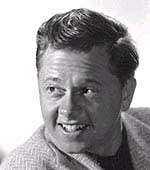
Actor Mickey Rooney speaks at the Pentagon in 2000 during a ceremony honoring the USO.Mickey Rooney (born Joseph Yule, Jr. on September 23, 1920), is an American film actor and musician whose eighty-five year career in entertainment began in 1922 and continues through 2007.


Biography

Early life

Rooney was born in Brooklyn, New York to a vaudeville family. His father, Joseph Yule, was from Scotland, and his mother, Nellie W. Carter, was from Kansas City, Missouri. Rooney began performing at the age of seventeen months in 1922.


Career

Entering the movie business in 1926, he made his name as the title character in the Mickey McGuire shorts. These were a series of more than 40 silent, two-reel comedies adapted from the Toonerville Trolley comic strip, in which he starred through 1936. For a time he billed himself as Mickey McGuire, but legally changed his name to Mickey Rooney in 1932. During this period, he met Walt Disney and would later claim Disney had named Mickey Mouse after him, although this seems unlikely since a common story is that Disney originally named the character Mortimer Mouse but changed the name to Mickey Mouse at the request of his wife. It is difficult to verify, and others have made similar claims, but Rooney takes credit for giving rising starlet Norma Jean Mortenson the stage name Marilyn Monroe (his co-star in the 1950 film The Fireball).

In 1934, he signed to MGM and was educated at the studio's School for Professional Children. Rooney's success as Andy Hardy in A Family Affair (1937) led to fourteen further films featuring that character from 1938 to 1958. His first role as the top-billed star in a feature film was as Shockey Carter in Hoosier Schoolboy (1937) with Edward Pawley playing his father. His breakthrough serious role came in 1938's Boys Town opposite Spencer Tracy as Whitey Marsh, which opened shortly before his 18th birthday. His fame peaked in World War II with a string of successful musicals with Judy Garland, including the Oscar nominated Babes in Arms (1939) as well as more serious roles in films such as The Human Comedy (1943) and National Velvet (1944).


In 1944, Rooney entered military service for 21 months during World War II, during which time he was a radio personality on the American Forces Network. After his return to civilian life, his career slumped. He appeared in a number of films, including Words and Music in 1948, which paired him for the last time with Garland on film (he appeared with her on one episode as a guest on her CBS variety series in 1963), and one final Andy Hardy film in the late 1950s. The Mickey Rooney Show, also known as Hey Mulligan, appeared on NBC television for 39 episodes during 1954 and 1955. In 1951, he directed a feature film for Columbia Pictures, My True Story starring Helen Walker. Rooney also starred as a ragingly egomaniacal television comedian in the live 90-minute television drama The Comedian, written by Rod Serling and directed by John Frankenheimer, on Playhouse 90 the evening of Valentine's Day in 1957.

In 1960, he directed and starred in The Private Lives of Adam and Eve, an ambitious comedy known for its multiple flashbacks and many cameos. In the 1960s, Rooney returned to theatrical entertainment. He still accepted film roles in undistinguished movies, but occasionally would appear in better works, such as Requiem for a Heavyweight (1962) and The Black Stallion (1979). On December 31, 1961, he appeared on television's What's My Line and mentioned that he had already started enrolling students in the MRSE (Mickey Rooney School of Entertainment). His school venture never came to fruition, but for several years he was a spokesman/partner in Pennsylvania's Downingtown Inn, a country club and golf resort.

In 1966, while Mickey was working on a film in the Philippines, his wife Barbara (aka Carolyn Mitchell), who had been a pin-up model and aspiring actress, was found dead in their bed. Beside her was her lover, an actor friend of Rooney's. Detectives ruled it murder-suicide, which was accomplished with Mickey's own gun. The lover, Milos Milos, was also a bodyguard and was connected to Stevan Markovic, bodyguard of French star Alain Delon. Markovic was also found dead in mysterious circumstances in Paris two years later.

Grief-stricken and not in his right frame of mind, Rooney quickly married Barbara's friend, Marge Lane. The union lasted about one hundred days.

He was awarded an Academy Juvenile Award in 1938, and in 1983 the Academy of Motion Picture Arts and Sciences voted him their Academy Honorary Award for his lifetime of achievement. Laurence Olivier called Rooney "the single best film actor America ever produced", a sentiment echoed by actor James Mason. Judy Garland stated that Rooney was "the world's greatest talent." As a result of the Andy Hardy series, Rooney was the highest paid actor in Hollywood in the late 1930s.

Rooney did the voices for three Christmas TV animated/stop action specials: Santa Claus Is Comin' to Town (1970), The Year Without a Santa Claus (1974), and Rudolph and Frosty's Christmas in July?-always playing Santa Claus. In 1970, he was approached by television producer Norman Lear to consider taking on the role of Archie Bunker in the upcoming CBS series, All in the Family. Like Jackie Gleason before him, Mickey rejected the project as too controversial. The role ultimately went to Carroll O'Connor.

Rooney continued to be busy in stage and television work through the 1980s and 1990s, appearing in the acclaimed stage play Sugar Babies with Ann Miller beginning in 1979; starring in the long-running TV series The Adventures of the Black Stallion, reprising his role as Henry Daily from The Black Stallion film; touring Canada in a dinner theatre production of The Mind with the Naughty Man in the mid-1990s; and playing The Wizard in a stage production of The Wonderful Wizard of Oz with Eartha Kitt at Madison Square Garden. Kitt was later replaced by Jo Anne Worley. He also appeared in the documentary That's Entertainment! III.

Rooney voiced Mr. Cherrywood in The Care Bears Movie (1985), and starred as the Movie Mason in a Disney Channel Original Movie family film, 2000's Phantom of the Megaplex. He played himself in the Simpsons episode "Radioactive Man" of 1995. In 1996-97, Mickey played Talbut on the TV series, Kleo The Misfit Unicorn produced by Gordon Stanfield Animation (GSA). He co-starred in Night at the Museum in 2006 with Dick Van Dyke and Ben Stiller.

Rooney has also been appearing in television commercials for Garden State Life Insurance Company in 1999, alongside his wife Jan. In current commercials (2007), Rooney can be seen in the background washing imaginary dishes.

Rooney continues to work in film, and tours with his wife, Jan Chamberlin in a multi-media live stage production called Let's Put On a Show! Chamberlin met Mickey through his son, Mickey Jr., whom she had been dating at the time. On May 26, 2007 he was Grand Marshal at the Garden Grove Strawberry Festival. It has recently been announced that Rooney will be making his British pantomime debut, playing Baron Hardup in Cinderella, at the Sunderland Empire Theatre over the 2007 Christmas period. He appeared in Points West dressed in a fetching pair of shorts and socks.

Currently, he and his wife live in Westlake Village, California.
0 Replies
 
bobsmythhawk
 
  1  
Reply Sun 23 Sep, 2007 07:45 am
John Coltrane
From Wikipedia, the free encyclopedia


Background information

Birth name John William Coltrane
Also known as "Trane"
Born September 23, 1926(1926-09-23)
Origin Hamlet, North Carolina, U.S.
Died July 17, 1967 (aged 40)
Genre(s) Avant-garde jazz
Bebop
Post bop
Hard bop
Free jazz
Modal jazz
Occupation(s) Saxophonist
Composer
Bandleader
Instrument(s) Tenor saxophone
Soprano saxophone
Alto saxophone
Flute
Bass clarinet
Years active 1946-1967
Label(s) Prestige Records
Blue Note Records
Atlantic
Impulse! Records
Associated
acts Miles Davis Quintet
John Coltrane Quartet
John Coltrane Quintet
Website Official Website

John William Coltrane (September 23, 1926 - July 17, 1967), nicknamed Trane, was an American jazz saxophonist and composer.

Although recordings of his work from as early as 1946 exist, Coltrane's recording career did not begin in earnest until 1955. From 1957 onward he recorded and produced dozens of albums, many of them not released until years after his death. He achieved extraordinary popularity, while also responding to a religious awakening that has made him spiritually inspiring to others.

Coltrane has been credited with reshaping modern jazz and being the predominant influence on successive generations of saxophonists. Like tenor saxophonists Coleman Hawkins, Lester Young, and Sonny Rollins before him, Coltrane fundamentally altered expectations for the instrument.

Coltrane received a posthumous Special Citation from the Pulitzer Prize Board in 2007 for his "masterful improvisation, supreme musicianship and iconic centrality to the history of jazz."


Biography

Early life and career (1926-1954)

Born in Hamlet, North Carolina, Coltrane grew up in comparatively privileged circumstances in High Point, during an era of racial segregation. He lived in an extended family within the household of his maternal grandfather, Rev. William Wilson Blair, a superintendent of the AME Zion Church, and a dominant figure in High Point's African American community. Midway through Coltrane's seventh grade school year, his close-knit family suffered the deaths of both of his maternal grandparents and his father. Soon afterward, his family lost its only remaining male breadwinner, Coltrane's uncle. These events brought the family to the brink of poverty, and forced Coltrane's mother and aunt into domestic service. It was during this time that Coltrane began playing music and practicing intensively.

His early life was influenced by his Southern middle-class upbringing; a heavy emphasis on religion along with exposure to and training in the Western European choral canon, both and equally, affected his later musical career. Coltrane first played alto horn in a community band, but soon switched to clarinet. In high school, he played in a fledgling school band and also sang in the William Penn High School Boys Chorus. The latter ensemble exposed him to challenging and sophisticated musical compositions. Coltrane learned of jazz through the radio, movies, and jukeboxes. As his enthusiasm for jazz blossomed, he changed instruments again, to alto saxophone, but lost interest in the school band; he did not play in the band at all during his senior year.

Coltrane moved to Philadelphia, Pennsylvania in June 1943, and was drafted into the Navy in 1945, where he played in a Hawaii-based Navy band. The group played then-current bebop standards: Tadd Dameron's "Hot House", Charlie Parker's "Ornithology", and some vocal tunes. Several sides recorded by this band in a single rushed session have since surfaced on compact disc. They are Coltrane's earliest known surviving recordings.

Contemporary correspondence shows that Coltrane was already known as "Trane" by this point, and that the music from the 1946 sessions had been played for Miles Davis ?- possibly impressing him. Coltrane returned to civilian life in 1946; at this time, he had a few brief encounters with Parker, who was already a dominant influence on his playing.

He worked at a variety of jobs in the late 1940s until he joined Dizzy Gillespie's big band in 1949 as an alto saxophonist. He stayed with Gillespie through the big band's breakup in May 1950 and switched to tenor saxophone during his subsequent spell in Gillespie's small group, staying until April 1951 when he returned to Philadelphia. It was at around this time that Coltrane became addicted to heroin.

In early 1952, Coltrane joined Earl Bostic's band. In 1953, after a stint with Eddie "Cleanhead" Vinson, he joined Johnny Hodges's small group, which was active during Hodges's four-year sabbatical from Duke Ellington's orchestra. Coltrane stayed with Hodges until mid-1954.


Miles and Monk period (1955-1959)

Coltrane was freelancing in Philadelphia in the summer of 1955 while studying with guitarist Dennis Sandole when he received a call from trumpeter Miles Davis. Davis's success during the late 1940s had dissipated during several years of heroin abuse, but he had now cleaned up, become active again, and was ready to form a regularly working quintet. With a few absences, Coltrane was with this edition of the Davis band (known as the "First Great Quintet" to distinguish it from Miles's later group with Wayne Shorter) from October 1955 through April 1957, a period which saw influential recordings from Davis and the first signs of Coltrane's growing ability.

This trend-setting group, best represented by two marathon recording sessions for Prestige in 1956, disbanded in mid-April. Coltrane would go on to adopt some of Davis's leadership traits for his future groups, such as allowing his musicians to solo with little interference, eschewing bandstand banter or tune identification, and remaining detached from both his audience and the press. Coltrane's style at this point was loquacious, and critics dubbed his playing angry and harsh. One especially harsh critic, Harry Frost, called Coltrane's solos "extended double-time flurries notable for their lack of direction." A Down Beat critic meanwhile stated that "the philosophical ramifications of Coltrane's playing are best left within the confines of his own tortured psyche."

In the early part of 1957, Coltrane succeeded in kicking his heroin addiction. He simultaneously experienced a spiritual epiphany that would lead him to concentrate wholly on the development of his music. He began to practice obsessively, incorporating violin and harp exercises. The resulting increase in his technical ability allowed him to play at wider intervals during his solos.[2] From this point until almost the end of his life, Coltrane was well-known for his intensive practicing.

During the latter part of 1957, Coltrane worked with Thelonious Monk at New York City's Five Spot Cafe during a legendary six-month gig. Unfortunately, this association was not extensively documented, and the best-recorded evidence demonstrating the compatibility of Coltrane with Monk, a fund-raising concert at Carnegie Hall on November 29, 1957, was only discovered and issued in 2005. It was accidentally found in an unmarked box at the Library of Congress and issued by Blue Note, along with another of their recordings, The Complete 1957 Riverside Recordings. His extensive recordings as a sideman and as a leader for Prestige have a mixed reputation.


Blue Train

Blue Train, his sole date as leader for Blue Note, featuring trumpeter Lee Morgan and trombonist Curtis Fuller, is widely considered his best album from this period. Four of its five tracks are original Coltrane compositions, and several of them, notably "Moment's Notice" and "Lazy Bird," have gone on to become standards.


Davis and Coltrane again

Coltrane rejoined Davis in January 1958. In October 1958, jazz critic Ira Gitler coined the term "sheets of sound" to describe the unique style Coltrane developed during his stint with Monk and was perfecting in Miles' group, now a sextet. His playing was compressed, as if whole solos passed in a few seconds, with rapid runs cascading in hundreds of notes per minute. He stayed with Davis until April 1960, working with, in due course, alto saxophonist Cannonball Adderley; pianists Red Garland, Bill Evans, and Wynton Kelly; bassist Paul Chambers; and drummers Philly Joe Jones and Jimmy Cobb. During this time he participated in such seminal Davis sessions as Milestones and Kind Of Blue, and the live recordings, Miles & Monk at Newport and Jazz at the Plaza.


Giant Steps

Toward the end of this period he recorded his first album exclusively of his own compositions, Giant Steps (for Atlantic Records) whose title track is generally considered to have the most complex and difficult chord progression of any widely-played jazz composition. Coltrane had already begun to experiment with harmony and to solo extensively.


My Favorite Things

Coltrane formed his first group, a quartet, in 1960. After moving through different personnel including Steve Kuhn, Pete LaRoca, and Billy Higgins, the lineup stabilized in the fall with pianist McCoy Tyner, bassist Art Davis, and drummer Elvin Jones. Tyner, from Philadelphia, had been a friend of Coltrane's for some years and the two men long had an understanding that the pianist would join Coltrane when Tyner felt ready for the exposure of regularly working with him.

Still with Atlantic Records, for whom he had recorded Giant Steps, his first record with his new group was also his debut playing the soprano saxophone, the hugely successful My Favorite Things. Around the end of his tenure with Davis, Coltrane had begun playing soprano saxophone, an unconventional move considering the instrument's near obsolescence in jazz at the time. His interest in the straight saxophone most likely arose from his admiration for Sidney Bechet and the work of his contemporary, Steve Lacy, even though Miles Davis claimed to have given Coltrane his first soprano saxophone.

The new soprano sound was coupled with further exploration. For example, on the Gershwin tune "But Not for Me," Coltrane employs the kinds of restless harmonic movement of his Giant Steps period (movement in major thirds rather than conventional perfect fourths) over the A sections instead of a conventional turnaround progression.


The first years with Impulse Records (1960-1962)

Shortly before completing his contract with Atlantic in May 1961 (with the album Olé Coltrane although Atlantic would continue to release recordings from their vaults for many years), Coltrane joined the newly formed Impulse! label, with whom the "Classic Quartet" would record. It is generally assumed that the clinching reason Coltrane signed with Impulse! was that it would enable him to work again with recording engineer Rudy Van Gelder, who had taped both his and Davis's Prestige sessions, as well as Blue Train. It was at Van Gelder's new studio in Englewood Cliffs, New Jersey that Coltrane would record most of his records for the label.

By early 1961, bassist Davis had been replaced by Reggie Workman while Eric Dolphy joined the group as a second horn around the same time. The quintet had a celebrated (and extensively recorded) residency in November 1961 at the Village Vanguard, which demonstrated Coltrane's new direction. It featured the most experimental music he'd played up to this point, influenced by Indian ragas, the recent developments in modal jazz, and the burgeoning free jazz movement. Longtime Sun Ra saxophonist John Gilmore was particularly influential; the most celebrated of the Vanguard tunes, the 15-minute blues, "Chasin' the 'Trane," was strongly inspired by Gilmore's music.

During this period, critics were fiercely divided in their estimation of Coltrane, who had radically altered his style. Audiences, too, were perplexed; in France he was famously booed during his final tour with Davis. In 1961, Down Beat magazine indicted Coltrane, along with Eric Dolphy, as players of "Anti-Jazz" in an article that bewildered and upset the musicians. Coltrane admitted some of his early solos were based mostly on technical ideas. Furthermore, Dolphy's angular, voice-like playing earned him a reputation as a figurehead of the "New Thing" (also known as "Free Jazz" and "Avant-Garde") movement led by Ornette Coleman, which was also denigrated by some jazz musicians (including Trane's old boss, Miles Davis) and critics. But as Coltrane's style further developed, he was determined to make each performance "a whole expression of one's being", as he would call his music in a 1966 interview.


Classic Quartet period (1962-1965)

In 1962, Dolphy departed and Jimmy Garrison replaced Workman. From then on, the "Classic Quartet", as it would come to be known, with Tyner, Garrison, and Jones, produced searching, spiritually driven work. Coltrane was moving toward a more harmonically static style that allowed him to expand his improvisations rhythmically, melodically, and motivically. Harmonically complex music was still present, but on stage Coltrane heavily favored continually reworking his "standards," "Impressions," "My Favorite Things," and "I Want to Talk about You."

The criticism of the quintet with Dolphy may have had an impact on Coltrane. In contrast to the radicalism of Trane's 1961 recordings at the Village Vanguard, his studio albums in 1962 and 1963 (with the exception of Coltrane, which featured a blistering version of Harold Arlen's "Out of This World") were much more conservative and accessible. He recorded an album of ballads and participated in collaborations with Duke Ellington and with deep-voiced ballad singer Johnny Hartman (the Impulse compilation Coltrane For Lovers is largely drawn from these three albums). The album Ballads is emblematic of Coltrane's versatility, as the quartet shed new light on old-fashioned standards such as "It's Easy to Remember." Despite a more polished approach in the studio, in concert the quartet continued to balance "standard" and its own more exploratory and challenging music, as can be seen on the Impressions album (two extended jams including the title track along with Dear Old Stockholm, After the Rain and a blues), Coltrane at Newport (where he plays My Favourite Things) and At Birdland both from 1963. Coltrane later said he enjoyed having a "balanced catalogue."


A Love Supreme

The Classic Quartet produced their most famous record, A Love Supreme, in December 1964. A culmination of much of Coltrane's work up to this period, this four-part suite is an ode to his faith in and love for God (not necessarily God in the Christian sense ?- Coltrane often mentioned that he worshipped all gods of all religions[citation needed]). These spiritual concerns would characterize much of Coltrane's composing and playing from this point onwards (as can be seen from album titles such as Ascension, Om and Meditations. The fourth movement of A Love Supreme, "Psalm," is, in fact, a musical setting for an original poem to God written by Coltrane, and printed in the album's liner notes. Coltrane plays almost exactly one note for each syllable of the poem, and bases his phrasing on the words. Despite its challenging musical content, the album was a commercial success by jazz standards, encapsulating both the internal and external energy of the quartet of Coltrane, Tyner, Jones and Garrison. Indeed the previous album Crescent recorded only a few months before already shows the adventurousness and rapport between these musicians.

The quartet only played A Love Supreme live once ?- in July 1965 at a concert in Antibes, France. By then, Coltrane's music had grown even more adventurous, and the performance provides an interesting contrast to the original.


Avant-garde jazz and the second quartet (1965-1967)

In his late (post-A Love Supreme) period, Coltrane showed an increasing interest in avant-garde jazz, purveyed, along with its aforementioned pioneer, Ornette Coleman, by Cecil Taylor, Albert Ayler, Sun Ra, and others. In formulating his late style, Coltrane was especially influenced by the dissonance of Ayler's trio with bassist Gary Peacock and drummer Sunny Murray. Coltrane championed many younger free jazz musicians, (notably Archie Shepp), and under his influence Impulse! became a leading free jazz record label.

After recording A Love Supreme, the influence of Ayler's playing became more prominent in Coltrane's music. A series of recordings with the Classic Quartet in the first half of 1965 show Coltrane's playing becoming increasingly abstract, with greater incorporation of devices like multiphonics, utilization of overtones, and playing in the altissimo register. In the studio, he all but abandoned his soprano to concentrate on the tenor saxophone. In addition, the quartet responded to the leader by playing with increasing freedom. The group's evolution can be traced through the recordings The John Coltrane Quartet Plays , Dear Old Stockholm (both May 1965), Living Space, Transition (both June 1965), New Thing at Newport (July 1965), Sun Ship (August 1965), and First Meditations (September 1965). Only Plays and New Thing at Newport were released during Coltrane's lifetime. In 2005 the historical record was supplemented by One Down, One Up: Live at the Half Note set by the quartet from 1965.

In June 1965, he went into Van Gelder's studio with ten other musicians (including Shepp, Pharoah Sanders, Freddie Hubbard, Marion Brown, and John Tchicai) to record Ascension, a 40-minute long piece that included adventurous solos by the young avant-garde musicians (as well as Coltrane), and was controversial primarily for the collective improvisation sections that separated the solos. After recording with the quartet over the next few months, Coltrane invited Pharoah Sanders to join the band in September 1965.

By any measure, Sanders was one of the most abrasive saxophonists then playing. While Coltrane used over-blowing frequently as an emotional exclamation-point, Sanders would opt to overblow his entire solo, resulting in a constant screaming and screeching in the altissimo range of the instrument. The more Coltrane played with Sanders, the more he gravitated to Sanders' uniquely shrill sound. The aforementioned John Gilmore was a major influence on Coltrane's late-period music, as well. After hearing a Gilmore performance, Coltrane is reported to have said "He's got it! Gilmore's got the concept!" [3] He also took informal lessons from Gilmore.


Adding to the quartet

By the fall of 1965, Coltrane was regularly augmenting his group with Sanders and other free jazz musicians. Rashied Ali joined the group as a second drummer. This was the end of the quartet; claiming he was unable to hear himself over the two drummers, Tyner left the band shortly after the recording of Meditations. Jones left in early 1966, dissatisfied by sharing drumming duties with Ali. Both Tyner and Jones subsequently expressed displeasure in interviews, after Coltrane's death, with the music's new direction, while incorporating some of the free-jazz form's intensity into their own solo projects.

In 1965 Coltrane may have begun using LSD[citation needed] - informing the sublime, "cosmic" transcendence of his late period, and also its incomprehensibility to many listeners. After Jones and Tyner's departures, Coltrane led a quintet with Pharoah Sanders on tenor saxophone, his new wife Alice Coltrane on piano, Jimmy Garrison on bass, and Rashied Ali on drums. Coltrane and Sanders were described by Nat Hentoff as "speaking in tongues." When touring, the group was known for playing very lengthy versions of their repertoire, with many stretching beyond 30 minutes and sometimes even being an hour long. Concert solos for band-members regularly were at least fifteen-minutes or longer.

Despite the radicalism of the horns, the rhythm section with Ali and Alice Coltrane had a more relaxed, random but meditative feel than with Jones and Tyner. The group can be heard on several live recordings from 1966, including Live at the Village Vanguard Again! and Live in Japan. In 1967, Coltrane entered the studio several times; though pieces with Sanders have surfaced (the unusual "To Be", which features both men on flutes), most of the recordings were either with the quartet minus Sanders (Expression and Stellar Regions) or as a duo with Ali. The latter duo produced six performances which appear on the album Interstellar Space.


Death (1967)

Coltrane died from liver cancer at Huntington Hospital in Long Island, NY on July 17, 1967, at the age of 40. Coltrane's excessive alcohol and heroin abuse during the 1940s and 1950s quite possibly laid the seed for this illness, which can strike reformed alcoholics years after they quit. In a 1968 interview Albert Ayler revealed that Coltrane was consulting a Hindu meditative healer for his illness instead of Western medicine, though Alice Coltrane later denied this. In any event, conventional treatment may have been ineffective.

The Coltrane family reportedly remains in possession of much more as-yet-unreleased music, mostly mono reference tapes made for the saxophonist and, as with the 1995 release Stellar Regions, master tapes that were checked out of the studio and never returned. The parent company of Impulse!, from 1965 to 1979 known as ABC Records, purged much of its unreleased material in the 1970s.[1] Biographer Lewis Porter has stated that Alice Coltrane intended to release this music, but over a long period of time as her son Ravi is also pursuing his own career.


Coltrane's religious beliefs

Coltrane was born and raised a Christian, and was in touch with religion and spirituality from childhood. As a youth, he practiced music in a southern African-American church. In A Night in Tunisia: Imaginings of Africa in Jazz, Norman Weinstein notes the parallel between Coltrane's music and his experience in the southern church.

In 1957 Coltrane began to shift spiritual directions. Two years earlier, he had married Juanita Naima Grubb, a Muslim convert, (for whom he later wrote the piece Naima), and came into contact with Islam, an experience that may have led him to overcome his addictions to alcohol and heroin; it was a period of "spiritual awakening" that helped him return to the Jazz scene and eventually produce his greatest work. The journey took him through Islam. Bassist Donald Garrett told Coltrane, "You've got to go to the source to learn anything, and Sufism is one of the best sources there is."

Coltrane also explored Hinduism, the Kabbala, Jiddu Krishnamurti, yoga, math, science, astrology, African history, and even Plato and Aristotle [4]. He notes..."During the year 1957, I experienced, by the grace of God, a spiritual awakening which was to lead me to a richer, fuller, more productive life. At that time, in gratitude, I humbly asked to be given the means and privilege to make others happy through music."[2] In his 1965 album Meditations, Coltrane wrote about uplifting people, "...To inspire them to realize more and more of their capacities for living meaningful lives. Because there certainly is meaning to life."[3]

In October 1965, Coltrane recorded Om, referring to the sacred syllable in Hindu religion, which symbolizes the infinite or the entire Universe. Coltrane described Om as the "first syllable, the primal word, the word of power". The 29-minute recording contains chants from the Bhagavad-Gita, a Hindu epic. A 1966 recording, issued posthumously, has Coltrane and Pharoah Sanders chanting from a Buddhist text, The Tibetan Book of the Dead, and reciting a passage describing the primal verbalization "om" as a cosmic/spiritual common denominator in all things.

Coltrane's spiritual journey was interwoven with his investigation into world music. He believed not only in a universal musical structure which transcended ethnic distinctions, but in being able to harness the mystical language of music itself. Coltrane's study of Indian music led him to believe that certain sounds and scales could "produce specific emotional meanings" (impressions). According to Coltrane, the goal of a musician was to understand these forces, control them, and elicit a response from the audience. Like Pythagoras and his followers who believed music could cure illness, Coltrane said: "I would like to bring to people something like happiness. I would like to discover a method so that if I want it to rain, it will start right away to rain. If one of my friends is ill, I'd like to play a certain song and he will be cured; when he'd be broke, I'd bring out a different song and immediately he'd receive all the money he needed."


Legacy

Although some jazz listeners still consider the late Coltrane albums to contain little more than cacophony, many of these late recordings ?- among them Ascension, Meditations and the posthumous Interstellar Space ?- are widely considered masterpieces.

The music of Coltrane's modal and Village Vanguard period was the admitted principal influence on what was arguably the first jazz-rock fusion recording, the Byrds' "Eight Miles High" (December 1965). Some of Coltrane's other innovations would be incorporated into the fusion movement, but with diminishing returns of spiritual fervency and earnestness.

The influence Coltrane has had on music spans many different genres and musicians. For example, Jimi Hendrix, Carlos Santana, Allan Holdsworth, Jerry Garcia, the Stooges, The Doors, Mike Watt, OutKast and Duane Allman cite Coltrane's work as inspiration.

Coltrane's massive influence on jazz, both mainstream and avant-garde, began during his lifetime and continued to grow after his death. He is one of the most dominant influences on post-1960 jazz saxophonists and has inspired an entire generation of jazz musicians. He was posthumously awarded the Grammy Lifetime Achievement Award in 1992.

His widow, Alice Coltrane, after several decades of seclusion, briefly regained a public profile before her death in 2007. Coltrane's son, Ravi Coltrane, named after the great Indian sitarist Ravi Shankar, whom Coltrane greatly admired, has followed in his father's footsteps and is a prominent contemporary saxophonist.

The Saint John Coltrane African Orthodox Church, an African Orthodox Church in San Francisco, has recognized Coltrane as a saint since 1971.[4] Their services incorporate Coltrane's music, using his lyrics as prayers.[5] A documentary on Coltrane, featuring the church, was produced for the BBC in 2004 and is presented by Alan Yentob.[6]
0 Replies
 
bobsmythhawk
 
  1  
Reply Sun 23 Sep, 2007 07:55 am
Ray Charles
From Wikipedia, the free encyclopedia

Background information

Birth name Ray Charles Robinson
Also known as Brother Ray, The Genius
Born September 23, 1930(1930-09-23)
Albany, Georgia, United States
Origin Greenville, Florida, United States
Died June 10, 2004 (aged 73)
Beverly Hills, California, United States
Genre(s) R&B, soul, blues, pop, country, jazz, gospel, piano blues
Occupation(s) Singer, songwriter, musician, arranger, bandleader
Instrument(s) Singing, piano, alto saxophone
Years active 1947-2004
Label(s) Atlantic, ABC, Warner Bros. Records
Associated
acts The Raelettes
Website www.raycharles.com

Ray Charles Robinson (September 23, 1930 - June 10, 2004) known by his stage name Ray Charles, was a pioneering American pianist and soul musician who shaped the sound of rhythm and blues. He brought a soulful sound to country music, pop standards, and a rendition of "America the Beautiful" that Ed Bradley of 60 Minutes called the "definitive version of the song, an American anthem ?- a classic, just as the man who sang it."[1]

Frank Sinatra called him "the only true genius in the business."[1][2] And in 2004, Rolling Stone Magazine ranked Ray Charles [3] #10 on their list of The Immortals: 100 Greatest Artists of All Time.[4]


Biography

Early years

Ray Charles Robinson was born in Albany, Georgia[5] to Bailey Robinson, a railroad repair man, mechanic and handyman,[6] and Aretha Williams, who stacked boards in a sawmill; the two were never married. The family moved to Greenville, Florida, when Ray was an infant. Bailey had two more families, leaving Aretha to raise the family. When Charles was five, he witnessed his younger brother ,George, drown in his mother's large portable laundry tub.[7]

When he was six, Charles began to go blind, becoming totally blind by the age of seven.[8] Charles never knew exactly why he lost his sight,[1] though there are sources which suggest Ray's blindness was due to glaucoma. He attended school at the St. Augustine School for the Deaf and the Blind in St. Augustine, Florida.[8] He also learned how to write music and play various musical instruments.[8] While he was there, his mother died. His father died two years later.

After he left school, Charles began working as a musician in several bands that played in various styles, including jazz and, in Tampa "with a hillbilly band called The Florida Playboys." [9]

Charles moved to Seattle in 1947[8] or 1948.[10] He soon started recording, first for the label Swingtime Records, achieving his first hit with "Baby, Let Me Hold Your Hand" in 1951, then signed with Ahmet Ertegün at Atlantic Records a year later.[8] When he entered show business, his name was shortened to Ray Charles to avoid confusion with boxer Sugar Ray Robinson [11].


Middle years

Almost immediately after signing with Atlantic, Charles scored his first hit singles with the label with the rap-like "It Should Have Been Me" and the Ertegun-composed "Mess Around", both making the charts in 1953. But it was Charles' "I Got a Woman" (composed with band mate Renald Richard [12]) that brought the musician to national prominence. The song reached the top of Billboard's R&B singles chart in 1955 and from there until 1959, Charles would have a series of R&B chart-toppers including "This Little Girl of Mine", "Lonely Avenue", "Mary Ann", "Drown in My Own Tears" and "The Night Time (Is the Right Time)". During this time of transition, he recruited a young girl group from New York named the Cookies as his background singing group, changing their name to the Raelettes in the process. In 1959, Charles crossed over to top 40 radio with the release of his impromptu blues number, "What'd I Say", which was initially conceived while Charles was in concert. The song would reach number 1 on the R&B list and would become Charles' first top ten single on the pop charts, peaking at number 6. Charles would also record one of his finest albums, The Genius of Ray Charles, before leaving Atlantic for a more lucrative deal with ABC in 1959. Hit songs such as "Georgia On My Mind", "Hit the Road Jack" and "Unchain My Heart" helped him transition to pop success and his landmark 1962 album, Modern Sounds in Country and Western Music, helped to bring country into the mainstream.


Later years

In 1965, Charles was arrested for possession of heroin, a drug to which he had been addicted for nearly 20 years [13] . It was his third arrest for the offense, but he avoided prison time after kicking the habit in a clinic in Los Angeles.[1] He spent a year on parole in 1966.

During the 1960s and 1970s, Charles' releases were hit-or-miss[8], with some big hits and critically acclaimed work, and some music that was dismissed as unoriginal and staid.[citation needed] His version of "Georgia On My Mind", was proclaimed the state song of Georgia on April 24, 1979, with Charles performing it on the floor of the state legislature.[8] He also had success with his unique version of "America the Beautiful." In November 1977 Charles appeared as the host of NBC's Saturday Night Live.[1]

In the late 1980s a number of events increased Charles' recognition among young audiences. He made a cameo appearance in the popular 1980 film The Blues Brothers. In 1985, "The Right Time" was featured in the episode "Happy Anniversary" of The Cosby Show on NBC. The cast members used the song to perform a wildly popular lip-synch that helped the show secure its wide audience.[citation needed]. Charles' new connection with audiences helped secure an advertising spot for Diet Pepsi.[citation needed] In a Pepsi Cola commercial of the early 1990s, Charles popularized the catchphrase "You Got the Right One, Baby!"

In 1989, Charles recorded a cover version of the Japanese band Southern All Stars' song "Itoshi no Ellie" as "Ellie My Love" for a Suntory TV advertisement, reaching #3 on Japan's Oricon chart. [14] Eventually, it sold more than 400,000 copies, and became that year's best-selling single performed by a Western artist for the Japanese music market. [15]

In the late '80s and early '90s, Charles made appearances on The Super Dave Osbourne Show, where he performed and appeared in a few vignettes where he was somehow driving a car, often as Super Dave's chauffeur. At the height of his newfound fame in the early nineties, Charles did guest vocals for quite a few projects. He also appeared (with Chaka Khan) on long time friend Quincy Jones' hit "I'll Be Good To You" in 1990, from Jones' album Back on the Block.

Following Jim Henson's death in 1990, Ray Charles appeared in the one-hour CBS tribute, The Muppets Celebrate Jim Henson. He gave a short speech about the deceased, stating that Henson "took a simple song and a piece of felt and turned it into a moment of great power". Charles was referring to the song It's Not Easy Being Green, which Charles later performed with the rest of the Muppet cast in a tribute to Henson's legacy.

During the sixth season of Designing Women, Ray Charles vocally performed "Georgia On My Mind", rather than the song being rendered by other musicians without lyrics as in the previous five seasons.


Final appearances

Although Charles passed on in 2004, his spirit and love for music lives on in those he left behind.

Gladys Knight performed Charles' "Georgia On My Mind" during the Opening Ceremonies of the 1996 Olympic Games in Atlanta, Georgia.

In 2000, Charles made a special guest appearance on Blues Clues Big Musical Movie as a fictional character named G-Clef. The Temptations also made a guest appearance as his companions. Charles recorded "There It Is" during and after filming with Steve Burns and Traci Paige Johnson. After recording, Charles commented "This has been the most fun I ever had since I met President Reagan in '84."

In 2002 Charles headlined during the Blues Passions Cognac festival in southern France. At one point in the performance a young fan rose to his feet and began to sing an a cappella version of Charles' early song, "Mess Around"; Charles responded by performing the song.[citation needed]

In 2002 he took part - with other musician - in a peace concert in Rome, which was the first event to take place inside the city's ancient Colosseum since 404 A.D. The event was organized in partnership with the Glocal Forum and the Quincy Jones Listen Up Foundation.

In June, 2003, Ray Charles presented one of his greatest admirers, Van Morrison, with his award upon being inducted in the Songwriters Hall of Fame and the two sang Morrison's song from the Moondance album, "Crazy Love". This performance is captured on Morrison's 2007 album, The Best of Van Morrison Volume 3.

In 2003 Charles performed "Georgia On My Mind" and "America the Beautiful" at a televised annual electronic media journalist banquet held in Washington, D.C., at what may have been his final performance in public. Ray Charles' final public appearance came on April 30, 2004, at the dedication of his music studio as a historic landmark in the city of Los Angeles.[8]


He died on June 10, 2004 of Hepatocellular carcinoma (liver cancer) at his home in Beverly Hills, California, surrounded by family and friends. </ref> He was interred in the Inglewood Park Cemetery in Inglewood, California.

His final album, Genius Loves Company, released two months after his death, consists of duets with various admirers and contemporaries: B.B. King, Van Morrison, Willie Nelson, James Taylor, Gladys Knight, Michael McDonald, Natalie Cole, Elton John, Bonnie Raitt, Diana Krall, Norah Jones, and Johnny Mathis. The album won eight Grammy Awards, including five for Ray Charles for Best Pop Vocal Album, Album of the Year, Record of the Year and Best Pop Collaboration with Vocals for "Here We Go Again" with Norah Jones, and Best Gospel Performance for "Heaven Help Us All" with Gladys Knight; he also received nods for his duets with Elton John and B.B. King.

The album included a version of Harold Arlen's "Over the Rainbow", sung as a duet by Charles and Johnny Mathis; that recording was later played at his memorial service.[16]

Two more posthumous albums, Genius & Friends (2005) and Ray Sings, Basie Swings (2006), were released. Genius & Friends consisted of duets recorded from 1997-2005 with artists were personally chosen by Ray Charles. Ray Sings, Basie Swings consists of archived vocals of Ray Charles from a live 1973 performance added to Count Basie's music. Charles' vocals recorded from the concert mixing board were added to a new accompaniment by the Count Basie Orchestra (among others). Gregg Field, who had performed as a drummer with both Charles and Basie, produced this album.


Controversies and criticisms

Despite his support of Martin Luther King, Jr. in the 1960s and his support for the American Civil Rights Movement, Charles courted controversy when he toured South Africa in 1981[8], during an international boycott of the country because of its apartheid policy.


Personal life

Charles was married twice and fathered twelve children by seven different women.[17][18] He was married for the first time to Eileen Williams on July 31, 1951. This marriage produced no children and ended in divorce in 1952. Three children are from his second marriage to Della Beatrice Howard Robinson, one of his original Raelettes, whom he married on April 5, 1955. They divorced in 1977. His long term girlfriend and partner at the time of his death was Norma Pinella.[19]

His children were:

Charles Wayne Hendricks (son of Marge Hendricks - one of the Raelettes)
Evelyn Robinson (daughter of Louise Mitchell)
Raenee Robinson (daughter of Mae Mosely Lyles)
Sheila Robinson (daughter of Sandra Jean Betts)
Vincent Kotchounian (son of Arlette Kotchounian - worked with him as photographer on Would You Believe album)
David Robinson (son of Della Robinson)
Ray Charles Robinson, Jr. (son of Della Robinson)
Reverend Robert Robinson (son of Della Robinson. The only child allowed to attend his funeral)
Reatha Butler
Alexandria Bertrand (daughter of Chantelle Bertrand)
Robyn Moffett
Ryan Corey Robinson den Bok (son of Mary Anne den Bok)

Ray: The Film


Charles was significantly involved in the biopic Ray, an October 2004 film which portrays his life and career between 1930 and 1966 and stars Jamie Foxx as Charles. Foxx won the 2005 Academy Award for Best Actor for the role.

Before shooting could begin, however, director Taylor Hackford brought Foxx to meet Charles, who insisted that they sit down at two pianos and play together. For two hours, Charles challenged Foxx, who revealed the depth of his talent, and finally, Charles stood up, hugged Foxx, and gave his blessing, proclaiming, "He's the one... he can do it."

Charles was expected to attend a showing of the completed film, but he died before it opened in theaters.

As noted in the film's final credits, Ray is based on true events, but includes some characters, names, locations, events which have been changed and others which have been "fictionalized for dramatization purposes." One example of the film's use of dramatic license are the scenes which refer to Charles as being banned from Georgia.[20]

The film's credits note that he is survived by 12 children, 21 grandchildren, and 5 great grandchildren.


Halls of Fame and other honors

Besides winning dozens of Grammy Awards in his career, Charles was also honored in many other ways. In 1979, he was one of the first honorees of the Georgia State Music Hall of Fame being recognized for being a musician born in the state.[21] Ray's version of "Georgia On My Mind" was made into the official state song for Georgia.[22] In 1981, he was given a star on the Hollywood Walk of Fame and was one of the first inductees to the Rock & Roll Hall of Fame at its inaugural ceremony in 1986.[23] He received the Kennedy Center Honors in 1986.[24] In 1987, he was awarded the Grammy Lifetime Achievement Award. In 1991, he was inducted to the Rhythm & Blues Foundation, in 2004 he was inducted to the Jazz Hall of Fame, and inducted to the National Black Sports & Entertainment Hall of Fame.[25] Also in 2004, Rolling Stone Magazine ranked him #10 on their list of the 100 Greatest Artists of All Time.[26].

In August 2005, the United States Congress honored Charles by renaming the former West Adams Station post office in Los Angeles the "Ray Charles Station".

The Grammy Awards of 2005 were dedicated to Charles.
0 Replies
 
edgarblythe
 
  1  
Reply Sun 23 Sep, 2007 07:56 am
Let me tell you bout a girl I know she's my baby and she lives next door
Every morning fore the sun comes up she brings me coffee in my favorite cup
That's why I know yes I know hallelujah I just love her so

When I'm in trouble and I need a little friend
That woman she stricks by me to the end
Now you ask me how do I know I smile at you and say she told me so
That's why I know yes I know hallelujah I love her so

Oh now when she call me on the telephone and tell me baby I'm all alone
By the time I count from one to four to hear me knockin' upon her door
In the evening fore the sun goes down ain't nobody else a hangin' around
She kisses me and holds me tight and tells me pretty baby everything's all right
That's why I know yes I know hallelujah I just love her so
[ piano ]
Oh now when she call me on the telephone...

Jerry Lee Lewis version
0 Replies
 
bobsmythhawk
 
  1  
Reply Sun 23 Sep, 2007 08:01 am
Romy Schneider
From Wikipedia, the free encyclopedia

Birth name Rosemarie Magdalena Albach-Retty
Born September 23, 1938(1938-09-23)
Vienna, Austria
Died May 29, 1982 (aged 43), age 43
Paris, France

Romy Schneider (September 23, 1938 - May 29, 1982) was a German actress.


Early life

She was born Rosemarie Magdalena Albach-Retty in Vienna into a family of actors that included her paternal grandmother Rosa Albach-Retty, her father Wolf Albach-Retty of Austria and her German mother Magda Schneider . After the divorce in 1945, Magda took charge of Romy and her brother Wolfi, eventually supervising the young girl's career, often appearing alongside her daughter. Romy thus made her film debut in Wenn der weisse Flieder wieder blüht (1953), at the age of 15. Young Romy's career was also overseen by her stepfather, Hans-Herbert Blatzheim, a noted restaurateur who Schneider indicated had an unhealthy interest in her [citation needed].

In the film Mädchenjahre einer Königin (Girlhood of a Queen, Ernst Marischka, 1954) Romy Schneider for the first time portrayed a royal. This Austrian movie is about the early years of Queen Victoria of Britain, in particular her first encounter with Prince Albert of Saxe-Coburg. Schneider's breakthrough, however, came with her portrayal of Princess Elisabeth of Bavaria -- later to become Empress Elisabeth of Austria -- in the romantic biopic Sissi (1955) and its two sequels (1956 and 1957).

Soon tired of the saccharine image these movies had bestowed upon her, Schneider was eager for the chance to star in the much more sombre Christine (1958), a remake of Max Ophüls's 1933 film Liebelei (itself based upon a play by Arthur Schnitzler). It was during the filming of Christine that Schneider fell in love with French actor Alain Delon, who co-starred in the movie. She abruptly left Germany to join him in Paris, creating a national scandal. Schneider became engaged to Delon in 1959. It was to be a pivotal point in both her personal and professional life.

Schneider stayed in France, slowly gaining the interest of film directors such as (Orson Welles) Le Procès (1963), based upon Franz Kafka's The Trial and was introduced by Delon to Luchino Visconti.

Under Visconti's direction, she gave metamorphic performances in John Ford's play "'Tis a pity she's a whore" and in the film "Boccaccio '70" (episode: The Job), where her delicate, feline beauty and fierce sensuality contrasted with the more obvious charms of Anita Ekberg and Sophia Loren (Coco Chanel made her costumes). A brief stint in Hollywood included appearances in Good Neighbor Sam, a 1964 comedy with Jack Lemmon, and 1965 What's New, Pussycat? costarring Peter O'Toole, Peter Sellers and Woody Allen who also wrote the screenplay).

Romy Schneider's private life continued turbulently. Dumped by Delon (they never married) in 1963, she married (1966) and divorced (1975) Harry Meyen (1924 - 1979), a German director and actor who later committed suicide. The couple had a son, David Christopher Meyen (1966-1981). In 1975, Schneider married Daniel Biasini, her private secretary; they separated in 1981. Their daughter Sarah Magdalena Biasini (b. July 14, 1977) is also an actress.

Schneider continued starring in films with Alain Delon. On a break from filming after marriage and motherhood, she soon realized she wanted and needed to continue working as an actress. "Just then," she later remembered, "Alain called me up and asked if I exclusively had husband and children on my mind, or would be interested in doing a movie".

The movie, a sexy thriller titled La Piscine (The Swimming Pool) (1968) was a sensation and added yet another dimension to Schneider's on-screen persona. The Assassination of Trotsky (1972) followed and Delon remained a lifelong friend, coming to her aid during difficult times.

Romy Schneider reigned in France as an actress during the 1970s, giving remarkable performances in films such as Le vieux fusil, Max et les ferrailleurs and the crowd pleasers Les choses de la vie and Cesar et Rosalie. The harsh L'important c'est d'aimer, garnered her first Cesar (France's equivalent of the Oscar).

Ludwig, Visconti's 1972 film about the life of King Ludwig II of Bavaria, featured her as a much more complex, mature, even bitter Elisabeth of Austria. "Sissi sticks to me just like oatmeal," Schneider once said. Reportedly, a portrait of her taken from the Visconti film was the only one of her roles she had displayed in her home.

Worth mentioning among her other films is the macabre Le Trio infernal (1974) with Michel Piccoli, and what may have been her greatest performance, a chilling turn in Garde à vue with Michel Serrault and Lino Ventura (1981).

In 1980 she starred in Bertrand Tavernier's prophetic La mort en direct (Deathwatch), based on D. G. Compton's novel, playing a dying woman whose last days are watched on national television via a camera implanted in the brain of a journalist (Harvey Keitel). Her last film was La Passante du Sans-Souci (The Passerby, 1982).


Death

Schneider began drinking alcohol in excess after the sudden death, on July 5, 1981, of her 14-year-old son, David. David had attempted to climb the spiked fence at his stepfather's parents home when he punctured his femoral artery. He got himself off the fence and into the house for help but by the time the ambulance got him to the hospital he had lost too much blood and died. When Romy was found dead in her apartment in Paris, France on May 29, 1982, at the age of 43, it was suggested that she had committed suicide by taking a lethal cocktail of alcohol and sleeping pills. However, no post-mortem examination was carried out. She was declared to have died from cardiac arrest.

Following her burial, it became known that her companion Laurent Petin had buried her with a large amount of gold jewelery, which led to her tomb being ransacked by thieves. She was later reburied in a more secure means. These circumstances were similar to that of Benny Hill after his burial.
0 Replies
 
bobsmythhawk
 
  1  
Reply Sun 23 Sep, 2007 08:16 am
Julio Iglesias
From Wikipedia, the free encyclopedia


Background information

Birth name Julio José Iglesias de la Cueva
Born September 23, 1943 (1943-09-23) (age 64)
Madrid,Spain
Origin Madrid
Genre(s) Latin
Occupation(s) Singer
Years active 1968 - Present
Label(s) Columbia, Sony
Website JulioIglesias.com

Julio José Iglesias de la Cueva (born September 23, 1943 in Madrid) is the best-selling singer of all time, having sold over 250 million records[1] in different languages and released 77 records. While Iglesias rose to international prominence in the 1970s and 1980s as a performer of romantic ballads and as an iconically suave Latin gentleman, his success has continued as he crossed musical and linguistic barriers. Thus far, he has performed approximately 5,000 concerts and recorded albums in fourteen different languages[2].


Biography

Julio is the eldest son of Dr. Julio Iglesias Puga from Galicia and Maria del Rosario de la Cueva y Perignat; his younger brother is Carlos. When Iglesias himself was 61, his 87-year-old father had more children. Half brother Jaime was born 18 May 2004, and half-sister Ruth on 26 July 2006. Julio's half-siblings were born from the second marriage of Dr. Julio Iglesias Puga and Ronna Keitt.

If not for a car accident, on 22nd September 1963, he may have never had a music career:"I had a car accident, very, very strong car accident," remembers Iglesias. I had what they call paraparexia, which is not a paraplegic. It's a compression in the cord, in the sense of the neck … my spinal cord, and I was very, very ill for three years." Doctors thought the young man would never walk again. But slowly, he started to recover. And to increase dexterity in his hands, he began to play the guitar. Once he recovered, he resumed his studies and he travelled to England to study English, first in Ramsgate and then at Bell Educational Trust's Language School in Cambridge.

In June 2001 he finished his law degree at Madrid Spain's Complutense University, fulfilling the promise he made to his then 84-year-old father that he would eventually graduate after dropping out 35 years ago to pursue his music career. He received a certificate as a lawyer from Cambridge University [citation needed].

During the 1970s he met the Filipina socialite and Hola! magazine journalist Isabel Preysler, and just 7 months later they married. Together they have 3 children:

Daughter: Isabel Iglesias known as Chabeli Iglesias (born September 3, 1971, in Madrid).
Son: Julio José Iglesias Jr. (born February 25, 1973, in Madrid).
Son: Enrique Iglesias (singer, born May 8, 1975, in Madrid).
Chabeli Iglesias is now a news reporter in Washington DC. Enrique Iglesias followed in his father's footsteps and is a world-famous singer. Julio José Iglesias is a model who has released two CDs. It was during the 1970s that the Iglesias family's private life became very public, with Julio and the rest of the family frequently featured on the covers of various international magazines. The couple divorced in 1978.

Since 1990 Iglesias has been with Dutch former model Miranda Johanna Maria Rijnsburger born on October 5, 1965. [3] He revealed that Miranda accepted his marriage proposal and they will marry[4] in the future so that their twin daughters will be bridemaids. Together they have 5 children:

Son: Miguel Alejandro (born September 7, 1997)[5]
Son: Rodrigo (born April 3, 1999)[6]
Twin daughters: Victoria and Cristina (born May 1, 2001).[7]
Guillermo was born on May 5, 2007, at 6:12pm in Mount Sinai Hospital in Miami Beach, FL. He weighed 8 lbs. 7oz. and was 21 inches long. The childbirth was natural, and was assisted by Doctor Rebeca Martinez and pediatrician Tony Adams. Both the baby and the mother are fine and in perfect health.

Musical career

Early career to 1978

In 1968, he won the Benidorm International Song Festival, a songwriter's contest in Spain, and signed a contract with a Columbia Records Latin music label, Discos Columbia. He represented Spain at the Eurovision Song Contest in 1970, finishing fourth behind Northern Irish singer Dana Scallon, and the Welsh singer Mary Hopkin. His entry was the song "Gwendolyne" which was his first recording. Notable albums from this decade include A Flor de Piel (1974, which spawned the big European hit Manuela), El Amor (1975) and Soy (1978).


Peak during 1978-1990

In 1978, he signed a contract for CBS International, adding English, French, Portuguese, German and Italian to his language repertoire. Iglesias released the album De Nina a Mujer in 1981, from which he had his first hit in the English market with a Spanish cover of "Begin the Beguine" (a No.1 hit in the United Kingdom). He also released a collection, Julio, in 1983 building his reputation.

In 1984, he released the smash hit album 1100 Bel Air Place, which gave him considerable fame in English-language markets. The album sold three million albums in the US alone, with the first single "To All The Girls I've Loved Before", a duet with Willie Nelson, reaching the top five on the Billboard Hot 100. The album also featured "All of You", a hit duet with Diana Ross.

In 1985, his father was kidnapped but found well and alive after two agonizing weeks. This prompted Julio (divorced from Preysler), to move his family to Miami, Florida, where they settled in a mansion on Miami Beach. That year he also recorded duets with Diana Ross and Willie Nelson. It was rumored in 1986 that Julio, perhaps seeking to get away from all the fame and hoopla for one week, was found walking around the streets of Cayey, Puerto Rico, after disappearing for seven days. After visiting the island of the Dominican Republic he fell so in love with it that in late 2005 he adopted legally Dominican citizenship.

Iglesias won a Grammy Award for Best Latin Pop Album in the 1988 Grammy Awards for the album Un Hombre Solo ("A Man Alone"). He also recorded a duet with Stevie Wonder on "My Love" from his Non Stop album which achieved crossover success in 1988.

Stories of Julio's expensive private jets, boats, and houses became legendary during that decade, and his world tours took him to many countries and continents around the world performing in many sold out concerts among the vast female populations.


Since 1990

In the 1990s, Julio went back to his Spanish music roots, and in 1996, he released a CD named Tango. He is still recording and touring constantly, fighting to keep his popularity around the world. He says in interviews that he would not recognize his life without singing, and that he wants to die on stage. He is also very proud of his son Enrique's success. Julio is very amenable to signing autographs, although he can be a little difficult to reach sometimes, due to his and his family's security detail, which they have had since the 1985 kidnapping of Julio's father.


Since 2000


Iglesias returned to the headlines in October, 2003, when he went to Argentina and kissed show host Susana Gimenez three times during a live telecast of her show.

2003 saw the release of the Spanish album "Divorcio." (Divorce) In its first day of sales, "Divorcio" sold a record 350,000 copies in Spain; and quickly reached the #1 spot on the charts in Spain, Portugal, France, Italy, and Russia.

The remainder of 2003 and early 2004 featured a mega 10 month world tour; which took Iglesias, fueled with the success of "Divorcio" from Europe and Asia to The United States, South America, and Africa. More than half the shows on the tour sold out within days of going on sale, showing that fans still adore Julio.

In December of 2004, Miranda and Julio recorded a duet of the Christmas song Silent Night. The song, which was not officially released, also included a voice message from Julio, Miranda, and their 4 young children. The song was released online through the singer's web page, and a CD was included in their Christmas card as a holiday gift from the Iglesias family to their friends and to fans around the world.

Julio has made important investments in the Dominican Republic's eastern town of Punta Cana, a major tourist destination, where he spends most of the year when he is not on tour.

The singer's south Florida mansion on the exclusive, security obsessed, private Indian Creek Island is currently on the market for $28 million dollars making it one of "Ten Most Expensive Homes in the South" in 2006 according to Forbes Magazine.[1]

In September 2006 a new English album titled "Romantic Classics" was released. "I've chosen songs from the '60s, '70s and 80s that I believe will come to be regarded as the new standards," Iglesias says in the album's sleeve notes. The album features the hits "I Want To Know What Love Is", "Careless Whisper", and "Right Here Waiting".

Romantic Classics was Julio's highest debut on the BILLBOARD charts entering at number 31 in the USA, 21 in Canada, 10 in Australia, and top spots across Europe and Asia.

In late September, Julio returned to the studio to record songs in Bahasa Indonesian and in Filipino for the Asian releases of "Romantic Classics"- which helped propel sales in the Asian Markets.

Julio promoted "Romantic Classics" very heavily in the remainder of 2006, and was seen all over the world on popular TV shows, and in the USA, he appeared on Dancing With The Stars where he sang his hit "I Want To know what Love Is," "Good Morning America," "The View," "Fox and Friends," and "Martha Stewart."

Julio is currently performing several concerts in Romania (in Bucharest, Sibiu, Timisoara, Bacau and Constanta) promoting his "Romantic Classics" album.

Family expansion

On May 5th, two weeks before the start of the European leg of his 2007 world tour, Guillermo, the eighth child of Julio Iglesias (fifth with wife Miranda Rijnsburger) was born at 6:12pm in Mount Sinai Hospital in Miami Beach, FL.
0 Replies
 
bobsmythhawk
 
  1  
Reply Sun 23 Sep, 2007 08:25 am
Bruce Springsteen
From Wikipedia, the free encyclopedia


Background information

Birth name Bruce Frederick Joseph Springsteen
Also known as "The Boss"
Born September 23, 1949 (1949-09-23) (age 57)
Freehold, New Jersey, U.S.
Genre(s) Rock
Heartland rock
Folk
Occupation(s) Singer-songwriter
Instrument(s) Vocals
Guitar
Harmonica
Piano
Drums
Years active 1965-present
Label(s) Columbia Records
Associated
acts E Street Band
The Castiles
Steel Mill
Dr. Zoom and the Sonic Boom
Bruce Springsteen Band
The Seeger Sessions Band
Website http://www.brucespringsteen.net/

Bruce Frederick Joseph Springsteen (born September 23, 1949) is an influential American singer, songwriter, and guitarist. He has frequently recorded and toured with the E Street Band. Springsteen is most widely known for his brand of heartland rock infused with pop hooks, poetic lyrics, and Americana sentiments centered around his native New Jersey. His eloquence in expressing ordinary, everyday problems has earned him numerous awards, including fifteen Grammy Awards and an Oscar, along with an international fan base. His most famous albums, Born to Run and Born in the U.S.A., epitomize his penchant for finding grandeur in the struggles of daily life. He has sold over 60 million albums in the U.S. alone.[1]

Springsteen's lyrics often concern men and women struggling to make ends meet. He has gradually become identified with progressive politics. Springsteen is also noted for his support of various relief and rebuilding efforts in New Jersey and elsewhere, and for his response to the September 11, 2001 attacks on which his album The Rising reflects.

Springsteen's recordings have tended to alternate between commercially accessible rock albums and somber folk-oriented works. Much of Springsteen's iconic status stems from his concerts and marathon shows in which he and the E Street Band revolve amongst intense ballads, rousing anthems, and party rock and roll songs, with Springsteen telling long whimsical or deeply emotional stories in between.

Springsteen has long had the nickname "The Boss," a term which he was initially reported to dislike but now seems to have come to terms with, as he sometimes jokingly refers to himself as such on stage. The nickname originated when a young Springsteen, playing club gigs with a band in the 1960s, took on the task of collecting the band's nightly pay and distributing it amongst his bandmates.[2]

Springsteen's music has long been intertwined with film. The song (Just Around the Corner to the) Light of Day was written for the early Michael J. Fox/Joan Jett vehicle Light of Day. His work has been used in films (winning him an Oscar for his song "Streets of Philadelphia"); and in turn, films have been inspired by his music, including "The Indian Runner," written and directed by Sean Penn, which Penn has specifically noted as being inspired by Springsteen's song Highway Patrolman. He was nominated for a second Oscar for "Dead Man Walkin'" from the movie Dead Man Walking. And "Lift Me Up" ran over the credits for the John Sayles film Limbo.


Biography

Early years

Springsteen was born in Long Branch, New Jersey[3]. His father, Douglas Frederick Springsteen, was a bus driver of Dutch and Irish ancestry. His mother, Adele Ann Zirilli, was a legal secretary of Italian ancestry.[4] He has an older sister, Virginia, and a younger sister, Pamela. Raised a Roman Catholic,[5] Springsteen attended the St. Rose of Lima parochial school in Freehold Borough, where he was at odds with both the nuns and other students,[6] In ninth grade he transferred to the public Freehold Borough High School, but did not fit in there either. He completed high school but felt so uncomfortable that he skipped his own graduation ceremony.[7] He briefly attended Ocean County Community College, but dropped out.[6]

Springsteen had been inspired to take up music at the age of seven after seeing Elvis Presley on The Ed Sullivan Show. At 13, he bought his first guitar for $18; later, his mother took out a loan to buy the 16-year-old Springsteen a $60 Kent guitar, an event he later memorialized in his song "The Wish". In 1965, he went to the house of Tex and Marion Vinyard, who sponsored young bands in town. They helped him become the lead guitarist of The Castiles, and later lead singer of the group. The Castiles recorded two original songs at a public recording studio in Brick Township, New Jersey and played a variety of venues, including Cafe Wha? in Greenwich Village. Marion Vinyard said that she believed Springsteen when, as a young man, he said he was going to make it big.[8] His sister Pamela had a brief film career, but left acting to pursue still photography full time.


Cities such as Asbury Park, New Jersey inspired the themes of ordinary life in Bruce Springsteen's music.From 1969 through early 1971, Springsteen performed around New Jersey with guitarist Steve Van Zandt, organist Danny Federici and drummer Vini Lopez in a band called Child, later renamed Steel Mill. They went on to play at Virginia Commonwealth University in Richmond, Virginia, and also in California. During this time Springsteen also performed regularly at small clubs in Asbury Park and along the Jersey shore, quickly gathering a cult following. Other acts followed over the next two years, as Springsteen sought to shape a unique and genuine musical and songwriting style: Dr Zoom & the Sonic Boom (early-mid 1971), Sundance Blues Band (mid 1971), and The Bruce Springsteen Band (mid 1971-mid 1972). With the addition of pianist David Sancious, the core of what would later become the E Street Band was formed, with occasional temporary additions such as horns sections, "The Zoomettes" (a group of female backing vocalists for "Dr Zoom") and Southside Johnny Lyon on harmonica. Musical genres explored included blues, heavy metal, R&B, jazz, church music, early rock'n'roll, and soul. His profilic songwriting ability, with more words in some individual songs than other artists had in whole albums, brought his skill to the attention of two people who were about to change his life: new manager Mike Appel and legendary Columbia Records talent scout John Hammond, who, under Appel's pressure, auditioned Springsteen in May 1972.

Even after gaining international acclaim, Springsteen's New Jersey roots reverberated in his music, and he routinely praised "the great state of New Jersey" in his live shows. Drawing on his extensive local appeal, he routinely sold out consecutive nights in major New Jersey and Philadelphia venues and, much like the Grateful Dead, his song lists varied significantly from one night to the next. He also made many surprise appearances at The Stone Pony and other shore nightclubs over the years, becoming the foremost exponent of the Jersey Shore sound.


1972-1974

Springsteen signed a record deal with Columbia Records in 1972, with the help of John Hammond, who had signed Bob Dylan to the same record label a decade earlier. Springsteen brought many of his New Jersey-based colleagues into the studio with him, thus forming the E Street Band (although it would not be formally named as such for a couple more years). His debut album, Greetings from Asbury Park, N.J., released in January 1973, established him as a critical favorite,[9] though sales were slow. Because of his lyrics-heavy, folk rock-rooted music exemplified on tracks like "Blinded by the Light" and "For You," as well as the Columbia and Hammond connections, critics initially compared Springsteen to Bob Dylan. "He sings with a freshness and urgency I haven't heard since I was rocked by 'Like a Rolling Stone'," wrote Crawdaddy magazine editor Peter Knobler in Springsteen's first interview/profile, in March, 1973. Crawdaddy "discovered" Springsteen in the rock press and was his earliest champion. Famed music critic Lester Bangs wrote in Creem, 1975, that when Springsteen's first album was released....."many of us dismissed it: he wrote like Bob Dylan and Van Morrison, sang like Van Morrison and Robbie Robertson, and led a band that sounded like Van Morrison's."[10] The track "Spirit in the Night" especially showed Morrison's influence, while with "Lost in the Flood" Springsteen presented the first of his many portraits of Vietnam veterans.

In September 1973 his second album, The Wild, the Innocent and the E Street Shuffle was released, again to critical acclaim but no commercial success. Springsteen's songs became grander in form and scope, with the E Street Band providing a less folky, more R&B vibe and the lyrics often romanticizing teenage street life. "4th of July, Asbury Park (Sandy)" and "Incident on 57th Street" would become fan favorites, and the long, rousing "Rosalita (Come Out Tonight)" would rank among Springsteen's most beloved concert numbers.

In the May 22, 1974 issue of Boston's The Real Paper, music critic Jon Landau wrote after seeing a performance at the Harvard Square Theater, "I saw rock and roll's future, and its name is Bruce Springsteen. And on a night when I needed to feel young, he made me feel like I was hearing music for the very first time."[11] Landau subsequently became Springsteen's manager and producer, helping to finish the epic new album, Born to Run. Given an enormous budget in a last-ditch effort at a commercially viable record, Springsteen became bogged down in the recording process while striving for a wall of sound production. But, fed by the release of an early mix of "Born to Run" to progressive rock radio, anticipation built toward the album's release.


1975-1981

On August 13, 1975, Springsteen and the E Street Band began a five-night, 10-show stand at New York's Bottom Line club; it attracted major media attention, was broadcast live on WNEW-FM, and convinced many skeptics that Springsteen was for real. (Decades later, Rolling Stone magazine would name the stand as one of the 50 Moments That Changed Rock and Roll.[12]) With the release of Born to Run on August 25, 1975, Springsteen finally found success: while there were no major hit singles, "Born to Run" (#23, Billboard Hot 100), "Thunder Road", "Tenth Avenue Freeze-out" and "Jungleland" all received massive FM radio airplay and remain perennial favorites on many classic rock stations to this day. With its panoramic imagery, thundering production and desperate optimism, some fans consider this among the best rock & roll albums of all time and Springsteen's finest work. It established him as a sincere and dynamic rock & roll personality who spoke for and in the voice of a large part of the rock audience. To cap off the triumph, Springsteen appeared on the covers of both Time and Newsweek in the same week, on October 27 of that year. So great did the wave of publicity become that Springsteen eventually rebelled against it during his first venture overseas, tearing down promotional posters before a concert appearance in London.

A legal battle with former manager Mike Appel kept Springsteen out of the studio for over two years, during which time he kept The E Street Band together through extensive touring across the U.S. Despite the optimistic fervor with which he often performed, the new songs he was writing and often debuting on stage had taken a more somber tone than much of his previous work. Reaching settlement with Appel in 1977, Springsteen finally returned to the studio, and the subsequent sessions produced Darkness on the Edge of Town (1978). Musically, this album was a turning point of Springsteen's career. Gone were the rapid-fire lyrics, outsized characters and long, multi-part musical compositions of the first three albums; now the songs were leaner and more carefully drawn and began to reflect Springsteen's growing intellectual and political awareness. Some fans consider Darkness Springsteen's best and most consistent record; tracks such as "Badlands" and "The Promised Land" became concert staples for decades to come, while the track "Prove It All Night" received a significant amount of radio airplay (#33, Billboard Hot 100). Other fans would prefer the work of the adventurous early Springsteen.[13] The cross-country 1978 tour to promote the album would become legendary for the intensity of its shows.

By the late 1970s, Springsteen had earned a reputation in the pop world as a songwriter whose material could provide hits for other bands. Manfred Mann's Earth Band had achieved a U.S. No. 1 pop hit with a heavily rearranged version of Greetings' "Blinded by the Light" in early 1977. Patti Smith reached number 13 with her take on Springsteen's unreleased "Because the Night" (which Smith co-wrote) in 1978, while The Pointer Sisters hit No. 2 in 1979 with Springsteen's also-unreleased "Fire".

In September 1979, Springsteen and the E Street Band joined the Musicians United for Safe Energy anti-nuclear power collective at Madison Square Garden for two nights, playing an abbreviated setlist while premiering two songs from his upcoming album. The subsequent No Nukes live album, as well as the following summer's No Nukes documentary film, represented the first official recordings and filmings of Springsteen's fabled live act, as well as Springsteen's first tentative dip into political involvement.

Springsteen continued to consolidate his thematic focus on working-class life with the double album The River in 1980, which finally yielded his first hit Top Ten single as a performer, "Hungry Heart", but also included an intentionally paradoxical range of material from good-time party rockers to emotionally intense ballads. The album sold well, and a long tour in 1980 and 1981 followed, featuring Springsteen's first extended playing of Europe and ending with a series of multi-night arena stands in major cities in the U.S.


1982-1989

Springsteen suddenly veered off the normal rock career course, following The River with the stark solo acoustic Nebraska in 1982. According to the Marsh biographies, Springsteen was in a depressed state when he wrote this material, and the result is a brutal depiction of American life. The title track on this album is about the murder spree of Charles Starkweather. The album actually started (according to Marsh) as a demo tape for new songs to be played with the E Street Band - but during the recording process, Springsteen and producer Landau realized they worked better as solo acoustic numbers; several attempts at re-recording the songs in a studio led them to realize that the original versions, recorded on a simple, low-tech four-track cassette deck in Springsteen's kitchen, were the best versions they were going to get.

While Nebraska did not sell especially well, it garnered widespread critical praise (including being named "Album of the Year" by Rolling Stone magazine's critics) and influenced later significant works by other major artists, including U2's album, The Joshua Tree. It helped inspire the musical genre known as lo-fi music, becoming a cult favorite among indie-rockers. Springsteen did not tour in conjunction with Nebraska's release.

Springsteen probably is best known for his album Born in the U.S.A. (1984), which sold 15 million copies in the U.S. alone and became one of the best-selling albums of all time with seven singles hitting the top 10, and the massively successful world tour that followed it. The title track was a bitter commentary on the treatment of Vietnam veterans, some of whom were Springsteen's friends and bandmates. The song was widely misinterpreted as jingoistic, and in connection with the 1984 presidential campaign became the subject of considerable folklore. Springsteen also turned down several million dollars offered by Chrysler Corporation for using the song in a car commercial. (In later years, Springsteen performed the song accompanied only with acoustic guitar to make the song's original meaning more explicitly clear. An acoustic version also appeared on Tracks, a later album.) "Dancing in the Dark" was the biggest of seven hit singles from Born in the U.S.A., peaking at No. 2 on the Billboard music charts. The music video for the song featured a young Courteney Cox dancing on stage with Springsteen, an appearance which helped kickstart the actress' career; a number of the videos for the album were made by noted film directors Brian De Palma or John Sayles.

During the "Born in the U.S.A." tour he met then model Julianne Phillips. Phillips met him in October 1984,[5] and they were married in Lake Oswego on May 13, 1985[5] surrounded by intense media attention.[5] Opposites in background, their marriage was not to be long-lived. Springsteen's 1987 album "Tunnel of Love" described some of his unhappinesses in the relationship and during the subsequent Tunnel of Love Express tour, Springsteen took up with backup singer Patti Scialfa, which Phillips found out by reading tabloids. [citation needed] Phillips and Springsteen filed for divorce in 1989. The divorce was finalized in 1990 and Springsteen finally married Scialfa in 1991.

The Born in the U.S.A. period represented the height of Springsteen's visibility in popular culture and the broadest audience demographic he would ever reach (this was further helped by releasing Arthur Baker dance mixes of three of the singles). Live/1975-85, a five-record box set (also released on three cassettes or three CDs), was released near the end of 1986 and also became a huge success, selling 13 million units in the U.S. and becoming the first box set to debut at No. 1 on the U.S. album charts. It is one of the best selling live albums of all time. It summed up Springsteen's career to that point and displayed some of the elements that made his shows so powerful to his fans: the switching from mournful dirges to party rockers and back; the communal sense of purpose between artist and audience; the long, intense spoken passages before songs, including those describing Springsteen's difficult relationship with his father; and the instrumental prowess of the E Street Band, such as in the long coda to "Racing in the Street". Despite its popularity, some fans and critics felt the album's song selection could have been better. Springsteen concerts are the subjects of frequent bootleg recording and trading among fans.

After this commercial peak, Springsteen released the much more sedate and contemplative Tunnel of Love (1987), a mature reflection on the many faces of love found, lost and squandered, which only selectively used the E Street Band. It presaged the breakup of his first marriage, to actress Julianne Phillips. Reflecting the challenges of love, on Tunnel of Love's title song, Springsteen famously sang:

Ought to be easy, ought to be simple enough. Man meets woman, and they fall in love. But the house is haunted, and the ride gets rough. You got to learn to live with what you can't rise above.
The subsequent Tunnel of Love Express tour shook up fans with changes to the stage layout, favorites dropped from the set list, and horn-based arrangements; during the European leg in 1988, Springsteen's relationship with E Street Band backup singer Patti Scialfa became public. Later in 1988, Springsteen headlined the truly worldwide Human Rights Now! Tour for Amnesty International. In the fall of 1989, he dissolved the E Street Band, and he and Scialfa relocated to California.


1990s

Bruce Springsteen won an Academy Award and multiple Grammy Awards for his song "Streets of Philadelphia" on the Philadelphia soundtrack.Springsteen married Scialfa in 1991; they have three children Evan James (b. 1990), Jessica Rae (b.1991) and Sam Ryan (b.1994).[14]

In 1992, after risking charges of "going Hollywood" by moving to Los Angeles (a radical move for someone so linked to the blue-collar life of the Jersey Shore) and working with session musicians, Springsteen released two albums at once. Human Touch and Lucky Town were even more introspective than any of his previous work. Also different about these albums was the confidence he displayed. As opposed to his first two albums, which dreamed of happiness, and his next four, which showed him growing to fear it, at points during the Lucky Town album, Springsteen actually claims happiness for himself.

Some E Street Band fans voiced (and continue to voice) a low opinion of these albums, (especially Human Touch), and did not follow the subsequent "Other Band" Tour. For other fans, however, who had only come to know Springsteen after the 1975 consolidation of the E Street Band, the "Other Band" Tour was an exciting opportunity to see Springsteen develop a working onstage relationship with a different group of musicians, and to see him explore the Asbury Park soul-and-gospel base in some of his classic material.

It was also during this tour that fans generally became aware of Springsteen using a teleprompter so as to not forget his lyrics, a practice that has continued ever since. An electric band appearance on the acoustic MTV Unplugged television program (that was later released as In Concert/MTV Plugged) was poorly received and further cemented fan dissatisfaction. Springsteen seemed to realize this a few years hence when he spoke humorously of his late father during his Rock and Roll Hall of Fame acceptance speech:

I've gotta thank him because ?- what would I conceivably have written about without him? I mean, you can imagine that if everything had gone great between us, we would have had disaster. I would have written just happy songs - and I tried it in the early '90s and it didn't work; the public didn't like it.[15]
A multiple Grammy Award winner, Springsteen also won an Academy Award in 1994 for his song "Streets of Philadelphia", which appeared in the soundtrack to the film Philadelphia. The song, along with the film, was applauded by many for its sympathetic portrayal of a gay man dying of AIDS. The music video for the song shows Springsteen's actual vocal performance, recorded using a hidden microphone, to a prerecorded instrumental track. This was a technique developed on the "Brilliant Disguise" video.

In 1995, after temporarily re-organizing the E Street Band for a few new songs recorded for his first Greatest Hits album (a recording session that was chronicled in the documentary Blood Brothers), he released his second (mostly) solo guitar album, The Ghost of Tom Joad. This was generally less well-received than the similar Nebraska, due to the minimal melody, twangy vocals, and didactic nature of most of the songs, although some praised it for giving voice to immigrants and others who rarely have one in American culture. The lengthy, worldwide, small-venue solo acoustic Ghost of Tom Joad Tour that followed successfully featured many of his older songs in drastically reshaped acoustic form, although Springsteen had to explicitly remind his audiences to be quiet during the performances.

Following the tour, Springsteen moved back to New Jersey with his family.[16] In 1998, another precursor to the E Street Band's upcoming re-birth appeared in the form of a sprawling, four-disc box set of out-takes, Tracks. In 1999, Springsteen and the E Street Band officially came together again and went on the extensive Reunion Tour, lasting over a year. Highlights included a record sold-out, 15-show run at Continental Airlines Arena in East Rutherford, New Jersey to kick off the American leg of the tour.


2000s

Springsteen's Reunion Tour with the E Street Band ended with a triumphant 10-night, sold-out engagement at New York City's Madison Square Garden in mid-2000 and controversy over a new song, "American Skin (41 Shots)", about the police shooting of Amadou Diallo. The final shows at Madison Square Garden were recorded and resulted in an HBO Concert, with corresponding DVD and album releases as Bruce Springsteen & the E Street Band: Live In New York City.

In 2002, Springsteen released his first studio effort with the full band in 18 years, The Rising, produced by Brendan O'Brien. The album, mostly a reflection on the September 11 attacks, was a critical and popular success. The title track gained airplay in several radio formats, and the record became Springsteen's best-selling album of new material in 15 years. Kicked off by an early-morning Asbury Park appearance on The Today Show, The Rising Tour commenced, barnstorming through a series of single-night arena stands in the U.S. and Europe to promote the album in 2002, then returning for large-scale, multiple-night stadium shows in 2003. While Springsteen had maintained a loyal hardcore fan base everywhere (and particularly in Europe), his general popularity had dipped over the years in some southern and midwestern regions of the U.S. But it was still strong in Europe and along the U.S. coasts, and he played an unprecedented 10 nights in Giants Stadium in New Jersey, a ticket-selling feat to which no other musical act has come close.[17] During these shows Springsteen thanked those fans who were attending multiple shows and those who were coming from long distances or another country; the advent of robust Bruce-oriented online communities had made such practices more common. The Rising Tour came to a final conclusion with three nights in Shea Stadium, highlighted by renewed controversy over "American Skin" and a guest appearance by Bob Dylan.

During the 2000s, Springsteen became a visible advocate for the revitalization of Asbury Park, and he's played an annual series of winter holiday concerts there to benefit various local businesses, organizations and causes. These shows are explicitly intended for the faithful, featuring numbers such as the unreleased (until Tracks) E Street Shuffle outtake "Thundercrack", a rollicking group-participation song that would mystify casual Springsteen fans. He also frequently rehearses for tours in Asbury Park; some of his most devoted followers even go so far as to stand outside the building to hear what fragments they can of the upcoming shows.

At the Grammy Awards of 2003, Springsteen performed The Clash's "London Calling" along with Elvis Costello, Dave Grohl, and E Street Band member Steven van Zandt in tribute to the late Joe Strummer; Springsteen and the Clash had once been considered multiple-album-dueling rivals at the time of the double The River and the triple Sandinista!.


Spingsteen and the Sessions Band performing in Milan in 2006In 2004, Springsteen announced that he and the E Street Band would participate in a politically motivated "Vote for Change" tour, in conjunction with John Mellencamp, John Fogerty, the Dixie Chicks, R.E.M., Jurassic 5, Dave Matthews Band, Jackson Browne and other musicians. All concerts were to be held in swing states, to benefit MoveOn.org and to encourage people to vote against George W. Bush. A finale was held in Washington, D.C., bringing many of the artists together. Several days later, Springsteen held one more such concert in New Jersey, when polls showed that state surprisingly close. While in past years Springsteen had played benefits for causes in which he believed - against nuclear energy, for Vietnam veterans, Amnesty International and the Christic Institute - he had always refrained from explicitly endorsing candidates for political office (indeed he had rejected the efforts of Walter Mondale to attract an endorsement during the 1984 Reagan "Born in the U.S.A." flap). This new stance led to criticism and praise from the expected partisan sources. Springsteen's "No Surrender" became the main campaign theme song for John Kerry's unsuccessful presidential campaign; in the last days of the campaign, he performed acoustic versions of the song and some of his other old songs at Kerry rallies. Springsteen's stance coincided with a reduction in his fan base over the next two years, but how much was due to his politics versus his noncommercial music choices was unclear.

Devils & Dust was released on April 26, 2005, and was recorded without the E Street Band. It is a low-key, mostly acoustic album, in the same vein as Nebraska and The Ghost of Tom Joad although with a little more instrumentation. Some of the material was written almost 10 years earlier during, or shortly after, the Ghost of Tom Joad Tour, a couple of them being performed then but never released.[18] The title track concerns an ordinary soldier's feelings and fears during the Iraq War. Starbucks rejected a co-branding deal for the album, due in part to some sexually explicit content but also because of Springsteen's anti-corporate politics. Nonetheless, the album entered the album charts at No. 1 in 10 countries (United States, Austria, Switzerland, Sweden, Denmark, Italy, Germany, the Netherlands, the United Kingdom and Ireland). Springsteen began the solo Devils & Dust Tour at the same time as the album's release, playing both small and large venues. Attendance was disappointing in a few regions, and everywhere (other than in Europe) tickets were easier to get than in the past. Unlike his mid-1990s solo tour, he performed on piano, electric piano, pump organ, autoharp, ukulele, banjo, electric guitar and stomping board, as well as acoustic guitar and harmonica, adding variety to the solo sound. (Offstage synthesizer, guitar and percussion also are used for some songs.) Unearthly renditions of "Reason to Believe", "The Promised Land", and Suicide's "Dream Baby Dream" jolted audiences to attention, while rarities, frequent set list changes, and a willingness to keep trying even through audible piano mistakes kept most of his loyal audiences happy.

In November 2005, New Jersey Senators Frank Lautenberg and Jon Corzine sponsored a U.S. Senate resolution to honor Springsteen on the 30th anniversary of the release of his Born to Run album. In general, resolutions honoring native sons are passed with a simple voice vote. For unstated reasons, this resolution was killed in committee. [19] Also in November 2005, Sirius Satellite Radio started a 24-hour, seven-day-a-week radio station on Channel 10 called "E Street Radio." This channel, which has since been discontinued, featured commercial-free Bruce Springsteen music, including rare tracks, interviews and daily concerts of Bruce Springsteen & the E Street Band recorded throughout their career.


In April 2006, Springsteen released another radical departure, We Shall Overcome: The Seeger Sessions, an American roots music project focused around a big folk sound treatment of 15 songs popularized by the radical musical activism of Pete Seeger. It was recorded with a large ensemble of musicians, including only Patti Scialfa, Soozie Tyrell, and The Miami Horns from past efforts. In contrast to previous albums, this was recorded in only three one-day sessions, and frequently one can hear Springsteen calling out key changes live as the band explores its way through the tracks. The Bruce Springsteen with The Seeger Sessions Band Tour began the same month, featuring the 18-strong ensemble of musicians dubbed the Seeger Sessions Band (and later shortened to the Sessions Band). Seeger Sessions material was heavily featured, as well as a handful of (usually drastically rearranged) Springsteen numbers. The tour proved very popular in Europe, selling out everywhere and receiving some excellent reviews[20], but newspapers reported that a number of U.S. shows suffered from sparse attendance.[21][22][23] By the end of 2006, the Seeger Sessions tour toured Europe twice and toured America for only a short span. Bruce Springsteen with The Sessions Band: Live in Dublin, containing selections from three nights of November 2006 shows at the The Point Theatre in Dublin, Ireland, was released the following June.

Springsteen's upcoming album, entitled Magic, is due October 2, 2007. Recorded with the E Street Band, it features ten new Springsteen songs plus "Long Walk Home," performed once with the Sessions band. First single "Radio Nowhere" was made available for a free download on August 28. An accompanying tour with the E Street Band was also announced to begin with the album's release and visit North America and Europe.[24]


E Street Band

The E Street Band is considered to have started in October 1972, even though it wasn't officially billed and known as such until September 1974.[25] The E Street Band was inactive from the end of 1988 through early 1999, except for a brief reunion in 1995.


Current members

Danny Federici - organ, electronic glockenspiel, accordion, other keyboards
Garry Tallent - bass guitar, tuba
Clarence "Big Man" Clemons - saxophone, percussion, backing vocals, larger-than-life persona and Springsteen foil
Max Weinberg - drums, percussion (joined September 1974)
Roy Bittan - piano, synthesizer (joined September 1974)
Steven Van Zandt - guitars, mandolin, backing vocals (officially joined July 1975 after playing in previous bands; left in 1984 to go solo; rejoined in early 1995)
Nils Lofgren - guitars, pedal steel guitar, backing vocals (replaced Steven van Zandt in June 1984; remained in group after van Zandt returned)
Patti Scialfa - backing and duet vocals, guitar (joined June 1984; became Springsteen's wife in 1991; they have a daughter and two sons)
Soozie Tyrell - violin, percussion, backing vocals (joined 2002,[26] occasional appearances before that)
Springsteen himself does all lead vocals, most lead guitar, harmonica, occasional piano, and even more rarely bass guitar.

Former members

Vinnie "Mad Dog" Lopez - drums (inception through February 1974, when asked to resign)
David Sancious - keyboards (June 1973 to August 1974)
Ernest "Boom" Carter - drums (February to August 1974)
Suki Lahav - violin, backing vocals (September 1974 to March 1975)
0 Replies
 
bobsmythhawk
 
  1  
Reply Sun 23 Sep, 2007 08:28 am
IF YOU'VE EVER FELT STUPID - READ ON:


(On September 17, 1994, Alabama's Heather Whitestone was selected as Miss America 1995.)
Question: If you could live forever, would you and why?
Answer: "I would not live forever, because we should not
live forever, because if we were supposed to live forever,
then we would live forever, but we cannot live forever,
which is why I would not live forever,"

-- Miss Alabama in the 1994 Miss USA contest .

````````````````````````````````````````````````````````````

"Whenever I watch TV and see those poor starving kids
all over the world, I can't help but cry. I mean I'd love
to be skinny like that, but not with all those flies and
death and stuff."
--Mariah Carey

`````````````````````````````````````````````````````````

"Smoking kills. If you're killed, you've lost a very
important part of your life."
-- Brooke Shields, during an interview to become
spokesperson for federal anti-smoking campaign .

```````````````````````````````````````````````````````


"I've never had major knee surgery on any other part
of my body"
-- Winston Bennett,
University of Kentucky basketball forward .

````````````````````````````````````````````````````````


"Outside of the killings, Washington has one of the
lowest crime rates in the country"
--Mayor Marion Barry, Washington , DC .


``````````````````````````````````````````````````````

"I'm not going to have some reporters pawing through
our papers. We are the president."
-- Hillary Clinton commenting on the release of
subpoenaed documents.


````````````````````````````````````````````````````

"That lowdown scoundrel deserves to be kicked to death
by a jackass, and I'm just the one to do it."
--A congressional candidate in Texas .

``````````````````````````````````````````````````

"Half this game is ninety percent mental."
--Philadelphia Phillies manager, Danny Ozark


````````````````````````````````````````````````

"It isn't pollution that's harming the environment. It's
the impurities in our air and water that are doing it."
--Al Gore, Vice President

And

"We are ready for an un foreseen event that
may or may not occur."
-- Al Gore, VP

````````````````````````````````````````````````````


"I love California . I practically grew up in Phoenix ."


-- Dan Quayle


```````````````````````````````````````````````````````


"We've got to pause and ask ourselves: How much
clean air do we need ?"
--Lee Iacocca


```````````````````````````````````````````````````````


"The word "genius" isn't applicable in football. A
genius is a guy like Norman Einstein."
--Joe Theisman, NFL football quarterback & sports analyst.


````````````````````````````````````````````````````````


"We don't necessarily discriminate. We simply exclude
certain types of people."
-- Colonel Gerald Wellman, ROTC Instructor .


`````````````````````````````````````````````````````````


"If we don't succeed, we run the risk of failure."
--Bill Clinton, President


```````````````````````````````````````````````````````


"Traditionally, most of Australia 's imports come
from overseas."
--Keppel Enderbery


``````````````````````````````````````````````````````

"Your food stamps will be stopped effective
March 1992 because we received notice that
you passed away. May God bless you. You may
reapply if there is a change in your circumstances."
--Department of Social Services, Greenville , South Carolina


``````````````````````````````````````````````````````````


"If somebody has a bad heart, they can plug this jack
in at night as they go to bed and it will monitor their
heart throughout the night. And the next morning, when
they wake up dead, there'll be a record."
--Mark S. Fowler, FCC Chairman
0 Replies
 
Letty
 
  1  
Reply Sun 23 Sep, 2007 08:46 am
Hee, hee. Love it, hawkman, both the bio's and the "clever" remarks. Reading those pithy observations just made me realize that I may be a candidate for MENSA. Thank you, Bio Bob.

Incidentally, folks, you MUST have a brain to play like the Trane.

One of my favorites by him.

But Not For Me


Written by George and Ira Gershwin
Available on the soundtrack Four Weddings and a Funeral


They're writing songs of love, but not for me
A lucky star's above, but not for me

With love to lead the way, I've found more clouds are grey
Than any Russian play could guarantee

I was a fool to fall and get that way
Heigh ho, alas, and also lack-a-day
Although I can't dismiss the memory of his kiss
I guess he's not for me

Just saw that Marcel Marceau died today. He was a mime with a mind. In pace requiscat, Marcel.
0 Replies
 
Raggedyaggie
 
  1  
Reply Sun 23 Sep, 2007 09:42 am
Laughing Those sayings are hilarious Bob.

Good morning WA2K.

Walter Pidgeon, Mickey Rooney, John Coltrane, Ray Charles, Romy Schneider, Julio Iglesius(I like Willie Nelson and Julio's recording, "To All the Girls I've Loved Before") and Bruce Springsteen (I love " Streets of Philadelphia")

http://members.cox.net/classicliz/images/pidgeon-w.jpghttp://www.hdtv55.com/Web_Images/Herb_images/mickey_rooney.jpg
http://images.umvd.com/aec/Toenails/fc00919fdd8948fb9b61626dcb8ac8a6.jpghttp://images.villagevoice.com/issues/0424/ray.jpg

Continued:
0 Replies
 
Letty
 
  1  
Reply Sun 23 Sep, 2007 10:33 am
Hooray for Rag-ge-dy, she did the pictures we can plainly see. Thanks, PA.
Can't wait to see the continuation as well, but you forgot this fellow....


http://www.un.org/spanish/envejecimiento/marcellogolg.jpg


So, folks, this one is from Julio, and we'll play it for Willie and The Boss.

To all the girls I've loved before
Who travelled in and out my door
I'm glad they came along
I dedicate this song
To all the girls I've loved before

To all the girls I once caressed
And may I say I've held the best
For helping me to grow
I owe a lot I know
To all the girls I've loved before

The winds of change are always blowing
And every time I try to stay
The winds of change continue blowing
And they just carry me away

To all the girls who shared my life
Who now are someone else's wives
I'm glad they came along
I dedicate this song
To all the girls I've loved before

To all the girls who cared for me
Who filled my nights with ecstasy
They live within my heart
I'll always be a part
Of all the girls I've loved before

The winds of change are always blowing
And every time I try to stay
The winds of change continue blowing
And they just carry me away

To all the girls we've loved before
Who travelled in and out our doors
We're glad they came along
We dedicate this song
To all the girls we've loved before

To all the girls we've loved before
Who travelled in and out our doors
We're glad they came along
We dedicate this song
To all the girls we've loved before
0 Replies
 
yitwail
 
  1  
Reply Sun 23 Sep, 2007 01:27 pm
Coltrane played this great Billy Strayhorn piece as an instrumental, and also recorded it with vocalist Johnny Hartman, on one of trane's most accessible & lyrical albums, <John Coltrane and Johnny Hartman> (incidentally, i've wondered if the word 'gay' was used by Strayhorn with it's modern connotation in mind, given his own orientation)

I used to visit all the very gay places
Those come-what-may places
Where one relaxes on the axis of the wheel of life
To get the feel of life from jazz and cocktails

The girls I knew had sad and sullen gray faces
With distingué gay traces that used to be there
You could see where they'd been washed away
By too many through the day, twelve o'clock tales

Then you came along with your siren song
To tempt me to madness
I thought for awhile that your poignant smile
Was tinged with the sadness of a great love for me
Ah yes, I was wrong
Again, I was wrong

Life is lonely again and only last year
Everything seemed so sure
Now life is awful again
A trough full of hearts could only be a bore

A week in Paris could ease the bite of it
All I care is to smile in spite of it

I'll forget you, I will while yet you are still
Burning inside my brain romance is mush
Stifling those who strive

So I'll live a lush life in some small dive
And there I'll be
While I rot with the rest of those
Whose lives are lonely too
0 Replies
 
Letty
 
  1  
Reply Sun 23 Sep, 2007 01:47 pm
Welcome back, M.D. Nat Cole did that song as well. Also saw a movie called Lush Life with Forest Whitaker and Jeff Goldblum. Forest has Clifford Brown's horn, I think.

http://cover6.cduniverse.com/MuzeAudioArt/Large/48/481948.jpg

I guess their hearts were young and gay, honu. Razz
0 Replies
 
Letty
 
  1  
Reply Sun 23 Sep, 2007 02:10 pm
Hey, Who's this guy with Billy?

http://www.news.uiuc.edu/WebsandThumbs/Librarymisc/am_music/Billy2_b.jpg

Just realized that the Duke and Billy co-wrote this song, folks.


You must take the "A"-Train
To go to sugar hill way up in Harlem
If you miss the "A"-Train
You'll find you missed the quickest way to Harlem

Hurry - get on now it's coming
Listen - to these rails a-humming - all board
get on the "A"-Train
Soon You will be on sugar hill in Harlem

I think Lawrence Welk introduced the song as "Take a train". Love it!
0 Replies
 
hamburger
 
  1  
Reply Sun 23 Sep, 2007 05:56 pm
Quote:
I think Lawrence Welk introduced the song as "Take a train".

Laughing

i also recall that he introduced some singer from NAXWILL Laughing .
i think he knew what his listeners wanted - and he obliged them !
"aren't my boys and girls WUNNERFULL ! "

still smiling when i think of him !
hbg
0 Replies
 
edgarblythe
 
  1  
Reply Sun 23 Sep, 2007 06:34 pm
To Ramona

Ramona, come closer,
Shut softly your watery eyes.
The pangs of your sadness
Shall pass as your senses will rise.
The flowers of the city
Though breathlike, get deathlike at times.
And there's no use in tryin'
T' deal with the dyin',
Though I cannot explain that in lines.

Your cracked country lips,
I still wish to kiss,
As to be under the strength of your skin.
Your magnetic movements
Still capture the minutes I'm in.
But it grieves my heart, love,
To see you tryin' to be a part of
A world that just don't exist.
It's all just a dream, babe,
A vacuum, a scheme, babe,
That sucks you into feelin' like this.

I can see that your head
Has been twisted and fed
By worthless foam from the mouth.
I can tell you are torn
Between stayin' and returnin'
On back to the South.
You've been fooled into thinking
That the finishin' end is at hand.
Yet there's no one to beat you,
No one t' defeat you,
'Cept the thoughts of yourself feeling bad.

I've heard you say many times
That you're better 'n no one
And no one is better 'n you.
If you really believe that,
You know you got
Nothing to win and nothing to lose.
From fixtures and forces and friends,
Your sorrow does stem,
That hype you and type you,
Making you feel
That you must be exactly like them.

I'd forever talk to you,
But soon my words,
They would turn into a meaningless ring.
For deep in my heart
I know there is no help I can bring.
Everything passes,
Everything changes,
Just do what you think you should do.
And someday maybe,
Who knows, baby,
I'll come and be cryin' to you.

Bob Dylan
0 Replies
 
Letty
 
  1  
Reply Sun 23 Sep, 2007 07:18 pm
Ah, hbg, we used to make such fun of Lawrence Welk as did Stan Freeberg.

"helpa; helpa, turn off the bubble machine."

Remember this one, Canada?

Though you belong
To somebody else,
Tonight you belong to me.
Though we're apart,
You're part of my heart,
Tonight you belong to me.
Down by the stream,
How sweet it will seem,
Once more to dream in the moonlight.
Though with the dawn,
I know when you're gone,
Tonight you belong to me

Back in a moment with an answer to edgar's Ramona, folks.
0 Replies
 
hamburger
 
  1  
Reply Sun 23 Sep, 2007 07:31 pm
"a fun , an' a too , an' a tree "

http://www.internationalpolka.com/images/Welk.jpg

he certainly played the accordion better than i ever did - and he was a pretty fancy polka dancer even as he got older .
always enjoyed his music .
hbg

ps. i should have been a (german speaking) farm boy :wink:
0 Replies


Related Topics

WA2K Radio is now on the air, Part 3 - Discussion by edgarblythe
 
Copyright © 2026 MadLab, LLC :: Terms of Service :: Privacy Policy :: Page generated in 0.25 seconds on 03/03/2026 at 10:36:03