106
   

WA2K Radio is now on the air


bobsmythhawk
 
  1  
Reply Sat 1 Sep, 2007 05:56 am
Inherit the Wind wasa wonderful film. I liked Gene Kelly's playing a reporter remarked when Spencer Tracy hit town. Welcome to the buckle on the bible belt.
0 Replies
 
bobsmythhawk
 
  1  
Reply Sat 1 Sep, 2007 06:01 am
Edgar Rice Burroughs
From Wikipedia, the free encyclopedia


Born: September 1, 1875(1875-09-01)
Chicago, Illinois, USA
Died: March 19, 1950 (age 74)
Encino, California, USA
Occupation: Novelist
Nationality: American
Writing period: 20th Century
Genres: Adventure novel, Lost World, Sword and Planet, Planetary Romance, Soft science fiction, Westerns
Debut works: Under the Moons of Mars (1912)
Influences: H. Rider Haggard, Rudyard Kipling, Jules Verne, Arthur Conan Doyle, H.G. Wells, Edwin Lester Linden Arnold
Influenced: Robert E. Howard, A. Merritt, Ray Bradbury, Robert A. Heinlein, Michael Moorcock, Lin Carter, Leigh Brackett, John Norman, Otis Adelbert Kline
Website: http://www.tarzan.com/

Edgar Rice Burroughs (September 1, 1875 - March 19, 1950) was an American author, best known for his creation of the jungle hero Tarzan, although he also produced works in many genres.


Biography

Burroughs was born on September 1, 1875 in Chicago, Illinois (although he later lived for many years in the neighboring suburb of Oak Park), the son of a businessman. He was educated at a number of local schools, and during the Chicago influenza epidemic in 1891 spent a half year on his brothers' ranch on the Raft River in Idaho. He then attended the Phillips Academy in Andover and then the Michigan Military Academy. Graduating in 1895, and failing the entrance exam for West Point, he ended up as an enlisted soldier with the 7th U.S. Cavalry in Fort Grant, Arizona Territory. After being diagnosed with a heart problem and thus found ineligible for promotion to officer class, he was discharged in 1897.

What followed was a string of seemingly unrelated and short stint jobs. Following a period of drifting and ranch work in Idaho, Burroughs found work at his father's firm in 1899. He married Emma Centennia Hulbert in 1900. In 1904 he left his job and found less regular work, initially in Idaho but soon back in Chicago.

By 1911, after seven years of low wages, he was working as a pencil sharpener wholesaler and began to write fiction. By this time Burroughs and Emma had two children, Joan and Hulbert. During this period, he had copious spare time and he began reading many pulp fiction magazines and has since claimed:

"...if people were paid for writing rot such as I read in some of those magazines that I could write stories just as rotten. As a matter of fact, although I had never written a story, I knew absolutely that I could write stories just as entertaining and probably a whole lot more so than any I chanced to read in those magazines."
Aiming his work at the 'pulp' magazines then in circulation, his first story "Under the Moons of Mars" was serialized in All-Story magazine in 1912 and earned Burroughs US$400 (roughly the equivalent of US$7600 in 2004).

Burroughs soon took up writing full-time and by the time the run of Under the Moons of Mars had finished he had completed two novels, including Tarzan of the Apes, which was published from October 1912 and went on to begin his most successful series. In 1913, Burroughs and Emma had their third and last child, John Coleman.

Burroughs also wrote popular science fiction/fantasy stories involving Earthly adventurers transported to various planets (notably Barsoom, Burroughs' fictional name for Mars, and Amtor, his fictional name for Venus), lost islands, and into the interior of the hollow earth in his Pellucidar stories, as well as westerns and historical romances. Along with All-Story, many of his stories were published in the Argosy Magazine.

Tarzan was a cultural sensation when introduced. Burroughs was determined to capitalize on Tarzan's popularity in every way possible. He planned to exploit Tarzan through several different media including a syndicated Tarzan comic strip, movies and merchandise. Experts in the field advised against this course of action, stating that the different media would just end up competing against each other. Burroughs went ahead, however, and proved the experts wrong?-the public wanted Tarzan in whatever fashion he was offered. Tarzan remains one of the most successful fictional characters to this day and is a cultural icon.

In 1923 Burroughs set up his own company, Edgar Rice Burroughs, Inc., and began printing his own books through the 1930s. He divorced Emma in 1934 and married former actress Florence Gilbert Dearholt in 1935, ex-wife of his friend, Ashton Dearholt, adopting the Dearholts' two children. They divorced in 1942.

At the time of the attack on Pearl Harbor he was a resident of Hawaii and, despite being in his late sixties, he asked for permission to be a war correspondent. This permission was granted and so he became the oldest war correspondent for the U.S. during World War II. After the war ended, Burroughs moved back to Encino, California, where, after many health problems, he died of a heart attack on March 19, 1950, having written almost seventy novels.

The town of Tarzana, California was named after Tarzan. In 1919 Burroughs purchased a large ranch north of Los Angeles, California which he named "Tarzana". The citizens of the community that sprang up around the ranch voted to adopt that name when their town was incorporated in 1928.

The Burroughs crater on Mars is named in Burroughs' honor.
0 Replies
 
Letty
 
  1  
Reply Sat 1 Sep, 2007 06:02 am
Bob, we all realize that Spencer Tracy represented Clarence Darrow and that Gene Kelly was H.L. Mencken, right?

Love "Welcome to the buckle on the bible belt, Boston."
0 Replies
 
bobsmythhawk
 
  1  
Reply Sat 1 Sep, 2007 06:04 am
Richard Farnsworth
From Wikipedia, the free encyclopedia


Born September 1, 1920
Los Angeles, California
Died October 6, 2000
Lincoln, New Mexico
Spouse(s) Margaret Hill (1947-1985)
[show]Awards
Academy Awards
Nominated: Best Supporting Actor
1978 Comes a Horseman
Nominated: Best Actor
1999 The Straight Story
Golden Globe Awards
Nominated: Best Actor - Motion Picture Drama
1984 The Grey Fox
2000 The Straight Story
Nominated: Best Supporting Actor - Miniseries
1986 Chase

Richard Farnsworth (September 1, 1920 - October 6, 2000) was an Academy Award-nominated American actor. Born in Los Angeles, California, he began his film career as a stunt man at the age of seventeen. He performed in several horse-riding stunts in such films as the Marx Brothers' A Day at the Races and Gunga Din. He received his first credit as "Dick Farnsworth" in Texas Across the River in 1966.


Biography

What differentiated Farnsworth from other western actors was his gradual step into acting from stunt work. Farnsworth was raised during the Great Depression. He lived with his aunt, mother and two sisters in downtown Los Angeles after his father died when he was seven years old. He had been working as a stable hand at a polo field in Los Angeles for $6 a week. When he was offered a chance to make $7 a day plus a box lunch, he started his career as a stuntman. When he was seventeen, he started by riding horses in films in 1937, in Marco Polo with Gary Cooper.

Farnsworth's career was largely in Western films, although he did appear in the television miniseries Roots. In 1985, he appeared in the Canadian miniseries Anne of Green Gables, winning a Gemini Award for his performance as Matthew Cuthbert. He also won a Genie Award in 1983 for his performance as stagecoach robber Bill Miner in the Canadian film The Grey Fox. Another one of his prominent roles was as a suspicious sheriff in the film version of Stephen King's Misery. He was on the set of Spartacus for eleven months. He laughed when he said he didn't look like a gladiator, but that's what he did, driving the chariots.

In 2000, at a press junket in Japan for The Straight Story Farnsworth was asked who his favorite western actors were. He said the best was Joel MacCrae, whom he called a working cowboy, a good horseman, looked good riding, a fine actor. Hank Fonda was next, and then John Wayne. But as a stuntman, he didn't hang much with the actors. He did his work, and would go his way. But he felt lucky he never had to get involved with the studio politics back then.[citation needed]

In 1979, Farnsworth was nominated for the Academy Award for Best Supporting Actor for Comes a Horseman, and in 1999 he was nominated for Best Actor for The Straight Story. He said of all the awards he would have liked to have won, it would have been the Oscar. "I would've loved to have got the Oscar. At 80 years old, you don't get too many more shots at it and....well...the best horse don't always win the race. And that's how I feel about the Oscars," he said at a press junket in Japan.[citation needed]

When David Lynch asked to see if he wanted to be in the simple but emotional movie The Straight Story, Farnsworth had no idea who he was. Farnsworth did not like violence or swearing, and so his agent was very careful and told him that Lynch was the director who made The Elephant Man. Fortunately, he liked this movie, even though it had been made 20 years prior. When Farnsworth and Lynch spoke, he again reiterated his dislikes. Lynch reassured him there would be none of that in this movie. The role, a rarity for a man his age, showed Hollywood that "there's a lot of talent out there." He garnered an Oscar nomination for the role.

When asked why he turned to acting, he indicated that a career of doing stuntwork and stuntwork coordinating had led to many sleepless nights. In addition, "The ground gets pretty hard when you're 57 years old," he said, and so he went into acting.[citation needed] He credited his agent for finding the right parts for him. "I couldn't do a nuclear physicist or a Philadelphia lawyer, but I've found parts where I seem to fit. When I quit doing stunts in 1977 ?- I haven't had any sleepless nights, the dialogue I've been doing has never bothered me. Where I had an advantage, I've been in the stunt business all my life. I started in the business in 1937 in a movie called Marco Polo with Gary Cooper. The camera never bothered me, 'cause I was doing my stuntwork, and I was oblivious to it. But there was a lot of actors who came from NY from the stage and the camera really bothered them. I had the advantage of not having the camera bother me."[citation needed]

Richard Farnsworth has a star on the Hollywood Walk of Fame at 1560 Vine Street. In 1997, he was inducted into the Western Performers Hall of Fame at the National Cowboy & Western Heritage Museum in Oklahoma City, Oklahoma.

Farnsworth was married to Margaret "Maggie" Hill for 38 years. She is the mother his two children, Diamond and Missy. She passed away in 1985. Toward the end of his life, he met Jewly Van Valin on the bridle trail, a stewardess 35 years his junior. Farnsworth and Van Valin started riding together, and were engaged. When asked about it at the press junket in Japan, Farnsworth recounted that a doctor first said, "Mr. Farnsworth, Jewel's only in her 40s, and you're almost 80. Well, this could be fatal." Farnsworth came back with a retort, "Well, if she dies, she dies!"[citation needed]

He was well liked and busy in his community of Lincoln, New Mexico, where he had a sixty-acre ranch, and moved after his wife's death. Farnsworth was the spokesperson for the Lincoln County Cowboy Symposium, an annual event in Ruidoso, NM. He made a VHS with cowboy poet Waddie Mitchell called Buckaroo Bard. He also helped with the Last Great Cattle Drive of This Millennium in 1999. Shortly before his passing, he was presented with an award from the Governor of New Mexico for Excellence and Achievement in the Arts.

Farnsworth was diagnosed and treated for prostate cancer in the early '90s. By 1999, he had been diagnosed as having terminal bone cancer. He made the movie The Straight Story while in considerable pain, and the crew marvelled that he hung on.

Shortly after The Straight Story was released, Farnsworth traveled to Japan for a press junket. In this 30-minute interview with members of the Japanese press, Farnsworth recounts a career that spanned from working as a stuntman on Marco Polo in 1937 with Gary Cooper to the many John Wayne movies he was in.[citation needed]

At the age of 80, Farnsworth ?- no longer able to bear the physical pain of the disease ?- shot himself with a single bullet at his ranch in Lincoln, New Mexico. He is survived by his son, Diamond Farnsworth, a stunt coordinator, daughter Missy, and fianceé Jewely Van Valin. He is interred with his wife Margaret in the Forest Lawn, Hollywood Hills Cemetery in Los Angeles, California.
0 Replies
 
bobsmythhawk
 
  1  
Reply Sat 1 Sep, 2007 06:09 am
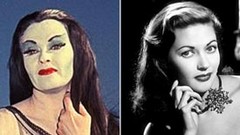
Yvonne De Carlo
From Wikipedia, the free encyclopedia

Birth name Margaret Yvonne Middleton
Born September 1, 1924(1924-09-01)
Vancouver, British Columbia
Died January 8, 2007 (aged 84)
Woodland Hills, California, USA
Years active 1941 - 2003
Spouse(s) Bob Morgan (1955-1974)
(Divorced)

Yvonne De Carlo (born Margaret Yvonne Middleton) (September 1, 1924 - January 8, 2007) was a Canadian-born American film and television actress, best known for her role as "Lily Munster" on the 1964-1966 CBS television series The Munsters.


Biography

Early life

The daughter of an aspiring actress, Marie De Carlo, and a salesman, William Middleton, De Carlo was born Margaret Yvonne Middleton in Vancouver, British Columbia. "I was named Margaret Yvonne - Margaret because my mother was very fond of one of the derivatives of the name. She was fascinated at the time by the movie star Baby Peggy, and I suppose she wanted a Baby Peggy of her own."[1] Her father abandoned her family when she was 3. As a teenager, "Peggy" was taken by her mother to Hollywood where she enrolled her in dancing school. Unable to find work, they returned to Canada. The pair made several such trips until 1940, when De Carlo was first runner up to "Miss Venice Beach" and was hired as a showgirl at Florentine Gardens. She made her first film appearance in 1941, but could only find bit parts for the next few years.

She was a Paramount starlet, but the studio apparently signed her mainly for her slight resemblance to Dorothy Lamour, as it was common then for studios to sign lookalikes in order to remind the stars in question that they easily could be replaced should their behavior become difficult or their box-office appeal begin to wane. When she moved to Universal Studios, she was utilized as a B-movie version of Maria Montez, one of the studio's reigning divas.


Film career

Her break came in 1945 playing the title role in Salome, Where She Danced. Though not a critical success, it was a box office favorite, and De Carlo was hailed as an up-and-coming star. Of the role, she was less sure, saying of her entrance, "I came through these beaded curtains, wearing a Japanese kimono and a Japanese headpiece, and then performed a Siamese dance. Nobody seemed to know quite why."

In 1947 she played her first leading role in Slave Girl and then in 1949 had her biggest success. As the female lead opposite Burt Lancaster in Criss Cross, she played a femme fatale, and her career began to ascend. The 1957 film Band of Angels featured her opposite Clark Gable in an American Civil War story, along with Sidney Poitier and Efrem Zimbalist, Jr.

For the next several years, she was constantly working although many of the films failed to advance her career.

Cast in The Ten Commandments (1956) in a leading role (as Zipporah, also spelled Sephora, Moses' wife), De Carlo was part of a major hit. The film was a huge success and De Carlo was among those to be praised for her restrained work.


The Munsters

However, her most famous role that led her to pop culture legacy is of Lily Munster in the cult television series The Munsters (1964-1966), which allowed De Carlo to demonstrate a comic flair that her films had failed to utilize. She also played Lily in the 1966 feature film Munster, Go Home and the 1981 TV movie The Munsters' Revenge.


Stars on the Hollywood Walk of Fame

For her contribution to the motion picture industry, Yvonne De Carlo was honored with a star on the Hollywood Walk of Fame at 6124 Hollywood Blvd. and a second star at 6715 Hollywood Blvd. for her contribution to television.


Other entertainment activities

Trained in opera and a former chorister when she was a child in Vancouver, De Carlo possessed a powerful contralto voice and released an LP of standards called Yvonne De Carlo Sings in 1957.This album was orchestrated by the movie composer John Williams. She sang and played the harp on at least one episode of The Munsters.

From 1967 onward she became increasingly active in musicals, appearing in off-broadway productions of Pal Joey and Catch Me If You Can. In early 1968 she joined Donald O'Connor in a 15 week run of Little Me staged between Lake Tahoe and Las Vegas, performing 2 shows per night. But her defining stage role came with her big break on Broadway in the Stephen Sondheim musical Follies, which ran from February 1971 until July 1, 1972. Notable in the role of Carlotta Campion, she introduced the song "I'm Still Here". The show opened in Los Angeles with the original cast on July 22 of that year, and closed 11 weeks later. She was the last lead female performer from the original production to die (having been predeceased by Alexis Smith, Dorothy Collins, Fifi D'Orsay, and Ethel Shutta).

She also received recognition for her work in various horror movies, spoofs and thrillers, such as The Power, The Seven Minutes, House of Shadows, Sorority House Murders, Cellar Dweller, The Man With Bogart's Face, Mirror, Mirror, Blazing Stewardesses, and American Gothic.


Personal life

She was married to the stuntman Robert Morgan from Nov 1955 to June 1974, when they divorced; they had two sons, Bruce and Michael. Morgan had a daughter, Bari, from a previous marriage. De Carlo was a naturalized citizen of the United States. In her autobiography, published in 1987, she listed 22 intimate friends, including Aly Khan, Billy Wilder, Burt Lancaster, Howard Hughes, Robert Stack, and Robert Taylor.


Last appearances and later life

De Carlo's last-released big-screen appearance was as Aunt Rosa in the 1991 Sylvester Stallone comedy Oscar, directed by John Landis.

Her last TV movie appearance was as Norma, in the 1995 Disney remake of The Barefoot Executive, opposite Eddie Albert.

Her son Michael died in 1997 as did her mother, Marie. De Carlo had a stroke the following year. Later, she moved to a home in the Black Lake retirement community near Solvang, California but in declining health, she then became a resident of the Motion Picture & Television Hospital, in Woodland Hills, California, where she spent her last years. There, on January 8, 2007, she died of natural causes at the age of 84. A memorial service was held a few days later at The Woodland Hills MGM Theater. She is survived by her son Bruce R. Morgan.
0 Replies
 
bobsmythhawk
 
  1  
Reply Sat 1 Sep, 2007 06:12 am
Vittorio Gassman
From Wikipedia, the free encyclopedia

Vittorio Gassman (September 1, 1922 - June 29, 2000), popularly known as Il Mattatore, was an Italian theatre and film actor and director.

Gassman is considered one among the best Italian actors and is commonly recalled as an extremely professional, versatile, magnetic interpreter, whose long career includes both important productions as well as dozens of divertissements (which gave him a vast popularity).


Biography

He was born in Genoa to a father from a wealthy family of German origins and a Pisan mother.

While very young he moved to Rome, where he attended the studies at the Accademia Nazionale d'Arte Drammatica where some of the most important figures of Italian theatre and cinema also studied, such as Paolo Stoppa, Rina Morelli, Adolfo Celi, Luigi Squarzina, Elio Pandolfi, Rossella Falk, Lea Padovani and, later, with Paolo Panelli, Nino Manfredi, Tino Buazzelli, Gianrico Tedeschi, Monica Vitti, Luca Ronconi and many others.

His debut was in Milan, in 1942, with Alda Borelli in Niccodemi's Nemica (theatre), he then moved to Rome and the Teatro Eliseo joining Tino Carraro and Ernesto Calindri in a team that remained famous; with them he acted in a range of plays from bourgeois comedy to the sophisticated intellectual theatre, with no apparent difficulty in the sudden changes.

In 1946 he made his film debut in Preludio d'amore, the year after he appeared in five films. In 1948 his famous interpretation in Riso Amaro displayed his love for cinema and his capability of excelling both in movies and at the theatre.

It was with Luchino Visconti's company that Gassman achieved his mature successes, together with Stoppa, Rina Morelli and Paola Borboni. He played a vigorous Kowalski in Tennessee Williams' Un tram che si chiama desiderio, then emphatic in Shakespeare's Rosalinda or in Vittorio Alfieri's Oreste. He then joined the Teatro Nazionale with Tommaso Salvini, Massimo Girotti, Arnoldo Foà, for a successful Peer Gynt (Ibsen).

With Luigi Squarzina in 1952 he co-founded and co-directed the Teatro d'Arte Italiano, producing the first complete version of Hamlet in Italy, then rare works such as Seneca's Tieste or Eschilo's The Persians.

In 1956, a key year in his career, Gassman played a memorable Othello with the great actor Salvo Randone, exchanging with him the roles of the Moor and Iago. A little later, in the television series entitled Il Mattatore (spotlight chaser) he obtained unexpected success and Il Mattatore soon became the nickname that accompanied him for the rest of his life. That year Gassman also directed and starred in a movie dedicated to theatre: it was a version of Kean.

Gassman's debut in the commedia all'italiana genre was rather accidental, in Mario Monicelli I soliti ignoti (Big Deal on Madonna Street, 1958), and not far from doubts, as he had been so far known as a dramatic actor. His role was however so successful that subsequently Gassman become considered one of the mainstays of the genre, together with Alberto Sordi, Marcello Mastroianni, Nino Manfredi and Ugo Tognazzi. Famous movies featuring Gassman include: Il sorpasso (1962), La Grande Guerra (1962), I mostri (1963), L'Armata Brancaleone (1966), Profumo di donna (1974) and C'eravamo tanto amati (1974).

A true perfectionist, he always hated imperfect diction, or dialectal corruptions (but he was also able to render, perfectly and when needed, most of almost all Italian dialects and inflections). Quite bravely, he accepted the challenge of directing Adelchi, one of the less known and less "easy" works by Alessandro Manzoni. He toured his production to half a million spectators, crossing Italy with his Teatro Popolare Itinerante (a newer edition of the famous Carro di Tespi). His productions include most of the famous authors of 20th century, with repeated returns to the classics of Shakespeare, Dostoevskij and the Greeks. He also founded a theatre school in Florence, which formed many of the more talented actors of the current generations.

In cinema he worked frequently both in Italy and abroad. With his natural charisma and his fluency in English he scored a number of roles in Hollywood; it was during an early stint there that he met and married Shelley Winters, whom he divorced to return to Italy.

But, despite his success in films, Gassman never left theatre. In the later part of his career, he added poetry to his repertoire, helping to bring to Italy foreign works.

In his late years he was a victim of depression.

He died of a heart attack in his Roman home.


Personal life

Gassman married three actresses: Nora Ricci (with whom he had Paola, an actress and wife of Ugo Pagliai); Shelley Winters (mother of his daughter Vittoria); Juliette Maynel (who gave him Alessandro, also an actor), and Diletta D'Andrea who gave him his younger son Jacopo.

Gassman was a man of intense emotions and intellectual honesty; his notable sense of humour and self-irony, brought him in the 1990s to take part in the popular TV show Tunnel in which he very formally and "seriously"' recited documents such as the gas invoice, the telephone bill and similar trivial texts like washing instructions for a woollen sweater or cookies' ingredients. He rendered them with the same professional skill that made him famous while reciting Dante's Divine Comedy.

Gassman was also discussed as a man, due to his private life - his divorces (a noted scandal in Italy during 1950s and 1960s) and his initial atheism (later he gained a certain personalistic faith). Also, in his public appearances on the media he often gave original or unconventional comments, sometimes with the clear intention of disturbing the moderated cultural positions; he also gained many enemies in the world of art for similarly frank judgments.
0 Replies
 
bobsmythhawk
 
  1  
Reply Sat 1 Sep, 2007 06:17 am
George Maharis
From Wikipedia, the free encyclopedia


Born September 01, 1928 (1928-09-01) (age 79)
Astoria, New York
Years active 1953-1993
George Maharis (born September 1, 1928 in Astoria, New York) is an American actor.


Early years

Maharis was one of seven children born to Greek immigrants. Although his father was in the restaurant business, Maharis had early ambitions to be a professional singer. After injuring his vocal cords through overuse, however, he switched to acting. He studied at the Actor's Studio and appeared in Off-Broadway productions of Jean Genet's Deathwatch and Edward Albee's The Zoo Story. Soon he was on television as well, in such showcases as Studio One, Kraft Theater, Goodyear Theater, Stirling Silliphant's Naked City and Otto Preminger's Exodus. Maharis also was featured on the soap opera Search for Tomorrow as Bud Gardner, one of Joanne Gardner's relatives who married Janet Bergman Collins.


Route 66

In 1960, Maharis shot to stardom with his successful turn as Buz Murdock in the popular TV series Route 66, which co-starred Martin Milner as formerly rich, now orphaned Tod Stiles. The show featured the two rebel-hunks traveling throughout the United States along Route 66 (and elsewhere) in a new Corvette that belonged to Milner's character. The series featured directors as acclaimed as Sam Peckinpah and Arthur Hiller, as well as guest stars as renowned as Robert Redford, Robert Duvall, Buster Keaton, Ethel Waters and Martin Sheen. Even in such company, Maharis' own acting skills did not go unnoticed, as he received an Emmy nomination in 1962 for his continuing performance as Buz.

Unfortunately, Maharis departed without completing his third season on the series. Maharis's participation that season had been spotty due to health problems, including two bouts of infectious hepatitis beginning in April 1962.[1] Maharis insisted that he left Route 66 entirely for health reasons, due to the long hours and grueling conditions he frequently experienced while shooting episodes on location. "I have to protect my future," Maharis said in a 1963 interview. "If I keep going at the present pace, I'm a fool. Even if you have $4,000,000 in the bank, you can't buy another liver."[2] This interpretation of events was disputed by series producers Stirling Silliphant and Herbert B. Leonard, who believed that the health issue camouflaged Maharis' desire to break his contract and make movies. Another claim was that there were conflicts between Milner and Maharis over acting styles, but this appears to have been less of an issue than was reported at the time.[2] After Maharis' departure, the show's appeal declined. Glenn Corbett stepped in as Milner's new sidekick on the road, Linc Case, but a year later, Route 66 was canceled.


Later career

For Maharis, a string of unsuccessful films followed, including Quick Before It Melts (1964), The Satan Bug and Sylvia (both 1965), A Covenant with Death and The Happening (both 1967) and The Desperados (1969). Returning to series television in 1970, Maharis starred as criminologist Jonathan Croft in the ABC adventure series The Most Deadly Game, co-starring Ralph Bellamy as Mr. Arcane. The series lasted twelve episodes, ending in January 1971. However, Maharis remained a popular sex symbol and in July 1973 posed nude for Playgirl's second issue.

Throughout the 1970s and 1980s, Maharis guest-starred in dozens of hit television series, including Fantasy Island, Kojak, McMillan and Wife, Barnaby Jones, Police Story, Switch, Night Gallery and The Bionic Woman as well as Murder She Wrote in 1990. His most significant film role of this era is probably as Count Machelli, King Cromwell's War Chancellor (who is not what he seems) in The Sword and the Sorcerer (1982). In the 1980s he also frequently starred in Las Vegas dinner theater. In 1993 he performed in his, to date, final film, Doppelganger. Maharis is now reported to be "fully retired."

Filmmaker Mercedes Maharis, maker of the controversial 2005 documentary Cochise County USA - Cries From The Border, is married to Maharis's brother Robert.


Art and music

Maharis released several LPs and numerous singles through Epic Records earlier in his career. After this period, he continued to perform in nightclubs, and pursued a secondary career as an impressionist painter.
0 Replies
 
bobsmythhawk
 
  1  
Reply Sat 1 Sep, 2007 06:22 am
Conway Twitty
From Wikipedia, the free encyclopedia


Conway Twitty (September 1, 1933 - June 5, 1993), born Harold Lloyd Jenkins) was one of the United States' most successful country music artists of the 20th century.

He had the most singles (55) reach Number 1 on various national music charts. Most commonly thought of as a country music singer, he also enjoyed success in early Rock and Roll, R&B, and Pop music (among others).[citation needed]


Biography

Birth Date

Conway Twitty was born Harold Lloyd Jenkins on September 1, 1933 in Friars Point, Mississippi.

Jenkins was named by his great uncle after his favorite silent movie actor, Harold Lloyd. The Jenkins family moved to Helena, Arkansas (now known as Helena-West Helena, Arkansas) when Jenkins was 10 years of age, and it was in Helena that Jenkins put together his first singing group, the Phillips County Ramblers.[citation needed]

Two years later, he had his own local radio show every Saturday morning. Jenkins also practiced his second passion, baseball. He received an offer to play with the Philadelphia Phillies after high school, but he was drafted into the Army, which effectively put an end to that dream.[citation needed]


Inspired By Elvis

After his discharge from the Army, Jenkins again pursued a music career. After hearing Elvis Presley's song, "Mystery Train", he began writing rock 'n' roll material. As a matter of course, he headed for the Sun Studios in Memphis, Tennessee and worked with Sam Phillips, owner and founder of Sun Studios, to get the "right" sound.[citation needed]


Source of Stage Name

Harry felt that his real name wasn't marketable, and he changed his show business name in 1957. (Harold Lloyd Jenkins would always remain his legal name, however). Looking at a road map, he spotted Conway, Arkansas and Twitty, Texas. Thus, he went with the professional name of "Conway Twitty".[citation needed]


First Successes

"It's Only Make Believe" was recorded in 1958 and became the first of nine Top 40 hits for Twitty, selling eight million copies.[1] The song was written by Conway and drummer, Jack Nance.


Rock Successes

Twitty's fortunes changed 1958, while he was with MGM Records. An Ohio radio station did not play "I'll Try", an MGM single that went basically nowhere in terms of sales, radio play, and jukebox play, instead playing the "B side" of the single. The B side was a song called "It's Only Make Believe". It was popular in Ohio, and was gradually becoming popular throughout the country, as well.

For a brief period in Twitty's career, some believed that he was Elvis Presley recording under a different name. This was largely the case with "It's Only Make Believe." The record took nearly one year in all to reach and stay at the top spot of the charts. The song went on to sell over 8 million records and to No. 1 on the Billboard pop music charts in the U.S. as well as No. 1 in 21 different nations.

Twitty would go on to enjoy rock-n-roll success with a hard rock song like, "Danny Boy" and "Lonely Blue Boy". "Lonely Blue Boy" was originally titled "Danny" and was recorded by Presley for the film King Creole, which was never used in the film soundtrack.


Career In Country Music

Conway Twitty always wanted to record country music and in 1965 he did just that. His first few country albums were met with country DJs refusing to play them because he was well known as a rock-n-roll singer. He finally broke free with his first number one country song, "Next In Line" in 1968.

In 1970, Conway recorded and released "Hello Darlin".

In 1971 he released his first hit duet with Loretta Lynn, "After the Fire Is Gone". It was a success, and many more followed, including "Lead Me On" (1971), "Louisiana Woman, Mississippi Man" (1973), "As Soon As I Hang Up the Phone" (1974), "Feelins" (1975), "I Still Believe in Waltzes", "I Can't Love You Enough" and many others. Together, Conway and Loretta (as they were known in their act), won four consecutive Country Music Association awards for vocal duo (1972-75).

In 1973, Twitty released "You've Never Been This Far Before", which was #1 for three weeks that September. Some disc jockeys refused to play the song because of its suggestive lyrics.

In 1993, Twitty became ill while performing in Branson, Missouri, and was in pain while he was on the tour bus. He died of an abdominal aneurysm. Shortly before he died, he had recorded a new album, "Final Touches".

Twitty's last chart appearance on the country charts was a duet with Anita Cochran, "I Want to Hear a Cheating Song" (2004). Twitty's voice was electronically created based on one of his hits from the 1980s.


Appearances in Other Media

In October, 2004 "Louisiana Woman, Mississippi Man" (sung by Conway Twitty & Loretta Lynn) appeared on the popular videogame Grand Theft Auto: San Andreas, playing on fictional country music station K-ROSE.

On March 11, 2007, in the episode "Bill and Peter's Bogus Journey", video clips of Conway Twitty's performances on Hee Haw featured in the animated-series Family Guy.


Covers

While Twitty has been known to cover songs - most notably "Slow Hand" which was a major pop hit for the Pointer Sisters - his own songs have not been covered that often. However, three notable covers include George Jones' rendition of "Hello Darlin", Blake Shelton's "Goodbye Time", and Elvis Presley's version of "There's A Honky Tonk Angel".


Awards

Twitty never won a solo CMA award. By the end of his tenure at MCA in 1981, he had accumulated 32 No. 1 hits, while another 15 had reached the Top 5. He moved to Warner Bros. Records in 1982, where he had another 11 No. 1 hits. By 1987, Twitty was back at MCA where he continued to score top 10 hits until 1991.

Conway Twitty was inducted into the Country Music Hall of Fame in 1999 and his pioneering contribution has been recognized by the Rockabilly Hall of Fame, as well.

In 2003, Twitty was ranked #8 in CMT's 40 Greatest Men in Country Music.


Private Life

Marriages

Twitty married three times. After his death, his widow, Dee Henry Jenkins, and his four grown children from the previous marriages, Michael, Joni, Kathy and Jimmy Jenkins engaged in a publicly visible dispute over the estate. His will had not been updated to account for the third marriage, but Tennessee law reserves one third of any estate to the widow. A public auction of much property and memorabilia was held due to the fact that the widow refused to accept the appraised value so therefore, she demanded that everything be sold so she could get a higher amount.


Twitty City

Twitty lived for many years in Hendersonville, Tennessee, just north of Nashville, where he built a country music entertainment complex called Twitty City. Its lavish displays of Christmas lights were a famous local sight. It has since been sold to the Trinity Broadcasting Network and converted to a Christian music venue in 1994.

He used to live in a house on Old Hickory Lake in Hendersonville, TN. The house is at the end of a peninsula and has a pink roof.


Death

Conway Twitty died June 5, 1993 in Springfield Missouri at Cox South Hospital from an abdominal aneurysm.
0 Replies
 
bobsmythhawk
 
  1  
Reply Sat 1 Sep, 2007 06:27 am
Lily Tomlin
From Wikipedia, the free encyclopedia


Birth name Mary Jean Tomlin
Born September 1, 1939 (1939-09-01) (age 67)
Detroit, Michigan, USA
Spouse(s) Jane Wagner (ca. 1972-present)
Official site www.LilyTomlin.com
[show]Awards
Emmy Awards
Outstanding Variety, Music or Comedy Program
1981 Lily: Sold Out
Outstanding Writing in a Comedy-Variety or Music Special
1978 The Paul Simon Special
1976 The Lily Tomlin Special
1974 Lily
Tony Awards
Best Actress in a Play
1986 The Search for Signs of Intelligent Life in the Universe
Special Award
1977

Lily Tomlin (born September 1, 1939) is an Academy Award-nominated American actress, comedian, writer and producer. Tomlin's body of work, which has spanned over 40 years, has garnered her several Tony Awards and Emmy Awards, as well as a Grammy Award.


Biography

Early life

Tomlin was born Mary Jean Tomlin in Detroit, Michigan to Guy Tomlin, a factory worker, and his wife Lillie Mae (Ford), a housewife and nurse's aide[1] who moved to Detroit from Paducah, Kentucky during the Great Depression. She is a 1957 graduate of Cass Technical High School. Tomlin attended Wayne State University, where her interest in the theater and performing arts began. After college, Tomlin began doing stand-up comedy in nightclubs in Detroit and later, in New York City. Her first television appearance was on The Merv Griffin Show in 1965.


Career

In 1969, Tomlin joined the sketch comedy show Laugh-In. Her characters from the show have been associated with her throughout her career, including the gum-chewing, wisecracking, snorting telephone operator Ernestine and the bratty five-year-old Edith Ann, rocking in her oversized rocking chair and making rude noises.

AT&T offered Tomlin $500,000 to film a commercial using her character Ernestine, but Tomlin declined because she thought it would compromise her artistic integrity. About that same time, however, she did star as Ernestine in a parody of a commercial on a Saturday Night Live in 1976, in which she proclaimed, "We don't care, we don't have to...we're the phone company." In 2003 she made two commercials as Ernestine for WebEx. The character would later make a guest appearance at The Superhighway Summit at UCLA, January 11, 1994, interrupting a speech being given on the information superhighway by then-Vice President Al Gore.

Tomlin is noted for her versatility. For example, in Robert Altman's Nashville, for which she was nominated for the Academy Award for Best Supporting Actress, she played Linnea Reese, a strait-laced, gospel-singing mother of two deaf children who has an affair with a country singer played by Keith Carradine, who sings I'm Easy for her in a crowded nightclub. She was also secretary Violet Newstead in Nine to Five, performed several roles in the 1981 comedy film The Incredible Shrinking Woman, and was a sickly heiress in the Steve Martin comedy All of Me.

She and Bette Midler played two pairs of identical twins who were switched at birth in the 1989 comedy Big Business, set at the Plaza Hotel in New York City. Tomlin also played chain-smoking waitress Doreen Piggott in Altman's 1993 ensemble film Short Cuts, and, in two films by director David O. Russell, she appeared as a peacenik Raku artist in Flirting with Disaster and later, as an existential detective in I ♥ Huckabees.

Tomlin voiced Ms. Frizzle on the animated television series The Magic School Bus from 1994 to 1998. Also, in the 1990s, Tomlin appeared on the popular sitcom Murphy Brown as the title character's boss. In 2005 and 2006, she had a recurring role as Will Truman's boss Margot on Will & Grace. She starred on The West Wing TV series for four years, between 2002 and the series' end in 2006, playing presidential secretary Deborah Fiderer.

Tomlin starred in the hit 1985 one-woman Broadway show The Search For Signs of Intelligent Life in the Universe, written by her long-time life partner, Jane Wagner. The show won Tomlin a Tony Award, and was made into a feature film in 1991. Tomlin revived the show for a brief run in 2000. In 1989, she won the Sarah Siddons Award for her work in Chicago theatre.

Tomlin recently collaborated again with director Robert Altman, starring in A Prairie Home Companion, playing half of a middle-aged Midwestern singing duo with Meryl Streep.


♥ Huckabees controversy

Two heated, profane clips of Tomlin clashing with director David O. Russell during the filming of I ♥ Huckabees were posted to YouTube in March 2007 and briefly caused an internet sensation. When asked to comment by the Miami New Times she replied, "Adults have fights and go through stuff...I know some people are more dignified in the world, that if you transgress against that kind of professionalism, that it's some kind of great sin, but I don't see it that way." She said the arguments with Russell were "in a way liberating…now it's all over, and so what, and I don't have to keep up some great pretention I'm the most dignified, eloquent, elegant, perfect, smart-thinking, kind, generous person. I'm just a plain old human with a whole bunch of flaws...After poor Britney Spears, with her poor little legs open...I'm not the least bit upset about it. That's part of the upside and the downside of the Internet."[2]


Personal life

Though Tomlin has now confirmed her sexual orientation in the press, it was, for many years, an open secret among many, including the gay press. Before she officially "came out", she was known for her involvement in feminist and gay-friendly film productions, and would often refer to her girlfriend Wagner. On her 1975 album Modern Scream she mocked straight actors who make a point of distancing themselves from their gay characters; answering the pseudo-interview question, How did it feel to play a heterosexual? she replied, I've seen these women all my life, I know how they walk, I know how they talk ... . Her narration of the documentary The Celluloid Closet in 1995 was also largely considered a nod to the open secret of her orientation.

However, in the 1990s, she refused to discuss her private life with the press, until 2000 when she came out on the New York City cable-access TV program Gay USA.


Awards

Tomlin has received numerous awards, including: six Emmys; a Tony for her one woman Broadway show, Appearing Nitely; a second Tony as Best Actress, Drama Desk Award and Outer Critics Circle Award for her one woman performance in Jane Wagner's The Search for Signs of Intelligent Life in the Universe; a CableACE Award for Executive Producing the film adaptation of The Search; a Grammy Award for her comedy album, This is a Recording as well as nominations for her subsequent albums Modern Scream, And That's the Truth, and On Stage; and two Peabody Awards ?- the first for the ABC television special, Edith Ann's Christmas: Just Say Noël and the second for narrating and executive producing the HBO film, The Celluloid Closet.

Tomlin was inducted into the Michigan Women's Hall of Fame in 1998. In 2003 she was awarded the Mark Twain Prize for American Humor.
0 Replies
 
bobsmythhawk
 
  1  
Reply Sat 1 Sep, 2007 06:30 am
Barry Gibb
From Wikipedia, the free encyclopedia


Background information

Birth name Barry Alan Crompton Gibb
Born 1 September 1946 (age 61)
Genre(s) Rock, Disco, Country
Occupation(s) Songwriter, Producer, Singer
Instrument(s) Guitar, Vocals
Associated
acts Bee Gees

Barry Alan Crompton Gibb CBE (born on 1 September 1946) is a singer, songwriter and producer. He was born in Douglas, Isle of Man, to English parents. With his brothers Robin and Maurice, he formed the Bee Gees, one of the most successful pop groups of all time. The trio got their start in Australia, and found their major success when they returned to England.


Early life

Gibb grew up with his family in Chorlton-cum-Hardy, Manchester, England. In 1958 his family moved to Brisbane, Australia, settling in one of the city's poorest suburbs, Cribb Island, which was subsequently obliterated to make way for Brisbane Airport.


Personal life

Gibb has been married to wife Linda Gray Gibb since 1970. They have 5 children: Stephen (1973), Ashley (1977), Travis (1981), Michael (1984), and Alexandra (1991). He has four grand-children: Nina and Angus Levas Gibb (Stephen's children), Lucas John Crompton Gibb (Ashley's child) and Damien Michael Crompton Gibb (Michael's child).

In January 2006 Gibb purchased the former home of country legends Johnny Cash and June Carter Cash in Hendersonville, Tennessee, intending to restore it and turn it into a songwriting retreat. [1] This house was destroyed by fire on April 10, 2007.[2]

Gibb resides in Miami Beach and England.


Political activity

On 7 December 2006, Barry Gibb along with around 4,500 other musicians, took out a full-page advertisement in the Financial Times newspaper calling for the British Government to extend the existing 50 years copyright protection for sound recordings in the United Kingdom. The fair play for musicians advertisement was viewed as a direct response to the Gowers Review published by the British Government on 6 December 2006 which recommended the retention of the 50 year protection for sound recordings.


Recent work

On the May 8, 2007 episode of American Idol, Gibb mentored the four remaining contestants, and on the following night, he sang his own song "To Love Somebody" before the elimination of LaKisha Jones.

As a preview to his forthcoming country album, Barry has released the song Drown On The River to iTunes. The song will also be featured in the 2007 movie Deal starring Burt Reynolds.
0 Replies
 
bobsmythhawk
 
  1  
Reply Sat 1 Sep, 2007 06:38 am
Gloria Estefan
From Wikipedia, the free encyclopedia

Background information

Birth name Gloria María Milagrosa Fajardo García
Born September 1, 1957 (1957-09-01) (age 50)
Havana, Cuba
Origin Miami, Florida
Genre(s) Latin Pop, Dance-pop, Salsa music, Pop, Adult Contemporary, Club-Dance
Occupation(s) Singer-songwriter, actress, writer
Instrument(s) Vocals
Guitar
Percussion
Years active 1977?-present
Label(s) SonyBMG/Epic
Associated
acts Emilio Estéfan, Jr.
Miami Sound Machine
Website gloriaestefan.com

Gloria Estefan (born Gloria María Milagrosa Fajardo García on September 1, 1957 in Havana, Cuba) is a five-time Grammy Award-winning Cuban American singer and songwriter.

Estefan began her career as lead vocalist for the Hispanic dance music band, Miami Sound Machine, in 1975. They crossed over to mainstream popular success with English-speaking audiences with the international hit singles, "Dr. Beat" (1984) and "Conga" (1986).

Also her single "Don't Wanna Lose You" (1989) was certified platinum in the U.S. and reached number-one on the Billboard Hot 100. Estefan is the only singer to have achieved success on different music genres since the Tropical/Salsa beats to Hi-NRG, Club/Dance music and Disco-House beats. Gloria also has number one hits on the pop, Dance, adult contemporary, latin and salsa charts.

Known as the "Queen of Latin Pop", Estefan is one of the world's most recognized popular music artists. With over 90 million albums sold worldwide, she is the single most successful crossover performer in Latin music history.


Early life

Fleeing Cuba

Cuban-born, Gloria's family moved to Miami, Florida when she was 16 months old, following the Cuban Revolution in 1959. Gloria's father José Fajardo, who in the 1950s was a personal bodyguard to then Cuban president Fulgencio Batista's wife, was captured in the ill-fated Bay of Pigs Invasion that attempted to overthrow the new communist government established by Fidel Castro. Gloria's father was held as a prisoner until an exchange was arranged by President John F. Kennedy.


Parents

Gloria's father Jose Fajardo was a proud anti-communist, served for multiple tours as an officer in the United States Army in Vietnam, where he was thought to have been exposed to Agent Orange, a defoliant used extensively during the Vietnam war to clear combat areas. He later contracted multiple sclerosis, and was nursed by a young Estefan for many years. He died in 1980.

Gloria's mother, Gloria García Pérez de Fajardo, now living in Miami, ran a school in Cuba in the 1950s for kindergarten students.


University of Miami

Gloria was raised primarily in Miami (though she accompanied her mother, father and younger sister, Becky, to several military bases in the 1960s during her father's military service). She attended the University of Miami. As a student there, she also worked as a Spanish and French translator at Miami International Airport's Customs Department.

Gloria graduated from the Catholic high school, Our Lady of Lourdes Academy in 1974, and the University of Miami in 1978 with a degree in communications and psychology (with a minor in French). Since graduating, she has been a prominent advocate for the university and a member of its Board of Trustees. She has appeared in national television advertisements for the university and is one of several highly prominent University of Miami alumni.

Estefan's first public musical performance was at a large Cuban wedding when her future husband, Emilio Estefan, Jr., asked her to join Miami Sound Machine in singing.

Her appearance was well-received and, a few weeks later, she became the lead singer for Miami Sound Machine, which performed and recorded in Spanish in the early years of its existence. The Miami Sound Machine soon gained a large fan base and released an LP in 1977. It was the first all-Spanish album from CBS International.

With Estefan on vocals, The Miami Sound Machine had its first English-language hit with "Dr. Beat," which topped the dance charts across Europe and went Top 10 in the UK and Australia, from the album Eyes of Innocence, in 1984. Primitive Love was released in 1985; The single "Conga" broke MSM into the American pop market. "Bad Boy", and "Words Get in the Way" became follow up hits in the US and around the world; "Words Get In The Way" reached #1 in the US Adult Contemporary chart, establishing that the group could do pop ballads equally as well as dance tunes. The song "Hot Summer Nights" was also released that year and was part of the blockbuster movie Top Gun.

Estefan's next album, 1987's Let It Loose, went multi-platinum, with six million copies sold alone in the US and featured the following hits: "Anything For You" (#1 Pop), "1,2,3" (#3 Pop), "Betcha Say That" (#36 Pop), "Rhythm Is Gonna Get You" (#5 Pop), and "Can't Stay Away From You" (#6 Pop). "Can't Stay Away From You," "Anything For You" and "1-2-3" were all #1 Adult Contemporary hits as well.

In 1988, Estefan took top billing as the band's name changed to Gloria Estefan and The Miami Sound Machine. Beginning in 1989, the group's name was dropped altogether and Estefan was credited as a solo artist, though the ever-changing line-up of Miami Sound Machine continues as her backing band to this day.

In 1989, after the worldwide chart success of single Anything For You, their Let It Loose album was repackaged as Anything For You. It became the band's first UK #1 album, selling over a million copies. It was the biggest selling album of the year in The Netherlands, staying at #1 for 22 weeks. The album also took top honors in Australia and Canada launching Estefan to superstar status.


Cuts Both Ways

In late 1989, she released her best-selling album to date, Cuts Both Ways. The hit single included Don't Wanna Lose You (a Billboard Hot 100]] #1 hit), Oye mi Canto (Hear my Voice), Here We Are, Cuts Both Ways (#1 on the US Hot Adult Contemporary Tracks chart), and Get on Your Feet. Cuts Both Ways sold over 10 million copies and went platinum within its first month of release in the US. The success followed in the UK, where it debuted at #1, with Gloria being the first act in 10 years to have two # 1 albums on the UK albums chart in one calendar year. Cuts Both Ways then shot to # 1 in Australia, The Netherlands, Belgium, Japan and more, selling over ten million copies worldwide.


Marriage and children

Gloria became romantically involved with the Miami Sound Machine's band leader, Emilio Estefan, in 1976. She and Emilio married on September 1, 1978. They have a son, Nayib (born September 2, 1980) and a daughter, Emily Marie (born December 5, 1994).

While touring in support of Cuts Both Ways on March 20, 1990, near Scranton, Pennsylvania, Estefan was critically injured, suffering a fractured spine when a tractor trailer crashed into her tour bus. She was flown by helicopter to New York City, where surgeons at the Hospital for Special Surgery permanently implanted two titanium rods to stabilize her spinal column. Her grueling rehabilitation required almost a year of intensive physical therapy but she sustained a fairly complete recovery. This would lead her to return to the tour in ten months.


Comeback: Into The Light, Mi Tierra and Abriendo Puertas

Estefan returned to the charts with a concept album, Into the Light in 1991. "Coming Out of the Dark" was performed publicly for the first time on the American Music Awards in January 1991, and reached #1 in the US as a single a few months later. The Into the Light World Tour covered 100 cities in nine countries and was seen by more than 10 million people worldwide. She followed up Into the Light with her first greatest-hits album in 1992, which included the minor US hit ballads "Always Tomorrow" and "I See Your Smile" and the international hit dance track "Go Away". Also in 1992, Estefan helped contribute to the mainstream success of fellow Cuban-American singer-songwriter Jon Secada, including singing backup on his breakthrough hit, "Just Another Day". Estefan spent much of the latter half of the year in Miami, helping with relief from the devastation of Hurricane Andrew.

1993's Mi Tierra saw Estefan return to her Cuban roots with a Spanish-language album, for which she won a Grammy Award for Best Tropical Latin Album. Mi Tierra was a successful album worldwide, with over eight million copies sold. In Spain, Mi Tierra became the country's best selling international album ever.

Hold me, Thrill me, Kiss me a cover album of some of Estefan's favorite 1960s and 1970s songs (including the title song, the Classics IV's "Traces," and Blood, Sweat & Tears' "You've Made Me So Very Happy," among others), was released in 1994. "Turn the Beat Around", the first single and a remake of Vicki Sue Robinson's 1976 disco classic, became another international hit, certified gold in the US and also featured in the Sharon Stone movie The Specialist. "Everlasting Love" (the 1967 Robert Knight and 1974 Carl Carlton classic) was a successful club and pop hit, and a third single, a remake of Carole King's signature song "It's Too Late," did well on Adult Contemporary radio.

1995's Spanish-language album Abriendo Puertas earned Estefan her second Grammy Award for Best Tropical Latin Album. It spun off two #1 Dance hits, "Abriendo Puertas" and "Tres Deseos", and two #1 Latin singles, "Abriendo Puertas" and "Mas Allá". The Miami Herald called Abriendo Puertas "a danceable pan-Latin American fusion, brilliantly built on improbable instrumental combinations and layers of styles and rhythms".


Anti-communism

Estefan is an ardent opponent of communism, who has spoken often of her desire for a free and democratic Cuba. In 1995, she sang the Billboard Latin #1 song "Mas Allá" for Pope John Paul II as part of the celebration of his 50th anniversary in the priesthood. She was the first pop star invited to perform for the Pope. At their meeting, Estefan, an anti-communist, asked the Pope to pray for a free Cuba. She has been an active opponent of Fidel Castro's government, and supported the unsuccessful effort to keep young Elián González in the United States.


1996 Summer Olympics

The platinum selling album Destiny released in 1996, featured "Reach", the official theme of the 1996 Atlanta Summer Olympics. Estefan performed in the closing ceremony, in front of an audience of 2 billion people worldwide. Televised ceremonies included Estefan singing both "Reach" and "You'll Be Mine (Party Time)" from the Destiny album.


Back to dance: Gloria!

On June 2, 1998, Estefan released her eighth album, (twenty-first overall), Gloria!. The album is highly influenced by Disco music, some blended with Salsa music percussion and Latin flavour. While it became her first album during the 1990s not to hit Platinum status, it sold into the higher end of Gold certification and was well received. Estefan successfully rode the wave of the Disco revival in the U.S. during the late 1990s. The album peaked at #23 on the The Billboard 200. The single, "Oye!", peaked at #1 the Hot Dance Music/Club Play and the Hot Latin Tracks charts. The other major hit single releases were "Don't Let This Moment End", which peaked at #76 on the Billboard Hot 100 and "Heaven's What I Feel", which peaked at #27 on the Billboard Hot 100. The latter song also became a Latin chart hit. The album's other singles are "Cuba Libre" and "Don't Stop". One of the album's highlights is "Don't Release Me", with Wyclef Jean. To promote Gloria!, Estefan performed at the famed New York City discoteque, Studio 54.


Other notable performances

On July 18, 1996, Estefan embarked on her Evolution World Tour (her first tour in five years), which covered the United States, Canada, Europe, Latin America, Australia, South Africa and Asia.

Estefan appeared in a movie, Music of the Heart (1999) and duetted with *NSYNC on the Billboard #2 and Academy Award-nominated "Music Of My Heart". She also released a Latin hit with the Brazilian group So Pra Contrariar called "Santo Santo", sang with Luciano Pavarotti in "Pavarotti and Friends for Guatemala and Kosovo," released the benefit album "A Rosie Christmas," and sang with Stevie Wonder at Super Bowl XXXIII in Miami. Estefan is the only artist to perform twice at the Super Bowl. Estefan also sang "The Star-Spangled Banner" before 3 of the 2003 World Series which was played in Miami between the Florida Marlins and New York Yankees and in Super Bowl XLI (2007), also played in Miami between the Indianapolis Colts and Chicago Bears.


Alma Caribeña and Greatest Hits Volume II

Estefan's next album, 2000's Alma Caribeña won the first Latin Grammy for Best Music Video for "No Me Dejes de Querer". The album reached number one in Spain, the United States and several South American countries. It also won a Grammy Award for Best Tropical Album. That year, she also won the American Music Awards, Award of Merit. It also made the Billboard Hot 100, peaking at #77. Also was released "Como Me Duele Perderte" and "Tres Gotas De Agua Bendita" with Celia Cruz at Spain.

Greatest Hits Vol. II was released in 2001. It contained hits from 1993 to 2000, three new songs and a remix of her first hit "Conga" now called "Y-Tu-Conga". It has also released a heavily-dance hit "Out of Nowhere" which was nominated for a Grammy Award in the category for Best Dance Recording, a saucy R&B song called "I Got No Love", probably the only one on this style of Estefan's career, and a passionate song called "You Can't Walk Away from Love", which featured at the movie Original Sin.


Unwrapped

In 2003, Estefan released Unwrapped, her first English-language CD in five years. To promote the CD, she toured Europe, Mexico, Puerto Rico and the United States. The CDs first video, for the single "Hoy/Wrapped," was shot in Machu Picchu, Peru. "Hoy" and the next single, "Tu Fotografía", were #1 on Billboard's Latin chart, and "I Wish You" reached the AC top 20.

In April 2004, Estefan appeared on the Fox Broadcasting Company's program, American Idol, but she declined an offer to be an official judge because, she said publicly, she does not like to "judge" others. On July 28, 2004, at the Trump Tower Building, in a press conference hosted by Donald Trump, Estefan announced that her then-upcoming tour would be her final one. The Live and Re-Wrapped Summer/Fall 2004 Tour, her first tour in eight years was produced by Clear Channel Entertainment. The tour featured Estefan's greatest hits, along with new material from Unwrapped. It began in McAllen, Texas on July 30, 2004, and played in 28 cities. Gloria finished her final concert tour in her home town of Miami on the weekend of October 9 and 10, a finale in a sold-out AmericanAirlines Arena that was delayed for two weeks by a hurricane.


Mash-up hit with Mylo

In late 2005, after being absent from the UK charts for five years, Estefan had her biggest hit single there when the popular club mash-up Dr. Pressure (combining Mylo's Number 19 hit "Drop The Pressure" with the Miami Sound Machine's "Dr. Beat") reached #3 on the UK singles chart. In Australia the single peaked at #1 on the dance chart, providing Gloria with her first top 40 hit and commercial radio airplay since 1996.


Dionne Warwick tribute

Along with dozens of other prominent singers in early 2006, Estefan performed in Los Angeles at a tribute to singer Dionne Warwick's 45-year career. Estefan sang "Walk On By," one of Warwick's signature songs that helped launch Warwick's career in the mid 1960s.


Selena tribute concert

On April 7, 2005, Estefan participated in "Selena ¡VIVE!, the tribute concert for Selena Quintanilla-Pérez, the "Queen of Tejano," who was murdered in March 1995 on the brink of her attempt to cross over as an English-language performer. She performed "I Could Fall in Love," one of Selena's posthumously released crossover hits.


UK promo tour

On December 9, 2006, Estefan appeared on ITV's The X Factor, and performed a medley of her greatest hits, accompanied by her band, The Miami Sound Machine. She also appeared on several radio shows and The New Paul O'Grady Show. This tour has been to help promote her greatest hits album in the run up to Christmas.

2006 compilations

In October 2006, Sony released a 2-CD compilation The Essential Gloria Estefan featuring most of her biggest hits from 1984 to 2003. The album features an uptempo disc and a second disc of ballads. This compilation also includes a special-internet view interview with Gloria in which she talks about every song featuring on the album.

Oye Mi Canto!: Los Grandes Exitos was released at October 2006 too, and there released all her Spanish greatest hits, in difference to her Amor y Suerte: Exitos Romanticos in where only released love songs, here she included all her biggest Spanish hits, but it were notorious some absents song such as "Tradicion" featured at the 1993 smash album Mi Tierra and "En el Jardin" a #1 Hot Latin Track topper which sung as duet with Mexican superstar Alejandro Fernandez.

Also at Europe and at Mexico Gloria released an additional compilation, The Very Best of Gloria Estefan similar to The Essential Gloria Estefan in which she included all her hits on her career, and included a bonus track "Dr. Pressure", who was released as a single at Europe and become a biggest hit after all in clubs, reaching several number ones throughout all Europe at dance charts.


90 Millas

In anticipation of the release of Estefan's 90 Millas album, a special edition English and Spanish language versions of iTunes Originals were released on June 2, 2007.

Gloria's new Spanish-language album, 90 Millas featuring original songs inspired by her native Cuba will be released on September 18, 2007 on Sony BMG Music Entertainment's Burgundy Records. On this upcoming album she collaborates with many Latin music greats, such as Jose Feliciano, Carlos Santana, Arturo Sandoval, Andy Garcia, Chocolate, La India, Cachao and other prominent Cuban musicians.

To promote the album, Gloria will do a new international tour that has just one date confirmed at Las Ventas, Spain[1]

Gloria will also be appearing in Rotterdam, Holland on 8th September 2007. This performance will include new songs, along with a collection of old hits. This performance will be free and open to members of the public, and is being held to commemorate the 75th Anniversary of the Port of Rotterdam.


Entrepreneur

In addition to her musical success, Estefan and her husband are entrepreneurs. Together, they own a number of business establishments: five Cuban-themed restaurants (oscubancafe.com os Cuban Café) in Miami; Miami Beach; Disney World's Pleasure Island in Orlando; Mexico City; and Puerto Vallarta, Mexico. They also own two hotels: a hotel in Vero Beach, which was destroyed by Hurricanes Frances and Jeanne in September 2004 (which will be renamed "Costa d'Este" and reopen in January 2008, according to a news release from Benchmark Hospitality), and The Cardozo in Miami. Estefan was appointed to the board of directors for Univision Communications Inc. in 2007, according to Hispanic Market Weekly. The Estefans' current estimated net worth is approximately $500 million, according to an article in People En Espanol magazine (February 2007).


Awards

In addition to her five Grammys, Estefan has received a number of other awards. In May 1993, she received the Ellis Island Congressional Medal of Honor, which is the highest award that can be given to a naturalized U.S. citizen. She has won the Hispanic Heritage Award, an MTV Video Music Award, two cable television ACE Awards and the 1993 National Music Foundation's Humanitarian of the Year award. The singer is the recipient of the American Music Award for Lifetime Achievement. She also has a star on the Hollywood Walk of Fame. Her husband, Emilio, a world-renowned music impresario, received a star adjacent to his wife's on the Hollywood Walk of Fame in 2005.

Estefan holds an honorary doctoral degree in music from the University of Miami, awarded in 1993. In 2002, Barry University in Miami bestowed upon her an honorary law degree. Along with her husband, Emilio, Estefan received an honorary doctoral degree in music from the Berklee College of Music in Boston in 2007. She also delivered the commencement address to the 2007 graduating class.

She has scores of encomiums for her musical accomplishments, humanitarian and philanthropic work. In 2002, she received the Congressional Hispanic Caucus Institute Medallion of Excellence for Community Service. The singer was Musicares Person of the Year in 1994. Gloria also founded the Gloria Estefan Foundation whose goal is to help those with spinal cord injuries.

She has been honored twice by the Songwriters Hall of Fame. In 1992, she served as a public member of the United States Delegation to the 47th General Assembly to the United Nations.


Recent work

New album


Estefan's new Spanish-language album, 90 Millas, featuring originial songs inspired by her native Cuba will be released in September 18, 2007, USA Today reported in March 2007. She collaborates with other Latin music greats, such as Jose Feliciano, Carlos Santana, Arturo Sandoval, Andy Garcia and other prominent Cuban musicians. Her inclusion of Carlos Santana as one of the artists contributing to "90 Millas" stirred a controversy among a tiny minority of the Cuban exile community in the U.S., who alleged Mr. Santana was sympathetic to the Fidel Castro regime and Che Guevara.

Emilio and Gloria issued a joint statement at the end of March, 2007, addressing the controversy. "For the past 32 years of our career our position against the Castro regime has been crystal clear . . . we have expressed our disagreement with the Cuban dictatorship and have spoken worldwide of the pain of the Cuban people. We have never nor would we ever collaborate with anyone who supports the Cuban dictatorship or Che Guevara. This should be apparently clear due to our trajectory," the statement said.

The first single from the album "No Llores" was released digitally at June 19, 2007 at the iTunes Store, but a physical single will be released only in Europe on August 23, 2007; a week after the album release.

Additionally, Gloria Estefan is working on co-writing songs on singer, Alex Vera, new album due out later this year. www.cdbaby.com/alexvera


Acting career

In addition to her music career, Estefan has appeared in two movies, Music of the Heart (1999) and For Love or Country: The Arturo Sandoval Story (2000). She is slated to star as Connie Francis, a U.S. pop singer whose peak commercial success was in the late 1950s and early 1960s, in Who's Sorry Now?, based on Francis' life. The "long-gestating biopic" will begin pre-production within a few months, according to a story published in March of 2007 in The [San Francisco] Bay Area Reporter.
0 Replies
 
bobsmythhawk
 
  1  
Reply Sat 1 Sep, 2007 06:41 am
"Funny Marriage Quotes"

I recently read that love is entirely a matter of chemistry. That must be why my wife treats me like toxic waste.
Bissonette

When a man steals your wife, there is no better revenge than to let him keep her.
Sacha Guitry

After marriage, husband and wife become two sides of a coin; they just cannot face each other, but still they stay together.
Hemant Joshi

By all means, marry. If you get a good wife, you will be happy. If you get a bad one, you will become a philosopher.
Socrates

Woman inspires us to great things, and prevents us from achieving them.
Dumas

The great question, which I have not been able to answer, is, "What does a woman want?
Sigmund Freud

I had some words with my wife, and she had some paragraphs with me.
Anonymous

"Some people ask the secret of our long marriage. We take time to go to a restaurant two times a week. A little candlelight, dinner, soft music and dancing. She goes Tuesdays, I go Fridays."
Henny Youngman

"I don't worry about terrorism. I was married for two years."
Sam Kinison

"There is a way of transferring funds that is even faster than electronic banking. It's called marriage."
James Holt McGavran

"I have had bad luck with both my wives. The first one left me and the second one did not."
Patrick Murray

Two secrets to keep your marriage brimming:
Whenever you are wrong, admit it,
Whenever you are right, shut up.
Nash

The most effective way to remember your wife's birthday is to forget it once.
Anonymous

You know what I did before I married? Anything I wanted to.
Henny Youngman

My wife and I were happy for twenty years. Then we met.
Rodney Dangerfield

A good wife always forgives her husband when she is wrong.
Milton Berle

Marriage is the only war where one sleeps with the enemy.
Anonymous

A man inserted an 'ad' in the classifieds: "Wife wanted." Next day he received a hundred letters. They all said the same thing: "You can have mine."
Anonymous

First Guy (proudly): "My wife is an angel!"
Second Guy: "You are lucky, mine is still alive."
0 Replies
 
edgarblythe
 
  1  
Reply Sat 1 Sep, 2007 07:35 am
You Send Me
Sam Cooke

Darling, you send me
I know you send me
Darling, you send me
Honest you do, honest you do
Honest you do, whoa-oh-oh-oh-oh-oh

You thrill me
I know you, you, you thrill me
Darling, you, you, you, you thrill me
Honest you do

At first I thought it was infatuation
But woo, it's lasted so long
Now I find myself wanting
To marry you and take you home
Whoa-oh-oh-oh-oh-oh

You, you, you, you send me
I know you send me
I know you send me
Honest you do

Whoa-oh-oh, whenever I'm with you
I know, I know, I know when I'm near you
Mmm hmm, mmm hmm, honest you do, honest you do
Whoa-oh-oh, I know-oh-oh-oh

I know, I know, I know, when you hold me
Whoa-oh-oh-oh-oh, whenever you kiss me
Mmm hmm, mmm hmm, honest you do

At first I thought it was infatuation
But woo, it's lasted so long
Now I find myself wanting
To marry you and take you home

I know, I know, I know, you send me
I know you send me
Whoa-oh-oh-oh, you you you you send me
Honest you do
0 Replies
 
Letty
 
  1  
Reply Sat 1 Sep, 2007 07:36 am
Well, Bob, we know that all those famous folks of yours are complete when you finish with your husband and wife routine. Love it, hawkman, especially the one by Socrates. Thanks for the smile.

I know that Raggedy is lurking out there somewhere, folks, because she set your PD straight on Van and Jim, so we'll await her great photo's before commenting further.

For some reason, I chose this one to play.

Hello Darlin'
Conway Twitty

Hello, darlin', nice to see ya
It's been a long time
You're just as lovely as you used to be

How's your new love? Are you happy?
Hope you're doin' fine
Just to know means so much to me

What's that, darlin? "How'm I doin'?"
Guess I'm doin' all right
Except I can't sleep
And I cry all night till dawn
What I'm trying to say is
"I love you and I miss you"
"And I'm so sorry that I did you wrong"

Look up, darlin', let me kiss ya
Just for old time's sake
Let me hold you in my arms one more time

Thank you, darlin', may God bless you
And may each step you take
Bring you closer to the thing you seek to find

Goodbye, darling', gotta go now
Gotta try to find a way
To lose these memories
Of a love so warm and true
And if you should ever find it
In your heart to forgive me
Come back, darlin',
I'll be waiting for you

As for chemistry, I love this one

"Us chemical professors don't get out of the lavatory too often." Razz
0 Replies
 
Raggedyaggie
 
  1  
Reply Sat 1 Sep, 2007 07:58 am
Good morning WA2K.

I like: "Some people ask the secret of our long marriage. We take time to go to a restaurant two times a week. A little candlelight, dinner, soft music and dancing. She goes Tuesdays, I go Fridays."
Henny Youngman

And now: Edgar Rice Burroughs (without whom there wouldn't have been a Johnny W, <sigh> in the movies); Richard (The Grey Fox) Farnsworth; Yvonne DeCarlo (still looking for the movie The Song of Scheherazade so I can hear Charles Kulman sing "The Song of India"); Vittorio Gassman; George Maharis; Conway Twitty; Lily Tomlin and Gloria Estefan.

http://www.librarything.com/authorpics/burroughsedgarrice7137.jpghttp://news.bbc.co.uk/olmedia/640000/images/_643900_richard_farnsworth150.jpghttp://www.scaredmonkeys.com/fun-images/Yvonne_De_Carlo_small.jpg
http://www.thegoldenyears.org/vittorio_gassman.jpghttp://www.fiftiesweb.com/tv/george-maharis.jpghttp://www.dance-lyrics.com/ama/gold_b000e97hc6.jpg
http://www.abc.net.au/tv/enoughrope/img/2006/ep23/tomlin01.jpghttp://www.celebrity-hairstyle.com/gloriaestefan/gloria-estefan.jpg
0 Replies
 
Letty
 
  1  
Reply Sat 1 Sep, 2007 08:34 am
Well, there's our Raggedy just as Letty predicted. PA, this is one of your best collages.

I think we recognize most of them, but I'm having some trouble with a couple. Need to re-check Bob's bio's shortly.

Oops, missed our edgar's Sam Cook song. I remember that one, Texas, and thanks.

Here's the theme from Route 66, folks, as done by Nat Cole

If you ever plan to motor west,
travel my way, take the highway that is best.
Get your kicks on Route sixty-six.

It winds from Chicago to LA,
more than two thousand miles all the way.
Get your kicks on Route sixty-six.

Now you go through Saint Looey
Joplin, Missouri,
and Oklahoma City is mighty pretty.
You see Amarillo,
Gallup, New Mexico,
Flagstaff, Arizona.
Don't forget Winona,
Kingman, Barstow, San Bernandino.


Won't you get hip to this timely tip:
when you make that California trip
Get your kicks on Route sixty-six.

solo

Won't you get hip to this timely tip:
when you make that California trip
Get your kicks on Route sixty-six.

Raggedy, Letty missed a great movie on AMC last evening. It came on too late and I just caught the end. I would loved to have watched The Wind and the Lion. <sigh>

For those who are interested, see here

http://en.wikipedia.org/wiki/The_Wind_and_the_Lion

One of these days, I'm going to learn how to imbed a link. It's much more colorful.
0 Replies
 
Ragman
 
  1  
Reply Sat 1 Sep, 2007 10:24 am
Box of Rain
Hi folks and folkettes!

I posted this also in the thread memorializing Timberlandko:

http://www.able2know.com/forums/viewtopic.php?t=93052&start=470

"Box of Rain"
Words by Robert Hunter; music by Phil Lesh
Copyright Ice Nine Publishing

Look out of any window
any morning, any evening, any day
Maybe the sun is shining
birds are winging or
rain is falling from a heavy sky -
What do you want me to do,
to do for you to see you through?
this is all a dream we dreamed
one afternoon long ago
Walk out of any doorway
feel your way, feel your way
like the day before
Maybe you'll find direction
around some corner
where it's been waiting to meet you -
What do you want me to do,
to watch for you while you're sleeping?
Well please don't be surprised
when you find me dreaming too

Look into any eyes
you find by you, you can see
clear through to another day
I know it's been seen before
through other eyes on other days
while going home --
What do you want me to do,
to do for you to see you through?
It's all a dream we dreamed
one afternoon long ago

Walk into splintered sunlight
Inch your way through dead dreams
to another land
Maybe you're tired and broken
Your tongue is twisted
with words half spoken
and thoughts unclear
What do you want me to do
to do for you to see you through
A a box of rain will ease the pain
and love will see you through


Just a box of rain -
wind and water -
Believe it if you need it,
if you don't just pass it on
Sun and shower -
Wind and rain -
in and out the window
like a moth before a flame

It's just a box of rain
I don't know who put it there
Believe it if you need it
or leave it if you dare
But it's just a box of rain
or a ribbon for your hair
Such a long long time to be gone
and a short time to be there
0 Replies
 
Letty
 
  1  
Reply Sat 1 Sep, 2007 10:39 am
Ragman, Welcome back. We've missed you on our wee cyber radio. Loved the lyrics to your song. Thank you. Ah, dear Kevin. We still miss him.

Incidentally, Where did you go? <smile>

Robert Hunter
"Where Did You Go"

Knock on the door
An echo returns
Where love flamed
Emptiness burns
The streets are empty
The bars are closed
I take out a room
And I sleep in my clothes

Where did you go?
I want to know

Laying awake
In a strange part of town
Sky like slate
Rain patters down
Check-out time
Believe it or not
Last buck for coffee
It's weak but it's hot

Where do I go?
I want to know
Where do I go?

The folks on the street
Look weary and gray
Was it love gone wrong
Done them that way?
My reflection on the window
Has the face to say
I'm just another loser
On the street today

Where did you go?
I want to know

It went by so quick
All that remains
Are variations
On the theme of pain
A fat crack of thunder
Seems to call my name
I forget you a minute
Ducking out of the rain

Where does it go?
I want to know
Where did you go?
Where did you go?
0 Replies
 
edgarblythe
 
  1  
Reply Sat 1 Sep, 2007 01:02 pm
Three Stars
Tommy Dee & Carol Kay With The Teen-Aires

Look up in the sky
Up toward the north
There are three new stars
Brightly shining forth
They're shining so bright
From heaven above
Gee we're gonna miss you
Everybody sends their love

(Spoken)
On the left stand Ritchie Valens
A young boy just seventeen
Just beginning to realize
And explore his teenage dreams
Why did God call him
Oh, so far away
Maybe to help some boy or girl
Who might have gone astray
With his star shining through the dark
And lonely night to light the path
And show the way, the way that's right

Gee we're gonna miss you
Everybody sends their love

(Spoken)
On the right stands Buddy Holly
With a shy grin on his face
Funny how you always seem to notice
That one little curl out of place
Not many people really knew Buddy
Or understood how he felt
But just a song from his lips
Would make the coldest hearts melt
Buddy's singing for God now
His chorus in the sky
Buddy holly we'll always remember you
With tears in our eyes

Gee we're gonna miss you
Everybody sends their love

(Spoken)
In the middle stands a stout man
The big Bopper is his name
Now God has called him
Perhaps to new fortune and fame
He wore a big Stetson hat
And sort of rambled up to the mike
And how can we ever forget
Those wonderful words
"You know, what I like"

Look up in the sky
Up toward the north
There are three new stars
Brightly shining forth
They're shining so bright
From heaven above
Gee we're gonna miss you
Everybody sends their love
0 Replies
 
Ragman
 
  1  
Reply Sat 1 Sep, 2007 01:10 pm
Letty, hi! thanks for your note. I come and go, but I often am in lurk mode. Lots of changes here...with a new permanent job and new seriously fun relationship.
0 Replies


Related Topics

WA2K Radio is now on the air, Part 3 - Discussion by edgarblythe
 
Copyright © 2026 MadLab, LLC :: Terms of Service :: Privacy Policy :: Page generated in 0.03 seconds on 03/04/2026 at 04:18:31