This song appeared the same year ML King and R Kennedy were murdered.
People Got To Be Free
The Rascals
[Words by Felix Cavaliere and Music by Edward Brigati Jr]
All the world over, so easy to see
People everywhere just wanna be free
Listen, please listen, that's the way it should be
Deep in the valley, people got to be free
You should see what a lovely, lovely world this'd be
Everyone learned to live together, ah-hah-unh
Seems to me such an itty bitty thing should be
Why can't you and me learn to love one another
All the world over, so easy to see
People everywhere just wanna be free
I can't understand it, so simple to me
People everywhere just got to be free
If there's a man who is down and needs a helpin' hand
All it takes is you to understand and to pull him through, ah-hah-unh
Seems to me we got to solve it individually, ah-hah-unh
And I'll do unto you what you do to me
Shout it from the mountain on out to the sea (out to the sea)
No two ways about it, people have to be free
Ask me my opinion, my opinion will be
Nat'ral situation for a man to be free
Git right on board now
---- Instrumental Interlude ----
Oh, what a feelin's just come over me
Love can move a mountain, make a blind man see
Everybody sing it now come on let's go see
Deep in the valley now, we ought to be free
SPOKEN
See that train over there
That's the train of freedom
It's about to 'rrive any minute, now
You know it's been'a long, long overdue
Look out 'cause it's a'comin' right on through
Ahhh, hbg. What a fantastic trio of lyrics.
Sweet Adeline was a barber shop song, I believe, and I love your Shakespeare song, Canada. He wasn't called "The Bard" for nothing, was he.
And, of course, your sea song. That means a lot to us ocean dwellers.
Here's one that was inspired from another forum, folks, and to me, it defines what life is all about.
GLORIA GAYNOR
Reach Out, I'll Be There
Now if you feel that you can't go on
Because all your hope is gone
And your life is filled with confusion
And happiness is just an illusion
And your world around is tumblin' down
Darling, reach out
Reach out, for me.
I'll be there to love and comfort you...(tell me baby)
I'll be there with the love I'll see you through
Now when you're lost and about to give up
'cause your best just ain't good enough
and you feel the world has grown cold
and you're driftin' on your own
when you need a hand to hold
darling, reach out
reach out, for me.
I'll be there to love and comfort you
I'll be there with the love I'll see you through
I'll be there to love and comfort you
I'll be there to with the love I'll see you through
I can tell by the way you hang your head
Now without any love , now you're afraid
And through your tears you look around
But there's no peace of mind to be found
I know what you're thinking
Without love, now you're alone
Baby, reach out
Reach out for me
I'll be there to love and comfort you
I'll be there with the Love I'll see you through
I'll be there to love and comfort you
Tell me baby
I'll be there to always see you through
I'll be there
I'll be there to love and comfort you
I'll be there with the love I'll see you through.
ah, dys, great calling song, buddy. I always misread Albuquerque as Albuquirky.

Here's one, folks, about name calling and it's by America.
On the first part of the journey
I was looking at all the life
There were plants and birds and rocks and things
There was sand and hills and rings
The first thing I met was a fly with a buzz
And the sky with no clouds
The heat was hot and the ground was dry
But the air was full of sound
Ive been through the desert on a horse with no name
It felt good to be out of the rain
In the desert you can remember your name
cause there aint no one for to give you no pain
La, la ...
After two days in the desert sun
My skin began to turn red
After three days in the desert fun
I was looking at a river bed
And the story it told of a river that flowed
Made me sad to think it was dead
You see Ive been through the desert on a horse with no name
It felt good to be out of the rain
In the desert you can remember your name
cause there aint no one for to give you no pain
La, la ...
After nine days I let the horse run free
cause the desert had turned to sea
There were plants and birds and rocks and things
There was sand and hills and rings
The ocean is a desert with its life underground
And a perfect disguise above
Under the cities lies a heart made of ground
But the humans will give no love
You see Ive been through the desert on a horse with no name
It felt good to be out of the rain
In the desert you can remember your name
cause there aint no one for to give you no pain
La, la ...
There's our Raggedy. Hi, PA. Ah, folks our pup is doing a solo today.
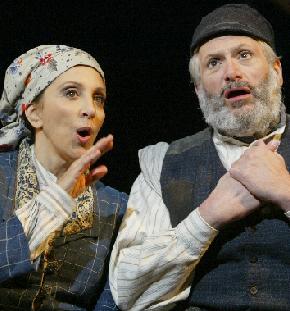
Hmmm. Thumbs up from Harvey, and I never saw Hairspray, but I adore Fiddler on the Roof. The hawkman is working, and the turtle is shirking, so we shall have to do without them today. <smile>
Shall we play?
Artist: Lyrics
Song: Sunrise, Sunset Lyrics
(Tevye)
Is this the little girl I carried?
Is this the little boy at play?
(Golde)
I don't remember growing older
When did they?
(Tevye)
When did she get to be a beauty?
When did he get to be so tall?
(Golde)
Wasn't it yesterday
When they were small?
(Men)
Sunrise, sunset
Sunrise, sunset
Swiftly flow the days
Seedlings turn overnight to sunflowers
Blossoming even as we gaze
(Women)
Sunrise, sunset
Sunrise, sunset
Swiftly fly the years
One season following another
Laden with happiness and tears
(Tevye)
What words of wisdom can I give them?
How can I help to ease their way?
(Tevye)
Now they must learn from one another
Day by day
(Perchik)
They look so natural together
(Hodel)
Just like two newlyweds should be
(Perchik & Hodel)
Is there a canopy in store for me?
(All)
Sunrise, sunset
Sunrise, sunset
Swiftly flow the days
Seedlings turn overnight to sunflowers
Blossoming even as we gaze
Sunrise, sunset
Sunrise, sunset
Swiftly fly the years
One season following another
Laden with happiness and tears
edgar, that song reminds me of a couple of things, but one idea in particular. Just got through reading along with Treya of Florida and she was rather upset with men, I think. She claims that they all suck. Made me think of what my daughter said to me.
Mom, your vacuum cleaner sucks. Is that an oxymoron?
Yesterday I was chatting with a friend and I mentioned how much I liked the arias of Enrico Caruso. So when edgar mentioned Pagliacci, I decided to play this one.
The aria VESTI LA GIUBBA:
LYRICS
Recitar!... mentre preso dal delirio
non so più quel che dico
e quel che faccio!
Eppur... è d'uopo... sforzati!
Bah! Sei tu forse un uom?
Tu se' Pagliaccio!
Vesti la giubba,
e la faccia infarina.
La gente paga e rider vuole qua.
E se Arlecchin t'invola Colombina,
ridi, Pagliaccio, e ognun applaudirà!
Tramuta in lazzi lo spasmo ed il pianto,
in una smorfia il singhiozzo e'l dolor - Ah!
Ridi, Pagliaccio,
sul tuo amore infranto.
Ridi del duol che t'av-velena il cor.
ENGLISH TRANSLATION
Perform! In the throes of delirium?
I no longer know
what I'm saying or what I'm doing!
Still... I must... force myself!
Bah! Are you a man or not?
You're just a clown!
Put on your costume,
and cover your face with flour.
People are paying, they want to laugh.
And when Arlecchino takes away your Colombina,
laugh, you clown, and everyone will applaud!
Turn into jest the spasms and weeping;
into a grimace the tears of pain - Ah!
Laugh, clown,
at your broken love.
Laugh at the pain that poisons your heart.
It helps to hear the melody. Ah, what a tenor.
Do You Want To Know A Secret
The Beatles
You never know how much I really love you
You'll never know how much I really care
Listen, do you want to know a secret
Do you promise not to tell, woh, woh, woh
Closer, let me whisper in your ear
Say the words you long to hear
I'm in love with you, oo
Listen, do you want to know a secret
Do you promise not to tell, woh, woh, woh
Closer, let me whisper in your ear
Say the words you long to hear
I'm in love with you, oo
I've known a secret for a week or two
Nobody know just we two
Listen, do you want to know a secret
Do you promise not to tell, woh, woh, woh
Closer, let me whisper in your ear
Say the words you long to hear
I'm in love with you, oo, oo
hamburger, we love the way you attach a bit of history to your songs. That was inspiring, Canada, and also it was FDR's campaign song.
Speaking of which, folks.
The Lost Chord
Seated one day at the organ,
I was weary and ill-at-ease;
And my fingers wandered idly
Over the noisy keys.
I know not what I was playing
Or what I was dreaming then,
But I struck one chord of music
Like the sound of a great Amen.
It flooded the crimson twilight
Like the close of an angel's psalm,
And it lay on my fevered spirit
With a touch of infinite calm.
It quieted pain and sorrow
Like love overcoming strife;
It seemed the harmonious echo
From our discordant life.
It linked all perplexèd meanings
Into one perfect peace,
And trembled away into silence
As if it were loathe to cease.
I have sought, but I seek it vainly,
That one lost chord divine,
Which came from the soul of the organ
And entered into mine.
It may be that death's bright angel
Will speak in that chord again;
It may be that only in heav'n
I shall hear that grand Amen.
The Lost Chord is a poem by Adelaide Anne Procter that was set to music by Arthur Sullivan in 1877. Sullivan composed "The Lost Chord" at the bedside of his brother Fred during Fred's last illness. The manuscript is dated January 13, 1877, and Fred Sullivan died five days later.
"The Lost Chord" was immediately successful and became particularly associated with Sullivan's close friend and sometime mistress, Fanny Ronalds, who often sang it at society functions. Sullivan was proud of the song and later noted: "I have composed much music since then, but have never written a second Lost Chord." The song has endured as one of Sullivan's best-known songs, and the setting is still performed today.
Jessica Tandy
From Wikipedia, the free encyclopedia
Born June 7, 1909
London, England, UK
Died September 11, 1994, aged 85
Easton,Connecticut, USA
Spouse(s) Jack Hawkins (1932-1942)
Hume Cronyn (1942-1994)
Academy Awards
Best Actress
1989 Driving Miss Daisy
Emmy Awards
Outstanding Lead Actress - Miniseries/Movie
1988 Foxfire
Tony Awards
Best Leading Actress in a Play
1948 A Streetcar Named Desire
1978 The Gin Game
1983 Foxfire
Golden Globe Awards
Best Actress - Motion Picture Musical/Comedy
1990 Driving Miss Daisy
BAFTA Awards
Best Actress
1989 Driving Miss Daisy
Jessica Tandy, christened Jessie Alice Tandy (June 7, 1909 - September 11, 1994) was a noted Academy Award-winning English theatre, film and TV actress who became an American citizen. To this day, she remains the oldest person ever (at the age of 80) to receive a competitive acting Oscar.
Personal life
Tandy was born in Geldeston Road in the London Borough of Hackney[1] and she was educated at the Dame Alice Owen's School in the London Borough of Islington.
She married twice:
the British actor Jack Hawkins (1932-1942); one daughter Susan Hawkins (born 1934)
the Canadian-American actor, Hume Cronyn from 1942 until her death in 1994; two children - daughter Tandy Cronyn (also an actress), son Christopher Cronyn.
In 1990, she was diagnosed with ovarian cancer which she battled fiercely for five years, during which she continued to work. She had previously been treated for angina and glaucoma.
Career
After an acting career spanning some sixty five years, Tandy found latter-day movie stardom in major-studio releases and intimate dramas alike. From a young age she was determined to be an actress, and first appeared on the London stage in 1926, playing, among others, Katherine opposite Laurence Olivier's Henry V, and Cordelia opposite John Gielgud's "King Lear". She also worked in British films. Following the end of her first marriage, she moved to New York and met Canadian actor Hume Cronyn, who became her second husband and frequent partner on stage and screen. She made her American film debut in The Seventh Cross (1944). She also appeared in The Valley of Decision (1945), The Green Years (1946, ironically enough as Cronyn's daughter!), Dragonwyck (1946) starring Gene Tierney and Forever Amber (1947). After her Tony-winning performance as Blanche DuBois in the original Broadway production of Tennessee Williams' A Streetcar Named Desire, (she lost the film role to actress Vivien Leigh) she concentrated on the stage and only appeared sporadically in films such as The Light in the Forest (1957) and The Birds (1963).
The beginning of the 1980s saw a resurgence in her film career, with character roles in The World According to Garp, Best Friends, Still of the Night (all 1982) and The Bostonians (1984), and the hit film Cocoon (1985), opposite Cronyn, with whom she reteamed for *Batteries not included (1987) and Cocoon: The Return (1988). She and Cronyn had been working together more and more, on stage and television, to continued acclaim, notably in 1987's Foxfire which won her an Emmy Award (recreating her Tony-winning Broadway role). However, it was her colorful performance in Driving Miss Daisy (1989), as an aging, stubborn Southern-Jewish matron, that made her a bonafide Hollywood star and earned her an Oscar. She was the oldest actor to ever win an Academy Award, beating out George Burns by less than a year.
She was chosen by People magazine as one of the fifty Most Beautiful People in the world in 1990.
She subsequently earned a Best Supporting Actress nomination for her work in the grass-roots hit Fried Green Tomatoes (1992), and co-starred in The Story Lady (1991 telefilm, with daughter Tandy Cronyn), Used People (1992, as Shirley MacLaine's mother), To Dance with the White Dog (1993 telefilm, with husband Hume Cronyn), Nobody's Fool (1994), and Camilla (also 1994, with Cronyn). Camilla was to be her last performance, and it was bold in one way that she, at the age of about eighty four and knowing that she was dying, had a brief nude scene, which could also be called "cheeky".
She died at home on September 11, 1994, in Easton, Connecticut, of ovarian cancer at the age of eighty five. Prior to moving to Connecticut, she lived with Cronyn for many years in nearby Pound Ridge, NY on land adjacent to their dear friends (and Cronyn's cousin), the producer Robert Whitehead and actress Zoe Caldwell.
Dean Martin
From Wikipedia, the free encyclopedia
Background information
Birth name Dino Paul Crocetti
Born June 7, 1917, Steubenville, Ohio, United States
Died December 25, 1995
Genre(s) Big band, Swing
Years active 1940-1989
Label(s) Capitol
Reprise
Dean Martin (born Dino Paul Crocetti, June 7, 1917 - December 25, 1995) was an American singer, film actor, and comedian. He was one of the most famous music artists in the 1950s and 1960s. His hit singles included songs such as "Memories Are Made Of This", "That's Amore", "Everybody Loves Somebody", "Mambo Italiano", "Sway", "Volare", and "Let Me Go Lover". Martin received a gold record in 2004 for his fastest-selling album ever, which also hit the iTunes Top 5, and Playboy magazine recently called Martin "the coolest man who ever lived."
Biography
Early life
Martin was born Dino Paul Crocetti in Steubenville, Ohio in the Pittsburgh Tri-State region. His parents were Gaetano Crocetti, a barber from Abruzzi, Italy, and Angela Barra, an Italian American from Fernwood, Ohio.[1] He spoke only Italian until age five. The traces of Italian are perhaps what lent a slight Southern drawl to Martin's speaking voice.
Martin dropped out of school in the tenth grade because, in his own words, he thought that he was smarter than the teachers. He delivered bootleg liquor, served as a speakeasy croupier and blackjack dealer, worked in a steel mill and boxed as welterweight. At the age of 15, he was a boxer who billed himself as "Kid Crocett" (Kro-Shey). From his prizefighting years, Martin earned a broken nose (later fixed), a permanently split lip, and many sets of broken knuckles (as a result of not being able to afford the tape used to wrap boxers' hands). He won 1 of his 12 bouts (Kehoe, John. "Dean Martin.." Biography 4.10 (2000): 124. History Reference Center) The prize money was small. For a while he roomed with Sonny King, who like Martin, was just starting out in show biz and had little money. Martin and King held bare knuckle matches in their apartment, fighting until one of them was knocked out; people paid to watch the sight.
Eventually, Martin gave up boxing. He worked as a roulette stickman and croupier in an illegal casino located behind a tobacco shop where he had started out as a stock boy. At the same time, he sang with local bands. Billing himself as "Dino Martini" (after the then-famous Metropolitan Opera tenor, Nino Martini), he got his first break working for the Ernie McKay Orchestra. He performed in a crooning style heavily influenced by Bing Crosby and Harry Mills (of the Mills Brothers), among others. In the early 1940s, he started singing for bandleader Sammy Watkins, at which time Sammy suggested he change his name to Dean Martin.
In October of 1941, Martin married Elizabeth Anne McDonald, and during their marriage (ended by divorce in 1949), they had four children. Martin worked for various bands throughout the early 1940s, more on looks and personality than vocal ability until he developed his own smooth singing style. Martin famously flopped at the Riobamba when he succeeded Frank Sinatra there in 1943, but it was the setting for the two men's introduction.
To earn extra money, Martin repeatedly sold 10% shares of his earnings for upfront cash. Martin apparently did this so often that he found he had sold over 100% of his income. Such was the power of his charm that most of his lenders forgave his debts and remained friends.
After being drafted into the United States Army during World War II, Martin served a year (1944-45) in Akron, Ohio. He was then classified 4-F (possibly due to a double hernia; Jerry Lewis referred to the surgery Martin needed for this in his autobiography) and was discharged.
By 1946, Martin was doing relatively well, but he was still little more than an East Coast nightclub singer with an all-too-common style, similar to that of Bing Crosby. He could draw audiences to the clubs he played, but he inspired none of fanatic popularity enjoyed by Sinatra.
Mafia connections
A recent biography on Martin entitled Dean Martin: King Of The Road by Michael Freedland, alleges he had links to the Mafia in his earlier career. Martin was allegedly given help with his early singing career by mob bosses who owned saloons in Chicago. In return, he performed in shows hosted by these bosses later when he was a star. These authors suggest that Martin felt little loyalty to or sympathy for the Mafia and that he only did such people small favors if it were of little inconvenience to him. Reportedly, the FBI's bugs once picked up a mafioso making plans to injure or kill Martin because of a perceived lack of gratitude. Another book, The Animal in Hollywood by John L. Smith , depicted Dean Martin's long-time friendship with Mafia mobsters Johnny Roselli and Anthony Fiato. Anthony Fiato (aka "the Animal") did Martin many favors, such as getting back money from two swindlers who had cheated Betty Martin, Dean's ex-wife, out of thousands of dollars of her alimony money.
Teaming with Jerry Lewis
Martin attracted some attention from Metro-Goldwyn-Mayer and Columbia Pictures, but a Hollywood contract was not forthcoming. He appeared destined to remain on the nightclub circuit until he met a young comic named Jerry Lewis at the Glass Hat Club in New York, where both men were performing. Martin and Lewis formed a fast friendship which led to their participation in each other's acts and ultimately forming a music-comedy team. Given their zany antics, more than a few people dubbed them "The Organ Grinder and the Monkey."
Martin and Lewis' official debut together occurred at Atlantic City's 500 Club on July 24, 1946, and they were not a hit. The owner, Skinny D'Amato, warned them that if they didn't come up with a better act for their second show later that same night, they would be fired. Huddling together out in the alley behind the club, Lewis and Martin agreed to go for broke, to throw out the pre-scripted gags that hadn't worked and to basically just improvise their way through the act. Dean sang some songs, and Jerry came out dressed as a busboy, dropping plates and more or less making a shambles of both Martin's performance and the club's sense of decorum. They did slapstick, reeled off old vaudeville jokes, and did whatever else popped into their heads at the moment. This time, the audience doubled over in laughter. Their success at the 500 led to a series of well-paying engagements up and down the Eastern seaboard, culminating with a triumphant run at New York's Copacabana. Club patrons were convulsed by the act, which consisted primarily of Lewis interrupting and heckling Martin while he was trying to sing, and ultimately the two of them chasing each other around the stage and having as much fun as possible. The secret, they have both said, is that they essentially ignored the audience and played to one another.
A radio series commenced in 1949, the same year that Martin and Lewis were signed by Paramount producer Hal Wallis as comedy relief for the film My Friend Irma.
Martin was thrilled to be out of New York City, a place he had developed a lifelong hatred for. He liked it that California, because of its earthquakes, had few tall buildings. Suffering as he did from claustrophobia, Martin almost never used elevators, and having to climb multiple flights of stairs in Manhattan's skyscrapers was not his idea of fun.
Their agent, Abby Greshler, negotiated for them one of Hollywood's best deals: although they received only a modest $75,000 between them for their films with Wallis, Martin and Lewis were free to do one outside film a year, which they would co-produce through their own York Productions. They also had complete control of their club, record, radio and television appearances, and it was through these endeavors that Martin and Lewis earned millions of dollars.
Although there had been a number of hugely successful film teams before, Hollywood had not seen anything like Martin and Lewis. The fun they had together set them apart from everything else being done at the time. Both were talented entertainers, but the fact that they were such good friends on and off stage took their act to a new level.
Martin and Lewis were the hottest act in America during the early '50s, but the pace and the pressure took its toll. Most critics of the time underestimated Dean's contribution to the team, as he usually had the thankless job of the straight man, and his singing had yet to develop into his unique style of his later years. Most critics praised Lewis, and while they admitted that Martin was the best partner he could have, most of them claimed that Lewis was the real talent of the team and could succeed with anyone. It is worth noting that Lewis always praised his partner, and while he appreciated the attention he was getting, he has always said with complete conviction that the act would never have worked without Martin. In the book Dean & Me he calls Martin one of the great comic geniuses of all time. But the harsh comments from the critics, as well as his frustration with the formulaic similarity of the Martin & Lewis movies which producer Hal Willis stubbornly refused to change, lead to Martin's dissatisfaction with the team. He put less and less enthusiasm into their work, leading to escalating arguments with Lewis. The two finally couldn't possibly work together, especially when Martin told his partner that he was "nothing to me but a ******* dollar sign." The act broke up in 1956, ten years to the day after the first official teaming.
But splitting up their partnership was not easy. It took months for lawyers to work out the details of terminating many of their club bookings, their television contracts, and the dissolution of York Productions. Through it all, there was intense public pressure for them to stay together. Dean tired of being second fiddle to Jerry's antics, as when Martin tried to sing a song and Lewis poured buckets of cold water over his head or slapped him. It took its toll and Dean had enough.
Lewis had no trouble maintaining his film popularity alone, but Martin, unfairly regarded by much of the public and the motion picture industry as something of a spare tire to his former partner, found the going hard; his first solo film, Ten Thousand Bedrooms, was a box office failure. He was still popular as a singer, but with rock and roll surging to the fore, the era of the pop crooner appeared to be waning, and it looked like Martin's fate was to be limited to nightclubs and to be remembered as Jerry Lewis's former partner.
Solo career
Never totally comfortable in films, Martin still wanted to be known as a real actor. Though offered a fraction of his former salary to co-star in the war drama The Young Lions (1957), he eagerly agreed so that he could learn from and appear with Marlon Brando and Montgomery Clift. Tony Randall already had the part, but talent agency MCA realized that with this movie, Martin would become a triple threat: they could make money from his work in night clubs, movies, and records. Martin replaced Randall in one of the best dramatic roles of the decade and the film turned out to be the cornerstone of Martin's spectacular comeback. By the mid '60s, he was a top movie, recording, and nightclub attraction, even as Lewis's film career rapidly declined. Martin was also acclaimed for his performance as Dude in Rio Bravo (1959), directed by Howard Hawks and also starring John Wayne and singer Ricky Nelson. He teamed up again with Wayne in The Sons of Katie Elder (1965), where they were somewhat unconvincingly cast as brothers.
Martin played a nightmare variation of his own smoothly womanizing persona as Vegas singer "Dino" in Billy Wilder's adult comedy Kiss Me, Stupid (1964) with Kim Novak, and he was never above poking sly fun at his image in films such as the Matt Helm spy spoofs of the 1960s.
As a singer, Martin copied the styles of Bing Crosby and Perry Como until he arrived at his own and he could hold his own in countless duets over the decades with Sinatra and Crosby. Like the The Beatles at their height, he couldn't read music, but he recorded more than 100 albums and 600 songs. His signature tune, "Everybody Loves Somebody", knocked The Beatles' "A Hard Day's Night" out of the number-one spot in 1964 (In the USA only). Elvis Presley was said to have been influenced by Martin, and patterned "Love Me Tender" after his style. Martin, like Elvis, was also heavily influenced by country music. By 1965, nearly all of Martin's albums, such as "The Hit Sound Of Dean Martin", "Welcome To My World" and "Gentle On My Mind" were composed of popular country and western songs made famous by artists like Johnny Cash, Merle Haggard, and Buck Owens. Martin hosted country performers on his TV show, and was even named "Man Of the Year" by the Country Music Association in 1966. Remarkably, "Ain't That a Kick in the Head," a song Martin performed in Ocean's Eleven that never became a hit at the time, has enjoyed a spectacular revival in the mid-2000s.
For three decades, Martin was among the most popular nightclub acts in Las Vegas. Martin himself was one of the smoothest comics around, benefiting from the decade of raucous comedy with Lewis. Though often thought of as a ladies' man, Martin spent a lot of time with his family; as second wife Jeannie put it, prior to the couple's divorce, "He was home every night for dinner."
The 1960s and 1970s
In 1965, Martin launched his weekly NBC comedy-variety series, The Dean Martin Show, which exploited his public image as a lazy, carefree boozer. It was there that he perfected his famous laid-back persona of the half-drunk crooner suavely hitting on beautiful women with hilarious remarks that would get anyone else slapped, and making snappy if slurred remarks about fellow celebrities during his famous roasts. Even though critics complained Dean was the epitome of sloth, few entertainers worked as hard to make what they were doing look so easy.
The TV show was a huge hit. Dean prided himself on memorizing whole scripts -- not merely his own lines. He disliked rehearsing because he firmly believed his best performances were his first performances. The show's loose format often prompted comedic, quick-witted improvisation from Dean and the rest of the cast. On occasion, he made remarks in Italian, some of them obscenties that brought angry mail from offended, Italian-speaking viewers. This prompted a battle between Martin and NBC censors, who insisted on more scrutiny of the show's content. As a result, the show was often in the Top Ten. Martin, deeply appreciative of the efforts of the show's producer, his friend Greg Garrison, later made a handshake deal giving Garrison, a pioneer TV producer in the 1950s, 50% ownership of the show.
Despite Martin's reputation as a heavy drinker ?- a reputation perpetuated via his vanity license plates reading 'DRUNKY' ?- he was remarkably self-disciplined. He was often the first to call it a night, and when not on tour or on a film location liked to go home, see his wife, and play with his children. It has been claimed that Martin was usually sipping apple juice (not liquor) most of the time onstage. He borrowed the lovable-drunk shtick from Joe E. Lewis, but his convincing portrayals of heavy boozers in Some Came Running and Howard Hawks's Rio Bravo led to unsubstantiated claims of alcoholism. More often than not, Martin's idea of a good time was playing golf-- not staying with Rat Pack friends Frank Sinatra and Sammy Davis, Jr. into the wee hours of the morning.
By the early 1970s, Martin seemed to have the Midas touch. The Dean Martin Show was still earning solid ratings, and although he was no longer a Top 40 hitmaker, his record albums continued to sell well. His name on a marquee could guarantee casinos and nightclubs a standing-room-only crowd. He found a way to make his passion for golf profitable by offering his own signature line of golf balls. Shrewd investments had greatly increased Martin's personal wealth; at the time of his death, Martin was reportedly the single largest minority shareholder of RCA stock. Martin even managed to cure himself of his claustrophobia by locking himself in the elevator of a tall building and riding up and down for hours until he was no longer panic-stricken.
Despite his enormous success, Martin retreated from show business by the early 1970s. The final (1973-74) season of his variety show would be retooled into one of celebrity roasts, requiring less of Martin's involvement. After the show's cancellation, NBC continued to air the Dean Martin Celebrity Roast format in a series of TV specials through 1984. For nearly a decade, Dean had recorded as many as four albums a year for Reprise records. That stopped in November of 1974, when Martin recorded his final Reprise album - "Once In A While", released in 1978. His last recording sessions were for Warner Brothers Records. An album titled "The Nashville Sessions" was released in 1983, and a follow up single "Drinking Champagne" came in 1985. The 1975 film Mr. Ricco marked Martin's final starring role, and Martin limited his live performances to Las Vegas and Atlantic City.
Martin seemed to be suffering a mid-life crisis. In 1972, he filed for divorce from his second wife, Jeannie. A week later, his business partnership with the Riviera casino was dissolved amid reports of the casino's refusal to agree to Martin's request to perform only once a night. He was quickly snapped up by the MGM Grand Hotel and Casino, and was signed to a three-picture deal with MGM Studios. Less than a month after his second marriage had been legally dissolved, Martin married 26 year-old Catherine Hawn on April 25, 1973. He divorced her November 10, 1976, claiming she was a gold-digger only interested in her husband's checkbook. He was also briefly engaged to Gail Renshaw, Miss USA 1969, and later dated an actress, Phyllis Davis.
Eventually, Martin reconciled with Jeannie, though they never remarried. He also made a public reconciliation with Jerry Lewis on Lewis' Labor Day Muscular Dystrophy Association telethon in 1976. Frank Sinatra shocked Lewis and the world by bringing Martin out on stage. As Martin and Lewis hugged and smiled, the audience erupted in cheers and the phone banks lit up, resulting in one of the telethon's most profitable years. Lewis reported the event was one of the three most memorable of his life. Lewis brought down the house when he quipped, "So, you working?" Martin, playing drunk, replied that he was "at the Meggum" -- this reference to the MGM Grand Hotel convulsed Lewis. This, along with the death of Martin's son Dean Paul Martin a few years later, helped to bring the two men together. They maintained a quiet but deep friendship but never performed together again.
Later years
After an enormously successful film and music career throughout the fifties and mid-sixties, Dean embarked upon a relatively new medium- television. The Dean Martin Show began on September 16, 1965, in which one of the segments, a celebrity roast, became wildly popular.
The Dean Martin Celebrity Roasts became a fast favorite with television audiences and soon evolved to become its own network series. At the time Dean Martin had one of the largest contracts between a network and a star.
The Dean Martin Celebrity Roasts were a fixture on the NBC Thursday night lineup from 1973 to 1984. In those 11 years, Dean and his panel of pals successfully ridiculed, embarrassed and made fun of legendary stars like, Frank Sinatra, Lucille Ball, Sammy Davis Jr. and Dean Martin himself, to name a few.
On December 1, 1983 while gambling at the Golden Nugget casino in Atlantic City, Martin and Sinatra intimidated the dealer and several employees into breaking New Jersey laws by making the dealer deal the cards by hand instead of by a shoe, as is required by law. Although Sinatra and Martin were implicated as the cause of the violation, neither were fined by the New Jersey Gaming Commission. The Golden Nugget, on the other hand, received a $25,000 fine and four employees including the dealer, a supervisor and pit boss were suspended from their jobs without pay. It's said that Sinatra and Martin picked up the tab for the suspended employees' pay.
Martin returned to films briefly with appearances in the two all-star Cannonball Run movies, but being a movie star no longer excited him and he found life on the set to be more tedious than ever. He also stepped back into the recording studio and scored a minor hit single with his version of "Since I Met You, Baby" and made his very first music video, which appeared on MTV.
Martin never claimed to be an intellectual and perhaps was telling the truth when he told an interviewer he had only read one book in his life. It was the children's story Black Beauty. In his 2005 book about Martin, Dean and Me: A Love Story, Jerry Lewis notes that Martin was especially fond of comic books, but would always send someone else out to buy them for him.
Decline
Martin's world began to crumble on March 21, 1987, when his son Dean Paul was killed when his jet fighter crashed while flying with the Air National Guard. A much-touted tour with Davis and Sinatra in 1988 sputtered, with Martin's heart just not into it. On one occasion, he infuriated Sinatra when he turned to him and muttered "Frank, what the hell are we doing up here?" Martin, who always responded best to a club audience, felt lost in the huge stadiums they were performing in (at Sinatra's insistence), and he was not the least bit interested in drinking until dawn after their performances.
In fact, Martin never completely recovered from losing his son, and as a lifelong smoker was suffering from emphysema. In September 1993, he was diagnosed with lung cancer which ultimately led to his death. He courageously kept his private life to himself, emerging briefly for a public celebration of his 77th birthday with friends and family.
Ultimately, it seemed that Martin had reconciled himself to reaching the end of a long career. He had been told he needed major surgery on his kidneys and liver to prolong his life, but he refused. It was widely reported, though never confirmed, that Martin had been diagnosed with Alzheimer's disease in 1991.
At his side in his last years was ex-wife Jeannie (Bieggers) Martin, whom he had divorced years earlier. The pair became close again, although they resisted suggestions that they wed and seemed content to just being together.
Martin died of respiratory failure, at home on Christmas morning 1995. Although widely believed, an error perpetuated by Jeannie herself, was that she was at his side at his death. The truth is that Jeannie was giving her annual Christmas party into the wee wee hours of the night and therefore was at her home with her daughter, Deana until about 4 a.m., with Dean having died about 3:15 am. Deana has attested to this on many occasions, including in her biography of her father. The lights of the Las Vegas Strip were dimmed in his honor. In 2005, Las Vegas renamed Industrial Road as "Dean Martin Drive".
Popular culture
There was talk of a film biography called "Dino", with Tom Hanks in the title role (Hanks previously portrayed the singer in an episode of Saturday Night Live) and Martin Scorsese directing. But as of 2007, the project has yet to happen.
Martin was portrayed by Joe Mantegna in an HBO movie about Sinatra and Martin titled The Rat Pack.
British actor Jeremy Northam also portrayed the late entertainer in a made-for-TV movie called Martin and Lewis, alongside Will & Grace's Sean Hayes as Jerry Lewis.
For the week ending December 23, 2006, the Dean Martin and Martina McBride duet of "Baby, It's Cold Outside" reached #7 on the R&R AC chart. It also went to #36 on the R&R Country chart.
The last time Martin had a song this high in the charts was in 1965, with the song "I Will", which reached #10 on the Pop chart.
A Budweiser commercial that premiered during Super Bowl XLI featured Martin's "Ain't it a Kick in the Head."
More than 40 years after knocking the Beatles out of the #1 spot, Martin continues to be popular with music fans. Movies such as Goodfellas, Casino, Swingers, Out of Sight, L.A. Confidential, A Bronx Tale and Payback, not to mention TV's "The Sopranos" and "The West Wing" as well as commercials for the 2005 Nissan Altima, Microsoft, Marriott Hotels and Heineken all feature Martin songs.
Capitol's 2004 collection "Dino: The Essential Dean Martin" features some of Martin's best recordings. Billboard's "Hotshot Debut" was the week's highest-charting new entry, and has sold more briskly than any previous Martin recording, going gold within months and to platinum status within a year. It also hit the Top 5 on Apple's iTunes Music Store album chart. As Bill Zehme observed in a 2004 Playboy profile, "Dean provides smooth, winking succor to generations anew."
Marriages and Children
Dean Martin was married three times, the second the most successful, with Dean and Jeanne remaining married for 24 years (1949-1973). Dean's first wife, Betty, by all accounts tried to be a good wife and mother, but she became an alcoholic. Dean gained custody of their four children. The third marriage was short-lived, just three years, and ended bitterly. Dean was the father of eight children and one step-child.
First Wife: Elizabeth (Betty) Anne McDonald
First Child: Stephen (Craig), born June 29, 1942
Second Child: Claudia, born March 16, 1944
Third Child: Barbara (Gail), born April 11, 1945 - died 2001 (breast cancer)
Fourth Child: Deana (Dina), born August 19, 1948
Second Wife: Jeanne Biegger
Fifth Child: Dino Paul (Jr.), born on November 17, 1951 - died March 21, 1987
Sixth Child: Ricci James, born on September 20, 1953
Seventh Child: Gina Caroline, born on December 20, 1956
Third Wife: Catherine Mae Hawn
Adopted Daughter: Sasha
Tom Jones
From Wikipedia, the free encyclopedia
Background information
Birth name Thomas Jones Woodward
Born June 07, 1940 (1940-06-07) (age 67)
Origin Pontypridd, Wales
Genre(s) Pop, Soul, R&B, Ballads.
Occupation(s) Singer, Actor
Years active 1960s - present
Website Official website
Sir Thomas Jones Woodward, OBE, (born 7 June 1940), known by his stage name as Tom Jones, is a Grammy Award winning Welsh popular music singer particularly noted for his powerful voice. He was born in Treforest, Pontypridd, near Cardiff in South Wales, Great Britain.
Musical career
Tom Jones rose to fame in the mid-1960s, with an exuberant live act which included wearing tight breeches and billowing shirts, in an Edwardian style popular amongst his peers at the time. He was known for his overt sexuality, before this was as common as it has become in subsequent years.
In 1963 he became the frontman for Tommy Scott and the Senators, a local beat group. Clad all in black leather, he soon gained a reputation in the South Wales area. The Senators were still unheard of in London.
In 1964 they laid down seven tracks with maverick Telstar producer Joe Meek, and took them to various labels in an attempt to get a record deal, with no success. The plan was to release a single, Lonely Joe/I Was A Fool, but the ever-flighty Meek refused to release the tapes. Only after It's Not Unusual became a massive hit, Meek was able to sell the tapes to Tower (USA) and Columbia (UK). The group returned to South Wales and continued to play gigs at dance halls and working men's clubs. One night, at the Top Hat in Cwmtillery, Jones was spotted by Gordon Mills, a London-based manager originally from South Wales. Mills became Jones' manager, and took the young singer to London. He also renamed him Tom Jones, an ingenious moniker which not only linked the singer to the image of the title character - a good-looking, low-born stud - portrayed in Tony Richardson's film of Fielding's Tom Jones which was a huge contemporary hit, but also subtly emphasized his nationality. Gordon Mills gave many rock stars their stage names, among them Engelbert Humperdinck (born Arnold George Dorsey). The Senators became the Playboys, and later still the Squires. It was the beginning of the second phase in Jones' career.
Record companies were finding his style and delivery to be too abrasive and raw. Jones' vocals were considered to be too raucous, and he moved like Elvis. But eventually, Decca rekindled their early interest, and Jones recorded his first single, Chills And Fever in late 1964.
The single didn't chart, but the follow-up, It's Not Unusual, (co-written by Les Reed), was an instant smash hit, released in early 1965. Initially the BBC refused to play it, but an offshore pirate station, Radio Caroline, picked it up. Its orchestrated arrangement coupled with Jones' energetic delivery proved infectious, and by March 1st the song reached number one in the UK and the top ten in America. In the same year, Jones sang the theme tune to the James Bond film Thunderball. Jones was awarded the Grammy Award for Best New Artist for 1965. In 1966 Jones' popularity began to slip somewhat, causing Mills to redesign the singer's image into a more respectable, mature tuxedoed crooner.
Inspired by long-time influence Jerry Lee Lewis' country version, Jones released his most successful single ever, Green Green Grass of Home (written by Claude "Curly" Putman Jr. in 1965), and began to sing material that appealed to a broad audience, as well as a string of hit singles and albums including What's New Pussycat?, Help Yourself and Delilah. The strategy worked, as he returned to the top of the charts in the UK and began hitting the Top 40 again in the U.S.
In 1967 he performed for the first time in Las Vegas, at The Flamingo. In 1968, starting at New York's Copacabana night club, women would swoon and scream, and some would throw their knickers on stage. Soon after, he began to play Las Vegas, where he began recording less, choosing to concentrate on his lucrative club performances. At Caesar's Palace his shows were traditionally a knicker-hurling frenzy of raw sexual tension and good-time entertainment. There, they started throwing hotel room keys. Jones and Elvis became good friends, spending time together in Las Vegas. They had a friendship that would endure until Presley's death in 1977.
Jones had an internationally successful television variety show from 1969-1971 titled This Is Tom Jones. This hit TV show aired on ABC-TV (American Broadcasting Company) in America and ITV in the UK. The 1970s saw Jones' popularity leveling off somewhat. But the hits kept on coming: Daughter Of Darkness, She's A Lady, Till and The New Mexican Puppeteer were all hits in the UK. On July 29, 1986, Gordon Mills, Jones' long-time manager, died of cancer. Jones' son Mark became the singer's manager. In April 1987 the singer re-entered the singles chart again. With the hit A Boy From Nowhere Tom got back in the public eye. A few months later he performed a version of Prince's Kiss, and recorded it with The Art of Noise, and it was an instant hit. In 1993 he signed to Interscope Records, releasing the album The Lead And How To Swing It, and his profile was raised with a younger audience by a powerful performance at the Glastonbury Festival. In 1998 he performed a medley of songs from the film The Full Monty with Robbie Williams at the BRIT Awards. That same year, Space and Cerys Matthews released The Ballad Of Tom Jones.
In 1999 he recorded the blockbuster album Reload, a collection of duets with some of the year's brightest stars, which brought him back into the limelight. On New Year's Eve 2000 President Bill Clinton invited him to perform at the Millennium Celebrations in Washington. Throughout 2000, Jones garnered several honors for his work, including a BRIT Award for Best Male. In 2001 he toured throughout the Middle East and Europe. In subsequent years he recorded albums in collaboration with such artists as Wyclef Jean and Jools Holland.
In celebration of his 65th birthday, on 28 May 2005 Jones returned to his homeland to perform a spectacular concert in Ynysangharad Park, Pontypridd. This was his first performance in Pontypridd since 1964.
His early hits include:
"It's Not Unusual" (1965), Jones' signature song.
"What's New Pussycat?", written by Burt Bacharach for What's New, Pussycat? (1965).
"Thunderball", the theme for the James Bond film of the same name (1965) - an urban legend states that upon hitting the final high note of the song Jones actually passed out, but that the take was so good it was the version that was released. Jones later denied this.
"The Green, Green Grass of Home" (1966), his most successful single, which was interpreted by many to refer to Jones' native Wales, despite being written about the USA [1]
"I'll Never Fall In Love Again" (1967)
"Delilah" (1968), the usual choice of song for impressionists "doing" Tom Jones, occasionally being criticized for the violent nature of the song
"Help Yourself" (1968)
"Without Love" (1969)
"She's A Lady" (1971), his highest charting US single, peaking at #2
Jones' recording career slumped on the pop charts during the seventies and eighties, although he placed sixteen singles on the Billboard Country Music charts between 1976 and 1985, the biggest of which was "Say You'll Stay Until Tomorrow" (# 1 Country, # 15 pop) in 1977, and his touring continued successfully. When his son Mark became his manager in 1987, his musical style was taken in a different direction. His recording career was revived with his first major hit single in over a decade, A Boy From Nowhere, taken from the musical Matador. In 1988 he collaborated with The Art of Noise to record Prince's popular song Kiss. Following this, he started to record in collaboration with a younger generation of musicians as listed below:
Prince's "Kiss" (1988, with The Art of Noise)
EMF's "Unbelievable" - a staple of his 1990s live shows
Talking Heads' song "Burning Down The House" (1999, with The Cardigans)
"Baby, It's Cold Outside" (1999, with Cerys Matthews of Catatonia)
Iggy Pop's song "Lust for Life" (1999, with The Pretenders)
Randy Newman's song "Mama Told Me Not To Come" (2000, with Kelly Jones of the Stereophonics)
"Sex Bomb" (From 1999's "Reload", with Mousse T)
"You Need Love Like I Do" (2000, with Heather Small of M People)
His Reload album, released in 2000, became the biggest hit of his career. An album of cover versions recorded as duets with contemporary artists, using their record producers, and utilizing their recording methods, it reached number one in the United Kingdom, and sold over 4 million copies worldwide.[2] In 2002, he released the album Mr. Jones, which was produced by Wyclef Jean and included the singles Tom Jones International and Black Betty. In 2003, he was honored with a BRIT Award for Outstanding Contribution to Music. In 2004, his Sex Bomb single became a major US club hit.
For his contribution to the recording industry, Tom Jones has a star on the Hollywood Walk of Fame at 6608 Hollywood Blvd.
In 2005 the album Together In Concert, was recorded live with John Farnham and his band.
He has collaborated with Chicane for Stoned in Love, a dance track that was released 24 April 2006. It entered at number eight in the UK charts the following Sunday.
The singer was awarded an OBE in 1999 and a Knight Bachelor in the 2006 New Years Honors list for his services to music, and was subsequently knighted by Her Majesty Queen Elizabeth II at Buckingham Palace, London on March 29, 2006.
Although his manager and public relations staff has attempted to change his sex-bomb image and neutralize the knicker-throwing fans, to the delight of his audiences Jones has never felt the need to tone down his behavior in the shows. Tom Jones has remained highly respected by other singers and continues to attract audiences of all ages. As of 2007, Jones continues to tour and record. He performs shows at the MGM Grand Las Vegas ten to twelve weeks each year, as well as performing concerts internationally.
Personal life
The son of coal miner Thomas Woodward (died 5 October 1981), and Freda Jones (died 7 February 2003, of cancer), Jones began singing at an early age. He'd regularly sing at family gatherings, weddings and also sang in his school choir. He was struck down by tuberculosis and bedridden for almost a year. It was a critical time for him, but he could do little else but listen to music and draw. At the age of sixteen, Jones married Linda Trenchard on March 2, 1957 and had a son named Mark, long before becoming a pop idol. Jones quit school with no qualifications and took a variety of jobs including a builder's laborer and a door-to-door vacuum cleaner salesman.
In 1974, Jones moved to America, buying the mansion formerly belonging to Dean Martin in Bel-Air, Los Angeles.
Despite publicized infidelities, including an affair with the dethroned Miss World of 1973, USA's Marjorie Wallace, and a one night stand with Cassandra Peterson a.k.a. Elvira, in which he claimed her virginity, he has remained married to the same woman for 50 years. One of his dalliances with a fan produced a love child, Jonathan Berkery born June 27th, 1988. He lost a paternity suit when DNA testing proved to be positive.
He has two grandchildren, Emma and Alexander Woodward. Alexander competed in the 2006 Commonwealth Games, representing Wales as a Full-Bore marksman.
Jones lives in Los Angeles, California and continues to tour extensively.
Trivia
Tom Jones famously split his trousers during a dance move on a live BBC TV variety show in the 1980's. Far from being embarrassed by the incident he turned round to show the audience he was wearing red underwear. In fact this has led to the UK slang expression "to do a Tom Jones" as meaning to (accidentally) split one's trousers.
A recurring gag in the American comedy The Fresh Prince of Bel Air, is Carlton's enthusiastic love of Tom Jones
The scouse band Space played tribute to him in their hit song "The ballad of Tom Jones", which reached number 4 in the UK charts. The song tells of a couple who are close to murdering each other but are saved by hearing Tom Jones' Greatest Hits.
The Progressive Universal Life Church in Sacramento, California has been dubbed
The Church of Tom Jones due to Pastor Jack Stahl's dancing and use of Tom Jones' music during his sermons.