I got everything I need, almost
I got everything I need, almost
But I don't got you
And you're the thing I need the most
I got a car that I bought
Won't get me far
I gotta wish on a star
Tell me mama
I got everything I need, almost
I got everything I need, almost
But I don't got you
And you're the thing I need the most
I got friends who like me
Cause I got lots of dough
The people recognize me
Wherever I go
I don't got trouble gettin' high
But if I don't get you I believe I will die
I got everything I need, almost
I got everything I need, almost
But I don't got you
And you're the thing I need the most
I got everything I need, almost
I got everything I need, almost
I got everything I need, almost
I got everything I need, almost
But I don't got you
And you're the thing I need the most
0 Replies
edgarblythe
1
Reply
Sat 12 May, 2007 09:23 pm
A Handful Of Stars
Glenn Miller & His Orchestra w/ Ray Eberle
[Written by Jack Lawrence and Ted Shapiro]
I recall the story
That night of love and glory
A night that left my heart romantic scars
We stood so near to heaven
That I reached clear to heaven
And gathered you a handful of stars
Sweet remembered hour
When love began to flower
With moonlight through the trees like silver balls
And as the moon grew older
I reached across your shoulder
And gathered you a handful of stars
I placed my fingertips upon your lips
And stars fell in your eyes
Moonglow made a halo of your hair
Suddenly you looked at me
And dreams began to rise
Oh, what things unspoken trembled in the air
Our hearts were madly beating
And then our lips were meeting
And Venus seemed to melt right into Mars
Then while we stood caressing
Blue heaven sent a blessing
A shower of a handful of stars
0 Replies
Letty
1
Reply
Sun 13 May, 2007 03:37 am
Good morning, WA2K folks.
First, allow me to thank everyone here for the contributions, and although I cannot acknowledge each one individually, I want you to know how much better it makes me feel.
Virginia was beautiful with the budding trees and tiny wild flowers that always give me a lift.
A couple of songs for the morning; one that is stuck in my head from the TV show Psych, and the other I am certain is familiar to all of us here.
Incidentally, Happy Mother's Day to all of you out there.
I know, you know, that I'm not telling the truth,
I know, you know, they just don't have any proof,
Embrace the deception, Lean how to bend,
Your worst inhibitions will PSYCH you out in the end.
Artist: Pilot Lyrics
Song: Magic Lyrics
Ho, ho, ho
It's magic, you know
Never believe it's not so
It's magic, you know
Never believe, it's not so
Never been awake
Never seen a day break
Leaning on my pillow in the morning
Lazy day in bed
Music in my head
Crazy music playing in the morning light
Ho, ho, ho
It's magic, you know
Never believe it's not so
It's magic, you know
Never believe, it's not so
I love my sunny day
Dream of far away
Dreaming on my pillow in the morning
Never been awake
Never seen a day break
Leaning on my pillow in the morning light
Ho, ho, ho
It's magic, you know
Never believe it's not so
It's magic, you know
Never believe, it's not so
Ho, ho, ho
It's magic, you know
Never believe it's not so
It's magic, you know
Never believe, it's not so
0 Replies
Dutchy
1
Reply
Sun 13 May, 2007 03:41 am
Welcome back Letty, nice to see you.
0 Replies
edgarblythe
1
Reply
Sun 13 May, 2007 07:43 am
Stop, It's Wonderful
Orrin Tucker & His Orchestra
Top's down on your mother's car
Right in front of every star
Don't you know just where you are
Stop, it's wonderful
I'll admit I think you're swell
Nice to know you, nice you fell
I'm afraid you'll kiss and tell
Stop, it's wonderful
And I don't know just what I'll do
'Cause I'm getting sentimental over you
What's to do
Better start that motor, turn the key
Promised I'd be home by three
Can't forget what Ma told me
Stop, it's wonderful
0 Replies
Tai Chi
1
Reply
Sun 13 May, 2007 09:29 am
Welcome back, Letty, and Happy Mother's Day!
0 Replies
bobsmythhawk
1
Reply
Sun 13 May, 2007 09:35 am
Dear Letty, you were truly missed and we are really grateful to have you back at the helm of our flagship.
wih great affection
Bob
0 Replies
edgarblythe
1
Reply
Sun 13 May, 2007 09:37 am
How High The Moon
Benny Goodman & His Orchestra
[Music and Lyrics by Morgan Lewis and Nancy Hamilton]
Some where there's music
How faint the tune
Some where there's heaven
How high the moon
There is no moon above
When love is far away too
'Til it comes true
That you love me as I love you
Some where there's music
It's where you are
Some where there's heaven
How near, how far
The darkest night would shine
If you would come to me soon
Until you will, how still my heart
How high the moon
0 Replies
bobsmythhawk
1
Reply
Sun 13 May, 2007 09:39 am
Beatrice Arthur
From Wikipedia, the free encyclopedia
Birth name Bernice Frankel
Born May 13, 1922 (1922-05-13) (age 85)
New York City, United States
Notable roles Maude Findlay, Maude
Dorothy Zbornak, The Golden Girls
Emmy Awards
Outstanding Lead Actress in a Comedy Series
1977 Maude
1988 The Golden Girls
Beatrice Arthur (born Bernice Frankel, May 13, 1922) is an Emmy-and Tony Award winning American actress, singer, and comedian. She is known for her distinctive deep voice, acid wit and prominent stature, standing almost 5 ft 10 in (1.77 m).[1]
In a career spanning five decades and encompassing film, television, and theater, Arthur's trademark roles were as the title character on the 1970s sitcom Maude, and as a part of the ensemble on the long-running sitcom The Golden Girls.
Biography
Arthur was born in New York City to parents Philip and Rebecca Frankel. In the 1930s, the family moved to Maryland, where they owned a women's clothing shop. After attending college in Virginia, Arthur became a medical technologist before World War II.
Beatrice Arthur was married twice--first to Robert Arthur, then for twenty-eight years to her second husband, director Gene Saks, with whom she adopted two sons. The marriage ended in divorce in 1978.[2]
Career
Theater roles
Arthur began her career as a member of the off Broadway theater group at The Cherry Lane Theatre in NY in the late 1940's. Coactors Anthony Franciosa and Robert Herrell were also members at that time.
On stage, her roles included "Lucy Brown" in the 1954 Off-Broadway premiere of Kurt Weill's Threepenny Opera, "Yente the Matchmaker" in the 1964 premiere of Fiddler on the Roof on Broadway, and a 1966 Tony Award-winning portrayal of "Vera Charles" to Angela Lansbury's Mame (she recreated the role on film opposite Lucille Ball in 1974). In 1981, she appeared in Woody Allen's The Floating Lightbulb.
Two decades later, she toured the U.S. with a one-woman show in which she made a triumphant return to Broadway. 2002's Bea Arthur on Broadway: Just Between Friends, a collection of stories and songs (with musician Billy Goldenberg) and based on her life and long career, was nominated for a Tony award for Best Special Theatrical Event, but lost to Elaine Stritch At Liberty.
Television roles
Arthur is perhaps best known for two long-running roles she portrayed on television; the title role on the popular sitcom Maude in the 1970s, and a starring role on The Golden Girls in the 1980s and 1990s.
In Maude, she played Maude Findlay, an outspoken liberal living in the community of Tuckahoe, Westchester County, New York, with her husband, Walter (Bill Macy). The show was a spinoff from All in the Family, on which Arthur had appeared in the same role, playing Edith Bunker (Jean Stapleton)'s cousin, a feminist Democrat, and antithesis to the prejudiced, conservative Republican Archie Bunker (Carroll O'Connor).
In The Golden Girls, she played Dorothy Zbornak, a fiftysomething divorcée and substitute teacher who lived in a Miami, Florida, house owned by Blanche Devereaux (Rue McClanahan). Her other roommates included widow Rose Nylund (Betty White) and Dorothy's Sicilian mother, Sophia Petrillo (Estelle Getty). (Getty is actually one year and two months younger than Arthur in real life, and was heavily made up to look significantly older.) Dorothy had an acidic sense of humor and was prone to making witty, biting wisecracks, often directed at the man-hungry Blanche or dimwitted Rose.
Pop culture references
The Marvel Comics character Deadpool harbors a bizarre obsession with Bea Arthur and seems to consider her particularly sexy. The obsession has since been brought up on numerous Internet forums, particularly Fark.com.
Arthur was seen throughout the 1980s in Canada as a regular character in Shoppers Drug Mart television commercials for a popular Canadian chain of pharmacies.
In the movie Airheads (1994)?-with Brendan Fraser, Steve Buscemi and Adam Sandler?-the main characters ask for naked pictures of Bea Arthur as part of an elaborate ploy to build an insanity defense.
Arthur is referenced in the song "California" by singer/songwriter Rufus Wainwright on his 2001 album Poses with the lyric, "I don't know this sea of neon / Thousand surfers, whiffs of freon / And my new grandma Bea Arthur".
In the Clerks: The Animated Series episode The Last Episode Ever, Randal Graves admits to stalking the Golden Girls, including "exposing myself to Bea Arthur."
0 Replies
bobsmythhawk
1
Reply
Sun 13 May, 2007 09:43 am
Harvey Keitel
From Wikipedia, the free encyclopedia
Birth name Harvey Johannes Keitel[1]
Born May 13, 1939 (1939-05-13) (age 68)
Brooklyn, New York, United States
Spouse(s) Lorraine Bracco (1982-1993)
Daphna Kastner (2001-)
Notable roles Charlie Cappa in Mean Streets
Jerry Bartowski in Blue Collar
Mickey Cohen in Bugsy
"Sport" Matthew in Taxi Driver
Mr. White in Reservoir Dogs
Judas Iscariot in The Last Temptation of Christ
George Baines in The Piano
Winston Wolf in Pulp Fiction
Academy Awards
Nominated: Best Supporting Actor
1991 Bugsy
AFI Awards
Best Actor
1993 The Piano
Harvey Keitel (born May 13, 1939) is an Academy Award-nominated American actor based in New York City.
Biography
Early life
The son of Nikonar Keitel and Maritska LeCose , Jewish immigrants from Poland and Romania [2], Keitel was born in Brooklyn, New York and grew up in the Brighton Beach section of Brooklyn with his sister, Renee, and brother, Jerry. At the age of sixteen, Keitel decided to join the United States Marine Corps, a decision that took him to Lebanon. After his return to the United States, he was a court reporter and was able to support himself before beginning his acting career.
Career
As a younger adult in New York City, before becoming a famous actor, Harvey Keitel was a free-lance court reporter.
Keitel studied under both Stella Adler and Lee Strasberg, eventually landing roles in some off-Broadway productions. During this time, Keitel met another struggling filmmaker named Martin Scorsese and gained a part in Scorsese's student production, Who's That Knocking at My Door. Since then, Scorsese and Keitel have worked together on numerous projects. Keitel had the starring role in Scorsese's Mean Streets but this proved to be Robert De Niro's breakthrough film. He later appeared with De Niro in Taxi Driver, playing the pimp Matthew for Jodie Foster's character of Iris.
Originally, Keitel was to have played the role of Captain Willard in Francis Ford Coppola's Apocalypse Now. However, he was fired early in the production and replaced by Martin Sheen. After this, it was many years before he would be able to get anything other than minor roles. At the end of the 1970s, Keitel was mostly working in European films for directors such as Ridley Scott, usually in sinister character parts.
Throughout the 1980s, Keitel continued to find plenty of work on both stage and screen, but was usually in the stereotypical role of a thug. This role reached its zenith when Keitel starred in Quentin Tarantino's Reservoir Dogs in 1992, where his performance as "Mr. White" relaunched his semi-slumping career. Ridley Scott also helped Keitel by casting him as the sympathetic policeman in Thelma and Louise in 1991. That same year he landed a role in Bugsy, for which he obtained an Academy Award nomination for Best Supporting Actor. Since then, Keitel has chosen his roles with care, seeking to change his image and show off a broader acting range. His decision to co-star in Jane Campion's The Piano marks the approximate beginning of this phase of Keitel's career. He played an efficient cleanup expert Winston Wolf in Quentin Tarantino's Pulp Fiction. In 1997, he starred in the crime drama, Cop Land. It starred Sylvester Stallone, Ray Liotta and for the third time, Robert De Niro. In 1997 he also landed a major role in Quentin Tarantino and Robert Rodriguez's film, From Dusk Till Dawn. Later roles include the fatherly Satan in Little Nicky, a wise navy man in U-571 and a diligent F.B.I. agent in National Treasure. In 1999, Keitel was replaced with Sydney Pollack on the set of Eyes Wide Shut due to scheduling conflicts. Keitel then came to great notoriety for his performance in Bad Lieutenant. He has also shown a willingness to help other startup filmmakers by appearing in their first feature film. He did this not only for Martin Scorsese and Quentin Tarantino, but also Ridley Scott (The Duellists), Paul Schrader (Blue Collar), James Toback (Fingers), and Tony Bui (Yellow Lotus).
Unlike many American male actors who either never appear nude in film or only do so once, Harvey Keitel has appeared in several films nude, including full frontal nudity.
Personal life
Keitel was formerly in a long-term relationship (common-law marriage) to actress Lorraine Bracco. He married Daphna Kastner in 2001. Keitel is the father of three children: daughter Stella (born 1985) from his relationship with Bracco; son Hudson (born 2001) from his relationship with Lisa Karmazin; and son Roman (born 2003) from his marriage to Kastner
0 Replies
Letty
1
Reply
Sun 13 May, 2007 09:46 am
Thank you, Tai, edgar, and Dutchy. Later, as is my wont, I will recognize each person by name.
I just got a wonderful card and picture from my daughter and son. He seems much better and more alert. A wonderful and caring staff in the hospital, and that means so much.
An interesting observation about "traveling by car Letty" from Florida to Virginia. I became very disoriented with the change in altitude this time. I had never experienced this before.
Here, then, is a mountain song.
Reba Mcentire - Climb That Mountain High Lyrics
Red sun a-rising, over the hill
I've had enough of this desert to last from now until
I'm tired of living day-to-day and hand-to-mouth
This could be the day I finally find my way out
Chorus:
I'm gonna climb that mountain high
I'm gonna see what's on the other side
I'm gonna kiss this town good-bye
I'm gonna climb that mountain
How I arrived here, heaven only knows
Seems more like the kind of place the devil would've chose
To spend my life here, is more than I can do
I know somewhere down the road my dream will come true
Repeat chorus
If I stay here forever
What will I have to show
But if I make it over
Then everyone will know
I'm gonna climb that mountain high
Repeat chorus
0 Replies
bobsmythhawk
1
Reply
Sun 13 May, 2007 09:47 am
Senta Berger
From Wikipedia, the free encyclopedia
Born May 13, 1941 (1941-05-13)
Vienna, Austria
Spouse(s) Michael Verhoeven
Senta Berger (born May 13, 1941) is an Austrian actress and producer, born in Vienna.
Berger's parents were not rich, but they tried everything to meet the desires of their daughter. Her father was a musician. Senta first appeared on stage at the age of four, when her father accompanied her singing on the piano. At the age of five she started ballet lessons, but her dream of a career as a dancer was destroyed when her teacher did not like the physical changes in Senta during puberty.
Berger then took private acting lessons. In 1957, she won her first small role in a film. She applied for the Max Reinhardt Seminar, a famous acting school in Vienna, and was accepted. However, shortly afterwards she was forced to leave, because she had accepted a film role without permission. In 1958, she became the youngest member of the Josefstadt Theatre in Vienna. Her ambition was still to be a film actress.
More and more directors and producers wanted to work with her, for example Bernhard Wicki and Arthur Brauner, who produced the film The Good Soldier Schweijk with Berger and the German actor Heinz Rühmann. Brauner used Senta Berger in several films, but she soon tired of musicals. In 1962, she went to Hollywood and worked with stars such as Charlton Heston, Frank Sinatra, John Wayne, and Yul Brynner. She returned to Germany to accept an offer for a series role, which would have brought an obligation of several years.
In 1963, Berger met Michael Verhoeven, son of the German film director Paul Verhoeven (not the Dutch Paul Verhoeven). They started their own film production company in 1965. In 1966, Senta and Michael married. In 1970, she starred for the first time in a film produced by her own company and directed by her husband. Other internationally successful films made by the duo included, amongst others, Die weiße Rose, The Terrible Girl (Das schreckliche Mädchen) and Mutters Courage. Berger continued to develop her European career in France and Italy.
In 1966, Berger co-starred with Kirk Douglas in the movie Cast a Giant Shadow. Berger played the role of Magda, a soldier in the army of Israel during the Israeli War of Independence (1948). Some say that this role was Berger's greatest movie role.[citation needed]
The birth of her two sons caused Senta to turn back to theatre work. She successfully played at the Burgtheater in Vienna, at the Thaliatheater in Hamburg and at the Schillertheater in Berlin. Between 1974 and 1982, she played the "Buhlschaft" in the play Jedermannn at the Salzburg Festival with Curd Jürgens and Maximilian Schell. One of her greatest movie roles of the period was co-starring with Schell and James Coburn and in the acclaimed war movie Cross of Iron (1977). In 1985−86, Berger started a comeback in front of German-speaking audiences in the very popular TV serial Kir Royal. Afterwards further serial hits followed, like The Fast Gerti, where she plays a taxi driver.
In the same year, she also started a career as a singer of Chansons. 2005 saw her in a beautiful and sad film, Einmal so wie ich will, as a woman trapped in an unhappy marriage who finds but turns her back on love when on holiday.
Since February 2003, Senta Berger has been president of the German Film Academy, which seeks to advance the new generation of actors and actresses in Germany and Europe. The Academy will decide the assignment of the German Film Awards in the future.
In the spring of 2006, her autobiography was published in Germany: Ich habe ja gewußt, daß ich fliegen kann ("I Knew That I Could Fly"). Among her memories of Hollywood are a less-than-subtle attempt by Darryl Zanuck to get her on his casting couch, and being called "You German pig" on her first day on the set of Major Dundee by a gaffer whose wife had lost her family in Auschwitz.
0 Replies
bobsmythhawk
1
Reply
Sun 13 May, 2007 09:51 am
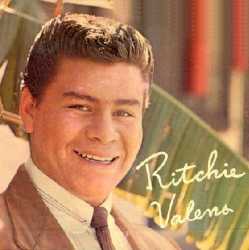
Ritchie Valens
From Wikipedia, the free encyclopedia
Background information
Birth name Richard Steven Valenzuela
Born May 13, 1941
Origin Pacoima, California, USA
Died February 3, 1959 (age 17)
near Clear Lake, Iowa, USA
Genre(s) Rock'n'Roll
Occupation(s) Singer
Instrument(s) Guitar
Years active 1958-1959
Label(s) Del-Fi Records
Richard Steven Valenzuela (May 13, 1941 - February 3, 1959), was a pioneer of rock and roll.
Career
The professional career of Ritchie Valens lasted a period of eight months, during which time he recorded some very influential songs of the 1950s rock and roll era. His best known song, "La Bamba", is probably the very first Latin Rock song to become a hit [1][2], making Valens the father of the Spanish rock and roll movement.
He was born in Pacoima, a neighborhood in the San Fernando Valley area of Los Angeles, on May 13, 1941. Brought up hearing traditional Mexican mariachi music, as well as flamenco guitar, R&B and jump blues, by the age of 5 he expressed an interest in making music of his own. He was encouraged by his father to take up guitar and trumpet, and it is also known that he later taught himself the drums. One day, a neighbor came across Ritchie trying to play a guitar that had only two strings. He re-strung the instrument, and taught Ritchie the fingerings of some chords. While Ritchie was left-handed, he was so eager to learn the guitar that he mastered the traditionally right-handed version of the instrument. By the time he was attending Pacoima Jr. High School, his proficiency on the guitar was such that he brought the instrument to school and would sing and play songs to his friends on the bleachers.
When he was sixteen years old, he was invited to join a local band named The Silhouettes as a guitarist. Later on, the main vocalist left the group and Ritchie assumed this position as well. In addition to the performances with The Silhouettes, he would play solo at parties and other social gatherings.
A completely self-taught musician, Valenzuela was an accomplished singer and guitarist. At his appearances he often improvised new lyrics and added new riffs to popular songs while he was playing. This is an aspect of his music that is not heard in his commercial studio recordings. Due to his high-energy performances, Valenzuela earned the nickname "The Little Richard of the Valley".
In May 1958, Bob Keane, the owner and President of Del-Fi Records, a small Hollywood record label, was given a tip about a young performer from Pacoima by the name of Richard Valenzuela. Keane, swayed by the Little Richard connection, went to see Valenzuela play a Saturday morning matinee at a movie theater in San Fernando. Impressed by the performance, he invited Ritchie to audition at his home in the Silver Lake area of Los Angeles, where he had a small recording studio in his basement. The recording equipment comprised an early portable tape recorder ?- a two-track Ampex 6012 ?- and a pair of Telefunken U-87 condenser microphones.
After this first 'audition', Keane decided to sign Ritchie to Del-Fi, and a contract was prepared and signed on May 27, 1958. It was at this point that he took the name Ritchie, because, as Keane said, "There were a bunch of 'Richies' around at that time, and I wanted it to be different." Similarly, it was Keane who decided to shorten his surname to Valens from Valenzuela, with the intention that a Latino name would make the DJs think that it was Latino music for a Latino audience - Keane wanted Ritchie's appeal to audiences of all kinds to be in the songs themselves.
Several songs that would later be re-recorded at Gold Star Studios in Hollywood were first demoed in Keane's studio. The demos were mostly just Ritchie singing and playing guitar. Some of them featured drums. These original demos can be heard on the Del-Fi album Ritchie Valens ?- The Lost Tapes. As well as the aforementioned demos, two of the tracks laid down in Keane's studio were taken to Gold Star and had additional instruments dubbed over to create full-band recordings. "Donna" was one track (although there are two other preliminary versions of the song, both available on ''The Lost Tapes), and the other was an instrumental entitled "Ritchie's Blues".
After several songwriting and demo recording sessions with Keane in his basement studio, Keane decided that Ritchie was ready to enter the studio with a full band backing him. Amongst the musicians were Rene Hall and Earl Palmer. The first songs recorded at Gold Star, at a single studio session one afternoon in July 1958, were "Come On, Let's Go", an original (credited to Valens/Kuhn, Keane's real name), and "Framed", a Jerry Leiber and Mike Stoller tune. Pressed and released within days of the recording session taking place, the record was a success. Valens' next record, a double A-side, which was the final record to be released in his lifetime, had the songs "Donna" (written about a real girlfriend), coupled with "La Bamba".
At this point, in the autumn of 1958, Valens quit high school to concentrate on his career. Keane booked appearances at venues all across the United States, and performances on television programs such as Dick Clark's American Bandstand on October 6, where he sang "Come On, Let's Go". In November, Ritchie travelled to Hawaii and performed alongside Buddy Holly and Paul Anka among others. Valens found himself a last-minute addition on the bill of Alan Freed's Christmas Jubilee in New York City in December, singing with some of those who had greatly influenced his music, including Chuck Berry, The Everly Brothers, Duane Eddy, Eddie Cochran and Jackie Wilson. December 27th saw a return to American Bandstand, this time for a performance of "Donna".
Upon his return to Los Angeles, Valens filmed an appearance in Alan Freed's movie Go Johnny Go!. In the film, he appears in a diner, miming his song "Ooh! My Head", using a Gretsch guitar borrowed from Eddie Cochran. In between the live appearances, Ritchie returned to Gold Star several times, recording the tracks that would comprise his two albums.
In early 1959, Valens was traveling the Midwest on a multi-act rock and roll tour dubbed "The Winter Dance Party". Accompanying him were Buddy Holly with a new back-up band, Tommy Allsup on guitar, Waylon Jennings on bass, and Carl Bunch on drums; Dion and the Belmonts; J.P. "The Big Bopper" Richardson; and Frankie Sardo. None of the other performers had backing bands, so Buddy's backup band filled in for all the shows.
Conditions for the performers on the tour buses that were used were abysmal, and the bitter Midwest weather took its toll on the party; Carl Bunch had to be hospitalized with frostbitten feet, and several others (including Valens and The Big Bopper) caught colds. The show was split into two acts, with Ritchie closing the first act. After Bunch was hospitalized, a member of the Belmonts who had some drum experience took over the drumming duties. When Dion and the Belmonts were performing, the drum seat was taken by either Valens or Buddy Holly. There is a surviving color photograph of Ritchie at the drum kit.
The Day The Music Died
Buddy Holly, fed up with the conditions on the buses, decided to charter a small plane for himself and his back-up band (The Crickets name was surrendered to Buddy's former bandmates Jerry Allison and Joe Mauldin) to get to the next show on time, get some rest, and get their laundry done. After the February 2, 1959 performance at the Surf Ballroom in Clear Lake, Iowa, Holly, Richardson (who pleaded with Waylon Jennings for his seat because he was stricken with flu), and Valens (who had won Tommy Allsup's seat after a coin toss), were taken to Clear Lake airport by the manager of the Surf Ballroom.
The plane, a four-passenger Beechcraft Bonanza, departed for Fargo, North Dakota into a blinding snowstorm bound and crashed into farmer Albert Juhl's cornfield shortly after takeoff. The crash ended the lives of all three passengers, as well as that of the 21 year-old pilot, Roger Peterson. This event is often said to have inspired singer Don McLean's popular 1971 ballad "American Pie", and immortalized February 3 as "The Day the Music Died". The event also inspired the Eddie Cochran song "Three Stars", which specifically mentions Holly, the Big Bopper, and Valens.
Legacy
Valens is interred in the San Fernando Mission Cemetery in Mission Hills, California. He has a star on the Hollywood Walk of Fame at 6733 Hollywood Blvd. in Hollywood, California. He was inducted into the Rock and Roll Hall of Fame in 2001 and his pioneering contribution to the genre has been recognized by the Rockabilly Hall of Fame. Ritchie's mother died in 1987 and is buried alongside him.
The 1987 biopic film La Bamba introduced Lou Diamond Phillips as Valens and co-starred Esai Morales as his older half-brother, Bob Morales. Los Lobos performed most of the music in the film.
Valens was a pioneer of Chicano rock, Spanish language rock and roll, and influenced the likes of The Blazers; Chris Montez, Los Lobos, Los Lonely Boys, and Carlos Santana.
"Come on Let's Go" has been covered by Los Lobos, The Ramones and "The Paley Brothers;" (jointly, The Ramones on guitar, bass, and drums and The Paley Brothers on vocals), Tommy Steele, The Huntingtons and The McCoys.
"Donna" has been covered by artists as diverse as MxPx, Cliff Richard, The Youngbloods, Clem Snide, and The Misfits among many others.
"La Bamba" would prove to be his most influential recording as by not only performing a rock song in Spanish but blending traditional Latin American music with rock he would be the first to use a formula that would be used by such artists as Selena, Caifanes, Cafe Tacuba,Circo, El Gran Silencio, Aterciopelados, Gustavo Santaolalla and many others in the Latin Alternative scene.
Ritchie's nephew, Ernie Valens, has toured worldwide playing his uncle's songs, including a new version of the "Winter Dance Party" tour with Buddy Holly impersonator John Mueller. This tour has taken place at many of the original 1959 venues in the midwest.
Tribute
In 1988, Ken Paquette, a Wisconsin fan of the 50s era, erected a stainless steel monument depicting a steel guitar and a set of three records bearing the names of each of the three performers. It is located on private farmland, about one quarter mile west of the intersection of 315th Street and Gull Avenue, approximately eight miles north of Clear Lake. He also created a similar stainless steel monument to the three musicians near the Riverside Ballroom in Green Bay, Wisconsin. That memorial was unveiled on July 17, 2003.
A park in Pacoima was renamed in his honor.
0 Replies
bobsmythhawk
1
Reply
Sun 13 May, 2007 09:53 am
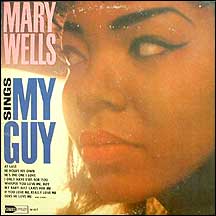
Mary Wells
From Wikipedia, the free encyclopedia
Background information
Birth name Mary Esther Wells
Born May 13, 1943
Origin Detroit, Michigan, United States
Died July 26, 1992 of Larynx Cancer (age 49)
Genre(s) R&B, pop
Occupation(s) Singer,
Years active 1959-1992
Label(s) Motown, Atco
Mary Esther Wells (May 13, 1943 - July 26, 1992) was an American soul, R&B, and pop singer. She was one of the signature voices of the Motown sound, most famous for her 1964 hit "My Guy".
Biography
Humble beginnings
Wells grew up in a poor Detroit, Michigan neighborhood without a father. Her mother worked tirelessly in domestic work to support Mary and her two siblings. When Wells was two, she caught spinal meningitis. She managed to survive the often fatal disease, but lost her sight, her hearing, and was temporary paralyzed. Eventually her hearing and eyesight returned, but it took her some time to learn to walk again.
Early career
From an early age Wells had a love of music and singing, and was a member of the Northwestern High School choir. She also sang at local clubs and competed in various talent contests. In 1959, she met Tamla Records chief Berry Gordy's assistant, Robert Bateman, telling him about a song she had written for artist Jackie Wilson. Bateman arranged an audition for Wells and her song with Gordy, and she sang the song for the record producer. Instead of buying the song for Wilson, Gordy offered Wells a contract as an artist. The song Wells had sang, "Bye Bye Baby," became her first single after some polishing and was released on the Tamla label. The song ended up a top ten R&B hit in 1960, and crossed over to pop radio where it peaked at #45.
With Mary Wells' debut success, Gordy, who was at the time expanding Tamla Records into the Motown Record Corporation, immediately brought her back to the studio. Their work produced the follow-up hit, "I Don't Want to Take a Chance," which equaled her first single's success. Her third single, "Strange Love," met indifferent reception at radio and failed to chart. In 1962, Gordy decided to bring Wells and Motown's star songwriter, Smokey Robinson, together.
In early 1962, "The One Who Really Loves You" swept across the nation. The ballad broke into the top ten at both R&B and Pop radio, eventually peaking at #2 at R&B and #8 on Billboard's Pop chart. Gordy immediately followed with the release of "You Beat Me to the Punch," a light-hearted tune that reached #1 at R&B and replicated its predecessor's success at Pop. The string of hits continued with "Two Lovers," a tune that brought Wells her second R&B #1 and her third Pop top ten in a row. When the album The One Who Really Loves You was released, it broke the top ten at the album chart and became the best selling Motown album to that point.
The year 1963 brought another string of hits and a premature greatest hits compilation. "Laughing Boy" and "What's Easy for Two is So Hard for One" both broke the R&B top ten and the top thirty at Pop. "Your Old Standby" surpassed its A-side ("What Love Has Joined Together") and peaked at #8 at R&B and broke the Pop top forty. Wells rounded out the year with another R&B top ten, "You Lost the Sweetest Boy" (with the Supremes and the Temptations singing backup), which also ended up peaking at #22 on the Pop chart.
"My Guy" and concurrent success
A new song for 1964 became Wells' signature song and her most successful as well. "My Guy", which featured the yearning voice of Wells and the Robinson's infectious lyrics and arrangement, became Wells' greatest hit. Though the song started off slowly, it broke up The Beatles run at the top of the pop charts in May of 1964. The song became one of Motown's classics, and today is used in many films and commercials.
With a smash hit riding the airwaves of summer, Gordy decided to team the two stars of his label, Wells and Marvin Gaye, who had gradually built up momentum on the charts. Together, the result of their work, became a hit album and featured two simultaneous top twenty hits, "Once Upon a Time" (#17 Pop) and "What's the Matter With You Baby (#19 Pop).
It was at this time that The Beatles openly called Wells their favorite American singer, and invited her to tour with them throughout the United Kingdom. Wells accepted their invitation, and, after she had left Motown, was inspired to record Love Songs to the Beatles, an album featured several songs penned by the British stars.
Breaking from Motown
After a successful year, Wells reflected on her career and especially the financial reward (or lack thereof) she had received from her success. With encouragement from her husband, Herman Griffin, and a lucrative contract with 20th Century Fox Records which promised a film career, Mary Wells sued Motown. She argued not only for larger royalties, but to dissolve the original contract she'd signed at age seventeen. Wells won the lawsuit and was rewarded a fair settlement. Gordy tried to prevent other labels from signing the successful singer to no avail, as she signed with Fox.
Life after Motown
Wells immediately began recording new material for her new self-titled album. Despite her first three singles at the label being relative successes, the album brought in disappointing sales. The label began having second thoughts and pulled promotion for the album. They also failed to fulfill the film agreements, and the contract was dissolved in mid-1965 with Wells walking away with a small settlement.
Next, Wells signed with Atco Records, a subsidiary of Atlantic Records. With the dedicated promotion of Atco Records, Well's first single with the label, "Dear Lover," hit #6 at R&B radio, and just missed breaking the top fifty at pop. All of the following singles failed. The Two Sides of Mary Wells album with the label was even less successful than her previous. A two-year contract with Jubilee Records brought two minor hits, "The Doctor" and "Dig the Way I Feel," but ended the same as her previous contracts.
By 1970, Wells had divorced Griffin and married Cecil Womack, brother of recording artist Bobby Womack. Together they had six children and she decided to retire from performing in 1970. She returned twice to record singles for Reprise Records, but neither found success. Wells divorced Womack in 1977 and experienced a slight career rebirth in 1981, when she recorded In and Out of Love, a disco-infused album for Epic Records. The single "Gigolo" became a major dance hit, peaking at #2 on the Billboard disco charts, and crossing over to peak at #69 on the R&B chart. She remarried in the late 80s, to concert promoter Kenneth Johnson, where they had met in Bakersfield, CA.
The last years
With newfound fame, Wells continued touring, and re-recorded some of her hits and some new material for an Allegiance Records album, I'm a Lady. In 1990, she released another album, Keeping My Mind on Love, for Motor City Records. That same year, Wells, a longtime smoker, was diagnosed with cancer of the larynx. She immediately began treatment and was forced to sell her house, possessions, and eventually could not afford health insurance. The treatments ravaged her voice, which forced Wells to quit touring. With no way to continue treatment, Wells' friends Diana Ross, Mary Wilson and Martha Reeves financially supported her, with the help of many artists who looked up to Wells, including Rod Stewart, Bruce Springsteen, Aretha Franklin, and Bonnie Raitt.
Wells was honored by Stevie Wonder, Little Richard, and others on an episode of The Joan Rivers Show in 1990. The following year, she testified for Congress to encourage government funding for cancer research. In the summer of 1992, Wells was hospitalized for pneumonia at the Kenneth Norris Jr. Cancer Hospital in Los Angeles, CA.
Still suffering the effects of her cancer, her weakened immune system could not take the extra strain. Wells died on July 26, 1992 at age forty-nine.
0 Replies
bobsmythhawk
1
Reply
Sun 13 May, 2007 09:55 am
A play on words....
A bicycle can't stand alone because it is two-tired.
Whats the definition of a will? (it's a dead giveaway)
Time flies like an arrow. Fruit flies like a banana.
A backward poet writes inverse.
In democracy, it's your vote that counts; in feudalism it's your count
that votes.
She had a boyfriend with a wooden leg, but broke it off.
A chicken crossing the road is poultry in motion.
If you don't pay your exorcist you get repossessed.
With her marriage she got a new name and a dress.
Show me a piano falling down a mineshaft and I'll show you a A-flat
minor.
When a clock is hungry it goes four seconds.
The man who fell into an upholstery machine is fully recovered.
A grenade thrown into a kitchen in France would result in Linoleum
Blownapart.
You feel stuck with your debt if you can't budge it.
Local Area Network in Austrailia: the LAN down under.
He often broke into song because he couldn't find the key.
Every calendar's days are numbered.
A lot of money is tainted: "taint yours and 'taint mine.
A boiled egg in the morning is hard to beat.
He had a photographic memory which was never developed.
A plateau is a high form of flattery.
The short fortune teller who escaped from prison was a small medium at
large.
Those who get too big for their britches will be exposed in the end.
When you've seen one shopping center you've seen a mall.
Those who jump off a Paris bridge are in Seine.
When an actress saw her first strands of gray hair she thought she'd
dye.
Bakers trade bread recipes on a knead to know basis.
Santa's helpers are subordinate Clauses.
Acupuncture is a jab well done.
Marathon runners with bad footwear suffer the agony of defeat.
0 Replies
edgarblythe
1
Reply
Sun 13 May, 2007 10:42 am
I Can't Love You Any More
Benny Goodman & His Orchestra
I can't love you any more
Any more than I do
For if I love you any more
I would have to be two
I love you with my heart
I love you with my mind
I love you, love you, love you
All there is, I find
So I can't love you any more
Any more than I do
0 Replies
TTH
1
Reply
Sun 13 May, 2007 10:46 am
Nice to see you again Letty
NEIL DIAMOND lyrics - "Beautiful Noise"
What a beautiful noise
Comin' up from the street
It's got a beautiful sound
It's got a beautiful beat
It's a beautiful noise
Goin' on ev'rywhere
Like the clickety-clack
Of a train on a track
It's got rhythm to spare
It's a beautiful noise
And it's a sound that I love
And it fits me as well
As a hand in a glove
Yes it does, yes it does
What a beautiful noise
Comin' up from the park
It's the song of the kids
And it plays until dark
It's the song of the cars
On their furious flights
But there's even romance
In the way that they dance
To the beat of the lights
It's a beautiful noise
And it's a sound that I love
And it makes me feel good
Like a hand in a glove
Yes it does, yes it does
What a beautiful noise
It's a beautiful noise
Made of joy and of strife
Like a symphony played
By the passing parade
It's the music of life
It's a beautiful noise
And it's a sound that I love
And it makes me feel good
Just like a hand in a glove
Yes it does, yes it does
What a beautiful noise
Comin' into my room
And it's beggin' for me
Just to give it a tune
0 Replies
Letty
1
Reply
Sun 13 May, 2007 10:47 am
Ah, dear hawkman, love your puns, honey, and thanks for the welcome back.
To Eva:
One of my favorite songs, gal, and thanks.
To ehBeth:
The Blues Bros. Perfect for the day, lilac lovely.
To RexRed:
Nice to see you back, Maine
To our dj:
You always know what to play. Big smile.
If I have missed anyone, please give me a second chance.
Will, as usual, await our Raggedy to do "you know what", and then I have a brief movie review for you.
0 Replies
Letty
1
Reply
Sun 13 May, 2007 11:05 am
TTH, nice to see you as well. This is the perfect opportunity to give a brief review of the movie, INFAMOUS. It is, in a way, the biography of Truman Capote, and the actor who did his role is someone of whom I have never heard, but he was superb. The entire thing delves into Capote's fascination with the two men who killed the Clutter family. The convicted murderers, Hickhock and Smith, became the object of Capote's interviews.
What was amazing to me. is that Gwyneth Paltrow did her own singing in the movie, and she was excellent. Actually, folks, the following song was based on an actual event of Peggy Lee who while singing, stopped abruptly, waited for several tense moments, then resumed the song as if nothing unusual had occurred.
Cole Porter
What is this thing called love?
This funny thing called love?
Just who can solve its mystery?
Why should it make a fool of me?
I saw you there one wonderful day
You took my heart and trew it away
That's why I ask the Lord in Heaven above
What is this thing called love?
0 Replies
Raggedyaggie
1
Reply
Sun 13 May, 2007 11:21 am
Good afternoon - an expecially good one to see Letty back here again.
Doing "you know what".
Senta Berger, Ritchie Valens and Mary Wells:
I've just seen "Capote" and "In Cold Blood" (also read the book) and would like to see "Infamous". Is it out on DVD, Letty?