Tex Morton (born Robert William Lane in Nelson, New Zealand, August 30, 1916; died July 23, 1983) was a pioneer of Australian country music. At age 14 he left home to launch himself into show business. His first attempts to run away and join the circus ended in him being found busking by police and he was promptly returned home. About 1934, he recorded some "hillbilly" songs privately. He later claimed that these were played on New Zealand radio, though this is perhaps unlikely. Some of these recordings have recently come to light, though they have not been commercially reissued. About 1934 (the exact date is uncertain - Morton himself once claimed it was 1932), he emigrated to Australia, apparently intent on a recording career. On February 25, 1936, he recorded four songs for the Columbia Graphophone Company in Sydney, Australia.
Between 1936 and 1943, Morton recorded 93 78-rpm records of his songs (accompanying himself on an acoustic guitar for most tracks) for Columbia's Regal Zonophone label. On some later tracks, he was accompanied by his band, The Rough Riders, and a female singer 'Sister' Dorrie (real name Dorothy Carroll). In 1943, he left Columbia following a dispute with Arch Kerr, the Record Sales Manager, probably over the company's reluctance to use The Rough Riders. He was billed as 'The Yodelling Boundary Rider' on records, though he apparently didn't approve of the name.
In 1949 and 1950, he recorded more sides in Sydney and possibly New Zealand. These were released on the Rodeo and Tasman labels; some songs were probably recorded at the instigation of Ralph Peer, who visited Sydney in 1949 and met Morton.
Morton, in his career, capitalized on American cowboy and "Wild West" images, and was sometimes billed as "The Singing Cowboy Sensation," performing for rodeos, and singing in a yodeling style that drew heavily on those of American singers such as Jimmie Rodgers. His yodelling was influenced by Rodgers, Goebel Reeves and the British Alpine yodeller, Harry Torrani. Although Morton chose to sing in an American (rather than Australian) accent and sang many songs with American subject matter, several of his recorded songs (such as "The Ned Kelly Song," "Beautiful Queensland," and "Murrumbidgee Jack") feature Australian themes. ("Beautiful Queensland" was a simple re-write of W. Lee O'Daniel's "Beautiful Texas", however.)
During the 1930s and 1940s, he gradually 'Australian-ised' many of the songs he wrote. This approach was followed by other Australian country artists who followed in his footsteps, such as Buddy Williams and Slim Dusty, leading to a particular genre of country music - the Australian bush ballad, which was also influenced by the turn-of-the-century poetry of 'Banjo' Patterson and Henry Lawson.
From 1950 to 1959, Morton was in Canada and the United States. He toured with Pee Wee King in 1952 and recorded in Nashville in March 1953. He claimed to have toured for six months as an opening act for Hank Williams, but this is extremely unlikely, though he may have met Williams in late 1952 through Oscar Davis, who was Morton's manager and Williams's last manager.
Morton toured Canada and the United States as a stage hypnotist, memory expert, whip cracker and sharpshooter, and was associated for some time with the Canadian country singer, 'Dixie' Bill Hilton. He returned to Australia in 1959 with a Grand Ole Opry show, featuring Roy Acuff, the Wilburn Brothers and June Webb, but the show was not popular with Australian audiences and the tour had to be called off.
Morton continued to record during the 1960s and 1970s, but increasingly showed an interest in acting. He appeared in Australian television shows and feature movies (eg "We Of The Never Never"). He was the first inductee into Australia's country music Roll of Renown in 1976, recognising his pivotal role in the development of country music in Australia and New Zealand.
Morton died on July 23, 1983, after a short illness.
Sergeant Small
Tex Morton
I went broke in western Queensland in 1931,
Nobody would employ me so my swagging days begun
I headed out to Charleville, out to the western towns,
I was on my way to Roma, destination Darling Downs
And my pants were getting ragged, my shoes were getting thin,
When we stopped in Mitchell, a goods train shunted in,
The engine blew her whistle, I was looking up to see,
She was on her way to Roma, that was very plain to me.
I wished that I was 16 stone and only seven foot tall,
I'd go back to western Queensland, and beat up Sergeant Small.
As I sat and watched her, inspiration seemed to grow,
And I remembered the government slogan, It's a railway that you own
So by the time the sun was setting, and night was going nigh,
So I gathered my belongings and I caught her on the fly.
And as we came into Roma, I tucked my head down low,
And a voice said any room mate? and I answered, Plenty Beu
Then at this tip this noble man, the voice of Sergeant Small,
Said, I've trapped you very nicely, you're headed for a fall
I wished that I was 16 stone and only seven foot tall,
I'd go back to western Queensland, and beat up Sergeant Small.
(instrumental, then change key)
The Judge was very kind to me, he gave me thirty days,
He said, Maybe that would help to cure my rattler jumping ways
So if your down and outback, let me tell you what I think,
Just stay off the Queensland railways, it's a shortcut to the clink.
I wished that I was 16 stone and only seven foot tall,
I'd go back to western Queensland, and beat up Sergeant Small.
I'd go back to western Queensland, and beat up Sergeant Small.
0 Replies
Raggedyaggie
1
Reply
Wed 31 Jan, 2007 07:34 pm
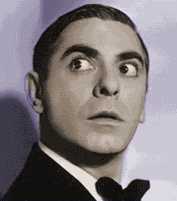
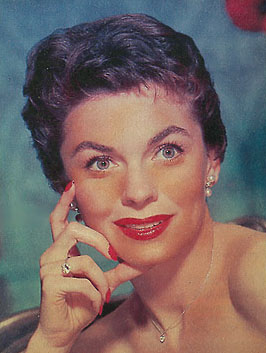
Eddie Cantor, Tallulah Bankhead, Carol Channing, Mario Lanza, Joanne Dru and Jean Simmons
Took awhile, but I made it.
0 Replies
Letty
1
Reply
Wed 31 Jan, 2007 07:34 pm
Hey, dj. Look up, Canada. There's our Raggedy with a trio, and they are either looking sexy or laughing.
Hey, PA. Welcome back. I think I see Eddie and Sylvia? and of course, laughing Carol.
Ok, now we can listen to dj's Tex Morton bio.
Great background, dj. Thanks for the info, cause I didn't know about that Aussie.
0 Replies
Raggedyaggie
1
Reply
Wed 31 Jan, 2007 07:59 pm
You see Sylvia, Letty?
WHO is Silvia? What is she?
That all our swains commend her?
Holy, fair, and wise is she;
The heaven such grace did lend her,
That she might admirèd be.
Is she kind as she is fair?
For beauty lives with kindness:
Love doth to her eyes repair,
To help him of his blindness;
And, being help'd, inhabits there.
Or is she, Talullah? and maybe, you're thinking of that Sydney lady?
0 Replies
Letty
1
Reply
Wed 31 Jan, 2007 08:16 pm
Ah, Raggedy. I always know you will keep me straight. You are one amazing lady, PA.
That lovely poem by the Bard was a delightful way to let me know that I was wrong.
" Goodnight, parting is such sweet sorrow, that I shall say goodnight til it be morrow."
From Letty with love.
0 Replies
edgarblythe
1
Reply
Wed 31 Jan, 2007 10:10 pm
Afraid To Dream
Benny Goodman
Afraid to dream
Afraid that you may not be there
Afraid to dream
Without you it would seem so bare
With open arms I call to you
I want you, dear
Just as I reach for you
Why do you disappear
Afraid to dream
I'll see you there with someone new
Afraid to find another one caressing you
Although you promised me that this could never be
It's the thought of losing you
That makes me so afraid to dream
0 Replies
Letty
1
Reply
Thu 1 Feb, 2007 06:39 am
Good morning, WA2K listeners and contributors.
Hey, edgar. What a delightful dream song, Texas. I wasn't afraid to dream, but I am glad that I woke up this morning. We missed our Raggedy's extra photo's, too. Thanks again for Mario's collage, Joanne, and Jean, gal.
Well, folks, while we weren't looking, daylight savings time was moved to March. So, here is a morning song that is the antithesis of what legislatures do when our heads are turned:
Spring Will Be A Little Late This Year
Spring will be a little late this year
a little late arriving, in my lonely world over here
For you have left me and where is our April love old
Yes you have left me and winter continues cold
As if to say that spring will be a little slow to start
A little slow reviving that music it made in my heart
Cause time heals all things, so I needn't cling to this fear
It's merely that spring will be a little late this year
Yes time heals all things so I needn't cling to this fear
It's merely that spring will be a little late this year
0 Replies
Raggedyaggie
1
Reply
Thu 1 Feb, 2007 11:55 am
Good afternoon, WA2K.
Remembering Clark Gable, ( Feb. 1, 1901 - 1960)
0 Replies
bobsmythhawk
1
Reply
Thu 1 Feb, 2007 01:11 pm
Clark Gable
From Wikipedia, the free encyclopedia
Birth name William Clark Gable
Born February 1, 1901
Cadiz, Ohio, USA
Died November 16, 1960
Los Angeles, California, USA
Academy Awards
Best Actor
1934 It Happened One Night
William Clark Gable (February 1, 1901 - November 16, 1960) was an Academy Award-winning American film actor and the biggest box office star of the early sound film era.
In 1999, the American Film Institute named Gable among the Greatest Male Stars of All Time, ranking at No. 7.
Early life
Clark Gable was born in Cadiz, Ohio, on February 1, 1901 to William H. Gable, an oil-well driller
His original name was probably William Clark Gable, but the usual authorities in such matters ?- including birth registrations and school records ?- contradict one another. The first name must have been in honor of his father, William Henry Gable. . . "Clark" was the maiden name of his maternal grandmother. In childhood he was almost always called "Clark," although some friends called him "Clarkie," "Billy," or "Gabe."
Harris, Warren G. (2002). Clark Gable: A Biography. Harmony, 1. ISBN 0-609-60495-3. </ref>
When he was six months old, his sickly mother had him baptized Roman Catholic. She died when he was ten months old, probably as the result of an aggressive brain tumor. Following her death, Gable's father's family refused to countenance any notion of raising the child a Catholic, provoking an enmity with his late mother's side of the family. The dispute was resolved when the Protestant side agreed to allow young William Clark Gable to spend more time with his mother's Catholic relatives.
In April 1903, Gable's father, Will Gable, married Jennie Dunlap, whose family came from the small neighboring Ohio town of Hopedale. Will purchased land there and built a house and the new Gable family settled in. By 1917, Clark was in high school when his father's business had financial difficulties. Will decided to try his hand at farming and the family moved to Ravenna, just outside of Akron, but Clark had trouble settling down and soon left school to work in Akron's tire factories.
Gable was inspired to be an actor after seeing a life-impressing play, but he was not able to make a real start until he turned 21 and could inherit money that had been left to him. By then, Jennie had died. Deciding not to follow his father, Clark found work with several second-class theater companies and worked his way across the Midwest to Portland, Oregon, where he found work as a tie salesman in the Meier & Frank department store. While there he met the grandson of well-known actress Laura Hope Crews, who encouraged him back onto the stage and into another theater company. His acting coach was Josephine Dillon, who had his teeth fixed and after some rigorous training eventually considered him ready to attempt a film career.
Hollywood
In 1924, with Josephine's financial aid, they went to Hollywood where she became his manager and his first wife. Although he found work as an extra and bit player in such silent films as The Plastic Age starring Clara Bow, Gable was not offered any major roles and so returned to the stage. It was only after his impressive appearance as the seething and desperate character Killer Mears in the play The Last Mile that he was offered a contract with MGM in 1930. Gable's first role in a sound picture was as the villain in a low-budget William Boyd western called The Painted Desert (1931). He received a great amount of fan mail as a result of his powerful voice and appearance, which forced the studio to take notice.
He worked mainly in supporting roles, often as the "heavy", building his fame and public visibility during 1931 in such important movies as A Free Soul, in which he played a gangster who slapped Norma Shearer (Gable never played a supporting role again as long as he lived after that slap), Susan Lenox (Her Fall and Rise) with Greta Garbo, and Possessed, in which he and Joan Crawford steamed up the screen with some of the passion they shared for decades in real life. To bolster his rocketing popularity, MGM was now frequently pairing him with well-established female stars, such as Jean Harlow. An enormously popular combination, Gable and Harlow were paired together in six films, the most notable being Red Dust and Saratoga, during production of which Harlow would die of kidney failure. In the following years, he acted in a succession of enormously popular pictures which levitated him to megastar status, earning him the undisputed title of "King of Hollywood." Throughout most of the 1930s and 1940s, he was arguably the world's biggest movie star.
When MGM head Louis B. Mayer decided that Gable was getting difficult and ungrateful, he loaned Gable out to the lower-rank Columbia studio. That would teach him a lesson. The result: Gable won the Academy Award for Best Actor for his 1934 performance in the film It Happened One Night. He returned to MGM a bigger star than ever.
In 1930, Clark and Josephine Dillon were granted a divorce. A few days later, he married Texas socialite Ria Franklin Prentiss Lucas Langham. After moving to California, they had to be married again in 1931, possibly due to differences in state legal requirements.
Most Famous Roles
Despite his reluctance at the time to appear in the role, Gable is best known for his performance as Rhett Butler in the 1939 classic Gone with the Wind, which earned him an Academy Award nomination for Best Actor. At the time, Gable was wary of potentially disappointing a public who had decided no one else could play the part. This was his first film in Technicolor.
A few years before, Gable had also earned an Academy Award nomination for his role as Fletcher Christian in 1935's Mutiny on the Bounty. In addition, Gable was one of the few actors to play the lead in three films that won an Academy Award for Best Picture. Decades later, Gable would say that whenever his career would start to fade, a re-release of Gone with the Wind would instantly revive everything, and he continued as a top leading man for the rest of his life.
Marriage to Carole Lombard and World War II
Gable's marriage in 1939 to his third wife, successful actress Carole Lombard, was reportedly the happiest period of his personal life. They purchased a ranch at Encino and once Clark had become accustomed to her often blunt way of expressing herself, they found they had much in common.
Then, on January 16, 1942, the idyll ended. Lombard, who had just wrapped her 57th film, To Be Or Not To Be, was on a tour to sell war bonds when the twin-engine DC-3 she was travelling in crashed into a mountain near Las Vegas. Upon hearing the news, Gable flew to the scene and had to be forcibly restrained from climbing the snowcapped mountain himself in an effort to rescue her.[citation needed] After Carole's body was recovered, he reportedly sobbed, "Oh, God! I don't want to go back to an empty house..."[citation needed]
Lombard's death, declared the first war-related female casualty the U.S. suffered during World War II, was the worst loss her husband ever endured. Gable lived out his life at the couple's Encino home, made 27 more movies and even remarried twice. "But he was never the same," said Esther Williams. "His heart sank a bit."[1]
Devastated and inconsolable at the loss of Lombard, Gable soon joined the U.S. Army Air Forces. As Captain Clark Gable he trained with and accompanied the 351st Heavy Bomb Group as head of a 6-man motion picture unit making a gunnery training film. While at RAF Polebrook, England, Gable flew five combat missions, including one to Germany, as an observer-gunner in B-17 Flying Fortresses between May 4 and September 23, 1943, earning the Air Medal and the Distinguished Flying Cross for his efforts. He left the Army Air Forces with the rank of Major.
After World War II
His first movie after returning from service in WWII was the 1945 production of Adventure. It was a critical and commercial failure and, despite some subsequent popular successes such as Mogambo (a Technicolor remake of Red Dust) and a lesser success Never Let Me Go opposite Gene Tierney (another remake of a film which he made a decade earlier). Tierney was a favorite of Gable and was very dissapointed when Grace Kelly replaced Tierney in Mogambo. Gable became increasingly unhappy with the mediocre roles offered him by MGM as a mature actor. He refused to renew his contract with them in 1953 and proceeded to work independently.
In 1949, Clark married Sylvia Ashley, a British divorcée who also was the widow of Douglas Fairbanks. Unfortunately, this relationship was profoundly unsuccessful and they divorced in 1952.
His fifth wife, married after an on-again, off-again affair spanning thirteen years, was Kay Spreckels (full name Kathleen Williams Capps de Alzaga Spreckels), a thrice-married former fashion model and stock actress. She was the mother of Gable's son, John Clark Gable, born on March 20, 1961, four months after Clark's death. She also had two children from her third marriage, Joan and Adolph Spreckels III (nicknamed "Bunker").
Gable also had a daughter, Judy Lewis (b. 1935), the result of an affair with actress Loretta Young, begun on the set of The Call of the Wild. In an elaborate scheme, Young took an extended vacation and went to Europe to give birth. On her return, she claimed to have adopted Judy (a gambit that got stranger when the child grew to look eerily like her mother, only with ears sticking out like Gable's).
According to Lewis, Gable visited her home once, but he didn't tell her that he was her father. While neither Gable nor Young would ever publicly acknowledge their daughter's real parentage, this fact was so widely known that in Lewis's autobiography Uncommon Knowledge, she wrote that she was shocked to learn of it from other children at school. Loretta Young would never officially acknowledge the fact, which she said would be the same as admitting to a "venial sin". However, she finally gave her biographer permission to include it only on the condition the book not be published until after Young's death.
Death
Gable's last film was The Misfits (written by Arthur Miller and directed by John Huston), which co-starred Marilyn Monroe and Montgomery Clift. The Misfits would prove not only to be Gable's swan song, but it would also mark the final completed performance by Marilyn Monroe. Many critics regard Gable's performance in his final film to be his finest. Gable died in Los Angeles, California in November 1960, the result of a fourth heart attack.
There was much speculation about Gable's physically demanding Misfits role (which required yanking on and being dragged by horses) having contributed to his sudden death soon afterward. In a widely reported quote, Kathleen Gable blamed it on stress caused by "the endless waiting... waiting (for Monroe)". Monroe, on the other hand, claimed that she and Kathleen had become close during the filming and would refer to Clark as "Our Man". (Spicer, Clark Gable, McFarland, pp. 300-301). Support for Monroe's claim may be found in that Kathleen Gable specifically invited Marilyn to Gable's funeral and the two of them sat together in the church during the service, as shown in contemporary newsreels. Others have blamed Gable's crash diet before filming began; for years, Gable's head would sometimes shake from the diet pills he would take to strip off pounds before making a film, a practice which may have contributed to his early death. [citation needed] It should be noted that Gable was in poor health when filming began from years of heavy smoking and drinking, and in the previous decade had suffered two seizures which may have been heart attacks. [citation needed]
Clark Gable is interred in Forest Lawn Memorial Park Cemetery in Glendale, California, beside his beloved Carole Lombard.
0 Replies
bobsmythhawk
1
Reply
Thu 1 Feb, 2007 01:16 pm
Stuart Whitman
From Wikipedia, the free encyclopedia
Stuart Whitman (born February 1, 1926 or, according to other sources 1928 or 1929) is an American actor arguably best known for playing Marshal Jim Crown in the western television series Cimarron Strip in 1967, co-starring with John Wayne in the Western film The Comancheros in 1961, and as the top-billed romantic lead in the extravagant aerial epic Those Magnificent Men in Their Flying Machines in 1965.
Born in San Francisco, California, he graduated from high school in Los Angeles and spent three years in the Army Corps of Engineers, where he took up boxing. After leaving the army, he enrolled in Los Angeles City College and the Los Angeles Academy of Dramatic Art. He had a small part in When Worlds Collide, then took small roles in such films as The All American, Brigadoon, Ten North Frederick and The Sound and the Fury. In 1957, Whitman was seriously considered for the role of Bart Maverick in the television series Maverick when the studio realized that they needed another Maverick to rotate as the series lead with James Garner, who closely resembled Whitman, but Jack Kelly wound up with the part. Whitman's first starring role was in Murder, Inc. in 1960.
In 1961, Whitman was nominated for an Academy Award for Best Actor for his role as a child molester in The Mark. He has since appeared in starring and supporting roles in many films, including Francis of Assisi, The Fiercest Heart, The Comancheros (sharing leading man status with John Wayne), Convicts 4, The Day and the Hour, Signpost to Murder, Shock Treatment, Rio Conchos, Those Magnificent Men in Their Flying Machines, Sands of the Kalahari, An American Dream, The Last Escape, The Decks Ran Red, The Invincible Six, Night of the Lepus, Shatter, Tony Saitta, and Guyana: Crime of the Century. Whitman had a memorable foray into television for a single season in 1967 as heroic Marshal Jim Crown in the lavish and critically acclaimed 90-minute weekly western series Cimarron Strip, which was also widely noted for its thrilling theme music. He would later on play the role of Clark Kent's father Jonathan Kent on the popular TV series Superboy.
0 Replies
bobsmythhawk
1
Reply
Thu 1 Feb, 2007 01:23 pm
The Everly Brothers
From Wikipedia, the free encyclopedia
The Everly Brothers are a pair of brothers who were top-selling country-influenced rock and roll performers, best known for their acoustic guitar playing and close harmony singing, who had their greatest success in the 1950s.
Don Everly was born Isaac Donald Everly February 1, 1937 in Brownie, a small coal-mining town (now defunct) near Central City, Muhlenberg County, Kentucky. Phil Everly was born Philip Everly January 19, 1939 in Chicago. The sons of two Kentucky country musicians, Ike and Margaret Embry Everly, the Everly Brothers grew up in the state of Iowa. They performed with their parents on live radio and in small-market live shows in the mid-West.
Style
In addition to both being competent guitarists, the brothers used a style of close harmony singing in which each brother sang a tune that could often stand on its own as a plausible melody line. This was in contrast to 'classic' harmony lines which, while working well alongside the melody, would sound strange if heard by themselves. One of the best examples of their close-harmony work is their recording of "Devoted To You."
With soft, mainly acoustic guitar backing, sweet close-harmony vocals, non-threatening lyrics (though arguably containing much of the same subversion and sexual tension as those of more controversial artists), and clean-cut white faces, the Everly Brothers were never perceived as a threat to society in the way that performers such as Chuck Berry and Little Richard were. Even so, they are one of rock and roll music's most important acts because their music helped bridge the gap between rock and country music in a way that appealed to fans of both genres. In addition, their approach to harmony singing influenced nearly every rock and roll group of the 1960s, The Beatles being the most notable example.
Early career
The Everly Brothers recorded their own first single, "Keep A' Lovin' Me," in 1956, under the aegis of Chet Atkins, but it flopped. However their next single, "Bye Bye Love," (which had been rejected by 30 other acts, including Elvis Presley) became an across-the-board smash, reaching #2 on the pop charts, and #1 on both the Country, and the R & B charts. The song, written by the songwriting husband and wife team of Felice and Boudleaux Bryant, became their first million-seller.
They soon became known as the stalwarts of Archie Bleyer's Cadence Records label. They had a hit with the single "Claudette," written by Roy Orbison. Working with the Bryants, the harmonic duo had a number of hits in the U.S. and the UK, the biggest of which were "Wake Up Little Susie," "All I Have to Do Is Dream," and "Bird Dog."
In 1960, when they signed with Warner Bros. Records, they continued to have hits, starting big with 1960's "Cathy's Clown" which was released as number WB1, the first release in the UK by that company. Other singles followed, such as "Crying In The Rain" (1963) and "The Ferris Wheel" (from 1964), but the years after 1962 saw the Everly Brothers become less commercially viable than before?-even as they became artistically more accomplished. Their enlistment in the United States Marine Corps in 1963, to meet military obligations, took them somewhat out of the spotlight immediately before The Beatles (whose close harmonies were modeled on the Everlys) broke loose in the US and changed the pop-music landscape.
The 1962 WB Golden Hits album included their WB hits from Cathy's Clown in 1960 to That's Old-Fashioned in 1962. The 1964 WB album The Very Best Of included new rerecordings of some Cadence hits along with original WB hits. Some of these rerecordings are sometimes played and mistaken for the originals, such as Devoted To You and Dream. Til I Kissed You particularly can't compare to the original. In 1963 Cadence obliged us with a more complete album of those original hits, titled "15 Everly Hits".
The 1963-64 period includes some interesting non-hits which are worth hearing, like Hello Amy, So It Always Will Be, and Nancy's Minuet. They are found currently on some completist reissues, particularly from Europe.
Later career
Following the British Invasion, Everly Brothers recordings like "Gone, Gone, Gone" (1964) and "The Price Of Love," "I'll See Your Light" and "It Only Costs a Dime" (all 1965) began to reflect many of the changes in popular music they had, with their earlier work, put into motion. They recorded, with members of The Hollies contributing songs such as "So Lonely" and "Don't Run and Hide," a classic album entitled Two Yanks in England (1966), at the time somewhat under-appreciated but now considered one of their best efforts.
In 1967, "It's All Over," hearkening back to their late-1950s sound, did not do as well as the more modern hit "Bowling Green." In 1968 they recorded another album now regarded as a classic, Roots, which featured their own compositions alongside songs by Randy Newman and others. In short, their mid- and late-'60s material is considered by many critics and listeners to compare favorably to that done by The Beatles and The Byrds.
The duo broke up in 1973, but reformed in 1983 with a new album produced by Dave Edmunds. "On the Wings of a Nightingale", written by Paul McCartney for the brothers, became a hit single in both the US and UK, and their 1983 Reunion Concert at the Royal Albert Hall in London which was instigated by English virtuoso guitarist Albert Lee (who was also the musical director) resulted in both a well-received CD and video. They then earned a final charting country-music hit with "Born Yesterday."
At around the same time, Phil enjoyed some success as a soloist, with an album Phil Everly, recorded mainly in London, and including musicians such as Dire Straits guitarist Mark Knopfler, Rockpile drummer Terry Williams, and evergreen session keyboard player Pete Wingfield. "She Means Nothing To Me", featuring Cliff Richard as joint lead vocalist, was a Top 10 hit, and "Louise" reached the Top 50 in 1983. In 1994, a new recording of "All I Have to Do Is Dream", featuring Cliff Richard and Phil sharing vocals, was a UK Top 20 hit.
In 2006, Phil Everly sang a duet, "Sweet Little Corrina", with country singer Vince Gill on his much acclaimed album These Days. [1]
Legacy
The Everly Brothers have had a total of 26 Billboard Top 40 singles. In 1986, they were among the first 10 artists inducted into the Rock and Roll Hall of Fame. In 1997, they were awarded the Grammy Lifetime Achievement Award. In addition, they were inducted into the Country Music Hall of Fame in 2001 and the Vocal Group Hall of Fame in 2004.[2] Their pioneering contribution to the genre has been recognized by the Rockabilly Hall of Fame. The Everly Brothers have a star on the Hollywood Walk of Fame at 7000 Hollywood Blvd. In 2004, Rolling Stone Magazine ranked them #33 on their list of the 100 Greatest Artists of All Time.[3].
They were also accomplished songwriters, penning a number of their own hits, including "Till I Kissed You" (Don), "Cathy's Clown" (Don and Phil), and "When Will I Be Loved" (Phil). "Cathy's Clown" and "When Will I Be Loved" later became hits for Reba McEntire and Linda Ronstadt, respectively. Also, the Norwegian band a-ha covered "Crying In The Rain" in 1990 for their fourth album, East of The Sun, West of The Moon.
They still perform occasionally, despite having declared their retirement from both touring and the studio more than once. Most notably, they joined Simon and Garfunkel as the featured act in the Simon and Garfunkel reunion tour of 2003 and 2004. As a special tribute to the Everly Brothers, they were not the opening act, rather Simon and Garfunkel opened their own show and had the Everlys come out in the middle of the show for three songs In the liner notes to the Old Friends CD. The Everlys were brought in the middle of the show as "a way to telling the story of Simon of Garfunkel". For Paul Simon, it was not the first time he got to preform with his heroes. In 1986, The Everlys played harmonies on the title track of Simon's landmark album Graceland.
0 Replies
bobsmythhawk
1
Reply
Thu 1 Feb, 2007 01:32 pm
Brandon Lee
From Wikipedia, the free encyclopedia
Birth name Brandon Bruce Lee
Born February 1, 1965
Oakland, California
Died March 31, 1993
Wilmington, North Carolina
Height 6'0" (183cm)
Notable roles Eric Draven in The Crow
Brandon Bruce Lee (李國豪 Cantonese: Léi Gwokhòu Pinyin: Lǐ Guóháo); February 1, 1965 - March 31, 1993) was an American actor of Chinese, German and Swedish descent. He was the son of the late legendary martial arts film star Bruce Lee.
Early life
Brandon Lee was born in Oakland, California, to the legendary martial artist actor Bruce Lee and his wife Linda Emery. The family moved to Los Angeles, California when Brandon was three months old, but when offers for film roles became limited for his father the family moved back to his father's childhood home of Hong Kong in 1971; Bruce Lee made three films there between 1971 and 1973.
When Brandon was eight, his father died suddenly from a cerebral edema. After her husband's death, Linda Lee moved the family (including daughter Shannon, who was born in 1969) back to the United States. They lived briefly in his mother's hometown of Seattle (where Bruce Lee is buried), and then in Los Angeles, where Brandon grew up in the affluent area of Rolling Hills. According to his mother, he was "a handful" - "either the teacher's pet, or the teacher's nightmare."
He attended high school at Chadwick School, but was expelled for insubordination three months before graduating. He received his GED in 1983, and then went to Emerson College in Boston, Massachusetts where he majored in theatre. After one year, Lee moved to New York City where he took acting lessons at the famed Lee Strasberg Academy and was part of the American New Theatre group founded by his friend John Lee Hancock.
Career
Early work
In 1986, Lee got his first movie role in the Hong Kong action thriller Legacy of Rage in which he starred with Michael Wong and Bolo Yeung, who also appeared in his father's last film, Enter the Dragon. The film was made in Cantonese, and directed by Ronny Yu. It was also the only film Lee made in Hong Kong. Regarding the pressures of being the son of a legendary father, Brandon said, "You only have the burdens on you that you choose to put there."
Kung Fu sequels
Lee then returned to Los Angeles, where he worked for Ruddy Morgan Productions as a script reader. He was asked to audition for a role by casting director Lyn Stalmaster. The project was Kung Fu: The Movie, which was to be a feature-length television movie that was a follow-up to the television series Kung Fu.
Herbie Pilato, in his 1993 book The Kung Fu Book of Caine: The Complete Guide to TV's First Mystical Eastern Western, commented on the casting of the original Kung Fu series:
Before the filming of the Kung Fu TV movie began, there was some discussion as to whether or not an Asian actor should play Kwai Chang Caine. Bruce Lee was considered for the role. In 1971, Bruce Lee wasn't the cult film hero he later became for his roles in The Big Boss (1971), Fist of Fury (1972), Way of the Dragon (1972), Enter the Dragon (1973), and Game of Death (1978). At that point he was best known as Kato on TV's Green Hornet (1966-1967). (Kung Fu guest actor Robert Ito reports that Lee hated the role of Kato because he "thought it was so subservient.") "In my eyes and in the eyes of Jerry Thorpe," says Harvey Frand, " David Carradine was always our first choice to play Caine. But there was some disagreement because the network was interested in a more muscular actor and the studio was interested in getting Bruce Lee." Frand says Lee wouldn't have really been appropriate for the series - despite the fact that he went on to considerable success in the martial arts film world. The Kung Fu show needed a serene person, and Carradine was more appropriate for the role. Ed Spielman agrees: "I liked David in the part. One of Japan's foremost Karate champions used to say that the only qualification that was needed to be trained in the martial arts was that you had to know how to dance. And on top of being an accomplished athlete and actor, David could dance." [...] The character was half-Asian, half-Caucasian, so either an Asian or a Caucasian would have been a reasonable choice (A Eurasian would have been the most natural choice.) Nonetheless, grumbling from the Asian community would have made sense, given the fact that minor roles for Asian actors were almost nonexistent. James Hong, an actor on the show and ex-president of the Association of Asian/Pacific American Artists (AAPAA) says that at the time Asian actors felt that "if they were going to do a so-called Asian hero on Kung Fu, then why don't they hire an Asian actor to play the lead? But then the show went on, we realized that it was a great source of employment for the Asian acting community." In fact, Hong says, Carradine had a good relationship with the Asian community, (pages 32-33).
Pilato also comments that Bruce Lee's son, Brandon Lee, was involved in sequels to the series:
The late Brandon Lee, son of Bruce Lee, played Caine's son, Chung Wang. Toward the end of the film, Chung Wang asks Caine if he is his father. The question seems somewhat ironic since-in real life-Brandon's father was the chief contender for the role of Caine in the series. After Bruce Lee lost the part to Carradine, he went back to China, where he made Enter the Dragon, the film that began his legendary career in martial arts movies, (page 157).
In the first, Kung Fu: The Movie (1986), Caine (played by Carradine) is forced to fight his hitherto unknown son, Chung Wang (played by Lee). In the second, Kung Fu: The Next Generation (1987), the story moves to the present day, and centers on the story of Johnny Caine (Lee), who is the great-grandson of Kwai Chang Caine.
Later work
Lee then had a guest appearance in the short-lived American television series Ohara (1988) as Kenji, son of title character Lt. Ohara (played by Pat Morita). 1990 saw the release of his first English language B-grade film, Laser Mission, which was filmed cheaply in South Africa in 1988. In 1991, he starred opposite Dolph Lundgren in Showdown in Little Tokyo, his first studio film and American debut.
Lee signed a multi-picture deal with 20th Century Fox in 1991. He then had his first starring role in Rapid Fire, and was scheduled to do two more films for them. Screenwriter Jonathan Hensleigh wrote a script entitled Simon Says that was originally developed for Lee, but was later used as the blueprint for the movie Die Hard With a Vengeance.
In 1992, Lee landed the lead role of Eric Draven, an undead vigilante avenging his murder, and that of his fiancée, in the movie adaptation of The Crow, a popular underground comic book. About his character Lee said, "He has something he has to do and he is forced to put aside his own pain long enough to go do it".
It would be Brandon Lee's last film. Filming began on February 1, 1993, which was his 28th birthday.
Death
On March 31, 1993, the 52nd day of a 60-day shooting schedule for The Crow, the scene being filmed involved Lee's character walking into his apartment and discovering his girlfriend being raped by thugs. This would subsequently lead to Eric being brutally killed, along with his girlfriend, by the thugs. Actor Michael Massee, who played one of the villains named Funboy in the movie, was supposed to fire a gun at Lee as he walked into his apartment with groceries.
Because the movie's second unit team were running behind schedule, it was decided that dummy cartridges ?- bullets that outwardly appear to be functional, but contain no gunpowder ?- would be made from real cartridges, which had been brought to the set earlier in production. Bruce Merlin, an effects technician, dismantled the live cartridges by removing the bullets, emptying out the gunpowder, detonating the primer and reinserting the bullets. This rendered the cartridges inoperative but realistic in appearance. Merlin and his propmaster, Daniel Kuttner, took initiative to create some blanks by removing live cartridges and replacing the gunpowder with firework powder; the bullets were not reinserted.
Later, a cartridge with only a primer and a bullet was fired in a pistol; this caused the bullet to lodge in the forcing cone of the revolver. When the first unit used this gun to shoot the death scene, the chamber was loaded with blanks which had no bullets. However, there was still the bullet in the barrel, which was propelled out by the blank cartridge's explosion. Consequently, Lee was shot and severely wounded as cameras were rolling at the Carolco Studios in Wilmington, North Carolina. Seconds later, director Alex Proyas stopped the scene, but Lee remained on the floor. Stuntman (and Lee's friend) Jeff Imada ran over to him with a paramedic, and discovered a thin slit an inch below to the right of his navel. By this time, Lee had slipped into unconsciousness and was rushed to the hospital where doctors discovered that a bullet was the cause of the damage. They fought for five hours in an attempt to save him, but at 1:04 PM he was pronounced dead at the age of 28.
His funeral was held several days later; he was buried next to his father in Lake View Cemetery, Capitol Hill, Seattle, Washington. The following day, a memorial service was held in Los Angeles, California, at the home of actress Polly Bergen; over 200 people attended, including David Carradine, David Hasselhoff and Kiefer Sutherland. Jeff Imada, Lee's closest friend; and Eliza ('Lisa') Hutton, Lee's intended bride, were so shocked they couldn't speak, while his mother, Linda Emery, reminded everyone, "Brandon would want this to be a happy occasion; we are here to celebrate his life."
The footage of the incident was soon destroyed without ever being developed.
The shooting was ruled as an accident, although many fans suspected foul play. (Bruce Lee's own death in 1973, at the age of 32, apparently from a reaction to an analgesic he had taken, was also considered suspicious.) Bruce Lee's character in the 1978 version of Game of Death is shot in a similar fashion. His character, like that of his son in The Crow, returns ('from the dead', although the character did not actually die) to get revenge on his adversaries.
Some fans also suspected that Lee's death was all part of a curse on the Lee family because Lee had died 20 years after his father; both deaths were very mysterious, and Brandon would also die before the release of a film that would catapult him to stardom. After his death, his fiancée Eliza Hutton and his mother supported director Alex Proyas' decision to complete the movie. At the time of Lee's death, only eight days were left before completion of the movie. A majority of the film had already been completed with Lee and only a few scenes had to be done.
To complete the film, a stunt double (Chad Stahelski), who was a friend of Lee's at the famed Inosanto Academy, and special effects were used to add Lee's face onto the stunt double. Another stunt double named Jeff Cadiente was also used to complete the movie (Cadiente was already Brandon Lee's stunt double on The Crow and they were also good friends). These scenes were filmed after Lee's death:
Eric Draven's death in flashbacks (this was the scene Brandon was filming at the time he had died);
a scene with Eric walking into his apartment after returning from the dead was digitally composited from a scene of Lee walking into an alleyway with raindrops added (the rest of the scenes in the apartment were all done with the double);
Lee's face was digitally composited onto the stunt double when Eric puts on make-up in front of a mirror and walks towards the broken down window of his apartment;
When Sarah (Rochelle Davis) visits Eric, his face is not seen as it is actually the stunt double.
When Eric Draven plays his guitar on the rooftops it is one of Brandon Lee's body doubles.
During T-Birds demise Eric Draven doesn't speak once nor is his face shown(the close up of Draven's face was from a deleted shot),because it was filmed after Lee's death.
After the shootout at Top Dollar's the scene where Eric Draven is running on the rooftops from the police was filmed with a double. So was his escape in Albrecht's car.
The Crow was finally released in May 1994 and became a box office smash. The film is dedicated to Lee and his fiancée Eliza Hutton. They were to have been married on April 17, 1993, in Mexico. Lee is survived by his mother and sister.
In an interview just prior to his death, Brandon quoted a passage from Paul Bowles' book The Sheltering Sky that he had chosen for his wedding invitations; it is now inscribed on his tombstone:
"Because we do not know when we will die, we get to think of life as an inexhaustible well. And yet everything happens only a certain number of times, and a very small number really. How many more times will you remember a certain afternoon of your childhood, an afternoon that is so deeply a part of your being that you cannot conceive of your life without it? Perhaps four, or five times more? Perhaps not even that. How many more times will you watch the full moon rise? Perhaps twenty. And yet it all seems limitless..."
Personal life
In 1990, Brandon met Eliza "Lisa" Hutton at director Renny Harlin's office, located at the headquarters of 20th Century Fox. Hutton was working as a personal assistant to Harlin, and later became a Story Editor for Stillwater Productions, in 1991. Lee and Harlin shared an agent at the time at William Morris Agency. Lee was immediately smitten, and soon the two were very much in love. They moved in together in 1991 and became engaged in October of 1992.
They were to be married in Mexico on April 17, 1993, a week after Lee was to complete filming on The Crow - just 18 days after he died. At the time of Lee's death, Hutton was working as a Casting Assistant and was on set of his film The Crow so much that she was later credited with being Brandon's on-set assistant. After his death, Hutton petitioned to have gun safety regulations tightened on film sets.
Trivia
Lee's Chinese zodiac sign is the dragon (like his father). He was born on Chinese New Year's eve, the last day of the dragon.
He was first asked to play his father in a biopic but declined. The role was later given to Jason Scott Lee (no relation), and the biopic, Dragon: The Bruce Lee Story, was released only a few months after his death. The film was dedicated to Brandon Lee in the end credits.
At the time of his death, he allegedly was in talks with filmmakers about making sequels to Rapid Fire and The Crow.
He was rumored to have been originally cast as Johnny Cage in Mortal Kombat.
He was born seven days before the death of his grandfather, Lee Hoi-Chuen.
He was named after actor Brandon De Wilde (Shane), who was his mother's favorite actor.[citation needed]
The Finnish band The 69 Eyes wrote a song titled "Brandon Lee" (on the album Blessed Be, released in 2000).
Seven years after his death, a Swedish direct-to-video film Sex, logner & videovåld was released in which Brandon Lee had a cameo appearance. Brandon had filmed his cameo in 1992 when he met the director of the film in Sweden where he was promoting his film Rapid Fire. The film took many years to complete therefore it was finally released in 2000. It is dedicated to Brandon in the end credits.[1]
0 Replies
bobsmythhawk
1
Reply
Thu 1 Feb, 2007 01:38 pm
Lisa Marie Presley
From Wikipedia, the free encyclopedia
Born February 1, 1968
Memphis, Tennessee USA
Height 5'2" (1.57m)
Spouse(s) Danny Keough (1988-1994)
Michael Jackson (1994-1996)
Nicolas Cage (2000-2004)
Michael Lockwood (2006- Present)
Lisa Marie Presley (born February 1, 1968 in Memphis, Tennessee) is an American singer, daughter of Elvis Presley and Priscilla Presley.
Lisa Marie is a close friend of her father's ex-girlfriend Linda Thompson. In 2003, after advice from Thompson's record producer and then-husband David Foster, she launched a career as a singer. Her debut album, To Whom It May Concern, reached #5 on the Billboard 200 albums chart and was certified gold. To promote it she presented a concert in the UK, something that her father never did. Presley released her second album, Now What, in 2005 and it reached #9 on the Billboard 200. It was certified gold in November 2005. Unlike her first album, Now What included a Parental Advisory sticker. Both albums as of 2007 have been certified Platinum.
Lisa Marie attended a variety of schools, mostly boarding schools, a few in Los Angeles County (among them the John Thomas Dye School[1]), and also in Ojai, Ventura County, California. She was expelled from at least one boarding school due to illegal drug abuse, especially cocaine. She was briefly a student at a Church of Scientology school in Los Angeles.
Presley heritage
As Elvis' only child, Lisa Marie eventually inherited his estate at the age of 30. In August 2005, she sold 85 percent of the estate's business holdings to CKX, Inc., excluding Graceland itself and the property within it.
Marriages and divorces
Presley married her first husband, musician Danny Keough, on October 3, 1988. They had two children together, Danielle Riley, born May 29, 1989 and Benjamin Storm, born October 21, 1992. Lisa Marie divorced Keough on grounds of irreconciliable differences on May 6, 1994 but they still remain friends.
Three weeks after her divorce became official, Lisa Marie married Michael Jackson on May 26, 1994 in the Dominican Republic. The marriage lasted 21 months. There was speculation that Jackson, who owned The Beatles catalog, wanted to buy Elvis Presley's catalog too-- although he already owned several Elvis Presley songs as part of his Sony/ATV Music Publishing company. There was also wide speculation that Jackson married Presley for various public relations purposes, and that she married him to recruit him into the Church of Scientology or to aid her in her bid to launch a music career. The two divorced on January 18, 1996 on grounds of irreconcilable differences.
On August 10, 2002, Presley married Academy Award-winner Nicolas Cage, someone well-known for his Elvis Presley obsession. Cage filed for divorce after just three months in November 2002 on grounds of irreconciliable differences, and their divorce became final on May 16, 2004.
On January 22, 2006, Presley married her guitarist and music producer, Michael Lockwood, in Kyoto, Japan. Keough served as best man at the couple's wedding.
The story of her parents' life together, and her birth and childhood until her father's passing away in 1977, was recounted in her mother's 1985 book, Elvis and Me.
Scientology
Presley and her mother were both introduced to the Church of Scientology by John Travolta. For two years prior to her marriage to Michael Jackson, Presley lived near the Scientology Celebrity Center in Clearwater, Florida while taking courses there with her children. She later sold her house in Clearwater to fellow Scientologist Kirstie Alley. Her first husband, Danny Keough, is an avid member of the Church of Scientology and they have raised and home-schooled their children in the religion.
In 2002, she and businessman Neil Bush (brother of President George W. Bush) testified together before a hearing of the United States Congress to speak out against medicating children for mental disorders, a practice which is forsworn by the Church of Scientology. [2]
In December 2005, Presley and her mother both appeared at the gala opening of Scientology's controversial "Psychiatry: An Industry of Death" Museum, which puts forth a conspiracy theory connecting Adolf Hitler to the psychiatric profession. [3]
Trivia
Her father, who called her Injun, Yisa, and Buttonhead, named one of his private aircraft, a converted CONVAIR 880 jet (original passenger capacity, 100), after her. The airplane "Lisa Marie" is currently on exhibit at the Graceland mansion museum of Elvis Presley in Memphis, Tennessee. The rock band Queen also used this for a flight, and Lisa gave Queen vocalist, Freddie Mercury, a scarf which belonged to her father.
She recently stated, on The Oprah Winfrey Show, that she is 5'2" tall. Lisa Marie Presley on Oprah
She has suffered from depression in the past.
She has a half brother, Navarone, from her mother's 22-year (ended in April 2006) relationship with Marco Garibaldi.
Comedian Dennis Miller cited Lisa Marie's wedding to Michael Jackson as conclusive evidence that Elvis was not alive, because were Elvis alive, he would have "put the kibosh on it".
She has a black belt in kung fu fighting.
She attended the 10th grade at an alternative boarding school in Ojai, California, called Happy Valley School
Charities
Lisa Marie Presley supports several charities, including:
Presley Place, which combats homelessness in Memphis.
CCHR, a Scientology-connected group that opposes psychiatry and psychiatrists.
LEAP, Literacy, Education and Abilities Program, a Scientology connected group affiliated with Applied Scholastics that promotes L. Ron Hubbard's studying techniques.
0 Replies
Letty
1
Reply
Thu 1 Feb, 2007 03:47 pm
Well, folks, our hawkman didn't get to favor us with his joke of the day, but this will do.
From the Night of the Lepus
Thanks, Boston, for all the great bio's, and of course our Raggedy showed us Clark Gable who needs no identification. Thanks, PA.
The following song was supposedly written for Clark, and this version is by Anne Murray, strangely enough.
You Made Me Love You
You made me love you.
I didn't want to do it.
I didn't want to do it.
You made me want you.
And all the time you knew it.
I guess you always knew it.
You made me happy sometimes.
You made me glad.
But there were times, dear,
You made me feel so bad.
Chorus:
You made me sigh for.
I didn't wanna tell ya.
I didn't wanna tell ya.
I want some love that's true,
Yes I do,
Deed I do, you know I do.
Give me, give me, give me,
Give me what I cry for.
You know you've got
The kind of kisses that I'd die for.
You know you made me love you.
--- Instrumental ---
Chorus:
You made me sigh for.
I didn't wanna tell ya.
I didn't wanna tell ya.
I want some love that's true,
Yes I do,
Deed I do, you know I do.
Give me, give me, give me,
Give me what I cry for.
You know you've got
The kind of kisses that I'd die for.
You know you made me love you.
You know you made me love you...
0 Replies
edgarblythe
1
Reply
Thu 1 Feb, 2007 06:13 pm
Miss You
The Rolling Stones
I've been holding out so long
I've been sleeping all alone
Lord I miss you
I've been hanging on the phone
I've been sleeping all alone
I want to kiss you
Well, I've been haunted in my sleep
You've been staring in my dreams
Lord I miss you, child
I've been waiting in the hall
Been waiting on your call
When the phone rings
It's just some friends of mine that say
Hey, what's the matter man
We're gonna come around at twelve
With some Puerto Rican girls
That are just dyin' to meet you
We're gonna bring a case of wine
Hey, let's go mess and fool around
You know, like we used to
Oh, everybody waits so long
Oh, baby why'd you wait so long
Won't you come home
Come home
I've been walking Central Park
Singing after dark
People think I'm crazy
I've been stumbling on my feet
Shuffling through the street
Asking people, "What's the matter with you boy"
Sometimes I want to say to myself
Sometimes I say
I won't miss you child
I guess I'm lying to myself
It's just you and no one else
Lord, I won't miss you child
0 Replies
Letty
1
Reply
Thu 1 Feb, 2007 06:31 pm
Hey, edgar. Welcome back, buddy. My word, Texas, The Stones have been doing stuff that is appealing for a long time. Thanks, for the reminder.
Somehow, this song is worth playing, because I heard it done last evening by some guitarist who had the most beautiful touch and chord changes that I have ever heard, and it was JUST the guitar and nothing more. Love that effect, folks:
When somebody loves you
It's no good unless they love you - all the way
Happy to be near you
When you need someone to cheer you - all the way.
Taller than the tallest tree is
That's how it's got to feel
Deeper than the deep blue sea is
That's how deep it goes - if it's real
When somebody needs you
It's no good unless they need you - all the way
Through the good or lean years
And for all the in between years - come what may
Who knows where the road will lead us
Only a fool would see
But if you'll let me love you
For sure I'm gonna love you - all the way,
All the way.
0 Replies
hamburger
1
Reply
Thu 1 Feb, 2007 06:40 pm
good evening all !
mild but blustery evening along the shores of lake ontario .
if we are lucky :wink: we might get a foot of snow - so made a big decision : we'll sleep in tomorrow morning !
a song to honour any and all lawyers :wink:
"the notary's song" by gilbert and sullivan :
About a century since,
The code of the duello
To sudden death
For want of breath
Sent many a strapping fellow.
The then presiding Prince
(Who useless bloodshed hated),
He passed an Act,
Short and compact,
Which may be briefly stated.
Unlike the complicated laws
A Parliamentary draftsman draws,
It may be briefly stated.
ALL:
We know that complicated laws,
Such as a legal draftsman draws,
Cannot be briefly stated.
NOT:
By this ingenious law,
If any two shall quarrel,
They may not fight
With falchions bright
(Which seemed to him immoral);
But each a card shall draw,
And he who draws the lowest
Shall (so 'twas said)
Be thenceforth dead--
In fact, a legal "ghoest"
(When exigence of rhyme compels,
Orthography forgoes her spells,
And "ghost" is written "ghoest").
ALL (aside):
With what an emphasis he dwells
Upon "orthography" and "spells"!
That kind of fun's the lowest.
NOT:
When off the loser's popped
(By pleasing legal fiction),
And friend and foe
Have wept their woe
In counterfeit affliction,
The winner must adopt
The loser's poor relations--
Discharge his debts,
Pay all his bets,
And take his obligations.
In short, to briefly sum the case,
The winner takes the loser's place,
With all its obligations.
ALL:
How neatly lawyers state a case!
The winner takes the loser's place,
With all its obligations
0 Replies
Letty
1
Reply
Thu 1 Feb, 2007 07:02 pm
Great, hbg. I love the way Gilbert and Sullivan force the rhyme, and is it coincidence or synchronicity, Canada, that I was just getting ready to answer Ticomaya in the travelogue forum.
Think of saying, "parliamentary procedure" and keeping the right meter.
0 Replies
djjd62
1
Reply
Thu 1 Feb, 2007 08:06 pm
Listening To Coast To Coast
UFO Phil
Well I never knew I had martians in my garden
And I never knew there were aliens on my roof
I got shadow people, and they're living in my basement
Got a Funny feeling bigfoot gonna be here soon
I was so uninformed, I was so unaware
But now i swear I'm seeing sasquatch over there
And I turned on my radio, in the middle of the night
And I heard things I need to know, now I can see the light
And I also see a ghost, 'cause i'm listening to Coast to Coast
Well you never knew that your baby was a hybrid
But as he grew you began to see the clues
Now you know the signs, 'cause you learned it from George Noory
Even while you sleep you got martians watching you
I turned on my radio, in the middle of the night
And I heard things I need to know, now I can see the light
And I also see a ghost, 'cause i'm listening to Coast to Coast
Good morning, or good evening, wherever you may be
Whichever world you're living in, whatever century
Your voice is always welcome here on my radio
Call in with your space transmitter or your telephone
And I turned on my radio, in the middle of the night
And I heard things I need to know, now I can see the light
And I also see a ghost, 'cause i'm listening to Coast to Coast





 :wink: