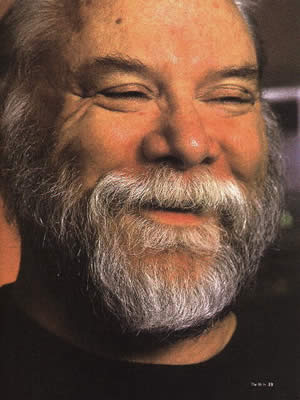
In fact, I would rate Erik up there with John Fahey.
0 Replies
Letty
1
Reply
Wed 25 Oct, 2006 06:41 am
Dys, thanks for that background info on The Weavers. I had no idea, cowboy. Love your "Walk Right in" as well.
I would say, listeners, that both songs have what I call, "biorhythms."
0 Replies
dyslexia
1
Reply
Wed 25 Oct, 2006 06:51 am
John Fahey
0 Replies
dyslexia
1
Reply
Wed 25 Oct, 2006 06:56 am
John Aloysius Fahey was born in Takoma Park, MD into a musical household--both his parents played the piano. On weekends, the family often attended performances of top country and bluegrass groups of the day, but it was hearing Bill Monroe's version of Jimmie Rodgers' "Blue Yodel No. 7" on the radio that ignited the young Fahey's passion for music.
In 1952 he purchased his first guitar for $17 from the Sears-Roebuck catalogue. Along with his budding interest in guitar, Fahey was attracted to record collecting. While his tastes ran mainly in the bluegrass and country vein, Fahey discovered his love of early blues upon hearing Blind Willie Johnson's "Praise God I'm Satisfied" on a record-collecting trip to Baltimore with his friend and mentor, the musicologist Richard K. Spottswood. Much later, Fahey compared the experience to a religious conversion and remained a devout blues disciple until his death.
As his guitar playing and composing progressed, Fahey developed a style that blended the picking patterns he discovered on old blues 78s with the dissonance of contemporary classical composers he loved, such as Charles Ives and Béla Bartók. In 1958 Fahey made his first recordings. These were for his friend Joe Bussard's amateur Fonotone label. He recorded under various pseudonyms, mainly as Blind Thomas.
The following year, having no idea how to approach professional record companies, Fahey decided to issue his first album himself, using some cash saved from his gas station attendant job and some borrowed from an Episcopalian priest. So Takoma Records was born, named in honor of his hometown. On one side of the album sleeve was the name "John Fahey" and on the other, "Blind Joe Death," another Fahey pseudonym. He had 100 copies pressed. Some he gave away, some he sneaked into thrift stores and blues sections of local record shops, and some he sent to folk music scholars, a few of whom were fooled into thinking that there really was a living old blues singer called Blind Joe Death. It took three years for Fahey to sell the remainder.
After graduating from American University with a degree in philosophy and religion, Fahey moved to California in 1963 to study philosophy at the University of California at Berkeley. Arriving on campus, Fahey ?- ever the outsider ?- began to feel dissatisfied with the program's curriculum (he later suggested that studying philosophy had been a mistake and that what he had wanted to understand was really psychology) and was equally unimpressed with Berkeley's (hippie) music scene. The following year, Fahey moved south to Los Angeles to join the folklore master's program at UCLA at the invitation of department head D.K. Wilgus. While living in Los Angeles, Fahey made a pilgrimage to the Deep South and was instrumental in the rediscovery of bluesmen Skip James and Bukka White. Fahey's UCLA master's thesis on the music of Charley Patton, later published, is considered among the very best of folklore academia. He completed it with the musicological assistance of his friend Alan Wilson, who shortly after became a member of Canned Heat.
During this period Takoma Records was reborn. Fahey and ED Denson, a Washington, DC area friend who had previously moved west, decided to track down Blues legend Bukka White by sending a telegram to Aberdeen, MS (White had sung that Aberdeen was his hometown). They were able to track him down and recorded an LP. They also recorded a new LP by Fahey - Death Chants, Breakdowns and Military Waltzes. To their surprise the Fahey release sold better than White's and Fahey had a career going.
His releases during the mid '60s employed odd guitar tunings and sudden style shifts rooted firmly in the old time and blues stylings of the 1920s. But he was not simply a copyist, as compositions such as "When the Cactus is in Bloom" or "Stomping Tonight on the Pennsylvania/Alabama Border" demonstrate. Fahey described the latter piece as follows : "The opening chords are from the last movement of Vaughan Williams' Sixth Symphony. It goes from there to a Skip James motif. Following that it moves to a Gregorian chant, 'Dies Irae'. It's the most scary one in the Episcopal hymn books, it's all about the day of judgement. Then it returns to the Vaughan Williams chords, followed by a blues run of undetermined origin, then back to Skip James and so forth." A hallmark of his classic releases was the inclusion of lengthy liner notes, parodying those found on blues releases. Typically, these were epic acts of self-mythologization, mixing personal biography, reverie, folklore and myriad obscure blues and bluegrass references.
Later albums from the sixties, such as Requia and The Yellow Princess found Fahey making sound collages from such elements as Gamelan music, Tibetan chanting, animal and bird cries and singing bridges. In 1967, Fahey recorded with Red Crayola at the 1967 Berkeley Folk Festival, music that resurfaced on the 1998 Drag City reissue, The Red Krayola: Live 1967. Fahey is rumoured to have recorded a further album with that group around this time, but this is apparently lost.
In addition to his own creative output, Fahey expanded the Takoma label, discovering fellow guitarists Leo Kottke, Robbie Băsho and Peter Lang, as well as emerging pianist George Winston. Kottke's debut release on the label, 6- and 12-String Guitar, ultimately proved to be the most successful of the crop, selling more than 500,000 copies. Fahey eventually sold Takoma to Chrysalis Records in the mid-'70s.
The record critic John Swenson gave 5 star (highest) ratings to several of Fahey's records (Blind Joe Death, and Best of John Fahey) in the best selling book The Rolling Stone Record Guide (1979).
0 Replies
Letty
1
Reply
Wed 25 Oct, 2006 08:56 am
Well, I am sorry to say that I could NOT locate the song, Blind Joe Death, nor could I locate any other song by John Fahey, but I did hear a wee bit of The Voice of the Turtle on guitar. Very, VERY dissonant, dys.
This may not be the same song that Fahey did, but I shall play it anyway.
Nana MOUSKOURI Lyrics - My Rainbow Race Lyrics
1-
One blue sky above us
One ocean lapping all our shores
One earth so green and brown
Who could ask for more
2-
And because I love you
I'll give it one more try
To show my rainbow race
It's too soon
Too soon to die
It's too soon to die
3-
Some want to be like an ostrich
And bury their heads in the sand
Some hope for plastic dreams
To unclutch those greedy hands
4-
Some want to take the easy way
Poisons,bombs they think we need them
Don't they know
You can kill all the unbelievers
There's no short cut to freedom
5-
Then because I promise
I'll give it one more try
To show my rainbow race
It's too soon
Too soon to die
It's too soon to die.
Incidentally, Thanks, cowboy, for the background on John.
0 Replies
bobsmythhawk
1
Reply
Wed 25 Oct, 2006 09:42 am
Georges Bizet
From Wikipedia, the free encyclopedia
Georges Bizet (October 25, 1838 - June 3, 1875) was a French composer and pianist of the romantic era. He is best known for his opera Carmen.
Biography
Bizet was born in Paris. He was registered with the legal name Alexandre-César-Léopold Bizet, but was baptized Georges Bizet and was always known by the latter name. A child prodigy, he entered the prestigious Paris Conservatory of Music a fortnight before his tenth birthday.
In 1857 he shared a prize offered by Jacques Offenbach for a setting of the one-act operetta Le docteur Miracle and won the Prix de Rome, a competitive scholarship for promising artists and musicians. In accordance with the conditions of the scholarship, he studied in Rome for three years. There, his talent began to mature with such works as the opera Don Procopio. Besides this stay in Rome, Bizet lived in the Paris area for his entire life.
Following his stay in Rome, he returned to Paris where he dedicated himself to composition. Early into his return to Paris, Georges's mother died. In 1863 he composed the opera Les pêcheurs de perles (The Pearl Fishers) for the Theatre-Lyrique. During this period Bizet also wrote the opera La jolie fille de Perth, his well-known L'arlésienne (written as incidental music for a play), and the piano piece Jeux d'enfants (Children's games) He also wrote the romantic opera Djamileh, which is often seen as a precursor to Carmen. His first symphony, the Symphony in C Major, was written at the Paris Conservatory when he was only seventeen years old, evidently as a student assignment. It seems that Bizet completely forgot about it himself, and it was not discovered again until 1935, in the dusty archives of the Conservatory library. Upon its first performance, it was immediately hailed as a junior masterwork and a welcome addition to the early Romantic period repertoire. A delightful work (and a prodigious one, from a seventeen-year-old boy), the symphony is noteworthy for bearing an amazing stylistic resemblance to the music of Franz Schubert, whose work was virtually unknown in Paris at that time (with the possible exception of a few of his songs). A second symphony, "Roma" was not completed.
Bizet's best-known work is his 1875 opera, Carmen, which was based on an 1846 novel of the same name by Prosper Mérimée. Influenced by Giuseppe Verdi, he composed the title role in Carmen for a mezzo-soprano. Not an immediate success, Bizet became despondent over the perceived failure, but praise came from such luminaries as Saint-Saëns, Tchaikovsky, and Debussy, who recognized its greatness. Their views were prophetic, as the public eventually made Carmen one of the most popular works in operatic history.
Although most known as a composer, Bizet was also an extraordinarily fine pianist, whose playing was praised by Franz Liszt himself. After Bizet sightread a complex piece flawlessly, Liszt said he considered Bizet one of the three finest pianists in Europe.
Bizet had long suffered from quinsy, a painful inflammation of the tonsils associated with angina and never got to enjoy Carmen's success. Just a few months after the opera's debut, he died on his sixth wedding anniversary at the early age of 36, the official cause of death being listed as a failed heart due to "acute articular rheumatism". He was interred in the Père Lachaise Cemetery, Paris.
0 Replies
bobsmythhawk
1
Reply
Wed 25 Oct, 2006 09:44 am
Leo G. Carroll
From Wikipedia, the free encyclopedia
Leo G. Carroll (October 25, 1892-October 16, 1972) was an English character actor, best known for his roles in several Hitchcock films and The Man from U.N.C.L.E..
He was born in Weedon, Buckinghamshire to a wealthy Catholic family, who named him after the reigning pope Leo XIII. Carroll made his stage debut in 1912, and played in London and Broadway until he moved to Hollywood in 1934 to start a career in film. Once there he soon made his film debut in Sadie McKee (1934). More parts followed, often playing doctors or butlers. He made notable appearances as Marley's ghost in A Christmas Carol (1938) and as Joseph in Wuthering Heights (1939).
Carroll is perhaps most well-known for his roles in six of Alfred Hitchcock's films. As with earlier roles he was often cast as doctors or other figure of authority, such as the spymaster The Professor in North by Northwest. He was also popular on television as the befuddled banker Topper (1953-56) and later as spymaster Alexander Waverly on The Man from U.N.C.L.E. (1964-68), echoing his earlier work for Hitchcock. Several U.N.C.L.E. films followed, and a spin-off The Girl from U.N.C.L.E. (1966). He was one of the first actors to appear in two different television series as the same character. He is also remembered for his role as the frustrated banker haunted by the ghosts of George and Marion Kirby, in the 1950's television series Topper which also starred Anne Jeffreys, Robert Sterling and Lee Patrick.
In 1972 he died in Hollywood of pneumonia brought on by cancer and was interred in the Grand View Memorial Park Cemetery in Glendale, California.
0 Replies
bobsmythhawk
1
Reply
Wed 25 Oct, 2006 09:47 am
Minnie Pearl
From Wikipedia, the free encyclopedia
Minnie Pearl was the stage name of Sarah Ophelia Colley Cannon (October 25, 1912 - March 4, 1996). She was a country comedian who, along with friend Roy Acuff, was somewhat of an institution at the Grand Ole Opry, and on the television show Hee Haw from 1969 to 1991. She was known for wearing a big hat with a price tag that read "$1.98" hanging off the side.
Sarah Ophelia Colley was born in Centerville, Tennessee. She graduated from what was then Nashville, Tennessee's most prestigious school for young ladies, Ward-Belmont. Her family, relatively affluent by the standards of the area and the day, was somewhat scandalized by her entry into "show business". Her first professional position was with the Wayne P. Sewell Production Company, producing and directing plays and musicals for local organizations in small towns throughout the Southeast.
While producing an ametuer musical comedy in Baileyton, AL, she met a young mountain woman from whom she based her famed and beloved onstage persona, "Cousin Minnie Pearl". Her first performance onstage as Minnie Pearl was in 1939 in Aiken, SC.
As a performer, Pearl's comedy was always a rather gentle and loving satire of her hometown of Centerville, about 50 miles (80 km) west of Nashville in Hickman County, Tennessee.
Her catch phrase was always, "Howdeeee! I'm jest so proud to be here!" delivered at what seemed to have been the top of her lungs. Once she was an established star, her audience almost invariably shouted "Howdeeee!" back to her.
Pearl's monologues almost always involved her comical relatives, notably "Uncle Nabob" and "Brother", who was somehow both slow-witted and wise, simultaneously. Her frequent bow-off line to applause was "I love you so much it hurts!" She also sang comic novelty songs, some of which were released as singles, such as "How To Catch A Man."
In her act, Pearl called her hometown Grinder's Switch, which is a real location just outside of Centerville which consists of little more than the eponymous railroad switch. Those who knew her recognized that the characters were largely based on real residents of Centerville. So much traffic resulted from fans and tourists looking for the hometown she described that the Hickman County Highway Department was finally motivated to change the designation on the "Grinder's Switch" road sign to "Hickman Springs Road". Attempts over the years to develop a Grinder's Switch theme park have proven futile.
Her character was always presented as a man-hungry spinster willing to settle for almost anything in the way of male companionship. In real life, she was happily married for many years to Henry Cannon. They had no children.
In the late 1960s, Mrs. Cannon and African-American gospel singer Mahalia Jackson were convinced to allow their names to be associated with a chain of fried chicken restaurants in competition with Kentucky Fried Chicken by Nashville entrepreneur John Jay Hooker. At first the stock price of this venture soared; later it collapsed amid allegations of accounting irregularities and stock price manipulation. This affair was thoroughly investigated by the U.S. Securities and Exchange Commission. Mrs. Cannon and Ms. Jackson were found to have been completely uninvolved in any alleged wrongdoing, but were considerably embarrassed by the negative publicity surrounding their names. (A small number of these restaurants actually survived into the 1980s in the Middle Tennessee area; one Mahalia Jackson outlet still exists in North Nashville where it has considerable local fame, particularly among students of Tennessee State University.)
As noted above, Mrs. Cannon portrayed the "Minnie Pearl" character for many years on the perennial Saturday night television cornfest Hee Haw, both on the original network and subsequent syndicated versions. This may have been less taxing than it would appear; the program was shot entirely in Nashville and totally out of sequence, so that each performer could record all of his or her appearances for an entire television season in a matter of a few days or parts of days. When asked why the cornball program was so popular, Cannon explained that it took viewers to a place where there was "no war, no cancer."
Her final regular national television appearances came on Ralph Emery's nightly Nashville Now country-music talk show on the former Nashville Network cable channel. She and Emery performed a weekly feature, "Let Minnie Steal Your Joke," in which viewers could send in jokes for Minnie to read on the show, with prizes for the best joke of the week.
Cannon was fairly influential in the lives of many younger country music artists, taking something of a maternal interest in them, especially Hank Williams, but also many of the younger generation of female singers; she had seen many of the inequities in the treatment of women in business in general, and women in the country music industry in particular, firsthand. She was also a close friend of Paul Reubens and the legendary Dean Martin. In her later years, she lived in a prestigious Nashville neighborhood next to the Governor's Mansion, where she befriended several of the governors. After surviving breast cancer through aggressive treatments including a double mastectomy and radiation therapy, she became a spokeswoman for the medical center in Nashville where she had been treated and somewhat for cancer survivors in general. She took on this role as herself, Sarah Ophelia Cannon, not desiring the "Minnie Pearl" character to be associated with such misfortune, although a nonprofit group, the Minnie Pearl Cancer Foundation, has been founded in her memory to help fund cancer research. The center where she was treated was later named the Sarah Cannon Cancer Center, and has been expanded to several other hospitals in the Middle Tennessee and Southern Kentucky area. Her name has also been lent to the affiliated Sarah Cannon Research Institute.
Her death at the age of 83 was brought on by complications due to a stroke. During her time in the nursing home, she was visited frequently by numerous country music industry figures, notably Chely Wright, Vince Gill and Amy Grant. She is buried at Mt. Hope Cemetery in Franklin, Tennessee.
Trivia
Her stage name "Minnie Pearl" is based on the knitting term purl, for an inside out stitch, as a reference to her homespun image.
Pearl's trademark straw hat was famous for having a price tag dangling from it which read "$1.98." This came from the fact that Minnie bought some silk flowers for the hat and forgot to remove the tag.
Chely Wright and Dean Sams (of Lonestar) posed for the brozen statues of Minnie Pearl and Roy Acuff which are displayed in the lobby of the Ryman Auditorium.
0 Replies
Tryagain
1
Reply
Wed 25 Oct, 2006 09:50 am
Good morning, it's ok, it was only
SWEET CHERRY WINE
TOMMY JAMES & THE SHONDELLS Lyrics
Come on, everyone
We got to get together now
Oh yeah, love's the only thing
That matters anyhow
And the beauty of life can only
Survive if we love one another
Oh yeah, yesterday, my friends
Were marching out to war
Oh yeah, listen now
You hear them marching any more
No, we ain't gonna fight
Only God has the right to decide
Who's to live and die
He gave us sweet
Cherry wine, so very fine
We'll drink it right down
Pass it all around
So stimulating, so intoxicating
Sweet cherry wine
And everybody's gonna feel so fine
Drinking sweet cherry wine
Yes, they will
Watch the mountain
Turn to dust and blow away
Oh no, you know there's
Got to be a better way
And the old masquerade
Is a no soul parade
Marching through the ruins of time
To save us, he gave us
Sweet cherry wine, so very fine
We'll drink it right down
Pass it all around
So stimulating, so intoxicating
Sweet cherry wine
Everybody's gonna feel so fine
Drinking sweet cherry wine
Oh, sweet cherry wine, so very fine
We'll drink it right down
Pass it all around
So stimulating, so intoxicating
Sweet cherry wine
Come on
Drink it with your brother
Trust in one another
Yeah, yeah, we need each other
Sweet cherry wine
Drink it right down
Pass it all around
People don't you know
The cup is running over
Yeah, yeah, yeah
0 Replies
bobsmythhawk
1
Reply
Wed 25 Oct, 2006 09:51 am
Billy Barty
From Wikipedia, the free encyclopedia
Billy Barty (born William John Bertanzetti) (October 25, 1924-December 23, 2000) was an American film actor.
Barty, an Italian American, was born in Millsboro, Pennsylvania. He was one of the most famous 20th century people with dwarfism, having prominent roles in popular movies such as Foul Play, The Lord of the Rings (both 1978), Under the Rainbow (1981), Night Patrol (1984), Legend (1985), Masters of the Universe (1987), Willow (1988), and UHF (1989). In The Gold Diggers of 1933 (1933), a nine-year-old Barty appeared as a baby who escapes from his perambulator. Because of his stature, most of his work consisted of bit parts and gag roles. Barty was known for his boundless energy and enthusiasm for any productions in which he appeared. He also performed a remarkable impression of the late pianist Liberace.
Barty was a noted activist for the promotion of rights for others with dwarfism. He was disappointed with contemporary Hervé Villechaize's insistence that they were "midgets" instead of actors with dwarfism. Barty founded the Little People of America to help with his activism.
Barty was married to Shirley Bolingbroke of Malad City, Idaho, from 1950 until his death at age 76. They had two children, Braden and Lori.
Barty and his family belong to The Church of Jesus Christ of Latter-day Saints (aka the Mormons).[1]
A recent tribute book on his life was published in December 2002. Within Reach: An Inspirational Journey into the Life, Legacy and Influence of Billy Barty was produced by Barty's nephew, Michael Copeland, and Michael's wife, Debra.
Quotes
"The name of my condition is Cartilage Hair Syndrome Hypoplasia, but you can just call me Billy."
"The general public thinks all little people are in circuses or sideshows. We have doctors, nurses, just about every field covered."
0 Replies
bobsmythhawk
1
Reply
Wed 25 Oct, 2006 09:54 am
Marion Ross
From Wikipedia, the free encyclopedia
Marion Ross as Lorelai Gilmore on Gilmore GirlsMarion Ross (born October 25, 1928) is an American actress.
Born Marian Ross in Albert Lea, Minnesota, she grew up there, and in nearby Waconia and Willmar. At the age of 13, she changed the spelling of her name from "Marian" to "Marion" because she thought it would look better on a marquee. After completing her sophomore year in high school, she moved to Minneapolis, Minnesota and worked as an au pair while studying drama at the MacPhail Center for the Arts, and attending Southwest High School. A year later, her family moved to San Diego, California.
Ross enrolled in San Diego State College, where she was named the school's most outstanding actress. After graduation in 1950, she performed in summer theater in La Jolla, California. The director was impressed by her talent, and recommended that she try for work in cinema.
Ross made her 1953 film debut in Forever Female, starring Ginger Rogers and William Holden. She found steady work in film, appearing in The Glenn Miller Story (1954), Sabrina (1954), and Operation Petticoat (1959).
Her career on television began in 1953, when she played the Irish maid on the series Life With Father for two years. Her list of credits spans the history of classic TV, from The George Burns and Gracie Allen Show, Love Boat and Night Court. Ross' most famous role was in the long-running series Happy Days from 1974 to 1984, in which she played "Marion Cunningham", Ritchie, Chuck and Joanie's mother, also known as "Mrs. C." She later starred in the short-lived by critically acclaimed drama Brooklyn Bridge, which ran on CBS in the early 1990s.
Ross has acted on Broadway and on film, but she prefers doing TV. In recent years, she played recurring roles as Drew Carey's mother, on The Drew Carey Show; as evil "Bernice Forman" on That '70s Show; and as "Lorelei's grandmother" on The Gilmore Girls. She also frequently appears on Hollywood Squares and did voiceovers for "Grandma SquarePants" on SpongeBob SquarePants.
Ross lives in Los Angeles, California with actor Paul Michael. Her two adult children also work in entertainment: Jim Meskimen's credits include How the Grinch Stole Christmas and appearances on Whose Line Is It Anyway?, and Ellen Plummer was a writer/producer on Friends.
0 Replies
bobsmythhawk
1
Reply
Wed 25 Oct, 2006 09:56 am
Anthony Franciosa
From Wikipedia, the free encyclopedia
Anthony Franciosa (October 25, 1928 - January 19, 2006), was an American actor, often billed as "Tony Franciosa."
Born Anthony George Papaleo, Jr. in New York City to Italian-American parents, he garnered rave reviews for his Broadway performance of the play A Hatful of Rain. Franciosa was his mother's maiden name (see [1])
When he reprised his role in the film version, he was nominated for an Academy Award for Best Actor. He followed that with roles in several major films, including A Face in the Crowd, Career, The Long Hot Summer, Period of Adjustment, The Pleasure Seekers and Rio Conchos.
In the late 1960s his film career began to fade, and he became a series lead in three different shows, starring in Valentine's Day, The Name of the Game (and its pilot TV-movie Fame Is the Name of the Game), and Matt Helm. When that career faded, his public renown faded as well.
During his career, his behavior on movie productions became the subject of Hollywood gossip. The stories alleged fiery disputes with directors, sulking in his dressing room, and outbursts with other actors (see [2]).
He was married four times, and had three children. His most famous wife was Oscar-winning actress Shelley Winters; they were married from May 4, 1957 until their divorce in 1960. They had no children.
His second wife, the former Judith Balaban, is the author of the book "The Bridesmaids," about her friend Princess Grace of Monaco, in whose wedding she served as a bridesmaid. This marriage produced Franciosa's only daughter, Nina.
His last wife (from November 27, 1970 until his death in 2006) was Rita Theil, by whom he had two sons, Marco and Christopher. Christopher Franciosa is an actor.
Anthony Franciosa died at age 77 at UCLA Medical Center in Los Angeles, California after suffering a massive stroke. His death came only five days after that of his ex-wife Shelley Winters.
0 Replies
bobsmythhawk
1
Reply
Wed 25 Oct, 2006 09:59 am
Helen Reddy
From Wikipedia, the free encyclopedia
Helen Reddy (born October 25, 1941 in Melbourne, Australia) is an Australian pop singer and actor.
Reddy was immensely successful as a singer in the 1970s with numerous hit records including three U.S. #1 singles. She has sold more than 15 million albums and 10 million singles, and was the first Australian-born performer to win a Grammy award. In 1974, she became a naturalized citizen of the United States, but currently lives near Sydney, Australia.
Early years
Reddy was born into a well-known Australian show business family?-her parents, well-known performers on the Australian vaudeville circuit, were actress and singer Stella Lamond and writer-actor-comedian Max Reddy; her older sister is actress-singer Toni Lamond; and her nephew is actor-singer Tony Sheldon.
Reddy began performing on stage with her parents at four years of age. In her late teens she was briefly married to an older musician, with whom she had a daughter, Traci, but they divorced soon afterwards. After beginning her career in radio and television in Australia, she won a talent contest on the Australian pop music TV show Bandstand which enabled her to move to the United States in 1966. Settling initially in New York, she met Jeff Wald, then an agent with the William Morris Agency; after living together for only four days, she and Wald married; he subsequently became her manager.
After a stint in Chicago, the family moved to Los Angeles, California, where Reddy tried to establish herself as a recording artist. Twenty-seven labels rejected her before she was finally signed to a contract with Capitol Records in 1970.
1970s success
Alongside her friend (and fellow Australian) Olivia Newton-John, Reddy became one of the most successful female recording artists of the Seventies, with 14 U.S. Top 40 singles between 1971 and 1978. Reddy was also instrumental in furthering Newton-John's career?-she encouraged her friend to move from Britain to the United States in the early 1970s, and Newton-John won the starring role of "Sandy" in the hit film version of the musical Grease after a chance meeting with the film's producer Allan Carr at a party at Reddy's house.
Reddy's first Top 40 U.S. hit (1971) was a cover of "I Don't Know How To Love Him" (from Jesus Christ Superstar). She scored an international hit in 1972 with a re-recorded version of a song she co-wrote with Australian musician Ray Burton, the feminist anthem "I Am Woman", which became her first U.S #1. Reddy has attributed the impetus for writing "I Am Woman" and her early awareness of the women's movement to expatriate Australian rock critic and pioneer feminist Lillian Roxon. Reddy is quoted in Fred Bronson's The Billboard Book of Number One Hits as saying that she was looking for songs to record which reflected the positive self-image she had gained from joining the women's movement but couldn't find any, so "I realized that the song I was looking for didn't exist, and I was going to have to write it myself." The single actually barely dented the chart on its initial release in the summer of 1972, but it wasn't long before female listeners adopted the song as an anthem and began requesting it from their local radio stations in droves, spurring it to re-enter the charts in September and become a hit. "I Am Woman" earned a Grammy Award for Female Pop Vocal Performance and at the awards ceremony she concluded her acceptance speech by famously thanking God "because She makes everything possible".
Over the next five years, she had more than a dozen other U.S. Top 40 hits including two more #1 hits. These included the Alex Harvey country ballad "Delta Dawn" (#1, 1973), "Leave Me Alone (Ruby Red Dress)" (#3), "Keep On Singing" (#15, 1974), "You And Me Against The World" (written by Paul Williams and featuring daughter Traci reciting the spoken bookends), "Emotion" (an English version of the French tune Amoreuse, which was also a U.K. hit for Kiki Dee as "Loving And Free"), "Peaceful" (#15), "Angie Baby" (#1), "Ain't No Way To Treat A Lady" (#8, 1975), the sophisticated Richard Kerr-Will Jennings "Somewhere In The Night" (#19; later a bigger hit for Barry Manilow), and the Carole King-Gerry Goffin song "I Can't Hear You No More" (1976). Her last Top 20 record was a 1977 revival of Cilla Black's 1964 hit "You're My World", co-produced by Kim Fowley. Reddy's final chart record was "I Can't Say Goodbye To You" in 1981. She was most successful on the Adult Contemporary charts, scoring seven #1 hits there over a three-year span, from "Delta Dawn" to "I Can't Hear You No More."
At the height of her fame in the late 1970s, Helen Reddy was a headliner with a full chorus of backup singers and dancers to standing room only crowds on The Strip in Las Vegas. Reddy's opening act was the then up and coming Joan Rivers. In 1976, Reddy covered the Beatles song "The Fool on the Hill" for the ephemeral musical documentary All This and World War II.
Behind the hits
The stories behind two of Reddy's biggest hits illustrate the often fickle nature of success in the music business. Both Bette Midler and the young Tanya Tucker recorded their own versions of "Delta Dawn" just before Reddy recorded hers. When the song started to get airplay, Barbra Streisand's producer Tom Catalano decided that Streisand could have a pop hit with it, so he had an instrumental backing track recorded. Fortunately for Reddy, Streisand refused to sing the song, so United Artists song plugger Wally Schuster called Jeff Wald and offered the song and the completed backing track to Reddy, who put her own vocal on it.
Reddy's version of "Delta Dawn" was released in the summer of 1973, just two days ahead Midler's version, but disc jockeys preferred Reddy's rendition and it eventually went to #1 on the U.S. charts and was a hit in several other countries including Australia.
She was equally fortunate with "Angie Baby" (written by Alan O'Day)?-it was first offered to Cher, who turned it down, so it was then offered to Reddy, who snapped it up, and it became her third U.S. #1 single (Cher was similarly unlucky with the song "The Night The Lights Went Out in Georgia"?-after she turned it down, it was recorded by Vicki Lawrence, who scored a #1 hit with it in 1973). The cryptic lyrics of "Angie Baby" have inspired a number of listener theories as to what the song is really about, and Reddy has refused to comment on what the true storyline of the song is, partly because she has said she enjoys hearing other listeners' interpretations. Reddy has also said that "Angie Baby" was the one song she never had to push radio stations into playing.
Film and theatre
Reddy has also worked extensively both on stage and the screen, with roles in movies such as Airport 1975 and Walt Disney's Pete's Dragon (in which she sang "Candle On The Water," which has become one of her best-known songs despite flopping as a single), and numerous television series. She has also hosted two television series, including her own show and the late-night music series The Midnight Special.
She has also appeared in a number of musical stage productions including Anything Goes, Call Me Madam, and The Mystery of Edwin Drood. She is also known for her appearances in works by British playwright Willy Russell and has performed both on Broadway and in the West End of London in the musical Blood Brothers and four productions of Shirley Valentine.
Recently
She recently published an autobiography and appeared in May 2006 on the Today Show [1]. She was also recently added to the ARIA Hall Of Fame, with a tribute performance by Vanessa Amorosi of "I Am Woman" at the ceremony. Reddy suffers from Addison's disease, a failure of the adrenal glands, which requires constant treatment to maintain normal activities.
0 Replies
bobsmythhawk
1
Reply
Wed 25 Oct, 2006 10:03 am
As we all know, when we hit retirement age we come
face to face with the fact that it may be time to relocate.
The big question is: where?
Here are some tips..
You can live in Phoenix, Arizona where.....
1. You are willing to park 3 blocks away because you
found shade. :-)
2. You can open and drive your car without touching
the car door or the steering wheel.
3. You've experienced condensation on your butt from
the hot water in the toilet bowl.
4. You would give anything to be able to splash cold
water on your face.
5. You can attend any function wearing shorts and a
tank top.
6. "Dress Code" is meaningless at high schools and
universities. Picture lingerie ads.
7. You can drive for 4 hours in one direction and
never leave town.
8. You have over 100 recipes for Mexican food.
9. The 4 seasons are: tolerable, hot, really hot, and
ARE YOU KIDDING ME??!!
10. You know that "dry heat" is comparable to what
hits you in the face when you open your oven door.
You can Live in Maine where...
1. You only have four spices: salt, pepper, ketchup,
and Tabasco.
2. Halloween costumes fit over parkas.
3. You have more than one recipe for moose.
4. Sexy lingerie is anything flannel with less than
eight buttons.
5. The four seasons are: winter, still winter, almost
winter, and construction.
You can Live in the Deep South where...
1. You can rent a movie and buy bait in the same
store.
2."y'all" is singular and "all y'all" is plural.
3. After five years you still hear, "You ain't from '
round here, are Ya?"
4. "He needed killin' " is a valid defense.
5. Everyone has 2 first names: Billy Bob, Jimmy Bob,
Mary Sue, Betty Jean, MARY BETH, etc.
AND You can live in Florida where...
1. You eat dinner at 3:15 in the afternoon.
2. All purchases include a coupon of some kind -- even
houses and cars.
3. Everyone can recommend an excellent dermatologist.
4. Road construction never ends anywhere in the state.
5. Cars in front of you are often driven by headless people
0 Replies
edgarblythe
1
Reply
Wed 25 Oct, 2006 10:04 am
Cobain tops dead earners' list
Irish Examiner - 5 hours ago
Dead Nirvana star Kurt Cobain has toppled Elvis Presley as the king of dead celebrities.
0 Replies
Letty
1
Reply
Wed 25 Oct, 2006 10:17 am
My goodness. Our BioBob is back. Glad to hear you hawkman, and thanks for the great bio's. Love your state facts, buddy, especially the ones concerning the South. When our Raggedy arrives, we will comment further.
Well, folks, our Try got a wine song in between, and I shall accompany that with a flower song, one of the many from Bizet's Carmen. Then, we shall digest edgar's surpassing info on Corbain and Presley.
The flower that you threw at me
stayed with me in my prison cell;
though withered and dried, this flower
lost none of its sweet scent,
and for hours on end
with my eyes closed
its odour intoxicated me,
and at night it was your face I saw!
I wanted to curse you,
to hate you, I asked myself:
Why has fate
put you in my path?
Then I accused myself of blasphemy,
and within me I felt
only one desire
only one desire, one hope:
to see you again, Carmen, see you again!
You only had to appear,
you only had to look at me
to take hold of my whole being,
oh my Carmen! and I was yours!
Carmen, I love you!
Let's face it, folks. The French lyrics are so much lovelier to the ear.
0 Replies
Raggedyaggie
1
Reply
Wed 25 Oct, 2006 10:45 am
Howdeeeee!
0 Replies
Letty
1
Reply
Wed 25 Oct, 2006 11:01 am
Well, folks, there's our "mini-pup". Howdeeee back, PA. Fabulous collage, gal, and now I know what Billy Barty looks like.
Many of our listeners are confused about how we can SEE on radio. So here's a reiteration. We have a bulletin board for all our groups that occasionally tour our studio, and today we see:
Leo, Minnie, Billy, Tony, Marion and Helen. I had no idea that Helen Reddy was Australian nor that Anthony was married to Shelley Winters.
Here's one from Helen:
This is for my dear friend, Polly(who loved to sing it) and her son Robby, both deceased
Delta Dawn, what's that flower you have on
Could it be a faded rose from days gone by
And did I hear you say he was a-meeting you here today
To take you to his mansion in the sky
She's forty-one and her daddy still calls her "baby"
All the folks around Brownsville say she's crazy
'Cause she walks around town with a suitcase in her hand
Looking for a mysterious dark-haired man
In her younger days they called her Delta Dawn
Prettiest woman you ever laid eyes on
Then a man of low degree stood by her side
And promised her he'd take her for his bride
Delta Dawn, what's that flower you have on
Could it be a faded rose from days gone by
And did I hear you say he was a-meeting you here today
To take you to his mansion in the sky
0 Replies
Letty
1
Reply
Wed 25 Oct, 2006 03:51 pm
It's dedication time, folks. This is for Dys and Di and the SealPoets:
Band: Byrd Tracy
Lyrics for Song: Pink Flamingos
Lyrics for Album: No Ordinary Man
I was a rebel in my younger years
I'd...drink with the devil if he bought me a beer
Wore out two pickups just running around
Mama thought I never would settle down
That was before I met sweet Irma Jean
She made a new man outta me
We got pink flamingos in the front yard
Picture window with a view of Wal-Mart
Blue collar heaven domestic bliss
It just doesn't get any better than this
We got pink flamingos, pink flamingos, pink flamingos
Sweet Irma Jean is a den mother now
With a station wagon and a charge account
Bubba Junior pitches for his baseball team
Little sister's running for Rose Bud Queen
And me I'm doing good at the used car lot
Is this a great country or what
We got pink flamingos in the front yard
Picture window with a view of Wal-Mart
Blue collar heaven domestic bliss
It just doesn't get any better than this
We got pink flamingos, pink flamingos, pink flamingos
People slow down when they drive by
They wave and smile but there's envy in their eyes
We ain't rich and won't be for a while
But no doubt about it baby we got style
With got pink flamingos in the front yard
Picture window with a view of Wal-Mart
Blue collar heaven domestic bliss
It just doesn't get any better than this
With got pink flamingos in the front yard
Picture window with a view of Wal-Mart
Blue collar heaven domestic bliss
It just doesn't get any better than this
We got pink flamingos
Picture windows
Pink flamingos
edgar, I was amazed when I did some research on Kurt Cobain. There seems to be a question whether or no it was a homicide or suicide.
0 Replies
edgarblythe
1
Reply
Thu 26 Oct, 2006 04:59 am
My True Love
Jack Scott
I prayed to the Lord to send me a love
He sent me an angel from heaven above
The stars in the sky he placed in her eyes
She is my true love
The touch (my true love) of her hand (my true love)
Captured (my true love) my soul (my true love)
And the kiss (my true love) from her lips (my true love)
Set my heart (my true love) aglow (my true love)
And I know (my true love) from heaven (my true love)
From heaven (my true love) above (my true love)
Came my, my true love
SPOKEN:
Darling, I love you
I'll always be true
My prayers, they were answered
When the Lord sent me you
With, love and devotion
That I never knew
Until the Lord above sent me you
And I thank (my true love) the heavens (my true love)
The heavens above (my true love)
For sending my true love
(My true love)