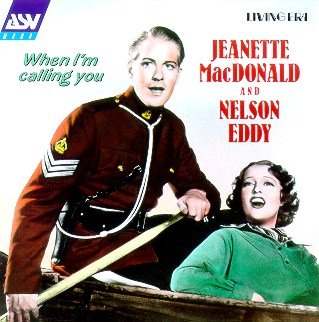
Jeanette MacDonald
From Wikipedia, the free encyclopedia
Jeanette MacDonaldJeanette MacDonald (June 18, 1903 - January 14, 1965) was a singer and actress best known for her film duets with Nelson Eddy, in films such as Naughty Marietta (1935) and Rose-Marie (1936).
Jeanette Anna MacDonald was born in Philadelphia, Pennsylvania to Daniel McDonald (a Scottish American) and Anna May Wright, who was of Welsh, English and Dutch descent. MacDonald made her professional debut at the age of six, singing "Old Mother Hubbard" in a charity opera at Philadelphia's Academy of Music. At the age of 16, accompanied by her father, she went to see her older sister, Blossom Rock, perform on Broadway in New York. An audition was arranged by her sister for a part as dancer in the chorus of another production. Jeanette got the part and was given permission by her parents to take the job. Of her start in Broadway, many years later she told Ed Sullivan, "I got a crick in my neck and $40 a week".
Jeanette MacDonald performed on Broadway a further nine years, progressing to leading roles in Yes, Yes, Yvette (1927), Sunny Days (1928), Angela (1928) and Boom Boom (1929) (opposite a young Cary Grant), before she was chosen by the Hollywood director Ernst Lubitsch to play the lead in his new film musical The Love Parade in 1929.
It was not until Irving Thalberg lured her to Metro Goldwyn Mayer in 1934, that she had her biggest hits including The Merry Widow (1934) (with Maurice Chevalier), Naughty Marietta, Rose-Marie (with an appearance by a very young Jimmy Stewart as her brother), and Maytime (1937) (all with Nelson Eddy). The latter, where she ages from a young girl to an old woman, is said to have been her favorite role. On very rare occasions she was given roles that allowed to extend her range as a dramatic actress, however she was still expected to sing.
Cast opposite Clark Gable and Spencer Tracy in San Francisco (1936), she was given some key dramatic scenes. This film also marks one of the few moments where MacDonald was able to contribute scenes where she sang opera arias from the standard repertoire, including rousing numbers from "La Traviata" and "Faust." The film was a spectacular success and was nominated for an Academy Award for Best Picture.
She did not confine herself to operetta, appearing in stage productions of grand opera, including Charles Gounod's Faust in 1943 and 1951, the latter being her last full length opera performance.
In 1937, Jeanette MacDonald married actor Gene Raymond, who was rumored to be bisexual, with whom she later co-starred in 1941's Smilin' Through. Although they were married until her death from heart disease at the age of 61 in 1965, they had no children. Jeanette continued to work with Nelson Eddy in radio during the 1940s, and in the 1950s they made joint TV appearances and cut a gold record, "Favorites in Hi-Fi (and Stereo)".
Several movies were proposed for the team in later years, including projects written by Nelson, and Florence L. Barclay's classic novel The Rosary, but none got off the ground. Jeanette died in Houston, Texas of heart disease, and was interred in the Forest Lawn Memorial Park Cemetery in Glendale, California.
After her death, rumors began to emerge that Jeanette MacDonald had an off-screen relationship with Nelson Eddy. A biography authorized by Jeanette's widower Gene Raymond, Hollywood Diva by Edward Baron Turk (2000), (ISBN 0520222539), denies there was any such affair.
However, Sharon Rich, a close friend of MacDonald's older sister, TV actress Blossom Rock (from The Addams Family), has written several books supporting these rumors with excerpts from letters, diaries and interviews. Sweethearts by Sharon Rich (revised edition, 2001 - ISBN 0971199817), discusses MacDonald's ill-fated affair with Eddy.
Jeanette MacDonald: The Irving Stone Letters annotated by Sharon Rich 2002, (ISBN 0971199841), is a compilation of Jeanette's handwritten letters to a beau from her Broadway years (with whom she also discusses her Hollywood years), while Jeanette MacDonald Autobiography: The Lost Manuscript annotated by Sharon Rich 2004, (ISBN 0971199884) presents MacDonald's unpublished autobiography, in which MacDonald verifies a problematic marriage.
In answer to unsourced gossip that MacDonald and Eddy could not have had an affair due to Eddy's being gay, Sweethearts quotes testimony of several women who had lengthy heterosexual affairs with him from the 1920s through the 1960s, including Maryon Murphy, wife of film director Ralph Murphy, and author K.T. Ernshaw ("To Love Again") (2001, ISBN 0595166075) who also provided a detailed and candid interview about herself and Eddy, and the Eddy and MacDonald affair, in Mac/Eddy Today Issue #62 and #63" (2003, ISSN 0891-527X).
Another false rumor is that studio head Louis B. Mayer forced Eddy to marry. Eddy's elopement to Las Vegas with Ann Franklin followed MacDonald's well-documented (ie, newspaper blurbs, a photo with Hedda Hopper at her bedside) hospital stays following a miscarriage, her going to Reno to establish residency there so she could obtain a divorce from Gene Raymond, then backing out due to pressure from Mayer.
On the rebound, Eddy eloped with Franklin. Sweethearts cites several sources that Eddy was drunk when he married Franklin; one of the sources was Eddy's accompanist, Theodore Paxson. It should be noted that Gene Raymond, who was also blond and somewhat resembled Eddy, was arrested at least three times for gay-related incidents; a photo of his 1938 arrest and booking number is reproduced in Sweethearts, page 498 of the 2001 edition, an army nurse is named and quoted for the second arrest, while retired Scotland Yard detective Joe Sampson discussed the third arrest,which occurred in England during WWII.
Jeanette MacDonald was given two stars on the Hollywood Walk of Fame for her contributions to Recordings and Motion Pictures.
Paul McCartney
From Wikipedia, the free encyclopedia
Birth name James Paul McCartney
Born June 18, 1942
Origin Liverpool, England
Sir James Paul McCartney, MBE (born June 18, 1942) is a British singer, musician and songwriter, who first came to prominence as a member of The Beatles.
Recognised as an icon of the twentieth century, McCartney is listed in The Guinness Book Of Records as the most successful composer in popular music history. He has a record twenty-nine US number one singles, twenty of them with The Beatles, the rest with Wings and as a solo artist. McCartney has written or has co-writing credit on over 50 top ten hits, more than any other songwriter, and has been an influential bassist as well as an accomplished singer, guitarist, pianist, and drummer. With The Beatles he was one half of the highly successful songwriting team credited as Lennon-McCartney, along with fellow bandmate John Lennon. Their compositions for The Beatles remain among the best known songs in rock and pop music. The most notable of The Beatles' songs generally attributed to McCartney alone include "Can't Buy Me Love", "Yesterday", "Hello Goodbye", "Hey Jude", and "Let It Be". He is the richest entertainer of all time, with a net worth of about US$1.5b as of June 2006, until his divorce with Heather Mills McCartney is finished.
Following the break-up of The Beatles in 1970, McCartney launched a successful solo career and formed the band Wings, scoring 30 Top Ten singles in the United Kingdom and United States. At the time of its release in 1977, the Wings single "Mull of Kintyre" became the highest selling record in British chart history (and remained so until 1984). McCartney has also worked in the fields of classical music (with works such as Liverpool Oratorio) and ambient/techno music (under the pseudonym The Fireman).
Aside from his musical work, McCartney is a painter (although until recently he kept his artwork private) and a strong advocate for animal rights, landmine action, vegetarianism, and music education.
Early years
James Paul McCartney was born at Walton Hospital in northern Liverpool, where his mother had worked as a nurse, and where his brother, Michael McCartney (also a performer, whose stage name is Mike McGear), was born a year later. He was baptised Roman Catholic, but otherwise raised non-denominationally; his parents were a mixed-religion couple. His father, James McCartney, was a self-taught pianist, and dance-band leader who encouraged his son to be musical. His father gave him a trumpet, which he largely abandoned when he learned it would put a callus on his upper lip and also realized that he could not sing while playing. Later, when skiffle music became popular, McCartney swapped the trumpet at Rushworth and Dreapers for a £15 Zenith acoustic guitar (which he still has). The early death, on October 31, 1956, of his mother Mary from breast cancer when he was 14 was a formative influence on his life; and it later created an additional bond between him and John Lennon, whose mother died on July 15, 1958 when Lennon was 17. Both McCartney and Lennon found some solace in music.
Paul McCartney claims Irish heritage on both sides of his family. McCartney's great-grandfather, James McCartney, was born in Ireland (some sources suggest his grandfather, James McCartney II, was as well). His mother's father, Owen Mohin, was born in 1880 in Tullynamalrow, County Monaghan in Ireland, and his mother's mother, Mary Theresa Danher, was a Glaswegian of Irish descent. Accordingly, Paul McCartney has five-eighths Irish ancestry.
History
Role in The Beatles
Paul McCartney first rose to fame as a bassist, pianist, guitarist, singer and songwriter for The Beatles. He met John Lennon at a church picnic on July 6, 1957, and was invited to join Lennon's band The Quarrymen as a guitarist. McCartney's schoolmate, George Harrison, joined soon after as a third guitarist, followed by the addition of Stuart Sutcliffe on bass. Pete Best joined on drums, rounding out the original lineup of the band. McCartney took over bass guitar duties in the early 1960s, when Lennon and Harrison declined following the departure of Sutcliffe. Ringo Starr replaced Best as drummer in 1962 to complete The Beatles' final line-up.
McCartney formed a close working relationship with Lennon and they collaborated on many songs, although only working 'eyeball to eyeball' (as Lennon had called it) in the early years of the band. Out of all The Beatles compositions, it is claimed only 27 were composed by both equally. Typically, one would write most or part of a song and the other would finish it, incorporate it into another song or suggest useful changes. Due to an early agreement between the two, all Beatles songs written by either of them are credited to both - this came about because John Lennon liked the idea of "Lennon & McCartney", echoing the songwriting credit of Leiber & Stoller, the songwriters whose names appeared on many of the records they owned from the 1950s. McCartney initially wanted it to be McCartney/Lennon, because he (naturally) thought it sounded better, but was convinced it didn't. However, very early copies of The Beatles' first official single "Love Me Do" are credited to McCartney - Lennon.
One of McCartney's most famous songs, covered by over 2,500 artists, is "Yesterday". McCartney claims the melody came to him in a dream, and was not sure for some time that the melody was original. McCartney once said that the original, provisional lyrics were 'Scrambled eggs / Oh - baby how I love your legs'. He played the melody to many people to see if they recognised it, because he was sure that he had subconciously 'borrowed' it from somewhere.
McCartney in February 1964, arriving in the US to appear on The Ed Sullivan ShowDuring the early years of The Beatles' recording career, McCartney developed rapidly as a musician, singer and songwriter. He was heavily influenced by Buddy Holly and Little Richard and Little Richard's trademark high-pitched 'wooo', which he used prominently as a musical punctuation on early songs like "From Me To You".
McCartney also became one of the most creative and influential rock bassists of his time, elevating the electric bass from back-row obscurity to prominence and inspiring many to take up the instrument. By 1965 McCartney was pressuring the engineers at EMI to get a better bass sound on Beatles recordings, frustrated by the relatively weak sound on their earlier records. His bass-playing and writing during The Beatles' most creative phase in 1965-67 was heavily influenced by the work of American producer-composer Brian Wilson, leader of The Beach Boys, whose classic album Pet Sounds set new standards for recording and featured bass parts unprecedented in pop music. As a result of hearing Wilson's work, McCartney began to pay increasing attention to both the sound and arrangement of his bass lines, often taking advantage of Abbey Road's new multi-track tape decks to re-record more complex parts after the basic tracks had been laid down. It is interesting to note that Wilson had crafted Pet Sounds as a direct response to The Beatles's 1965 album Rubber Soul.
Toward the end of his relationship with actress Jane Asher, McCartney met Linda Eastman, an American photographer, at the launch party for the Sgt Pepper's Lonely Hearts Club Band album, in May 1967, and the relationship blossomed over the next two years. They married at a small civil ceremony at Marylebone Registry Office on March 12, 1969, while he was still a member of The Beatles. He adopted her daughter from her first marriage, Heather (born 1962) and they went on to have three other children together: Mary (born in 1969, and named after his late mother), Stella (born in 1971), and James Louis (born in 1977, and named after McCartney's late father, who had died in 1976). The McCartneys would remain married and devoted to each other until Linda McCartney's death from breast cancer in 1998; the couple reportedly spent less than a week apart during their entire marriage, interrupted only by Paul's brief incarceration in Tokyo on drug charges in 1981. Wishing to avoid an international incident, Japanese authorities quickly dropped all charges.
Among The Beatles, McCartney was the last to marry and the only member whose first marriage didn't end in divorce. After his first wife's death, he married Heather Mills in 2002; they announced - on May 17, 2006 - that they are planning to divorce, citing media intrusion as the reason.
In the latter part of The Beatles' career, McCartney wrote such enduring favourites as "Hey Jude", "Let It Be", and "The Long and Winding Road".
It is now generally accepted that McCartney was the motivator for much of The Beatles' later work. After the band retired from touring in mid-1966 Lennon, Harrison and Starr retreated to secure country estates in the so-called 'stockbroker belt', well outside of London. However, McCartney continued to live in the city, first in a house in the centre of town, and then at a larger property in St John's Wood, a short distance from Abbey Road Studios. He was often seen at major cultural events such as the launch party for the International Times at The Roundhouse (which he attended in disguise). He also avidly delved into the visual arts, becoming a close friend of leading art dealers and gallery owners, explored experimental film, and regularly attended movie, theatrical and classical music performances.
Although he was not the first Beatle to take LSD, McCartney was the first British pop star to openly admit to using it, and his frank revelation during a newspaper interview in the early summer of 1967 made headlines around the world. In a famous interview broadcast nationally on BBC TV on June 19, 1967, McCartney was again asked about his LSD use, and his answer was impressive for its clarity:
'I was asked a question by a newspaper, and the decision was whether to tell a lie or tell him the truth. I decided to tell him the truth ... but I really didn't want to say anything, you know, because if I had my way I wouldn't have told anyone. I'm not trying to spread the word about this. But the man from the newspaper is the man from the mass medium. I'll keep it a personal thing if he does too, you know ... if he keeps it quiet. But he wanted to spread it so it's his responsibility, you know, for spreading it, not mine.'
In spite of his statements then, and later admissions that he also used cocaine regularly at that time, McCartney was fortunate to be one of the few leading British pop stars who did not fall foul of the Drug Squad (for corruption allegations see Norman Pilcher), as did Lennon, Harrison and many other friends including The Rolling Stones and Donovan.
On the musical side, McCartney was the first Beatle to record an outside project, composing (with George Martin) a score for the 1966 feature film The Family Way, starring British actress Hayley Mills, for which he won the Ivor Novello Award for Best Instrumental Theme. He also wrote and produced several successful recordings for other artists, and on some of these outside productions he worked under a pseudonym, reflecting his enduring fascination with disguises and aliases.
McCartney was the main creative foece for the "mature" middle Beatles period projects including the concept for Sgt. Pepper's Lonely Hearts Club Band, the film and record of Magical Mystery Tour, and the suite of songs that closes the album Abbey Road. Sgt Pepper is widely regarded as the most important rock album of all time, according to many polls and critics.
In 1969, despite obvious signs that the band was falling apart, he attempted to convince The Beatles to return to the stage, suggesting the project Get Back, which evolved into their valedictory film and album Let It Be. Although McCartney hoped it might revive them, the film made it obvious that the band was done as a creative force and that bickering, jealousy and the pressures of being The Beatles had driven the four musicians apart. Regardless of the internal strife, the band retained their popularity, and the public's interest in them was only intensified in late 1969 when an urban legend was started that McCartney died and was secretly replaced in 1966 by one Billy Shears. It was believed Brian Epstein was replaced too, but the whole conspiracy turned out to be false. This hoax is still a popular topic throughout cyberspace, and has been the subject of no less than five books, the best and most definitive being Turn Me On, Dead Man: The Beatles And The 'Paul-Is-Dead' Hoax by Andru J. Reeve [2]
Although Starr had briefly quit in 1968, and Harrison had done likewise (prompting John Lennon's infamous quote. "**** 'im. We'll get Clapton (Eric Clapton)" in 1969, it was Lennon who was the first to leave and not return, between August and September of 1969. McCartney publicly announced the break-up on April 10, 1970, a week before releasing his first solo album, McCartney, which featured a press release inside with a self-written interview explaining the end of The Beatles and his hopes about the future. The band was legally dissolved after he filed a lawsuit on December 31, 1970.
By this time Lennon and McCartney's friendship had been eroded by years of friction and rivalry; they were reconciled to some extent before Lennon's death on December 8, 1980.
Early solo career
As The Beatles broke up in 1970, McCartney launched a solo career with his album McCartney, on which he played all the instruments and sang all the vocals, except for some backing vocals from his wife Linda. While some found this record underwhelming (including Lennon, in an interview), it did contain "Maybe I'm Amazed", which has remained a centerpiece of McCartney's concerts ever since. Another successful track was "Every Night", which was later a hit for singer Phoebe Snow. The simplicity of the album later became a touchstone for the lo-fi movement of the 1990s[citation needed]. McCartney chose to release the album close to the planned release date of The Beatles' Let It Be, contributing to some discord with the other group members.
McCartney followed his debut album in 1971 with the stand-alone single "Another Day/Oh Woman, Oh Why", the former of which, to some, recalled the observational style of his mid-period Beatles work. The album Ram, also issued in 1971, was credited to both Paul and Linda McCartney, and featured back-up from, for the most part, studio musicians. While both the single and album were commercially popular, detractors viewed them as largely insubstantial. Time has treated the album kindly, however, and it is now considered one of McCartney's finest post-Beatles works. The album's artwork included a picture of two beetles copulating - a possible hint at McCartney's feelings toward his previous group. The album also contained some apparent references to Lennon, notably in the song "Too Many People" ('Too many people preaching practices, don't let 'em tell you what you wanna be'); later that year, Lennon responded with the famously scathing "How Do You Sleep?" on his album Imagine; the end of 1971 saw the McCartney song "Dear Friend" appear, on Wild Life, the first album released by Wings. Wild Life amounted to a Wings audition, and its rustic feel made McCartney sound polished.
McCartney famously insisted that his wife should be involved with his music ?- and later tour in his bands so they did not have to be apart while he travelled ?- in spite of her protests that she was not talented enough. After hearing her sing, many seconded her opinion, but McCartney's move was clearly a deliberate act, intended to help dispel some of the lingering Beatles mystique and prove his assertion that 'anyone can do it'. Despite persistent attacks on her ability (including one notorious 1990s bootleg concert tape in which her out-of-tune vocals were deliberately mixed to the fore), Linda McCartney became a valuable member of her husband's band and an inspiring musician throughout the remainder of her life. (In many ways this paralleled the role that Yoko Ono played in Lennon's post-Beatles musical life, just as there would be organisational similarities between Wings and Lennon's Plastic Ono Band).
Briefly, after an uneven start and despite many personnel changes, Wings became one of the most successful 1970s rock bands, hitting its cinematic apex in 1973 with one of the best-remembered Bond theme songs, "Live and Let Die"; its critical apex at the end of 1973 with the highly acclaimed album Band on the Run; and its commercial apexes in 1976 with a wildly popular world tour and in 1977 with one of the best-selling British singles of all time, "Mull of Kintyre".
Solo again: 1980s
In 1980, as Wings came to an end, McCartney made international headlines when he was arrested for possession of marijuana in Japan and he spent nine days in prison there before being deported. Since that time, he has reportedly stopped using all drugs, although it is generally believed that he used marijuana consistently throughout the late 1960s and 1970s. He was quoted in the 2000s as saying that he had recently given up marijuana at the behest of his second wife.
McCartney caused outrage with his reaction to the murder of John Lennon in December 1980 when circled by reporters quizzing him on his feelings he merely sighed "It's a drag, isn't it?". However, it should be noted that McCartney was clearly in no condition or mood to comment on the death of his long time friend to the reporters who encircled him as he attempted to leave a studio after hearing the news. He enjoyed continued success in the early 1980s. A live version of his song "Coming Up" hit #1 in the U.S., while the UK sent his album McCartney II to the top of the charts. McCartney II was an intriguing update of the recording approach he used ten years earlier for his eponymous debut, playing every instrument himself, with an emphasis on synthesisers this time instead of acoustic guitars.
Tug of WarHis 1982 album Tug of War was a major success and in the same year he scored two huge hits with duet singles: "Ebony and Ivory", recorded with soul legend Stevie Wonder; and "The Girl is Mine", recorded with emerging pop megastar Michael Jackson. Tug of War also included his moving eulogy to Lennon, "Here Today". The album also marked a return to Beatles producer George Martin, who has produced off and on for McCartney since. Another successful McCartney-Jackson duet, "Say Say Say" was released in 1983 from the Pipes of Peace album. The title song made the top of the charts in the United Kingdom. He then wrote and starred in the 1984 film Give My Regards to Broad Street, which included a role for Tracey Ullman. The film and soundtrack featured the U.S. and UK top ten hit "No More Lonely Nights". The film, however, did not do well at the box office or with critics.
McCartney's friendship with Jackson was short-lived. Not long afterward, Jackson paid a huge sum to acquire the Northern Songs catalogue, which included the publishing rights to most of The Beatles' songs. McCartney has made it clear that he does not wish to have the catalogue back. According to Contact Music [3], McCartney said 'I do get some cash from the publishing already. And in a few years more of the rights will automatically be reverting to me. The only annoying thing is when I tour America, I have to pay to play some of my own songs.'
In the mid-1980s, while making a home movie reminiscing about his days as a schoolboy, McCartney discovered the 1837 building which had once been his old school was derelict. He purchased it, and pursued a dream he had always had of helping his home town of Liverpool in some way. January 1996 saw the dedication of the Liverpool Institute for Performing Arts, of which Paul is the lead patron. On June 7, 1996, Her Majesty, Queen Elizabeth II officially opened the building.
McCartney's career hit some bumps in the mid-1980s. Following the commercial failure of the film Give My Regards to Broad Street, McCartney would follow up with 1986's Press to Play. While the reviews were positive, this would become McCartney's weakest-selling album to date. Realising he needed to re-evaluate things, in the late 1980s, McCartney began a songwriting partnership with Elvis Costello. The resulting songs would appear on several albums by both artists. The best known of these are the 1989 hit "Veronica", from Costello's album Spike, and "My Brave Face", a modest hit from McCartney's album Flowers in the Dirt.
During 1989-1990 McCartney staged a major, year-long world tour, in which for the first time he included a substantial number of Beatles songs in the set list. "The Paul McCartney World Tour" was a huge success, filling arenas and stadiums at each stop, and was documented by the album Tripping the Live Fantastic. Costello had also gotten McCartney to unearth his iconic Höfner violin-shaped bass guitar from Beatles days; besides being used on records again, it became a familiar sight on stage, a visual link to the past.
1990s
Following the release of the album Off the Ground, the similarly-scaled New World Tour took place in 1993. The live album capturing this tour, Paul Is Live, parodied the famous "Paul Is Dead" conspiracy of the late '60s - in both the title, and in the cover art which showed McCartney walking across the famous Abbey Road zebra crossing on his own, wearing shoes - once again showing his willingness to acknowledge his Beatles past. (The dog with him is a descendant of Martha, his pet sheepdog from The Beatles years and inspiration for the song "Martha, My Dear" on The Beatles' White Album.)
McCartney and his wife became outspoken vegetarians and animal-rights activists. McCartney tells the story of how their vegetarian instincts were realised when they happened to see lambs frolicking in a field as they ate a meal of lamb. In 1991, Linda introduced her own line of vegetarian meals to the general market. After Linda's death in 1998, Paul pledged to continue her line of food and keep it free from genetically modified organisms.
In 1991, McCartney made his first complete foray into classical music, collaborating with Carl Davis to compose the quasi-autobiographical Liverpool Oratorio. This was received well in general, although many commented that the music lacked the complexity normally associated with the genre. Liverpool Oratorio had its North American premiere in Carnegie Hall in New York on 18 November 1991 with Davis conducting and both McCartneys in attendance.
In 1995, the three remaining Beatles-- McCartney, George Harrison and Ringo Starr finally reunited to release the first of three albums entitled The Beatles Anthology, consisting of alternative takes and live recordings of Beatles songs; the second and third volumes were released in 1996. They also created two new Beatles songs, "Free As A Bird" (1995) and "Real Love" (1996) by layering new music on unfinished tracks Lennon had made before his death fourteen years earlier.
In the late 1990s, McCartney was involved in a feud with John Lennon's widow, Yoko Ono. Their dispute centered on the writing credits for a number of Beatles songs. He had wanted to change the credits from the traditional Lennon-McCartney to 'Paul McCartney and John Lennon' for songs McCartney had primarily composed. Ono was offended by this move, which she felt broke an agreement that the two had made, while Lennon was still alive, to credit songs as a team. However, McCartney has stated, to the contrary, that he and Lennon agreed the credits could be inverted, if so desired, in future endeavours. The two other Beatles agreed that the credits should remain as they always had been, and McCartney withdrew his request.
On 11 March 1997, McCartney was knighted (Knight Bachelor) by Queen Elizabeth II.
On 17 April 1998, McCartney's wife Linda died after a prolonged bout with breast cancer, the same illness that had claimed McCartney's mother decades before.
"Elvis McCartney", drawn by Klaus Voormann, from the album Run Devil Run (1998)Run Devil Run was released in 1999 to positive reviews. In the same year, he was inducted into the Rock and Roll Hall of Fame as a solo artist (having already been inducted with the rest of The Beatles in 1988).
In 1997 he had made his second venture into classical music with Standing Stone, a work that received a mixed response. In 1999 he released Working Classical, a collection of shorter pieces and pop songs redone for string quartet or orchestra.
McCartney is also a visual artist. For more than 17 years he has been a committed painter, finding in his work on canvas both a respite from the world and another outlet for his drive to create. His painting has generally been a private endeavour. In April 1999, however, he exhibited his work for the first time in Siegen, Germany, where it met with acclaim. That led to his decision to share the work in galleries across the UK.
He is also a fan of animation, having released Tropic Island Hum, a DVD compilation of various animations he has made over the years.
2000s
In 2000, McCartney published A Garland for Linda, a classical tribute album for Linda with collaborations of composers.
In 2001, McCartney released Wingspan: Hits and History, an updated best-hits collection of music from his band Wings, accompanied by a DVD, Wingspan: An Intimate Portrait, a visual history of the band released later in the year.
Also in 2001 McCartney published Blackbird Singing, a volume of poems, some of which were lyrics to his songs, and gave readings at Liverpool and New York, the selections being serious ("Here Today", about John Lennon) and humourous ("Maxwell's Silver Hammer"). In the same year, he contributed to an album titled Good Rockin' Tonight: The Legacy Of Sun Records which included a version of the Elvis Presley hit "That's All Right (Mama)" recorded with Presley musicians Scotty Moore and D.J. Fontana.
On 20 October 2001, McCartney took a lead role in organising The Concert For New York City, a celebration of the resilience and pride of New York and America in response to the September 11 terrorist attacks. The concert was held at Madison Square Garden and featured performances by The Who, the Backstreet Boys, Mick Jagger and Keith Richards, David Bowie, Billy Joel, Destiny's Child, Eric Clapton, Adam Sandler, Bon Jovi, Elton John, James Taylor and many more. McCartney was the final performer and debuted his song "Freedom".
McCartney continues to release pop albums (such as 1997's Flaming Pie, 2001's Driving Rain, and 2005's Chaos and Creation in the Backyard), as well as campaign for the groups Greenpeace and People for the Ethical Treatment of Animals, among others.
On June 11, 2002, McCartney married Heather Mills, a former model and anti-landmines campaigner, in a highly elaborate ceremony at Castle Leslie in Glaslough, County Monaghan, in the Republic of Ireland. He has joined with her to campaign against landmines, and he has donated substantial sums to the cause; for example, in 2003, he held a personal concert for the wife of banker Ralph Whitworth and donated one million dollars to Adopt-a-Landmine. Paul and Heather's first child, Beatrice Milly, was born on 28 October 2003.
Of Paul and Linda's children, James can be heard playing guitar on McCartney's albums Flaming Pie and Driving Rain; Mary is the baby inside McCartney's jacket in the back cover photograph of his first solo album, McCartney and was one of the producers of the documentary Wingspan: An Intimate Portrait; Heather (Linda's daughter from her first marriage, whom Paul adopted) is a potter, and can be seen as a young girl in the film Let It Be; and Stella is a famous, award-winning fashion designer and animal rights activist. Paul's nephew, Josh McCartney, is the drummer of the Wirral band The Famous Last Words.
In 2002, McCartney launched another major American tour, garnering strong notices for an energetic and tight supporting band, and an evocative and varied show that appealed to fans of all generations. This leg became the top-grossing U.S. tour of the year, taking in over $126 million. The tour has subsequently continued around the rest of the world in 2003 and 2004. His backing band, formed for the 2002 tour and continuing with the same musicians to this day, includes Rusty Anderson (guitar/vocals), Brian Ray (guitar/bass/vocals), Paul 'Wix' Wickens (keyboards, guitar, accordion, vocals), and Abe Laboriel Jr. (drums, vocals).
McCartney performed during the pre-game ceremonies at the NFL's Super Bowl XXXVI on 3 February 2002, and was the halftime performer at Super Bowl XXXIX on 6 February 2005. Unlike in many previous years, he was the 'only' performer in the entire halftime show. His set consisted of "Drive My Car", "Get Back", "Live And Let Die" and "Hey Jude". It featured an interesting stage design, fireworks, and fan-held placards.
Earlier in 2003, McCartney went to Russia to play a concert at Red Square. During the concert, Russian President Vladimir Putin entered the audience. It was during McCartney's emotionally charged Hey Jude, that he called out Putin to sing along by saying 'Come on Mr. Putin!' At the same time, the men who were with Putin (believed to be security) were standing and singing along.
In June 2004, McCartney headlined the Glastonbury Festival - his first ever appearance at a British music festival.[1] McCartney and festival organiser Michael Eavis picked up the NME Award on behalf of the Festival which won "Best Live Event" in the 2005 awards.[2]
McCartney performed at the main Live 8 concert on 2 July 2005, playing "Sgt. Pepper's Lonely Hearts Club Band" with U2 to open the Hyde Park event (the song choice reflecting the 20 years after Live Aid), then returning almost ten hours later to close the show with "Get Back", "Drive My Car" (sharing the vocals with George Michael), "Helter Skelter", "The Long And Winding Road", and an ensemble rendition of the refrain from "Hey Jude". Some controversy erupted when Ringo Starr criticised McCartney for not asking him to play with him at Live 8[3]
McCartney's album Chaos and Creation in the Backyard was released in September 2005, coinciding with the start of another successful U.S. tour. Longtime Radiohead collaborator Nigel Godrich, suggested to McCartney by George Martin, produced the album, recorded in London and Los Angeles over the prior two years. McCartney was to use his concert backing band in the studio but later, at the suggestion of Godrich, decided to play almost all the instruments himself, including drums, guitar, bass, keyboards, block flute, harmonium, and flugelhorn. The album included both up-tempo and introspective numbers, and included "Follow Me", which McCartney had debuted at Glastonbury. "Fine Line" was released as the first single on August 29, 2005, with "Jenny Wren" selected as the follow-up. The album reached #10 in the UK charts and #6 in the US, and also achieved success in other countries' pop charts, such as France (#2) and Italy (#3). The album was nominated for three Grammy Awards, including Album of the Year.
He released a children's book in October 2005, called High In The Clouds: An Urban Furry Tail, which tells the story of a frog and a squirrel who save the lives of other animals. McCartney teamed up with veteran children's book author Philip Ardagh and animator Geoff Dunbar. The picture book is to be released with a first print of 500,000 copies.
McCartney joined Jay-Z and Linkin Park onstage at the 2006 Grammy Awards in a performance of his Beatles' classic "Yesterday" to commemorate the recent passing of Coretta Scott King, while also performing "Fine Line" and "Helter Skelter" on his own.[4] McCartney later noted that it was the first time he had performed at the Grammys and that 'I finally passed the audition', a clear reference to a statement made by John Lennon at the end of The Beatles' famous rooftop concert. [5]
In March 2006, McCartney finished composing a 'modern classical' musical work named "Ecce Cor Meum". It was later recorded at Abbey Road Studios with some well known musicians, including the Academy of St Martins in the Fields and the boys of King's College Choir and Magdalen College, Oxford. In the same month, McCartney and his wife Heather travelled to Prince Edward Island to bring international attention to the seal hunt which they believe is inhumane. Their arrival on the floes sparked much attention in Newfoundland and Labrador where the hunt is of cultural and economic significance. The couple debated with Newfoundland's Premier Danny Williams on the CNN show Larry King Live. The couple stated that the fishermen should quit hunting seals and begin seal watching business. Reaction was mixed. Some criticised that McCartney should quit his music job as it is an unnecessary luxurious activity.
On 17 May 2006, McCartney and his wife Heather announced they are to separate, citing constant media attention as detrimental to a harmonious relationship.[4] Media speculation is rife over the amount that McCartney will have to give his wife, with sums between £50 million and as high as £400 million being mentioned, [5] although Heather has claimed that she is not interested in any money as settlement.
Pseudonyms
Over the years McCartney has released work under a number of alter egos. This has generally been for more experimental and less commercial material. In 1967 he produced the song "I'm the Urban Spaceman" by the Bonzo Dog Doo-Dah Band, but McCartney was credited as "Apollo C. Vermouth".
In 1977 he released an orchestral version of the Ram album under the name Percy 'Thrills' Thrillington. In the 1990s he collaborated with Youth of Killing Joke under the name The Fireman and released two ambient albums, Strawberries Oceans Ships Forest in 1994 and Rushes in 1998. In 2000 he released an album, Liverpool Sound Collage, with Super Furry Animals and Youth utilising the collage and musique concrete techniques which fascinated him in the mid 1960s. Most recently in 2005 he has worked on a project with bootleg producer and remixer Freelance Hellraiser, under the name Twin Freaks.
Hey Jude
(As Recorded by Tiny Tim & Brave Combo)
(Lennon-McCartney)
--------------------------------------------------------------------------------
Hey, Jude, don't make it bad
Take a sad song and make it better
Remember to let her into your heart
Then you can start to make it better
Hey, Jude, don't be afraid
You were made to go out and get her
The minute you let her under your skin
Then you begin to make it better.
And any time you feel the pain, hey, Jude, refrain
Don't carry the world upon your shoulders
Well don't you know that its a fool who plays it cool
By making his world a little colder
Hey, Jude! Don't let her down
You have found her, now go and get her
Remember, to let her into your heart
Then you can start to make it better.
So let it out and let it in, hey, Jude, begin
You're waiting for someone to perform with
And don't you know that it's just you, hey, Jude,
You'll do, the movement you need is on your shoulder
Hey, Jude, don't make it bad
Take a sad song and make it better
Remember to let her into your heart
Then you can start to make it better
Prior to the success of The Beatles, McCartney would sometimes use the stage name Paul Ramon(e), a name that inspired The Ramones to name their band. "Paul Ramone" was his credited name as guest performer (drums and backing vocals) on The Steve Miller Band song "My Dark Hour".