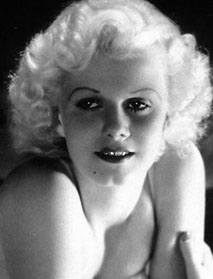
Jean Harlow
From Wikipedia, the free encyclopedia
Jean Harlow (born March 3, 1911 - died June 7, 1937) was an American film actress who became known as the "original blonde bombshell," predating Marilyn Monroe as a blonde sex symbol.
Harlow was the first blonde to be cast in "bad girl" roles. Before her, bad girls in movies were dark-haired and exotic looking. She made over 30 films during a career that lasted only 10 years, and had a talent for comedy as well as drama that is still recognized today by record numbers of fans and film critics alike.
Early years
Harlow was born Harlean Carpenter in Kansas City, Missouri, the daughter of Mont Clair Carpenter, a dentist, and his wife, Jean Poe Harlow. Her given name (Harlean) was invented from parts of her mother's maiden name, Jean Harlow. At first, Harlow adopted her mother's name as a stage name, then legally changed it in 1935.
Mother Jean, as she was known, divorced Harlean's father and moved to Hollywood with hopes of becoming an actress herself. Shortly afterward she remarried and moved to Chicago, where Jean attended Ferry Hall School, a private girls' academy in the wealthy suburb of Lake Forest. At the age of 16, Jean eloped with Charles McGrew 2nd, a wealthy young stockbroker and the couple moved to Los Angeles, California. They divorced two years later.
Movies and marriages
Jean wanted to be a wife and mother, but to please Mother Jean she looked for work as an extra in films, in which she made $7 a day. In the beginning Jean landed bit parts in silent films such as Why is a Plumber? (1927), Moran of the Marines (1928) and The Love Parade (1929). She had a more substantial role in Laurel and Hardy's short Double Whoopee (1929). She got her first major role when producer Howard Hughes cast her in the World War I film Hell's Angels (1930).
Notable for its two-strip Technicolor sequences (including some footage of Harlow in color), this film launched Harlow as the premier sex symbol of the 1930s and started a craze for platinum blonde hair that continues to this day.
In 1931, Harlow began to gain popularity when she appeared in The Public Enemy, Goldie, The Secret Six with Clark Gable, and Platinum Blonde. In 1932 she had bigger roles in Red-Headed Woman, for which she received a salary of $1,250/week, and Red Dust, her second film with Clark Gable. Harlow and Gable worked well together and co-starred in a total of six films.
It was during the making of Red Dust that Harlow's second husband, MGM producer Paul Bern (né Paul Levy) died in an incident that remains mysterious to this day; he was found naked in his wife's bedroom, shot in the head and drenched in his wife's perfume. Years later it was suggested by screenwriter Ben Hecht that Bern was murdered by an unbalanced former lover, Dorothy Millette, who actually committed suicide the next day. (Years later, the Bern-Harlow house became the home of Jay Sebring and, for a time, Sharon Tate. They were later both murdered by Charles Manson's followers.)
By 1933, Harlow was becoming a superstar. She had a great comedic part in Dinner at Eight, and later that year she starred in Bombshell. Because of Harlow's indiscreet affair with boxer Max Baer, Mrs. Baer threatened divorce proceedings, naming Harlow as a co-defendent for "alienation of affection," then the common term for adultery. MGM diffused the situation by arranging a quick marriage between Harlow and cinematographer Harold Rosson. Still feeling the aftershocks of the mysterious Bern death, the studio didn't want another Harlow scandal on its hands. Rosson and Harlow were friends, and the cameraman went along with the plan. They divorced quietly seven months later. Harlow then starred in two more films with Clark Gable, China Seas (1935) and Wife vs. Secretary (1936). Other co-stars included Spencer Tracy, Robert Taylor and William Powell.
Critics early on praised Harlow's beauty, but panned her sometimes clumsy acting in the standard '30s gangster potboilers and romantic melodramas. After seeing her in Bombshell, many started to reconsider their previous opinions of Harlow's acting, and MGM discovered Harlow's strong suit: comedy. Her performance in Dinner at Eight cemented her reputation as an expert comedienne, not just a sex symbol.
Following the end of her third marriage, Harlow met MGM star William Powell. They reportedly were engaged for two years, but differences kept them from marrying swiftly (she wanted children; he did not). Harlow also said that studio head Louis B. Mayer would never allow them to wed.
Death
Harlow fell ill with influenza during the early part of 1937; although she recovered, the attack weakened her body against the onslaught of a more serious illness that was just beginning to take hold: kidney failure. In retrospective analysis, Harlow's kidneys may have been slowly failing during the ten years since she contracted scarlet fever while in her early teens. In the days before kidney dialysis and transplants, this condition was fatal.
While filming Saratoga (1937) with Clark Gable, Harlow collapsed on set and was rushed to the hospital, diagnosed with uremic poisoning. She died just days later, at the age of 26.
Harlow is buried at the Forest Lawn Memorial Park, in Glendale, California. William Powell paid for her tomb, which bears the simple inscription "Our Baby." Her funeral took place in the Wee Kirk O' The Heather Chapel at Forest Lawn Cemetery. She was buried in the negligee that she had worn just weeks before, while filming a scene from Saratoga. It's been reported that a single white gardenia with an unsigned note attached that read "Good night, my dearest darling" were placed in her hands. It is assumed that both were from her beloved William Powell, who also paid for her final resting place?-the $25,000, 9x10-foot private room lined with multicolored imported marble located in the Sanctuary of Benediction.
Many myths have swirled around Harlow's death and it was not until the early 1990s that her long-sealed medical records were uncovered. Legend had it that Harlow's mother, a Christian Scientist, prevented doctors from attending to her dying daughter, but this myth has been extinguished; records prove Harlow received constant medical attention. Other long-standing myths, such as the suggestion that Harlow's kidneys were damaged in a beating from husband Paul Bern or that bleach from her hair seeped into her brain and killed her, are equally untrue.
Trivia
* Harlow was linked to American mobster Bugsy Siegel and was the godmother of his daughter Millicent. She also dated mobster Abner Zwillman at one time. He bought her a Cadillac and a jeweled bracelet, as well as getting her a two-picture deal with Harry Cohn of Columbia Pictures due to a loan he made to Cohn.
* Jean Harlow was one of Marilyn Monroe's idols when Marilyn was growing up. Ironically, just like her idol, Monroe was a sex symbol who would be more respected as an actress after her death than during her career.
* William Powell told Harlow that he had married a blonde bombshell already, and he was not going to marry another one.
* Jean's beautiful green eyes were deep-set and she had to be lit just so for film and photo sessions in order to bring them out in contrast to the angle of her nose and the cleft in her chin. Her trademark extremely-arched eyebrows were drawn in after her own comparatively straight eyebrows were shaved off.
* Although a natural ash blonde, Harlow achieved her trademark platinum tresses through weekly bleaching sessions using a mixture of peroxide, ammonia, Clorox and Lux Flakes?-an extremely painful and harsh process.
* Harlow died as her last film, Saratoga, was 90% completed. Word got out that MGM intended either to reshoot the film with a new actress or scrap it altogether. Hearing this news, thousands of fans wrote letters to MGM asking them not to scrap Harlow's last film, but to release it to theaters. The last 10% of the film was completed using a soundalike and a body double, Mary Dees, mostly accomplished with wide-angle shots. The film broke box-office records and became the biggest picture of Harlow's career. Clark Gable remarked that during filming scenes after Harlow's death, he felt as if he "were in the arms of a ghost."
* Two competing films, both titled Harlow, were released in 1965. Carroll Baker played Jean in the more successful film, although Baker was almost a decade older than the age Harlow was when she died. More age-appropriate, but less successful at the box office, was Carol Lynley in her "quickie" film version. In the 1950's, there was talk that Marilyn Monroe might make a film on Harlow's life for 20th Century-Fox and Columbia Pictures considered making a Harlow biopic with either Cleo Moore or Kim Novak but neither project got off the ground.
* Gwen Stefani made her acting debut playing Jean Harlow in the 2004 Martin Scorsese movie The Aviator. Like Baker, Stefani was 34 when she played Jean Harlow?-who was 19 years old at the time she was discovered by Hughes.
http://en.wikipedia.org/wiki/Jean_Harlow