106
   

WA2K Radio is now on the air


Letty
 
  1  
Reply Mon 24 Oct, 2005 08:34 pm
Good evening, WA2K radio fans and listeners. There is nothing more beautiful than listening to our contributors well wishes and fantastic music, right folks?

Things are looking up, and I am happy to say that I felt--yes felt the kindness and concern. Good neighbors and good friends are worth more than we will ever understand. Things seem okay as of now.

Goodnight, and remember those who are unable to communicate for whatever reason.

From Letty with love
0 Replies
 
Ticomaya
 
  1  
Reply Mon 24 Oct, 2005 08:38 pm
Hey, Letty! Good to hear your voice back on the radio.

Good night.
0 Replies
 
Reyn
 
  1  
Reply Mon 24 Oct, 2005 09:03 pm
Letty wrote:
Things are looking up, and I am happy to say that I felt--yes felt the kindness and concern. Good neighbors and good friends are worth more than we will ever understand. Things seem okay as of now.

Good to hear, Letty.

A big hug to you, your husband, and family. Smile
0 Replies
 
edgarblythe
 
  1  
Reply Mon 24 Oct, 2005 09:44 pm
I selected this song only because it is one I like by Dinah Washington. No other significance. It was featured in the film about Ira Hayes.

Where are you
Where have you gone without me
I thought you cared about me
Where are you
Where's my heart
Where is the dream we started
I can't believe we're parted
Where are you
When we said good-bye love
What had we to gain
When I gave you my love
Was it all in vain
All life through
Must I go on pretending
Where is my happy ending
Where are you
When we said good-bye love
What had we to gain
When I gave you my love
Was it all in vain
All life through
Must I go on pretending
Where is that happy ending
Where are you
Where are you
0 Replies
 
JLNobody
 
  1  
Reply Mon 24 Oct, 2005 10:09 pm
It does seem that Letty has no electricity, in the literal sense.
0 Replies
 
bobsmythhawk
 
  1  
Reply Tue 25 Oct, 2005 03:32 am
Georges Bizet
From Wikipedia, the free encyclopedia.


Georges Bizet (October 25, 1838 - June 3, 1875), was a French composer of the romantic era best known for his opera Carmen.

Born Alexandre-César-Léopold, but baptized Georges, Bizet, a child prodigy, entered the prestigious Paris Conservatory of Music at the unheard-of age of nine.

In 1857 he shared a prize offered by Jacques Offenbach for a setting of the one-act operetta Le Docteur Miracle and won the Prix de Rome. As per the conditions of the scholarship, he studied in Rome for three years. There, his talent began to mature with such works as Symphony in C (Roma) and the opera Don Procopio. Besides this stay in Rome, Bizet lived in the Paris area for his entire life.

Following his stay in Rome, he returned to Paris where he dedicated himself to composition. Early into his return to Paris, Georges' mother died. In 1863 he composed the opera Les Pêcheurs de Perles (The Pearl Fishers) for the Theatre-Lyrique. During this period Bizet also wrote the opera La jolie fille de Perth, his well-known L'arlésienne (written as incidental music for a play), and the piano piece Jeux d'enfants (Children's games) He also wrote the romantic opera Djamileh, which is often seen as a percursor to Carmen.

Bizet's best-known work is his 1875 opera, Carmen, which was based on an 1846 novel of the same name by Prosper Mérimée. Influenced by Giuseppe Verdi, he composed the title role in Carmen for a mezzo-soprano. Not an immediate success, Bizet became despondent over the perceived failure, but praise came from such luminaries as Camille Saint-Saëns, Peter Tchaikovsky, and Claude Debussy, who recognized its greatness. Their views were prophetic, as the public made Carmen one of the most popular works in operatic history.

Bizet had long suffered from quinsy, a painful inflammation of the tonsils associated with angina and never got to enjoy Carmen's success. Just a few months after the opera's debut, he died on his sixth wedding anniversary at the early age of 36, the official cause of death being listed as a failed heart due to "acute articular rheumatism". He was interred in the Père Lachaise Cemetery, Paris, France.

The 1954 motion picture Carmen Jones, adapted from the opera, won the Golden Globe Award for Best Motion Picture Musical.

Although it is not well known, Bizet was an extraordinarily fine pianist, whose playing was praised by no less a judge than Franz Liszt himself. After Bizet flawlessly sightread a complex piece, Liszt said he considered Bizet one of the three finest pianists in Europe.

http://en.wikipedia.org/wiki/Georges_Bizet
0 Replies
 
bobsmythhawk
 
  1  
Reply Tue 25 Oct, 2005 03:38 am
Pablo Picasso
From Wikipedia, the free encyclopedia.


Pablo Picasso[1], formally Pablo Ruiz Picasso, Spanish painter, (October 25, 1881 - April 8, 1973) was one of the recognized masters of 20th century art, probably most famous as the founder, along with Georges Braque, of Cubism.


Introduction

Picasso is most famous as the co-founder of Cubism. However, in a long life he produced a wide and varied body of work, the best-known being the Blue Period works which feature moving depictions of acrobats, harlequins, prostitutes, beggars and artists.

While Picasso was primarily a painter (in fact he believed that an artist must paint in order to be considered a true artist), he also worked with small ceramic and bronze sculptures, collage and even wrote some poetry. "Je suis aussi un poète," as he quipped to his friends.

Picasso was the most prolific painter ever, as deemed in the Guiness Book of Records. He produced about 13,500 paintings or designs, 100,000 prints or engravings, 34,000 book illustrations, and 300 sculptures and ceramics plus drawings and tapestries. The total value of his work was estimated in 1973 to be about $750 million.


Arguably Picasso's most famous work is his depiction of the German bombing of Guernica, Spain ?- Guernica. This large canvas embodies for many the inhumanity, brutality and hopelessness of war. The act of painting it was captured in a series of photographs by Picasso's most famous lover, Dora Maar, a distinguished artist in her own right. Guernica hung in New York's Museum of Modern Art for many years; Picasso stipulated that the painting should not return to Spain until democracy was restored in that country. In 1981 Guernica was returned to Spain and exhibited at the Casón del Buen Retiro. In 1992 the painting became one of the main attractions in Madrid's Reina Sofía Museum when it opened.

Picasso was extremely talented as a painter and draughtsman, even by the standards of the world's great artists. He worked with equal facility in oil, watercolour, pastels, charcoal, pencil, and ink. He famously rendered complex scenes as just a few geometric shapes in his mixed-media Cubist works, but he also produced masterful realist portraits throughout his life. His pen and ink sketches of his friends from the Cubist era and afterwards are valued for their understated intimacy, examples of the fluidity of his skills. Indeed, Picasso moved with ease among the plastic arts despite limited academic training (he finished only one year at the Royal Academy in Madrid). His natural talents were augmented by a ferocious work ethic that survived into the final years of his long life.

Periods

Picasso's work is often categorized into "periods". While the names of many of his later periods are debated, the most commonly accepted periods in his work are:

* Blue Period (1901-1904) - sombre paintings which are influenced from a trip in Spain, his sad mood in many of the pictures possibly coming from his reaction to the death of a friend.

* Rose Period (1905-1907) - A more cheerful style in orange and pink colours, which featured many harlequins. He met Fernande Olivier in Paris and many of these paintings are influenced by his warm relationship with her, and also from French painting.

* African influenced Period (1908-09) - Influenced by the two figures on the right in his painting of Les Demoiselles d'Avignon, he used African artifacts as the inspiration for his work.

* Analytic Cubism (1909-12) - A style of painting he developed along with Braque using monochrome brownish colours, where they took apart objects and 'analysed' them in terms of their shapes. Picasso's and Braque's paintings at this time are very similar to each other.

* Synthetic Cubism (1912-19) - Involving the use of collage and cut paper, it was the first time collage had been used as a fine art work.


Early life

Pablo Diego José Santiago Francisco de Paula Juan Nepomuceno Crispín Crispiniano de los Remedios Cipriano de la Santísima Trinidad Ruiz Picasso was born on October 25, 1881 in Málaga, Spain, the first child of José Ruiz y Blasco and María Picasso y López.

Picasso's father, José Ruiz y Blasco, was himself a painter; for most of his life, a professor of art at the School of Fine Arts and Crafts; and was a curator of a local museum. It was from his father that Picasso learned the basics of formal academic art training - figure drawing, and painting in oil. Although Picasso attended art schools throughout his childhood, often those where his father taught, he never finished his college level course of study at the Royal Academy of San Fernando in Madrid, leaving after less than a year.

The Museu Picasso in Barcelona features many of Picasso's early works, created while he was living in Spain, as well as the extensive collection of Jaime Sabartés, Picasso's close friend from his Barcelona days and for many years Picasso's personal secretary. There are many precise and detailed figure studies done in his youth under his father's tutelage, as well as rarely seen works from his old age, that clearly demonstrate Picasso's firm grounding in classical techniques.

Picasso used a harlequin in many of his early works, especially in his Blue and Rose Periods. A comedic character depicted usually in checkered patterned clothing, the harlequin became a personal symbol of Picasso. During the 1930s, the minotaur replaced the harlequin as a motif which he used often in his work. His use of the minotaur came partly because of contact with the Surrealists who often used it as their symbol. The minotaur appears in Picasso's painting Guernica.

Picasso and pacifism

Picasso remained neutral during the Spanish Civil War, World War I and World War II, refusing to fight for any side or country. Picasso never commented on this but encouraged the idea that it was because he was a pacifist. Some of his contemporaries though (including Braque) felt that this neutrality had more to do with cowardice than principle.

As a Spanish citizen living in France, Picasso was under no compulsion to fight against the invading Germans in either world war. In the Spanish Civil War, service for Spaniards living abroad was optional and would have involved a voluntary return to the country to join either side. While Picasso expressed anger and condemnation of Franco and the Fascists through his art he did not take up arms against them.

He also remained aloof from the Catalan independence movement during his youth despite expressing general support and being friendly with activists within it. No political movement seemed to compel his support to any great degree.

During the Second World War, Picasso lived in German occupied Paris. The Nazis hated his style of painting, so he was not able to show his works during this time. He retreated into his studio, continuing to paint nevertheless. While the Germans outlawed bronze casting in Paris, Picasso was still able to continue because of the French resistance who would smuggle bronze to him.

After the Second World War, Picasso rejoined the French Communist Party, and even attended an international peace conference in Poland. But party criticism of a portrait of Stalin as insufficiently realistic cooled Picasso's interest in Communist politics, though he remained a loyal member of the Communist Party until his death.


Personal life


Picasso hated to be alone when he wasn't working. In Paris, in addition to having a distinguished coterie of friends in the Montmartre and Montparnasse quarters, including André Breton, Guillaume Apollinaire, writer Gertrude Stein and others, he usually maintained a number of mistresses in addition to his wife or primary partner. Picasso married twice and had four children by three women.

In the early years of the 20th century, Picasso, still a struggling youth, began a long term relationship with Fernande Olivier. It is she who appears in many of the Rose period paintings. After garnering fame and some fortune, Picasso left Olivier for Marcelle Humbert, whom Picasso called Eva. Picasso included declarations of his love for Eva in many Cubist works. Humbert was diagnosed with cancer and during her rapid deterioration, Picasso administered to her every need, making daily trips across Paris to visit her in the hospital.


In 1918, Picasso married Olga Khoklova, a ballerina with Sergei Diaghilev's troupe, for whom Picasso was designing a ballet, Parade, in Rome. Khoklova introduced Picasso to high society, formal dinner parties, and all the social niceties attendant on the life of the rich in 1920s Paris. The two had a son, Paulo, who would grow up to be a dissolute motorcycle racer and chauffeur to his father.

Khoklova's insistence on social propriety clashed with Picasso's bohemian tendencies and the two lived in a state of constant conflict. In 1927 Picasso met 17 year old Marie-Thérèse Walter and began a secret affair with her. Picasso's marriage to Khoklova soon ended in separation rather than divorce, as French law required an even division of property in the case of divorce and Picasso did not want Khoklova to have half his wealth. The two remained legally married until Khoklova's death in 1955.

Picasso carried on a long-standing affair with Walter and fathered a daughter, Maya, with her. Marie-Thérèse lived in the vain hope that Picasso would one day marry her and hanged herself after Picasso's death.

The photographer and painter Dora Maar was also a constant companion and lover of Picasso. The two were closest in the late 1930s and early 1940s and it was Maar who documented the painting of Guernica. Like all the women in his life, Maar was cruelly emotionally abused by the narcissistic Picasso.

After the liberation of Paris in 1944, Picasso began to keep company with a young art student, Françoise Gilot. The two eventually became lovers, and had two children together, Claude, and Paloma. Uniquely among Picasso's women, Gilot left Picasso in 1953 because of his abusive treatment and infidelities. This came as a severe blow to Picasso.

He went through a difficult period after Gilot's departure, coming to terms with his advancing age and his perception that he was an old man, now in his 70s, who was no longer attractive, but rather grotesque to young women. A number of ink drawings from this period explore this theme of the hideous old dwarf as buffoonish counterpoint to the beautiful young girl, including several from a six-week affair with Geneviève Laporte, who in June 2005 auctioned off the drawings Picasso made of her.

Picasso was not long in finding another lover, Jacqueline Roque. Roque worked at the Madoura Pottery, where Picasso made and painted ceramics. The two remained together for the rest of Picasso's life, marrying in 1961. Their marriage was also the means of one last act of revenge against Gilot. Gilot had been seeking a legal means to legitimize her children with Picasso, Claude and Paloma. With Picasso's encouragement, she had arranged to divorce her then husband, Luc Simon, and marry Picasso to secure her children's rights. Picasso then secretly married Roque after Gilot had filed for divorce in order to exact his revenge for her leaving him.

In addition to his manifold artistic accomplishments, Picasso had a film career, including a cameo appearance in Jean Cocteau's Testament of Orpheus. Picasso always played himself in his film appearances.


Later works

In the 1950s his style changed once again as he began looking at the art of the great masters, and making new art about it. He made a series of works based on Velazquez's painting of Las Meninas. He also based paintings on works on art by Goya, Poussin, Manet, Courbet and Delacroix. During this time he lived at Cannes and in 1955 helped make the film Le Mystère Picasso (The Mystery of Picasso) directed by Henri-Georges Clouzot.

Picasso had accumulated a huge fortune and could afford large villas in the south of France, at Notre-dame-de-vie on the outskirts of Mougins, in the Provence-Alpes-Côte d'Azur. The media would give him much attention, though they were often more interested in his personal life than his art.

He was commissioned to make a maquette for a huge 50 foot high sculpture to be built in Chicago, Illinois, known usually as the Chicago Picasso. He approached the project with a great deal of enthusiasm, designing a sculpture which was ambiguous and became somewhat controversial. What the figure is exactly is not known; it could be a bird, a horse, a woman or a totally abstract shape. The sculpture, one of the most recognizable landmarks of downtown Chicago was unveiled in 1967. Picasso refused to be paid $100,000 for it, donating it to the people of Chicago.

In his 80s and 90s, Picasso, no longer quite the energetic dynamo he had been in his youth, became more and more impotent. To a man for whom this was such an important part of life, this was a serious life change and Picasso seems to have dealt with it by redoubling his already prolific artistic output.

Picasso's final works were a mixture of styles, his styles and periods changing right until the end of his life. Devoting his full energies to his work, Picasso became more daring, his works more colourful and expressive, and from 1968 through 1971 he produced a torrent of paintings and hundreds of copperplate engravings. At the time these works were dismissed by most as pornographic fantasies of an impotent old man or the slapdash works of an artist who was past his prime. One long time admirer, Douglas Cooper, called them "the incoherent scribblings of a frenetic old man". Only later, after Picasso's death, when the rest of the art world had moved on from abstract expressionism, did the critical community come to see that Picasso had already discovered neo-expressionism and was, as usual, ahead of his time.

Pablo Picasso died on April 8, 1973, and was interred at Castle Vauvenargues' park, in Vauvenargues, Bouches-du-Rhône. Jacqueline Roque prevented his children Claude and Paloma from attending the funeral. His final words were "drink to me".

Legacy


At the time of his death, he had kept off the art market that which he had not needed to sell. In addition, Picasso had a considerable collection of the work of other famous artists, some his contemporaries, such as Henri Matisse, with whom he had exchanged works. Since Picasso left no will, his death duties, or estate tax to the French state, were paid in the form of his works and others from his collection. These works form the core of the immense and representative collection of the Musée Picasso in Paris. In 2003, relatives of Picasso inaugurated a museum dedicated to him in his birthplace, Málaga, Spain, the Museo Picasso Málaga.

The film Surviving Picasso was made about Picasso in 1996, as seen through the eyes of Francois Gilot. Anthony Hopkins played Picasso in the movie.

In 1999, Picasso's Les Noces (The Marriage of Pierrette) sold for more than USD $51 million.

Several paintings by Picasso rank among the most expensive paintings in the world. On May 4, 2004 Picasso's painting Garçon à la pipe was sold for USD $104 million at Sotheby's, thus establishing a new price record (see also List of most expensive paintings)

http://en.wikipedia.org/wiki/Pablo_Picasso
0 Replies
 
bobsmythhawk
 
  1  
Reply Tue 25 Oct, 2005 03:43 am
Richard E. Byrd
From Wikipedia, the free encyclopedia.

Rear Admiral Richard Evelyn Byrd, USN (October 25, 1888 - March 11, 1957) was an pioneering American polar explorer and famous aviator.

Biography

Byrd attended the University of Virginia before financial circumstances inspired his transfer and graduation from the United States Naval Academy. He learned to fly in World War I during his tour with the United States Navy. He developed a passion for flight, and pioneered many techniques for navigating airplanes over the open ocean including drift indicators and bubble sextants. His expertise in this area resulted in his appointment to plan the flight path for the U.S. Navy's 1919 transatlantic crossing. Of the three flying boats that attempted it, only Albert Read's aircraft the NC-4 completed the trip; becoming the first ever transatlantic flight.


Attempt to fly over the North Pole, 1926

On May 9, 1926, Byrd and Floyd Bennett attempted a flight over the North Pole. They claimed to have achieved the pole, however subsequent evidence from their diaries and mechanical analysis of their plane confirmed by the Norwegian-American aviator and explorer Bernt Balchen has cast significant doubt on their claim. Nonetheless, this trip earned Byrd widespread acclaim, enabling him to secure funding for subsequent attempts on the South Pole.


Trans-Atlantic Flight, 1927


First Antarctic expedition, 1928-1930

In 1928, Byrd began his first expedition to the Antarctic involving two ships and three airplanes. A base camp was constructed on the Ross Ice Shelf and scientific expeditions by dog-sled, snowmobile, and airplane began. Photographic expeditions and geological surveys were undertaken for the duration of that summer, and constant radio communications were maintained with the outside world. After their first winter their expeditions were resumed and on November 29, 1930 the famous flight to the South Pole was launched. Byrd, along with pilot Bernt Balchen co-pilot / radioman Harold June and photographer Ashley McKinley flew the Floyd Bennet to the South Pole and back in 18 hours, 41 minutes. They had difficulty gaining altitude, and had to dump empty gas tanks as well as their emergency supplies in order to achieve the altitude of the Polar Plateau. However, the flight was successful, and entered Byrd into the history books. After a further summer of exploration, the expedition returned to America on June 18, 1930.


Byrd's later Antarctic expeditions

Byrd undertook three more expeditions to the South Pole from 1933-35, 1939-41 and 1946-47.

On the first, in 1934, he spent five winter months alone operating a meteorological station, Advance Base, from which he narrowly escaped with his life after suffering carbon monoxide poisoning from a poorly-ventilated stove. Unusual radio transmissions from Byrd finally began to alarm the men at the base camp, who then attempted to go to Advance Base. The first two trips were a failure due to darkness, snow, and mechanical troubles. Finally, Dr. Thomas Poulter, E.J. Demas and Amory Waite arrived at advanced base, where they found Byrd in poor physical health. The men remained at advanced base until October 12 when an airplane from the base camp picked up Dr. Poulter and Byrd. The rest of the men returned to base camp with the tractor.

The third culminating expedition, Operation Highjump, was the largest Antarctic expedition to date.

Byrd also commanded Operation Deep Freeze, which established permanent Antarctic bases at McMurdo Sound, the Bay of Whales and the South Pole in 1955, accompanied by Andrew Van Mincey, for whom Mincey Glacier is named.


Awards and decoration

By the time Richard Byrd died on March 12, 1957, he had amassed twenty-two citations and special commendations, nine of which were for bravery and two for extraordinary heroism in saving the lives of others. As well he earned the Medal of Honor, the Congressional Life Saving Medal, the Distinguished Service Medal, the Flying Cross, the Navy Cross and three ticker-tape parades. However, Byrd was reportedly very modest about these achievements, preferring to dwell on the substance of his adventures, and the stories of those that had gone awry.

http://en.wikipedia.org/wiki/Richard_E._Byrd
0 Replies
 
bobsmythhawk
 
  1  
Reply Tue 25 Oct, 2005 03:50 am
Leo G. Carroll
From Wikipedia, the free encyclopedia.


Leo G. Carroll (October 25, 1892-October 16, 1972) was a British character actor, best known for his roles in several Hitchcock films and The Man from U.N.C.L.E..

He was born in Weedon, Buckinghamshire to a wealthy Catholic family, who named him after the reigning pope Leo XIII. Carroll made his stage debut in 1912, and played in London and Broadway until he moved to Hollywood in 1934 to start a career in film. Once there he soon made his film debut in Sadie McKee (1934). More parts followed, often playing doctors or butlers. He made notable appearances as Marley's ghost in A Christmas Carol (1938) and as Joesph in Wuthering Heights (1939).

Carroll is perhaps most well-known for his roles in six of Alfred Hitchcock's films. As with earlier roles he was often cast as doctors or other figure of authority, such as the spymaster The Professor in North by Northwest. He was also popular on television as the befuddled banker Topper (1953-56) and later as spymaster Alexander Waverly on The Man From U.N.C.L.E. (1964-68), echoing his earlier work for Hitchcock. Several U.N.C.L.E. films followed, and a spin-off The Girl from U.N.C.L.E. (1966). He was one of the first actors to appear in two different television series as the same character.

In 1972 he died in Hollywood of pneumonia brought on by cancer and was interred in the Grand View Memorial Park Cemetery in Glendale, California.

http://en.wikipedia.org/wiki/Leo_G._Carroll
0 Replies
 
bobsmythhawk
 
  1  
Reply Tue 25 Oct, 2005 03:55 am
Minnie Pearl
From Wikipedia, the free encyclopedia.

Minnie Pearl was the stage name of Sarah Ophelia Colley Cannon (October 25, 1912 - March 4, 1996). She was a country comedienne who appeared frequently on the Grand Ole Opry, and on the television show Hee Haw from 1970 to 1991. She was known for wearing a big hat with a price tag ($1.98) hanging off the side.

Colley was born in Centerville, Tennessee. She graduated from what was then Nashville, Tennessee's most prestigious school for young ladies, Ward-Belmont. Her family, relatively affluent by the standards of the area and the day, was somewhat scandalized by her entry into "show business", and at first her involvement was more as a booking agent, business manager, and facilitator than as a performer.

As a performer, her comedy was always a rather gentle and loving satire of her hometown of Centerville, about fifty miles (eighty km) west of Nashville in Hickman County. Her trademark opener was always, "Howdeeee! I'm just so proud to be here!" delivered at what seemed to have been the top of her lungs. (Once she was an established star, her audience almost invariably shouted "Howdeeee!" back to her.) Her monologues almost always involved her comical relatives, notably "Uncle Nabob" and "Brother", who was somehow both slow-witted and wise in a way, simultaneously. She called her hometown in her act "Grinders Switch", a real location just outside of Centerville which consisted of little more than the eponymous railroad switch; those who knew her knew that the characters were largely based on real residents of Centerville. (So much unwarranted traffic to Grinder's Switch looking for the hometown she described was generated by tourists following the road sign that the Hickman County Highway Department was finally motivated to change the designation on the sign to "Hickman Springs Road". Attempts over the years to develop a "Grinder's Switch" theme park have proven futile.) Her character was always presented as a man-hungry spinster willing to settle for almost anything in the way of male companionship; in real life she was happily married for many years to Henry Cannon.

In the late 1960s, Mrs. Cannon and African-American Gospel Singer Mahalia Jackson were convinced to allow their names to be associated with a chain of fried-chicken restaurants in competition with Kentucky Fried Chicken by Nashville entrepreneur John Jay Hooker. At first the stock price of this venture soared; later it collapsed amid allegations of accounting irregularities and stock price manipulation. This affair was throughly investigated by the U.S. Securities and Exchange Commission; Miss Pearl/Mrs. Cannon and Ms. Jackson were found to have been completely uninvolved in any alleged wrongdoing, but were considerably embarrassed by the negative publicity surrounding their names. (A small number of these restaurants actually survived into the 1980s in the Middle Tennessee area.)

As noted above, Mrs. Cannon portrayed the Minnie Pearl character for many years on the perennial Saturday-night television cornfest Hee Haw, both on the original network and subsequent syndicated versions. This may have been less taxing than it would appear; the program was shot entirely in Nashville and totally out of sequence, so that each performer could record all of his or her appearances for an entire television season in a matter of a few days or parts of days.

Cannon was fairly influential in the lives of many younger country artists, taking something of a maternal interest in them, especially Hank Williams, but also many of the younger generation of female singers; she had seen many of the inequities in the treatment of women in business in general, and women in the country music industry in particular, first-hand. She was also a close friend of Paul Reubens aka Pee-Wee Herman. In her later years she lived in a prestigious Nashville neighborhood next to the Governor's Mansion, where she befriended several of the governors. After surviving breast cancer through aggressive treatments including mastectomy and radiation therapy, she became a spokeswoman for the medical center in Nashville where she had been treated and somewhat for cancer survivors in general. She took on this role as herself, Sarah Ophelia Cannon, not desiring the Minnie Pearl character to be associated with such misfortune, although a nonprofit group called the "Minnie Pearl Cancer Foundation" has been founded in her memory to help fund cancer research. The center where she was treated was later named the "Sarah Cannon Cancer Center", and has been expanded to several other hospitals in the Middle Tennessee and Southern Kentucky area. Her name has also been lent to the affiliated Sarah Cannon Research Institute .

Her death at the age of 83 was brought on by complications due to a stroke. During her time in the nursing home she was visited frequently by numerous country music industry figures, notably Vince Gill and Amy Grant, whose romantic relationship is alleged to have begun during joint visits to see her. She is buried at Mt. Hope Cemetery in Franklin, Tennessee.

http://en.wikipedia.org/wiki/Minnie_Pearl
0 Replies
 
bobsmythhawk
 
  1  
Reply Tue 25 Oct, 2005 04:00 am
Marion Ross
From Wikipedia, the free encyclopedia.

Marion Ross (born October 25, 1928) is an American actress.

Born Marian Ross in Albert Lea, Minnesota, she grew up there, and in nearby Waconia and Willmar. At the age of 13, she changed the spelling of her name from "Marian" to "Marion" because she thought it would look better on a marquee. After completing her sophomore year in high school, she moved to Minneapolis, Minnesota and worked as an au pair while studying drama at the MacPhail Center for the Arts, and attending Southwest High School. A year later, her family moved to San Diego, California.

Ross enrolled in San Diego State College, where she was named the school's most outstanding actress. After graduation in 1950, she performed in summer theater in La Jolla, California. The director was impressed by her talent, and recommended that she try for work in cinema.

Ross made her 1953 film debut in Forever Female, starring Ginger Rogers and William Holden. She found steady work in film, appearing in The Glenn Miller Story (1954), Sabrina (1954), and Operation Petticoat (1959).

Her career on television began in 1953, when she played the Irish maid on the series Life With Father for two years. Her list of credits spans the history of classic TV, from The George Burns and Gracie Allen Show, Love Boat and Night Court. Ross's most famous role was in the long-running series Happy Days from 1974 to 1984, in which she played "Marion Cunningham", Ritchie and Joanie's mother, also known as "Mrs. C."

Ross has acted on Broadway and on film, but she adores doing TV. In recent years, she played recurring roles as Drew Carey's mother, on The Drew Carey Show; as evil "Grandma Forman" on That '70s Show; and as "Lorelei's grandmother" on The Gilmore Girls. She also frequently appears on Hollywood Squares and did voiceovers for "Grandma SquarePants" on SpongeBob SquarePants.

Ross lives in Los Angeles, California with actor Paul Michael. Her two adult children also work in entertainment: Jim Meskimen's acting credits include How the Grinch Stole Christmas, and Ellen Plummer is a writer/producer on Friends.

http://en.wikipedia.org/wiki/Marion_Ross
0 Replies
 
bobsmythhawk
 
  1  
Reply Tue 25 Oct, 2005 04:15 am
Helen Reddy
From Wikipedia, the free encyclopedia.


Helen Reddy (born October 25, 1941 in Melbourne, Australia) is a pop singer and actress. Reddy was immensely successful as a singer in the 1970s with numerous hit records including three U.S. #1 singles. She has sold more than 15 million albums and 10 million singles, and was the first Australian-born performer to win a Grammy award. In 1974, she became a naturalized citizen of the United States.

Reddy was born into a well-known Australian show business family?-her parents, well-known performers on the Australian vaudeville circuit, were actress and singer Stella Lamond and writer-actor-comedian Max Reddy; her older sister is actress-singer Toni Lamond; and her nephew is actor-singer Tony Sheldon.

Reddy began performing on stage with her parents at four years of age. In her late teens she was briefly married an older musician, with whom she had a daughter, Traci, but they divorced soon afterwards. After beginning her career in radio and television in Australia, she won a talent contest on the Australian pop music TV show Bandstand which enabled her to move to the United States in 1966. Settling initially in New York, she met Jeff Wald, then an agent with the William Morris Agency; the couple began living together four days later and she and Wald (who became her manager) subsequently married.

After a stint in Chicago, the family moved to Los Angeles, California where Reddy tried to established herself as a recording artist. Twenty-seven labels rejected her before she was finally signed to a contract with Capitol Records in 1970.

Alongside her friend (and fellow Australian expatriate) Olivia Newton-John, Reddy became one of the most successful female recording artists of the Seventies, with fourteen U.S. Top 40 singles between 1971 and 1978. Reddy was also instrumental in furthering Newton-John's career?-she encouraged her friend to move from Britain to the United States in the early 1970s, and Newton-John won the starring role of "Sandy" in the hit film version of the musical Grease after a chance meeting with the film's producer Allan Carr at a party at Reddy's house.

Reddy's first Top 40 U.S. hit (1971) was a cover of "I Don't Know How To Love Him" (from Jesus Christ Superstar. She scored an international hit in 1972 with a re-recorded version of a song she co-wrote with Australian musician Ray Burton, the feminist anthem "I Am Woman", which became her first U.S #1. Reddy has attributed the impetus for writing "I Am Woman" and her early awareness of the women's movement to expatriate Australian rock critic and pioneer feminist Lillian Roxon. The single earned a Grammy Award and at the awards ceremony she concluded her acceptance speech by famously thanking God "because She makes everything possible".

Over the next five years, she had more than a dozen other U.S. Top 40 hits including two more #1 hits. These included the Alex Harvey country ballad "Delta Dawn" (#1, 1973), "Leave Me Alone (Ruby Red Dress)" (#3), "Keep On Singing" (#15, 1974), "You And Me Against The World" (written by Paul Williams and featuring daughter Traci reciting the spoken bookends), "Emotion", "Peaceful" (#15), "Angie Baby" (#1), "Ain't No Way To Treat A Lady" (#8, 1975), the sophisticated Richard Kerr-Will Jennings "Somewhere In The Night" (#19; later a bigger hit for Barry Manilow), and the Carole King-Gerry Goffin song "I Can't Hear You No More" (1976). Her last Top 20 record was a 1977 revival of Cilla Black's 1964 hit "You're My World", co-produced by Kim Fowley.

The stories behind two of Reddy's biggest hits illustrate the often fickle nature of success in the music business. Both Bette Midler and the young Tanya Tucker recorded their own versions of "Delta Dawn" just before Reddy recorded hers. When the song started to get airplay, Barbra Streisand's producer Tom Catalano decided that Streisand could have a pop hit with it, so he had an instrumental backing track recorded. Fortunately for Reddy, Streisand refused to sing the song, so United Artists song plugger Wally Schuster called Jeff Wald and offered the song and the completed backing track to Reddy, who put her own vocal on it.

Reddy's version of "Delta Dawn" was released in the summer of 1973, just two days ahead Midler's version, but disc jockeys preferred Reddy's rendition and it eventually went to #1 on the U.S. charts and was a hit in several other countries including Australia.

She was equally fortunate with "Angie Baby" (written by Alan O'Day)?-it was first offered to Cher, who turned it down, so it was then offered to Reddy, who snapped it up, and it became her third U.S. #1 single (Cher was similarly unlucky with the song "The Night The Lights Went Out in Georgia"?-after she turned it down, it was recorded by Vicki Lawrence, who scored a #1 hit with it in 1973).

Reddy has also worked extensively both on stage and the screen, with roles in movies such as Airport 1975 and Walt Disney's Pete's Dragon, and numerous television series. She has also hosted two television series, including her own show and the late-night music series The Midnight Special. She has also appeared in a number of musical stage productions including Anything Goes, Call Me Madam, and The Mystery of Edwin Drood. She is also known for her appearances in works by British playwright Willy Russell and has performed both on Broadway and in the West End of London in the musical Blood Brothers and four productions of Shirley Valentine.

At the height of her fame in the late 1970s, Helen Reddy was a headliner with a full chorus of backup singers and dancers to standing room only crowds on The Strip in Las Vegas. Reddy's opening act was then up and coming Joan Rivers.

Reddy currently lives near Sydney, Australia.

http://en.wikipedia.org/wiki/Helen_Reddy

I Am Woman :: Helen Reddy

I am woman hear me roar in numbers too big to ignore
and I know too much to go back and pretend,
cause I've heard it all before
and I've been down there on the floor
and no ones ever going to keep me down again.

Oh, yes I am wise
but it's wisdom born of pain
yes I paid the price
but look how much I gained,
if I have to ... I can do anything!
I am strong (strong) I am invincible (invincible)
I am woman

You can bend but never break me
cause it only serves to make me
more determined to achieve my final goal
and I'll come back even stronger
Not a novice any longer
cause you've deepened the conviction in my soul

Oh, yes I am wise
but it's wisdom born of pain
Oh, yes I've paid the price
but look how much I gained
If I have to
I can do anything
I am strong (strong) I am invincible (invincible)
I am Woman

I am woman watch me grow
See me standing toe to toe,
as i spread my loving arms across the land,
but I'm still an embryo
with a long, long way to go
until i make my brother understand

Oh, yes I am wise
but it's wisdom born of pain-
Oh, yes I've paid the price
but look how much I gained
If I have to
I can do anything

I am strong (strong) I am invincible (invincible)

I am woman

I am Woman

I am Woman
I am Woman,
I am invincible
I am Woman
0 Replies
 
Letty
 
  1  
Reply Tue 25 Oct, 2005 06:47 am
Good morning, WA2K contributors.

First, may I welcome dear Mags to our studio. So wonderful to see her here.

Folks, it is actually COLD here in my little corner of Florida. Wow!

Believe it, my friends. I never did lose power and obviously neither did our little station.<smile>

I do so wish that I could recognize each person and the beauty of the music, but let me just say I am hopeful.

Thanks again to our Bob of Boston for his wonderful background on people that we think we know.

Song for the morning:


Good Morning Starshine - Oliver

Good morning starshine
The earth says hello
You twinkle above us
We twinkle below
Good morning starshine
You lead us along
My love and me as we sing
Our early morning singing song
Gliddy glub gloopy
Nibby nabby noopy
La la la lo lo
Sabba sibby sabba
Nooby abba nabba
Le le lo lo
Tooby ooby walla
Nooby abba naba
Early morning singing song
Good morning starshine
The earth says hello
You twinkle above us
We twinkle below
Good morning starshine
You lead us along
My love and me as we sing
Our early morning singing song
Gliddy glub gloopy
Nibby nabby noopy
La la la lo lo
Sabba sibby sabba
Nooby abba nabba
Le le lo lo
Tooby ooby walla
Nooby abba naba
Early morning singing song
Singing a song
Humming a song
Singing a song
Loving a song
Laughing a song
Singing a song
Sing the song
Song song song sing
Sing sing sing sing song
[Extra verse, London 1993]
Good morning starshine
The universe rings
With milky way music
Our blue planet sings
Good morning starshine
And someday so strong
They'll hear the song we sang
Our early morning singing song
0 Replies
 
Raggedyaggie
 
  1  
Reply Tue 25 Oct, 2005 07:06 am
Good Morning WA2K.

Hope all is well with our Letty.

Today's birthdays:

1102 - William Clito, Count of Flanders (d. 1128)
1330 - Louis II of Flanders (d. 1384)
1683 - Charles FitzRoy, 2nd Duke of Grafton, British politician (d. 1757)
1692 - Elizabeth Farnese, queen of Philip V of Spain (d. 1766)
1767 - Benjamin Constant, Swiss writer (d. 1830)
1806 - Max Stirner, German philosopher (d. 1856)
1811 - Evariste Galois, French mathematician (d. 1832)
1825 - Johann Strauss II, Austrian composer (d. 1899)
1838 - Georges Bizet, French composer (d. 1875)
1856 - Dragutin Gorjanovic-Kramberger, Croatian paleontologist (d. 1936)
1864 - Alexander Gretchaninov, Russian composer (d. 1956)
1867 - Józef Dowbór-Muśnicki, Polish general (d.1937)
1869 - John Heisman, American football coach (d. 1936)
1881 - Pablo Picasso, Spanish painter and sculptor (d. 1973)
1888 - Richard E. Byrd, American explorer (d. 1957)
1889 - Abel Gance, French film writer (d. 1981)
1892 - Leo G. Carroll, English actor (d. 1972)
1895 - Levi Eshkol, Prime Minister of Israel (d. 1969)
1902 - Eddie Lang, American jazz guitarist (d. 1933)
1908 - Edmond Pidoux, Swiss writer (d. 2004)
1910 - William Higinbotham, physicist (d. 1994)
1912 - Minnie Pearl, American comedienne and singer (d. 1996)
1913 - Klaus Barbie, Nazi war criminal (d. 1991)
1914 - John Berryman, American poet (d. 1972)
1915 - Ivan M. Niven, Canadian mathematician (d. 1999)
1924 - Billy Barty, American actor (d. 2000)
1926 - Galina Vishnevskaya, Russian soprano
1927 - Barbara Cook, American singer and actress
1928 - Marion Ross, American actress
1935 - Russell Schweickart, astronaut
1940 - Bobby Knight, American basketball coach
1941 - Anne Tyler, American novelist
1942 - Helen Reddy, Australian singer
1944 - Jon Anderson, English singer (Yes)
1944 - James Carville, American political operative
1948 - Glenn Tipton, English guitarist
1948 - Dan Gable, American wrestler and coach
1948 - Marty Katz, German born engineer
1954 - Mike Eruzione, American hockey player
1955 - Robin Eubanks, American jazz trombonist
1959 - Nancy Cartwright, American voice actress
1961 - Grover Waldrop, American biochemist
1962 - Chad Smith, American drummer (Red Hot Chili Peppers)
1962 - Darlene Vogel, American actress
1964 - Nicole, German singer
1970 - Ed Robertson, Canadian guitarist and singer (Barenaked Ladies)
1970 - James Richard born, PLC Manager of World Wide Automation
1971 - Pedro Martínez, Dominican Major League Baseball player
1971 - Midori, Japanese violinist
1976 - Joshua P. Warren, American author and paranormal investigator
1977 - Birgit Prinz, German footballer
1979 - Tony Torcato, American Major League Baseball player
1981 - Shaun Wright-Phillips, English footballer
1984 - Sara Helena Lumholdt, Swedish musician (A-Teens)
1985 - Ciara Harris, American singer
1995 - Conchita Campbell, Child actress

Happy Birthday to the first (on Broadway) Marian the Librarian. 78 years young today.

http://www.kenwright.com/uploads/97.jpg
0 Replies
 
Letty
 
  1  
Reply Tue 25 Oct, 2005 07:34 am
And there's our Raggedy, listeners. Thanks, PA for the celeb updates.

When I have a moment, I would like to address Bizet and Piccasso.

Back later, my friends.

This is cyber space, WA2K radio.
0 Replies
 
Letty
 
  1  
Reply Tue 25 Oct, 2005 10:20 am
Time for an aria, listeners. I adore this one from Bizet's Carmen:

Don José has just returned from detention, and is jealous and disappointed that Carmen seems to care so little for him, especially when she mocks him when duty calls him to the barracks. He shows her what she means to him:

La fleur que tu m'avais jetée
dans ma prison m'était restée;
flétrie et sèche, cette fleur
gardait toujours sa douce odeur,
at pendant des heures entières,
sur mes yeux fermant mes paupières,
de cette odeur je m'enivrais
et dans la nuit je te voyais!
Je me prenais à te maudire,
à te detester, à me dire:
Pourquoi faut-il que le destin
l'ait mise là sur mon chemin?
Puis je m'accusais de blasphème,
et je ne sentais en moi-même,
je ne sentais qu'un seul désir,
un seul désir, en seul espoir:
te revoir, o Carmen, oui, te revoir!

Car tu n'avais eu qu'à paraître,
qu'à jeter un regard sur moi,
pour t'emparer de tout mon être,
o ma Carmen! et j'étais une chose à toi!
Carmen, je t'aime!

The flower that you threw at me
stayed with me in my prison cell;
though withered and dried, this flower
lost none of its sweet scent,
and for hours on end
with my eyes closed
its odour intoxicated me,
and at night it was your face I saw!
I wanted to curse you,
to hate you, I asked myself:
Why has fate
put you in my path?
Then I accused myself of blasphemy,
and within me I felt
only one desire
only one desire, one hope:
to see you again, Carmen, see you again!

You only had to appear,
you only had to look at me
to take hold of my whole being,
oh my Carmen! and I was yours!
Carmen, I love you!
0 Replies
 
Letty
 
  1  
Reply Tue 25 Oct, 2005 11:16 am
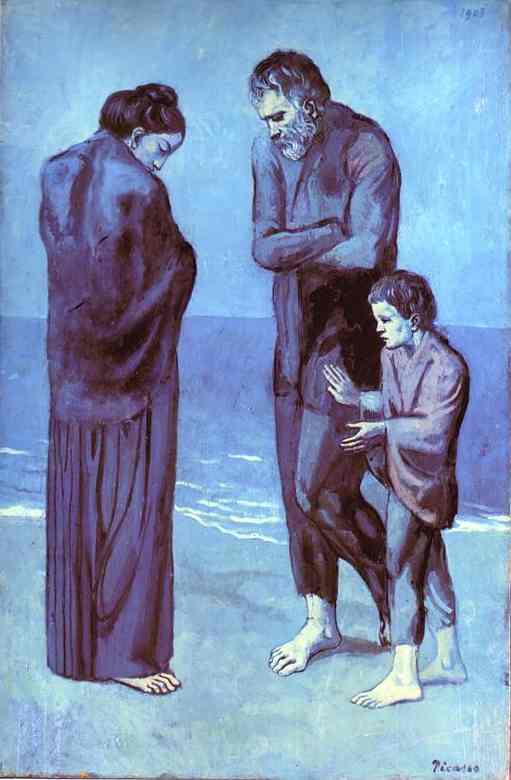
And, listeners we are fortunate to have on loan from the Catalunya Gallery, an original Picasso, The Tragedy

http://www.join2day.net/abc/P/picasso/picasso179.JPG

This is my very favorite:
0 Replies
 
bobsmythhawk
 
  1  
Reply Tue 25 Oct, 2005 03:00 pm
Wilma Helps Stoke Powerful Nor'easter

By KEN MAGUIRE, Associated Press Writer

GLOUCESTER, Mass. - A nor'easter that drew energy from the remnants of far-off Hurricane Wilma battered New England and the mid-Atlantic states with 20-foot waves and winds up to 70 mph Tuesday, brought some inland areas their first snow of the season and knocked out power to nearly 200,000 homes and businesses.


The powerful nor'easter reminded fishermen of the deadly "Perfect Storm" of October 1991.

"It's pretty nasty," said John Yard, who had rented an apartment a block from the ocean in Manasquan, N.J., three weeks ago ?- just in time for flooding caused by eight straight days of rain earlier this month. "It's been hell with all the flooding and the water out here. It's amazing what this weather is doing."

On Cape Cod, Harwich Harbormaster Thomas Leach recorded sustained wind of 56 mph and gust of 70 mph.

The storm was reinforced by the remnants of Hurricane Wilma, which was about 400 miles southeast of Boston and speeding toward the North Atlantic after battering Florida a day earlier.

"It's getting some energy from Wilma, but it's its own separate system," said Alan Dunham, a meteorologist with the
National Weather Service in Taunton. The nor'easter is "a good storm in its own right."

Many commercial fishermen stayed in port, mindful of the "Perfect Storm," which inspired the book and movie of the same name about a Gloucester fishing boat that disappeared when a nor'easter collided with Hurricane Grace in the North Atlantic.

"I wouldn't want to be out there today ?- too dangerous," fisherman Matt Farrara said as he made repairs to his boat at Gloucester. He fished through the 1991 storm.

In New Jersey, waves up to 20 feet high washed away stretches of beach at Bay Head, and howling wind stripped sand off the shore at Point Pleasant Beach, piling it 3 feet deep on a street a block inland.

Dozens of flights were canceled at Boston's Logan Airport. In the New York City area, airports reported flight delays of as much as 3 1/2 hours.

With the ground already soggy from one of the rainiest Octobers on record, the high winds toppled trees, bringing down power lines. In Massachusetts alone, 40,000 homes and businesses lost electricity.

Snow fell at higher elevations from West Virginia, which got up to 7 inches, to northern Maine. The wet, heavy snow brought down tree limbs and power lines, blacking out some 76,000 customers in West Virginia and 27,000 in Pennsylvania.

One Pennsylvania traffic death was blamed on the weather.

Atop New Hampshire's Mount Washington, the Northeast's tallest peak at 6,288 feet, the Mount Washington Observatory measured 100 mph wind and near-blizzard conditions in fog and blowing snow.

"It's going pretty crazy out here," said Tim Markle, the observatory's chief meteorologist.

___

AP reporters Wayne Parry in Manasquan, N.J.; Vicki Smith in Morgantown, W.Va.; Matt Pitta on Cape Cod, Theo Emery in Concord and Brooke Donald in Boston contributed to this report.


Have You Ever Seen The Rain?

(J.C. Fogerty)

Someone told me long ago
There's a calm before the storm
I know
It's been coming for some time
When it's over so they say
It'll rain on a sunny day
I know
Shining down like water

I wanna know
Have you ever seen the rain?
I wanna know
Have you ever seen the rain?

Coming down on a sunny day
Yesterday and days before
Sun is cold and rain is hard
I know
It's been that way for all my time
Till forever on it goes
Through the circle fast and slow
I know
And it can't stop I wonder

I wanna know
Have you ever seen the rain?
I wanna know
Have you ever seen the rain?

I wanna know
Have you ever seen the rain?
I wanna know
Have you ever seen the rain?
0 Replies
 
dyslexia
 
  1  
Reply Tue 25 Oct, 2005 03:14 pm
here in the albaturkey it's 69, sunny, winds out of the west at 7 mph.
0 Replies
 
Letty
 
  1  
Reply Tue 25 Oct, 2005 03:22 pm
Thanks, Bob, for that weather update. Those nor'easters can be very destructive; sometimes more so than hurricanes.

Our listeners love that rain song, as do I, Boston. Thanks.

Well, folks, there are many things for us to be thankful for, even though it's not near that holiday as yet.

For me:

My car is fine; it was the driver that didn't understand all the bells and whistles.

My house is clean.

Husband is stable, although he will not be discharged today.

and, per request, a poem about the wind:


~ Wind Songs ~


A luminous glow


lay in a ribbon


across rolling surf


From far away


faint sounds float


as if trying to outrun


a storm


Wind songs drift


in on soulful moans


hanging on top of


undulating rolling mounds


Clouds drift and part


as rays of moonlight


start dripping out


touching only tops of


a mystical , haunting mist


as if anticipating


finding only tranquility


© 2005


Carole Mathys
0 Replies


Related Topics

WA2K Radio is now on the air, Part 3 - Discussion by edgarblythe
 
Copyright © 2026 MadLab, LLC :: Terms of Service :: Privacy Policy :: Page generated in 0.24 seconds on 03/07/2026 at 08:08:35