hey, edgar. We were wondering where you were. Great song, incidentally.
This may seem like a strange goodnight song, listeners, but it does say something to me:
Remembering
Do you remember the wind, Cassandra?
Do you remember the fierce, strident howling
Of the wind?
Do you remember the wind's deceit---
The destructive force
That tore our world apart?
Do you remember my face, Cassandra?
Do you remember my eyes
That looked at you with love?
Do you remember my hands---
Fingers touching your lips,
Begging for silence?
Do you remember the night, Cassandra?
Do you remember your clandestine trysts
With Truth?
Do you remember the shadows of the moon,
The frail September moon
That was our only barrier
To the winds of winter?
Do you remember my words, Cassandra?
Pleading for recognition---
Words of adoration---
Words of love---
Reaching for you in the agony of indifference---
Celebrating the beauty of your eyes,
The elegance of your grace,
The ravishing astonishment of your being
The words, the endless words
Searching for an entrance to your soul.
Do you remember?
Do you remember my songs
Goodnight from your letty
With love.
Thoughts on Exercising. . .
- I have to exercise early in the morning before my brain figures out
what I'm doing.
- I like long walks, especially when they are taken by people who annoy
me.
- I have flabby thighs, but fortunately my stomach covers them.
- The advantage of exercising every day is that you die healthier.
- If you are going to try cross-country skiing, start with a small
country.
- Walking can add minutes to your life. This enables you at 85 years old
to spend an additional 5 months in a nursing home at $5000 per month.
- My grandmother started walking five miles a day when she was 60. Now
she's 97 years old and we don't know where on earth she is.
- The only reason I would take up exercising is so that I could hear
heavy breathing again.
- I joined a health club last year, spent about 400 bucks. Haven't lost
a pound. Apparently you have to go there.
- And last but not least: I don't exercise because it makes the ice jump
right out of my glass.
- You could run this over to your friends but why not just e-mail it to
them!
Edgar Rice Burroughs
From Wikipedia, the free encyclopedia.
Edgar Rice Burroughs (September 1, 1875 - March 19, 1950) was an American author, best known for his creation of the jungle hero Tarzan, although he produced works in many genres.
Biography
Burroughs was born on September 1, 1875 in Chicago, Illinois, the son of a businessman. He was educated at a number of local schools, and during the Chicago influenza epidemic in 1891 spent a half year on his brothers' ranch on the Raft River in Idaho. He then attended the Phillips Academy in Andover and then the Michigan Military Academy. Graduating in 1895, and failing the entrance exam for West Point, he ended up as an enlisted soldier with the Seventh Cavalry in Arizona. After being diagnosed with a heart problem and thus found ineligible for promotion to officer class, he was discharged in 1897.
What followed was a string of seemingly unrelated and short stint jobs. Following a period of drifting and ranch work in Idaho, Burroughs found work at his father's firm in 1899. He married Emma Centennia Hulbert in 1900. In 1904 he left his job and found less regular work, initially in Idaho but soon back in Chicago.
By 1911, after seven years of low wages, he was working as a pencil sharpener wholesaler and began to write fiction. By this time Burroughs and Emma had two children, Joan and Hulbert. During this period, he had copious spare time and he began reading many pulp fiction magazines and claimed:
"...if people were paid for writing rot such as I read in some of those magazines that I could write stories just as rotten. As a matter of fact, although I had never written a story, I knew absolutely that I could write stories just as entertaining and probably a whole lot more so than any I chanced to read in those magazines."
Aiming his work at the 'pulp' magazines then in circulation, his first story "Under the Moons of Mars" was serialized in All-Story magazine in 1912 and earned Burroughs US$400.
Burroughs soon took up writing full-time and by the time the run of "Under the Moons of Mars" had finished he had completed two novels, including Tarzan of the Apes which was published from October 1912 and went on to become his most successful brand. In 1913, Burroughs and Emma welcomed their third and last child, John Coleman.
Burroughs also wrote popular science fiction/fantasy stories involving Earthly adventurers transported to various planets (notably Barsoom, Burroughs' fictional name for Mars), lost islands, and into the interior of the hollow earth in his Pellucidar stories, as well as westerns and historical romances. Along with All-Story, many of his stories were published in the Argosy Magazine.
Tarzan was a cultural sensation when introduced. Burroughs was determined to capitalize on Tarzan's popularity in every way possible. He planned to exploit Tarzan through several different media including a syndicated Tarzan comic strip, movies and merchandise. Experts in the field advised against this course of action, stating that the different media would just end up competing against each other. Burroughs went ahead, however, and proved the experts wrong?-the public wanted Tarzan in whatever fashion he was offered. Tarzan remains one of the most successful fictional characters to this day and is a cultural icon.
In 1923 Burroughs set up his own company, Edgar Rice Burroughs, Inc., and began printing his own books through the 1930s. He divorced Emma in 1934 and married former actress Florence Gilbert Dearholt in 1935, ex-wife of his friend, Ashton Dearholt, adopting the Dearholt's two children. They divorced in 1942. At the time of the attack on Pearl Harbor he was a resident of Hawaii and, despite being a sexagenarian, he spent the conflict as a war correspondent. He died in Encino, California on March 19, 1950 having written almost seventy novels.
The town of Tarzana, California was named after Tarzan. In 1919 Burroughs purchased a large ranch north of Los Angeles, California which he named "Tarzana". The citizens of the community that sprang up around the ranch voted to adopt that name when their town was incorporated in 1928.
The Burroughs crater on Mars is named in Burroughs' honor.
http://en.wikipedia.org/wiki/Edgar_Rice_Burroughs
D. H. Lawrence
From Wikipedia, the free encyclopedia.
(Redirected from D H Lawrence)
David Herbert Lawrence (11 September 1885 - 2 March 1930) was one of the most important, prolific and certainly one of the most controversial English writers of the 20th century, whose output spans novels, short stories, poems, plays, essays, travel books, paintings, translations, literary criticism and personal letters. These works, taken together, represent an extended reflection upon the dehumanising effects of modernity and industrialisation. In them Lawrence confronts issues relating to emotional health and vitality, spontaneity, sexuality, and instinctive behaviour, making him iconic in an age influenced by Freud and Nietzsche.
Lawrence's unsettling opinions earned him many enemies and he endured hardships, official persecution, censorship and the misrepresentation of his creative work throughout the second half of his life, much of which he spent in voluntary exile, self defined as a 'savage pilgrimage'. At the time of his death his public reputation was that of a pornographer who had wasted his considerable talents. E. M. Forster, in an obituary notice challenged this widely held view; describing him as 'the greatest imaginative novelist of our generation'. Later the influential Cambridge critic F. R. Leavis championed both his artistic integrity and his moral seriousness, placing much of Lawrence's fiction within the canonical 'great tradition' of the English novel. He is now valued as a visionary thinker and a significant representative of modernism in English literature, although some feminists have questioned the attitudes to women and sexuality to be found within his works.
Early life (1885-1912)
The fourth child of Arthur John Lawrence, a barely literate miner, and Lydia, née Beardsall, a former schoolmistress, David Herbert Richards Lawrence was born and spent his formative years in the coal mining town of Eastwood, Nottinghamshire, United Kingdom. The conflict between his mismatched parents provided the raw material for a number of his works and Lawrence would return to this locality, which he was to call "the country of my heart", as a setting for much of his fiction.
The young Lawrence attended Beauvale Board School from 1891 until 1898, becoming the first local pupil to win a County Council scholarship to the High School in nearby Nottingham. He left in 1901, working for three months as a junior clerk at Haywood's surgical appliances factory before a severe bout of pneumonia ended this career. Whilst convalescing he often visited Haggs Farm, the home of the Chambers family and began a friendship with Jessie Chambers. An important aspect of this relationship with Jessie and other adolescent acquaintances was a shared love of books, an interest that lasted throughout Lawrence's life. In the years 1902 to 1906 Lawrence served as a pupil teacher at the British School, Eastwood . He went on to become a full time student and received a teaching certificate from University College Nottingham in 1908. During these early years he was working on his first poems, some short stories, and a draft of a novel, Laetitia, that was eventually to become The White Peacock. At the end of 1907 he won a short story competition in the Nottingham Guardian, the first time that he had gained any wider recognition for his literary talents.
In the autumn of 1908 the newly qualified Lawrence left his childhood home for London. Whilst teaching in Davidson Road School, Croydon he continued writing. Some of the early poetry, submitted by Jessie Chambers, came to the attention of Ford Madox Hueffer, editor of the influential The English Review. Hueffer then commissioned the story 'Odour of Chrysanthemums' which, when published in that magazine, encouraged Heinemann, a London publisher, to ask Lawrence for more work. His career as a professional author now began in earnest, although he taught for a further year. Shortly after the final proofs of his first published novel The White Peacock appeared in 1910, Lawrence's mother died. She had been ill with cancer. The young man was devastated and he was to describe the next few months as "his sick year". It is clear that Lawrence had an extremely close relationship with his mother and his grief following her death became a major turning-point in his life, just as the death of Mrs. Morel forms a major turning-point in his autobiographical novel Sons and Lovers, a work that often faithfully records much of the writer's experience of his provincial upbringing.
During 1911 Lawrence was introduced to Edward Garnett, a publisher's reader, who acted as a mentor, provided further encouragement, and became a valued friend. Throughout these months the young author revised Paul Morel, the first sketch of what was to become Sons and Lovers. In addition, a teaching colleague, Helen Corke, gave him access to her intimate diaries about an unhappy love affair, which formed the basis of The Trespasser, his second novel. In November 1911 pneumonia struck once again. After recovering his health Lawrence decided to abandon teaching in order to become a full time author. Another symptom of his desire to refashion himself was the breaking of an engagement to Louie Burrows, an old friend from his days in Nottingham and Eastwood.
[edit]
Blithe Spirits (1912-1914)
In March 1912 the author met the free spirited woman with whom he was to share the rest of his life. She was six years older than her new lover, married and with three young children. Frieda Weekley née von Richthofen was then the wife of Lawrence's former modern languages professor from Nottingham University, Ernest Weekley. Frieda was bored with her marriage and she had already had brief affairs with other lovers, including Otto Gross, a disciple of Freud. She now eloped with Lawrence to her parent's home in Metz, a garrison town in Germany near the disputed border with France. Their stay here included Lawrence's first brush with militarism when he was arrested and accused of being a British spy, before being released following an intervention from Frieda's father. After this encounter Lawrence left for a small hamlet to the south of Munich where he was joined by Frieda for their 'honeymoon', later memorialised in the series of love poems entitled Look! We Have Come Through (1917).
From Germany they walked southwards across the Alps to Italy, a journey that was recorded in the first of his brilliant travel books, a collection of linked essays entitled Twilight in Italy and the unfinished novel, Mr Noon. During his stay in Italy, Lawrence completed the final version of Sons and Lovers that, when published in 1913, was acknowledged to represent a vivid portrait of the realities of working class provincial life. The couple returned to England in 1913 for an short visit. Lawrence now encountered and befriended John Middleton Murry, the critic, and the short story writer from New Zealand, Katherine Mansfield. Lawrence and Frieda soon went back to Italy, staying in a cottage in Fiascherino on the Gulf of Spezia. Here he started writing the first draft of a work of fiction that was to be transformed into two of his finest novels, The Rainbow and Women in Love. Eventually Frieda obtained her divorce. The couple returned to England at the outbreak of World War I and were married on the 13 July 1914.
[edit]
The nightmare (1914-1919)
Frieda's German parentage and Lawrence's open contempt for militarism meant that they were viewed with suspicion in wartime England and lived in near destitution. The Rainbow (1915) was suppressed after an investigation into its alleged obscenity in 1915. Later, they were even accused of spying and signalling to German submarines off of the coast of Cornwall where they lived at Zennor. During this period he finished a sequel to The Rainbow, that many regard as his masterpiece. This radical new work, Women in Love, is a key text of European modernism. In it Lawrence explores the destructive features of contemporary civilization through the evolving relationships of four major characters as they reflect upon the value of the arts, politics, economics, sexual experience, friendship and marriage. This book is a bleak, bitter vision of humanity and proved impossible to publish in wartime conditions. It is now widely recognised as an English novel of great dramatic force and intellectual subtlety.
In late 1917, after constant harassment by the military authorities, Lawrence was forced to leave Cornwall at three days notice under the terms of the Defence of the Realm Act (DORA). This persecution was later described in an autobiographical chapter of his Australian novel, Kangaroo, published in 1923. Until 1919 he was compelled by poverty to shift from address to address and barely survived a severe attack of influenza.
The savage pilgrimage begins (1919-1922)
After the traumatic experience of the war years, Lawrence began what he termed his 'savage pilgrimage', a time of voluntary exile. He escaped from England at the earliest practical opportunity, to return only twice for brief visits, and with Frieda spent the remainder of his life travelling; settling down for only short periods. This wanderlust took him to Italy, Ceylon (now called Sri Lanka), Australia, North America,Mexico and after returning once more in Italy, southern France.
Lawrence abandoned England in November 1919 and headed south; first to the Abruzzi district in central Italy and then onwards to Capri and the Fontana Vecchia in Taormina, Sicily. From Sicily he made brief excursions to Sardinia, Monte Cassino, Malta, Northern Italy, Austria and Southern Germany. Many of these places appeared in his writings. New novels included The Lost Girl, Aaron's Rod and the fragment entitled Mr Noon that was eventually published in 1984. He experimented with shorter novels or novellas, such as The Captain's Doll, The Fox and The Ladybird. In addition, some of his short stories were issued in the collection England, My England and Other Stories. During these years he produced a number of poems about the natural world in Birds, Beasts and Flowers. Lawrence is widely recognised as one of the finest travel writers in the English language and Sea and Sardinia, a book that describes a brief journey from Taormina undertaken in January 1921, is a vivid recreation of the life of the inhabitants of this part of the Mediterranean. Less well known is the brilliant memoir of Maurice Magnus, in which Lawrence recalls his visit to the monastery of Monte Cassino. Other non-fiction books include two studies of Freudian psychoanalysis and Movements in European History, a school textbook that was published under a pseudonym, a reflection of his blighted reputation in England.
Seeking a new world (1922-1925)
In late February 1922 the Lawrences left Europe behind with the intention of migrating to the United States. They sailed in an easterly direction, first to Ceylon and then on to Australia. After a brief stop in the small town of Thirroul, Lawrence completed Kangaroo,a novel about local politics that also revealed a lot about his wartime experiences in Cornwall. Resuming their jouney, Frieda and Lawrence finally arrived in the USA in September 1922. Here they encountered Mabel Dodge Luhan, a prominent socialite, and considered establishing a utopian community on the Kiowa Ranch near Taos, New Mexico. By all accounts Lawrence loved the ranch high up in the mountains, the only property he ever owned. He stayed in New Mexico for two years, with extended visits to Lake Chapala and Oaxaca in Mexico. Whilst in the New World, Lawrence rewrote his Studies in Classic American Literature which he had begun in 1917, and completed The Boy in the Bush, The Plumed Serpent, St Mawr, The Woman who Rode Away, The Princess and a number of short stories. He also found time to produce some more travel writing, such as the collection of linked essays that became Mornings in Mexico. A brief voyage to England at the end of 1923 was a failure and he soon returned to Taos, convinced that his life as an author now lay in America. However, in March 1925 he suffered a near fatal attack of malaria and tuberculosis whilst on a third visit to Mexico. Although he eventually recovered, the diagnosis of his condition obliged him to return once again to Europe. He was dangerously ill and poor health limited the ability to travel for the remainder of his life.
Approaching death (1925-1930)
Lawrence and Frieda set up home in a villa in Northern Italy, living near to Florence whilst he wrote The Virgin and the Gipsy and the various versions of Lady Chatterley's Lover (1929). This book, his last major novel, was initially published in private editions in Florence and Paris and reinforced his notoriety. Lawrence responded robustly to those who claimed to be offended, penning a large number of satirical poems, published under the title of "Pansies" and "Nettles", as well as a tract on Pornography and Obscenity.
The return to Italy allowed Lawrence to renew some of his old friendships and during these years he was particular close to Aldous Huxley, a loyal companion who was to edit the first collection of Lawrence's letters after his death, along with a generous memoir. With another friend, the artist Earl Brewster, Lawrence found the time to visit a number of local archaeological sites in April 1927. The resulting essays describing these visits to old tombs were written up and collected together as Sketches of Etruscan Places, a beautiful book that contrasts the lively past with the brutal, bombastic stupidity of Mussolini's fascism. Lawrence continued to produce fiction, including short stories and The Escaped Cock/The Man Who Died , a reworking of the Christian myth of the Resurrection. During these final years Lawrence renewed a serious interest in oil painting. Official harassment persisted and an exhibition of some of these pictures at the Warren Gallery in London was raided by the British police in mid 1929 and a number of works were confiscated.
He continued to write despite his physical frailty. In his last months he authored numerous poems, reviews, essays, and a robust defence of his last novel against those who sought to suppress it. His last significant work was a spirited reflection on the New Testament Book of Revelation, Apocalypse. After being discharged from a sanatorium he died at the Villa Robermond, Vence, France in 1930 at the age of 44. Frieda returned to live on the ranch in Taos and later her third husband brought Lawrence's ashes to rest there in a small chapel set amidst the mountains of New Mexico.
His birthplace, in Eastwood, 8a Victoria Street, is now a museum.
Works
Realism was the main feature of Lawrence's writings and his unflinching depictions of the gritty struggles of everyday life give many of his novels a melancholy tone. His poems help to balance this with many powerful and evocative descriptions of nature, although moments of beauty are present in his books.
Among his many works, most famous are his novels Sons and Lovers (1913), The Rainbow (1915), Women in Love (1920), and Lady Chatterley's Lover (1928). These all take place in and around Eastwood, Lawrence's birthplace, which was a grim industrial mining town. Lawrence would return here in his literature despite leaving it in real life, giving it an importance similar to that held by Wessex for Thomas Hardy, whom Lawrence admired.
Kangaroo, Aaron's Rod and The Plumed Serpent are usually considered together as his "leadership novels". They contain some of the ideas that contributed to his plan for Rananim (meaning 'celebrations' and taken from a Hebrew folk song), the community of like-minded writers and artists that he hoped to establish in New Mexico. Little came of his effort, however.
Part of the realist nature of his writing meant that he could not obscure the subjects of sex and love in his books and his descriptions of sex were shockingly frank for the period. The Rainbow was banned for containing a lesbian relationship and one publisher called Sons and Lovers "the dirtiest book he had ever read."
The publication of Lady Chatterley's Lover caused a scandal due to its explicit sex scenes and perhaps particularly because the lover was working-class, and an obscenity trial followed in Britain. The British publisher, Penguin Books, won the court case that ensued. He also produced a series of explicit expressionistic paintings later in life some of which were almost destroyed due to their depiction of pubic hair.
What is often forgotten amongst the claims of Lawrence as a pornographer is the fact that he was extremely religious. He was tired of the stifling Christianity of Europe and wished to rejuvenate it with earlier, tribal religions. This search for a primeval religious consciousness was part of the reason for his 'savage pilgrimage'. He was also inspired by contemporary 'process philosophy': for example works by Nietzsche, Henri Bergson and others, as well as by the works of Freud, most notably in Sons and Lovers which was also his most autobiographical work. He wished to free himself from the sexual restrictions of the past so that he could examine their place in religion but he would have been perhaps horrified if he realised his role in the "sexual revolution" of the 1960s.
Poetry
Although best known for his novels, Lawrence wrote almost eight hundred poems, most of them relatively short. His first poems were written in 1904 at the age of nineteen and two of his poems, Dreams Old and Dreams Nascent, were among his earliest published works in The English Review. His early works clearly place him in the school of Georgian poets; a group not only named after the present monarch but also to the romantic poets of the previous Georgian period whose work they were trying to emulate. What typified the entire movement, and Lawrence's poems of the time, were well-worn poetic tropes and deliberately archaic language. Many of these poems display what John Ruskin called the "pathetic fallacy", the tendency to ascribe human emotions to animals and even inanimate objects.
It was the flank of my wife
I touched with my hand, I clutched with my hand,
rising, new-awakened from the tomb!
It was the flank of my wife
whom I married years ago
at whose side I have lain for over a thousand nights
and all that previous while, she was I, she was I;
I touched her, it was I who touched and I who was touched.
?-excerpt New Heaven and Earth
Just as the first world war dramatically changed the work of many of the poets who saw service in the trenches, Lawrence's own work saw a dramatic change, during his miserable war years in Cornwall. He had the works of Walt Whitman to thank for showing him the possibilities of free verse. He set forth his manifesto for much of his later verse in the introduction to New Poems. "We can get rid of the stereotyped movements and the old hackneyed associations of sound or sense. We can break down those artificial conduits and canals through which we do so love to force our utterance. We can break the stiff neck of habit...But we cannot positively prescribe any motion, any rhythm." Many of his later works took the idea of free verse to the extremes of lacking all rhyme and metre so that they are little different from short ideas or memos, which could well have been written in prose.
Lawrence rewrote many of his novels several times to perfect them and similarly he returned to some of his early poems when they were collected in 1928. This was in part to fictionalise them, but also to remove some of the artifice of his first works. As he put in himself: "A young man is afraid of his demon and puts his hand over the demon's mouth sometimes and speaks for him." His best known poems are probably those dealing with nature such as those in Birds Beasts and Flowers and Tortoises. Snake, one of his most frequently anthologised, displays some of his most frequent concerns; those of man's modern distance from nature and subtle hints at religious themes.
In the deep, strange-scented shade of the great dark carob tree
I came down the steps with my pitcher
And must wait, must stand and wait, for there he was at the trough before me.
?-excerpt Snake
Look! We have come through! is his other work from the period of the end of the war and it reveals another important element common to much of his writings; his inclination to lay himself bare in his writings. Although Lawrence could be regarded as a writer of love poems, his usually deals in the less romantic aspects of love such as sexual frustration or the sex act itself. Ezra Pound in his Literary Essays complained of Lawrence's interest in his own 'disagreeable sensations' but praised him for his 'low-life narrative'. This is a reference to Lawrence's dialect poems akin to the Scots poems of Robert Burns, in which he reproduced the language and concerns of the people of Nottinghamshire from his youth.
Tha thought tha wanted ter be rid o' me.
'Appen tha did, an' a'.
Tha thought tha wanted ter marry an' se
If ter couldna be master an' th' woman's boss,
Tha'd need a woman diferent from me,
An' tha knowed it; ay, yet tha comes across
Ter say goodbye! an' a'.
?-excerpt The Drained Cup
Pound was the chief proponent of modernist poetry and although Lawrence's works after his Georgian period are clearly in the Modernist tradition, they were often very different to many other modernist writers. Modernist works were often austere works in which every word was carefully worked on and hard-fought for. Lawrence felt all poems had to be personal sentiments and that spontaneity was vital for any work. He called one collection of poems Pansies partly for the simple ephemeral nature of the verse but also a pun on the French word panser, to dress or bandage a wound. He wounds still needed soothing for the reception he regularly received in England with The Noble Englishman and Don't Look at Me being removed from the official edition of Pansies on the grounds of obscenity. Even though he lived most of the last ten years of his life abroad, his thought were often still on England. His last work Nettles published in 1930 just eleven days after his death were a series of bitter, 'nettling' but often amusing attacks on the moral climate of England.
O the stale old dogs who pretend to guard
the morals of the masses,
how smelly they make the great back-yard
wetting after everyone that passes.
?-excerpt The Young and Their Moral Guardians
Two notebooks of Lawrence's unprinted verse were posthumously published as Last Poems and More Pansies.
Quotations
Wikiquote has a collection of quotations by or about:
D. H. Lawrence
* "Be a good animal, true to your instincts." -- The White Peacock
* "Mrs Morel always said the after-life would hold nothing in store for her husband: he rose from the lower world into purgatory, when he came home from pit, and passed into heaven in the Palmerston Arms." -- Sons and Lovers. Edited out of the 1913 edition restored in 1992
* "Don't you find it a beautiful clean thought, a world empty of people, just uninterrupted grass, and a hare sitting up." -- Women In Love
* "Never trust the artist. Trust the tale." -- Studies in Classic American Literature
* Ours is essentially a tragic age, so we refuse to take it tragically. -- Lady Chatterley's Lover
Conway Twitty
From Wikipedia, the free encyclopedia.
Conway Twitty, born Harold Lloyd Jenkins, (September 1, 1933 - June 5, 1993) was one of America's most successful hit makers of the 20th century, in that he had the most singles (55) reach Number 1 in US Country chart. Conway Twitty's totals in that chart were greater than that of Elvis, Frank Sinatra, the Beatles in the pop charts and Garth Brooks in either chart. Most notably known as a country music singer, Twitty also enjoyed success in early Rock and Roll, R&B, and Pop music (among others).
Twitty was born in the small town of Friars Point, Mississippi and named after a silent film star. His family moved to Helena, Arkansas when he was 10, and there he put together his first band, the "Phillips County Ramblers". Two years later, he had his own local radio show every Saturday morning. While in Arkansas, Twitty indulged his second passion, baseball. He received an offer to play with the Philadelphia Phillies after high school but he joined the United States Army instead.
After his discharge from the Army, Twitty again pursued a music career. After hearing Elvis Presley's "Mystery Train," he began writing original rock 'n' roll material. As a matter of course, he headed for the Sun Studios in Memphis, Tennessee, and worked with the likes of Presley, Carl Perkins, Jerry Lee Lewis, Johnny Cash and many others. He changed his name in 1957, looking at a map, he selected Conway, Arkansas and Twitty, Texas. The character of Conrad Birdie in the musical Bye Bye Birdie is said to be based loosely on a combination of Twitty and Presley.
Twitty's fortune changed when he joined MGM records. He had all but given up hope when news came from a DJ in Ohio that he was very popular. The single "I'll Try" had failed, but the DJ flipped the single over and began playing "It's Only Make Believe". The song was an instant hit and for a brief period, some believed that it was Elvis recording under a different name. Conway Twitty became an overnight success thanks to the B side of his single. The song didn't take long to record and never was thought to have been anything but a filler until that day in 1958. The song went on to sell over 8 million records and to No. 1 on the Billboard pop music charts in the U.S. as well as No. 1 in 21 different nations. Twitty would go on to enjoy rock-n-roll success with a hard rock song like, "Danny Boy" and "Lonely Blue Boy".
Conway Twitty always wanted to record country music and in 1965 he did just that. His first few country albums were met with country DJs refusing to play them by the count that he was well-known as a rock-n-roll singer. He finally broke free with his first number one country song, "Next In Line" in 1968. In 1970, Conway would record and release his second signature song, "Hello Darlin'". He twice accomplished something that few singers ever do even once - score a signature song (and in two genres, yet). Up through the time of his death, Conway opened his concerts with one and closed with the other, and that first signature song - "It's Only Make Believe" - would become accepted as a country standard, even though it never made the Billboard country charts.
In 1971, he released his first hit duet with Loretta Lynn, "After the Fire Is Gone," followed by "Lead Me On" (1971), "Louisiana Woman, Mississippi Man" (1973), "As Soon As I Hang Up the Phone" (1974) and "Feelins'" (1975). Together, they won four consecutive Country Music Association awards for vocal duo (1972 - 1975).
In 1973, Conway released "You've Never Been This Far Before," which was No. 1 for three weeks that September. Some disc jockeys refused to play the song because of its suggestive lyrics.
Twitty lived for many years in Hendersonville, Tennessee, just north of Nashville, where he built a country music entertainment complex called Twitty City. Its lavish displays of Christmas lights were a famous local sight. It has since been sold to the Trinity Broadcasting Network and converted to a Christian music venue.
Twitty never won a solo CMA award. Yet, by the end of his tenure at MCA in 1981, he had accumulated 32 No. 1 hits, while another 15 had reached the Top 5. He moved to Warner Brothers records in 1982, where he had another 11 No. 1 hits. By 1987, Conway was back at MCA, where he continued to score top 10 hits until 1991.
Twitty became ill while performing in Branson, Missouri, and he died from an abdominal aneurysm. Shortly before he died, he had recorded a new album, suitably called Final Touches. Twitty was inducted into the Country Music Hall of Fame in 1999.
Conway Twitty married three times. And after his death the widow, Dee Henry Jenkins, and his four grown children from the previous wives, Michael, Joni, Kathy and Jimmy Jenkins, fell into a very public dispute over the estate. His will had not been updated to account for the third marriage, but Tennessee law reserves one third of any estate to the widow. A public auction of much property and memorabilia had to be held due to the inability of the heirs to agree on a division of the assets.
While Conway has been known to cover songs - most notably "Slow Hand," which was a major pop hit for the Pointer Sisters - his songs have not been covered that often. However, two notable covers include George Jones' rendition of "Hello Darlin'" and Blake Shelton's "Goodbye Time."
Conway is often noted for being "The Best Friend a Song Ever Had," and to his millions of fans, such a statement rings true, 12 years after his passing.
Twitty's last chart appearance on the country charts was a duet with Anita Cochrane, "I Want to Hear a Cheating Song," in 2004. Twitty's voice was electronically created based on some of his hits from the 1980s.
http://en.wikipedia.org/wiki/Conway_Twitty
Conway Twitty
Slow Hand Lyrics
Album: Silver Anniversary Collection
As the midnight moon was drifting through
The lazy sway of the trees
I saw the look in your eyes looking into the night
Not seeing what you wanted to see.
Darling, don't say a word I've already heard
What your body is saying to mine
You're tired of fast moves
You got a slow groove on your mind.
You want a man with a slow hand
You want a lover with an easy touch
You want somebody who will spend some time
Not come and go in a heated rush
Baby, believe me I understand
When it comes to love you want a slow hand.
--- Instrumental ---
Moon shadowed ground with no one around
And a blanket of stars in our eyes
Hey, we're drifting free like two losties
On the crazy wind of the night.
Darling don't say a word I've already heard
What your body is saying to mine
If you want all night you know it's alright
I've got time.
You've got a man with a slow hand
You've got a lover with an easy touch
You've got somebody who will spend some time
Not come and go in a heated rush
Baby, believe me I understand
When it comes to love you want a slow hand.
You want a lover with an easy touch
You've got somebody
Who will spend some time with you baby
Not come and go in a heated rush
Baby believe me I understand
When it comes to love you want a slow hand...
barry gibb
born Barry Alan Crompton Gibb on 1 September 1946 in Douglas, Isle of Man
As a member of the Bee Gees, Barry Gibb sang and played the guitar along with his twin brothers
Maurice Gibb and Robin Gibb. Among the group's well-known hits are "How Deep Is Your Love," "Night Fever" and "Run to Me." For more than two decades the band has produced hits. Their records have sold more than 100 million copies; they have produced more than 25 albums and have had at least 19 hits on the American music charts.
Barry Gibb was born in England and emigrated with his family to Australia where the career of the Bee Gees began. The Bee Gees name came from the Brothers Gibb. Their debut performance was on Australian television in 1963 when they sang their first single, "The Battle of the Blue & Grey." "Spicks and Specks," another hit, went over big in Australia. Despite the band's success "down under" they were envious of groups like the Beatles who had become internationally known by this time. In 1967 the trio went back to Britain to achieve national fame.
After signing a record contract the Bee Gees produced their first hit in the UK, "New York Mining Disaster 1941," which also scored on the American musical charts. Following this the group had a string of hits that landed on both the UK and American charts. The songs included "Massachusetts," "Words," "I've Got a Message to You," "I Started a Joke" and "First of May."
With success looming in their path, Robin Gibb decided to leave the group in 1969 to pursue a solo career. Barry Gibb and his brother decided to keep the Bee Gees alive and produced the hit single "Tomorrow, Tomorrow." The two performed on the television show Cucumber Castle singing "Don't Forget to Remember." Barry Gibb's songwriting talents not only benefited the Bee Gees but also several other 70s and 80s singers such as Barbra Streisand, Dolly Parton, Kenny Rogers and most recently Celine Dion and Michael Bolton.
By 1970 Robin Gibb had rejoined the group and a new decade was upon the Bee Gees. The early 70s were hard on the group as the transition was happening between pop and folk rock to heavier rock. Main Course, released in 1975, produced the band's next hit, "Jive Talkin." Their manager, Robert Stigwood, used these songs to enhance the trio's popularity during the disco phenomenon. The Saturday Night Fever soundtrack brought about enormous popularity for the Bee Gees. Hits from the soundtrack include "Night Fever," "How Deep Is Your Love," "Stayin' Alive" and "You Should Be Dancin." By the end of the '70s the group was once again on the charts.
Despite the '70s success, the Bee Gees were less successful in the 80s, producing few hits. The group released You Win Again in 1987. Unfortunately, Andy Gibb, the group's musically talented younger brother, died in 1988 of a cocaine overdose. The '90s proved a bit more successful with the 1993 album Size Isn't Everything with the singles "Paying the Price of Love" and "For Whom the Bell Tolls." The Bee Gees were awarded the lifetime achievement award at the Brit Awards in 1996 and at the American Music Awards in 1997. Also in 1997 they were inducted into the Rock & Roll Hall of Fame.
After three decades, Barry Gibb continues singing and writing. He and his wife Linda have five children, Stephen, Ashley, Travis, Michael and Alexandria. ~ Kim Summers, All Music Guide
http://www.vh1.com/artists/az/gibb_barry/bio.jhtml
Grease lyrics:
Bee Gees
I saw my problems and i'll see the light
We got a lovin' thing, we gotta feed it right
There ain't no danger we can go too far
We start believin' now that we can be who we are - grease is the word
They think our love is just a growin' pain
Why don't they understand? it's just a cryin' shame
Their lips are lyin', only real is real
We stop the fight right now, we got to be what we feel - grease is the word
Chorus:
(grease is the word, is the word that you heard)
It's got a groove, it's got a meaning
Grease is the time, is the place, is the motion
Grease is the way we are feeling
We take the pressure, and we throw away conventionality, belongs to yesterday
There is a chance that we can make it so far
We start believin' now that we can be who we are - grease is the word
Chorus
This is a life of illusion, a life of control
Mixed with confusion - what're we doin' here?
We take the pressure, and we throw away conventionality, belongs to yesterday
There is a chance that we can make it so far
We start believin' now that we can be who we are - grease is the word
Chorus repeats 2x
(grease is the word, is the word, is the word...)
Lily Tomlin
From Wikipedia, the free encyclopedia.
Lily Tomlin (born Mary Jean Tomlin on September 1, 1939 in Detroit, Michigan), is an American actress and comedian. She first became well-known for her character skits on television's Laugh-In, in which she created several indelible characters that have stayed with her and become associated with her throughout her career, including the gum-chewing, wisecracking, snorting telephone operator Ernestine (famous for her lines "One ringy dingy, two ringy dingy" and "A gracious good morning to you ... Have I reached the party to whom I am speaking?") and the bratty five-year-old Edith Ann, rocking in her oversized rocking chair and making rude noises (famous for her line "And that's the truth!").
Tomlin was the daughter of a factory worker and a housewife who moved to Detroit from Paducah, Kentucky during the Great Depression. Tomlin attended Wayne State University, where her interest in the theater and performing arts began. After college, Tomlin began doing stand-up comedy in nightclubs in Detroit and then New York City. Her first television appearance was on The Merv Griffin Show in 1965. Tomlin joined the Laugh-In cast in 1969. AT&T offered Tomlin $500,000 to film a commercial using her character Ernestine, but Tomlin turned the offer down because she thought the commercial would compromise her artistic integrity. In 2003 she did film two commercials as Ernestine for the company WebEx.
Tomlin is noted for her wide range. For example, in Nashville, she played Linnea Reese, a strait-laced mother of two deaf children who has an affair with a country singer played by Keith Carradine; secretary Violet Newstead in Nine to Five,she also starred in the 1981 comedy film The Incredible Shrinking Woman, and a sickly heiress in the Steve Martin comedy All of Me. Tomlin also voiced the Ms. Frizzle character on the animated television series The Magic School Bus from 1994 to 1998. Also in the 1990s, due entirely to financial reverses, Tomlin appeared on the popular sitcom Murphy Brown. Tomlin currently plays presidential assistant "Deborah Fiderer" on the TV show The West Wing.
Tomlin starred in the 1985 hit one-woman Broadway show The Search For Signs of Intelligent Life in the Universe, written by her long-time life partner, Jane Wagner. The show won Tomlin a Tony Award. It was made into a feature film in 1991. Tomlin revived the show for a brief run in 2000.
Though Tomlin is now open about being lesbian, the media doesn't focus on this aspect of her personal life. In fact, many of her fans are unaware of her sexual orientation. Tomlin came out in 2000 on the New York City cable-access TV program Gay USA. Actually, Tomlin frequently referred to Wagner, but avoided saying point-blank that she herself was, in fact, gay.
Tomlin was inducted into the Michigan Women's Hall of Fame in 1998. In 2003 she won the Mark Twain Prize for American Humor.
Good morning WA2K listeners and contributors.
Hey, Bob. You hawk; me Letty. My word, Boston. I have never seen such a wealth of information and music. As most of you know, I loved D.H. Lawerence's short story, "The Rocking horse Winner." To me the man was and is fantastic. Such a pity that good writers are hounded by those who can't see their individualism, no?
Thanks, hawkman, and as soon as I have had my coffee, I will trot across the street and give your exercise regime to my neighbors. <smile>
No, it's not possible that today is September 1, 2005.
How about a song that gives a weather report in my area and reflects the month and unrequited love in one lovely melody.This version by The Beatles:
The leaves of brown
came tumbling down,
remember in september in the rain.
The sun went out
just like a light,
remember in september in the rain.
To every word
of love I heard you whisper
the raindrops seems
to play a sweet refrain.
Thought it's spring,
to me it's still september,
oh that september in the rain.
To every word
of love I heard you whisper
the raindrops seems
to play a sweet refrain.
Thought it's spring,
to me it's still september,
oh that september in the rain.
I said I said it's september in the rain.
Ah september in the rain.
Folks, I am going to leave the lyrics untouched, but they are NOT the good ones. <place eye roll here>
Back later with the original version.
Seems to me this song may have been posted recently but I'll do it again since it seems so apropos. I think I've got Alzheimers but I forget.
Neil Diamond Lyrics
September Morn Lyrics
Stay for just a while
Stay and let me look at you
It's been so long, I hardly knew you
Standing in the door
Stay with me a while
I only wanna talk to you
We've traveled halfway 'round the world
To find ourselves again
September morn
We danced until the night
Became a brand new day
Two lovers playing scenes
From some romantic play
September morning
Still can make me feel that way
Look at what you've done
Why, you've become a grown-up girl
I still can hear you crying
In a corner of your room
And look how far we've come
So far from where we used to be
But not so far that we've forgotten
How it was before
September morn
Do you remember
How we danced that night away
Two lovers playing scenes
From some romantic play
September morning
Still can make me feel that way
September morn
We danced until the night
Became a brand new day
Two lovers playing scenes
From some romantic play
September morning
Still can make me feel that way
September morn
We danced until the night
Became a brand new day
Two lovers playing scenes
From some romantic play
September morning
Still can make me feel that way
September morning
Still can make me feel that way
Hi Letty.
I'm going up to Wigan now.
Bet no-one knows any songs about Wigan (but there is one, a famous one, written in Wigan...at a railway station. Now there's a clue.)
Thanks, Bob. I do believe that September morn has been played here on our station, but it is lovely. Isn't there a painting called September Morn? My goodness. What odd things emerge from our memories, listeners.
There's our McTag with a question about Wigan. I knew where Walter was going, but I'm afraid that I will have to cheat on your question, Manchester.<smile>
The sky has cleared,
The sun is up,
Even disaster
Does not interrupt
The nature of things.
Now who wrote that, McTag?
O, Wigan is a grand old town;
The Romans knew it well.
It always had its Good King Coal,
As long as folks can tell.
?- Wigan Grammar School song
My goodness, Bob. That's a neat little Wigan ditty.
I found this and was stunned:
Wigan Songs and Chants
YOU ARE MY SUNSHINE
"You are my Sunshine, my only Sunshine,
You make me happy, when skies are grey (when skies are grey);
You'll never know dear, how much I love you,
So please don't take my Sunshine away"
Well, it seems that the Brits stole something from us, then. <smile>
What Do The Wigan Fans Sing?
We come from Wigan and we live in mud huts,
Ooh, aah, ooh ooh aah,
Ooh to be a Wiganah! (normally sung at away games).
E-I, E-I. E-I-O, up the football league we go,
when we win promotion this is what we'll sing,
we are Wigan, we are Wigan, Wigan football team.
You are my sunshine, my only sunshine,
You make me happy when skies are grey,
You'll never know, dear, how much I love you,
So please don't take my Wigan away, altogether now.....
Lets hang to what we've got,
Don't let go girl we got a lot,
Got a lot of love between us,
Hang on, hang on, hang on,
To what we've got, oooh, hooo....
To the tune of 'No Nay Never';
And its Wigan Latics,
Wigan Latics FC,
We're by far the greatest team,
The world has ever seen!
I wanna tell you 'bout Texas Radio and the Big Beat
Comes out of the Virginia swamps
Cool and slow with plenty of precision
With a back beat narrow and hard to master
Some call it heavenly in it's brilliance
Others, mean and rueful of the Western dream
I love the friends I have gathered together on this thin raft
We have constructed pyramids in honor of our escaping
This is the land where the Pharaoh died
The Negroes in the forest brightly feathered
They are saying, "Forget the night.
Live with us in forests of azure.
Out here on the perimeter there are no stars
Out here we is stoned - immaculate."
Listen to this, and I'll tell you 'bout the heartache
I'll tell you 'bout the heartache and the lose of God
I'll tell you 'bout the hopeless night
The meager food for souls forgot
I'll tell you 'bout the maiden with wrought iron soul
I'll tell you this
No eternal reward will forgive us now for wasting the dawn
I'll tell you 'bout Texas Radio and the Big Beat
Soft drivin', slow and mad, like some new language
Now, listen to this, and I'll tell you 'bout the Texas
I'll tell you 'bout the Texas Radio
I'll tell you 'bout the hopeless night
Wandering the Western dream
Tell you 'bout the maiden with wrought iron soul
Wishing all a pleasant September 1, a day that came much too quickly to suit me.
I enjoyed those bios, Bob, particularly the D. H. Lawrence.
Today's birthdays:
1157 - King Richard I of England (d. 1199)
1651 - Nataliya Kyrillovna Naryshkina, Tsaritsa of Russia (d. 1694)
1653 - Johann Pachelbel, German composer (d. 1706)
1711 - William Boyce, English composer (d. 1779)
1734 - Joseph Wright of Derby, English painter (d. 1797)
1854 - Engelbert Humperdinck, German composer (d. 1921)
1875 - Edgar Rice Burroughs, American writer (d. 1950)
1877 - Francis William Aston, English chemist, Nobel Prize laureate (d. 1945)
1885 - D H Lawrence, English writer (d. 1930)
1887 - Blaise Cendrars, Swiss writer (d. 1961)
1888 - Andrija tampar, Croatian physician and World Health Organization diplomat (d. 1958)
1889 - Richard Arlen, American actor (d. 1976)
1905 - Elvera Sanchez, Puerto Rican dancer (d. 2000)
1906 - Joaquín Balaguer, President of the Dominican Republic (d. 2002)
1907 - Walter Reuther, American labor union leader (d. 1970)
1913 - Christian Nyby, American director and film editor (d. 1993)
1920 - Richard Farnsworth, American actor (d. 2000)
1921 - Willem Frederik Hermans, Dutch writer (d. 1995)
1922 - Yvonne De Carlo, Canadian actress
1922 - Vittorio Gassman, Italian actor (d. 2000)
1923 - Rocky Marciano, American boxer (d. 1969)
1929 - Anne Ramsey, American actress (d. 1988)
1933 - Ann W. Richards, American politician
1933 - Conway Twitty, American country music singer (d. 1993)
1935 - Seiji Ozawa, Japanese conductor
1939 - Lily Tomlin, American actress, comedienne
1944 - Leonard Slatkin, American conductor
1946 - Barry Gibb, Manx-Australian singer
1947 - Al Green, American politician
1949 - P.A. Sangma, Indian politician
1951 - Nicu Ceauşescu, Romanian politician
1952 - Phil Hendrie, American radio personality
1955 - Billy Blanks, American martial artist
1955 - Bruce Foxton, English bassist (The Jam)
1957 - Gloria Estefan, Cuban singer
1962 - Ruud Gullit, Dutch footballer
1966 - Tim Hardaway, American basketball player
1970 - Vanna, Croatian singer
1977 - Aaron Schobel, American football player
1981 - Clinton Portis, American football player
1985 - Ciara-Camile Roque Velasco, American singer
And love that Tarzan:
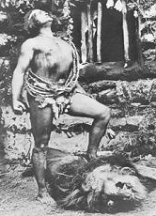


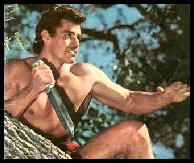
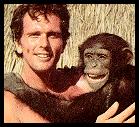


and the one and only:

Well, upon my word, folks. McTag has run off with the chamber maid and pot. <smile> I do suspect that he knows that we know something of Wigan. Sheeeeze. Sports?
Good morning, dys. Wow! That is one eerie song, poem? Virginia's will- o- the wisp, I suppose.
Raggedy, I can't get past your fabulous pictures of all the Tarzanites. Thanks, PA. I suspect Hollywood took a few liberties with Burrough's original, but who doesn't love that yodel!
And then, of course, there's the cartoon character:
George of the jungle land,
The dumb but lovable jungle man.
WEIRD AL YANKOVIC LYRICS
"George Of The Jungle"
George, George, George of the jungle
Strong as he can be
Ahhh
Watch out for that tree
George, George, George of the jungle
Lives a life that's free
Ahhh
Watch out for that tree
When he gets in scrapes
When he makes his escapes
With the help of his friend
An ape named Ape
Then away he'll schlep
On his elephant Shep
While Fella and Ursula
Stay in step with
George, George, George of the jungle
Friend to you and me
Ahhh
Watch out for that tree
Watch out for that (Ahhh) (Oooh) tree
George, George, George of the Jungle
Friend to you and me
Funny, Bob. Whatever happened to Weird Al?
I think I recall his having a parody on Michael Jackson's, "I'm Bad."
Well, listeners. Time for a little bit of history:
On Sept. 1, 1939, World War II began as Nazi Germany invaded Poland.
On this date:
In 1807, former Vice President Aaron Burr was found innocent of treason.
In 1878, Emma M. Nutt became the first female telephone operator in the United States, for the Telephone Despatch Co. of Boston.
In 1905, 100 years ago, Alberta and Saskatchewan entered Confederation as the eighth and ninth provinces of Canada.
In 1923, the Japanese cities of Tokyo and Yokohama were devastated by an earthquake that claimed some 150,000 lives.
In 1932, New York City Mayor James J. ``Gentleman Jimmy'' Walker resigned following charges of graft and corruption in his administration.
In 1945, Americans received word of Japan's formal surrender that ended World War II. (Because of the time difference, it was September 2 in Tokyo Bay, where the ceremony took place.)
In 1951, the United States, Australia and New Zealand signed a mutual defense pact, the ANZUS treaty.
In 1961, the Soviet Union ended a moratorium on atomic testing with an above-ground nuclear explosion in central Asia.
In 1972, American Bobby Fischer won the international chess crown in Reykjavik, Iceland, defeating Boris Spassky of the Soviet Union.
In 1983, 269 people were killed when a Korean Air Lines Boeing 747 was shot down by a Soviet jet fighter after the airliner entered Soviet airspace.
Ten years ago: A ribbon-cutting ceremony was held for the Rock and Roll Hall of Fame in Cleveland, Ohio.
Five years ago: President Clinton deferred a decision on whether to develop a missile defense system to his successor.
One year ago: More than 1,000 people were taken hostage by heavily armed Chechen militants at a school in Beslan in southern Russia; more than 330, mostly children, were eventually killed in three-day ordeal. Militants in Iraq freed seven employees of a Kuwaiti trucking firm after their employer paid $500,000 in ransom. The criminal case against Kobe Bryant case collapsed as prosecutors in Colorado dropped a sexual assault charge against the NBA star.
