William Powell
From Wikipedia, the free encyclopedia
Born William Horatio Powell
July 29, 1892(1892-07-29)
Pittsburgh, Pennsylvania
Died March 5, 1984 (aged 91)
Palm Springs, California
Spouse(s) Eileen Wilson (1915-1930)
Carole Lombard (1931-1933)
Diana Lewis (1940-1984)
William Horatio Powell (July 29, 1892 - March 5, 1984) was a three-time Academy Award-nominated American actor, noted for his sophisticated, cynical roles. He is most widely known for portraying the detective Nick Charles in six The Thin Man films.
Childhood
Powell, an only child, was born in Pittsburgh, Pennsylvania to Nettie Manila Brady and Horatio Warren Powell.[1] He showed an early aptitude for performing. In 1907, he moved with his family to Kansas City, Missouri.
Film career
After high school, he left home for New York and the American Academy of Dramatic Arts at the age of 18. In 1912 Powell graduated from the AADA, and worked in some vaudeville and stock companies. After several successful experiences on the Broadway stage, he began his Hollywood career in 1922 playing a small role in a production of Sherlock Holmes that starred John Barrymore as the great detective. His most memorable role in silent movies was as a bitter film director opposite Emil Jannings' Academy Award-winning performance as a fallen general in The Last Command (1928), which led to Powell's first starring role as amateur detective Philo Vance in The Canary Murder Case (1929).
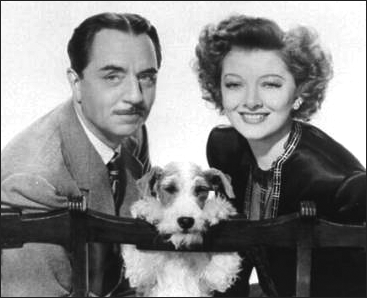
Powell's most famous role was that of Nick Charles in six Thin Man films, beginning with The Thin Man in 1934. The role provided a perfect opportunity for Powell to showcase his sophisticated charm and his witty sense of humor, and he received his first Academy Award nomination for The Thin Man. Myrna Loy played his wife, Nora, in each of the Thin Man films. Their partnership was one of Hollywood's most prolific on-screen pairings, with the couple appearing in 14 films together.
He and Loy also starred in the Best Picture of 1936, The Great Ziegfeld, with Powell in the title role and Loy as Ziegfeld's wife Billie Burke. That same year, he also received his second Academy Award nomination, for the comedy My Man Godfrey.
In 1935, he starred with Jean Harlow in Reckless. Soon it developed into a serious romance, though she died in 1937 before they could marry. His distress over her death, as well as his own battle with colon cancer around the same time, caused him to accept fewer acting roles.
His career slowed considerably in the 1940s, although in 1947 he received his third Academy Award nomination for his work in Life with Father. His last film was Mister Roberts in 1955, with Henry Fonda, James Cagney, and Jack Lemmon. Despite numerous entreaties to return to the screen, Powell refused all offers, happy in his retirement.
Personal life
In 1915, he married Eileen Wilson, with whom he had his only child, William David Powell, before an amicable divorce in 1930. (Powell's son became a television writer and producer before a period of ill health led to his suicide in 1968.)
In 1931, Powell married actress Carole Lombard. The marriage lasted just over two years. They were divorced in 1933, though they too remained on good terms, even starring together in My Man Godfrey three years later.
A close relationship with Jean Harlow, begun in 1935, was cut short by her untimely death in 1937. It is reported that a single white gardenia with an unsigned note, but presumed to be written by Powell, that read "Good night, my dearest darling" were placed in her hands before she was interred. He also paid for her final resting place?-the $25,000, 9?-10-foot private room lined with multicolored imported marble located in the "Sanctuary of Benediction".
On January 6, 1940, he married actress Diana Lewis, whom he called "Mousie". Although the couple had only met for the first time three weeks before their wedding, they remained married until Powell's death.
On March 5, 1984, Powell died of cardiac arrest in Palm Springs, California at the age of 91, some thirty years after his retirement. His widow, Diana Lewis, died in 1997.
Clara Bow
From Wikipedia, the free encyclopedia
Born Clara Gordon Bow
July 29, 1907(1907-07-29)
Brooklyn, New York
Died September 27, 1965 (aged 58)
West Los Angeles, California
Spouse(s) Rex Bell
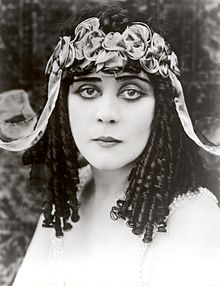
Clara Gordon Bow (July 29, 1907 - September 27, 1965) was an American actress and sex symbol, who rose to fame in the silent film era of the 1920s. Clara was renowned for her sexual magnetism and became known around the world as "The It girl", where "It" was commonly understood to mean sex appeal. Though she had terrible self-esteem and was painfully shy, she is known as the the quintessential flapper.
Early Life
Clara was born in a tenement in Brooklyn, New York, the only surviving child of a dysfunctional family afflicted with mental illness, poverty, and physical and emotional abuse. She was the third child of Robert Bow and Sarah Gordon; the first two, also daughters, were short lived. One lived for two hours, the other for two days. Clara's mother, hoping that her third child would also die at birth, did not bother to call a doctor or get a birth certificate. Clara did not cry after she was born so her Mother thought her to be dead and tried to make sure of it by shaking her but miraculously, the baby awoke. [1]
As a child, Clara was a tomboy and played games, such as baseball, in the streets with the boys. Clara's only true friend Johnny was severely burned and died in her arms when she was nine years old. Years later, she could make herself cry at will on a movie set by asking the band to play the lullaby "Rock-a-bye Baby". She said it reminded her of Johnny because that was the song Johnny's Mother would sing to help him fall asleep.
Clara's mother was an occasional prostitute who suffered from mental illness and epilepsy. She was noted for her frequent public affairs with local firemen. Clara's father, Robert Bow, was rarely present and may have had a mental impairment. Whenever he returned home, he was verbally and physically abusive to both wife and daughter. Clara's father reportedly molested her when she was between 15 and 16 years old.[2]
Early Career
Always an avid movie fan, Clara entered and won the Motion Picture Magazine's "Fame and Fortune" contest in 1921, the grand prize being a part in a film. According to the articles in February, March, and April 1928 in Motion Picture Classic, in which she told her life story, she asked her father for one dollar to have some pictures taken for the contest's judges. She went to a Brooklyn photographer, who took two pictures which she said "were terrible". Although she hated the pictures of her wearing a red tam and her only nice dress, the contest judges were impressed. After numerous screen tests, Clara was selected the winner. She won a part in Beyond the Rainbow (1922), but to her humiliation and disappointment, her scenes were cut from the final print and were not seen until the film was restored years later. Bow preferred playing poker with her cook, maid, and chauffeur over attending her movie premieres.[3]
Clara had horrible problems with her mother, who would tell Clara that being an actor was the same as being a prostitute. Clara's mother took to threatening to kill Clara because she felt her daughter would be better off dead. One night, Clara awoke to find her mother holding a butcher knife above her head. She said, "I'm gonna kill ya', Clara. It'll be better." Clara ran and locked herself in a closet until her grandmother came home. Clara never slept for a full night the rest of her life.
Fame and Fortune
Clara's screen debut came with her next film, Down to the Sea in Ships. She began to appear in numerous small movie roles. All the while, she felt guilty over her mother's disapproval. In 1923, Clara was on the set when she learned that her mother had died. She was devastated, feeling that her acting was somehow responsible for her mother's insanity and death.
Her earliest films were all East Coast productions. Clara got her big break when an officer of Preferred Pictures approached her on the set. She offered her free train fare to make a screen test in Hollywood. The first time Preferred Pictures head B.P. Schulberg saw disheveled Clara Bow in her one ragged dress, he was dismayed. He was reluctant even to give her a screen test, but when he finally did, the results astounded him. Clara was already adept at pantomime, and she could cry on command.
Starting with Maytime (1923), Schulberg cast Clara in a series of small roles. She nearly always stole her scenes. However, instead of creating projects for her, he loaned her out to other studios for easy money. Nevertheless, Clara started to make a name for herself through these many small roles and was selected as one of the WAMPAS Baby Stars in 1924.
As soon as Clara started to make money, she brought her father to live with her in Hollywood. For the next few years, she funded numerous business ventures for him, including a restaurant and a dry cleaners, all of which failed. He soon became a drunken nuisance on her sets, where he would try to pick up young girls by telling them his daughter was Clara Bow. Despite the behavior of her unwanted relative, Clara was adored during this time of her career. Crew members always seemed to fall in love with her. She was friendly, generous, and so grateful for her success that she always remained humble.
In 1925, Schulberg cast Clara in The Plastic Age. The movie was a huge hit, and Clara was suddenly the studio's most popular star. She also began to date her co-star Gilbert Roland, who would become the first of many engagements for her. Clara followed her first big success with Mantrap (1926), directed by Victor Fleming. Though he was twice her age, Clara quickly fell in love with her director. She began seeing both Roland and Fleming at the same time.
The It Girl
In 1927, Clara reached the heights of her popularity with the film It; the film was based on a story written by Elinor Glyn, and upon the film's release, Clara became known as "The It Girl". In Glynn's story, It, a character explains what "It" really is: "It...that strange magnetism which attracts both sexes...entirely unself-conscious...full of self-confidence...indifferent to the effect...she is producing and uninfluenced by others.") More commonly, "It" was taken to mean sex appeal. "It, hell," quipped Dorothy Parker, "She had those."[4]
This image was enhanced by various off-screen love affairs publicized by the tabloid press. However, some Hollywood insiders considered her socially undesirable, especially in light of rumored sexual escapades with many famous men of the time. Bela Lugosi, Gary Cooper, Gilbert Roland, John Wayne, director Victor Fleming, and John Gilbert were all reputed to have been among her many lovers. After a night out with Clara, Lugosi came to a movie set the next day with bite marks. In 1929, Lugosi's wife, Beatrice weeks, cited Bow as the other party in their divorce.
Clara's alleged alcoholism, drug abuse and mental illness, were also becoming problems for the studios. Budd Schulberg, the producer's son, wrote in his memoir Moving Pictures, "There was one subject on which the staid old Hollywood establishment would agree: Clara Bow, no matter how great her popularity, was a low life and a disgrace to the community."
However, Clara was praised for her vitality and enthusiasm ?- Adolph Zukor once said that "She danced even when her feet weren't moving"[citation needed] ?- though her roles rarely allowed her to show much range. In the early 1930s, Motion Picture magazine complained that the studio never gave her film plots any thought beyond "Hey, let's put Clara in a sailor suit!"[citation needed] At least one important film writer, Adela Rogers St. Johns, felt Clara had enormous promise that was never tapped by the studios.
Documentation indicates that as Clara developed a reputation as "Crisis-a-Day Clara".[citation needed] Paramount went out of its way to humiliate the increasingly emotionally-frail actress by canceling her films, docking her pay, charging her for unreturned costumes, and insisting that she pay for her publicity photographs. Her contract also included a morality clause offering her a bonus of $500,000 for behaving like a lady and staying out of the newspapers.
In 1927, Clara starred in Wings, a war picture largely rewritten to accommodate her, as she was Paramount's biggest star at the time. The film went on to win the first Academy Award for Best Picture. In 1928, Clara wrote the foreword for a novelization of her film The Fleet's In. Between 1927 and 1930, Clara was one of Hollywood's top five box office attractions.[5]
Clara's career continued with limited success into the early sound film era. She worried that her strong Brooklyn dialect would destroy much of her mystique. Clara began experiencing microphone fright on the sets of her sound films. A visibly nervous Clara had to do a number of retakes in The Wild Party, her first talkie, because her eyes kept wandering up to the microphone overhead [3]. Greta Garbo was given two years to prepare for talking pictures, Clara was given only two weeks. Scandal and a damaging court trial involving former assistant Daisy DeVoe further tarnished Clara's image. Paramount released her from her contract in late 1931.
Following a brief period away from Hollywood, Clara signed a two-picture deal with Fox Film Corporation and returned to the screen in the early talkie classic Call Her Savage (1932). Although the film was a success, Clara opted for marriage and motherhood, and ended her film career after the release of Hoopla the following year.
Later life
The 1930 U.S. Census lists Clara's residence as 512 North Bedford Drive in Beverly Hills, California. Her home's value was listed as $25,000, higher than most others on her block at the time.
Clara and cowboy actor Rex Bell (actually George F. Beldon), later a Lieutenant Governor of Nevada, married in 1932 and had two sons, Tony Beldon (born 1934, changed name to Rex Anthony Bell, Jr.) and George Beldon, Jr. (born 1938). Bow retired from acting in 1933. Her last public exposure, albeit fleeting, was a guest appearance on the radio show Truth or Consequences in 1947; Clara provided the voice of "Mrs. Hush".
In 1944, while her husband was running for the U.S. House of Representatives Clara tried to commit suicide.[6] After being diagnosed with schizophrenia in 1949, Clara entered a treatment regimen that included shock treatments. Later, her husband sent her to one of the top mental institutions in the nation. Doctors found out that Clara had been raped by her father at a young age.
Clara spent her last years living in a modest house, living off an estate worth about $500,000 at the time of her death.[1] She died on September 27, 1965 of a heart attack and was interred in the Forest Lawn Memorial Park Cemetery in Glendale, California.
Honors
For her contributions to the motion picture industry, Clara Bow was given a star on the Hollywood Walk of Fame.
In 1994, she was honored with an image on a United States postage stamp designed by caricaturist Al Hirschfeld.
Quotes
"Even now I can't trust life. It did too many awful things to me as a kid."
"I was dancin' on a table with just a few clothes on when my Mama left me for good."
"The more I see of men, the more I like dogs."
Urban Myths
The book Hollywood Babylon spread the urban myth that Clara's friendship with members of the 1927 University of Southern California football team included group sex with the entire team. During her lifetime, Clara was the subject of wild rumors regarding her sex life, none substantiated.[3] Oddly, one of the USC players at the time was John Wayne: however, John Wayne did not play in 1927.
Clara in Popular Culture
In Tennessee Williams' play The Night of the Iguana, Hannah Jelkes explains to Reverend Shannon that when she was 16, a young man made advances toward her in a movie theatre and was arrested. To get him off the hook, she says, "I told the police it was a Clara Bow picture?-well, it was a Clara Bow picture?-and I was just over-excited."
The alternative rock band 50 Foot Wave entitled a song "Clara Bow" on their CD Golden Ocean.
Clara is mentioned in the song "Condition of the Heart" by Prince on his album Around the World in a Day.
Max Fleischer's cartoon character Betty Boop was modeled after Bow and entertainer Helen Kane (the "boop-boop-a-doop-girl").
Clara's mass of tangled red hair was one of her most famous features. When fans of the new star found out she put henna in her hair, sales of the dye tripled.[3]
Clara applied her red lipstick in the shape of a heart. Women who imitated this shape were said to be putting a "Clara Bow" on their mouths.[3]
Clara was mentioned in the lyrics of the song "Chop Suey" in Rodgers & Hammerstein's musical comedy Flower Drum Song
She is Effy's idol in the E4 popular show Skins.[7]
An autographed picture of Clara Bow is offered as a consolation prize of a beauty contest in the 1931 Gershwin musical "Of Thee I Sing".
Richard Egan
From Wikipedia, the free encyclopedia
Richard Egan (July 29, 1921 - July 20, 1987) was an American actor. In some films he is credited as Richard Eagan.
Born in San Francisco, California, Egan served in the United States Army as a judo instructor during World War II. A graduate of the University of San Francisco (B.A.) and Stanford University (M.A.), he studied and taught at Northwestern University for a time. Having studied theatre, he took a bit role in the 1949 Hollywood film "The Story of Molly X".
This start would lead to his signing of a contract with 20th Century Fox where his talent, rugged physique and good looks made him a favorite and respected leading man.
In 1956, he starred as Elvis Presley's older brother in Presley's first film, Love Me Tender, and in 1959 was the male lead opposite Dorothy McGuire in A Summer Place. In 1960, Egan appeared in such films as Pollyanna and with Joan Collins in Esther and the King. Other noteworthy films include Undercover Girl (1950), Split Second (1953), A View from Pompey's Head (1955), Slaughter on 10th Avenue (1957), Voice In The Mirror, about the man who started Alcoholics Anonymous, and The 300 Spartans (1962).
During the decade of the 60s, Richard Egan worked extensively in television, starring in the western drama series, Empire from 1962 to 1964. After his series ended, he made guest appearances on other television shows as well as acting in several motion pictures for the big screen plus in films made specifically for television. In 1982 he joined the cast for the new daytime television political drama Capitol.
Richard Egan died in Los Angeles, California, on July 20th, 1987, of prostate cancer, 9 days before his 66th birthday, and was interred in the Holy Cross Cemetery in suburban Culver City, California.
A devout Roman Catholic, with a brother who was a priest, Egan was married to the former Patrica Hardy for thirty years until his death; they had five children, including son Rich Egan, owner of Vagrant Records, and daughter, writer/director Maureen Egan.
Egan was respected within the acting community for having helped a number of young actors get their first break in the film industry.[citation needed]
Recently reported in the Massachusetts Bar Association Lawyers Journal, the following are 22 questions actually asked of witnesses by attorneys during trials and, in certain cases, the responses given by insightful witnesses:
"Now doctor, isn't it true that when a person dies in his sleep, he doesn't know about it until the next morning?"
"The youngest son, the twenty-year old, how old is he?"
"Were you present when your picture was taken?"
"Were you alone or by yourself?"
"Was it you or your younger brother who was killed in the war?"
"Did he kill you?"
"How far apart were the vehicles at the time of the collision?"
"You were there until the time you left, is that true?"
"How many times have you committed suicide?"
Q: So the date of conception (of the baby) was August 8th?
A: Yes.
Q: And what were you doing at that time?
Q: She had three children, right?
A: Yes.
Q: How many were boys?
A: None.
Q: Were there any girls?
Q: You say the stairs went down to the basement?
A: Yes.
Q: And these stairs, did they go up also?
Q: Mr. Slatery, you went on a rather elaborate honeymoon, didn't you?
A: I went to Europe, Sir.
Q: And you took your new wife?
Q: How was your first marriage terminated?
A: By death.
Q: And by whose death was it terminated?
Q: Can you describe the individual?
A: He was about medium height and had a beard.
Q: Was this a male, or a female?
Q: Is your appearance here this morning pursuant to a deposition notice which I sent to your attorney?
A: No, this is how I dress when I go to work.
Q: Doctor, how many autopsies have you performed on dead people?
A: All my autopsies are performed on dead people.
Q: All your responses must be oral, OK? What school did you go to?
A: Oral.
Q: Do you recall the time that you examined the body?
A: The autopsy started around 8:30 p.m..
Q: And Mr. Dennington was dead at the time?
A: No, he was sitting on the table wondering why I was doing an autopsy.
Q: You were not shot in the fracas?
A: No, I was shot midway between the fracas and the navel.
Q: Are you qualified to give a urine sample?
A: I have been since early childhood.
Q: Doctor, before you performed the autopsy, did you check for a pulse?
A: No.
Q: Did you check for blood pressure?
A: No.
Q: Did you check for breathing?
A: No.
Q: So, then it is possible that the patient was alive when you began the autopsy?
A: No.
Q: How can you be so sure, Doctor?
A: Because his brain was sitting on my desk in a jar.
Q: But could the patient have still been alive nevertheless?
A: It is possible that he could have been alive and practicing law somewhere.
Hey, BioBob, thanks again for the great info about famous folks, and we love the lawyer jokes. (UhOh, where is Ticomaya?

)
and there's our puppy with a marvelous montage to match the hawkman's info. Thanks, PA, for the great quintet and the clip from The Thin Man series. Glad it wasn't the Tin Man as The Wizard of Australia was on again last evening.
Hey, I know that dog's name. It's Asta.
No surprise to our listeners about what I'm going to play. Rom somebody by Mario whatever.
http://uk.youtube.com/watch?v=30SRarDHOR8&feature=related
You're spot on, Raggedy. (one must start practicing at four or five to wear a dress like that.)
Hey, folks. Want to hear something wild?
Listen to these three different songs, then.
First, Tony at the age of 94.
http://www.youtube.com/watch?v=qFsdvek8bL8&feature=related
Now, Elvis
http://www.youtube.com/watch?v=1HtfuGgFkCo
And finally as the magic three would have it...
http://www.youtube.com/watch?v=qW3zHEtL0T4
Tributes to two ladies of the classic silver screen.
For Clara Bow, "The It Girl" on her birthday, along with a song written for her.
http://www.youtube.com/watch?v=Dxo_99eaEEA&feature=related
And, for "The Vamp", Theda Bara, let's watch her do her stuff.
http://www.youtube.com/watch?v=rtpnuDwFVPQ&feature=related
that's beautiful, firefly. the legends make it look effortless.
here's two more, McLaughlin & Hancock, paying tribute to Jim Hall & Bill Evans, respectively.
http://www.youtube.com/watch?v=VXZHhjhTTi0&feature=related
Thanks, firefly, for the memories of the silver screen. In looking at the comments, I was saddened to see the blurb about Clara's life. Theda, was a real vamp. The classical guitar by Segovia was wonderful.
Hey, bigislandman. Welcome back. That surfin' music was terrific. That guy's shirt looks exactly like the cover on my purse.
You may have missed edgar's announcement about John Beck. He died, M.D.
Here' are two songs, folks, that match the lightning bug's and honu's Herbie Hanncock.
First, Rudolph.
Then, Herbie Mann.
http://www.youtube.com/watch?v=L7RCRlnsbe0
http://www.youtube.com/watch?v=bRsOCKENeJU&feature=related
blame it on the tango, i'm reminded of Un Chien Andalou by Bunuel & Dali
(warning: there's a notorious portion around the 1:30 mark )
 http://www.youtube.com/watch?v=Csm-1Sv-zKY
Ah, honu, Bunuel and Dali-"To shock and provoke". Well, perhaps in another era, M.D., but when one knows the intention, it loses some of the juice.
Met a couple of interesting people today, folks. One was a jolly man who joked and called me a lady, a princess, and a queen. I learned later that he had worked in a steel factory and had almost been killed. The woman at the check out and I decided that he was going to be vociferous and funny to people for the rest of his life. What a wonderful guy. The other was a shy and retiring man who looked exactly..and I mean EXACTLY like Hugh Laurie. He remarked that he had been told that before. He never kept his eyes off the floor. Interesting world we live in.
Well, it's time for me to say goodnight, and I just discovered a jazz piano man who is wonderful, and he is playing the Duke. Here is Billy Taylor replete with lyrics.
http://ca.youtube.com/watch?v=bY89ewAx4wU&feature=related
In A Sentimental Mood I can see
the stars come thru my room
While your loving attitude is
like a flame that lights the gloom
On the wings of ev'ry kiss
Drift a melody so strange and sweet
In this sentimental bliss you make
my Paradise complete
Rose pearls seem to fall
It's all like a dream to call you mine
My heart's lighter thing since you
made me this night a thing divine
In A Sentimental Mood
I'm within a world so heavenly
For I never dreamt that you'd be
loving sentimental me
In A Sentimental Mood I can see
the stars come thru my room
While your loving attitude is
like a flame that lights the gloom
On the wings of ev'ry kiss
Drift a melody so strange and sweet
In this sentimental bliss you make
my Paradise complete
Rose pearls seem to fall
It's all like a dream to call you mine
My heart's lighter thing since you
made me this night a thing divine
In A Sentimental Mood
I'm within a world so heavenly
For I never dreamt that you'd be
loving sentimental me
Goodnight, everyone.
From Letty with love
Good morning, WA2K listeners and contributors.
edgar, Jimmy wouldn't play for me, but that's ok. Another day?
Loved Apache, Texas, and I have heard that one before. It's a very different song.
Well, folks, I am happy to announce the recent marriage of our Mysteryman. If you recall, he is a veteran who performed one of the greatest services to those on the battlefield, that of a medic.
So, all, for Mr. and Mrs. Mysteryman, here is their favorite song.
http://www.youtube.com/watch?v=3aqZV463Yis