Linda Ronstadt
From Wikipedia, the free encyclopedia
Also known as Queen of Rock
Queen of Country Rock
First Lady of Rock
Born July 15, 1946 (1946-07-15) (age 62)
Tucson, Arizona, United States
Genre(s) Rock, rock and roll, new wave, folk, Country, ranchera, Mariachi, Latin American, rhythm & blues, opera, cajun, big Band, jazz, children's music, pop, adult contemporary, art rock, acoustic rock
Occupation(s) Singer-Songwriter, Musician, Record producer, Actress
Instrument(s) Vocals, Guitar, Percussion
Years active 1967 - present
Label(s) Capitol, Elektra, Asylum, Verve Records, Vanguard
Associated acts Stone Poneys (1966-68)
Swampwater (1969-1970)
The Eagles (1972-1975, 1999)
Nelson Riddle (1982-86)
Trio (with Dolly Parton,Emmylou Harris) (1987 & 1999)
Aaron Neville (1989)
Emmylou Harris (2000)
The Zozo Sisters (with Ann Savoy) (2002 & 2006)
Linda Maria Ronstadt (born July 15, 1946 in Tucson, Arizona) is an American popular vocalist and entertainer who has earned multiple Grammy Awards, an Emmy Award, numerous United States and internationally certified gold, platinum and multiplatinum albums, a Tony Award and Golden Globe nominations. A singer-songwriter and record producer, she is better known as a definitive interpreter of songs.[1][2] A prolific recording artist, Ronstadt has recorded over 30 studio solo albums, and has made guest appearances on over 100 other albums.[3]
Ronstadt has recorded studio albums in many genres outside the rock field and is known throughout the music industry as one of the most versatile, durable, and commercially successful female singers of all time. Branching out, she has recorded Traditional Pop, mariachi, jazz, folk, Broadway and opera. However, her most commercially successful period was during the 1970s and 1980s. By the mid 1970's, she became the first female artist in music history to have highly anticipated arena and stadium tours - coinciding with a string of blockbuster albums, thus making her able to command sell-out concerts.[4][5]. By the end of the decade, she solidified her role as one of rock and pop's most successful solo female acts of all time, and for a time, the highest paid woman in rock. As she moved on to other genres in the 1980s she maintained her consistent commercial success, scoring many platinum albums, and remaining one of the best-selling solo album artists of this decade. From the 1990s on till today, Ronstadt has continued her success, releasing many Grammy winning recordings and remaining one of the most celebrated recording artist to date. Ronstadt has charted over 30 albums on the Billboard 200 pop album chart, 10 of which have reached top 10, and three of those have peaked at No. 1. She also has 21 Top 40 hits on the Billboard Hot 100, 10 of which have reached the top 10, three peaking at No. 2, and the No. 1 hit, "You're No Good."
Career overview
Establishing her professional career in the mid-1960s at the forefront of California's emerging folk rock and country rock movements, genres which later defined post-60s rock music, Linda Ronstadt became the lead singer of a successful folk rock group, The Stone Poneys. Later as a solo artist, she released Hand Sown ... Home Grown in 1969, considered the first alternative country record by a female recording artist.[6] During these years as greater fame eluded her, Ronstadt actively toured with Jackson Browne, The Doors, Neil Young and others, made television show appearances, and began to contribute her voice to a variety of albums such as Carla Bley's jazz opera Escalator Over the Hill. However, in the mid 1970s, Ronstadt was successful with chart-topping albums such as Heart Like A Wheel, Simple Dreams, and Living In The USA. Coupled with her chart success, Ronstadt became the first female "arena class" rock star, setting records as one of the top-grossing concert artists of the decade,[4][7] and the most successful female rock singer of her era[8].[9][10] Labeled the First Lady of Rock,[5] and one of The Queens of Rock, Ronstadt was voted the Top Female Pop Singer of the 1970s.[5] Her rock and roll image was equally as famous as her music, appearing six times on the cover of Rolling Stone magazine, Newsweek and Time. In the early 1980s Ronstadt went to Broadway, garnered a Tony nomination, she also teamed with composer Phillip Glass, she recorded traditional music, and collaborated with famed conductor Nelson Riddle, an event at that time viewed as an original and unorthodox move for a rock and roll artist. This venture paid off,[11] and Ronstadt remained one of the best-selling vocalists throughout the 1980s with multi-platinum selling albums such as: What's New, Canciones de Mi Padre and Cry Like a Rainstorm, Howl Like the Wind. Ronstadt has continued to successfully tour, collaborate, and record celebrated albums such as: Winter Light, Hummin' to Myself and Adieu False Heart. Ronstadt's thirty-plus album catalog continue to be best-sellers, with a majority of them certified gold, platinum and multiplatinum.[12] Selling in excess of 100 million records worldwide and setting records as one of the top-grossing concert performers for over a decade, Linda Ronstadt was the most successful female rock singer of the 70s and one of the most successful female recording artist in US History. A consummate American artist, Ronstadt opened many doors for women in rock and roll and in music by achieving success and being at the vanguard of many musical movements.[13]
Private life
Early life
Linda Ronstadt was born in Tucson, Arizona in 1946 to Gilbert Ronstadt (1911-1995), a prosperous machinery merchant who ran the F. Ronstadt Co.,[14] and Ruthmary Copeman Ronstadt (1914-1982), a homemaker with a gift for science. She was raised along with her brothers Peter (served as Tucson's chief of police from 1981-1992) and Michael and her sister Gretchen (Suzy), on the family's 10-acre ranch. The family was featured in Family Circle Magazine in 1953.[15]
Her father, Gilbert, came from a leading and pioneering Arizona ranching family[5]being of Mexican-American, with some German and English ancestry. Her father's grandfather, Frederick Augustus Ronstadt (who used Federico Augusto Ronstadt) immigrated to the West (then a part of Mexico) in the 1840s from Hanover, Germany and married a Mexican citizen. The marriage resulted in several children, including Federico José María Ronstadt (Linda's grandfather) who eventually settled in Tucson.[16][17]
The Ronstadt Family has contributed much to arts and culture in the American Southwest.[18] So great are their contributions to Arizona that their history and influence, including wagon making, commerce, pharmacies and music, is chronicled in the library of the University of Arizona, her alma mater.[19]
Her mother, Ruthmary, was of Anglo-American descent with German, English and Dutch heritage. Ruthmary was the daughter of the prolific American inventor Lloyd Groff Copeman, and was raised in Michigan. Lloyd, with nearly 700 patents to his name, invented an early form of the toaster, many refrigerator devices, the grease gun, the first electric stove and an early form of the microwave oven. His flexible rubber ice cube tray earned him millions of dollars in royalties.[20] He once told his grandson that he could walk into any store or home and find one of his inventions.
Ronstadt's early life was filled with music and tradition, which influenced her musical choices.[21] A product of the American radio of the 1950s and 1960s with its eclectic broadcasting.[22] Growing up she listened to all types of music, and credits her mother for her appreciation of Gilbert and Sullivan and the Traditional Pop music that she herself would in turn help reintroduce to an entire generation.[23][22] Staying true to any musical tradition Ronstadt sticks to "what... the music demand(s)".[24]
Personal life
In the 1970s her private life was given publicity because of a relationship with then-Governor Jerry Brown of California, a Democratic presidential candidate. They shared a Newsweek magazine cover in April 1979.[25] Ronstadt and Brown also took a trip to Africa which became fodder for the media.
In the mid-1980s, Ronstadt was engaged ("ring on the finger and all") to Star Wars director George Lucas.[26]
In the early 1980s, Ronstadt was criticized by some (mainly rock critics) for playing two concerts in what was then apartheid South Africa, at a time when artists like Ray Charles, Frank Sinatra, Shirley Bassey, Stevie Wonder, and Cher were also performing there. Rolling Stone magazine covered the trip. The controversy eventually died out and apartheid ended.
Ronstadt is a major supporter and admirer of sustainable agriculture pioneer Wes Jackson, of Salina, Kansas, saying in 2000 "the work he's doing right now is the most important work there is in the (United States)",[27] and dedicating the rock anthem Desperado to him at an August, 2007 Kansas City, Kansas concert of hers.[28]
She has two adopted children, Mary and Carlos. Her daughter has made her a fan of musician Pink. Her son, who prefers death metal, has introduced her to the music of Rob Zombie. Of his work, Ronstadt says "There's real power and energy (to his music)",[29] and on AC/DC she says "I really love Back in Black. I appreciate it musically (and) how good the rhythm guitar player is."
Ronstadt is a big fan of J. K. Rowling's Harry Potter novels, and even persuaded friend and noted New York Times book critic Michiko Kakutani to start reading them.[30]
Ronstadt says her favourite female vocalist is Maria Callas, saying "There's no one in her league. That's it. Period.".[31] "I learn more...about singing rock n roll from listening to Maria Callas records than I ever would from listening to pop music for a month of Sundays." "She's the greatest chick singer ever".[32] She admires Callas for her musicianship and her attempts to push 20th century singing, particularly opera, back into the Bel Canto "natural style of singing".[33] Ronstadt defines her voice as a coloratura soprano.
In 2007 Ronstadt resided in the San Francisco area, while also maintaining her home in Tucson, Arizona.[34] That same year she drew criticism and praise[35] from some Tucsonians by observing that the local city council's failings, developers' strip mall mentality, greed and growing dust problem had rendered the city unrecognizable and poorly developed.[36]
In an August 14, 2007, interview she commented on all her well publicized outspoken views, in particular her, Aladdin Theatre for the Performing Arts incident (see Political controversy below), by noting, "If I had it to do over I would be much more gracious to everyone... you can be as outspoken as you want if you are very, very respectful. Show some grace".[37]
On September 23, 2007, Ronstadt, was inducted into the Arizona Music & Entertainment Hall of Fame. Among other inductees were Stevie Nicks, Buck Owens and filmmaker Steven Spielberg.[38]
Political controversy
Major criticism and praise involving Ronstadt's politics arose during a July 17, 2004 performance at the Aladdin Theatre for the Performing Arts in Las Vegas. Towards the end of her performance, as she had done across the country, Ronstadt spoke to the audience, praising Michael Moore's documentary film Fahrenheit 9/11, a movie discussing the Iraq War, and dedicated the song "Desperado" to Michael Moore.[39]
Accounts say the crowd's initial reaction was mixed, with "half the crowd heartily applauding her praise for Moore, (and) the other half booing".[39] However, the situation escalated into what Tyri Squyres, director of public relations at the Aladdin, described as a "mob scene.... It's amazing how ugly it got," with people walking out, tearing down posters, throwing drinks and demanding a refund.
Following the concert, news accounts reported that Ronstadt was "evicted" from the hotel premises.[40] Ronstadt claimed she wasn't physically taken off stage but was ordered by Aladdin staff to wait to speak with Aladdin President Bill Timmins. She claims to have refused to wait and to have left, and later remarked that while Aladdin staff attempted to detain her, she thought, "Or they were going to make me start writing on a chalkboard or read me my Miranda rights?" Later she said, "Apparently..(the Aladdin)... called up one of the people that was traveling with us and went, 'She's talking about Michael Moore, and this is a place for entertainment, not politics'."
Ronstadt's comments, as well as some audience members and the hotel reactions, became a topic of discussion nationwide, as Timmons and Michael Moore all made public statements on the controversy.[41] The incident prompted international headlines and debate on an entertainer's right to express a political opinion from the stage. The Aladdin Incident made the editorial section of the New York Times.[42]
Following the incident, many friends of Ronstadt's, including The Eagles, immediately cancelled their engagement at the Aladdin.[33] Ronstadt also received immediate telegrams of support from her rock 'n' roll friends around the world, such as The Rolling Stones, The Eagles, and Elton John.
Despite reports of this public response, Ronstadt continued in her praise of Moore and his film throughout her 2004 and 2006 summer concerts across North America, which evidently continued to have a polarizing effect on the public. At a 2006 concert in Canada, Ronstadt told the Calgary Sun that she was "embarrassed George Bush (was) from the United States.... He's an idiot.... He's enormously incompetent on both the domestic and international scenes.... Now the fact that we were lied to about the reasons for entering into war against Iraq and thousands of people have died ?- it's just as immoral as racism." This Canadian incident drew international headlines. Politician turned political pundit Joe Scarborough referenced Ronstadt's controversial comments on his MSNBC show. This was subsequently posted on You Tube and has attracted over 2.3 million hits or views and thousands of comments.[43]
As Peter Asher noted, "Linda is an extremely determined woman, in every area".[44]
Career biography
At 14, Ronstadt formed a folk trio with brother Peter and sister Suzy. They billed themselves as "The New Union Ramblers", "The Union City Ramblers", and "The Three Ronstadts", and the trio played around coffeehouses, fraternity houses, and small joints and supposedly had a 45 single pressed with two of their songs which they sold at their gigs. Their repertoire included the music they grew up on - folk, country, bluegrass, and Mexican.[45] But increasingly, Ronstadt wanted to make a union of folk music and rock 'n' roll,[46] and in 1964, at 17, she decided to move on to Los Angeles.
The Stone Poneys
While Ronstadt was a student at Arizona State University, she met guitarist Bob Kimmel. Together they moved to Los Angeles. In 1964, guitarist-songwriter Kenny Edwards joined the pair, co-writing several folk-rock songs with Kimmel. They recorded "So Fine" for Curb Records. The record company wanted them to change the group's name to "The Signets" and sing surf music, which the trio chose not to do.
The Stone Poneys were discovered and signed with Nik Venet and Capitol Records, recording their first album in 1966, The Stone Poneys (released in January 1967). Ronstadt was the lead singer, although she performed only a handful of solos on the album. They became a leading attraction on California's folk circuit with Ronstadt usually performing on stage in mini skirts and bare feet,[47] and also acted as a supporting act for The Doors on tour. "The Lizard King" didn't endear himself to Ronstadt who remarked, "We thought they were a good band, but we didn't like the singer".[48]
A second album followed in June 1967, Evergreen, Volume 2. The album cover shows all three Stone Poney members clearly (the two male bandmembers were in the background on the first album cover). Evergreen was significant for the group's hit single "Different Drum", which reached #13 on the Billboard Hot 100. It was written by Monkees member Michael Nesmith, along with songs "Back on the Street Again" (Steve Gillette) and "One for One" (Al Silverman and Austin DeLone).
The beginning of the end for the Stone Poneys occurred when their then-manager announced at The Troubadour one night, Well, I can get your chick singer recorded, but I don't know about the rest of the group. Capitol Records released The Stone Poneys in January 1968, although Kenny Edwards recorded and toured with Ronstadt for many years thereafter.
A third album with only a photograph of Ronstadt on the cover, Linda Ronstadt, Stone Poneys and Friends, Vol. III - consisting mostly of outtakes and other unreleased material - was issued in April 1968 and included the single "Up To My Neck In High Muddy Water". The album stalled at No. 93, but at that stage the group had already disbanded, and Ronstadt went solo.
Solo career
Still contractually obligated to Capitol Records, Ronstadt released her first solo album, Hand Sown ... Home Grown in 1969, considered the first alternative country record by a female recording artist.[49]
Ronstadt also vocalized in some commercials. A famous one was the late 1960s commercial for Remington electric razors, with a multi-tracked Ronstadt and Frank Zappa saying that the electric razor "cleans you, thrills you... may even keep you from getting busted".[50]
Ronstadt released her second solo album titled Silk Purse in March 1970. It was the only one of her studio discs that was recorded entirely in Nashville. She hired Elliot Mazer to produce the album. He had been recommended by her friend Janis Joplin, who had worked with him on her Cheap Thrills album.[51] The Silk Purse album cover was the first to establish a trend in many other Ronstadt album covers - bold, colorful and memorable. It showed Ronstadt in a muddy pig pen, with the back and inside cover showed Ronstadt in bold red, on stage. Ronstadt has stated that she wasn't pleased with this album although it provided her with her first solo hit, the multi-format single, "Long Long Time". Also Silk Purse earned Ronstadt a Grammy Award nomination for Best Contemporary Vocal Performance - Female, the first of her 27 Grammy nominations.
Ronstadt began incorporating new sounds into her stage gigs, with the help of various backing bands. However, she noted in a 1969 interview for Fusion Magazine, that it was difficult being a single chick singer with a decidedly all-male backup band.[52] According to her, it was difficult for a single woman to get a band of backing musicians because of their ego problem of being labeled a sideman for a female singer. For example, the guitar player would hurry to the microphone and say "thank you" before she could even get to the mic after their set. Or she'd find that musicians felt their masculinity was threatened being sidemen to a girl singer.[53]
Soon after she went solo in the late 1960s, one of her first backing bands was the pioneering country-rock band Swampwater, famous for incorporating cajun and swamp-rock elements into their music. Its members included cajun fiddler Gib Guilbeau and John Beland, before either of them joined The Flying Burrito Brothers,[54] Stan Pratt, Thad Maxwell and Eric White, brother of Clarence White of The Byrds. Swampwater went on to back Ronstadt on TV in the The Johnny Cash Show,[55] The Mike Douglas Show and The Big Sur Folk Festival.[56] Another backing band featured players Don Henley, Glenn Frey, Bernie Leadon and Randy Meisner who later formed The Eagles, who became one of the best-selling American group ever in the US.[57] They toured with her for a short period in 1971, and were her studio band for her third solo album, the self-titled Linda Ronstadt album.
In 1973, Ronstadt hired producer Peter Asher, then producer for James Taylor. Asher at first was hesitant because Ronstadt had a reputation throughout the music business of being a "woman of strong opinions and knew what she wanted to do (with her career)". Asher was also strong-willed, at the time when opinionated qualities in a woman were considered a "negative, whereas in a man they were perceived as being masterful and bold", but he agreed to become her producer.[58] Their relationship continued through the late 1980s. Asher went on to produce numerous other artists and win two Grammy Awards for Producer of the Year. He later remarked that Linda Ronstadt remains his "favorite female singer of all time. Her voice is just astounding and ... (with) very clear ideas herself about what she (wants) to do, but also she could just sing the **** out of anything".[59]
Ronstadt released her fourth solo album in 1973, Don't Cry Now, the first of her studio releases for Asylum Records. The album covers continued her theme of bold, colorful and memorable. It featured her first 'Country' hit with the 1950s song, "Silver Threads and Golden Needles," which she had first recorded on her 1969 Hand Sewn... Home Grown album, which this time hit the Top 20.
In 1973, Ronstadt toured as the opening act for Neil Young's Time Fades Away tour. This tour was significant in that she was introduced to Emmylou Harris. Backstage at a concert in Texas, Chris Hillman put the newcomer Harris together with Ronstadt, telling them, "You two could be good friends".[60]
In the 1974 book Rock'n'Roll Woman, author Katherine Orloff interviewed Ronstadt stating, "her own musical preferences run strongly to rhythm and blues, the type of music she most frequently chooses to listen to... (and) her goal is to... be soulful too. With this in mind, Ronstadt fuses country and rock into a special union".[61]
By this stage of her career Ronstadt had established her niche in the field of Country-rock. She, along with other musicians such as The Flying Burrito Brothers, Emmylou Harris, Gram Parsons, Swampwater, Neil Young, and The Eagles, helped free country music from stereotypes and showed rockers that country was OK. However, she stated that she was being pushed hard, into singing more rock n roll.[60]
Most successful female rock singer of her era
Author Andrew Greeley in his book God in Popular Culture, described Ronstadt as "the most successful and certainly the most durable and most gifted woman Rock singer of her era".[62] Author Gerri Hirshey explains in her book We Gotta Get Out of This Place: The True, Tough Story of Women in Rock, Linda Ronstadt became the first "arena-class rock diva", with "hugely anticipated tours",[4] signaling her wide popularity as a concert artist, outside of the singles charts and the recording studio. Dirty Linen magazine describes her as the "first true woman rock 'n' roll superstar.....(selling) out stadiums with a string of mega-successful albums".[6] Amazon.com, defines her as the American female rock superstar of the decade.[63] By the end of the 1970s, Cashbox gave Ronstadt a Special Decade Award,[64] as the top female pop singer of the decade.[5] Coupled with the fact that her album covers, posters, magazine covers - basically her entire rock n roll image conveyed - was just as famous as her music.[65] By the end of the decade, Redbook defined her as, "the most successful female rock star in the world... (who) has survived in the mostly male world of rock".[66]
Having been a cult favorite on the music scene for several years, 1975 was "remembered in the music biz as the year when 29 year old Linda Ronstadt belatedly happened".[67] With the release of Heart Like A Wheel, Ronstadt reached No. 1 on the Billboard Album Chart (it was also the first of four No. 1 Country Albums for Ronstadt) and the disc was certified Double-Platinum[68] (over 2 million copies sold). Ronstadt also developed a knack for picking good songs, finding obscure songs, and shining a light on up and coming songwriters. In many instances, her own interpretations were more successful than the original recordings and many times new songwriters were discovered by a larger audience as a result of Ronstadt interpreting and recording their songs. Interestingly, Ronstadt had major success interpreting songs from a diverse spectrum of artist. This skill would eventually serve her later in her career, as a noted master song interpreter. Rolling Stone Magazine stated, that considering Ronstadt's mass appeal and mass audience, a whole generation "but for her, might never have heard the work of Buddy Holly, Chuck Berry, or Elvis Costello." [69] Therefore, it appeared that Ronstadt didn't just "cover" songs as some of her detractors would sometimes claim but she "exposed" and "uncovered" obscure songs, while introducing many songwriters and songs to a new generation of listeners.
Heart Like a Wheels first single release was "You're No Good," - a rootsy rockified version of a song written by Clint Ballard, Jr. - climbed to No. 1 on the Pop singles chart.[70] The album's second single release was "When Will I Be Loved," - an uptempo country rock version of a song written by Phil Everly - climbed to the No. 2[70] on the Pop singles chart and the No. 1 slot on the Country singles chart[70]
The album showed a physically attractive Ronstadt on the cover but, more importantly, its critical and commercial success was due to a fine presentation of country and rock with Heart Like A Wheel her first of many major commercial successes that would put her on the path as one of the best-selling female artists of all time. Ronstadt won her first Grammy Award[71] for Best Country Vocal Performance/Female for "I Can't Help It (If I'm Still In Love With You)" - originally recorded and written by Hank Williams - with Ronstadt interpretation, peaking at No. 2 on the Country charts. The album was nominated for Album of the Year.
Immediately, Rolling Stone magazine put her on its cover in March 1975, for the first time. The cover was the first of six Rolling Stone magazine covers and photographed by famed photographer Annie Leibovitz. It also included her as featured artist with a full photo layout and an article by Ben Fong-Torres, discussing her many struggling years in rock n roll, home life and what it meant to be a women on tour in a decidedly all-male environment.
Later this same year, 1975, her album Prisoner in Disguise was released. It climbed to No. 4 on the Billboard Album Chart and sold over a million copies.[68] It became her second in a row to go platinum, "a grand slam" in the same year (Ronstadt would eventually be the first female artist in popular music history to have three consecutive platinum albums and would go on to have eight consecutive platinum albums and then another six between 1983 and 1990).[72] The disc's first single release was "Love Is A Rose". It was climbing the Pop and Country charts but Heat Wave, a rockified version of the 1963 hit by Martha and the Vandellas, was receiving considerable airplay. Asylum pulled the "Love Is A Rose" single and issued "Heat Wave" with "Love Is A Rose" on the B-side. "Heat Wave" hit the Top Five on Billboard's Hot 100 while "Love Is A Rose" hit the Top Five on Billboard's Country chart.
In 1976 Ronstadt reached the Top 3 of Billboard's Album Chart and won her second career Grammy Award for Best Pop Vocal Performance, Female for her third consecutive platinum[68] album Hasten Down the Wind. The album showcased Ronstadt the singer-songwriter, composing two songs, "Try Me Again" and "Lo Siento, Mi Vida". It also included interpretation of Willie Nelson's classic "Crazy", which became a Top 10 Country hit for Ronstadt in early 1977.
In late 1977 Ronstadt surpassed the success of Heart Like A Wheel with her album Simple Dreams, which held the No. 1 position for five consecutive weeks on the Billboard Album Chart. The album has been certified triple platinum (over 3 million US copies sold). The album was released in September of 1977, and by December, it had replaced Fleetwood Mac's long running No. 1 album Rumours in the top spot. Simple Dreams spawned hit singles on both the pop and country singles charts as well. It included the RIAA platinum-certified single "Blue Bayou" - a Country Rock interpretation of a Roy Orbison written song - as well as "It's So Easy" previously sung by Buddy Holly - and "Poor Poor Pitiful Me" a song written for the album, by Warren Zevon, an up and coming songwriter of the time whom Ronstadt elected to highlight and record. The album, garnered several Grammy Award nominations - including Record Of The Year and Best Pop Vocal Performance, Female for "Blue Bayou" - and won its art director, Kosh a Grammy Award for Best Album Cover, the first of three Grammy Awards he would win for designing Ronstadt album covers.
Simple Dreams became one of the singers most successful international selling albums as well, reaching No. 1 on the Australian and Canadian pop and country album charts.[73] Simple Dreams also made Ronstadt the most successful international female touring artist as well. The same year, she completed a highly successful concert tour around Europe. As, Country Music Magazine, wrote in October 1978, Simple Dreams solidified Ronstadt's role as "easily the most successful female rock and roll and country star at this time."[74]
Also in 1977, she was asked by the L.A. Dodgers to sing the U.S. National Anthem at game three of the World Series against the New York Yankees.[75]
Time Magazine and Image
Ronstadt has remarked that she felt as though she was "artificially encouraged to kinda cop a really tough attitude (and be tough) because rock n roll is kind of a tough (business)" which she felt wasn't worn quite authentically.[76] Female rock artists like her and Janis Joplin, whom she described as lovely, shy and very literate in real life and the antithesis of the "red hot mamma" routine she was artificially encouraged to project, went through an identity crisis.[77] Ironic, as Ronstadt noted in the 1974 interview with publicist Katherine Orloff, was that "women in rock and roll... have to compete with the boys... (which is) to talk as dirty and (to) have just as callous an attitude," even as a kid hunting with her father and brother she "wanted to (be tough) and just like my brother, carry my .22, which was bigger than I was".[76]
Eventually, Ronstadt's rock n roll image became just as famous as her music in mid 1970s.[78] The 1977 appearance on the cover of Time magazine under the banner "Torchy Rock" , especially for the most famous woman singer of the 1970s,[79] was controversial for Ronstadt, considering what the image appeared to project about the most famous woman in rock.[80] At a time in the industry when men still told women what to sing and what to wear,[81] Ronstadt hated the image of her that was projected to the world,[80] on the cover of Time magazine no less, and she noted recently how the photographer kept forcing her to wear a dress, which was an image she did not want to project,[80] (although she wore a rather revealing dress for the cover of Hasten Down the Wind which projected an image of her not all that different from the Time magazine cover). In 2004, she was interviewed for CBS This Morning[82] and stated that this image was not her because she didn't sit like that. The Time magazine cover did not deter critics and they regarded it as affirming their claim that Ronstadt was her producer's puppet. It also encouraged them to belittle her music along with her image. Asher noted this irony, "anyone who's met Linda for 10 seconds will know that I couldn't possibly have been her Svengali. She's an extremely determined woman, in every area. To me, she was everything that feminism's about."[81] Qualities, which Asher has stated, were considered a "negative (in a woman), whereas in a man they were perceived as being masterful and bold".[83] As noted, since her solo career began, Ronstadt has fought hard to be recognized as a solo female singer in the world of rock,[84] and her portrayal on the Time cover didn't appear to help the situation. As evidence of how troublesome this cover was to her, Ronstadt later refused to acknowledge that she was reclining and insisted that she was "sitting down... looking stupid"[80] .
Later in 1977, Rolling Stone published for its cover, an alluring collection of photographs taken by Annie Leibovitz, which helped to further the image that Ronstadt later said she wasn't pleased with. Ronstadt and Asher claim to have viewed the photos prior to publication and, when asked that they be removed and the request was denied, they unceremoniously threw Leibovitz out of the house.
In 1978, Rolling Stone magazine declared Ronstadt, "by far America's best-known female rock singer".[85] She had a third No. 1 album on the Billboard Album Chart, with Living In The USA - a Chuck Berry song - and a major hit single with Smokey Robinson and The Miracles' "Ooh Baby Baby", which hit all four major singles charts (Pop, AC, Country and R&B). Another song is Warren Zevon's, "Mohammed's Radio," in which Godot turns out to be rock & roll and Mohammed's radio is the grail. Living In The USA was the first album by any recording act, in music history, to ship double-platinum (over 2 million advanced copies).[4] The album eventually sold 3 million US copies.
Billboard Magazine crowned Linda Ronstadt with Four No.1 Awards for the Year: No.1 Pop Female Singles Artist of the Year; No.1 Pop Female Album Artist of the Year; No.1 Female Record Artist of the Year; and the No.1 Female Vocalist of the Year.[86]
Living In The USA showed the singer on roller skates with a newly short haircut on the album cover. Ronstadt continued this theme on concert tour promotional posters with photos of her on roller skates in a dramatic pose with a large American flag in the background. By this stage of her career, she was promoting every album released, with posters[78] and concerts - which at the time were recorded live on radio and/or TV. Ronstadt was also featured in the 1978 film FM, where the plot involved disc jockeys attempting to illegally record and broadcast live, a Linda Ronstadt concert. The movie also showed Ronstadt in concert singing the hit song Tumbling Dice - a cover of a The Rolling Stones song.
Keeping with this theme, Ronstadt conducted successful disc promotional tours and concerts. In one concert in 1978 Ronstadt made a guest appearance onstage with The Rolling Stones at the Tucson Community Center on July 21, 1978 in her hometown of Tucson, where Ronstadt and Mick Jagger vocalized on "Tumbling Dice".
Highest paid woman in rock
By the end of 1978, Ronstadt had solidified her role as one of rock and pops most successful solo female acts, and due to her commercial success and her ability to command sell out concerts, a feat for a female solo artist at the time, Ronstadt became the "highest paid woman in rock",[4] and the first-ever woman able to command sell-out concerts in arenas and stadiums hosting tens of thousands of fans.[5] She had three No. 1 Pop albums, six platinum certified albums and numerous charted Pop singles. In 1978 alone, she made over $12 million (equivalent to $38,000,000 today),[5] and in the same year her albums sales were reported at being 17 million in sales - worth $60 million".[87]
As Rolling Stone magazine dubbed her "Rock's Venus",[8] her record sales continued to multiply and setting records themselves. By the end of the 1970s, Ronstadt had collected eight gold, six platinum and four multi-platinum certifications for her albums, an unprecedented feat at the time. Her 1976 Greatest Hits album would sell consistently for the next 25 years and in 2001 was certified by the RIAA for 7 times platinum[68] (over 7 million US copies sold). In 1980 Greatest Hits Volume II was released and certified platinum)[68] (over 1 million copies sold).
In 1979 , Ronstadt went on a successful international tour, playing in arenas across Australia to Japan, including the Olympic Park Stadium in Melbourne, Australia and the Budokan in Tokyo, Japan. She also participated in benefit concert for her friend Lowell George, held at the The Forum, in Los Angeles, California.
By the end of the decade, Ronstadt had outsold her female competition, no other female artist to date had five straight platinum LPs: Hasten Down the Wind, and Heart Like a Wheel among them.[88] US Magazine reported in 1978, that Linda Ronstadt, Stevie Nicks, Carly Simon and Joni Mitchell had become "The Queens of Rock"[87] and 'Rock is no longer exclusively male. There is a new royalty ruling today's record charts'.[87]
She would go on to parlay her mass commercial appeal with major success in interpreting The Great American Songbook, made famous a generation prior by Frank Sinatra, and Ella Fitzgerald and later the Mexican folk songs of her childhood.
From rock to Broadway
In 1980, Ronstadt recorded Mad Love, her seventh consecutive platinum selling album. Mad Love is a straightforward rock n roll album with strong post-punk, new wave influences, including tracks by songwriters such as Elvis Costello, The Cretones, and musician Mark Goldenberg who played on the record himself. This same year she also made the cover of Rolling Stone Magazine for a record-setting sixth time. Mad Love entered the Billboard 200 in the Top Five its first week (a record at that time) and climbed to the No. 3 position. In 1980, she continued her streak of Top 10 hits with "How Do I Make You?", "Hurt So Bad", originally recorded by Little Anthony & the Imperials, and the Top 40 hit I Can't Let Go ?- a cover of a song by The Hollies. The album earned Ronstadt a 1980 Grammy Award nomination for Best Rock Vocal Performance, Female (but she lost to Pat Benatar for "Crimes of Passion"). However, this same year Benatar praised Linda Ronstadt by stating, How can I be the best (female) rock singer, Ronstadt is still alive!.[89]
In the summer of 1980, Ronstadt began rehearsals for the first of several leads in Broadway musicals. Joseph Papp cast her as the lead in the New York Shakespeare Festival production of Gilbert and Sullivan's The Pirates of Penzance, alongside Kevin Kline.[90] However, this endeavor wasn't, to Ronstadt, as far a left field endeavor as it might have appeared to Ronstadt's popular music audience. She recounts that singing Gilbert and Sullivan was a natural choice for her, since Grandfather Fred Ronstadt is credited with creating Tucson's first orchestra, the Club Filarmonico Tucsonense and had once created an arrangement of Pirates of Penzance, likewise, her mother, Ruthmary Copeman Ronstadt, owned a large Gilbert and Sullivan collection.[91]
The Pirates of Penzance revival turned out to be a major hit on Broadway. The musical opened for a limited engagement in New York City's Central Park and moved its production to Broadway where it ran from January 8, 1981 to November 28, 1982.[92] Newsweek was effusive in its praise: "...she has not dodged the coloratura demands of her role (and Mabel is one of the most demanding parts in the G&S canon): from her entrance trilling 'Poor Wand'ring One,' it is clear that she is prepared to scale whatever soprano peaks stand in her way".[70]
A DVD of the Central Park production was released in October 2002, but there is no recording of the Broadway run which followed. The "Central Park" disc has somewhat mediocre videotaping and sound quality, both a result of the outdoor location. Ronstadt also co-starred with Kline and Angela Lansbury in the 1983 motion picture version of the Gilbert and Sullivan operetta. Ronstadt received a Golden Globe nomination for the role in the movie version. The two versions (stage and for-film) are distinguishable by cover art.
For her effort on Broadway, she garnered a Tony Award nomination for Best Performance by a Leading Actress in a Musical and The Pirates of Penzance won several Tony Awards, including a Tony Award for Best Revival.
In 1984, Ronstadt had discovered La Boheme through the silent movie with Lillian Gish and was determined to play the part of Mimi. When she mentioned it to her friend, opera superstar Beverly Sills, she was told, "My dear...every soprano in the world wants to play Mimi!" Ronstadt was later cast in the role of Mimi at Joseph Papp's Public Theatre.[93]
In 1988, Ronstadt returned to Broadway, for a limited run engagement in the musical show adaptation of her 1988 album of Mexican folk songs, Canciones de Mi Padre - "My Father's Songs".[94]
After her stint on Broadway, Ronstadt went back to the studio to record more rock 'n' roll music. In 1982, Ronstadt released Get Closer a primarily rock album with some country and pop music as well. It is her only album from 1975 (Heart Like A Wheel) to 1990 (Cry Like A Rainstorm, Howl Like The Wind) that wasn't officially certified Platinum. It peaked at #31 on the Billboard Album Chart. In 1982, she continued her streak of Top 40 hits with "Get Closer", and "I Knew You When" - a 1965 hit by Billy Joe Royal, and the Jimmy Webb song "Easy For You To Say" which was a Top 10 AC hit. The album earned Ronstadt two Grammy Award nominations for Best Rock Vocal Performance, Female as well as Best Pop Vocal Performance, Female. The album won its art director, Kosh his second Grammy Award for Best Album Package.
Along with the release of her Get Closer album, Ronstadt also embarked on a very successful North American tour, remaining one of the top rock concert draws that summer and fall. One famous concert was her November 25, 1982 Happy Thanksgiving Day concert held at Dallas, Texas's Reunion Arena and broadcast live via satellite on radio stations across the United States.[95]
Branching out
Ronstadt has remarked that in the beginning of her career "(she)..was so focused on folk, rock and country that..(she) got a bit bored and started to branch out, and..(has) been doing that ever since".[96] By this stage of her career, in 1983, Linda Ronstadt was reportedly worth over $40 million (equivalent to $81,000,000 today), mostly from successful rock n roll records and concerts.[97]
Ronstadt eventually became tired of playing arenas.[76] She didn't feel that arenas, where people milled around lighting joints and buying beer, were "approriate places for music". She wanted "angels in the architecture" - a reference to a lyric in the Paul Simon song You Can Call Me Al. Likewise, she has noted that she wanted to sing in places similar to the Theatre of ancient Greece, where the attention is focused on the stage and performer.[98]
Ronstadt's recording career in the 1980's proved to be just as commercially and critically successful as her 1970's recordings. Between 1983 and 1990 Ronstadt scored a total of six platinum albums: two of which have been certified triple platinum (each with over 3 million US copies sold); one which as been certified double platinum (over two million copies sold); and one Gold (over 500,000 US copies sold) double disc album.[99] By electing to record traditional pop, traditional country and adult contemporary popular music, Ronstadt won over new fans, thus sending her career into a new stratosphere and whole new direction.
What's New
In 1983, a then 37-year old Ronstadt embarked on an unorthodox and original approach in rehabilitating the Great American Songbook when she recorded the first of what would be a trilogy of highly successful traditional pop albums alongside, the then 62-year-old grand master of pop orchestration, conductor Nelson Riddle: What's New (1983); Lush Life (1985); and For Sentimental Reasons (1986). The three have a combined sales of over 8 million copies sold in the U.S. alone.
The album design for What's New by designer Kosh was unlike any of her previous disc covers. But in keeping with the themes of her other discs it was bold, colorful and memorable. The cover seemed to playfully suggest what's new? It showed Ronstadt in a vintage dress lying on shimmering satin sheets with a Walkman headset. At the time, Ronstadt received a lot of ridicule for both the album cover and her venture into what was then considered "elevator music" by cynics. In a 1984 Saturday Night Live skit, comedienne Julia Louis-Dreyfus parodied Ronstadt by dressing and posing in a copy of the What's New cover while the title track played in the background. Louis-Dreyfus sang things like "I sing old songs for you, ?'Cause I can't do what's new!", referring to the fact that these 1920's and 30's written songs that Ronstadt chose and elected to perform were too old to cover, un-hip, not rock 'n' roll and therefore, unmarketable.
Ronstadt faced considerable pressure not to record What's New or record with Riddle. According to jazz historian Peter Levinson, author of the book September In The Rain - a Biography on Nelson Riddle, Joe Smith, president of Elektra Records, was terrified that the Nelson Riddle album would turn off Ronstadt's rock audience.[100] Nonetheless, Ronstadt remained determined to record with Riddle, despite an ill-fated attempt in 1981 to create an album of Jazz standards with famed producer Jerry Wexler. The project titled "Keeping Out Of Mischief" was never released because of Ronstadt's disappointment with the final product, although ten tracks were recorded and the album cover was finalized. Ronstadt went on to call them her most "expensive rehearsal sessions". What's New was released in September of 1983, it spent 81 weeks on the Billboard Album Chart and climbed to the No. 3 position (held out of the top spot by Michael Jackson's 'Thriller' and Lionel Richie's 'Can't Slow Down') and the RIAA certified it triple platinum[68] (over 3 million US copies sold). The album earned Ronstadt another Grammy nomination for Best Pop Vocal Performance, Female and critical raves, with Time Magazine calling it "one of the gutsiest, most unorthodox and unexpected albums of the year".[101]
What's New brought Nelson Riddle to a younger audience. According to Levinson "the younger audience hated what Riddle had done with Frank Sinatra,[102] which in 1983 was considered "Vintage Pop". Working with Ronstadt, Riddle brought his career back into focus in the last three years of his life.[102] Stephen Holden of the New York Times wrote, What's New "isn't the first album by a rock singer to pay tribute to the golden age of the pop, but is ... the best and most serious attempt to rehabilitate an idea of pop that Beatlemania and the mass marketing of rock LPs for teen-agers undid in the mid-60s ... In the decade prior to Beatlemania, most of the great band singers and crooners of the 40s and 50s codified a half-century of American pop standards on dozens of albums ... many of them now long out-of-print".[103] What's New is the first album by a rock singer to have major commercial success in rehabilitating the Great American Songbook.[103]
In 2004, Ronstadt released Hummin' to Myself, her first album for Verve Records. It was her first foray into traditional jazz since her sessions with Jerry Wexler and her records with the Nelson Riddle Orchestra, but this time with a smaller jazz combo. The album was a quieter affair for Ronstadt, receiving few interviews and only one television performance as promotion. The album debuted at No. 2 on the Billboard Top Jazz Albums Chart, and not having the mass distribution Warner Music gave her, Hummin' To Myself sold over 75,000 copies in the US alone within the first 6 months of its release, quite successful for a small record label like Verve Records and it did achieve critical acclaim from the jazz cognoscenti.[104]
The Trio recordings
In 1978, Ronstadt, with Dolly Parton and Emmylou Harris, began recording a Trio album. The attempt was not successful. Ronstadt later remarked that not too many people were focused at the time and everyone was too involved with their own careers. This concept album was put on the back burner for almost ten years.
In 1987, the three eventually did make their way into the recording studio and released the album Trio, which they first had conceived of ten years earlier. It was a considerable hit, holding the No. 1 position on Billboard's Country Albums chart for five weeks running and hitting the Top 10 on the Pop side also. Selling two million copies and winning them a Grammy Award for Best Country Performance by a Duo or Group with Vocal, it produced four top-ten country singles including "To Know Him Is To Love Him" which hit No. 1. The album was also a nominee for overall Album of the Year, in the company of Michael Jackson, U2, Prince, and Whitney Houston.
In 1999, Ronstadt reunited with Parton and Harris for the Trio 2 album, the long-anticipated follow up to their 1987 Trio album. It included "After The Gold Rush" which became a popular music video. The effort was certified Gold (over 500,000 copies sold) and won them a Grammy Award for Best Country Collaboration with Vocals for the track. Ronstadt co-produced the album with George Massenburg.
Canciones - songs of her family
At the end of 1987, Ronstadt released an album of traditional Mexican folk songs, or what she describes as "world class songs", titled Canciones de Mi Padre - "My Father's Songs". Keeping with the Ronstadt theme, her cover art was dramatic, bold, and colorful. For Canciones De Mi Padre Ronstadt was in full Mexican regalia and her musical arranger was famed Mariachi musician Rubén Fuentes.
These canciones were a big part of Ronstadt's family tradition and musical roots. For example, the history of this album goes back half a century. In January, 1946, the University of Arizona published a booklet by Luisa Espinel entitled Canciones de mi Padre.[105] Luisa Espinel was Linda Ronstadt's aunt and an international singer in the 1920s. Ms. Espinel's father was Fred Ronstadt (Linda Ronstadt's grandfather), and the songs she had learned, transcribed and published were some of the ones he had brought with him from Sonora. Ronstadt researched and extracted from the favorites she had learned from her father Gilbert and she called her album by the same name as her aunt's booklet and as a tribute to her father and his family. Though not fully bilingual, she has a fairly good command of the Spanish language, allowing her to sing Latin American songs with little discernible accent; Ronstadt has often identified herself as Mexican-American.[106] Her formative years were spent with her father's side of the family.[107] Also, Ronstadt has credited Mexican singer Lola Beltran as an influence in her own singing style, and she recalls how a frequent guest to the Ronstadt home, Eduardo "Lalo" Guerrero, father of Chicano music, would often serenade her as a child.[108]
This album won Ronstadt a Grammy Award for Best Mexican-American Performance. The real achievement however is the disc's RIAA double-platinum[68] (over 2 million US copies sold) certification - making it the biggest-selling non-English language album in US music history.
Ronstadt produced and performed a theatrical stage show in concert halls across the United States and Latin America to both Hispanic and non-Hispanic audiences, including on the Great White Way. She called the stage show by the same name Canciones de mi Padre. These performances were released on DVD. Ronstadt elected to return to the Broadway stage, 4 years after she performed La bohème, for a limited run engagement. PBS Great Performances aired the celebrated stage show during its annual fund drives and the show was a hit with audiences, earning Ronstadt an Emmy Award for Individual Performance In A Variety Or Music Program.
She recorded two additional discs of Latin music in the early 1990s. Although their promotion, like all her albums in the 1990s, was a quieter affair for Ronstadt, where she appeared to do the "bare minimum" to promote. They were not as successful in terms of sales as Canciones De Mi Padre, but were critically acclaimed. The first one she recorded was Mas Canciones, a follow up to the first Canciones. For this effort she won a Grammy award for Best Mexican/Mexican-American Album. The same year she stepped outside of Mariachi genre and decided to record well known "afro-Cuban" songs. This disc was titled Frenesi. Like her second Latin recording venture, this third Latin album won Ronstadt another Grammy award, this time for Best Traditional Tropical Latin Album.
In 1991, Ronstadt participated in La Pastorela, a musical filmed at San Juan Bautista. It was written and directed by Luis Valdez. from Canciones de Mi Padre fame, and like Canciones, the production was part of the PBS "Great Performances" series. It currently exists on VHS format but has not been released on DVD.
Defining mainstream pop
Still enjoying the success of her traditional pop collaborations with Nelson Riddle and the sleeper hit success of her Mariachi recordings, by the late 1980's Linda Ronstadt elected to join the mainstream pop charts once again, with a couple of hit singles and arranging one highly successful pop album entitled Cry Like a Rainstorm, Howl Like the Wind. Of the album, Amazon.com wrote that Ronstadt recorded "an album that defines virtually everything that is right about adult contemporary pop." .[109]
Beginning in 1987, Ronstadt made a return to the top of Billboard Hot 100 singles charts with "Somewhere Out There", which peaked at No. 2 on 14 March 1987[70] - being a sentimental duet with James Ingram and featured in the animated film An American Tail. The song was nominated for several Grammy Awards, eventually winning the Song Of The Year category. It also received an Academy Award for Motion Picture song and achieved high sales, earning a million-selling Gold single in the US - one of the last 45s ever to do so. On the heels of this success, Steven Spielberg asked Ronstadt again to record the title song, for the sequel to An Americal Tail, titled An American Tail: Fievel Goes West. The song she recorded was "Dreams To Dream". Although it failed to achieve the same success as its predecessor, the song did give Ronstadt an Adult Contemporary hit in 1991.
Ronstadt made a full return to the mainstream pop charts in 1989, releasing both an album and several popular singles. This effort titled Cry Like a Rainstorm, Howl Like the Wind became one of the singers all-time biggest albums, in terms of production, arrangements, chart sales, and critical acclaim. The album returned Ronstadt, as a solo artist, back to the Top 10 of the Billboard Album Chart, reaching the #7 position and being certified triple-platinum[68] (over 3 million US copies sold). The album also received critical acclaim, being nominated for numerous Grammy awards. She even featured American soul singer Aaron Neville on four of the twelve disc cuts.
Ronstadt incorporated the sounds of the Oakland Interfaith Gospel Choir, Tower of Power horns, the Skywalker Symphony and numerous musicians. It had duets including "Don't Know Much" (Billboard Hot 100 No. 2 hit - Christmas 1989[70]) and "All My Life" (Billboard Hot 100 #11 hit), both long-running No. 1 Adult Contemporary hits. These duets with singer Aaron Neville received much critical acclaim, garnering several Grammy nominations and won both 1989's and 1990's Best Pop Vocal Performance by a Duo or Group with Vocal award, shared with Aaron Neville.
Her last live Grammy Award appearance was in February 1990 when she and Neville performed the song for the public for the first time since it became a hit the previous year. She hasn't watched the Grammys since then[33] despite winning five subsequent awards.
In December 1990, Linda Ronstadt participated in a concert to commemorate John Lennon's 50th birthday, and to raise awareness of environmental issues, held in Tokyo at the Tokyo Dome. Other participants included Miles Davis, Lenny Kravitz, Hall & Oates, Natalie Cole, Japanese artists, Yoko Ono and Sean Lennon. A CD resulted, titled Happy Birthday, John.[110]
Ronstadt continues to be original and explore different manners in which to introduce classic music, in a new and unorthodox fashion. For example, in 1996, Ronstadt produced Dedicated to the One I Love, an album of rock 'n roll songs reinvented as children's music. This effort won her and longtime collaborator, recording engineer George Massenburg, Grammys for Best Album for Children.
On November 16, 1999 Elektra/Wea released The Linda Ronstadt Box Set. The Box Set includes a total of four discs arranged thematically rather than chronologically with five hours of eighty-six songs that highlight Ronstadt's eclectic career. There are two CDs that essentially serve as best-of sets. Disc three consists of duets with the likes of Emmylou Harris, Dolly Parton, Aaron Neville, and Frank Sinatra. Disc four offers rarities, including her contributions to Randy Newman's Faust and a contribution to Carla Bley's jazz opera Escalator Over the Hill and songs off 1978's Living in the USA and 1980's Mad Love period that didn't make it onto the albums. In addition, some live contributions including "All I Have To Do Is Dream" with Kermit the Frog.
In 2000, Linda Ronstadt completed her long contractual relationship with Elektra/Asylum which had now become part of the Warner Music Group. The fulfillment of this contract was the release of A Merry Little Christmas, her first holiday collection, which included rare choral works, the song "River" by Joni Mitchell, and a rare recorded duet with Rosemary Clooney on her signature song, White Christmas. Since leaving Warner Music, Ronstadt has gone on to work under the Verve and Vanguard Record labels.
A return to roots music
One of the world's leading magazines for commercial and project studio recording, MIX Magazine, stated that "Ronstadt (has) left her mark on more than the record business; her devotion to the craft of singing influenced many audio professionals.... (and is) intensely knowledgeable about the mechanics of singing and the cultural contexts of every genre she passes".[111] In 2004 Ronstadt wrote the Forward Introduction to the book titled The NPR Curious Listener's Guide To American folk music,[112] and in 2005 she wrote the Introduction to the book titled Classic Ferrington Guitars, about guitar-maker and luthier Danny Ferrington and his custom guitars that have been created for various musicians from Ronstadt, Elvis Costello, and Ry Cooder to Kurt Cobain.[113] On August 3, 2007, Ronstadt headlined the Newport Folk Festival, making her debut at this prestigious event, where she incorporated jazz, rock and folk music into her repertoire.
Continuing with her crafted approach to more mainstream-oriented material, Ronstadt released the highly acclaimed Winter Light album at the end of 1993. It included New Age arrangements such as the lead single "Heartbeats Accelerating" as well as the self-penned title track and featured the unique glass armonica instrument. 1995's Feels Like Home was Ronstadt's much heralded return to Country-Rock and included her version of Tom Petty's classic hit "The Waiting". The following year saw the release of Dedicated To The One I Love, an ethereal disc of children's lullabies which earned Ronstadt her ninth Grammy Award. Recent Ronstadt albums have been much quieter promotional affairs for Ronstadt, receiving few interviews - mostly print interviews, and only one or two television performances on selective shows as promotion. During this period, Ronstadt raised her two children, and she only agreed to do the "bare minimum" to promote her albums.
In 1998 Ronstadt recorded We Ran. The disc has a non-dramatic photo, unlike previous covers that over the years had won three Grammy Awards for artist Kosh. Although inside the disc, the music harkens back to Ronstadt's country-rock and folk-rock heyday. She returned to her rock 'n' roll roots with vivid interpretations of songs by Bruce Springsteen, Doc Pomus, Bob Dylan and John Hiatt. The disc was produced by Glyn Johns. The album is one of Ronstadt's few albums to not hit the Top 100 on the Billboard album chart. We Ran also did not chart any hit singles on either the Pop or Adult Contemporary charts. The album however was well received by critics. Her vocal performance on the track "Cry 'till My Tears Run Dry" is particularly worthy of note, and demonstrated how much her voice had grown, since her early, somewhat raw, country music performances.
Despite the limited success of We Ran, Ronstadt kept towards this adult rock exploration. She released Western Wall ?- The Tucson Sessions (1999), a folk-rock oriented project with EmmyLou Harris. It earned a Grammy nomination for Best Contemporary Folk Album, and made the Top 10 of Billboard's Country Albums chart and the Top 100 of the Billboard album charts, debuting at No. 73. They had a modest alternative rock hit with Sweet Spot, a song that was written with and recorded with Jill Cunniff of Lucious Jackson.
Also in 1999, Ronstadt went back to her concert roots, when she performed with The Eagles and Jackson Browne at Staples Center's 1999 New Year's Eve celebration kicking off the December 31 end-of-the-millennium festivities. As Staples Center Senior Vice President and General Manager Bobby Goldwater said, "It was our goal to present a spectacular event as a sendoff to the 20th century", and "The Eagles, Jackson Browne, and Linda Ronstadt are three of the most popular acts of the century. Their performances will constitute a singular and historic night of entertainment for New Year's Eve in Los Angeles.[114]
In 2006, recording as the ZoZo Sisters, Ronstadt teamed with longtime friend, musician and musical scholar Ann Savoy to record Adieu False Heart, an album of roots music incorporating pop, cajun, and early 20th century music on the Vanguard Records label. The album was released to an international market, and has different covers, one showing artistic farm art and the other prominently showing Ronstadt and Savoy (international cover) - primarily in Australia and Japan.
Adieu False Heart, recorded in Louisiana, features a cast of local musicians, including Chas Justus, Eric Frey and Kevin Wimmer of the Red Stick Ramblers, Sam Broussard of The Mamou Playboys, Dirk Powell and Joel Savoy, as well as an array of Nashville musicians: fiddler Stuart Duncan, mandolinist Sam Bush and guitarist Bryan Sutton. The recording earned two Grammy nominations: Best Traditional Folk Album and Best Engineered Album, Non-Classical. On the heels of Adieu False Heart''s critical success, commencing 2007, Ronstadt has been in the studio with Ann Savoy recording a follow-up album.
In 2007 a UK compilation album was released, combining Linda Ronstadt Greatest Hits I & II on one disc. And in June 2007, Ronstadt could be heard on the compilation LP "We All Love Ella: Celebrating The First Lady Of Song" on the track "Miss Otis Regrets."[115]
Career achievements
At the end of 2007, Ronstadt's albums had earned her three No. 1 albums, 10 Top 10 pop albums and over 30 charting pop albums on the Billboard 200. On the Billboard's Country Album chart, she had four No. 1 albums.
Also at the end of 2007, Ronstadt's singles had earned her a No. 1 single and three No. 2 singles on the Billboard Hot 100, 10 Top 10 pop singles, 21 Top 40 pop singles, two No. 1 hits on the Billboard Country Single chart, two No. 1 hits and on Billboard's Adult Contemporary charts she had recorded 37 Top 40 hits.
She has recorded over 30 studio albums and has made guest appearances on over 100 other albums.[116] Her guest appearances included the classical minimalist Philip Glass's album Songs from Liquid Days, a hit Classical record with other major Pop stars either singing or writing lyrics, she also appeared on Glass's follow up recording; 1000 Airplanes on the Roof, an appearance on Paul Simon's Graceland, she voiced herself in The Simp
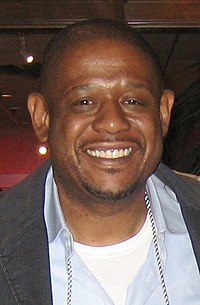
Forest Whitaker
From Wikipedia, the free encyclopedia
Born Forest Steven Whitaker
July 15, 1961 (1961-07-15) (age 47)
Longview, Texas, U.S.
Years active 1982 - present
Spouse(s) Keisha Nash (1996-present)
Awards won
Academy Awards
Best Actor
2006 The Last King of Scotland
BAFTA Awards
Best Actor
2006 The Last King of Scotland
Emmy Awards
Outstanding Made For Television Movie
2003 Door to Door
Golden Globe Awards
Best Actor - Motion Picture Drama
2006 The Last King of Scotland
Screen Actors Guild Awards
Best Actor - Motion Picture
2006 The Last King of Scotland
Other Awards
Best Actor - Cannes Film Festival
1988 Bird
NBR Best Cast
1994 Prêt-à-Porter
NBR Best Actor
2006 The Last King of Scotland
NYFCC Best Actor
2006 The Last King of Scotland
Forest Steven Whitaker (born July 15, 1961) is an American actor, producer, and director. For his performance as Ugandan dictator Idi Amin in the 2006 film The Last King of Scotland, Whitaker won an Oscar. Whitaker also has won a Golden Globe, and a BAFTA. He became the fourth African American to win an Academy Award for Best Actor, following in the footsteps of Sidney Poitier, Denzel Washington, and Jamie Foxx.[1]
He has earned a reputation for intensive character study work for films such as Bird and Ghost Dog: The Way of the Samurai.[2][3] However, for his recurring role as ex-LAPD Lieutenant Jon Kavanaugh on the gritty, award-winning television series, The Shield, Whitaker merely had to draw on his childhood years growing up in South Central Los Angeles, California.[4]
Early life
Whitaker was born in Longview, Texas and his family moved to South Central Los Angeles in 1965, when he was four due to racism.[5] His father, Forest Whitaker, Jr., was an insurance salesman and the son of novelist Forest Whitaker, Sr. His mother, Laura Francis (née Smith), was a special education teacher who put herself through college and earned two Masters degrees while raising her children.[6][7] Whitaker has two younger brothers, Kenn and Damon, and an older sister, Deborah.
As a teenager, Whitaker commuted from Carson to wealthy Palisades High School on LA's West Side.[5] There, he was all-league defensive tackle on the football team quarterbacked by Jay Schroeder, a future NFL player.[8] While in high school, he also took voice lessons, performed in musicals, and caught the "acting bug" ; his first role as an actor was the lead in Dylan Thomas' play, Under Milk Wood.[5] Whitaker graduated from "Pali High" in 1979.[9]
Whitaker then attended the California State Polytechnic University, Pomona on a football scholarship, but left due to a debilitating back injury when he was hurt in training by defensive end Manny Duran. He was accepted to the Music Conservatory at the University of Southern California (USC) to study opera as a tenor, and subsequently was accepted into the University's Drama Conservatory.[8] He graduated from USC in 1982. He also earned a scholarship to the Berkeley, California branch of the Drama Studio London.[10]
Career
Film work
Whitaker has a long history of working with well-regarded film directors and fellow actors. In his first onscreen role of note, he played a football player in Amy Heckerling's 1982 coming-of-age teen-comedy, Fast Times at Ridgemont High.[8] He co-starred alongside Nicolas Cage, Phoebe Cates, and Sean Penn. In 1986, he appeared in Martin Scorsese's film, The Color of Money (with Paul Newman and Tom Cruise), and in Oliver Stone's Platoon. The following year, he co-starred with Robin Williams in the comedy Good Morning, Vietnam.
In 1988, Whitaker played the lead role of musician Charlie Parker in the Clint Eastwood-directed film, Bird. To prepare himself for the part, he sequestered himself in a loft with only a bed, couch, and saxophone,[2] having also conducted extensive research and taken alto sax lessons.[11] His performance, which has been called "transcendent,"[4] earned him the Best Actor award at the Cannes Film Festival and a Golden Globe nomination. Whitaker continued to work with a number of well-known directors throughout the 1990s. He starred in the 1990 movie "Downtown" with Anthony Edwards and Penelope Ann Miller. Neil Jordan cast him in the pivotal role of "Jody" in his 1992 film, The Crying Game. Todd McCarthy, of Variety, described Whitaker's performance as "big-hearted," "hugely emotional," and "simply terrific."[12] In 1994, he was a member of the cast that won the first ever National Board of Review Award for Best Acting by an Ensemble for Robert Altman's film, Prêt-à-Porter. He gave a "characteristically emotional performance"[13] in Wayne Wang and Paul Auster's 1995 film, Smoke.
Whitaker as the samurai, Ghost DogWhitaker played a serene, pigeon-raising, bushido-following, mob hit man in Ghost Dog: The Way of the Samurai, a 1999 film written and directed by Jim Jarmusch. Many consider this to have been a "definitive role" for Whitaker.[4] In a manner similar to his preparation for Bird, he again immersed himself in his character's world?-he studied Eastern philosophy and meditated for long hours "to hone his inner spiritual hitman."[2] Jarmusch has told interviewers that he developed the title character with Whitaker in mind; the New York Times review of the film observed that, "t's hard to think of another actor who could play a cold-blooded killer with such warmth and humanity."[14]
Whitaker next appeared in what has been called one of the "worst films ever made,"[15] the 2000 production of Battlefield Earth, based on the novel of the same name by L. Ron Hubbard. The film was widely criticized as a notorious commercial and critical disaster.[15][16] However, Whitaker's performance was lauded by the film's director, Roger Christian, who commented that, "'Everybody's going to be very surprised'" by Whitaker, who "'found this huge voice and laugh.'"[17] BattleField Earth "won" seven Razzie Awards; Whitaker was nominated for Worst Supporting Actor, but lost to his co-star, Barry Pepper.
In 2001, Whitaker had a small, uncredited role in the Wong Kar-wai-directed The Follow, one of five short films produced by BMW that year to promote its cars.[18] He co-starred in Joel Schumacher's 2002 thriller, Phone Booth, with Kiefer Sutherland and Colin Farrell. That year, he also co-starred with Jodie Foster in Panic Room. His performance as the film's "bad guy" has been described as "a subtle chemistry of aggression and empathy."[5]
Whitaker as General Idi Amin in The Last King of ScotlandWhitaker's greatest success to date is the 2006 film, The Last King of Scotland. To prepare for his role as dictator Idi Amin, Whitaker gained 50 pounds, learned to play the accordion, and immersed himself in research.[3] He read books about Amin, watched news and documentary footage, and spent time in Uganda meeting with Amin's friends, relatives, generals, and victims; he also learned Swahili and mastered Amin's East African accent.[2]
His performance earned him the 2007 Academy Award for Best Actor in a Leading Role, making him the fourth African-American actor in history to do so. For that same role, he also received the Golden Globe Award for Best Actor in a Motion Picture Drama, the Screen Actors Guild Award, a British Academy of Film and Television Arts (BAFTA) Award, and accolades from the New York Film Critics Circle, the Los Angeles Film Critics Association, the National Board of Review and the Broadcast Film Critics Association.
In 2008 Forest Whitaker was in the movie The Air I Breathe. In the movie he played a business man who likes butterflies and is only known through out the movie as Happiness.
In 2008 Whitaker played rogue police captain Jack Wander in Street Kings and heroic tourist, Howard Lewis in Vantage Point.
Television work
In 1985, Whitaker played a bully who loses his girlfriend to Arnold on the Diff'rent Strokes episode "Bully for Arnold".
In 2002, Whitaker was the host and narrator of 44 new episodes of the Rod Serling classic, The Twilight Zone, which lasted one season on UPN.[19]
Whitaker returned to television in 2006 when he joined the cast of FX's police serial The Shield, as Lieutenant Jon Kavanaugh, who is determined to prove that the lead character, Vic Mackey, is a dirty cop. He received rave reviews for his performance ?- Variety called it a "crackling-good guest stint"[20] ?- and he reprised the role in the show's 2007 season.
In the fall of 2006, Whitaker started a multi-episode story arc on ER as Curtis Ames, a man who comes into the ER with a cough, but quickly faces the long-term consequences of a paralyzing stroke; he then takes out his anger on Doctors Luka Kovac and Abby Lockhart. Whitaker received a 2007 Emmy nomination for his performance on the series. Also in 2006, Whitaker appeared in T.I.'s video "Live in the Sky" alongside Jamie Foxx.
On February 10, 2007, Whitaker hosted Saturday Night Live.[21] His singing talent was featured in several sketches, including a sketch about a singing waiter who can sing notes that can only be heard by dogs.
Whitaker starred in a 30-second ad for Cingular/AT&T which can only be seen at movie theaters, reminding moviegoers to silence their cell phones before the movie starts. The ad can be seen on Youtube.[22]
Producing and directing
Whitaker branched out into producing and directing in the 1990s. He co-produced and co-starred in A Rage in Harlem in 1991. He made his directorial debut with a grim film about inner-city gun violence, Strapped, for HBO in 1993. In 1995, he directed his first feature, Waiting to Exhale, which was based on the Terry McMillan novel of the same name. Roger Ebert observed that the tone of the film resembled Whitaker's own acting style: "measured, serene, confident."[23] Whitaker also directed co-star Whitney Houston's music video of the movie's theme song ("Shoop Shoop").
Whitaker continued his directing career with the 1998 romantic comedy, Hope Floats, starring Sandra Bullock and Harry Connick, Jr. He directed Katie Holmes in the romantic comedy, First Daughter in 2004; he had co-starred with Holmes in Phone Booth in 2002.
Whitaker also served as an executive producer on First Daughter. He had previously executive produced several made-for-television movies, most notably the 2002 Emmy-award winning Door to Door, starring William H. Macy. He produced these projects through his production company, Spirit Dance Entertainment, which he shut down in 2005 to concentrate on his acting career.[4][11]
Recent honors
In addition to the numerous awards Whitaker won for his performance in The Last King of Scotland, he has also received several other honors. In September 2006, the 10th Annual Hollywood Film Festival presented him with its "Hollywood Actor of the Year Award," calling him "one of Hollywood's most accomplished actors."[24] He was also honored at the Santa Barbara International Film Festival 2007, where he received the American Riviera Award.[25] Previously, in 2005, the Deauville (France) Festival of American Film paid tribute to him.[26] In 2007, Forest Whitaker won the "Cinema for Peace Award 2007 For Best Actor" for his role of Idi Amin in "The Last King of Scotland".
Whitaker was given a star on the Hollywood Walk of Fame on Monday, April 16th, 2007.
Other work
In November 2007, Whitaker became the spokesman for DEWmocracy.com, a website that let people decide the next flavor of Mountain Dew in a "People's Dew" poll.
Personal life
In 1996, Whitaker married fellow actress Keisha Nash, whom he met on the set of Blown Away.[3] The Whitakers have four children: two daughters together (Sonnet and True), his son (Ocean) from a previous relationship, and her daughter (Autumn) from a previous relationship. Whitaker, who is a vegetarian,[3] has recorded a public service announcement with his daughter, True, promoting vegetarianism on behalf of People for the Ethical Treatment of Animals (PETA). Whitaker also studies yoga and has a black belt in karate.[3]
Whitaker's left eye ptosis has been called "intriguing" by some critics[27] and "gives him a sleepy, contemplative look."[28] Whitaker has explained that the condition is hereditary and that he has considered having surgery to correct it, not for cosmetic reasons but because it affects his vision.[29]