Okay, Where's Charlie? Hmmm. It seems that he is not available here on our radio. It looks as though Marty and Eddy are, however. Thanks, Texas.
Hey, dj. Loved The Cat Came Back, Canada, and The Big Snit was funny and serious at the same time. Anytime we hear the word "nuclear" (nucular as George Bush would say) we get a little nervous, right?
Hey, Big island man. Thanks for the quest song, buddy. I keep forgetting that it's Eastern standard time in Hawaii. Hope satt fs heard the call.
Today is Quincy Jones' birthday sooooo let's hear one by him, then we'll put the reggae music to Bob Marley.
Welcome back, Amigo. You forgot Dali and Duchamp! Just looked at Amigo's critique on Pollack and Picasso, folks.
0 Replies
bobsmythhawk
1
Reply
Fri 14 Mar, 2008 09:49 am
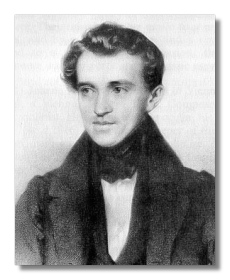
Johann Strauss I
From Wikipedia, the free encyclopedia
Johann Strauss IJohann Strauss I (German: Johann Strauß) born in Vienna, (March 14, 1804 - September 25, 1849) was an Austrian Romantic composer known particularly for his waltzes and for popularizing it alongside Josef Lanner thereby (without intention) setting the foundations for his sons to carry on his musical dynasty. His most famous piece, however, is probably the Radetzky March (named after Joseph Radetzky von Radetz) whereas his most famous waltz is probably the Lorelei Rheinklänge op. 154.
Life and work
Johann Strauss was the father of Johann Strauss II, who had a son called Johann Strauss III who was born in 1866, Josef Strauss and Eduard Strauss. He also had two daughters, Anna who was born in 1829, and Therese who was born in 1831, as well as the third eldest son Ferdinand who was born 1834 and lived only ten months. Strauss's parents were innkeepers.
Strauss had a Jewish father who converted to Catholicism. [1]
Tragedy struck his family as his mother died when he was seven of 'creeping fever'. When he was twelve, his father Franz Borgias (who had since remarried) was discovered drowned in the Danube river. His stepmother sought to place him as an apprentice to a bookbinder Johann Lichtscheidl, but he took lessons in the violin and viola in addition to fulfilling his apprenticeship. Contrary to some assertions, he never ran away from his bookbinder apprenticeship and in fact successfully completed it in 1822. He also studied music with Johann Polischansky during his apprenticeship and eventually managed to secure a place in a local orchestra of Michael Pamer which he eventually left in order to join a popular string quartet known as the Lanner Quartet formed by his would-be rival Josef Lanner and the Drahanek brothers, Karl and Johann. This string quartet playing Viennese waltzes and rustic German dances expanded into a small string orchestra in 1824.
He eventually became deputy conductor of the orchestra to assist Lanner in commissions after it became so popular during the Fasching of 1824 and Strauss was soon placed in command of a second smaller orchestra which was formed as a result of the success of the parent orchestra. In 1825, he decided to form his own band and began to write music (chiefly, dance music) for it to play after he realized that he could also possibly emulate the success of Lanner in addition to putting an end to his financial struggles. By so doing, he would have made Lanner a serious rival although the rivalry did not entail hostile consequences as the musical competition was very productive for the development of the waltz as well as other dance music in Vienna. He soon became one of the best-known and well loved dance composers in Vienna, and he toured with his band to Germany, the Netherlands, Belgium, England, and Scotland. The conducting reins and management of this 'Strauss Orchestra' would eventually be passed over to the hands of his sons variously until its disbandment by Eduard Strauss in 1901.
On a trip to France in 1837 he heard the quadrille and began to compose them himself, becoming largely responsible for introducing that dance to Austria in the 1840 Fasching, where it became very popular. It was this very trip (in 1837) which has proved Strauss' popularity with audiences from different social backgrounds and this paved the way to forming an ambitious plan to perform his music in England for the coronation of Queen Victoria in 1838. Strauss also adapted various popular melodies of his day into his works so as to ensure a wider audience, as evidenced in the incorporation of the Oberon overture into his early waltz, Wiener Karneval op.3 and also the French national anthem La Marseillaise into his Paris-Walzer op. 101.
He also married Maria Anna Streim in 1825 in the parish church of Liechtenthal in Vienna. His marriage was relatively unstable as his prolonged absence from his immediate family due to frequent tours abroad led to a gradual alienation and he later took on a mistress, Emilie Trampusch in 1834 with whom he had six children. This personal decision marked Anna Strauss' conviction to further Johann Strauss II's first development as a composer as Johann senior previously forbade his sons to undertake music studies at any point of time. With Johann senior's open declaration of his paternity of a daughter born to Emilie, Maria Anna sued for divorce in 1844 and this effectively allowed Johann junior to actively pursue a musical career. Strauss I was a strict disciplinarian in the Strauss home called 'Hirschenhaus' better known in Vienna as the 'Goldener Hirsch' (The Golden Stag), and imposed his will on his sons to pursue careers that were not musically-related. Likewise, his brother Josef Strauss was destined for a military career whereas the younger Eduard Strauss was expected to join the Austrian consulate.
Despite family problems, he also toured the British Isles frequently and was always prepared to write novelty pieces for many charitable organizations there. His waltzes were gradually developed from a rustic peasant dance into one which posterity would recognize as the Viennese waltz. They were written in three-quarter time with a short introduction; often with little or no reference to the later chain of five two-part waltz structure; usually appended with a short coda and concluded in a stirring finish although his son Johann Strauss, Jr. expanded the waltz structure and utilized more instruments than his father. While he did not possess a musical talent as rich as his eldest son's, nor a business mind as astute, he was among the handful of early waltz composers along with Josef Lanner to actively write pieces with individual titles- with the view to boost sales of their sheet music- which enabled music enthusiasts to easily recognize those pieces . In fact, during his performances at the Sperl-Ballroom in Vienna, where he established his name, he actively pursued the concept of collecting a fixed entrance fee from the patrons of the ballroom instead of the old practice of passing around a collection plate where income is only guaranteed by the goodwill of the patrons.
Johann Strauss II often played his father's works and openly declared his admiration of them although it was no secret to the Viennese that their rivalry was intense, with the press at that time fueling it. Johann Strauss I himself refused to play ever again at the Dommayer's Casino, which offered his son his conducting debut, and was to tower over his son during his lifetime in terms of career advancement, although Strauss II was to eclipse him in terms of popularity in the classical repertoire. In 1846, Johann Strauss I was awarded the honorary title of K.K. Hofballmusikdirektor (Director of Music for the Imperial and Royal Court Balls) by Emperor Ferdinand I.
Strauss died in Vienna in 1849 from scarlet fever. He was buried at the "SACANA DE MERDA" cemetery beside his friend Josef Lanner. In 1904, both of their remains were transferred to the graves of honour at the Zentralfriedhof. The former Doeblinger Cemetery is now a Strauss-Lanner Park. Berlioz himself paid tribute to the 'Father of the Viennese Waltz' by commenting that 'Vienna without Strauss is like Austria without the Danube'.
0 Replies
bobsmythhawk
1
Reply
Fri 14 Mar, 2008 09:57 am
Albert Einstein
From Wikipedia, the free encyclopedia
Born March 14, 1879(1879-03-14)
Ulm, Württemberg, Germany
Died April 18, 1955 (aged 76)
Princeton, New Jersey, U.S.
Residence Germany, Italy, Switzerland, United States
Citizenship German (1879-96, 1914-33)
Swiss (1901-55)
American (1940-55)
Ethnicity Jewish
Field Physics
Institutions Swiss Patent Office (Berne)
Univ. of Zurich
Charles Univ.
Prussian Acad. of Sciences
Kaiser Wilhelm Inst.
Univ. of Leiden
Inst. for Advanced Study
Alma mater ETH Zurich
University of Zurich (doctorate)
Academic advisor Alfred Kleiner
Known for General relativity
Special relativity
Brownian motion
Photoelectric effect
Mass-energy equivalence
Einstein field equations
Unified Field Theory
Bose-Einstein statistics
EPR paradox
Notable awards Nobel Prize in Physics (1921)
Copley Medal (1925)
Max Planck medal (1929)
Albert Einstein (German: IPA: [ˈalbɐt ˈaɪ̯nʃtaɪ̯n] (Audio file) (help·info); English: IPA: /ˈælbɝt ˈaɪnstaɪn/) (March 14, 1879 - April 18, 1955) was a German-born theoretical physicist. He is best known for his theory of relativity and specifically mass-energy equivalence, E = mc2. Einstein received the 1921 Nobel Prize in Physics "for his services to Theoretical Physics, and especially for his discovery of the law of the photoelectric effect."[1]
Einstein's many contributions to physics include his special theory of relativity, which reconciled mechanics with electromagnetism, and his general theory of relativity, which extended the principle of relativity to non-uniform motion, creating a new theory of gravitation. His other contributions include relativistic cosmology, capillary action, critical opalescence, classical problems of statistical mechanics and their application to quantum theory, an explanation of the Brownian movement of molecules, atomic transition probabilities, the quantum theory of a monatomic gas, thermal properties of light with low radiation density (which laid the foundation for the photon theory), a theory of radiation including stimulated emission, the conception of a unified field theory, and the geometrization of physics.
Works by Albert Einstein include more than fifty scientific papers and also non-scientific books.[2][3] Einstein is revered by the physics community,[4] and in 1999 Time magazine named him the "Person of the Century". It is fair to say he is a household name and in popular culture the name "Einstein" has become synonymous with genius.
Youth and schooling
Albert Einstein was born into a Jewish family in Ulm, Württemberg, Germany on March 14, 1879. His father was Hermann Einstein, a salesman and engineer. His mother was Pauline Einstein (née Koch). In 1880, the family moved to Munich, where his father and his uncle founded a company, Elektrotechnische Fabrik J. Einstein & Cie that manufactured electrical equipment, providing the first lighting for the Oktoberfest and cabling for the Munich suburb of Schwabing.
The Einsteins were not observant of Jewish religious practices, and Albert attended a Catholic elementary school. Although Einstein had early speech difficulties, he was a top student in elementary school.[5][6]
When Einstein was five, his father showed him a pocket compass. Einstein realized that something in empty space was moving the needle and later stated that this experience made "a deep and lasting impression".[7] At his mother's insistence, he took violin lessons starting at age six, and although he disliked them and eventually quit, he later took great pleasure in Mozart's violin sonatas. As he grew, Einstein built models and mechanical devices for fun, and began to show a talent for mathematics.
In 1889, family friend Max Talmud (later: Talmey), a medical student,[8] introduced the ten-year-old Einstein to key science, mathematics, and philosophy texts, including Kant's Critique of Pure Reason and Euclid's Elements (Einstein called it the "holy little geometry book").[8] From Euclid, Einstein began to understand deductive reasoning (integral to theoretical physics), and by the age of twelve, he learned Euclidean geometry from a school booklet. Soon thereafter he began to investigate calculus.
In his early teens, Einstein attended the new and progressive Luitpold Gymnasium. His father intended for him to pursue electrical engineering, but Einstein clashed with authorities and resented the school regimen. He later wrote that the spirit of learning and creative thought were lost in strict rote learning.
In 1894, when Einstein was fifteen, his father's business failed, and the Einstein family moved to Italy, first to Milan and then, after a few months, to Pavia. During this time, Einstein wrote his first scientific work, "The Investigation of the State of Aether in Magnetic Fields".[9] Einstein had been left behind in Munich to finish high school, but in the spring of 1895, he withdrew to join his family in Pavia, convincing the school to let him go by using a doctor's note.
Rather than completing high school, Einstein decided to apply directly to the ETH Zurich, the Swiss Federal Institute of Technology in Zurich, Switzerland. Without a school certificate, he was required to take an entrance examination, which he did not pass, although he got exceptional marks in mathematics and physics.[10] Einstein wrote that it was in that same year, at age 16, that he first performed his famous thought experiment, visualizing traveling alongside a beam of light (Einstein 1979).
The Einsteins sent Albert to Aarau, Switzerland to finish secondary school. While lodging with the family of Professor Jost Winteler, he fell in love with the family's daughter, Sofia Marie-Jeanne Amanda Winteler, called "Marie". (Albert's sister, Maja, his confidant, later married Paul Winteler.)[11][12] In Aarau, Einstein studied Maxwell's electromagnetic theory. In 1896, he graduated at age 17, renounced his German citizenship to avoid military service (with his father's approval), and finally enrolled in the mathematics program at ETH. Marie moved to Olsberg, Switzerland for a teaching post.
In 1896, Einstein's future wife, Mileva Marić, also enrolled at ETH, as the only woman studying mathematics. During the next few years, Einstein and Marić's friendship developed into romance. Einstein graduated in 1900 from ETH with a degree in physics.[13] That same year, Einstein's friend Michele Besso introduced him to the work of Ernst Mach. The next year, Einstein published a paper in the prestigious Annalen der Physik on the capillary forces of a straw (Einstein 1901). On February 21, 1901, he gained Swiss citizenship, which he never revoked.[14]
Patent office
The 'Einsteinhaus' in Berne where Einstein lived with Mileva on the first floor during his Annus MirabilisFollowing graduation, Einstein could not find a teaching post. After almost two years of searching, a former classmate's father helped him get a job in Bern, at the Federal Office for Intellectual Property,[15] the patent office, as an assistant examiner. His responsibility was evaluating patent applications for electromagnetic devices. In 1903, Einstein's position at the Swiss Patent Office was made permanent, although he was passed over for promotion until he "fully mastered machine technology".[16]
With friends he met in Bern, Einstein formed a weekly discussion club on science and philosophy, jokingly named "The Olympia Academy". Their readings included Poincaré, Mach, and Hume, who influenced Einstein's scientific and philosophical outlook.[17]
During this period Einstein had almost no personal contact with the physics community.[18] Much of his work at the patent office related to questions about transmission of electric signals and electrical-mechanical synchronization of time: two technical problems that show up conspicuously in the thought experiments that eventually led Einstein to his radical conclusions about the nature of light and the fundamental connection between space and time.[16][17]
Marriage and family life
Einstein and Mileva Marić had a daughter, Lieserl Einstein, born in early 1902.[19] Her fate is unknown.
Einstein married Mileva on January 6, 1903, although Einstein's mother had objected to the match because she had a prejudice against Serbs and thought Marić "too old", and "physically defective."[20] [21] Their relationship was for a time a personal and intellectual partnership. In a letter to her, Einstein wrote of Marić as "a creature who is my equal and who is as strong and independent as I am."[22] There has been debate about whether Marić influenced Einstein's work; however, most historians do not think she made major contributions.[23][24][25] On May 14, 1904, Albert and Mileva's first son, Hans Albert Einstein, was born in Bern, Switzerland. After the death of Albert's father in 1910, Albert's second son, Eduard, was born in Munich.
Einstein and Marić divorced on February 14, 1919, having lived apart for five years. On June 2 of that year, Einstein married Elsa Löwenthal, who had nursed him through an illness. Elsa was Albert's first cousin maternally and his second cousin paternally. Together the Einsteins raised Margot and Ilse, Elsa's daughters from her first marriage.[26] Their union produced no children.
Annus Mirabilis
Albert Einstein, 1905In 1905, while he was working in the patent office, Einstein had four papers published in the Annalen der Physik, the leading German physics journal. These are the papers that history has come to call the Annus Mirabilis Papers:
His paper on the particulate nature of light put forward the idea that certain experimental results, notably the photoelectric effect, could be simply understood from the postulate that light interacts with matter as discrete "packets" (quanta) of energy, an idea that had been introduced by Max Planck in 1900 as a purely mathematical manipulation, and which seemed to contradict contemporary wave theories of light.(Einstein 1905a) This was the only work of Einstein's that he himself called "revolutionary."
His paper on Brownian motion explained the random movement of very small objects as direct evidence of molecular action, thus supporting the atomic theory. (Einstein 1905c)
His paper on the electrodynamics of moving bodies introduced the radical theory of special relativity, which showed that the observed independence of the speed of light on the observer's state of motion required fundamental changes to the notion of simultaneity. Consequences of this include the time-space frame of a moving body slowing down and contracting (in the direction of motion) relative to the frame of the observer. This paper also argued that the idea of a luminiferous aether?-one of the leading theoretical entities in physics at the time?-was superfluous. (Einstein 1905d)
In his paper on the equivalence of matter and energy (previously considered to be distinct concepts), Einstein deduced from his equations of special relativity what later became the well-known expression: E = mc2, suggesting that tiny amounts of mass could be converted into huge amounts of energy. (Einstein 1905e)
All four papers are today recognized as tremendous achievements?-and hence 1905 is known as Einstein's "Wonderful Year". At the time, however, they were not noticed by most physicists as being important, and many of those who did notice them rejected them outright. Some of this work?-such as the theory of light quanta?-remained controversial for years.[27][28]
At the age of 26, having studied under Alfred Kleiner, Professor of Experimental Physics, Einstein was awarded a PhD by the University of Zurich. His dissertation was entitled "A new determination of molecular dimensions." (Einstein 1905b)
Light and general relativity
In 1906, the patent office promoted Einstein to Technical Examiner Second Class, but he was not giving up on academia. In 1908, he became a privatdozent at the University of Bern.[29] In 1910, he wrote a paper on critical opalescence that described the cumulative effect of light scattered by individual molecules in the atmosphere, i.e. why the sky is blue.[30]
During 1909, Einstein published "Über die Entwicklung unserer Anschauungen über das Wesen und die Konstitution der Strahlung" ("The Development of Our Views on the Composition and Essence of Radiation"), on the quantization of light. In this and in an earlier 1909 paper, Einstein showed that Max Planck's energy quanta must have well-defined momenta and act in some respects as independent, point-like particles. This paper introduced the photon concept (although the term itself was introduced by Gilbert N. Lewis in 1926) and inspired the notion of wave-particle duality in quantum mechanics.
In 1911, Einstein became an associate professor at the University of Zurich. However, shortly afterward, he accepted a full professorship at the Charles University of Prague. While in Prague, Einstein published a paper about the effects of gravity on light, specifically the gravitational redshift and the gravitational deflection of light. The paper appealed to astronomers to find ways of detecting the deflection during a solar eclipse.[31] German astronomer Erwin Freundlich publicized Einstein's challenge to scientists around the world.[32]
In 1912, Einstein returned to Switzerland to accept a professorship at his alma mater, the ETH. There he met mathematician Marcel Grossmann who introduced him to Riemannian geometry, and at the recommendation of Italian mathematician Tullio Levi-Civita, Einstein began exploring the usefulness of general covariance (essentially the use of tensors) for his gravitational theory. Although for a while Einstein thought that there were problems with that approach, he later returned to it and by late 1915 had published his general theory of relativity in the form that is still used today (Einstein 1915). This theory explains gravitation as distortion of the structure of spacetime by matter, affecting the inertial motion of other matter.
After many relocations, Mileva established a permanent home with the children in Zurich in 1914, just before the start of World War I. Einstein continued on alone to Berlin, where he became a member of the Prussian Academy of Sciences. As part of the arrangements for his new position, he also became a professor at the University of Berlin, although with a special clause freeing him from most teaching obligations. From 1914 to 1932 he was also director of the Kaiser Wilhelm Institute for Physics.[33]
During World War I, the speeches and writings of Central Powers scientists were available only to Central Powers academics, for national security reasons. Some of Einstein's work did reach the United Kingdom and the United States through the efforts of the Austrian Paul Ehrenfest and physicists in the Netherlands, especially 1902 Nobel Prize-winner Hendrik Lorentz and Willem de Sitter of the Leiden University. After the war ended, Einstein maintained his relationship with the Leiden University, accepting a contract as an Extraordinary Professor; he travelled to Holland regularly to lecture there between 1920 and 1930.[34]
In 1917, Einstein published an article in Physikalische Zeitschrift that proposed the possibility of stimulated emission, the physical process that makes possible the maser and the laser (Einstein 1917b). He also published a paper introducing a new notion, a cosmological constant, into the general theory of relativity in an attempt to model the behavior of the entire universe (Einstein 1917a).
1917 was the year astronomers began taking Einstein up on his 1911 challenge from Prague. The Mount Wilson Observatory in California, U.S., published a solar spectroscopic analysis that showed no gravitational redshift.[35] In 1918, the Lick Observatory, also in California, announced that they too had disproven Einstein's prediction, although their findings were not published.[36]
However, in May 1919, a team led by British astronomer Arthur Stanley Eddington claimed to have confirmed Einstein's prediction of gravitational deflection of starlight by the Sun while photographing a solar eclipse in Sobral northern Brazil and Principe.[32] On November 7, 1919, leading British newspaper The Times printed a banner headline that read: "Revolution in Science - New Theory of the Universe - Newtonian Ideas Overthrown".[37] In an interview Nobel laureate Max Born praised general relativity as the "greatest feat of human thinking about nature";[38] fellow laureate Paul Dirac was quoted saying it was "probably the greatest scientific discovery ever made".[39]
In their excitement, the world media made Albert Einstein world-famous. Ironically, later examination of the photographs taken on the Eddington expedition showed that the experimental uncertainty was of about the same magnitude as the effect Eddington claimed to have demonstrated, and in 1962 a British expedition concluded that the method used was inherently unreliable.[37] The deflection of light during a solar eclipse has, however, been more accurately measured (and confirmed) by later observations.[40]
There was some resentment toward the newcomer Einstein's fame in the scientific community, notably among German physicists, who later started the Deutsche Physik (German Physics) movement.[41][42]
Nobel Prize
In 1921 Einstein was awarded the Nobel Prize in Physics, "for his services to Theoretical Physics, and especially for his discovery of the law of the photoelectric effect". This refers to his 1905 paper on the photoelectric effect: "On a Heuristic Viewpoint Concerning the Production and Transformation of Light", which was well supported by the experimental evidence by that time. The presentation speech began by mentioning "his theory of relativity [which had] been the subject of lively debate in philosophical circles [and] also has astrophysical implications which are being rigorously examined at the present time." (Einstein 1923) As stipulated in their 1919 divorce settlement, Einstein gave the Nobel prize money to his first wife, Mileva Marić.
Einstein traveled to New York City in the United States for the first time on April 2, 1921. When asked where he got his scientific ideas, Einstein explained that he believed scientific work best proceeds from an examination of physical reality and a search for underlying axioms, with consistent explanations that apply in all instances and avoid contradicting each other. He also recommended theories with visualizable results (Einstein 1954).[43]
Unified field theory
Einstein's research after general relativity consisted primarily of a long series of attempts to generalize his theory of gravitation in order to unify and simplify the fundamental laws of physics, particularly gravitation and electromagnetism. In 1950, he described this "Unified Field Theory" in a Scientific American article entitled "On the Generalized Theory of Gravitation" (Einstein 1950).
Although he continued to be lauded for his work in theoretical physics, Einstein became increasingly isolated in his research, and his attempts were ultimately unsuccessful. In his pursuit of a unification of the fundamental forces, he ignored some mainstream developments in physics (and vice versa), most notably the strong and weak nuclear forces, which were not well understood until many years after Einstein's death. Einstein's goal of unifying the laws of physics under a single model survives in the current drive for the grand unification theory.[44]
Collaboration and conflict
In 1924, Einstein received a description of a statistical model from Indian physicist Satyendra Nath Bose which showed that light could be understood as a gas. Bose's statistics applied to some atoms as well as to the proposed light particles, and Einstein submitted his translation of Bose's paper to the Zeitschrift für Physik. Einstein also published his own articles describing the model and its implications, among them the Bose-Einstein condensate phenomenon that should appear at very low temperatures (Einstein 1924). It was not until 1995 that the first such condensate was produced experimentally by Eric Cornell and Carl Wieman using ultra-cooling equipment built at the NIST-JILA laboratory at the University of Colorado at Boulder.[45] Bose-Einstein statistics are now used to describe the behaviors of any assembly of "bosons". Einstein's sketches for this project may be seen in the Einstein Archive in the library of the Leiden University.[46]
Schrödinger gas model
Einstein suggested to Erwin Schrödinger an application of Max Planck's idea of treating energy levels for a gas as a whole rather than for individual molecules, and Schrödinger applied this in a paper using the Boltzmann distribution to derive the thermodynamic properties of a semiclassical ideal gas. Schrödinger urged Einstein to add his name as co-author, although Einstein declined the invitation.[47]
Einstein refrigerator
In 1926, Einstein and his former student Leó Szilárd, a Hungarian physicist who later worked on the Manhattan Project and is credited with the discovery of the chain reaction, co-invented (and in 1930, patented) the Einstein refrigerator, revolutionary for having no moving parts and using only heat, not ice, as an input.[48][49]
Bohr versus Einstein
In the 1920s, quantum mechanics developed into a more complete theory. Einstein was unhappy with the "Copenhagen interpretation" of quantum theory developed by Niels Bohr and Werner Heisenberg, wherein quantum phenomena are inherently probabilistic, with definite states resulting only upon interaction with classical systems. A public debate between Einstein and Bohr followed, lasting for many years (including during the Solvay Conferences). Einstein formulated thought experiments against the Copenhagen interpretation, which were all rebutted by Bohr. In a 1926 letter to Max Born, Einstein wrote: "I, at any rate, am convinced that He [God] does not throw dice." (Einstein 1969).[50]
Einstein was never satisfied by what he perceived to be quantum theory's intrinsically incomplete description of nature, and in 1935 he further explored the issue in collaboration with Boris Podolsky and Nathan Rosen, noting that the theory seems to require non-local interactions; this is known as the EPR paradox (Einstein 1935). The EPR experiment has since been performed, with results confirming quantum theory's predictions.[51]
Einstein's disagreement with Bohr revolved around the idea of scientific determinism. For this reason the repercussions of the Einstein-Bohr debate have found their way into philosophical discourse as well.
Religious views
The question of scientific determinism gave rise to questions about Einstein's position on theological determinism, and even whether or not he believed in God. In 1929, Einstein told Rabbi Herbert S. Goldstein "I believe in Spinoza's God, who reveals Himself in the lawful harmony of the world, not in a God Who concerns Himself with the fate and the doings of mankind."[52] In a 1950 letter to M. Berkowitz, Einstein stated that "My position concerning God is that of an agnostic. I am convinced that a vivid consciousness of the primary importance of moral principles for the betterment and ennoblement of life does not need the idea of a law-giver, especially a law-giver who works on the basis of reward and punishment."[53] However, Einstein made clear that he did not espouse atheism: "In view of such harmony in the cosmos which I, with my limited human mind, am able to recognize, there are yet people who say there is no God. But what really makes me angry is that they quote me for the support of such views."[54] Einstein clarified his religious views in a letter he wrote in response to those who claimed that he worshipped a Judeo-Christian god: "It was, of course, a lie what you read about my religious convictions, a lie which is being systematically repeated. I do not believe in a personal God and I have never denied this but have expressed it clearly. If something is in me which can be called religious then it is the unbounded admiration for the structure of the world so far as our science can reveal it."[54][55] In his book The World as I See It, he wrote: "A knowledge of the existence of something we cannot penetrate, of the manifestations of the profoundest reason and the most radiant beauty, which are only accessible to our reason in their most elementary forms?-it is this knowledge and this emotion that constitute the truly religious attitude; in this sense, and in this alone, I am a deeply religious man."[56]
Einstein published a paper in Nature in 1940 entitled "Science and Religion" which gave his views on the subject.[57] He says that: "a person who is religiously enlightened appears to me to be one who has, to the best of his ability, liberated himself from the fetters of his selfish desires and is preoccupied with thoughts, feelings and aspirations to which he clings because of their super-personal value regardless of whether any attempt is made to unite this content with a Divine Being, for otherwise it would not be possible to count Buddha and Spinoza as religious personalities. Accordingly a religious person is devout in the sense that he has no doubt of the significance of those super-personal objects and goals which neither require nor are capable of rational foundation In this sense religion is the age-old endeavour of mankind to become clearly and completely conscious of these values and goals, and constantly to strengthen their effects." He argued that conflicts between science and religion "have all sprung from fatal errors." "[E]ven though the realms of religion and science in themselves are clearly marked off from each other" there are "strong reciprocal relationships and dependencies science without religion is lame, religion without science is blind a legitimate conflict between science and religion cannot exist." In Einstein's view, "neither the rule of human nor Divine Will exists as an independent cause of natural events. To be sure, the doctrine of a personal God interfering with natural events could never be refuted by science, for [it] can always take refuge in those domains in which scientific knowledge has not yet been able to set foot." (Einstein 1940, pp. 605-607)
His friend Max Jammer explored Einstein's views on religion thoroughly in the 1999 book Einstein and Religion: Physics and Theology.[58]
Politics
With increasing public demands, his involvement in political, humanitarian, and academic projects in various countries, and his new acquaintances with scholars and political figures from around the world, Einstein was less able to achieve the productive isolation that he needed in order to work.[59] Due to his fame and genius, Einstein found himself called on to give conclusive judgments on matters that had nothing to do with theoretical physics or mathematics. He was not timid, and he was aware of the world around him, with no illusion that ignoring politics would make world events fade away. His very visible position allowed him to speak and write frankly, even provocatively, at a time when many people of conscience could only flee to the underground or keep doubts about developments within their own movements to themselves for fear of internecine fighting. Einstein flouted the ascendant Nazi movement, tried to be a voice of moderation in the tumultuous formation of the State of Israel and braved anti-communist politics and resistance to the civil rights movement in the United States. He participated in the 1927 congress of the League against Imperialism in Brussels.[60]
Zionism
Einstein was a cultural Zionist. In 1931, The Macmillan Company published About Zionism: Speeches and Lectures by Professor Albert Einstein.[61] Querido, an Amsterdam publishing house, collected eleven of Einstein's essays into a 1933 book entitled Mein Weltbild, translated to English as The World as I See It; Einstein's foreword dedicates the collection "to the Jews of Germany".[62] In the face of Germany's rising militarism, Einstein wrote and spoke for peace.[63][64]
Despite his years of Zionist efforts, Einstein publicly stated reservations about the proposal to partition the British-supervised British Mandate of Palestine into independent Arab and Jewish countries. In a 1938 speech, "Our Debt to Zionism", he said: "I am afraid of the inner damage Judaism will sustain?-especially from the development of a narrow nationalism within our own ranks, against which we have already had to fight strongly, even without a Jewish state."[65]
The United Nations did divide the mandate, demarcating the borders of several new countries including the State of Israel, and war broke out immediately. Einstein was one of the authors of a 1948 letter to the New York Times criticizing Menachem Begin's Revisionist Herut (Freedom) Party for the Deir Yassin massacre (Einstein et al. 1948). Einstein served on the Board of Governors of The Hebrew University of Jerusalem. In his Will of 1950, Einstein bequeathed literary rights to his writings to The Hebrew University, where many of his original documents are held in the Albert Einstein Archives.[66]
When President Chaim Weizmann died in 1952, Einstein was asked to be Israel's second president, but he declined. He wrote: "I am deeply moved by the offer from our State of Israel, and at once saddened and ashamed that I cannot accept it."[67]
Nazism
In January 1933, Adolf Hitler was appointed Chancellor of Germany. One of the first actions of Hitler's administration was the Law for the Restoration of the Professional Civil Service which removed Jews and politically suspect government employees (including university professors) from their jobs, unless they had demonstrated their loyalty to Germany by serving in World War I. In December 1932, in response to this growing threat, Einstein had prudently traveled to the U.S. For several years he had been wintering at the California Institute of Technology in Pasadena, California,[68] and also was a guest lecturer at Abraham Flexner's newly founded Institute for Advanced Study in Princeton, New Jersey.
The Einsteins bought a house in Princeton (where Elsa died in 1936), and Einstein remained an integral contributor to the Institute for Advanced Study until his death in 1955. During the 1930s and into World War II, Einstein wrote affidavits recommending United States visas for a huge number of Jews from Europe trying to flee persecution, raised money for Zionist organizations and was in part responsible for the formation, in 1933, of the International Rescue Committee.[69][70]
Meanwhile in Germany, a campaign to eliminate Einstein's work from the German lexicon as unacceptable "Jewish physics" (Jüdische physik) was led by Nobel laureates Philipp Lenard and Johannes Stark. Deutsche Physik activists published pamphlets and even textbooks denigrating Einstein, and instructors who taught his theories were blacklisted?-including Nobel laureate Werner Heisenberg, who had debated quantum probability with Bohr and Einstein. Philipp Lenard claimed that the mass-energy equivalence formula needed to be credited to Friedrich Hasenöhrl to make it an Aryan creation.[71][72]
Einstein became a citizen of the United States in 1940, although he retained his Swiss citizenship.[73]
Atomic bomb
Concerned scientists, many of them refugees from European anti-Semitism in the U.S., recognized the possibility that German scientists were working toward developing an atomic bomb. They knew that Einstein's fame might make their fears more believable. In 1939, Einstein signed a letter to U.S. President Franklin Delano Roosevelt written by Leó Szilárd warning that based on Szilárd's research the Third Reich might be developing nuclear weapons.[74]
The United States took stock of this warning, and within five years, the U.S. created its own nuclear weapons, and used them on the Japanese cities of Nagasaki and Hiroshima. According to chemist and author Linus Pauling, Einstein later expressed regret about the Einstein-Szilárd letter.[75]
Along with other prominent individuals such as Eleanor Roosevelt and Henry Morgenthau, Jr., Einstein in 1947 participated in a "National Conference on the German Problem," which produced a declaration stating that "any plans to resurrect the economic and political power of Germany [were] dangerous to the security of the world."[76]
Cold War era
When he was a visible figure working against the rise of Nazism, Einstein had sought help and developed working relationships in both the West and what was to become the Soviet bloc. After World War II, enmity between the former allies became a very serious issue for people with international résumés. To make things worse, during the first days of McCarthyism Einstein was writing about a single world government; it was at this time that he wrote, "I do not know how the third World War will be fought, but I can tell you what they will use in the Fourth?-rocks!"[77] In a 1949 Monthly Review article entitled "Why Socialism?"[78] Albert Einstein described a chaotic capitalist society, a source of evil to be overcome, as the "predatory phase of human development" (Einstein 1949). With Albert Schweitzer and Bertrand Russell, Einstein lobbied to stop nuclear testing and future bombs. Days before his death, Einstein signed the Russell-Einstein Manifesto, which led to the Pugwash Conferences on Science and World Affairs.[79]
Einstein was a member of several civil rights groups, including the Princeton chapter of the NAACP. When the aged W. E. B. Du Bois was accused of being a Communist spy, Einstein volunteered as a character witness, and the case was dismissed shortly afterward. Einstein's friendship with activist Paul Robeson, with whom he served as co-chair of the American Crusade to End Lynching, lasted twenty years.[80]
In 1946, Einstein collaborated with Rabbi Israel Goldstein, Middlesex heir C. Ruggles Smith, and activist attorney George Alpert on the Albert Einstein Foundation for Higher Learning, Inc., which was formed to create a Jewish-sponsored secular university, open to all students, on the grounds of the former Middlesex College in Waltham, Massachusetts. Middlesex was chosen in part because it was accessible from both Boston and New York City, Jewish cultural centers of the U.S. Their vision was a university "deeply conscious both of the Hebraic tradition of Torah looking upon culture as a birthright, and of the American ideal of an educated democracy."[81] The collaboration was stormy, however. Finally, when Einstein wanted to appoint British economist Harold J. Laski as the university's president, Alpert wrote that Laski was "a man utterly alien to American principles of democracy, tarred with the Communist brush."[81] Einstein withdrew his support and barred the use of his name.[82] The university opened in 1948 as Brandeis University. In 1953, Brandeis offered Einstein an honorary degree, but he declined.[81]
Given Einstein's links to Germany and Zionism, his socialistic ideals, and his links to Communist figures, the U.S. Federal Bureau of Investigation kept a file on Einstein[83] that grew to 1,427 pages. Many of the documents in the file were sent to the FBI by concerned citizens: some objecting to his immigration, while others asked the FBI to protect him.[84]
Although Einstein had long been sympathetic to the notion of vegetarianism, it was only near the start of 1954 that he adopted a strict vegetarian diet.[85]
Death
On April 17, 1955, Albert Einstein experienced internal bleeding caused by the rupture of an aortic aneurism.[86] He took a draft of a speech he was preparing for a television appearance commemorating the State of Israel's seventh anniversary with him to the hospital, but he did not live long enough to complete it.[87] He died in Princeton Hospital early the next morning at the age of 76. Einstein's remains were cremated and his ashes were scattered.[88][89]
Before the cremation, Princeton Hospital pathologist Thomas Stoltz Harvey removed Einstein's brain for preservation, in hope that the neuroscience of the future would be able to discover what made Einstein so intelligent.[90]
Legacy
While travelling, Einstein had written daily to his wife Elsa and adopted stepdaughters, Margot and Ilse, and the letters were included in the papers bequeathed to The Hebrew University. Margot Einstein permitted the personal letters to be made available to the public, but requested that it not be done until twenty years after her death (she died in 1986[91]). Barbara Wolff, of The Hebrew University's Albert Einstein Archives, told the BBC that there are about 3,500 pages of private correspondence written between 1912 and 1955.[92]
The United States' National Academy of Sciences commissioned the Albert Einstein Memorial, a monumental bronze and marble sculpture by Robert Berks, dedicated in 1979 at its Washington, D.C. campus adjacent to the National Mall.
Einstein bequeathed the royalties from use of his image to The Hebrew University of Jerusalem. The Roger Richman Agency licenses the use of his name and associated imagery, as agent for the Hebrew University.[93]
Honors
In 1999, Albert Einstein was named "Person of the Century" by Time magazine,[94][95] the Gallup Poll recorded him as the fourth most admired person of the 20th century[96] and according to The 100: A Ranking of the Most Influential Persons in History, Einstein is "the greatest scientist of the twentieth century and one of the supreme intellects of all time."[97]
Albert Einstein Memorial located on the public grounds of the U.S. National Academy of Sciences, Washington, D.C.A partial list of his memorials:
The International Union of Pure and Applied Physics named 2005 the "World Year of Physics" in commemoration of the 100th anniversary of the publication of the Annus Mirabilis Papers.[98]
The Albert Einstein Memorial by Robert Berks
A unit used in photochemistry, the einstein
The chemical element 99, einsteinium
The asteroid 2001 Einstein
The Albert Einstein Award
The Albert Einstein Peace Prize
In 1990, his name was added to the Walhalla temple.[99]
Impact on popular culture
In the period before World War II, Albert Einstein was so well-known in America that he would be stopped on the street by people wanting him to explain "that theory". He finally figured out a way to handle the incessant inquiries. He told his inquirers "Pardon me, sorry! Always I am mistaken for Professor Einstein."[100]
Albert Einstein has been the subject of or inspiration for many novels, films, and plays. Einstein is a favorite model for depictions of mad scientists and absent-minded professors; his expressive face and distinctive hairstyle have been widely copied and exaggerated. Time magazine's Frederic Golden wrote that Einstein was "a cartoonist's dream come true."[101]
0 Replies
bobsmythhawk
1
Reply
Fri 14 Mar, 2008 09:59 am
Les Baxter
From Wikipedia, the free encyclopedia
Les Baxter (March 14, 1922-January 15, 1996) was an American musician and composer.
Baxter studied piano at the Detroit Conservatory before moving to Los Angeles for further studies at Pepperdine College. Abandoning a concert career as a pianist, he turned to popular music as a singer. At the age of 23 he joined Mel Tormé's Mel-Tones, singing on Artie Shaw records such as "What Is This Thing Called Love".
Baxter then turned to arranging and conducting for Capitol Records in 1950 and was responsible for the early Nat King Cole hits, "Mona Lisa" and "Too Young". In 1953 he scored his first movie, the sailing travelogue Tanga Tika. With his own orchestra, he released a number of hits including "Ruby" (1953), "Unchained Melody" (1955) and "The Poor People Of Paris" (1956). He also achieved success with concept albums of his own orchestral suites: Le Sacre Du Sauvage, Festival Of The Gnomes, Ports Of Pleasure, and Brazil Now, the first three for Capitol and the fourth on Gene Norman's Crescendo label. He worked with first class session musicians, the likes of Plas Johnson and Clare Fischer.
Baxter also wrote the "Whistle" theme from the TV show Lassie. Baxter had obvious skill in writing Latin music for strings, but he did not restrict his activities to recording. As he once told Soundtrack! magazine, "I never turn anything down".
In the 1960s, he formed the Balladeers, a besuited and conservative folk group that at one time featured a slim and youthful David Crosby. He operated in radio as musical director of Halls Of Ivy and the Bob Hope and Abbott and Costello shows; he also worked on movie soundtracks and later composed and conducted scores for Roger Corman's Edgar Allan Poe films and other horror stories and teenage musicals, including The Pit and the Pendulum, The Comedy of Terrors, Muscle Beach Party, The Dunwich Horror, and Frogs.
When soundtrack work reduced in the 1980s, he scored music for theme parks and SeaWorlds. In the 1990s, Baxter was widely celebrated, alongside Martin Denny and Arthur Lyman Group, as one of the progenitors of what had become known as the "exotica" movement. In his 1996 appreciation for Wired magazine, writer David Toop remembered Baxter thus:
Baxter offered package tours in sound, selling tickets to sedentary tourists who wanted to stroll around some taboo emotions before lunch, view a pagan ceremony, go wild in the sun or conjure a demon, all without leaving home hi-fi comforts in the white suburbs.
Les Baxter has a motion picture star on the Hollywood Walk of Fame at 6314 Hollywood Blvd.
0 Replies
bobsmythhawk
1
Reply
Fri 14 Mar, 2008 10:02 am
Michael Caine
From Wikipedia, the free encyclopedia
Born Maurice Joseph Micklewhite, Jr.
14 March 1933 (1933-03-14) (age 75)
London, England
Spouse(s) Patricia Haines
(1955-1958; 1 child)
Shakira Caine
(8 January 1973-present; 1 child)
[show]Awards won
Academy Awards
Best Supporting Actor
1986 Hannah and Her Sisters
1999 The Cider House Rules
BAFTA Awards
Best Actor
1984 Educating Rita
2000 Academy Fellowship
Golden Globe Awards
Best Actor - Miniseries
1989 Jack The Ripper
Best Actor - Motion Picture Comedy /Musical
1984 Educating Rita
1999 Little Voice
Screen Actors Guild Awards
Outstanding Performance by a Male Actor in a Supporting Role
1999 The Cider House Rules
Sir Maurice Joseph Micklewhite, Jr., CBE (born March 14, 1933), known professionally as Michael Caine, is a double Academy Award-, triple Golden Globe-, BAFTA- and Screen Actors Guild Award-winning English film actor. Having appeared in over 100 films, he is one of England's best-known actors and one of few actors to win all four major motion picture acting awards.[1]
Biography
Early life
Caine was born in Rotherhithe, South East London, the son of Ellen Frances Marie (née Burchell), a cook and charlady, and Maurice Joseph Micklewhite, Sr., a fish market porter.[2] Caine's father was Catholic, though Caine was raised in his Protestant mother's religion.[3] He grew up in Camberwell, attending Wilson's School (at that time Wilson's Grammar School) and during World War II was evacuated to North Runcton in Norfolk.[4] In 1944 he passed his eleven-plus exam. He left school at sixteen after gaining four O-Levels and did his National Service from April 1952 to 1954 in the Royal Fusiliers, serving in Germany and in combat in the Korean War.
Acting career
When Caine first became an actor, he adopted the stage name "Michael Scott". His agent soon informed him, however, that another actor was already using the same name, and that he had to come up with a new name immediately. Speaking to his agent from a telephone box in Leicester Square in London, Caine looked around for inspiration, noted that The Caine Mutiny was being shown at the Odeon Cinema, and decided to change his name to "Michael Caine". He once joked to an interviewer that had he looked the other way, he would have ended up as "Michael One Hundred and One Dalmatians".[citation needed]
Caine's acting career began in Horsham, West Sussex. He responded to an advertisement for an assistant stage manager for the Horsham-based Westminster Repertory Company. This led to walk-on roles at the Carfax Theatre.[5] After several minor roles, Caine came into the public eye as an upper-class British army officer in the 1964 film Zulu. This proved paradoxical, as Caine was to become notable for using a regional accent, rather than the received pronunciation hitherto considered proper for film actors. At the time, Caine's working-class cockney, just as with The Beatles' Liverpudlian accents, stood out to American and British audiences alike. Zulu was closely followed by two of his best-known roles: the spy Harry Palmer in The Ipcress File (1965), and the woman-chasing title character in Alfie (1966). He went on to play Palmer in a further four films, Funeral in Berlin (1966), Billion-Dollar Brain (1967), Bullet to Beijing (1995) and Midnight in St. Petersburg (1995). Caine made his first movie in the United States in 1966, after an invitation from Shirley MacLaine to play opposite her in Gambit. During the first two weeks, whilst staying at the Beverly Hills Hotel, he met long term friends John Wayne and agent "Swifty" Lazar.[6]
After ending the 1960s with the equally iconic The Italian Job, with Noel Coward, and a solid role as an RAF fighter pilot, Squadron Leader Canfield, in the all-star cast of Battle of Britain (1969), Caine entered the 1970s with Get Carter, a British gangster film. Caine was busy throughout the 1970s, with successes including Sleuth (1972), opposite Sir Laurence Olivier and The Man Who Would Be King (1975), costarring Sean Connery. By the end of the decade, he had moved to the U.S., but his choice of roles was beginning to be criticised; he admitted to and has since made many self-deprecating comments about taking parts in numerous movies he knew to be bad strictly for the money. Caine was averaging two films a year, but these included such failures as The Swarm (1978), Beyond the Poseidon Adventure (1979), The Island (1980) and The Hand (1981). Although Caine also took better roles, including a BAFTA-winning turn in Educating Rita (1983) and an Oscar-winning one in Hannah and Her Sisters (1986), he continued to appear in notorious duds like Jaws: The Revenge (1987) and Bullseye! (1990); his appearing in so many bad films made him the butt of numerous jokes on the subject. Of the former, Caine famously said "I have never seen the film, but by all accounts it was terrible. However I have seen the house that it built, and it is terrific."[7]
The 1990s were a lean time for Caine, as he found good parts harder to come by. His early '90s output included playing Ebenezer Scrooge in the whimsical Muppet Christmas Carol (1992), a villain in the Steven Seagal flop On Deadly Ground (1994), two straight to video Harry Palmer sequels and a few television movies. However, Caine's reputation as a pop icon was still intact, thanks to his roles in films such as The Italian Job and Get Carter. His performance in 1998's Little Voice was seen as something of a return to form, and won him a Golden Globe Award. Better parts followed, including The Cider House Rules (1999), for which he won his second Oscar, Last Orders (2001), The Quiet American (2002) and others which helped rehabilitate his reputation. Several of Caine's classic films have been remade to appeal to new, younger audiences, including The Italian Job, Get Carter, and Alfie. In 2005, he was cast as Bruce Wayne's butler Alfred in the Batman film series. In 2006, he appeared in the films Children of Men and The Prestige.
Caine has been Oscar-nominated six times, winning his first Academy Award for the 1986 film Hannah and Her Sisters, and his second in 1999 for The Cider House Rules, in both cases as a supporting actor. He was appointed Commander of the Order of the British Empire (CBE) in 1993 for services to drama, and in 2000 he was knighted, becoming Sir Maurice Micklewhite. Unlike many actors who adopt their stage name for everyday use, Caine still uses his real name when he is not working.
Caine is a popular subject for impressionists and mimics, having a voice and manner of speaking that are distinctive, yet fairly easy to imitate. Most Caine impressions include the catchphrase "Not a lot of people know that." Peter Sellers initiated this when he appeared on BBC1's Parkinson show on 28 October 1972 and said: "Not many people know that. This is my Michael Caine impression. You see, Mike's always quoting from the Guinness Book of Records. At the drop of a hat he'll trot one out. 'Did you know that it takes a man in a tweed suit five and a half seconds to fall from the top of Big Ben to the ground? Now there's not many people know that!'"
In 1983, Caine was given the line to say as an in-joke in the film Educating Rita. The line was parodied in Harry Enfield's Television Programme by Paul Whitehouse, who introduced himself with the line "My name is Michael Paine, and I am a nosey neighbour."
Caine is one of only two actors to be nominated for an Academy Award for acting (either lead or supporting) in every decade since the 1960s. The other is Jack Nicholson.
On 16 December 2007 Caine was the second guest on Michael Parkinson's Final Conversation.
Personal life
Caine lives near Leatherhead in Surrey. He has also lived in North Stoke, Oxfordshire, Clewer near Windsor, Berkshire, and Chelsea Harbour in London. In addition, Caine owns a penthouse in Miami Beach, Florida.
He was married to actress Patricia Haines from 1955 to 1958; they had one daughter, Dominique. Caine has been married to actress and model Shakira Baksh since January 8, 1973. They have a daughter named Natasha.[8]
Some time after his mother died, Caine and his younger brother, Stanley, learned they had an elder half-brother, named David. He suffered from severe epilepsy and had been kept in hospital his entire life. Although their mother regularly visited her first son in hospital, even her husband did not know the child existed. David died in 1992.[9]
Caine is a fan of the football team West Ham United[10]
Trivia books written by Caine include Not Many People Know That!, And Not Many People Know This Either!, Michael Caine's Moving Picture Show and Not A Lot of People Know This is 1988. Proceeds from the books went to the National Playing Fields Association (now Fields In Trust) of which Caine was a prominent supporter.
Musical career
Caine is a fan of chillout music and to that end has compiled a mix CD called Cained which was released in early October by UMTV.[11] According to Caine, he met with Elton John, and was discussing musical tastes, when Caine claimed that he had been creating chillout mix tapes as an amateur for years.[12]. Also in music, Caine provided vocal samples for British band Madness for their 1984 hit Michael Caine as his daughter was a fan. He has sung in movie roles as well, including for the musical movie, the Muppet Christmas Carol.
Friendship with Terence Stamp
In the 1960s, actor Terence Stamp shared a flat with Caine before and during their rise to fame (Stamp became famous first after his Oscar-nominated role in Billy Budd). In his autobiography, "Double Feature", Stamp describes various incidents with Caine, including the moment when Caine was offered his breakthrough role in Zulu. This was a couple of hours before Caine's thirtieth birthday, which was a deadline Caine had set himself to "make it" or quit acting. Also, Caine tried to force Stamp to reverse his decision to turn down the role of Alfie; a star role that Caine later accepted. In his later autobiography, What's it All About, Caine states that he still wakes up sweating in the night as he sees Terence agreeing to "accept my advice". The friendship eventually dwindled at the tail-end of the '60s, and this is described in contrast by Stamp and Caine in their respective autobiographies.
0 Replies
bobsmythhawk
1
Reply
Fri 14 Mar, 2008 10:06 am
Quincy Jones
From Wikipedia, the free encyclopedia
Background information
Birth name Quincy Delight Jones, Jr.
Also known as Q
Born March 14, 1933 (1933-03-14) (age 75)
Chicago, Illinois
Origin New York City, New York
Genre(s) Pop, Funk, Soul, Big band music, Swing music, Crossover jazz, Jazz pop, Traditional pop
Occupation(s) music impresario, conductor, record producer, musical arranger,
film composer, trumpeter
Years active 1951 - present
Label(s) Mercury, Qwest
Associated acts Michael Jackson,
Frank Sinatra
Quincy Delight Jones, Jr. (born March 14, 1933) is an American music impresario, conductor, record producer, musical arranger, Academy Award-winning film composer and trumpeter. During five decades in the entertainment industry, Jones has earned 79 Grammy Award nominations,[1] 27 Grammys,[2] including a Grammy Legend Award in 1991. He is best known as the producer of two of the top-selling records of all time: the album Thriller, by pop icon Michael Jackson, which sold 104 million copies worldwide,[3] and the charity song "We Are the World".
In 1968, Jones and his songwriting partner Bob Russell became the first African-Americans to be nominated for an Academy Award in the Best Original Song category. That same year, he became the first African-American to be nominated twice within the same year when he was nominated for Best Original Score for his work on the music of In Cold Blood. Jones was also the first (and so far, the only) African-American to be nominated as a producer in the category of Best Picture (in 1986, for The Color Purple). He was also the first African-American to win the Academy's Jean Hersholt Humanitarian Award, in 1995. He is tied with sound designer Willie D. Burton as the most Oscar-nominated African-American, each of them having seven nominations.
Biography
Early life
Jones was born in Chicago, Illinois, the eldest son of Sarah Frances (née Wells), an apartment complex manager and bank executive who suffered from schizophrenia, and Quincy Delight Jones, Sr., a semi-professional baseball player and carpenter.[4] His mother is a descendant of Mary Belle Lanier, the out of wedlock daughter of James Balance Lanier (second cousin four times removed of George Washington and first cousin of the maternal grandfather of John McCain) by an unknown African American woman.[5] Jones is also of, Welsh, and West African/Central African ancestry (for the 2006 PBS television program African American Lives he had his DNA tested; the test showed him to be of Tikar descent).[1] Jones discovered music in grade school and took up the trumpet. When he was 10, his family moved to Seattle, Washington; there he attended Garfield High School.
In 1951, Jones won a scholarship to the Schillinger House in Boston. However, he abandoned his studies when he received an offer to tour as a trumpeter with the bandleader Lionel Hampton. While Jones was on the road with Hampton, he displayed a gift for arranging songs. Jones relocated to New York City, where he received a number of freelance commissions arranging songs for artists like Sarah Vaughan, Count Basie, Duke Ellington, Gene Krupa, and his old friend Ray Charles.
Career
In 1956, Jones toured again as a trumpeter and musical director of the Dizzy Gillespie Band on a tour of the Middle East and South America sponsored by the United States State Department. Upon his return to the United States, Jones got a contract from ABC-Paramount Records and commenced his recording career as the leader of his own band. Jones moved to Paris, France in 1957. He studied music composition and theory with Nadia Boulanger and Olivier Messiaen. He also performed at the Paris Olympia. Jones became music director at Barclay Disques, the French distributor for Mercury Records and during the 1950s, Jones successfully toured throughout Europe with a number of jazz orchestras. He formed his own band and organized a tour of North America and Europe. Though the tour was a critical success, poor budget planning made it an economic disaster and the fallout left Jones in a financial crisis. Irving Green, head of Mercury Records, got Jones back on his feet with a loan and a new job as the musical director of the company's New York division. In 1964, Jones was promoted to vice-president of the company, thus becoming the first African American to hold such a position. Quoted in Musician magazine, Jones said about his ordeal, "We had the best jazz band in the planet, and yet we were literally starving. That's when I discovered that there was music, and there was the music business. If I were to survive, I would have to learn the difference between the two."
In 1963 Jones helped discover singer Lesley Gore, and produced some of her biggest hits, including "It's My Party". In 1964 Jones broke down another barrier: at the invitation of film director Sidney Lumet he began composing the first of the 33 major motion picture scores he would eventually write. The result was the score for The Pawnbroker.
With Hollywood beckoning, Jones resigned from Mercury Records and moved to Los Angeles to compose film scores full time. Some of his most celebrated compositions were for the films Walk, Don't Run, In Cold Blood, The Slender Thread, In the Heat of the Night, Bob & Carol & Ted & Alice, which featured Merrilee Rush performing a cover of the Burt Bacharach classic "What The World Needs Now", Cactus Flower, The Getaway, The Italian Job, and The Color Purple. He also scored for television, including the shows Roots, Ironside, Sanford and Son, and The Bill Cosby Show, as well as the theme music for The New Bill Cosby Show titled "Chump Change," which would later serve as the theme for the game show Now You See It.
In the 1960s, Jones worked as an arranger for some of the most important artists of the era, including Frank Sinatra, Ella Fitzgerald, Peggy Lee, and Dinah Washington. Jones' solo recordings also garnered acclaim, including Walking in Space, Gula Materi, Smackwater Jack and Ndeda, You've Got It Bad, Girl, Body Heat, Mellow Madness, I Heard That, and The Dude. Starting in the late 1970s, Jones tried to convince Miles Davis to re-perform the music he had played on several classic albums that had been arranged by Gil Evans in the 1960s. Davis had always refused, citing a desire not to revisit the past. In 1991, Davis, then suffering from pneumonia, relented and agreed to perform the music at a concert at the Montreux Jazz Festival. The resulting album from the recording, Miles & Quincy Live at Montreux, was Davis' last released album (he died several months afterward) and is considered an artistic triumph.[6]
In 1985, Jones scored the Steven Spielberg film adaptation of The Color Purple. He and Jerry Goldsmith (from Twilight Zone: The Movie) are the only composers besides John Williams to have scored a theatrical Spielberg film. After the 1985 American Music Awards ceremony, Jones used his influence to draw every major American recording artist of the day into a studio to lay down the track "We Are the World" to raise money for the victims of Ethiopia's famine. When people marvelled at his ability to make the collaboration work, Jones explained that he'd taped a simple sign on the entrance: "Check Your Ego At The Door".
In 1996, Jones collaborated with David Salzman to produce the concert extravaganza An American Reunion, a celebration of Bill Clinton's inauguration as president of the United States. In 1994, Salzman and Jones decided to form the company Quincy Jones/David Salzman Entertainment (QDE) with Time/Warner Inc.. QDE is a diverse company which produces media technology, motion pictures, television programs (In the House, The Fresh Prince of Bel-Air, and MADtv, literary publications (Vibe and Spin magazines).
In 2001, he published his autobiography Q: The Autobiography of Quincy Jones. On July 31st, 2007, Jones partnered with Wizzard Media to launch the Quincy Jones Video Podcast.[7] In each episode, Jones shares his knowledge and experience in the music industry. The first episode features Jones in the studio, producing "I Knew I Loved you" for Celine Dion, which is featured on the Ennio Morricone tribute album, We All Love Ennio Morricone and is slated for an October 2007 release on Dion's forthcoming album.
Work with Michael Jackson
While working on the film The Wiz, Jones met Michael Jackson, who asked him to produce his upcoming solo record. The result, Off The Wall sold a staggering 20 million copies and made Jones the most powerful record producer in the industry. Jones' and Jackson's next collaboration Thriller sold 104 million copies and became the highest-selling album of all time.[8] Jones also worked on Michael Jackson's third solo album Bad, which sold 32 million copies. After the Bad album, Jackson and Jones went their separate ways so that Jackson could produce his later solo works by himself.
In a 2002 interview, when asked if Jackson would ever work with Jones again he replied, "the door is always open". However, in 2007, when NME.COM asked Jones a similar question, he said "Man please, I've got enough to do. We already did that. I have talked to him about working with him again but I've got too much to do. I've got 900 products, I'm 74 years old. Give me a break".[9]
Work with Frank Sinatra
Jones first worked with Frank Sinatra when he was invited by Princess Grace to arrange a benefit at the Monaco Sporting Club in 1958. [10] Six years later, Sinatra hired him to arrange and conduct Sinatra's second album with Count Basie, It Might as Well Be Swing (1964). Jones conducted and arranged 1966's live album with the Basie Band, Sinatra at the Sands. [11] Jones was also the arranger/conductor when Sinatra, Sammy Davis, Jr., Dean Martin, and Johnny Carson performed with the Basie orchestra in St. Louis in a benefit for Dismas House in June 1965. The fund-raiser was broadcast to a number of other theaters around the country and eventually released on DVD. [12] Later that year, Jones was also the arranger/conductor when Sinatra and Basie appeared on "The Hollywood Palace" TV show on October 16, 1965. [13] Nineteen years later, Sinatra and Jones teamed up for 1984's L.A. Is My Lady, after a joint Sinatra-Lena Horne project was abandoned. [14]
Personal life
Jones has never learned to drive, citing an accident in which he was a passenger (at age 14) as the reason.[15] Jones has been married three times and has seven children:
to Jeri Caldwell from 1957 to 1966. One daughter, Jolie Jones Levine.
to Ulla Andersson from 1967 to 1974; they had two children, Martina Jones and son Quincy Jones III;
to actress Peggy Lipton from 1974 to 1990; they had two daughters, actresses Kidada Jones and Rashida Jones.
Jones also had a brief affair with Carol Reynolds and had daughter, Rachel Jones.
Jones dated and lived with actress Nastassja Kinski from 1991 until 1997. In 1993 their daughter Kenya Julia Miambi Sarah Jones was born.[16]
In 1974, Jones suffered a cerebral aneurysm that almost claimed his life. He underwent two major brain surgeries and spent half a year convalescing. He was advised never to play trumpet again as it might disturb the settings left in his head by the procedure.
Social activism
Jones's social activism began in the 1960s with his support of Dr. Martin Luther King Jr. Jones is one of the founders of the Institute for Black American Music (IBAM) whose events aim to raise enough funds for the creation of a national library of African-American art and music. Jones is also one of the founders of the Black Arts Festival in his hometown Chicago. For many years he has worked closely with Bono of U2 on a number of philanthropic issues. He is the founder of the Quincy Jones Listen Up Foundation, a charity which connects youths with technology, education, culture and music. One of the organizations programs is an intercultural exchange between underprivileged youths from Los Angeles and South Africa.
In 2001, the Quincy Jones Listen Up Foundation built over 100 homes for Nelson Mandela's foundation in South Africa.
In 2004, Jones helped launch the We Are the Future (WAF) project, which gives children in poor and conflict-ridden areas a chance to live their childhoods and develop a sense of hope. The program is the result of a strategic partnership between the Glocal Forum, the Quincy Jones Listen Up Foundation and Mr. Hani Masri, with the support of the World Bank, UN agencies and major companies. The project was launched with a concert in Rome, Italy, in front of a half-million-person audience.
Jones supports a number of other charities including the NAACP, GLAAD, Peace Games and AmFAR. On July 26, 2007 he announced his endorsement of Hillary Clinton for president.
Awards and recognition
In 2000, Harvard University endowed the Quincy Jones Professorship of Afro-American Music with a grant of $3 million from Time Warner. The endowed chair for African-American music, housed in Harvard's African and African-American Studies Department, is believed to be the first in the nation, and is presently held by the ethnomusicologist Ingrid Monson. Distinguished scholar and public intellecual Henry Louis Gates, Jr. is a close, personal friend of Jones's.
In January 2005, Jones was honored by the United Negro College Fund at their annual Evening of Stars event for an entertainment career that has spanned over five decades.
Berklee College of Music considers Jones to be its most successful alumnus, even though he only attended for a year. His original application for admission is housed in a display case at the school. On September 19, 2005, Jones was honored at the Dance Music Hall of Fame ceremony, when he was inducted for his many outstanding achievements as a producer. He was awarded the Polar Music Prize in 1994. On May 20, 2007, Jones received an honorary doctorate of humanities degree from Morehouse College in Atlanta, Georgia.
On March 26, 2001, Quincy Jones received the highly coveted French Légion d'Honneur medal for his significant achievements in his career.[17]
Media appearances
Jones had a cameo in the 1997 video for the Puff Daddy song "Been Around the World" (as "Uncle Q"). Rapper Ludacris sampled Jones' "Soul Bossa Nova" for his 2005 single "Number One Spot". Jones was featured in the video; he also performed a cameo in Austin Powers in Goldmember, which also featured "Soul Bossa Nova" on its soundtrack. Jones was a guest star on an episode of The Boondocks. In it, he and the main character Huey Freeman co-produced a Christmas play for his school.
For the 2006 PBS television program African American Lives, Jones had his DNA tested; the test showed him to be descended from the Tikar of Cameroon, an ethnic group whose members are well known for their artistic and musical prowess. The test also showed that 34 percent of his ancestry is European.
February 10, 2008 Quincy presented at the Grammy Awards. He presented Album of The Year to Herbie Hancock.
References in popular culture
South Korean popstar BoA, a popular artist in Japan, released a single called Quincy in 2004 that was a "soul disco" song in homage to his legacy. (The single made it to #4 on the Japanese Oricon Charts.)
Jones was portrayed by Larenz Tate in the 2004 biography about Ray Charles, Ray.
In the sitcom Arrested Development, the character Starla claims to have had a relationship with Quincy Jones. In one of the episodes, she says that Quincy and her mother are the most important people in her life. Jones is frequently referred to in her lexicon; for example, when someone had a good idea, she says "Flashes of Quincy!"
In the award-winning NBC sitcom 30 Rock, in response to being called normal, character Tracy Jordan replies, "I can't be normal. If I'm normal, I'm boring. If I'm boring, I'm not a movie star. If I'm not a movie star, then I'm poor. And poor people can't afford to pay back the $75,000 in cash they owe Quincy Jones."
Jones was mentioned on an episode of the HBO sitcom Flight of the Conchords as the brother of a would-be record-producing street hustler.
As a master inventor of musical hybrids, Jones has blended pop, soul, hip-hop, jazz, classical, African and Brazilian music into many dazzling fusions.[18] Among his favourites Brazilian artists, Simone, whom he quotes "one of the best singers in the world"[19] Milton Nascimento, Gilson Peranzzetta,[20] Ivan Lins[21] and many bossa nova musicians.
0 Replies
bobsmythhawk
1
Reply
Fri 14 Mar, 2008 10:09 am
Rita Tushingham
From Wikipedia, the free encyclopedia
Born March 14, 1942 (1942-03-14) (age 66)
Garston, Liverpool
[show]Awards won
BAFTA Awards
Best Newcomer
1961 A Taste of Honey
Golden Globe Awards
Most Promising Newcomer - Female (1963)
Rita Tushingham (b. 14 March 1942, Liverpool, England) is an English actress.
Career
She started her career as a stage actress at the Liverpool Playhouse. Her screen debut was in A Taste of Honey (1961), the groundbreaking movie of the British realist tradition. Other performances included The Leather Boys (1962), Girl with Green Eyes (1963), The Knack...and How to Get It (1965), Doctor Zhivago (1965), The Trap (1966), Smashing Time (1967) and The 'Human' Factor (1975).
She was an icon of 1960s Britain, and was popularised again in the 1980s by her appearance in Carla Lane's Bread.
She was last seen in the film Being Julia (2005) and in "The Sittaford Mystery", a 2006 episode of Marple.
Homages
Clips from her performance in The Leather Boys appeared in The Smiths' music video for the single, "Girlfriend in a Coma", in 1987. She is also mentioned in the Franz Ferdinand song "L. Wells" and the Television Personalities song "Favourite Films".
Personal life
Tushingham married the photographer Terry Bicknell in 1962. They had two daughters, Dodonna and Aisha Bicknell. In 1981 she married Iraqi cinematographer Ousama Rawi, spending eight years in Canada with him. She now divides her time between Germany and London, with her partner since the mid-1990s, writer Hans-Heinrich Ziemann.
In April 2005, at the age of 33, her daughter Aisha Bicknell was diagnosed as suffering from breast cancer. Tushingham became an activist for breast cancer health and support [1]. She and her daughter support Cancer Research UK's Relay for Life and have given a number of interviews to raise breast cancer awareness [2].
0 Replies
bobsmythhawk
1
Reply
Fri 14 Mar, 2008 10:12 am
Billy Crystal
From Wikipedia, the free encyclopedia
Born William Jacob Crystal
March 14, 1948 (1948-03-14) (age 60)
New York City, New York
Spouse(s) Janice (Goldfinger) Crystal (1970-)
[show]Awards won
Emmy Awards
Outstanding Performance in Special Events
1989 The 31st Annual Grammy Awards
Outstanding Writing in a Variety or Music Program
1990 Midnight Train to Moscow
1991 The 63rd Annual Academy Awards
1992 The 64th Annual Academy Awards Outstanding Individual Performance in a Variety or Music Program
1991 The 63rd Annual Academy Awards
1998 The 70th Annual Academy Awards.
William Jacob Crystal (born March 14, 1948) is a Golden Globe Award-nominated and Emmy Award-winning American actor, writer, producer, comedian, and film director. He gained prominence in the 1970s for playing Jodie Dallas, on the ABC sitcom, Soap, and became a Hollywood film star during the late 1980s and 1990s, appearing in the box office successes When Harry Met Sally... and City Slickers.
Personal life
Crystal was born in Doctor's Hospital in Manhattan and grew up in Long Beach, New York, the son of Helen (née Gabler), a housewife, and Jack Crystal, a record company executive and producer of jazz records, who owned and operated the Commodore Record store.[1][2] His uncle was musician and songwriter Milt Gabler, and his brother, Richard Crystal, is a television producer. Crystal grew up in a Jewish family that he has described as "large" and "loving".[3] After graduation from Long Beach High School, Crystal attended Marshall University in Huntington, West Virginia, on a baseball scholarship, having learned the game from his father, who pitched for St. John's University. Crystal though never played a game at Marshall because the program was suspended during his freshman year and he didn't return as a sophomore, staying back in New York with his future wife. Later, he attended New York University and Nassau Community College.[4]
Crystal has been married to Janice Goldfinger, whom he met when he was 18 and she 17, since 1970. They have two daughters, actresses Jennifer and Lindsay, and are now grandparents. They reside in Pacific Palisades, California.
Career
Television
Crystal returned to New York and performed regularly at The Improv and Catch a Rising Star. He studied film and television direction under Martin Scorsese at New York University. Crystal's earliest prominent role was as Jodie Dallas on Soap, one of the first gay characters portrayed on American television. In 1976, Crystal appeared on an episode of All in the Family. He was scheduled to appear on the first episode of Saturday Night Live (October 11, 1975), but his sketch was cut.[5] He did do a stand-up bit later on that first season as "Bill Crystal", on the April 17, 1976, episode. After hosting a show years later, in 1984, he joined the cast.[5] His most famous recurring sketch was his parody of Fernando Lamas - Fernando, a smarmy talk show host whose catch phrase, "You look mahvelous!," became a media sensation.[5]
Crystal's first film role was in Joan Rivers's 1978 film Rabbit Test. Crystal also made game show appearances such as The Hollywood Squares and The $20,000 Pyramid. He holds the record for getting his contestant partner to the top of the pyramid in the bonus round in the fastest time, 26 seconds.
Crystal hosted the Academy Awards broadcast in 1990-1993, 1997, 1998, 2000, and 2004; and he reportedly turned down the opportunity to host the 2006 ceremony to concentrate on his one-man show, 700 Sundays. He is second only to legendary Oscar host Bob Hope in most ceremonies hosted.
Film
Crystal appeared briefly in Rob Reiner's 1984 "rockumentary" This Is Spinal Tap as Morty The Mime, a waiter dressed as a mime at one of Spinal Tap's parties. He shared the scene with a then-unknown Dana Carvey, who didn't speak. Crystal's memorable line in the film was "Mime is money." Eventually, Reiner directed Crystal again in The Princess Bride and then in the romantic comedy When Harry Met Sally..., for which Crystal was nominated for a Golden Globe. Crystal also appeared in the box-office hit City Slickers (1991).
Crystal wrote, directed, and starred in Mr. Saturday Night (1992) and Forget Paris (1995), the former of which Crystal played a serious role in aging makeup, as an egotistical comedian who reflects back on his career. He directed the made-for-television movie 61* (2001) based on Roger Maris's and Mickey Mantle's race to break Babe Ruth's single-season home run record in 1961. This earned Crystal an Emmy nomination for Outstanding Directing for a Miniseries, Movie or a Special.
Crystal has continued working in film, including the popular Analyze This (1999) and Analyze That (2002) with Robert De Niro.[5] Crystal lent his voice to the character Mike Wazowski in Pixar's animated feature film Monsters, Inc.,[5] and in the English version of Howl's Moving Castle as the voice of Calcifer. Pixar originally approached him to provide the voice of Buzz Lightyear in Toy Story. He turned down that offer, but regretted it after the film became one of the most popular releases of the year.[5]
Broadway
Crystal won the 2005 Tony Award for Best Special Theatrical Event for 700 Sundays, a two-act, one-man play, which he conceived and wrote about his parents and his childhood growing up on Long Island.[5] He toured the U.S. with the show in 2006 and Australia in 2007.
Following the initial success of the play, Crystal wrote the book 700 Sundays for Warner Books, which was published on October 31, 2005. In conjunction with the book and the play, which also paid tribute to his uncle, Milt Gabler, Crystal produced two CD compilations: Billy Crystal Presents: The Milt Gabler Story, which featured his uncle's most influential recordings from Billie Holiday's "Strange Fruit" to "Rock Around the Clock" by Bill Haley & His Comets; Billy Remembers Billie featured Crystal's favorite Holiday recordings.
Philanthropic
In 1986, Crystal started hosting Comic Relief on HBO with Robin Williams and Whoopi Goldberg.[5] Founded by Bob Zmuda, Comic Relief raises money for homeless men, women, and children in the United States.
On September 6, 2005, on The Tonight Show, Crystal and Jay Leno were the first celebrities to sign a Harley-Davidson motorcycle to be auctioned off for Gulf Coast relief.[6]
New York Yankees
On March 10, 2008, Billy Crystal signed a one game contract to play with the New York Yankees. Billy wore uniform number 60 one day before his 60th birthday.[7] On March 13, in a spring training game against the Pittsburgh Pirates, Crystal led off as the designated hitter. He managed to make contact, fouling a fastball up the first base line, but was eventually struck out by Pirates pitcher Paul Maholm on 6 pitches and was later replaced in the batting order by Johnny Damon.[8]
Awards
In addition to his Golden Globe Award-nominations, Emmy Awards, and Tony Award, Crystal is the 2007 recipient of the Mark Twain Prize for American Humor.[9]
0 Replies
bobsmythhawk
1
Reply
Fri 14 Mar, 2008 10:14 am
He backs his truck out of the garage and discovers the rain
is really pouring down, It is like a torrential downpour.
There is also some snow mixed in with the rain, and the wind
is blowing 50 MPH. He comes back into the house and turns the
TV to the weather channel. He finds it's going to be bad
weather all day long, so minutes later, he puts his truck in
the garage, quietly undresses and slips back into bed. There
he cuddles up to his wife's back, now with a different
anticipation, he whispers, "The weather out there is really
terrible." To which she sleepily replies, "Can you believe
my stupid husband is out hunting on a day like this?"
0 Replies
Letty
1
Reply
Fri 14 Mar, 2008 11:04 am
Hey, Bob. Thanks again for the great info on the celebrities, and we hate to think what happened to the "she" after that sleepy retort. Loved it!
Until our puppy arrives, here are two songs, folks. One involves the ides of March which will occur tomorrow. (of course we all know about Julius and that day) This one, however, is a little different.
Hey, Letty, I have a couple of friends that dropped in today and they are bugging the hell out of me. I need to run into town and I don't want to drag their sorry asses along, so I figured I'd drop them off at one of the A2K threads and have someone babysit them for me.
This thread looks like a good place. Keep an eye on them, would you?
Oh, their names are Brad and Betty Eberle.
0 Replies
Letty
1
Reply
Fri 14 Mar, 2008 01:01 pm
Of course, Gus.
Betty and Brad, have a seat in our studio, and we'll do a song for you.